The meeting invitation is in your inbox, the school has sent a stack of reports, and you're trying to remember what happened during homework last week. You know your child needs support, but you're not sure how to turn those everyday experiences into something the team can act on.
Learning how to prepare for an IEP meeting starts with a different goal: don't just arrive ready to listen. Arrive with a dated evidence trail, a short list of priorities, and questions that require clear answers. Attendance isn't the same as informed participation.
Table of Contents
- Prep Timeline From Invitation to Meeting Day
- Build the Evidence File and Check the School's Records
- Turning Each Goal Into a Measurable Target
- Making the Meeting Format Work for Your Family
- Ask These Questions in the Room
- Deciding What to Sign and When to Reconvene
Prep Timeline From Invitation to Meeting Day
The invitation names a meeting date, but the date alone does not tell you what to prepare. First, identify whether the meeting is for an initial IEP, an annual review, an evaluation, or a proposed change. That purpose helps you decide which records and questions matter most.
Open your calendar and work backward from the meeting. Leave time to read the school's materials, request anything missing, and write down questions while the details are fresh.
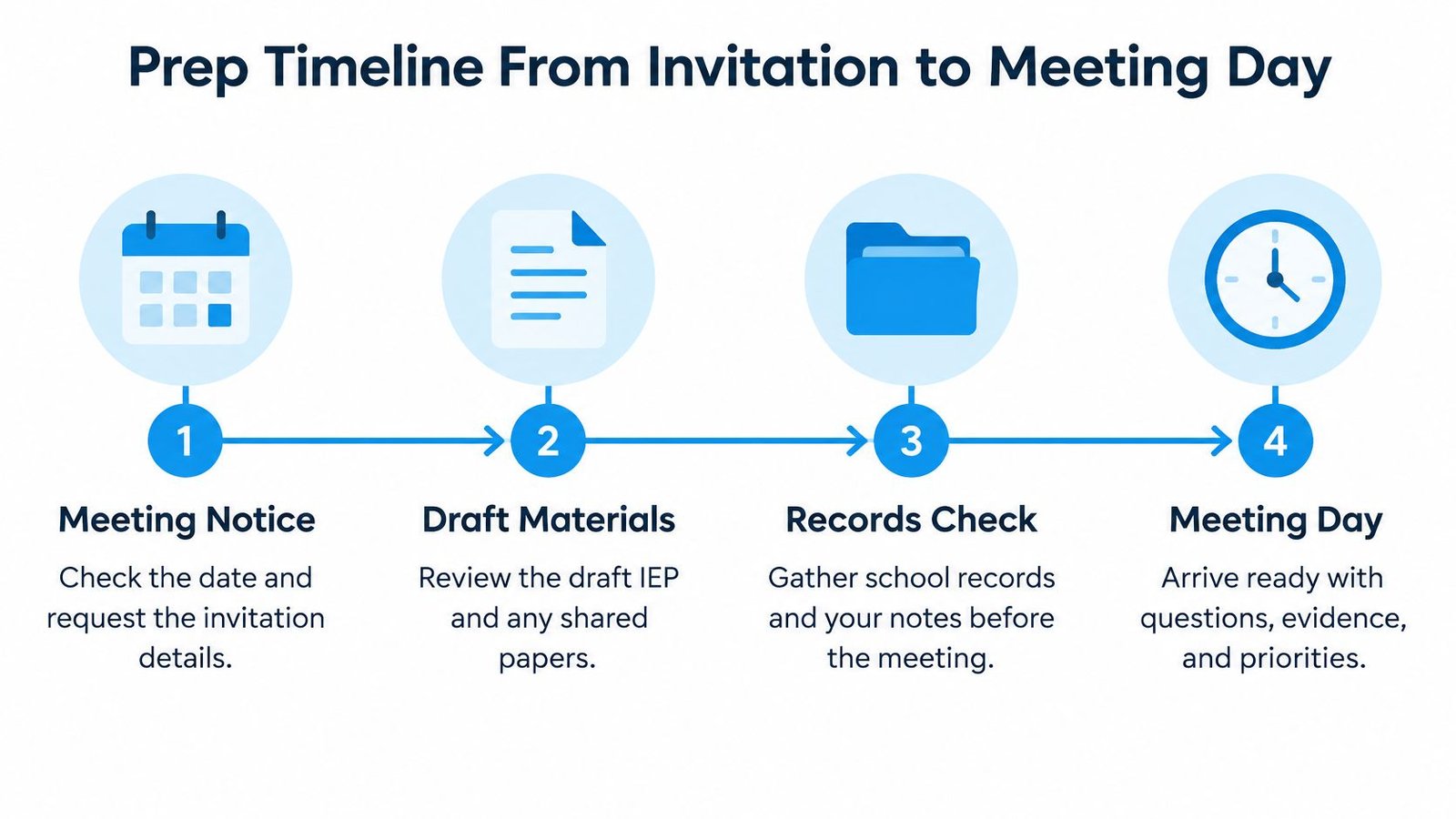
Match the deadline to your jurisdiction
Notice and document deadlines differ by jurisdiction. The Maryland IEP timelines guide describes an invitation 10 calendar days before the meeting and documents 5 business days beforehand. Illinois guidance requires written materials at least 3 school days ahead.
These are local examples, not nationwide deadlines. Use the table to identify which timing may apply, then confirm the rule for your state or district.
IEP preparation milestones and deadlines
| Milestone | Timing and source | What to check |
|---|---|---|
| Meeting notice | 10 calendar days before, Maryland guidance | Purpose, attendees, time, place and format |
| Draft goals, reports and proposed services | 5 business days before, Maryland guidance | Goal baselines, service minutes and progress reports |
| Written materials for the team | 3 school days before, Illinois guidance | Every document the team will consider |
| First IEP after eligibility | Within 30 days of eligibility, IDEA | Draft goals, supports and placement |
| Annual IEP review | At least once a year, IDEA | Progress on each goal and needed revisions |
| Initial evaluation | Generally 60 days after consent unless the state sets another timeline, IDEA | Consent date, appointments and reports received |
The IDEA IEP questions and answers explains that an initial evaluation generally must be completed within 60 days after parental consent unless the state sets another timeline. The evaluation deadline is not automatically the deadline for the eligibility decision or the first IEP meeting.
Mark the applicable dates, then keep the invitation and document-request emails together. A simple calendar entry can show what should arrive and when you need to follow up.
Practical rule: If documents arrive too late for meaningful review, request a reconvening date rather than rushing through decisions you have not had time to understand.
Build the Evidence File and Check the School's Records
Your evidence file doesn't need to be enormous. It needs to let you place a proposed goal beside the information that supposedly supports it.
Use this sequence to organize the school papers and your observations.
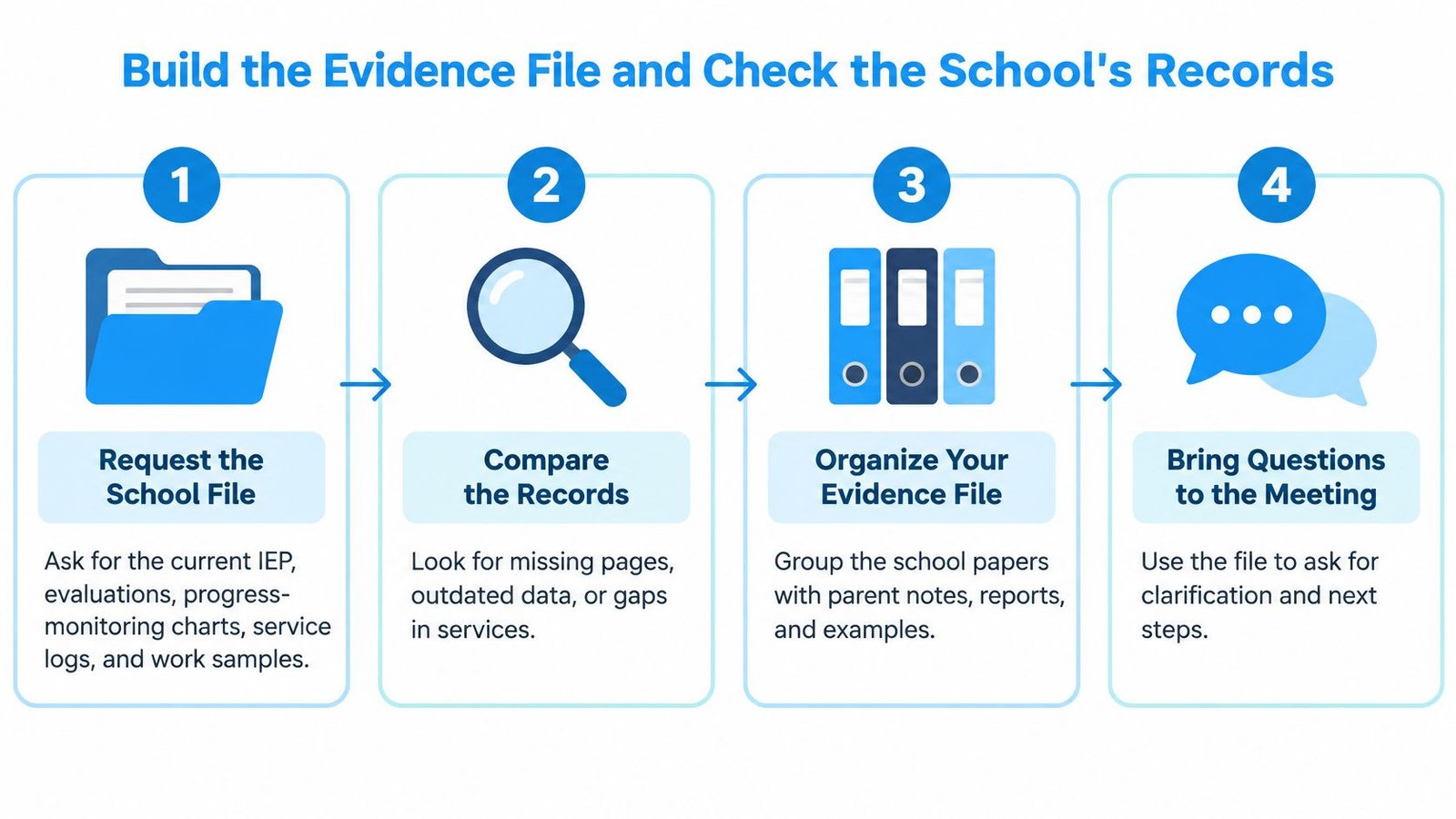
Assemble, compare and prioritize
Request the school file. Ask for the current IEP, evaluations, progress-monitoring charts, service logs, work samples, behavior data, and proposed draft. You can't evaluate a recommendation if you haven't seen the evidence behind it.
Compare each proposed goal with its records. Find the starting performance, measurement method, reporting frequency, and service delivered. Put unresolved questions beside the relevant page rather than in a separate pile.
Write a one-page parent statement. Include strengths, successful supports, and concerns. Separate observation from interpretation: leaving the homework table after directions is observable; assuming the child doesn't care is an interpretation.
Make home notes dated and descriptive. Record sleep, communication, regulation, task completion, and routines that help. Include the setting, what happened beforehand, support offered, and outcome so the team can distinguish a recurring pattern from an isolated event.
Select priorities tied to educational access. The parent-involvement study published in the Journal of Vocational Rehabilitation supports bringing three to five priorities, such as functional communication, safety, task initiation, or independent transitions. Send them before the meeting so the team can prepare relevant information.
Red flags in school progress records
| What you see | What it may mean | What to request |
|---|---|---|
| Progress notes that say making progress with no numbers | No baseline or criterion to judge against | Baseline median, graph and goal line |
| A goal marked met months before the IEP is amended | The goal may be too easy or was never updated | Mastery data with dates and the amendment record |
| Progress updates that conflict with each other | Inconsistent measurement or missing probes | Full progress-monitoring chart and data source |
| Service logs with fewer minutes than the IEP lists | Services may not have been delivered, or documentation may be incomplete | Complete service log, explanation and a make-up plan |
| Only teacher impressions, no checklists or probes | Anecdotal evidence in place of measurement | Observation checklists, curriculum probes or test scores |
A red flag is a reason to investigate, not proof of what happened. For example, an incomplete service log needs clarification before you conclude that your child missed instruction.
Keep observations useful
Say your child completes a familiar worksheet at home but stops when the directions change. Save both examples and note the supports used; successful performance under familiar conditions doesn't establish independent performance everywhere.
Our guide to data collection in ABA explains ways to make observations more consistent. You don't need to become a therapist to record what happened clearly.
For an additional preparation walkthrough, use the video below.
The common slip is arriving with compelling stories but no dates, counts, or examples. A concise evidence file helps you keep your priorities on the agenda without dismissing the school's observations.
Turning Each Goal Into a Measurable Target
A proposed annual goal is a measurement specification, not a promise. Before agreeing, check for an observable skill, a condition, a metric, a success criterion, and a measurement schedule.
A vague goal about improving independence leaves everyone guessing. Starting a classroom task is observable; independence by itself isn't specific enough to measure.
Test the wording against daily instruction
The table uses a hypothetical task-initiation goal. The target is reduced adult prompting, but the team must decide whether the intended endpoint is no prompting or limited prompting.
Five fields every measurable goal needs
| Goal field | Question to ask | Example |
|---|---|---|
| Target behavior or skill | What exactly will the child do? | Starts a classroom task without adult prompting as the intended independent skill |
| Condition | Under what setting or support? | During independent work time with a visual checklist |
| Metric | How is it counted or timed? | Number of prompts needed to begin the task |
| Performance criterion | What counts as success? | Two or fewer prompts on four of five school days |
| Measurement schedule | How often, and who collects it? | At least three times weekly by the classroom teacher |
The IRIS Center's progress-monitoring guidance gives numerical measurement examples such as at least three times weekly or every two weeks, and a usable task-initiation example allows no more than two prompts on four of five school days. It also explains IDEA's requirement to state how progress will be measured and when parents will receive reports.
Notice the distinction in the table: starting without adult prompting isn't identical to starting with limited prompting. Resolve that mismatch before finalizing the goal, rather than letting later reports treat the standards as interchangeable.
Match the goal to meaningful access
For reading, don't let a single score replace discussion of comprehension, interest, decoding, or access to classroom texts. ReadLab's resource on choosing books beyond the reading score can help you think about suitable reading materials while the team identifies the specific skill to teach.
Our guide to IEP targets for autistic students offers further context for connecting targets to everyday participation. A useful target should improve the child's access, communication, learning, or independence, not merely make adult supervision easier.
A progress report should measure the same skill, under the same conditions, against the same success criterion as the goal.
Ask for a brief data check every two weeks as a practical proposal, not a universal requirement. Request a formal review if the child remains below the projected goal line, regresses, or needs a changed intervention.
Record who collects each measure, how results will reach you, and when the team will reconvene if the plan isn't working.
Making the Meeting Format Work for Your Family
You can sit through an entire meeting and still be unable to participate meaningfully. Technical language, an unavailable interpreter, inaccessible documents, or a work shift can prevent you from evaluating what the school proposes.
Changing the format isn't a distraction from the child's education. It makes informed decision-making possible.
Request conditions that let you contribute
The Bureau of Indian Education IEP manual recognizes participation supports such as interpreters, sibling supervision, alternative meeting formats, and accessible locations. Ask for the supports you need before the meeting, rather than trying to solve access problems while goals are being discussed.
- Communication access: Request an interpreter, accessible documents, and explanations of unfamiliar terminology.
- Scheduling and location: Ask about sibling supervision, an accessible location, or phone or video participation.
- Thinking time: Request an advance agenda, a pause when needed, and time to review proposed changes before consenting.
- Support: Invite someone who knows your child and can help you follow the discussion.
Under IDEA's parent-participation regulation, schools must take steps to ensure parents have an opportunity to participate, arrange a mutually agreed time and place, and use alternative methods when parents can't attend in person. Explain the barrier and propose a workable arrangement in writing.
Check who will be making decisions
The Parent Center Hub's IEP meeting tip sheets describe the required team roles: parents, a regular-education teacher when applicable, a special-education teacher or provider, an agency representative able to commit or supervise resources, and someone able to interpret evaluation results. Other people with relevant knowledge may attend at your invitation.
Required-member excusal needs written parent-school agreement. When the member's area will be discussed, written input is also needed beforehand; check what the proposed excusal covers.
Keep a meeting-access checklist with these entries:
- Request made: Name the interpreter, format, document, or other support needed.
- Person responsible: Record who will arrange it.
- Written confirmation: Save the confirmation date and email.
- Unresolved barrier: Identify what still needs attention before substantive decisions begin.
Ask These Questions in the Room
Bring your questions on paper with space beneath each answer. Ask them while the relevant goal or service is on screen, not after the team has moved to placement or scheduling.
You don't need to challenge every sentence. You need enough detail to understand what the school will do and how everyone will know whether it helped.
Keep the discussion measurable
What is the baseline median, and where is the projected goal line? Ask the team to show the graph. The median is the middle value in the baseline measurements; ask whether that starting point represents the child's typical performance.
What is the data source, and who collects it on which days? Identify the actual probe, checklist, work sample, or observation method. A general assurance that staff monitor progress doesn't describe a collection plan.
What rule changes instruction or services when progress is inadequate? Ask what pattern in the measurements will trigger action and who reviews it.
Does the monitoring criterion exactly match the goal criterion? Have the team compare the wording aloud, including the support level and setting.
Which service minutes, setting, and provider are written into the IEP? Ask how missed sessions are documented and what make-up plan is proposed when services aren't delivered.
What evidence would trigger a revised goal, service change, or new evaluation? Identify the decision process before concerns become urgent.
When will the next progress report arrive, and when will we reconvene? Put actual dates in your notes rather than leaving with an agreement to check in sometime.
Record decisions, not just discussion
Use a decision log with columns for the concern, team response, evidence cited, next action, responsible person, and follow-up date. If an answer remains vague, record that it hasn't been resolved and ask for a measurable answer.
You can disagree with a recommendation while keeping the conversation focused on the evidence and the child's access to learning.
Say the school reports successful classroom transitions, while your notes describe distress afterward. Ask about the transition conditions, communication supports, and recovery time rather than arguing over whose observation is correct.
Our guide to navigating IEP and 504 supports can help you organize broader support questions without losing track of the decisions being made.
Deciding What to Sign and When to Reconvene
Hold off signing agreement or consent to a plan you don't understand. Before agreeing, make sure each goal has a baseline, a criterion, a measurement schedule, and a named person responsible for collecting data.
First ask what the signature means. A record of attendance isn't necessarily agreement with the plan, and consent requirements differ by jurisdiction and type of decision.
Leave with a written next step
Before the meeting ends, complete a final check:
- Services: Confirm minutes, setting, provider responsibilities, and unresolved delivery concerns.
- Reporting: Record progress-report dates and how you'll receive the information.
- Follow-up: Set a reconvening date or a clear process for scheduling one.
- Documentation: Request the updated plan and written decisions, then compare them with your notes.
If you disagree, identify the specific issue and request prior written notice explaining what the school proposes or refuses and why. Record the disagreement calmly; you don't have to settle every dispute in the room.
The IDEA parents and families guidance explains that an initial IEP meeting generally must occur within 30 days of eligibility and that the IEP must be reviewed at least annually. Keep evidence current between meetings so the team can respond to changing needs rather than reconstructing them later.
Keep your evidence current
Our Guiding Growth mobile app is an all-in-one tool for autism parents to track and improve behaviors, nutrition, health, and sleep. Log dated observations about sleep, behavior, therapy, and helpful routines, then filter by date range and generate a meeting-oriented summary for an annual review, 504 discussion, or follow-up.
The Collaboration feature lets parents share information in real time with family members, caregivers, and medical professionals. Review entries before sharing so the summary distinguishes observed events from your interpretation.
The app keeps daily observations available for preparation.
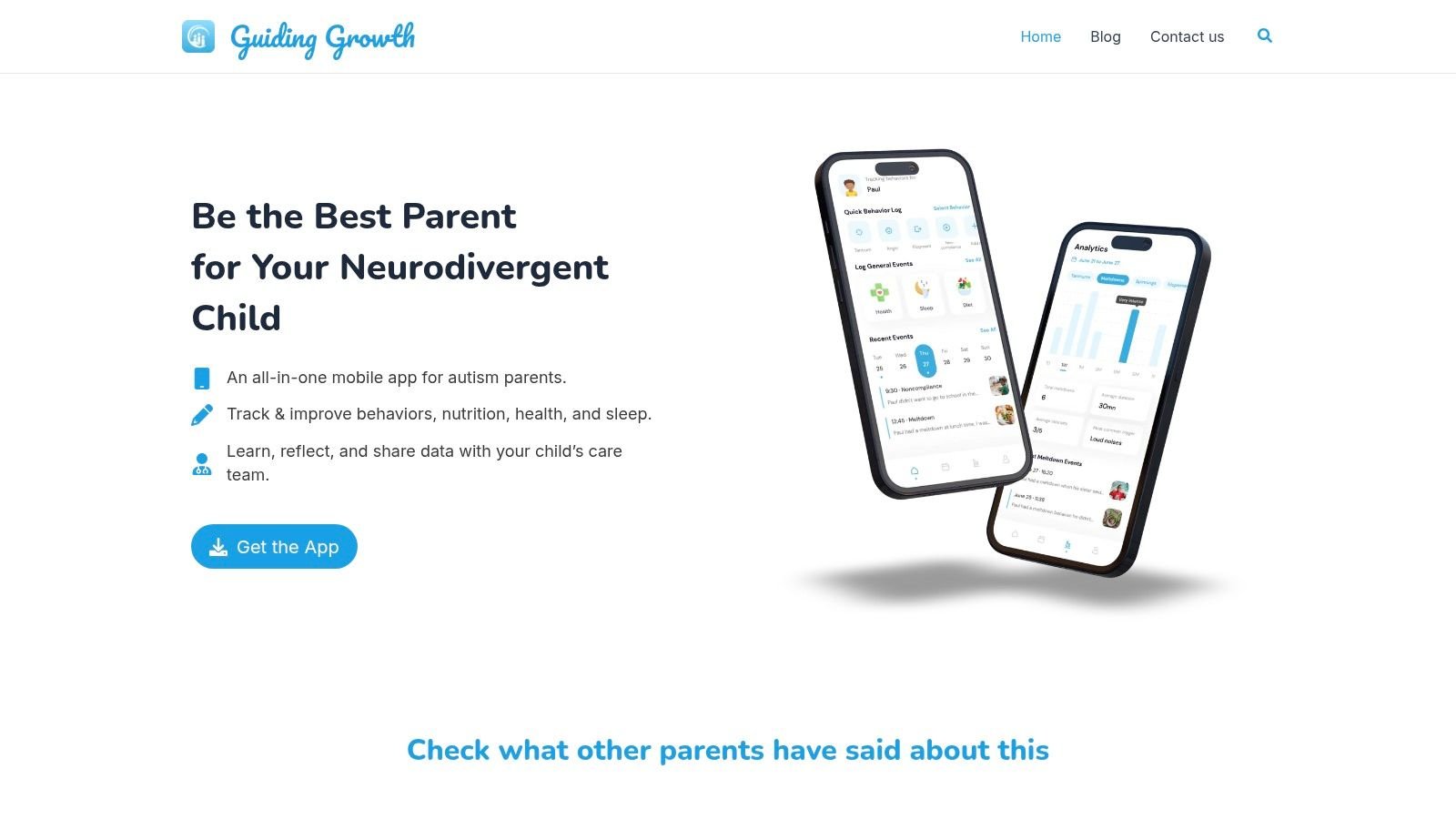
Guiding Growth doesn't provide medical advice. Its summaries supplement your preparation; the school's IEP documents remain the controlling educational records.
Guiding Growth helps you organize daily observations and turn selected records into a meeting-ready summary. Visit Guiding Growth to start keeping the dated evidence you want beside you at your child's next IEP meeting.