You're standing in a grocery aisle, your child is on the floor crying, and you're trying to stay calm while people move around you. Later, someone will ask what happened just before, how long it lasted, and what helped. In that moment, you don't need a long form. You need a behavior log for parents that captures a few clear facts close to the event, in words another adult could understand, without turning your child into a list of problems.
Table of Contents
- Fields to Capture in a Parent Behavior Log
- Why a Written Log Beats Memory
- How an ABC Note Explains One Event
- Sample Entries Written in Neutral Language
- The Smallest Log for a Hard Week
- Patterns Care Teams Can Use
- Start the Log Before the Next Visit
Fields to Capture in a Parent Behavior Log
You're in a waiting room and a clinician asks about Tuesday afternoon. You remember how it ended, but the order is gone. A behavior log fixes that gap when it's a short note made close to the moment, in the place it happened, not a diary reconstructed days later.
Start with the fields below and lock them in before the next hard moment. The sample column follows one grocery aisle event from start to finish so you can see what a complete note looks like.
What to Write in Each Field
| Field | Write this | Sample note |
|---|---|---|
| Onset | The visible moment the behavior starts | Dropped to the floor when asked to leave the aisle |
| Cycle | The full event from first cry to walking out | Dropped, cried on the floor, quieted, pointed to card, walked out |
| Antecedent | What changed just before | Transition demand after a long shop |
| Behavior | Only what others could see | Cried loudly and stayed on the floor |
| Intensity | Rate disruption from 1 to 5 | 4, hard to move through the aisle |
| Duration | Minutes from start to calm | About 11 minutes |
| Context | Place and people present | Grocery aisle, one parent, no siblings |
| Response | What adults did next | Stayed nearby, few words, no extra items |
| Recovery and communication | How regulation returned and any message | Pointed to the car picture card, then walked out |
Onset is the visible start, not a guess about feelings. Write "dropped to the floor when asked to leave" rather than "got upset." Antecedent is the change in the minutes before, such as an instruction to leave after a long shop. That one line gives a care team something to compare across events.
Behavior stays observable. Another adult should be able to picture it from your words alone. Intensity uses your family's shared 1 to 5 disruption scale, so a 4 means the same thing each time you use it. Duration runs from the onset until your child is regulated again, not just until the loudest part stops.
Why These Fields Make a Note Measurable
Colorado's Functional Behavioral Assessment guidance identifies onset, cycle, duration, and intensity as fields that make behavior data measurable, and it recommends that at least two different staff members conduct observations. For parents, that points to the same habit. Two adults using the same fields for the same kind of event produce a stronger record than one person's memory alone.
Context names the place and people present, because a quiet kitchen and a crowded aisle aren't comparable settings. Response records exactly what adults did next, including staying nearby with few words. Recovery and communication closes the cycle, here the point to the car card and walking out.
Write what a camera could see and hear, then add what helped. Leave interpretations for the meeting, not the entry.
Families who also need dated, consistent records for legal settings sometimes keep related notes in parallel, and guidance on keeping a parenting journal for court from Casewell shows how that separate purpose shapes what to save. For care planning, your aim is simpler. Set these nine fields up once, agree on them with anyone else who'll log, and use them the same way every time.
Why a Written Log Beats Memory
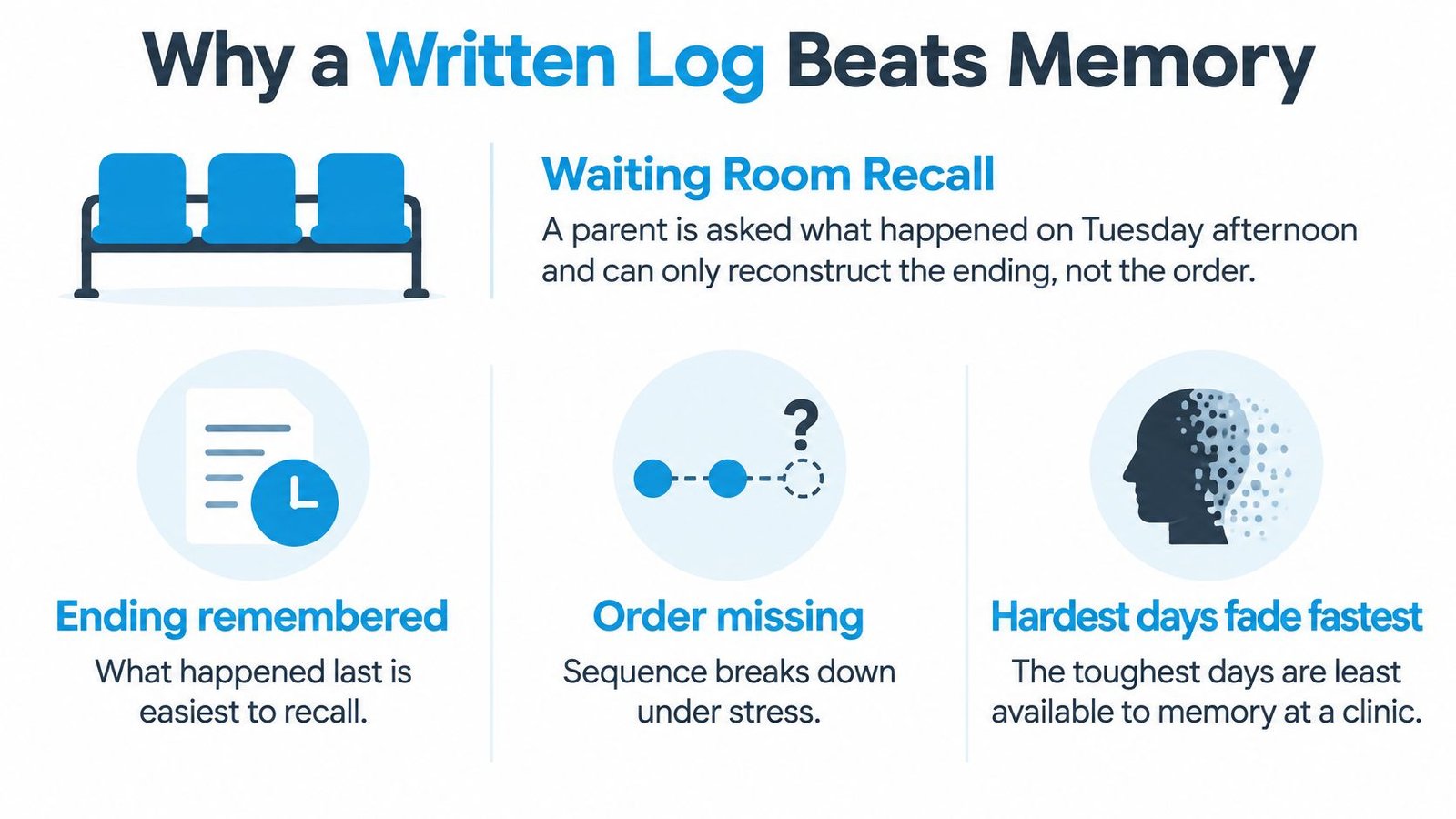
A parent in a waiting room is asked what happened on Tuesday afternoon. She can reconstruct the ending clearly, but not the order. The hardest days are often the ones least available to memory at a clinic or school meeting.
That isn't a failure of attention. It's what happens when you're managing care, work, and family at the same time, then trying to recall a fast sequence days later.
The Load Behind the Recall Gap
In a 2023 study of 77 caregivers of children with autism spectrum disorder, 41.6% experienced mild-to-moderate caregiver burden, 33.8% experienced high burden, and only 24.9% reported no-to-mild burden. In the same sample, 36.36%, or 28 caregivers, reported frequent stress while managing autism-related care alongside work and family responsibilities.
Those figures describe one sample of 77 people, not a national rate for every family. They still make the practical problem concrete. When burden is already high, expecting precise recall of triggers, timing, and responses across several days isn't realistic.
The same study reported that 72.3% of participants were female and 64.3% were mothers. Documentation often lands on one person. If that person's memory is the only record, the rest of the care team works from a secondhand summary.
What a Short Note Preserves
A retrospective summary tends to keep the peak and the ending. It loses the sequence that a clinician needs.
- Scattered notes: A text here and a sticky note there can't be compared across days.
- Group chats: Two adults describe the same afternoon differently, with no shared fields.
- Memory only: You recall that it was loud and long, but not what changed right before.
A brief note taken near the event keeps time, place, people present, the activity just before, and the adult response attached to each other. That turns one caregiver's recollection into a shared timeline. The next professional can read the order for herself instead of asking you to rebuild it under pressure, and you can spend the meeting deciding what to change rather than debating what happened.
How an ABC Note Explains One Event
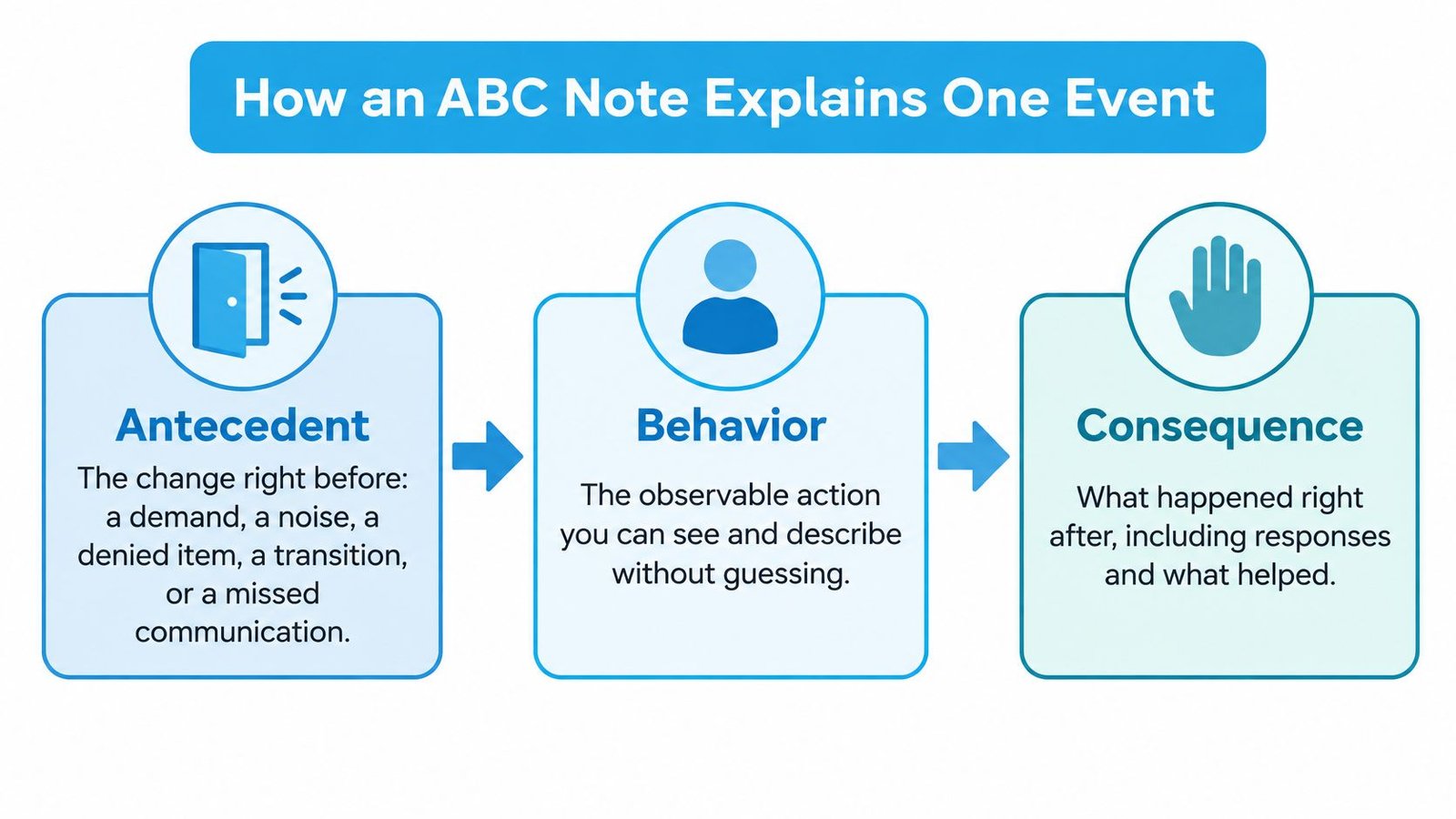
An ABC note isn't three extra forms. It's three linked questions about one event. What changed right before? What could another person see? What followed?
Three Questions in Order
Antecedent is the change right before the behavior. It might be a demand, a sudden noise, a denied item, a transition, or a communication that didn't land. Write the concrete change, such as "told to stop the video and come to the table," not "routine was off."
Behavior is the observable act. Write "left the table after the instruction" or "hit the wall twice." Don't write "seemed anxious" as the behavior, and don't let "had a meltdown" stand as the whole entry. That label tells a team nothing about what your child did, for how long, or how intense it was.
Consequence is what followed immediately after. That could be adult attention, a break from the task, access to the item, or a regulation support such as headphones. You're recording what happened next, not judging whether it was the right response.
If you're unsure how antecedents link to what follows, a plain explanation of how antecedents and consequences connect around a behavior can help you keep the three parts in order.
Why Counting Alone Falls Short
The same crying can sit beside very different antecedents. On Monday it follows a demand, on Wednesday a loud sound, on Friday a denied item. A tally of three events hides that difference completely.
A row of ABC notes keeps competing explanations side by side. A team can look across rows and ask whether demands, sensory load, communication breakdowns, or access to a preferred item are the repeating thread, and whether the same consequence keeps following.
In a study involving 176 behavior analysts and four autistic children, conclusions from open-ended functional-assessment interviews matched traditional functional-analysis outcomes in 74% of cases. That's useful, and it isn't final. About a quarter of the time, the interview conclusion didn't match.
Practical rule: Keep the raw observation and leave the function blank. The clinician's job is to interpret the pattern, yours is to preserve it accurately.
So don't write "did it for attention" or "wanted to escape" in the parent note. Several similar ABC rows can justify asking for a direct assessment. One dramatic row can't carry that weight on its own.
Sample Entries Written in Neutral Language
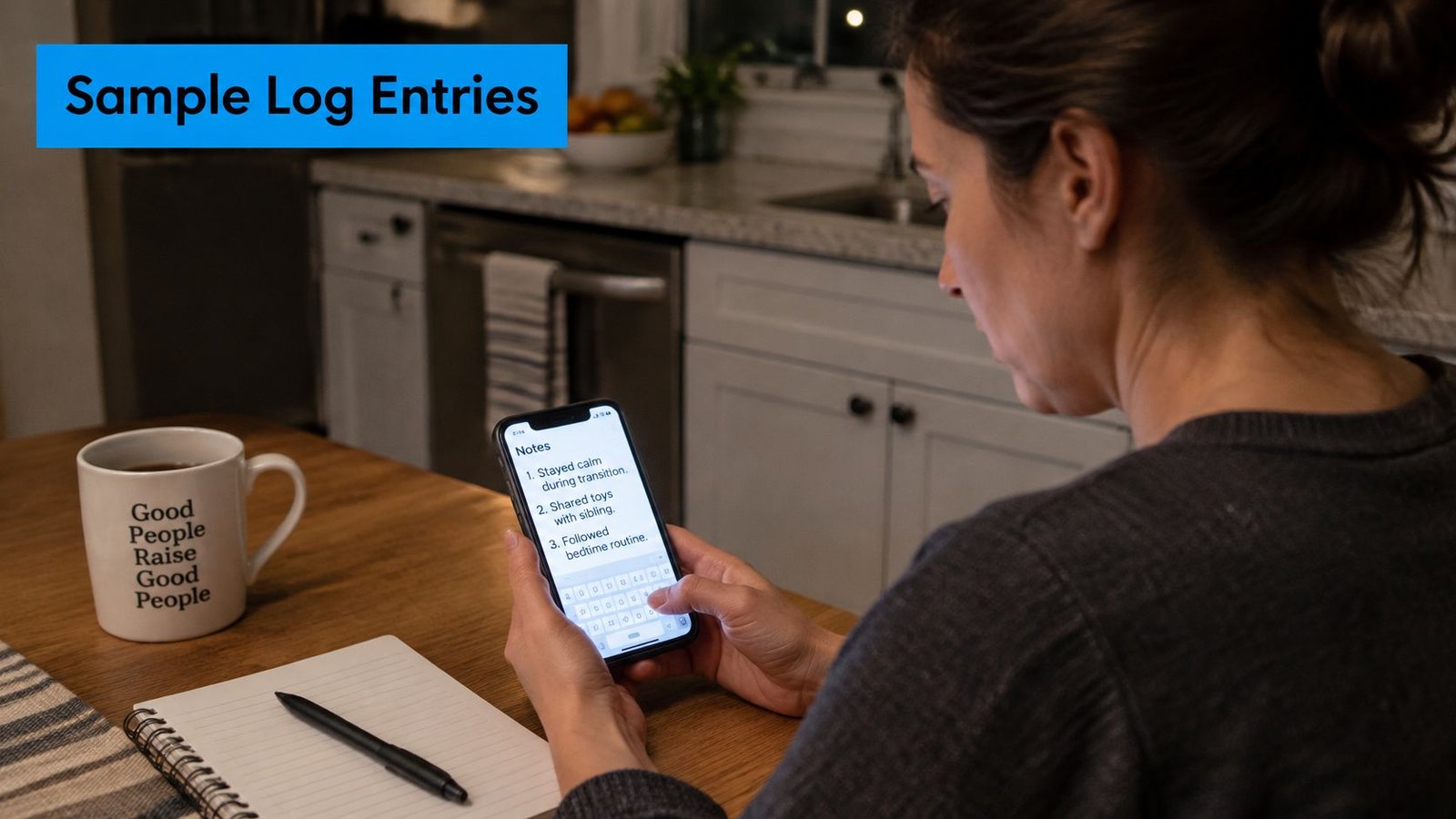
The entries below are written so you could paste the structure into a notes app tonight. Each one keeps time, antecedent, observable behavior, intensity, duration, people, response, and what helped in a few lines.
A parent logging a positive moment at home looks like this in practice.
Three Entries You Can Copy
Morning transition, 7.40 a.m., hallway, one parent. Antecedent, told to put shoes on to leave. Behavior, sat in the doorway and pushed shoes away. Intensity 3, 8 minutes. Response, visual timer shown, choice of two coats offered. Recovery, chose the blue coat, put shoes on, said "ready."
Cafeteria noise, 12.15 p.m., school lunchroom, teacher nearby. Antecedent, trays clattering and voices getting louder. Behavior, hands over ears, left the table and stood by the wall. Intensity 2, 4 minutes. Response, headphones offered without extra talking. Recovery, put headphones on, returned to the table, and ate.
Waiting room, 3.05 p.m., sibling present. Two separate lines matter here. First, rocking side to side while waiting, logged as a calming movement with no safety concern. Second, hit sibling's arm twice when the sibling took the tablet, adult blocked a third hit, tablet returned, both children separated to different chairs.
Each entry replaces a weak line worth retiring. "Bad morning," "meltdown," and "noncompliant" erase the communication attempt, the environment, and the recovery. They also collapse harmless self-regulation and behavior that could hurt someone into one judgment.
The video below walks through how to phrase observations in neutral, observable terms.
Keeping Your Child Whole in the Record
Recent qualitative research in PMC found that parents describe substantial positive experiences of parenting autistic children, yet tracking frameworks can center deficit and crisis. A crisis-only log never shows those joys, strengths, or successful recoveries. It can also make your child's identity look like a list of incidents to anyone who reads it later.
Record what your child was trying to communicate, what support was offered, and what helped regulation return. For a nonspeaking child, log communication in the channel your child uses, such as a gesture, pointing to a picture card, an AAC message, or a consistent sound, in the recovery line next to the behavior it accompanied.
When communication allows, review a pattern with your child and use their words for what helped. A good entry should answer what your child was trying to do, not only what went wrong.
The Smallest Log for a Hard Week
More boxes don't automatically produce better data. An exhausting form produces missing and biased notes exactly when the week is hardest, because you're least able to complete it after the events that matter most.
The fix isn't trying harder. It's shrinking the log to a minimum reliable record you can finish on a bad day, then adding detail only when you have capacity.
Hard-Week Minimum Versus a Fuller Day
| Situation | Record | Skip for now | Raise it when |
|---|---|---|---|
| Hard week | Time, duration, one-line trigger, support used, recovery | Meals, screen time, long narratives | Same trigger and support repeat across several days |
| Two settings disagree | Who saw it, where, exact support, outcome | A single blended story | Home and school descriptions conflict on antecedent or response |
| Fuller day | Minimum fields plus sleep, meals, medication, screen time | Guessed feelings and function labels | A cluster appears by time of day or after a routine change |
On a hard week, capture five things. Whether it happened and about when, how many minutes it lasted, a one-line trigger, the support used, and whether your child recovered. That's enough for a team to see repetition without asking you to write an essay in a parking lot.
On a fuller day, add sleep, meals, medication, and screen time if they're relevant to the question you're tracking. Don't add them out of guilt. Extra fields you fill in inconsistently can mislead more than a short record you complete the same way each time.
A Design Target That Keeps Burden Low
A pilot study described in PMC's ecological momentary assessment research used two parent reports per day for 10 consecutive weekdays and achieved response rates of 91.1% for autistic participants and 88.55% for comparison participants, with scores correlating at r > 0.80 with a one-time standardized functional-independence measure. Brief, repeated entries close to the event can stay both doable and meaningful.
In practice, aim for event-based notes that take under a minute. Use prompts you can switch off. Leave a visible gap when a day was missed rather than backfilling a chart so it looks complete.
A short record with honest gaps is more trustworthy than a complete-looking chart rebuilt from memory on Sunday.
Mark a pattern as worth raising when the same trigger and response repeat across several days or appear in two settings. Don't raise an alarm after one spike. You're looking for repetition, not a single hard afternoon.
Patterns Care Teams Can Use
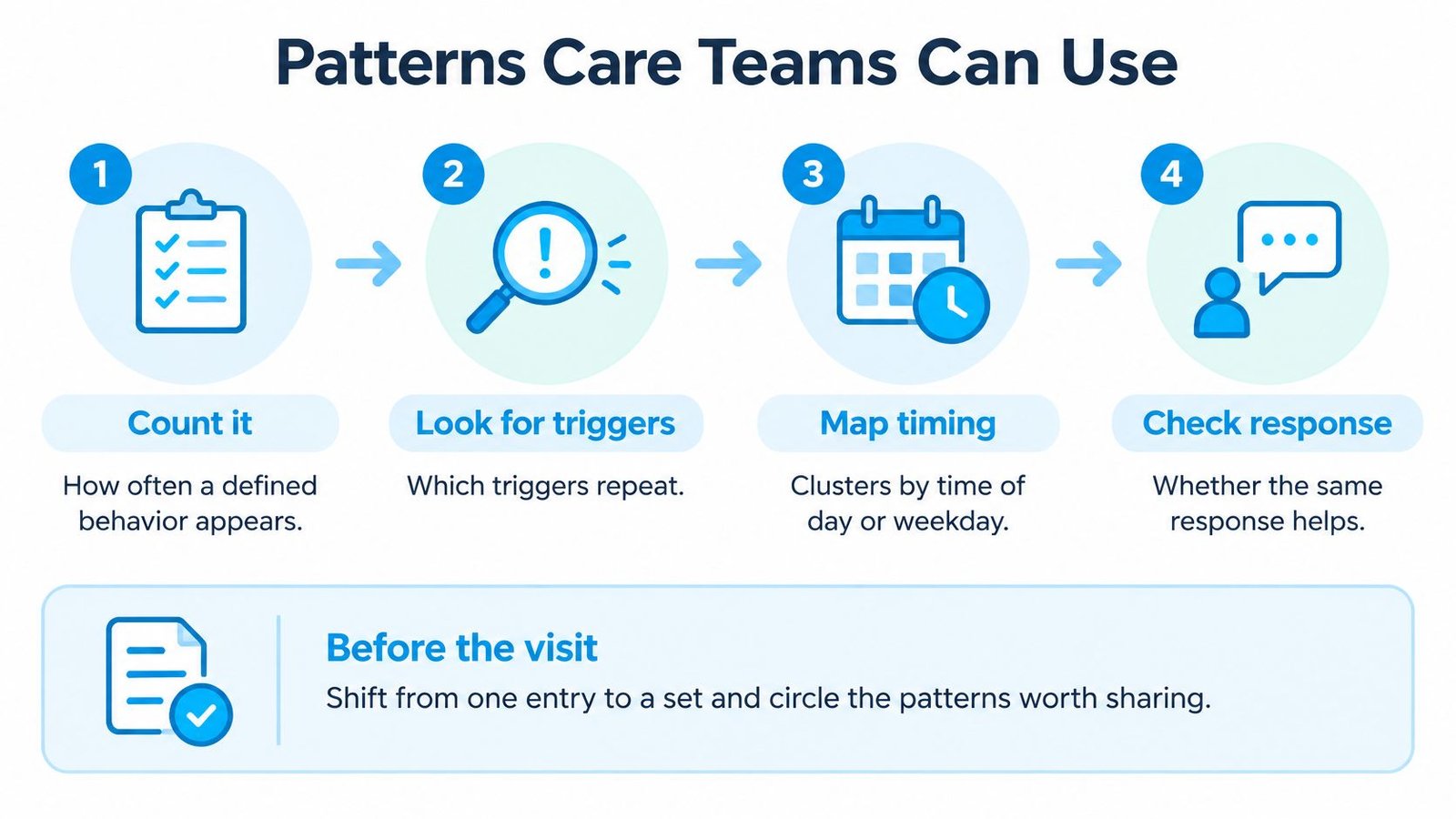
One entry describes an event. A set of entries can change a decision. Before a visit, shift from reading notes one by one to circling the few patterns a team can act on.
Four Patterns Worth Circling
- Count it: How often does one clearly defined behavior appear in the date range?
- Look for triggers: Which antecedents repeat before it, and which appear only once?
- Map timing: Do events cluster by time of day or weekday, such as after school or before dinner?
- Check response: Does the same support keep preceding recovery, or does recovery time stay unchanged?
You can go deeper on reading clusters with these examples of how pattern recognition works in everyday records. Also check whether the picture changes with a particular person or place. A behavior that appears at home but not at school, or the reverse, is information, not a contradiction to hide.
Provenance makes those comparisons fair. In plain terms, that means each entry shows who observed it, where it occurred, what changed beforehand, and the exact support given. It also means duration and intensity were scored the same way at home and at school, so you're not comparing a home 3 with a school 5 that mean different things.
Sharing the Right Pieces With the Right People
Parents often find little ongoing exchange between school and health professionals, so a comparable log becomes the bridge. That doesn't mean every audience needs every private detail.
The U.S. Department of Health and Human Services HIPAA guidance for individuals states that individuals may request that a doctor share health information directly with family members, caregivers, a mobile application, or a researcher, and that the HIPAA Privacy Rule permits routine communications between providers and family or friends involved in care unless the patient objects. That permission doesn't give every recipient automatic access. Your family still decides who sees what.
Build the handoff in four moves. Pick one date range, keep behavior, sleep, meals, and medication only if they bear on the question, and export a short summary for an IEP, a 504 review, or a new specialist. Then let a co-parent, therapist, or educator see only the parts they need for their role.
Start the Log Before the Next Visit
The next appointment does not require a perfect record. A small, consistent log can help a professional understand what happened and what support helped. Start with the next event, then keep the same fields for a week.
A Five-Step Start
- Name three observable behaviors. Agree with other caregivers on what intensity 3 and intensity 5 look like, using actions you can see rather than labels or guesses about why they happened.
- For the next seven days, record the hard-week minimum close to each event. Add more only when you have time.
- With permission, invite another caregiver to contribute. Ask school or therapy staff for the same five facts, not a separate form. If therapy is part of the picture, use therapy session notes to keep dates and terms aligned.
- Before the visit, choose one date range and write three sentences: the most common trigger, the typical duration, and the support that most often came before recovery.
- Share a meeting summary and leave questions about behavioral function to the clinician, who can decide whether direct assessment is warranted.
A log works best when the details stay together. Guiding Growth is a mobile app for parents of autistic and neurodivergent children. It brings together voice Quick Log entries, customizable behavior and trigger lists, and photos or notes attached to an event. Co-parents and therapists can be invited to contribute, while a dashboard shows behavior frequency and time-of-day patterns. For meetings, Smart Summaries can be exported as a PDF. The app is available on iOS and Android at guidinggrowth.app. Your care team remains responsible for clinical decisions.
Start small tonight. Record the next event with the same five facts, including what happened, the context, and what helped your child recover. That gives the next conversation a useful starting point without turning the log into a tally of problems.