You're standing in the kitchen after another hard moment. Your child just melted down over something that looked small from the outside. Maybe it was being asked to put on shoes. Maybe it was turning off a tablet. Maybe it was walking into a noisy store and suddenly shutting down.
Now you're replaying it all. What set that off? Did I respond the wrong way? How do I stop this next time?
That question often pulls parents straight to the end of the story. We focus on the behavior itself, or on what happened after it. But the most useful clue is often earlier. It's in the moments before the behavior, including details that are easy to miss when everyone is stressed.
That shift matters. On behavior forums, 70% of parent queries focus on “how to stop” meltdowns, even though antecedent events are often better predictors of problem behavior than consequences, a gap discussed in this research review on antecedent events and problem behavior. When you learn to notice what came before, you move from crisis response to prevention.
Table of Contents
- Moving Beyond Why Did That Happen
- The ABCs of Behavior Antecedent and Consequent
- Spotting the Hidden Antecedents in Your Child's World
- How to Document ABCs Without the Overwhelm
- Turning Data into Actionable Support Plans
- Embrace Proactive and Empowered Parenting
Moving Beyond Why Did That Happen
A parent tells me, “It came out of nowhere.” Then we slow the scene down together.
Breakfast was rushed. The shirt felt scratchy. The bus was late. School was loud. The after-school transition was abrupt. By the time homework was mentioned, the meltdown looked sudden, but it wasn't random. The child had been carrying stress all day.
That's why “why did that happen?” can feel so painful. You're searching for one clean answer, but behavior usually grows from a chain of events. Some of those events are visible. Some are internal. None of that means your child is being difficult on purpose, and it doesn't mean you failed.
Practical rule: Most challenging behavior makes more sense when you study the minutes and hours before it, not just the moment it peaks.
Parents often get handed reactive advice first. Remove the privilege. End the activity. Give a consequence. Stay firm. Sometimes those responses help in the moment. But they don't always explain the pattern, and they rarely tell you what to change tomorrow morning.
A more useful role is detective, not judge. You're gathering clues. What was happening before? What changed in the environment? What need may have gone unmet? What demand landed when your child had no room left to cope?
A calm shift in perspective
This approach doesn't ask you to excuse everything. It asks you to understand behavior well enough to support it skillfully.
That's especially important for neurodivergent children, whose behavior may reflect sensory overload, uncertainty, fatigue, hunger, or emotional strain long before anyone sees an outward reaction. When parents learn to identify those early clues, the whole family often feels less trapped in a cycle of confusion.
What proactive support sounds like
Instead of asking only:
- How do I stop this right now
- What consequence should happen after
- How do I make sure it doesn't happen again through discipline
You start asking:
- What happened right before this
- Was there a pattern building earlier in the day
- What can I change next time so my child has a better chance of success
That's where antecedent and consequent become powerful. They give you a structure for seeing behavior clearly, without blame and without guesswork.
The ABCs of Behavior Antecedent and Consequent
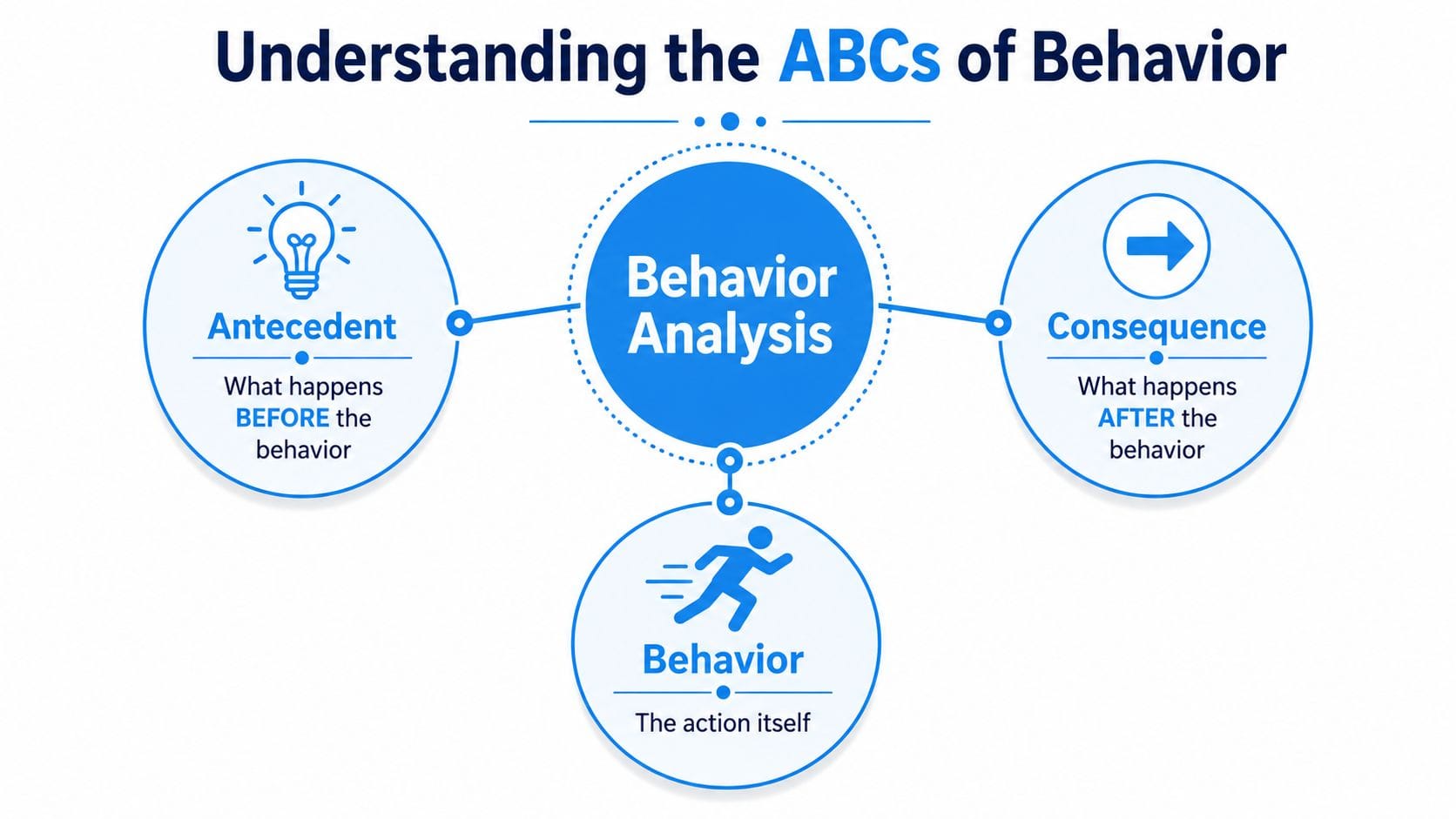
Behavior is easier to understand when you break it into three parts: Antecedent, Behavior, and Consequence. People often call this the ABC model.
A simple analogy helps. Think about baking. Before the cake goes into the oven, you gather ingredients, heat the oven, and prepare the pan. That setup is like the antecedent. The batter baking is the behavior. What comes out of the oven, and how people respond to it, is like the consequence.
A simple way to understand the flow
Here's the plain-language version:
| Part | What it means | Example |
|---|---|---|
| Antecedent | What happens before the behavior | Parent says, “Time to leave the park” |
| Behavior | The action itself | Child drops to the ground and screams |
| Consequence | What happens immediately after | Parent delays leaving and comforts child |
This model helps because it separates observation from emotion. Instead of saying, “My child overreacted,” you can say, “The transition from a preferred activity happened, then the child cried and dropped down, then the family stayed longer.” That's a clearer starting point.
What antecedent and consequent really mean
In plain terms, the antecedent is the before. It's the trigger, setup, cue, or condition that happens right before behavior. The consequent is the after. It's the immediate outcome that follows the behavior.
In behavioral psychology, antecedents cue learned actions, while consequences are the main driver of whether a behavior becomes more or less likely in the future. Consequences control approximately 80% of future behavior frequency by acting as reinforcing or punishing agents, as explained in this behavioral overview of antecedents and consequences.
That doesn't mean antecedents are unimportant. It means the two do different jobs. Antecedents set the stage. Consequences teach.
Antecedents answer, “What was going on when this started?” Consequents answer, “What did the child learn happened after?”
A common point of confusion is thinking that the antecedent must be dramatic. It doesn't. It can be a sound, a request, a transition, a facial expression, a long wait, or even a subtle change in routine.
If you want to see how this looks in real life, this functional behavior analysis example shows how breaking behavior into parts makes patterns easier to understand.
Spotting the Hidden Antecedents in Your Child's World
Parents are usually quick to notice obvious triggers. A loud blender. A denied request. A difficult worksheet. Those matter. But many of the most important antecedents are quieter.

A child refuses to get into the car. It looks like defiance. Later, the parent realizes the car seat straps were rubbing against a sore spot on the child's neck. Another child starts repeating phrases over and over when guests arrive. It looks random, but the repetition may be helping with anxiety and unpredictability.
The nuance of internal antecedents is easy to miss. Parents often identify antecedents only as external events while overlooking internal triggers like tiredness or boredom that are equally important, as described in this explanation of the ABCs of behavior and internal triggers.
The triggers you can see
External antecedents are easier to spot because they happen around your child.
Examples include:
- A direct demand such as “Put your shoes on now”
- A transition like leaving the playground or stopping a preferred activity
- A sensory event such as a hand dryer, fluorescent lighting, or crowded hallway
- A change in routine like a substitute teacher or a different pickup plan
- A social demand such as greeting relatives or making eye contact
These triggers matter, but they're only part of the picture.
The triggers many parents miss
Internal antecedents happen inside your child's body or emotional world. They may not be visible unless you slow down and look for patterns.
Some of the most common are:
- Hunger. A child may seem explosive before dinner, especially after a long school day.
- Fatigue. The behavior appears during homework, but the underlying issue may be exhaustion.
- Pain or discomfort. A tag, constipation, headache, or tooth pain can change everything.
- Anxiety. The demand itself may be manageable, but uncertainty makes it feel impossible.
- Sensory overload building over time. Your child might tolerate one noise, then another, then another, until a small request becomes the breaking point.
- Boredom or under-stimulation. Some behaviors begin when a child needs more movement, novelty, or input.
- Loss of control. Repeated adult directions can stack up until one more demand feels unbearable.
Sometimes the true antecedent isn't the instruction you gave. It's the state your child was already in when they heard it.
A helpful habit is to ask two questions at once. What happened around my child, and what may have been happening inside my child?
That second question often changes everything. It shifts you away from “They're choosing this to be difficult” and toward “Something about this moment was too much.” That's the beginning of useful support.
How to Document ABCs Without the Overwhelm
The hardest part of ABC tracking isn't understanding the model. It's doing it consistently when real life is loud, messy, and fast.
Most parents try mental notes first. You tell yourself you'll remember what happened. By bedtime, the details blur. Was it before snack or after? Was grandma there? Did the behavior start when the TV went off or when the bath was mentioned?
The ABC model works best when you capture a few concrete details. Questions like “At what time does the problem behavior typically happen?”, “Where is it observed?”, and “What activities come before it?” are central to useful observation, as outlined in this guide to antecedent tracking and structured ABC questions.
What to write down
You don't need a long essay. You need a small set of repeatable observations.
Try capturing:
- Time so you can see whether the behavior tends to happen before school, after school, or late in the evening
- Location because the kitchen, classroom, car, and grocery store create different demands
- Who was present since behavior can shift depending on which adult, sibling, or peer is nearby
- What happened right before including requests, noises, transitions, waits, and internal clues like hunger or fatigue
- The specific behavior described plainly, such as crying, hitting, bolting, covering ears, scripting, or shutting down
- The immediate outcome including what adults did, what stopped, what was gained, or what changed
How to keep it realistic
Don't try to track everything at once. Pick one behavior that happens often or creates the most stress. Keep your wording concrete. “Refused” is less useful than “turned away, yelled no, and dropped to the floor.”
A short table can help if you're using paper:
| Detail | Example note |
|---|---|
| Time | 4:15 PM |
| Place | Car after school |
| Before | Asked to get in car, backpack strap tangled, no snack yet |
| Behavior | Cried, screamed, hit seat |
| After | Parent untangled strap, gave snack, sat quietly for a minute |
A good ABC note is brief enough to complete and specific enough to teach you something later.
If scattered notes keep disappearing into bags, phones, and memory, a dedicated behavior tracking app can make the process much easier. Structured fields reduce guesswork, and quick logging is far more realistic for busy caregivers than trying to reconstruct a hard moment hours later.
Turning Data into Actionable Support Plans
Tracking matters because patterns hide in repetition. One isolated event can feel confusing. Five or ten similar entries start telling a story.
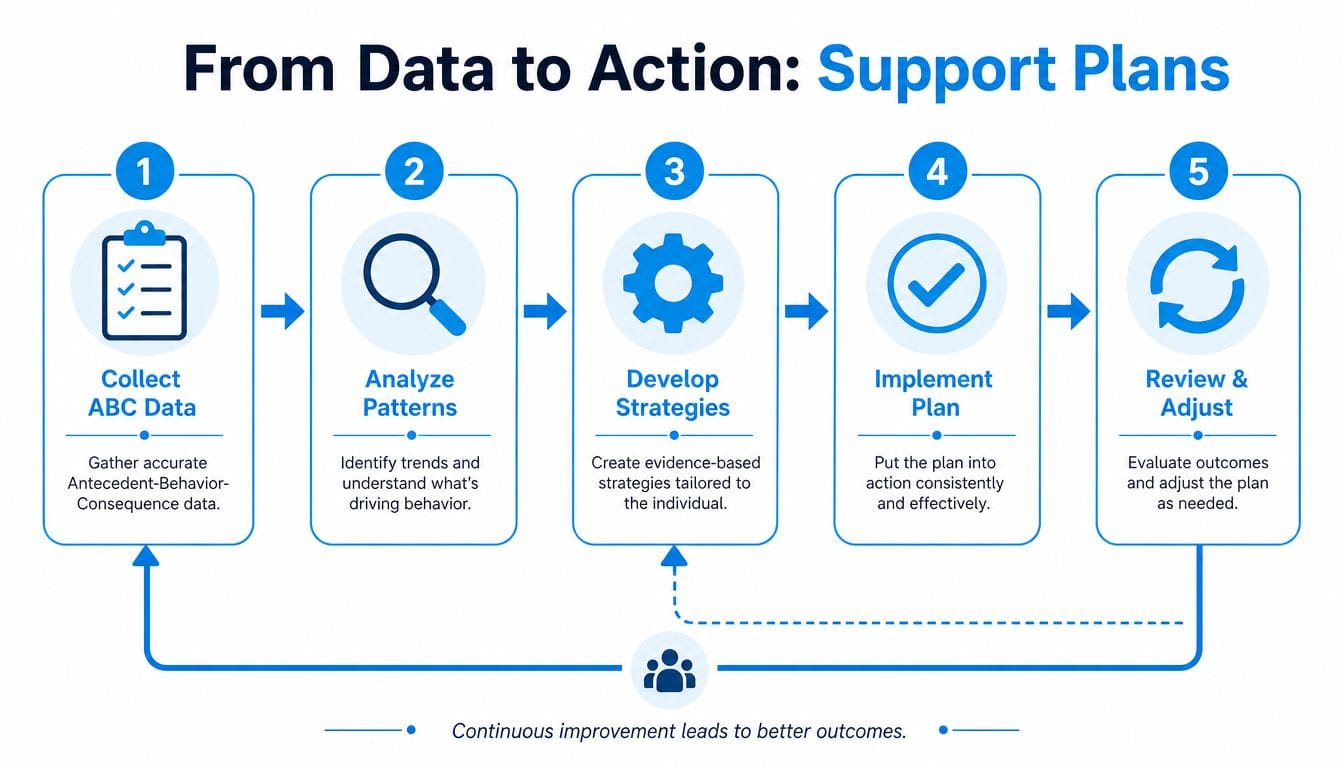
A parent may notice that a child melts down “all the time.” After reviewing logs, the pattern is narrower. It happens after school, before food, during transitions, and especially when a verbal demand comes too quickly. That's no longer vague. That's actionable.
Support transitions to a proactive model. Instead of waiting for distress, you change the setup before the hard moment arrives.
What patterns often look like
Patterns usually show up in clusters such as:
- Time-based patterns where behavior appears during the same part of the day
- Transition patterns where moving from one activity to another is consistently hard
- Sensory patterns linked to lighting, sound, clothing, crowds, or physical discomfort
- Demand patterns where certain instructions, especially unexpected ones, trigger stress
- People patterns where behavior changes depending on who is present
When families and professionals review this kind of information together, support plans become more grounded. A therapist doesn't have to guess what “bad days” means. A caregiver can point to repeated conditions and shared observations. That makes collaboration stronger, especially when using organized ABA session notes.
Small changes before the hard moment
Antecedent-Based Interventions are built around changing what happens before behavior. They're defined as arranging events or circumstances before a demand to reduce challenging behavior, and evidence-based examples include choice-making and advanced notice, as described by the overview of Antecedent-Based Interventions for parents.
That can look like:
- Offering a choice between two shirts before dressing
- Giving advanced notice before ending screen time or leaving the house
- Reducing demand intensity when a child is already taxed
- Adjusting the environment by dimming lights, lowering noise, or changing seating
- Adding a regulating step such as snack, movement, pressure, or quiet time before a tough task
The best support plan often starts with one question. What can I change before this happens again?
A strong plan isn't rigid. You try something, watch the result, and adjust. That cycle matters. The child's needs may shift with sleep, illness, growth, school stress, or sensory load. Good data helps adults respond with flexibility instead of frustration.
Embrace Proactive and Empowered Parenting
When you understand antecedent and consequent, behavior stops feeling so mysterious. It becomes more readable.
That doesn't make parenting easy. Hard moments are still hard. But it does replace some of the helplessness with direction. You start seeing that behavior is communication, stress response, skill gap, sensory signal, or unmet need in context. That understanding protects your relationship with your child.
A proactive approach also changes the emotional tone in the home. Instead of waiting for the next explosion, you start making small supports ahead of time. A snack before transitions. More warning before stopping a favorite activity. Fewer stacked demands after school. Better tracking of discomfort, sleep, and setting events. Those changes can build trust because your child experiences you as someone who notices, not just someone who reacts.
For many families, planning tools outside behavior tracking can also help reduce daily strain. If you're trying to coordinate routines, appointments, school tasks, and caregiver responsibilities, Kuraplan features for parent planning may be useful as part of a broader family organization system.
You don't need to decode everything in one day. You need a repeatable way to notice patterns and respond with support.
This is not about fixing your child. It's about shaping the environment so your child can succeed more often, with less distress and more dignity. That's what supportive parenting looks like. You observe clearly, respond compassionately, and keep learning.
If you want one place to log ABC patterns, track routines and daily factors, and stay aligned with caregivers or professionals, Guiding Growth can help you turn stressful moments into clearer insights and more supportive next steps.