Can a spouse be a caregiver? Yes. Spouses are among the people who provide unpaid family care, and a national U.S. study found that spouses or partners made up 12% of caregivers supporting adults.
Being able to provide care, being paid for it, and managing its effect on a marriage are separate questions. Payment depends on the program, state, care recipient's income and needs, and whether the spouse is legally responsible for support. Love may make someone willing to help, but it does not automatically provide the time, health or financial capacity to do every task. A workable plan considers the work a spouse can do, the payment a program allows and the cost the household can sustain.
Table of Contents
- Yes, a Spouse Can Be a Primary Caregiver
- Roles a Spouse Caregiver Usually Takes On
- How Caregiving Affects a Spouse's Health and Mood
- Paid Caregiving Options and Who Qualifies
- The Hidden Financial Cost of Unpaid Care
- Setting Boundaries and Role Agreements at Home
- Legal Authority and Decision Rights for Spouses
- Sharing One Accurate Picture of the Care Load
- Bringing in Outside Support Before Strain Builds
Yes, a Spouse Can Be a Primary Caregiver
Yes, a spouse can be the primary caregiver, but that role doesn't automatically establish eligibility for payment or benefits. Marriage describes the relationship; caregiving describes the assistance someone provides.
The 2020 Caregiving in the U.S. study from AARP and the National Alliance for Caregiving estimated that 21.3% of U.S. adults, approximately 53.0 million people, had provided unpaid care to an adult or child with special needs during the previous year, and spouses or partners represented 12% of caregivers supporting adults. Spousal care is an ordinary form of family care, not an exceptional arrangement.
What makes someone the primary caregiver
A primary caregiver carries most of the ongoing assistance, coordination and urgent responsibilities. Other relatives may help, but this person is usually the one who notices changes, arranges support and makes sure essential tasks happen.
Spouses may take on that role after:
- A diagnosis or disability: A partner needs help managing symptoms, daily activities or communication.
- Age-related changes: Mobility, memory or personal-care needs increase.
- An injury or operation: A partner needs temporary assistance during recovery.
Say a husband handles his wife's discharge instructions, meals, medication schedule and transport after surgery. He's functioning as her caregiver even if neither partner uses that term.
Important distinction: Being someone's primary caregiver doesn't automatically make you their legal decision-maker, paid employee or sole source of support.
The practical questions are therefore separate: what help is needed, who can safely provide it, what funding is available and which responsibilities require legal authority. A sustainable arrangement also accounts for the caregiver's health, household finances, boundaries, shared information and access to outside help.
Roles a Spouse Caregiver Usually Takes On
| Care function | What it includes | Sign it needs sharing |
|---|---|---|
| Personal care | Bathing, dressing, toileting, feeding | Caregiver injuries or no rest days |
| Medication management | Dosing, refills, side-effect tracking | Any missed or doubled dose |
| Appointments and communication | Scheduling, attending visits, relaying information between providers | Visits missed or information lost between providers |
| Transportation | School runs, therapy trips, pharmacy pickups | No backup driver for emergencies |
| Supervision and behavior monitoring | Observing triggers, safety checks, night-time watch | Watch needed every night with no break |
| Household and finances | Bills, groceries, insurance claims | Late bills or unclaimed benefits |
| Crisis response | Emergency calls, hospital stays | Repeated emergencies without a written plan |
Use this table as a care inventory, not a checklist of everything a loving spouse should do. Mark the functions you perform, how often you perform them and who can cover them if you're unavailable. Include preparation and follow-up, not just the visible task.
For example, attending a specialist visit includes more than driving there. Someone gathers symptom notes, checks the medication list, asks questions, collects instructions and follows up when a referral doesn't arrive.
Count coordination as work
Hands-on care means directly helping someone eat, dress or move. Care coordination means organizing the people, information and services that make that assistance possible. A spouse can be the coordinator without providing intimate personal care.
The study of spousal caregiving published through PubMed Central describes caregiving in terms of assistance with daily activities and practical tasks, supporting the need to identify the actual functions a spouse performs rather than rely on the relationship label.
Ask questions that uncover otherwise invisible responsibilities:
- Decisions: Who follows up when clinicians give conflicting instructions?
- Overnight responsibility: Who gets up when help is needed?
- Current information: Who knows the medication list and where it's stored?
- Backup: Who could take over without needing a complete explanation?
For intimate care, protect both partners' dignity and physical safety. If continence support is part of the routine, DME Superstore's guide to safe adult brief changing techniques can help you prepare questions about positioning, supplies and skin protection for a nurse.
Tasks requiring clinical skill, including injections or wound care, need an individualized plan. Arrange trained staff or clinician-approved caregiver training rather than improvising. If you can't demonstrate a task safely, it shouldn't become your responsibility just because you live together.
How Caregiving Affects a Spouse's Health and Mood
The health question isn't whether someone is a spouse caregiver. It's whether they're strained, prepared, supported and able to recover between demands.
Caregiver exhaustion can become part of the household routine before either partner recognizes it.

The American Psychological Association's synthesis of caregiver health findings reports depression scores approximately 0.58 standard-deviation units higher and physical-health measures approximately 0.18 standard-deviation units worse among caregivers than noncaregivers; it also describes a longitudinal analysis in which strained spouse caregivers had 63% higher subsequent mortality risk than spouses of nondisabled partners, while caregivers reporting no strain had statistically similar risk to the comparison group.
These findings don't mean caregiving causes illness or that every caregiver faces the same risk. Population studies don't uniformly find worse objective health or higher mortality. The useful distinction is between providing care with adequate support and providing care under sustained strain.
Check the caregiver, not just the care recipient
Set a recurring self-check that includes:
- Sleep: Are you getting uninterrupted rest, or remaining on alert?
- Mood: Are sadness, irritability or anxiety becoming persistent?
- Your medical care: Have you postponed appointments or prescriptions?
- Time away: Can you leave knowing someone competent is covering?
- Confidence: Which tasks still feel unsafe or unfamiliar?
The National Institutes of Health's caregiving guidance notes that caregivers are less likely to receive preventive care such as annual checkups. Book your own visits as actual appointments, with replacement care arranged, rather than something you'll fit in if the day goes well.
For parents balancing a child's needs with their own wellbeing, this guide to autism caregiver burnout can help identify where the workload has exceeded available support.
Needing relief is information about the care arrangement, not evidence that you love your spouse less.
Rising strain, missed medical care, unfinished essential tasks or any safety concern should trigger a redistribution of duties and professional support. Don't make exhaustion the condition someone must prove before they're allowed help.
Paid Caregiving Options and Who Qualifies
| Option | Can a spouse be paid? | Key requirement | Where to verify |
|---|---|---|---|
| Medicaid personal care or waiver services | Often possible where the specific program permits legally responsible relatives | Financial eligibility and documented functional need | State Medicaid agency |
| VA Program of Comprehensive Assistance for Family Caregivers | A family caregiver, including a spouse, may receive a stipend | Veteran and caregiver must meet the program's service-connected disability and care requirements | VA Caregiver Support Program |
| State self-directed or consumer-directed programs | Some programs allow spouses; others exclude them | Enrollment and an approved care plan | State disability services office |
| Private long-term care insurance | Only if the policy covers the arrangement; some require licensed providers | Policy benefit trigger and an eligible provider | Insurer claims department |
| Job-protected leave under FMLA | No, the leave itself is unpaid | Eligible employee, covered employer and qualifying family-care reason | Employer HR department |
| State paid family leave programs | Partial wage replacement may be available | Coverage under the state program and a qualifying claim | State labor or paid leave office |
A spouse can sometimes be paid, but no nationwide rule guarantees it. Treat each route as a separate application, with its own definitions, exclusions and paperwork.
The 2025 Caregiving in the U.S. report reports that 46 states allow legally responsible relatives, including spouses or parents of minor children, to become paid care workers, subject to stricter federal and state rules. That doesn't mean every Medicaid program in those states pays spouses.
Prepare for the eligibility sequence
Start with the care recipient's needs. An assessor may ask about bathing, dressing, eating, mobility, supervision and the help required to complete those activities safely.
Next come financial checks, which may include income and assets. A person can clearly need assistance yet fail a program's financial eligibility rules. Don't assume a disability diagnosis alone establishes coverage.
If the program permits the spouse to provide paid care, ask about provider enrollment, training, authorized tasks, timesheets and backup-care requirements. Get confirmation before treating hours as reimbursable.
Use these questions during the agency call:
- Spouse eligibility: Can my spouse be paid under this specific program?
- Evidence: What assessments, care notes and financial documents do you need?
- Coverage gaps: Who provides backup when the paid caregiver is sick?
Compare payment with the alternatives
FMLA offers qualifying workers unpaid, job-protected leave, not a caregiver wage. State paid family leave may replace part of employment income, but it isn't the same as ongoing payment for authorized care hours.
If you're comparing a spouse-led arrangement with professional help, Life Senior Placement's resource on weighing home care for a spouse offers a starting point for discussing home support and residential alternatives.
Before accepting payment, ask a benefits counselor about taxes, benefit interactions and household income. Payment recognizes labor, but it may not replace lost wages, retirement contributions or future Social Security benefits.
The Hidden Financial Cost of Unpaid Care
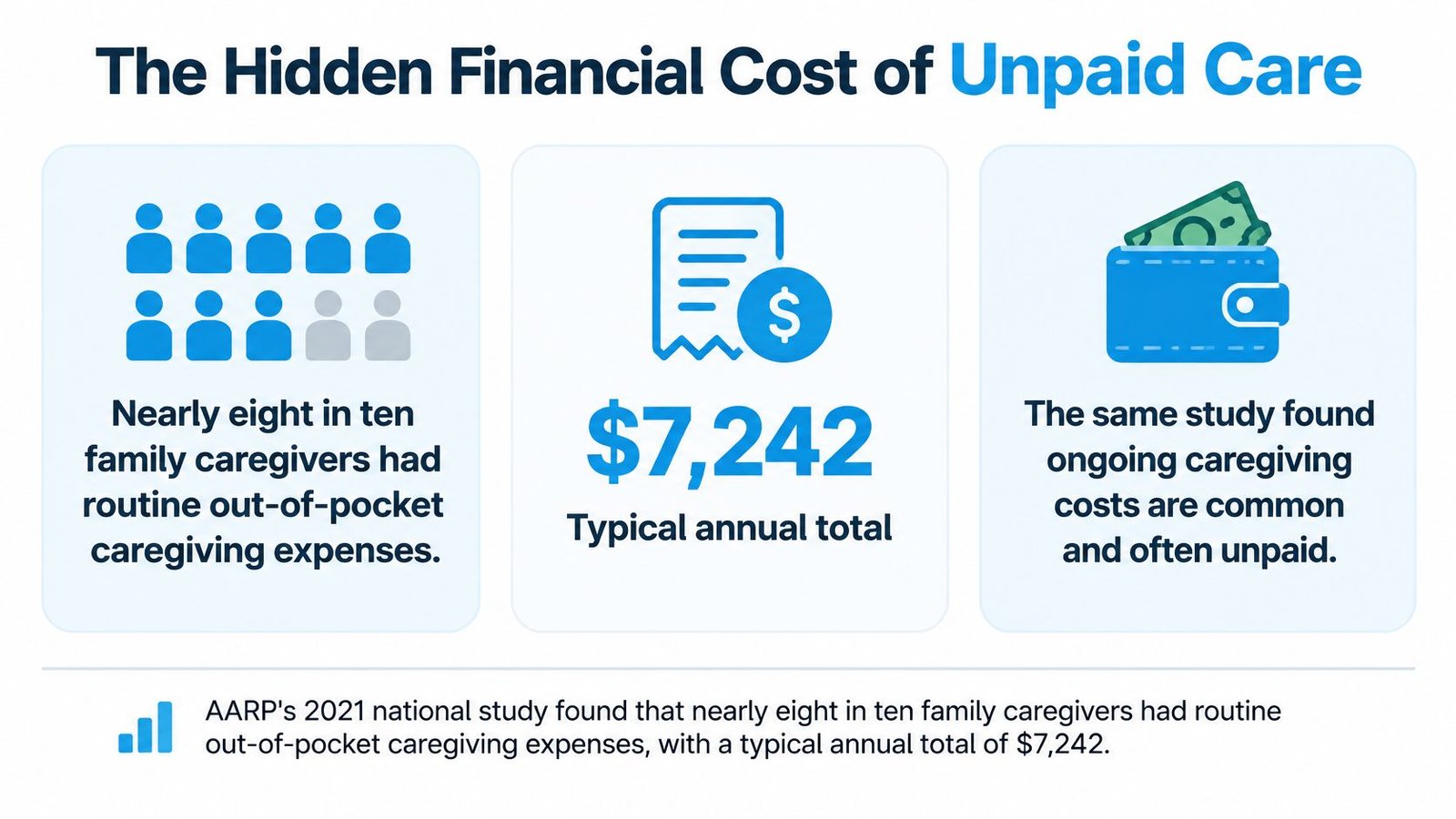
A typical annual out-of-pocket caregiving total was $7,242, and nearly eight in ten family caregivers reported routine expenses in AARP's 2021 national caregiver cost study; caregivers also reported spending an average of 26% of their income on caregiving activities. In that same study, about half paid household-related expenses, 30% paid a loved one's rent or mortgage, 21% financed home modifications, and medical costs represented 17% of caregiver spending.
Those figures describe family caregivers broadly, not a predicted bill for an individual couple. Their practical value is showing why unpaid care still needs a household budget.
Separate spending from earnings you give up
Receipts show supplies, transport, equipment and paid support. They don't show reduced working hours, a promotion declined because travel is impossible, or retirement contributions that stopped when a spouse left employment.
A working caregiver may remain employed while repeatedly arriving late, leaving early or taking time off. Track those changes alongside purchases so the household can compare an apparently inexpensive arrangement with its full financial cost.
The scale of unpaid work is substantial: AARP's estimate reported by MarketWatch put U.S. family caregivers' unpaid care at 49.5 billion hours in 2024.
Keep a running record with separate categories:
- Money spent: Supplies, travel, home changes and professional support.
- Income lost: Unpaid leave, reduced shifts and employment changes.
- Longer-term effects: Missed retirement contributions and benefits to review.
- Possible assistance: Pending claims, reimbursements and applications.
For households raising an autistic child, the autism care financial planning guide can help organize the broader planning conversation.
Review the household budget regularly and before changing employment. Bring expense records and income changes to benefit and tax appointments, but don't assume every caregiving purchase qualifies for reimbursement or a deduction.
Setting Boundaries and Role Agreements at Home
Love doesn't automatically supply capacity. A spouse may want to help while lacking the strength, training, time or emotional reserves to provide every part of the care plan.
A written agreement makes those limits easier to discuss before either partner reaches a breaking point.

A 2025 study abstract published in Innovation in Aging identified spouse caregivers as reporting the greatest burden and intensity among caregiver types and highlighted younger spouses caring for partners with dementia as a potentially vulnerable group. The practical response isn't to assume every marriage will struggle, but to make responsibilities negotiable.
Put the agreement in everyday language
Answer these questions together, using the care recipient's preferred communication supports:
- Who decides what? Identify medical decisions, daily choices and matters requiring joint discussion.
- Who owns each task? Name the person responsible for completing it, not merely helping.
- What workload is acceptable? Agree on limits for hands-on assistance, supervision and overnight coverage.
- What time is protected? Reserve predictable time for rest, friendships, work and personal appointments.
- What happens when someone can't continue? Write down who takes over and how that person is contacted.
For example, a spouse might agree to manage appointments and meals but decline lifting and overnight supervision. That isn't abandoning care. It identifies the services the household must arrange.
Preserve choice and companionship
The person receiving care should retain control over routines, privacy and ordinary decisions wherever possible. Needing help bathing doesn't erase the right to choose when to bathe or who provides intimate assistance.
Protect time together that isn't used for symptom reviews, paperwork or scheduling. A shared meal, music or a quiet conversation can remain part of the relationship without becoming another treatment goal.
Use a conversation prompt when it's difficult to start discussing changing roles.
At a recurring check-in, review workload, sleep, mood and whether the agreement still fits. If either partner feels unsafe, controlled or persistently overwhelmed, renegotiate the arrangement and seek outside support.
A spouse can decline tasks beyond their capacity without declining the relationship.
Legal Authority and Decision Rights for Spouses
Providing care and having legal authority are different. Helping with meals doesn't automatically authorize access to a bank account, consent to treatment or control over another adult's choices.
Check the documents before a crisis
- Healthcare proxy or advance directive: Name the preferred medical decision-maker for situations in which the person cannot decide. Some states recognize a spouse as a default surrogate, but confirm local rules and the document's activation requirements.
- Durable financial power of attorney: Specify authority for financial matters while the person has capacity to choose. Banks and benefit agencies may require their own procedures.
- Information releases: Ask clinicians and insurers which HIPAA authorizations they need. Schools use education-record consent procedures, not a medical release.
- Guardianship or conservatorship: Ask about this court process only when necessary. It can restrict rights and involve hearings and ongoing oversight; supported decision-making or other less restrictive options may be appropriate.
- Support obligations: Confirm how state law treats a spouse's legal responsibility for support and how the particular paid-care program applies it.
A parent's authority concerning a minor child is different from a spouse's authority concerning another adult. Neither role should be treated as unlimited.
Bring signed copies to appointments, keep secure scans accessible to authorized people and ask an elder law attorney or disability rights organization to review the arrangement. Don't store sensitive legal documents in a shared system without checking its access controls and suitability.
Sharing One Accurate Picture of the Care Load
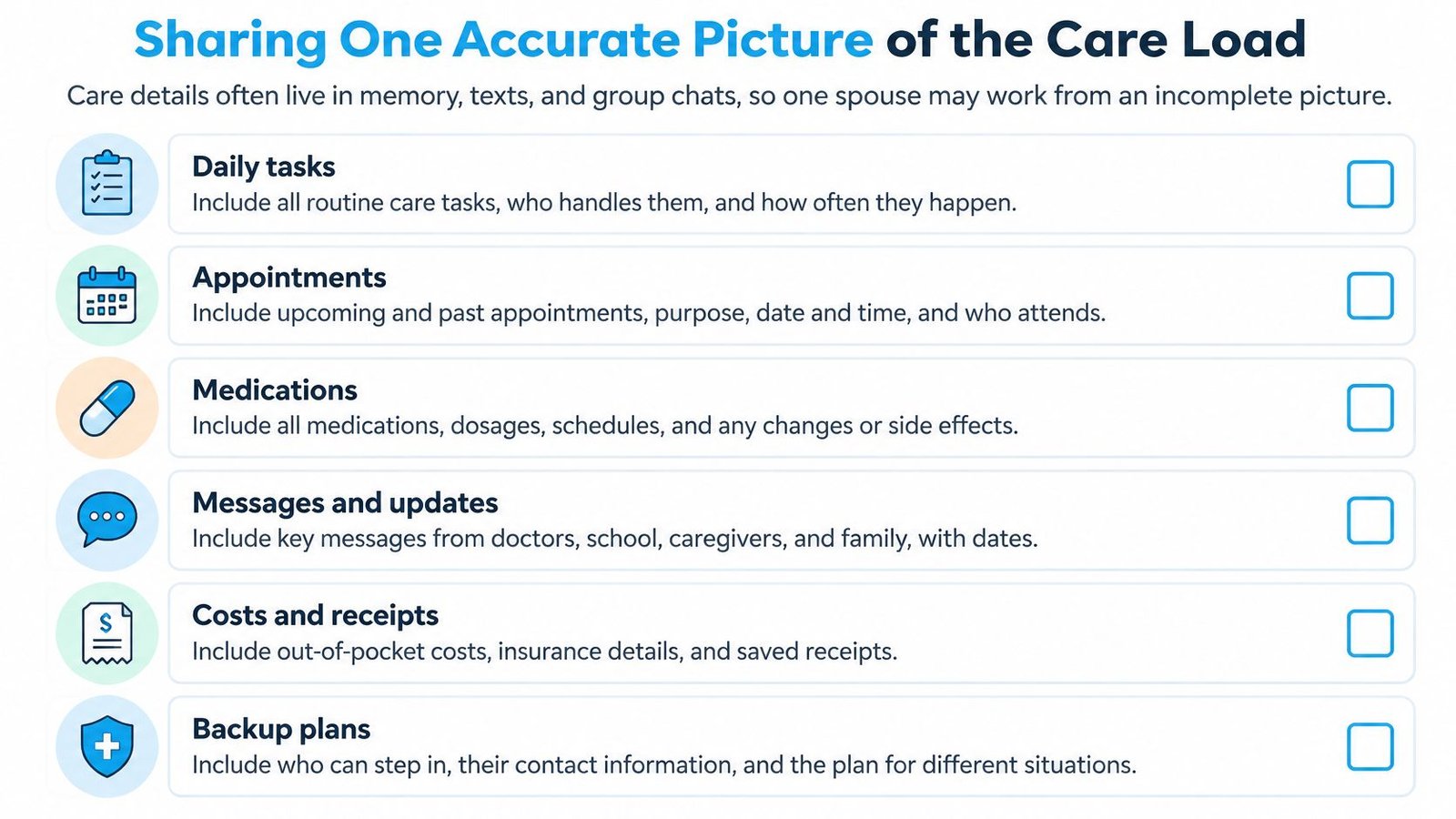
A shared record should capture the information another caregiver needs to act, not every detail of family life.
- Routines and sleep: Usual patterns, changes and support that helped.
- Behavior or symptoms: Triggers, timing, intensity, duration and relevant context.
- Medications: Current instructions, schedules and changes confirmed with the prescriber.
- Meals and allergies: Foods, reactions and established safety instructions.
- Appointments and therapies: Upcoming visits, questions, recommendations and follow-up.
- Contacts: School staff, clinicians, agencies and backup caregivers.
- Costs and receipts: Purchases, claims and documents needed for financial discussions.
When those details stay in memory, texts and group chats, the spouse who wasn't present receives only part of the picture. Before a visit, both partners should be able to review the same current information rather than reconstruct events from separate recollections.
Choose a record that matches the household
A shared calendar can handle appointments, while a secure folder can hold documents. Families raising an autistic or neurodivergent child can also use Guiding Growth for child-focused logs, family collaboration and meeting preparation.
A parent can describe the day by voice, review the organized entries and correct them before saving. Structured behavior entries capture triggers, intensity, duration and location, while the analytics dashboard displays patterns over time.
Each spouse can receive their own permissions, allowing one person to add events while another manages the child's profile. Smart Summaries can turn selected entries from a chosen date range into an exportable PDF for an IEP meeting, a 504 review or a specialist appointment.
Keep the distinction clear: spouses coordinating their child's care are co-caregivers, not necessarily caregivers for each other. The app supports that child-care coordination; it doesn't provide medical advice, and records can be exported so the family retains access to its information.
Bringing in Outside Support Before Strain Builds
| Signal | Action | Where to turn |
|---|---|---|
| Missed doses or appointments | Share duties with another person and ask whether pharmacy pill packs are suitable | Pharmacist and care team |
| Caregiver repeatedly sleeping too little | Arrange scheduled respite and reliable overnight coverage | Area agency on aging or disability services office |
| Persistent low mood or physical symptoms | Book the caregiver's own medical visit and discuss counseling | Primary care clinician or therapist |
| Essential tasks cannot be completed or a safety concern appears | Request an urgent care-plan review; contact emergency services for immediate danger | Care recipient's clinician or emergency services |
| Considering reducing hours or leaving work | Check paid options and leave rights before deciding | Benefits counselor or state Medicaid agency |
These are reasons to act, not requirements someone must meet before asking for help. A medication error or immediate safety problem needs prompt attention; don't wait for a scheduled family discussion.
Contact the service that matches the problem
For an older adult, start with the area agency on aging and ask about respite, caregiver support and local service navigation. For an adult with a disability, contact the state disability services office about assessment and community support.
For a child, ask the school team or service coordinator which services belong in the educational plan and which require a separate health or disability application. A benefits counselor can help distinguish these systems without assuming that eligibility for one creates eligibility for another.
If the household needs administrative help, Approved Lux Personal Assistant care coordination describes an option to investigate for organizing appointments and communications. Confirm fees, privacy practices, qualifications and scope before sharing records or relying on a service.
For emotional support and practical ways to involve others, use the family caregiver support guide to prepare a specific request. Asking someone to cover a therapy trip is easier to act on than asking them to help more.
Make the next steps concrete
Choose deadlines that fit the coming week:
- Early in the week: Write the role agreement and identify the task with the weakest backup.
- Before the next appointment: Put current care information in a shared record and invite the spouse with appropriate permissions.
- During agency hours: Call Medicaid or the disability office about paid-care eligibility and assessments.
- Before the week ends: Set the next check-in and confirm who will provide relief.
For a child's appointment, Alma can help draft questions from logged history. Treat it as a sounding board, not a replacement for the care team, and verify clinical decisions with the appropriate professional.
Guiding Growth gives spouses raising autistic and neurodivergent children a shared place to log daily care, review patterns and prepare meeting summaries. Visit Guiding Growth, invite your spouse with the permissions they need, and begin with the routine that's currently hardest to hand over.