It is 7:40 a.m. and a meltdown started over a sock. By the time the school call comes, the details are gone. You remember the volume, not the trigger. You remember being late, not how long it lasted or who was in the room.
That gap is why behavioral data examples beat a longer memory. A survey answer is what someone thinks they saw. An event record is the action, close to the moment it happened. A Webflow guide to behavioral data makes the same point with clicks and page paths. A clickstream is a timed record of movement, with the action, the page, and what came before it. At home the fields are plainer and more useful: timestamp, antecedent, behavior, duration, intensity, setting, people present, consequence, and outcome.
This guide walks through eight behavioral data examples, from ABC event logs to sleep diaries. Each one is a working entry you can copy, plus how a clinician or IEP team reads it later. I would rather walk in with six clean rows than a week of texts nobody can sort.
The list is practical, not a catalog of every clinic form. Start with the fight you are already having.
Table of Contents
- 1. ABC (Antecedent-Behavior-Consequence) Event Logs
- 2. Ages & Stages Questionnaires, Third Edition (ASQ-3)
- 3. Modified Checklist for Autism in Toddlers, Revised with Follow-Up (M-CHAT-R/F)
- 4. Vineland Adaptive Behavior Scales, Third Edition (Vineland-3)
- 5. Short Sensory Profile, Second Edition (SSP-2)
- 6. Child Behavior Checklist (CBCL) from ASEBA
- 7. Individualized Education Program (IEP) Goal Progress Data
- 8. Sleep Diaries and Wrist-Worn Actigraphy Data
- How the eight behavioral data types compare on purpose, collector, and time commitment
- Keeping the Log Alive Once the Examples Make Sense
1. ABC (Antecedent-Behavior-Consequence) Event Logs
An ABC log is direct observation, not a mood report. You write what happened right before the behavior, the behavior itself, and what happened immediately after. Teachers, caregivers, and ABA teams use those three columns to stop arguing about whether it was "a bad day."
A usable row looks like this. Time: 7:41 a.m. Antecedent: sock seam against the ankle during the rush to the car. Behavior: screamed, threw the sock, dropped to the floor. Duration: four minutes. Intensity: could not be redirected by voice. People: parent only. Consequence: parent removed the sock and delayed departure. Outcome: calm once shoes went on without socks.
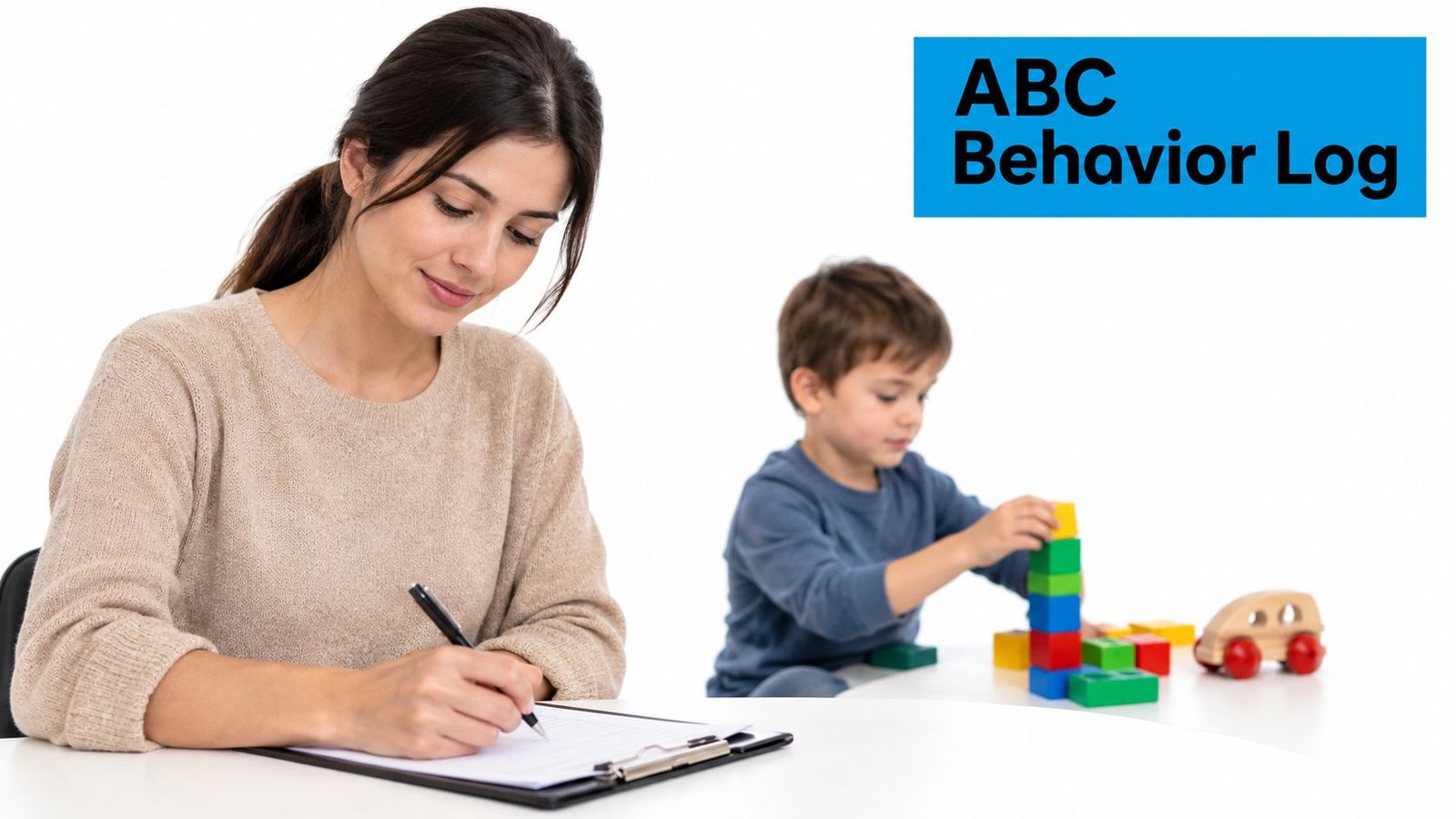
NICE guidance on autism in under-19s says a functional assessment should identify triggers, recurring patterns, the needs a child may be trying to meet, and the consequences that follow. Weeks of rows can point toward escape, attention, sensory input, or access to an item. One row cannot. A school psychologist who sees outbursts after unstructured transitions can justify a visual schedule. A family who sees bedtime refusal after screens can change the evening, not the child.
What holds up in the meeting
Practical rule: Log within a few minutes, use one definition of the behavior for every adult, and bring a weekly cluster summary, not the raw pile.
The trade-off is real. ABC logs miss internal distress and anything that happened at school while you were not there. They also tempt you to write a diagnosis in the behavior cell. "Covered ears and left the room for four minutes after the fire alarm" is data. "Sensory meltdown because of auditory sensitivity" is a theory. If you want the clinical frame behind those columns, explore a holistic approach to ABA before you treat the log as a finished plan. An app can organize the fields. It does not replace a professional functional assessment.
The same record is easier to review on video than in a rushed handoff, which is why many teams start families here.
2. Ages & Stages Questionnaires, Third Edition (ASQ-3)
A child's ASQ-3 scores can look steady in one domain and shift in another across visits. Pediatric offices and early intervention teams use the ASQ-3, a parent-completed questionnaire that does not require a testing room. It covers children from 1 month to 5 years 6 months, with age-specific questions in communication, gross motor, fine motor, problem solving, and personal-social. Scores are compared with cutoffs: on track, monitor, or refer.
One completed form captures a snapshot. Repeated forms show how skills change over time. For example, a pediatrician comparing the 18-, 24-, and 30-month domain scores can notice communication concerns while motor scores remain steady, then discuss whether a speech referral is appropriate. The pattern helps make the conversation specific; it does not diagnose the child.
Copy these fields beside the official form:
- Date and age band: Include adjusted age if your child was premature. The tool allows this correction.
- Domain and item: Record the question and one concrete example from this week.
- Your answer and the cutoff result: Note whether the result is on track, monitor, or refer.
- What you will ask next: Write down questions about the timeline for a fuller evaluation, rather than choosing a new label.
A flagged domain is a prompt for follow-up, not a conclusion about your child.
Keep each completed questionnaire. Domain scores give clinicians and an IEP team a clearer comparison than a general recollection that “they said he was behind.” The trade-off is coverage: the ASQ-3 tracks developmental milestones, but it will not explain a meltdown, sleep debt, or a skill that appears at home and not in the waiting room. Pair the form with a dated event entry when the concern is a behavior pattern rather than milestone status. Note the context and outcome so the team can distinguish a skill concern from a situation-specific response.
3. Modified Checklist for Autism in Toddlers, Revised with Follow-Up (M-CHAT-R/F)
Say the 24-month visit includes the M-CHAT-R/F. You answer 20 yes-or-no items about social communication, play, and responsiveness for a toddler between 16 and 30 months. Items marked no can trigger a follow-up interview. That interview, not the first pass alone, is what pushes a referral. The screen is a starting point. It is not a diagnosis.
Between visits, the useful companion entry is tiny and dated. Tuesday, pointing: pointed at the bus, then looked back at you. Eye contact: brief during snack, absent when the TV was on. Pretend play: fed the bear a cup, once. Those notes stop the follow-up from turning into a coin flip about an unusual Tuesday.
Where parent ratings go soft
Caregiver scores can move because of age, anxiety, and attention or hyperactivity symptoms, even when the behavior itself has not changed, a problem described in research on caregiver ratings. Answer from a typical week, not the day everyone was sick. Write an example next to any item you hesitate on. Follow-up questions usually land there.
Ask the pediatrician what a positive screen means this month, including the referral timeline. Send the result to early intervention if you already have a team. The trade-off is sharpness versus context. Twenty items are fast, and they miss school, siblings, and the communication attempts a checklist never names. Daily examples fill that hole without turning the screen into a diary you cannot finish.
4. Vineland Adaptive Behavior Scales, Third Edition (Vineland-3)
A child may use a skill at home and not at school. The Vineland-3 helps describe that difference through a semi-structured interview or a parent and caregiver rating form. It measures everyday independence across communication, daily living skills, socialization, and motor skills, with an optional maladaptive behavior index. It covers birth through adulthood, and compares scores with age-based norms.
Before the interview, organize examples by setting. Record the skill, context, and outcome: “Requests help with a two-word phrase at home; does not request help at school.” Add the dates, who observed the skill, and what the adult did next. A parent and teacher may report different levels of independence. That gap can show where support is needed, rather than which reporter is right.
A district can pair parent and teacher forms to document differences in daily living and socialization for eligibility discussions. A clinic that repeats the Vineland-3 about every 12 months can compare communication and self-care over time instead of relying on a general impression that a child “seems better.”
Use the same reporter for repeat ratings when possible. A change in reporter can look like progress when it reflects a different memory or setting. Ask for the domain profile page, not only the composite, and bring dated examples so the interview reflects more than a difficult week. Composite scores can hide the specific domain under discussion. Standardized scores also miss sensory context and what happens after school, so pair them with context-rich observations when needed. The Vineland-3 answers a distinct question: can the child perform a skill often enough to count as independent for their age?
5. Short Sensory Profile, Second Edition (SSP-2)
Video of a meltdown looks objective. A short parent rating is often the safer record. The SSP-2 is 38 items for ages 3 to 14, covering tactile sensitivity, taste and smell, movement, auditory filtering, low energy, and visual or auditory sensitivity. You rate how often each response happens on a five-point scale. Occupational therapists use domain scores to spot patterns and to check whether those patterns shift after intervention.
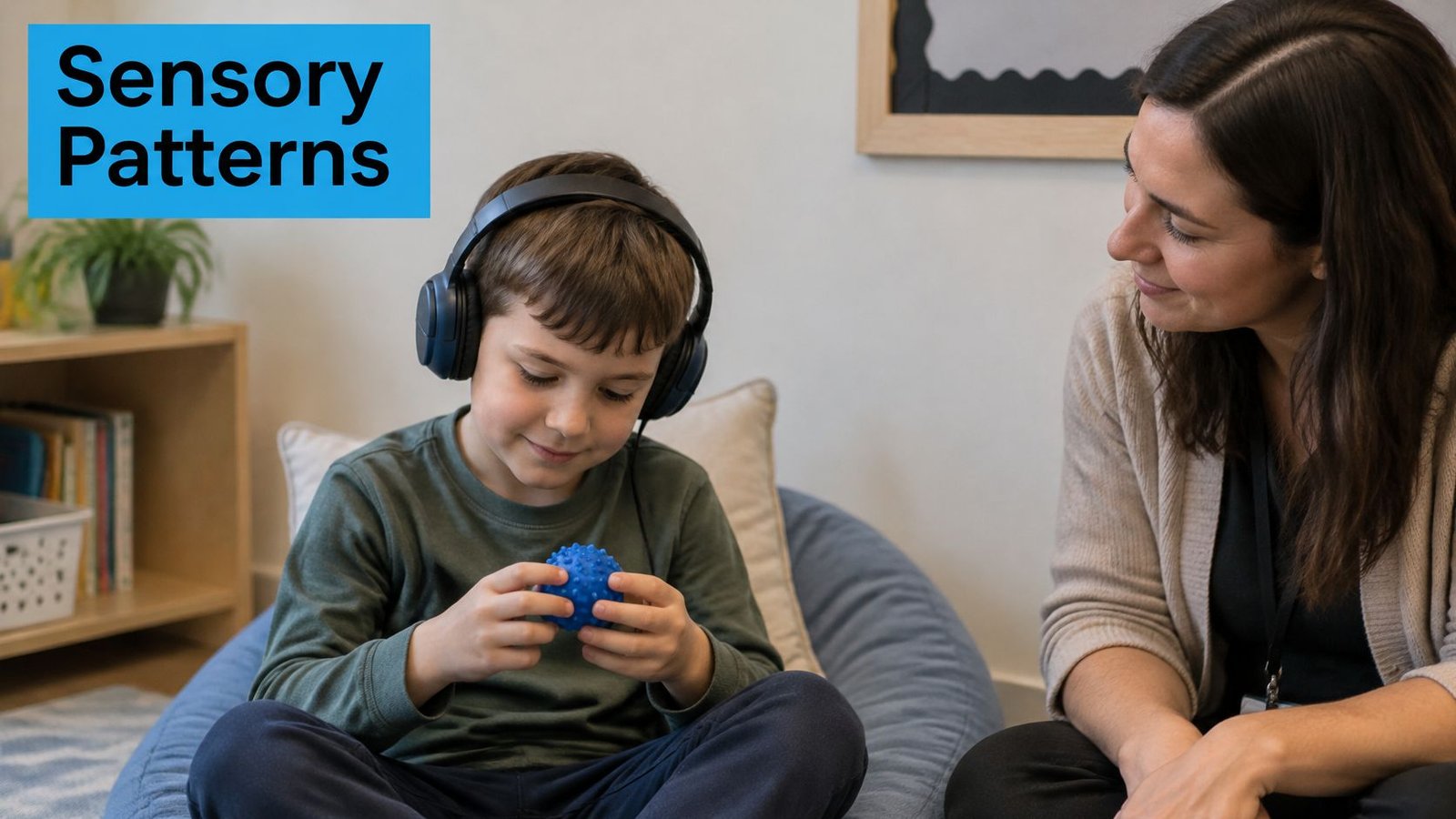
A 2025 computer-vision paper on self-injurious behavior treats children's images as sensitive by nature. That team used face blurring, sought extra consent before showing anonymized images, and pointed to pose-based datasets as a lower-risk option. Sensors and home video can cut logging effort and still miss why it happened, feel intrusive for a child with sensory sensitivities, and fail when behavior differs sharply from child to child. I would rather store "covered ears in the cafeteria, left for six minutes, headphones helped" than a raw clip.
Pair the questionnaire with a four-field diary: setting, time, response, outcome. Repeat the SSP-2 on a steady interval, such as every three to six months, and share domain scores, not only the total. An OT can compare intake with a later profile and see auditory filtering move while tactile scores stay put. Totals wash that out. The form still will not prove that the cafeteria caused the behavior. It shows where responses cluster, which is what the next accommodation should target.
6. Child Behavior Checklist (CBCL) from ASEBA
The argument in many meetings is not whether a concern exists. It is where it shows up. The Child Behavior Checklist, part of ASEBA, is a parent questionnaire on emotional and behavioral problems and on competencies. CBCL 1.5-5 covers toddlers and preschoolers. CBCL 6-18 covers school-age children and adolescents. You get syndrome scales such as anxiety, withdrawn behavior, and attention problems, plus broad internalizing and externalizing scores. Teacher Report Form (TRF) and Youth Self-Report (YSR) let you compare informants.
How a psychologist actually uses it
Complete the form from the past two weeks, not from the hardest month of the year. Ask for the profile graph. Change is visible there in a way raw totals bury. A psychologist who lays CBCL beside TRF might show attention concerns at school and not at home, which argues for classroom supports rather than a blanket home plan. A family repeating the CBCL about every six months in therapy can track externalizing scores without treating one bad assembly as a trend.
Put three lines under the graph before you send it:
- Setting split: which scale moved at school, at home, or in both.
- Event context: two dated logs that explain a spike, such as a substitute week or a medication change.
- Missing voice: what the child, or the school day, still is not saying.
The trade-off is breadth against mechanism. The CBCL will not name the antecedent. Your event log does that job. Together they stop a team from treating a setting difference as defiance.
7. Individualized Education Program (IEP) Goal Progress Data
A useful IEP progress sheet shows more than whether a skill happened. It records the date, opportunity, prompt level, and outcome. Typical targets include following a two-step direction, requesting help, or completing a transition. Schools must report IEP goal progress as often as they report general education progress.
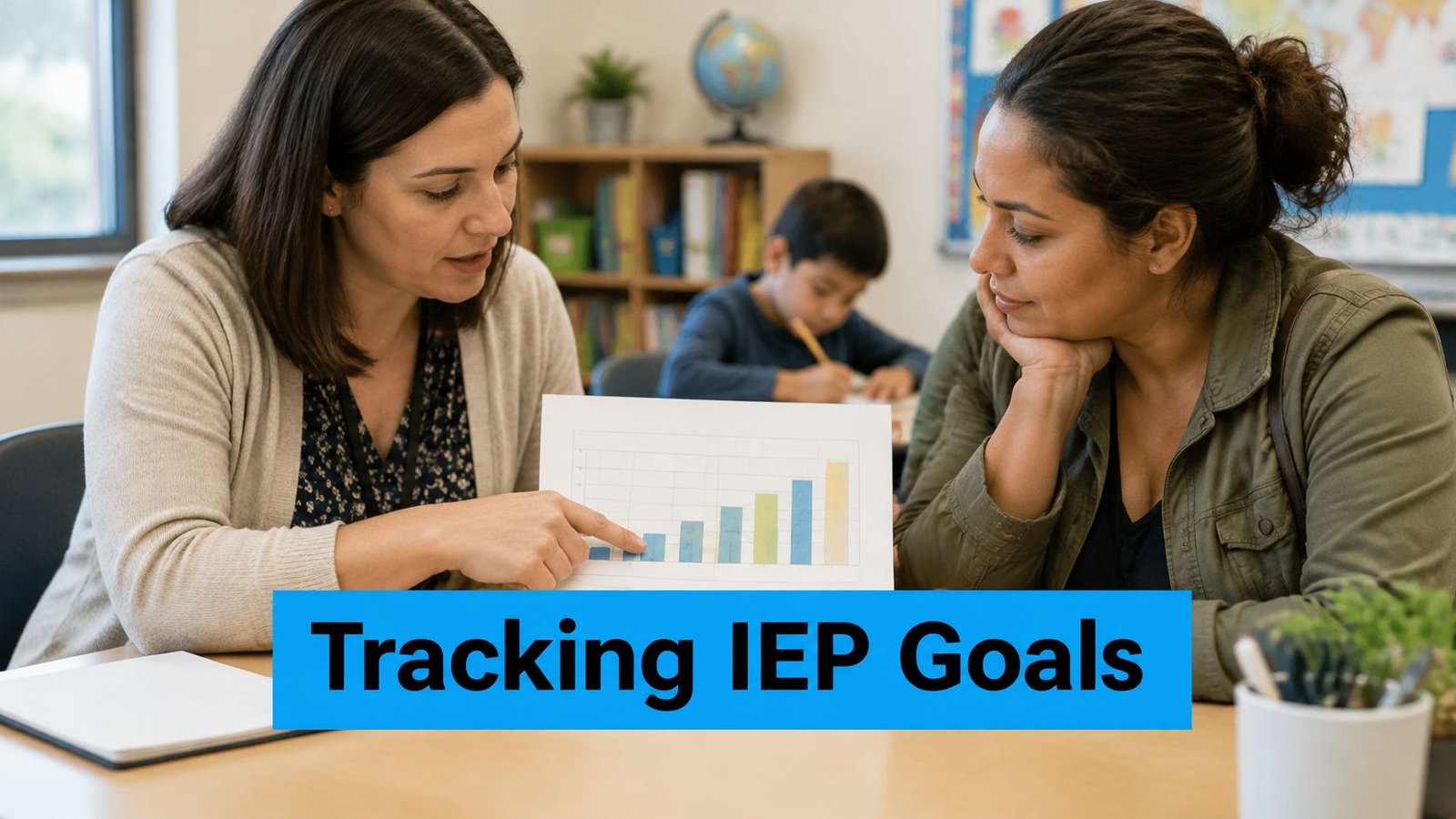
For each entry, add the timestamp, setting, antecedent, behavior, support provided, and outcome. A clinician or IEP team can then compare performance across settings and see whether a prompt, transition, or other context changes the result. Clinic gains do not automatically carry over to home or school.
In a mixed-methods behavioral case study, researchers tracked aggression frequency, parent-reported change, and field notes several times a week for three months, across sessions and family life. They calculated agreement by dividing agreements by agreements plus disagreements in 10-second bins. Home counts helped check whether the effect extended beyond therapy sessions.
Ask for the data sheets before the meeting, and check the measurement rule and collection frequency. If transition completion rises from 40 percent to 75 percent over six weeks, the team has a concrete basis for discussing whether to continue the support. A dated morning-routine log can support a home-school communication goal. When home and school records differ, compare the dates, settings, and prompts rather than relying on a summary label such as “progressing.”
8. Sleep Diaries and Wrist-Worn Actigraphy Data
Sleep is the record that explains tomorrow's behavior better than another tally of the behavior itself. In a mobile-care comparison of children with autism, caregiver feedback came at three-month intervals. Sleep-problem impact was high for the supported group at baseline and significantly reduced by the end, while the control group's measure stayed largely constant. One child who started with a low response gradually increased across the project. Read that as a reason to keep a baseline and a comparison, not as proof that any app or plan will cut your nights in half.
A diary entry is four clocks plus context. Bedtime. Sleep onset. Night wakings, with clock time and what you did. Wake time. Add the routine, screens, medications, and supplements. Actigraphy estimates sleep and wake from wrist movement. It does not measure sleep directly, so clinics pair it with the diary. A sleep visit that lines up two weeks of both and sees wakings after late screens has something to change. A month of wake times gives a pediatrician a reason to loop in a sleep specialist.
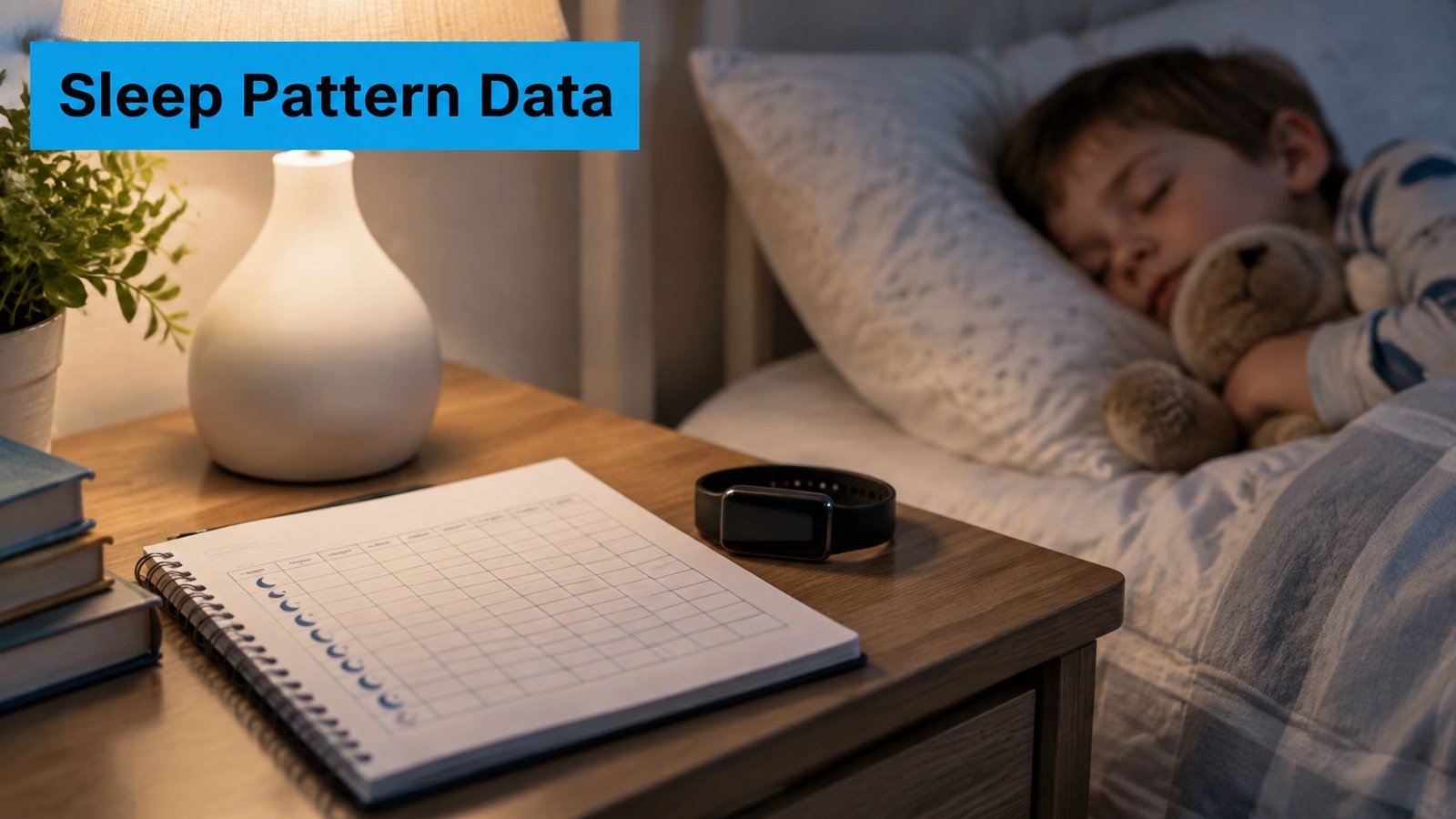
Write it in the morning, before the day eats the details. Send the diary before the appointment. Ask whether a wrist device fits your child's age and sensory profile. Some children will not tolerate the band, and a fought-over sensor is worse data than a complete diary. Separate a parent impact rating from minutes awake. A calmer morning can mean longer sleep, a lighter burden, or both, and the plan should say which one you are tracking.
How the eight behavioral data types compare on purpose, collector, and time commitment
| Item | Primary Purpose | Who Collects It | Typical Time Needed | Main Output |
|---|---|---|---|---|
| ABC (Antecedent-Behavior-Consequence) Event Logs | Identify behavior triggers and likely functions | Caregivers, teachers, or ABA therapists | Ongoing, with entries recorded after events | Event patterns that inform FBAs and behavior plans |
| Ages & Stages Questionnaires, Third Edition (ASQ-3) | Screen developmental progress across five domains | Parent or caregiver | About 10–15 minutes | Domain scores indicating whether development is on track, needs monitoring, or warrants referral |
| Modified Checklist for Autism in Toddlers, Revised with Follow-Up (M-CHAT-R/F) | Screen toddlers for early autism-related signs | Parent or caregiver; provider conducts follow-up interview when needed | Quick to complete; flagged items require follow-up | Screening result and indication of whether diagnostic evaluation is recommended |
| Vineland Adaptive Behavior Scales, Third Edition (Vineland-3) | Assess everyday adaptive functioning | Trained administrator using caregiver, parent, or teacher input | About 20–60 minutes or more | Norm-referenced scores across adaptive behavior domains |
| Short Sensory Profile, Second Edition (SSP-2) | Identify patterns in a child's everyday sensory responses | Parent or caregiver | About 10–15 minutes | Sensory domain and total scores with classifications |
| Child Behavior Checklist (CBCL) from ASEBA | Assess emotional and behavioral concerns and competencies | Parent or caregiver; teacher and youth forms may also be used | Form completion time varies | Normed syndrome and broad behavior scores |
| Individualized Education Program (IEP) Goal Progress Data | Measure progress toward a student's IEP goals | School staff and the IEP team | Collected regularly throughout the school year | Progress reports and data for decisions about goals and supports |
| Sleep Diaries and Wrist-Worn Actigraphy Data | Track sleep patterns, duration, and quality | Parents or caregivers; actigraphy device records movement data | Typically one to two weeks of tracking | Sleep diary and estimated sleep metrics and patterns |
Keeping the Log Alive Once the Examples Make Sense
Pick one stream for this week. If mornings are the war, use an ABC row for that hour only. If nights are wrecking the next day, run a sleep diary for two weeks. Copy the fields from the matching example into one template so every adult records the same thing. Log within minutes. On Sunday, mark time-of-day clusters and ignore the single worst afternoon.
The record has to leave your notes app. HHS explains that you can request copies of health information and ask a doctor to send information to a family member, a caregiver, an app, or a researcher. A parent log is not automatically part of a provider's designated record set, so those access rules do not clone themselves onto every entry you type. Export still matters. A date range, an event type, and a short summary will survive an IEP or a new-patient visit. A thread of texts will not.
Sharing needs the same discipline. Covered entities may share protected health information that is directly relevant to a person's role in care or payment. That is not a blanket release, and the child's preferences still count. Decide who may view, who may add, and who may edit the profile before a co-parent, a therapist, and a teacher are all in the same thread.
Guiding Growth can hold the entries this list describes, including triggers, intensity, duration, purpose, people present, and location, then turn a date range into an exportable summary. It organizes observation. It does not diagnose, and it does not replace the Vineland, the IEP sheet, or your clinician. If local counseling would help the adults in the house while you build the log, support for Vernon parents and families is one place to start that conversation. Bring the summary, not the guilt, to the next appointment.
Guiding Growth is a mobile log for autistic and neurodivergent kids, built so a hard morning becomes fields a clinician or IEP team can read instead of a story you have to reconstruct. You can track behavior, sleep, and the rest of the day, then export a meeting summary when someone asks what changed. Visit Guiding Growth and start with the one entry you keep losing.