At 9:47 p.m., the dishes are still on the counter. You're sitting on the kitchen floor after the third meltdown of the day, staring at a phone filled with therapy emails, school messages, appointment reminders, and questions you don't have the energy to answer. Your child is finally quiet, but your body hasn't received the message. Your jaw is tight, your shoulders hurt, and you're already bracing for tomorrow morning.
That pattern can be autism caregiver burnout, not a failure of patience or love. It develops when the demands of caregiving remain high while recovery, support, and coordination stay limited. A 2023 peer-reviewed study found that 41.6% of caregivers experienced mild-to-moderate burden, 33.8% experienced high burden, and only 24.9% reported no-to-mild burden (peer-reviewed caregiver burden study). Recognizing the pattern gives you a place to begin. From there, you can track what is driving the load, share more of the work, and create a plan that protects both you and your child.
Table of Contents
- What Autism Caregiver Burnout Feels Like
- The Four Stages Parents Usually Move Through
- Why Autism Caregiving Hits Harder Than Other Caregiving
- Evidence-Informed Coping Strategies That Go Beyond Bubble Baths
- A Practical Self-Care and Prevention Plan You Can Start This Week
- Turning the Plan Into a Workflow With Guiding Growth
- When to Seek Professional Help and What Recovery Can Look Like
What Autism Caregiver Burnout Feels Like
At the end of a demanding day, you may still love your child while feeling numb during a meltdown, resentful about another appointment, or desperate for ten uninterrupted minutes. These reactions can exist together. Burnout does not erase love, and needing relief does not mean you want to leave your child.
Autism caregiver burnout develops when caregiving demands stay higher than the resources available to meet them. It reaches beyond ordinary tiredness after a difficult day or a single hard week. Over time, the nervous system remains on alert, anticipating the next disruption. You may carry worry about transitions, grief about an uncertain future, and less room for interests or relationships outside caregiving.
The three dimensions of burnout
The Maslach framework describes burnout through three connected experiences:
- Emotional exhaustion: You feel depleted before the day begins. Another transition, phone call, or behavior incident seems impossible because your emotional reserves are already low.
- Depersonalization: You feel detached or numb within the caregiving relationship. Routines become mechanical, interaction feels difficult, and shame may follow.
- Reduced accomplishment: You question your competence despite doing a great deal. Progress becomes difficult to notice because your attention stays fixed on the next urgent task.
These signs describe an overloaded system, not laziness, poor adjustment, or insufficient devotion. One nervous system is being asked to absorb too much for too long. Recognizing the pattern changes the practical question from “Why can't I cope?” to “Which demands, decisions, and handoffs need to be made visible and shared?”
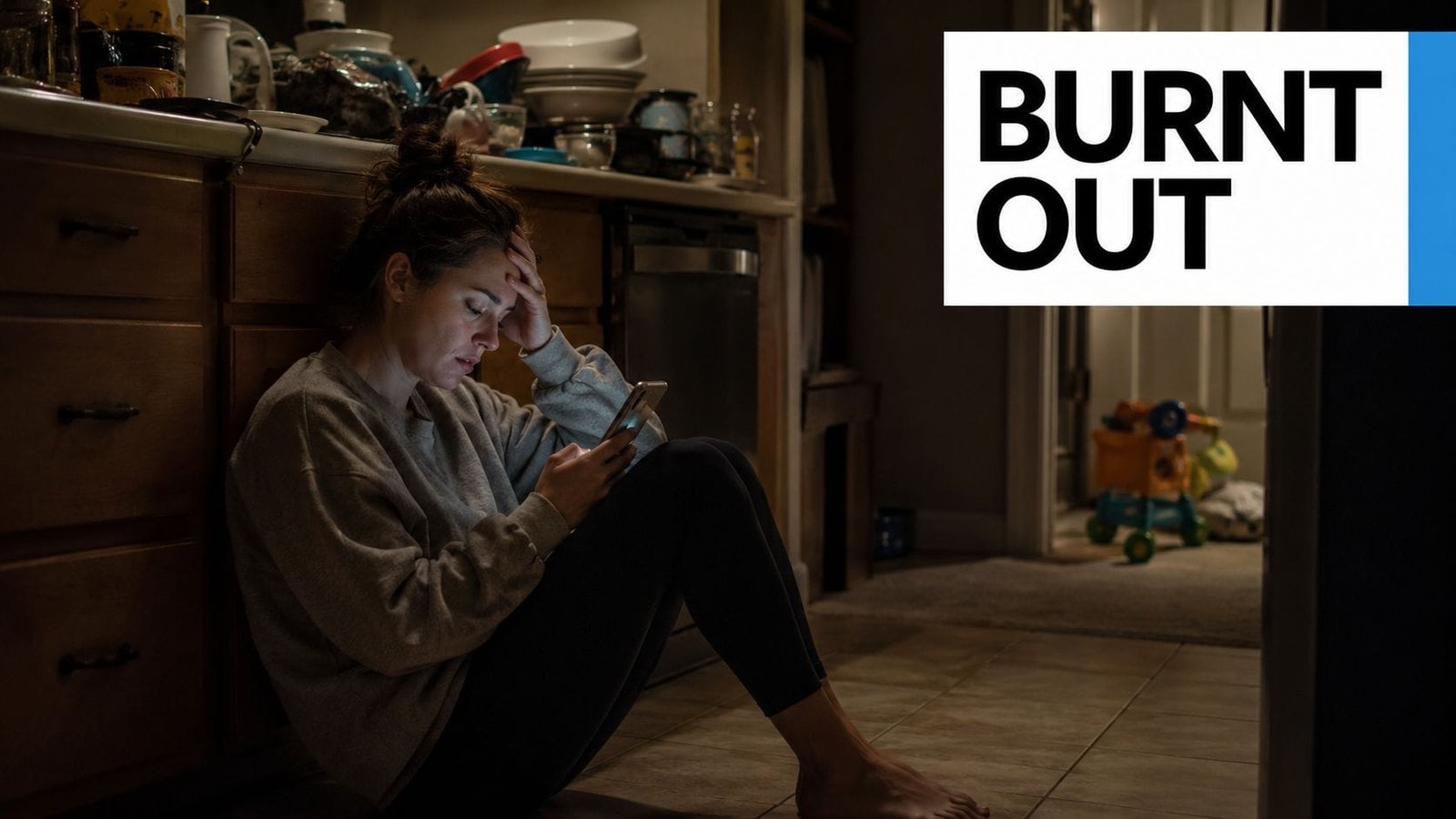
A useful reframe: Burnout is a pattern of overload, not a verdict on your parenting.
The pattern may appear as a slow bleed rather than a dramatic collapse. You answer fewer messages, stop making plans, and lose interest in activities that once helped you feel like yourself. A shared record of appointments, triggers, responses, and follow-up tasks can turn vague overload into information that another caregiver, teacher, or clinician can act on. Guiding Growth's guide to handling overwhelm as an autism parent offers a starting point for identifying what needs attention before you try to solve everything at once.
The Four Stages Parents Usually Move Through
Burnout usually builds through recognizable shifts rather than arriving all at once. The four-stage model below adapts the Maslach and Leiter framework to autism caregiving. It is not a diagnosis. It is a way to identify which pattern is taking up the most space, so you can change demands, decisions, or handoffs before your capacity is gone.
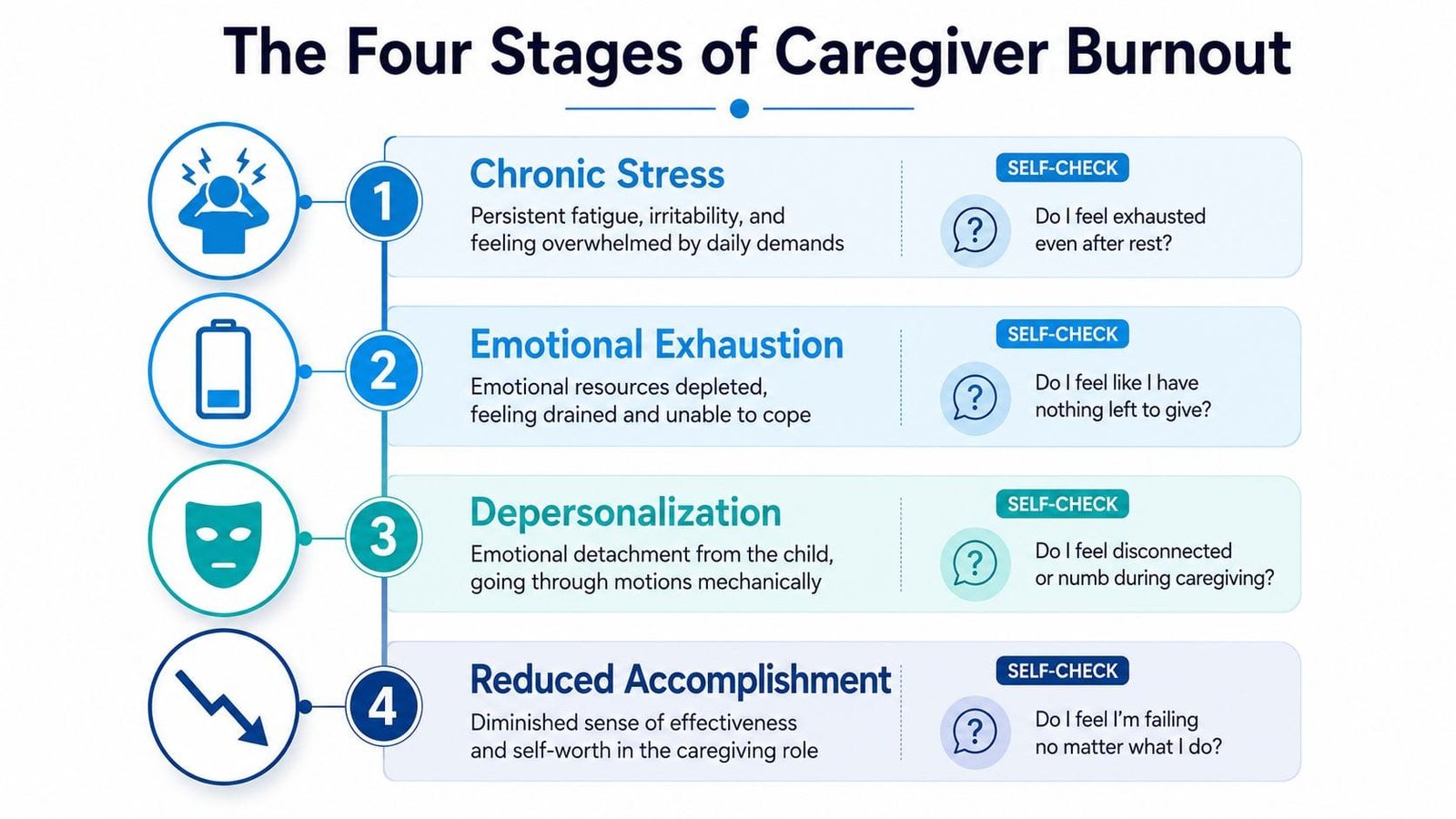
Stage one is chronic stress
Your nervous system remains prepared for the next disruption. You may clench your jaw, sleep lightly, react sharply to small problems, or dread routine transitions such as dressing, leaving home, or beginning bedtime.
Notice if you feel tense before anything has gone wrong.
The goal is not constant calm. It is recognizing repeated stress points while you still have enough capacity to adjust a routine, request help, or remove unnecessary decisions. A shared record of triggers, responses, and follow-up tasks can make the pattern visible to another caregiver, teacher, or clinician.
Stage two is emotional exhaustion
Ongoing demands begin to use more emotional energy than you can restore. Chest tightness, headaches, irritability, and the wish to disappear for a while may appear. During a meltdown, you might feel emotionally blank because your system is conserving energy for immediate functioning.
After basic tasks are complete, notice whether you have any capacity left for connection, planning, or recovery.
The 2025 study of parents of autistic children found that 19.9% were experiencing parenting burnout and 16.9% were at risk, while 72.3% reported high parenting stress in a sample of 231 parents (2025 parenting stress and burnout study). Stress can become the pathway into burnout rather than a separate problem.
Stage three is depersonalization and withdrawal
Connection starts to feel like another task on an already crowded list. You may avoid school pickup, delay replying to caregivers, or withdraw from friends because explaining your circumstances feels too demanding. Guilt can grow alongside that withdrawal, making support harder to request.
Notice whether solitude is helping your nervous system recover, or whether you are avoiding people because one more demand feels impossible.
Stage four is reduced accomplishment and identity erosion
Daily life can shrink into appointments, routines, safety planning, and crisis recovery. You question decisions, lose contact with former interests, and interpret ordinary difficulties as proof that you are failing, despite the effort required to keep going.
Recovery does not require every stage to appear. Earlier recognition gives you more room to coordinate support, reduce uncertainty, and turn scattered observations into a workable plan rather than relying on willpower alone.
Why Autism Caregiving Hits Harder Than Other Caregiving
Autism caregiving often produces a distinctive strain because the work is continuous, sensitive to behavior, and heavy on coordination. The main drivers are not effort or commitment alone. Child behavior and symptom severity can shape both the practical demands of care and the caregiver's internal experience. A clinical synthesis found disruptive behavior to be the strongest predictor of objective strain, while autism severity combined with disruptive behavior predicted subjective internalized strain (clinical synthesis of autism caregiver strain).
Behavior creates a repeated alert cycle
Aggression, self-injury, elopement, intense distress, or prolonged noncompliance can require immediate safety decisions. You are responding to the current event while also scanning for what came before it, judging risk, adjusting demands, and estimating recovery time. Your nervous system may remain on alert because the next decision is difficult to predict.
The same synthesis reported higher odds of stress among autism caregivers than non-autism caregivers, with an odds ratio of 3.61 and a 95% confidence interval of 2.60 to 4.99. It also reported higher odds of anxiety, OR 1.85, 95% CI 1.37 to 2.49, and depressive disorders, OR 1.83, 95% CI 1.17 to 2.86. These findings describe added risk, not a personal failure or an inevitable outcome.
Sleep loss removes the repair period
Night waking, wandering, co-sleeping, and irregular routines can interrupt the period when your body should recover. In one cohort, 54.8% of caregivers reported insufficient sleep, and sleep-disorder symptoms were connected with poorer individual and family quality of life (caregiver sleep and quality-of-life study). A separate study found that a caregiver burden cutoff score of 26.50 identified risk of poor sleep quality. Post-test probability rose to 82.02% from a pre-test probability of 76.72% (caregiver burden and sleep-quality study).
Poor sleep reduces patience, attention, and recovery capacity. Reduced capacity can make the next difficult episode harder to handle, creating a cycle that requires coordinated support rather than more self-discipline.
Time and coordination consume the day
Caregiving can include direct support, school communication, therapy coordination, medication management, transportation, meals, safety supervision, and recovery after difficult events. One caregiver-burden study found that half of the men provided care for 5 to 10 hours per day, while half of the women provided care for more than 15 hours per day. Another autism-related sample reported average daily contact time of 16.86 hours (caregiving time study).
| Driver | Mechanism | Evidence snapshot |
|---|---|---|
| Behavior-linked strain | Monitoring and safety decisions keep the caregiver on alert. | Disruptive behavior strongly predicted objective strain in the same study. |
| Sleep disruption | Interrupted sleep limits physical and emotional recovery. | 54.8% reported insufficient sleep. |
| Extended time load | Direct care and coordination occupy much of the day. | Average daily contact time was 16.86 hours in one sample. |
| Uncertainty and unmet needs | Unpredictability, limited support, and unclear planning increase vigilance. | A 2025 ecological caregiver study associated burnout with unmet needs, self-stigma, and low family resilience (2025 ecological caregiver study). |
The pattern is a coordination problem as much as a stress problem. Centralizing observations, schedules, questions, and handoffs in a shared system such as Guiding Growth can reduce uncertainty and make support easier to distribute. That turns “try to rest” into visible tasks, shared responsibility, and earlier recognition of mounting strain.
Evidence-Informed Coping Strategies That Go Beyond Bubble Baths
“Take a bath” isn't bad advice. It's just incomplete when you're managing night waking, school transitions, safety concerns, and a queue of provider messages. A relaxing activity may soothe you briefly, but it won't reduce the number of decisions you must make tomorrow.
A more useful distinction is between emotional coping and structural coping. Emotional coping helps you tolerate the moment. Structural coping changes the conditions that keep creating the moment.
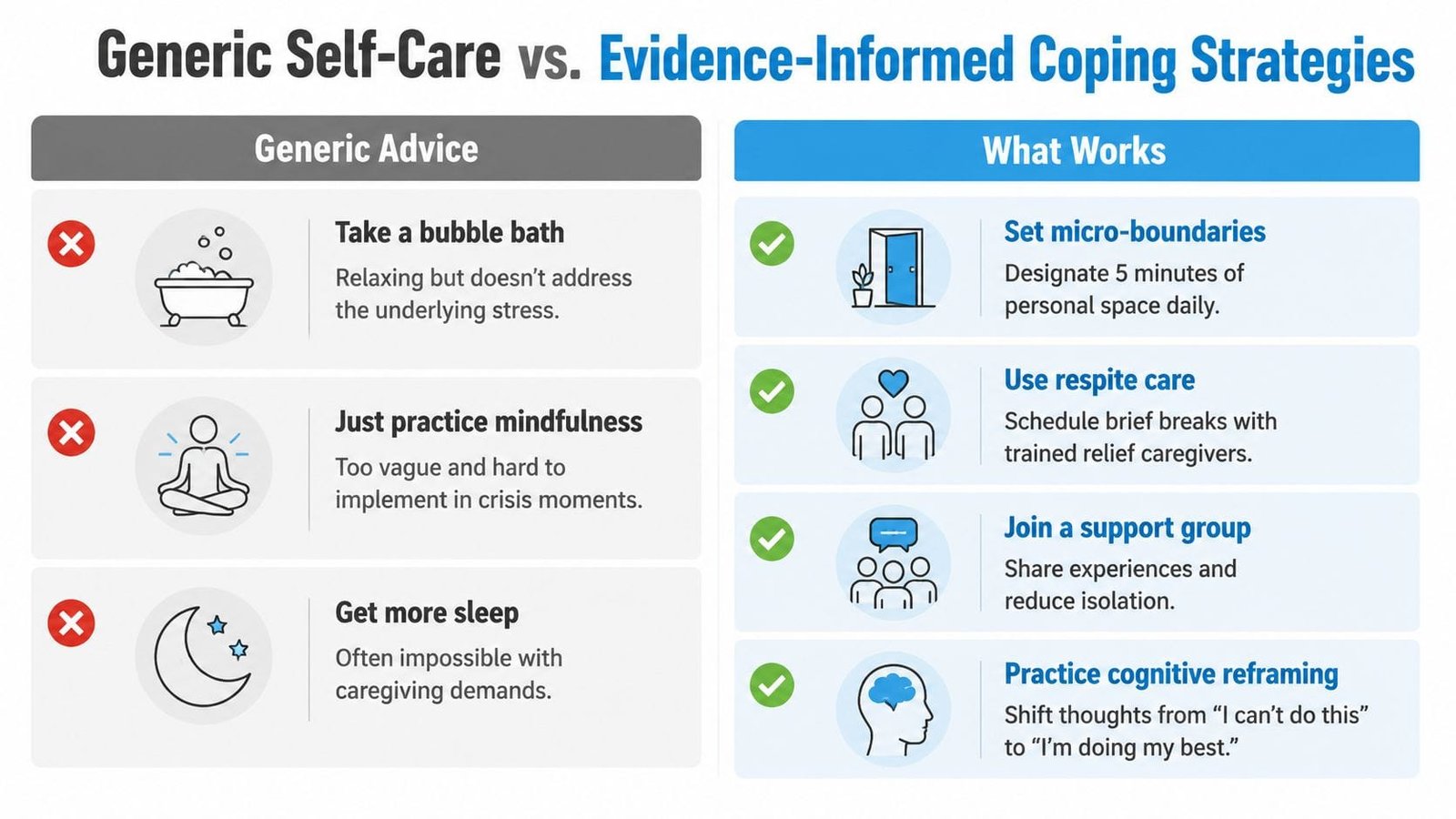
Track patterns instead of relying on memory
When every day feels chaotic, memory tends to preserve the most intense events. Briefly recording what happened before a meltdown, what the behavior looked like, how long recovery took, and what helped can reveal patterns that are invisible in the moment.
This approach supports problem-focused coping. You're not blaming your child or trying to eliminate every difficult behavior. You're identifying which transitions, sleep conditions, sensory contexts, or demands repeatedly increase strain, then bringing clearer information to therapists, educators, and other caregivers.
Share responsibility, not just updates
A partner who says “tell me what you need” may be willing to help but still leave you responsible for noticing, planning, and delegating. Shared caregiving works better when responsibilities are visible and specific. One adult handles the morning routine, another owns therapy communication, and a trusted caregiver receives the same essential information.
Research on parents of autistic children found that social support and coping strategies partially mediated the relationship between stress and burnout (2025 parenting stress and burnout study). Support matters most when it removes work from your mental load, not when it adds another conversation you must manage.
Build connection that doesn't require explanation
Parent-to-parent support can reduce isolation because you don't have to translate every detail of your day. A support group, trusted friend, or autism-informed therapist can provide a place to discuss anger, grief, uncertainty, and practical barriers without turning the conversation into a judgment of your parenting.
For an immediate regulation tool, you can also use this practical peace guide from psychiatry to practice self-soothing during a high-intensity moment. Then return to the structural question: What demand can be shared, simplified, tracked, or postponed?
More ideas for protecting your energy are available in this resource on self-care for caregivers. The next step is converting those ideas into a routine that doesn't depend on remembering everything while exhausted.
A Practical Self-Care and Prevention Plan You Can Start This Week
A prevention plan should lower your workload, not become another standard you can fail to meet. Start with one practice and add another only when the first one feels familiar.
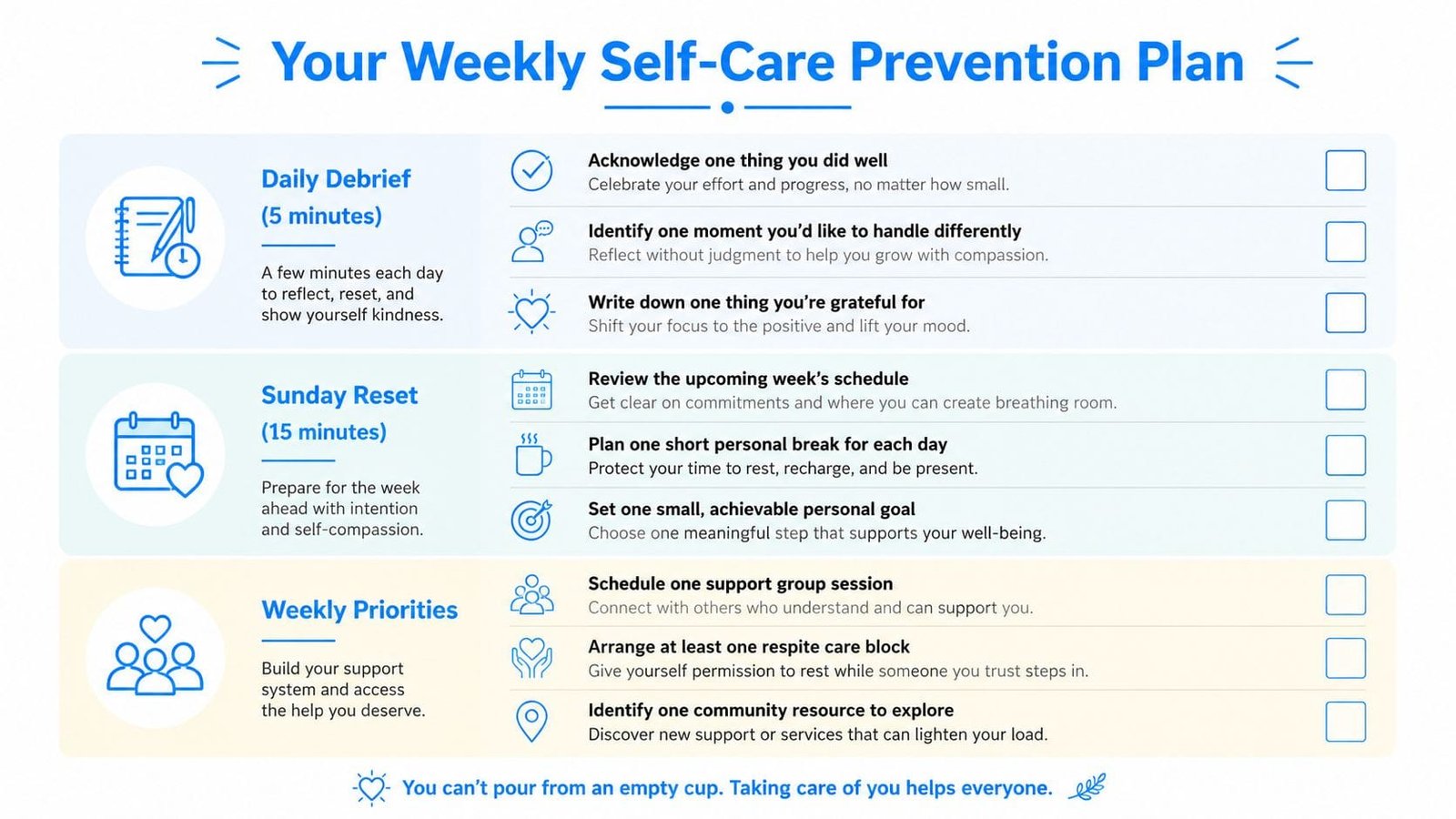
End the day with a five-minute debrief
Use five minutes after your child is settled, or at another consistent point, to write three brief notes:
- One thing you did well: This could be preventing escalation, asking for help, or getting through a hard routine.
- One moment to review: Record what happened without turning it into a character judgment.
- One thing you appreciate: Choose something concrete, such as a calm car ride or a helpful message.
The purpose is not forced positivity. It's to give your brain a balanced record rather than allowing the most difficult event to define the entire day.
Use a 15-minute Sunday pattern review
Once a week, review the upcoming schedule and look for pressure points. Mark appointments, school changes, difficult transitions, and nights when sleep may be disrupted. Choose one short personal break for each day, even if another adult covers only a small portion of the routine.
Look for repeated links between context and behavior. If difficult mornings follow poor sleep, or certain demands consistently precede distress, record that observation for discussion with the relevant professional. A pattern is a prompt for collaboration, not proof of a single cause.
Create a handoff that another adult can follow
A handoff checklist should include current routines, known triggers, helpful responses, medications, important appointments, and what recovery looks like. Keep it short enough that a co-parent, family member, or respite caregiver can use it without calling you for every decision.
Protect one support contact and one personal anchor
Schedule one support conversation, group session, or professional appointment. Also choose one activity that belongs to you, such as reading, walking, music, exercise, or a conversation unrelated to caregiving.
If technology can reduce communication friction, a Voice Control Pro app guide may help families explore speech and language tools that support communication workflows. The practical barriers are predictable: forgotten notes, changing schedules, unclear ownership, and the belief that you must complete the entire plan perfectly. Design around those barriers instead of treating them as personal shortcomings.
Turning the Plan Into a Workflow With Guiding Growth
A plan becomes sustainable when the information needed to use it is easy to find. If behavior notes live in a notebook, sleep details sit in a phone app, appointment information is buried in email, and each caregiver remembers a different version of the routine, coordination itself becomes another caregiving task.
A centralized tool such as Guiding Growth can organize those pieces in one shared workspace. Its purpose in this context isn't to replace clinical judgment. It's to reduce memory demands and make daily observations easier to share with the people involved in care.
Log the event while the context is available
After a meltdown, shutdown, demand-avoidant response, or episode of hand flapping, record the relevant context:
- What happened immediately before it?
- What did the behavior look like?
- How intense was it for your child and for you?
- How long did recovery take?
- What response appeared to help?
Guiding Growth supports behavior logging with contextual triggers and outcomes. A quick voice-log feature can be useful when typing is unrealistic, allowing you to capture the observation before the details disappear.
Review trends instead of isolated incidents
A single difficult evening rarely explains a pattern. Visual summaries of sleep, behavior, routines, and emotional states can help you compare periods over time. You may notice that caregiver distress rises after several disrupted nights, that one transition repeatedly requires longer recovery, or that a change in routine affects everyone in the household.
These observations don't prove why something happened. They give you better questions for a pediatrician, therapist, behavior specialist, teacher, or occupational therapist.
Make the invisible workload shared
Shared child profiles and activity feeds can keep co-parents, family caregivers, and professionals aligned. One adult can see that a medication was recorded, another can review a sleep note, and a therapist can understand what happened outside the session. That reduces the need for one parent to act as the household's sole historian and interpreter.
Use reminders for your own anchors, too. A break, therapy appointment, support-group meeting, or personal activity is part of the caregiving system because your capacity affects how sustainably care is delivered.
The goal isn't to collect endless data. It's to replace scattered memory with a small amount of structured information that reduces uncertainty, supports handoffs, and makes the next decision easier.
When to Seek Professional Help and What Recovery Can Look Like
You don't need to wait for a complete collapse before asking for help. Seek professional support when sleep disruption persists beyond two weeks, physical symptoms continue, emotional numbness toward your child is increasing, substance use is rising, intrusive or suicidal thoughts appear, or the caregiving partnership is breaking down.
Suicidal thoughts require immediate support. In the United States, call or text 988 for the Suicide and Crisis Lifeline, or contact emergency services if you or someone else is in immediate danger.
Choose the right level of support
- Primary care: Start here for persistent sleep problems, headaches, chest symptoms, pain, fatigue, or other physical changes.
- Licensed therapy: Look for someone experienced with caregiver fatigue, chronic stress, family dynamics, and autism-informed practice.
- Psychiatric care: A psychiatrist can review symptoms, medication needs, and interactions with existing treatment.
- Respite programs: Autism-informed respite can create actual recovery time rather than asking you to relax while remaining responsible.
- Peer support: Parent-led groups can reduce isolation and offer practical understanding from people living with similar demands.
If you're seeking structured outpatient support, this resource on outpatient care for Massachusetts caregivers may help you consider therapy options. You can also review these signs you need mental health support as a caregiver when you're unsure whether your symptoms have crossed a threshold.
Recovery usually arrives gradually. You may notice that sleep becomes more restorative, patience returns in small moments, abandoned interests become possible again, and conversations with co-parents or professionals become less reactive. The aim isn't to become endlessly available. It's to create a caregiving system in which responsibility, information, and recovery are shared.
Recognition, structured tracking, shared load, and professional support form a continuous loop. Start by naming one pattern, telling one trusted person, and changing one part of this week's workflow. That is a parenting decision, not an admission of failure.
Guiding Growth brings behavior, sleep, routines, appointments, medications, and caregiver collaboration into one mobile workspace, with quick voice logging and visual pattern summaries to reduce guesswork. Visit Guiding Growth to explore a more coordinated way to track your child's needs while protecting your own capacity.