You can leave a session with three separate scraps of information and no clear record of what happened. One parent remembers the therapist's advice, another caregiver remembers the child's mood shift, and the clinician has a rushed mental note that feels too thin to trust later. Therapy session notes are what turn that blur into something usable, shareable, and clinically meaningful.
For families, the best notes do more than satisfy a documentation requirement. They help everyone on the team see patterns, track responses to interventions, and keep follow-up from slipping through the cracks. For clinicians, they also need to hold up as accurate, timely, complete, and objective records, because that's what good care depends on PACFA guidance on session note quality.
Table of Contents
- From Scattered Papers to Clear Insights
- Choosing the Right Note Format for Your Needs
- Essential Information to Capture in Every Note
- Making Notes Actionable for Long-Term Tracking
- Legal Privacy and Collaboration Best Practices
- Streamlining Your Workflow with Modern Tools
From Scattered Papers to Clear Insights
The hard part often starts after the appointment ends. A parent walks out with a few verbal takeaways, a school notebook gets half-filled in the car, and a sticky note disappears before dinner. By the time someone asks, “What did the therapist say about the tantrums this week?”, the family is piecing together fragments instead of working from a shared record.
That's where structured therapy session notes change the day-to-day reality. Instead of one person carrying the whole story in memory, the team has a consistent record of what was discussed, what was observed, and what was planned next. That matters especially in child and family work, where caregivers, school staff, and clinicians may all need the same facts without the confusion that comes from passing around loose recollections Quenza's progress note guidance.
Practical rule: if a note can't help another adult understand the session later, it's not doing its job.
A useful note doesn't read like a diary entry. It records the date, session type, presenting concern, observed behavior, intervention, client response, risk, and next step, which is the kind of information that can be reviewed over time and compared across sessions Tava Health note best practices. That structure is especially helpful when a parent and clinician need to share responsibility for follow-through, because the note can quickly answer, “What worked, what didn't, and what needs to happen next?”
Parents often worry that documentation will feel cold or overly clinical. In practice, the opposite is usually true. Clear notes reduce guesswork, cut down on repeated explanations, and make it easier for everyone to stay aligned without re-litigating the whole week every time they talk.
For families trying to organize records alongside evaluations and school planning, a structured system can also keep the paperwork from ballooning. A practical starting point is to pair session notes with a broader records system, such as this guide on how to organize autism records for evaluations, so the information from therapy doesn't live in a separate silo from everything else.
Choosing the Right Note Format for Your Needs
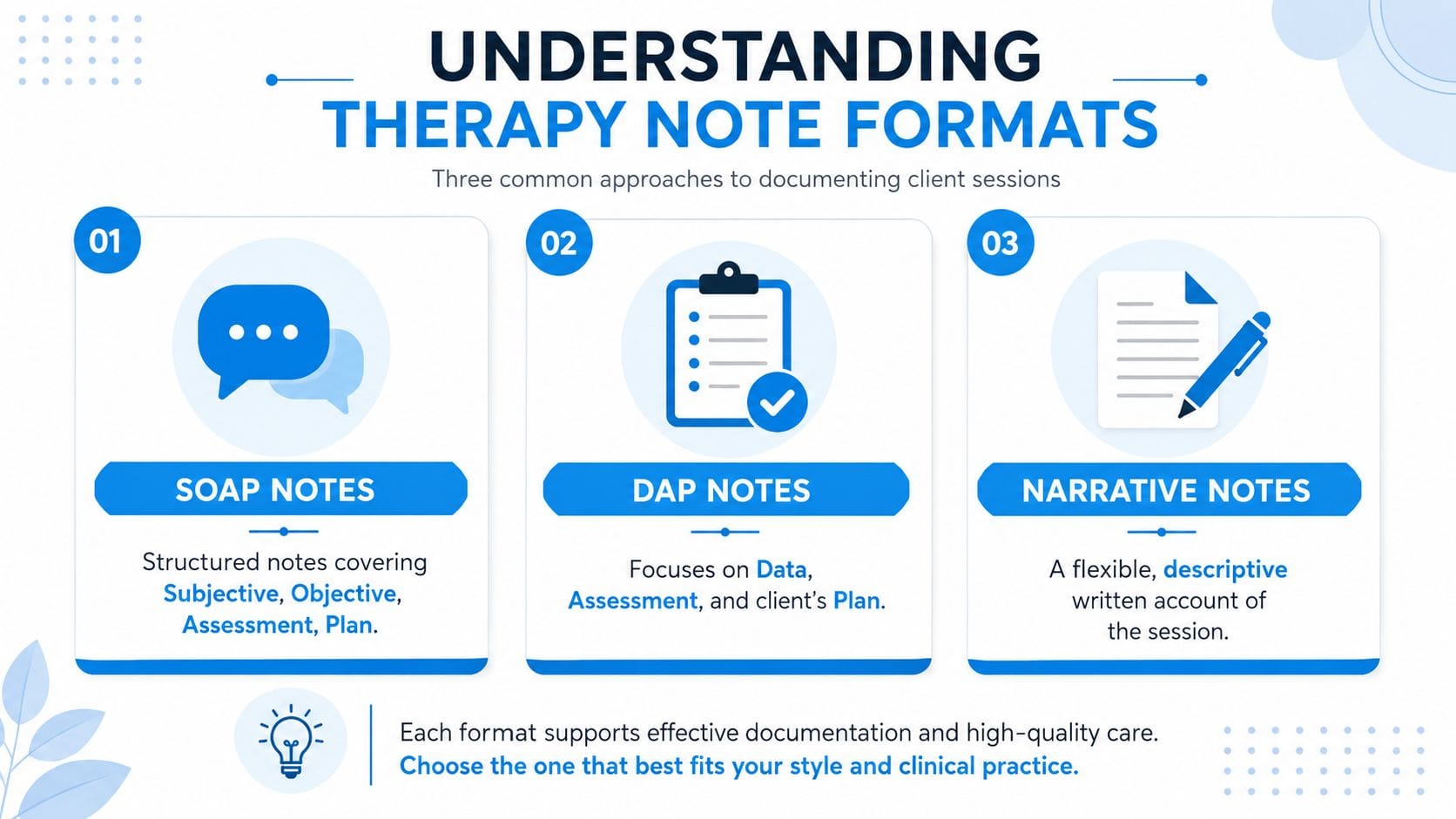
The format matters because the format shapes the thinking. SOAP, DAP, and Narrative notes all record a session, but they do it with very different levels of structure. One historical reason SOAP became so common is that it separates subjective report, objective observation, clinical assessment, and plan, which improves consistency and continuity of care SimplePractice on therapist session notes.
SOAP works best when the team needs precision
SOAP stands for Subjective, Objective, Assessment, Plan. It works well when the clinician needs a clear boundary between what the family says, what was observed, and what the clinician concludes. That makes it easier to support billing, supervision, and review, especially in settings where multiple providers may read the chart.
For a parent, SOAP can feel a little formal at first, but it has a real advantage. It prevents the note from turning into a story that drifts away from the facts. For a clinician, it also creates a dependable rhythm, because each section has a clear job.
DAP is leaner and often faster
DAP means Data, Assessment, Plan. It keeps the note shorter by folding reported details and observations into one data section. That can be a good fit for busy outpatient work when the team wants a concise record without losing the core clinical meaning.
The trade-off is that DAP can become too compressed if the writer isn't disciplined. If the data section gets vague, the assessment loses support. It's a practical format, but it still needs enough detail to show what happened and why the next step makes sense.
Narrative notes are flexible, but they can drift
Narrative notes read more like a story of the session. They can be useful when the context is complex or when the clinician needs more room to explain transitions, family dynamics, or unusual events. They're also the easiest format for a busy caregiver to understand quickly.
The downside is consistency. Without a structure to hold them in place, narrative notes can become hard to scan, harder to compare, and easier to overwrite with opinion. That's why many teams keep narrative language for occasional context, but still anchor the note in a structured format.
| Format | Structure | Best For | Key Benefit |
|---|---|---|---|
| SOAP | Subjective, Objective, Assessment, Plan | Compliance-focused clinical settings | Strong separation of report, observation, and judgment |
| DAP | Data, Assessment, Plan | Fast, concise documentation | Lean structure without losing core meaning |
| Narrative | Freeform written account | Context-heavy sessions | Flexible detail and easier reading for families |
For shared pediatric care, the best format is usually the one everyone can keep using consistently. A format that gets used every time beats a more “perfect” format that only gets used when there's time.
Essential Information to Capture in Every Note

A useful note captures the session as a sequence, not a blur. In a family-centered workflow, that means starting with the basic identifiers, then moving through the client's experience, the observable data, the intervention and response, and finally the next step. That order keeps the record readable for clinicians and makes it easier for parents to see what happened, what changed, and what needs follow-up.
A good note also gives both sides something usable. Parents should be able to read it and understand the session without needing a translation, while the clinician still has enough detail to support clinical judgment and continuity of care.
Behaviors and observations
This part of the note answers, “What did I see?” In child work, that might include pacing, withdrawal, eye contact, tearfulness, refusal, cooperation, or shifts in play. The goal is to describe behavior without layering on interpretation.
Use plain, observable language. “Cried for most of the session” is stronger than “was upset” because it tells the reader what happened instead of asking them to guess. If the clinician or parent can read the same description and agree on it, the note is on solid ground.
Triggers and context
A behavior makes more sense when the context is visible. Notes get stronger when they capture what happened right before the change, because that helps the team understand patterns instead of treating every episode as isolated. A child who melted down after a schedule change is telling a different story from a child who melted down after a long wait in a noisy room.
Clinical habit: document the context that came before the behavior, not just the behavior itself.
That context can include transitions, fatigue, a denied request, social conflict, sensory overload, or a change in routine. When notes are shared across caregivers, that extra detail makes it easier to avoid repeating the same trigger later and helps everyone speak about the child's needs in the same way.
Interventions and responses
The note also needs to show what the therapist or caregiver did. That might be prompting, modeling, redirection, praise, coping practice, parent coaching, or a structured behavioral strategy. The key is to name the intervention, not just say the session was “productive.”
Then capture the response. Did the child engage, resist, calm, repeat the skill, or need extra support? The note becomes more useful over time when it shows what the child responds to and what does not seem to land. A simple structure can help families and clinicians compare notes across visits, and a functional behavior analysis example can give both sides a shared way to think about patterns and responses.
Mood, energy, and quotes
Mood and energy matter because they often shape how the rest of the session unfolds. A child who arrives tired, irritable, or overstimulated may need a very different approach than a child who is playful and alert. Direct quotes can help too, but they should stay brief and purposeful, not turn the note into a transcript.
The best quoted lines are the ones that capture the child's own framing of the problem. If a child says, “I hate when it gets loud” or “I thought I was going to mess up”, that phrase may be more informative than a long summary sentence. Keep notes short enough that they still mean something, and use direct quotes only when they add real clarity.
For families who also track behavior outside therapy, this is the point where a shared log becomes useful. A structured system can carry the same core fields from session to session, and that gives parents and clinicians a common language instead of two separate versions of the child's story.
Making Notes Actionable for Long-Term Tracking
A single session note is just a snapshot. Its full value shows up when you can compare notes over time and see what keeps repeating. That's especially important in pediatric care, where the same behavior may look random in the moment but reveal a pattern once several weeks of records are lined up.
Look for recurring conditions, not just recurring behaviors
If a child is dysregulated every time a session follows poor sleep, the note should make that visible. If tantrums rise when demands are placed too quickly, or if coping skills work better in one setting than another, those patterns matter more than any one isolated event. That's the practical difference between writing a note and building a record.
The challenge is that many systems stop at documentation. They make it easy to say what happened, but not easy to see what repeated, what changed, or what drifted. That gap is a real limitation in current note guidance, which often emphasizes legal defensibility but gives less help with trend analysis across multiple sessions Mentalyc on therapy notes.
Use notes to support better decisions
Once the record is consistent, it becomes easier to ask better questions. Are certain strategies helping with transitions? Is anxiety worse on days with less structure? Does the child respond better to visual prompts, verbal rehearsal, or a slower warm-up? Those are the kinds of practical questions that turn notes into a care tool instead of a filing chore.
A good log doesn't just remember the week. It shows the shape of the week.
That matters for advocacy too. When parents meet with teachers, therapists, or medical providers, a pattern-rich note history gives them something concrete to point to instead of relying on a vague impression. It helps the team make choices based on repeated evidence, not whoever remembers the loudest incident.
For families who want this without extra manual work, app-based logging is a natural fit. A centralized record can keep sessions, behaviors, triggers, and outcomes together so the history is easier to scan than a stack of separate notebooks or scattered texts. That's also where a dedicated behavior log, like the one described in this behavior tracking app overview, becomes more than a convenience. It becomes the bridge between daily life and clinical follow-through.
Legal Privacy and Collaboration Best Practices
A parent asks whether the therapy notes can be shared with a teacher, while the clinician is deciding what belongs in the chart and what should stay private. That is the line that matters in shared care. Progress notes are part of the clinical record and may be available to clients, insurers, and litigators, while process notes are separate private reflections kept by the clinician Dr. Paul McCarthy's note guidance. Families and new clinicians do better when the system keeps that difference clear from the start.
Share enough for coordination, not so much that privacy collapses
A family can coordinate well without opening every part of the therapy conversation. Schools usually need practical details about triggers, accommodations, and follow-up. Other caregivers may need to know which calming strategies are in use and which responses tend to make things harder. They do not usually need every private detail from the session.
The safest approach is to write as if the note might be read later by someone outside the immediate room. That does not mean writing vaguely. It means sticking to facts, keeping the note relevant to care, and separating shared documentation from private clinical reflection with care.
Complete notes promptly and consistently
Timeliness protects accuracy. Clinical guidance often points to writing notes soon after the session, and many practice settings treat 24 hours as a common target and 72 hours as a harder outer limit. Once the session is fresh, details are clearer, language is tighter, and the note is less likely to drift into guesswork.
That same standard helps in shared care. If a parent is adding observations after therapy, the note is more useful when it is entered while the details are still specific. A short, factual note written the same day usually serves the team better than a polished summary built from memory days later.
Use secure systems, not convenience shortcuts
A shared care system should make privacy easier, not harder. If a note contains sensitive information, the tool storing it should limit access, preserve the record, and reduce the risk of accidental sharing. For a practical guide to that side of the workflow, parents and clinicians can also review protecting confidential information digitally.
Modern app-based logging can support that balance. A dedicated behavior log, like the one described in this behavior tracking app overview, can keep session notes, caregiver observations, and follow-up steps in one place without forcing families to search through texts, paper slips, or scattered emails. The goal is simple. Keep the record useful for coordination, and keep the private material private.
The main rule is straightforward. If a detail does not help the team care for the child, it probably does not belong in the shared record. That discipline keeps collaboration open without turning the chart into an overshared family archive.
Streamlining Your Workflow with Modern Tools
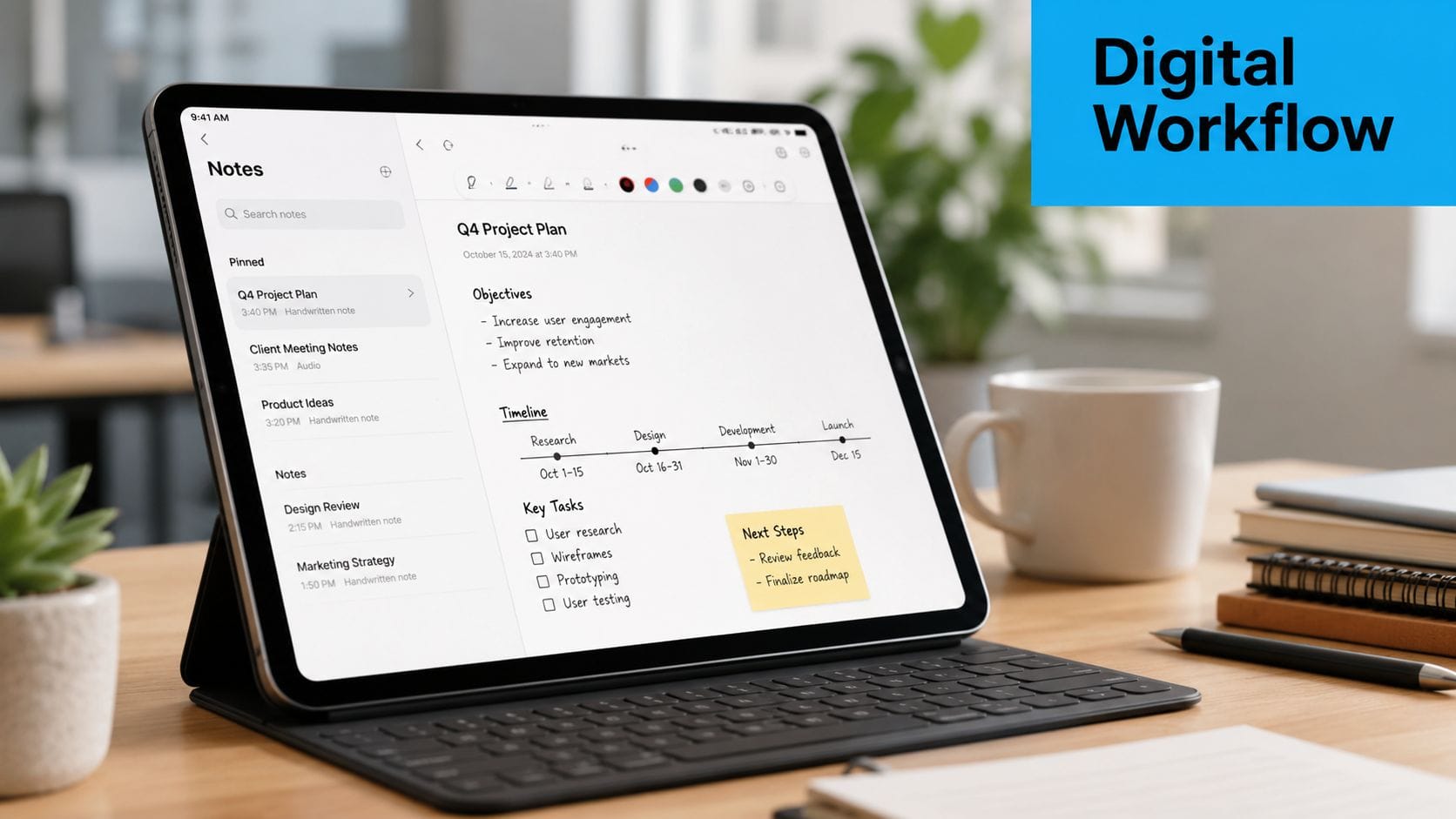
A parent finishes a therapy session, then tries to remember what the clinician said about transitions, triggers, and follow-up. By the time that information gets moved from a sticky note to a text thread to a paper folder, details are already fading. A shared digital workflow cuts that waste by keeping the note, the context, and the next step in one place, so both families and clinicians can work from the same record instead of rebuilding the story each time they connect.
That shared record also has to fit the way clinicians document care. Progress notes need to stay brief but complete, and they are easiest to write while the session is still fresh in mind. A note that gets entered right away is usually cleaner and more reliable than one reconstructed later from memory, paper scraps, or scattered reminders. For a practical overview of how that can work in day-to-day documentation, Quenza's progress note guidance offers a useful reference point.
A good system should do a few things well:
- Capture fast details: quick tags for behaviors, triggers, and outcomes help keep the note factual without forcing a parent or clinician to type out a long narrative.
- Keep everything together: sessions, behavior logs, medication updates, and family observations belong in one record, not five disconnected ones.
- Support voice logging: speaking a note often takes less effort than typing one, especially right after the appointment when the details are still clear.
- Make sharing intentional: the right people should see the right information without copy-pasting, screenshots, or other workarounds that create privacy problems.
For families managing several appointments, a tool that removes friction often determines whether documentation stays current or gets pushed to later and then forgotten. The goal is not to create more notes. It is to make the notes dependable enough that they support the child's care and give parents and clinicians a shared place to track progress.
A shared digital log also helps keep home, clinic, and school notes aligned. That matters because the most useful records are the ones a parent, therapist, or teacher can open and act on the same day. If you want a single place to keep therapy notes, behavior patterns, and family updates organized, use Guiding Growth to support that workflow. A dedicated behavior tracking app can also make it easier to keep the clinical record and the family's observations in the same system without losing privacy or clarity.