You're sitting at the kitchen table long after bedtime, and the house is finally quiet. Your child used to say a handful of words, wave at people, maybe light up during peekaboo, and now those skills seem to be slipping away. That kind of change can make a parent question their memory, their judgment, even what “normal” looked like just a month ago.
The good news is that this pattern has a name, a clinical context, and a clear next step. Regressive autism age concerns are not just about one narrow toddler window, even though that's where many cases begin. Skill loss can show up in language, social connection, play, or behavior, and the most useful thing you can do is track what changed, when it changed, and what seemed to happen around it. If you're trying to make sense of that pattern right now, it can help to speak with specialist autism support near you while you document what you're seeing at home.
Table of Contents
- When Skills Disappear Instead of Grow
- What Regressive Autism Actually Means
- The Typical Age Window and Why It Varies
- Early Signs Parents Notice First
- How Diagnosis and Evaluation Actually Work
- Possible Causes and What Prognosis Looks Like
- Your First 30 Days of Action and Tracking
- Moving Forward With Clarity and Support
When Skills Disappear Instead of Grow
The kitchen is dim except for the light over the sink. Your toddler stands near the cabinet, silent, while the stack of little cups sits untouched on the floor. A few weeks ago, that same child was saying “mama,” “more,” maybe even a few animal sounds, and now the words are gone or coming less often.
That moment is hard because it feels so personal. It also raises a real developmental question, not just a parenting worry. When a child who was gaining skills suddenly stops using them, or starts pulling away from people and play, the concern is no longer about a slow pace. It's about skill loss, and that deserves attention.
A lot of parents start searching for regressive autism age because they want to know whether their child fits the usual pattern. Many children who later receive an autism diagnosis do show regression in the second year of life, but the exact timing can vary. The bigger point is simpler, and more useful. Any new loss of skills matters, especially when it happens alongside changes in communication or social engagement.
Practical rule: if a skill was clearly there before and then fades, write it down as a change, not a feeling.
A developmental specialist can sort out whether the pattern points toward regression, a broader delay, hearing concerns, or something else. If you're trying to organize your next step, it helps to bring concrete examples instead of a general worry. A simple log, short videos, and a timeline of when you first noticed the change can make the visit far more productive. Tools that help families track behavior and context can be useful here, and structured notes are easier for specialists to review than a late-night memory scramble.
What Regressive Autism Actually Means
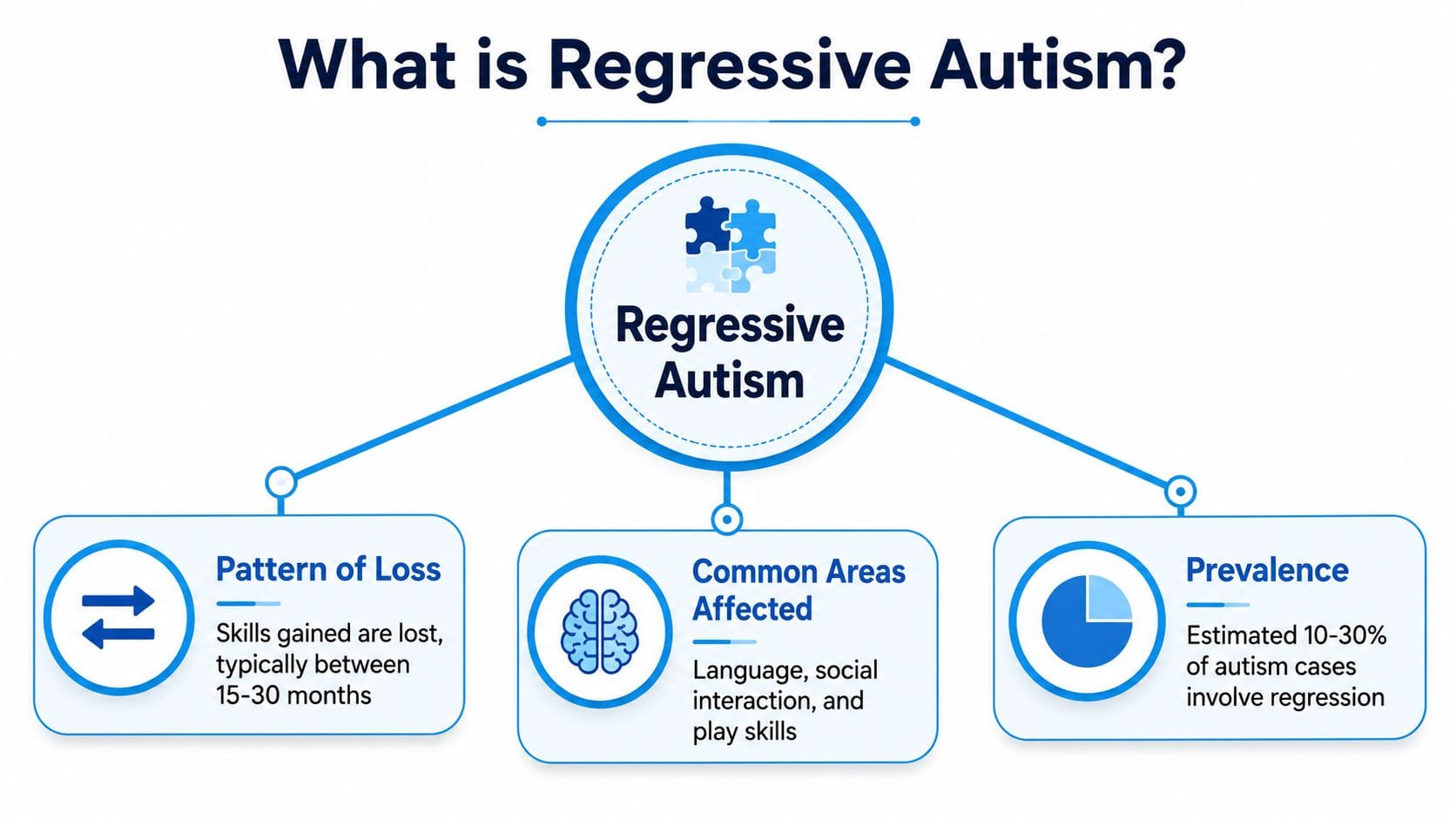
Regressive autism is a pattern of development, not a separate diagnosis. It describes a child who seemed to be moving along a typical path, then lost previously acquired skills in areas like speech, social engagement, play, or behavior. The final diagnosis, if one is made, is still autism spectrum disorder.
A film strip projected on a wall provides a useful analogy. Most frames still show the scene, but a few go dark. The whole reel hasn't vanished. A specific part of the story has changed, and that change is what matters clinically.
Regression is not the same as general delay
A child with a general developmental delay may be slower to reach milestones from the start. Regression is different because something that was already gained is lost. That distinction matters because parents often say, “My child was doing fine, then stopped.” That isn't the same as “My child was always behind.”
Temporary quietness can happen for many reasons, including fatigue, a big change at home, or illness. But if the loss persists, spreads to other skills, or is paired with reduced eye contact, less response to name, or less interest in play, it's worth treating seriously. A clinician will want to know what disappeared, whether it disappeared all at once or gradually, and whether it came with other developmental shifts.
A simple way to keep the concept straight
If you're wondering whether you're reading the right article at all, use this basic test:
- The skill was present before. A child used words, gestures, shared attention, or back-and-forth play.
- The skill then faded. The child used it less, then stopped, or it became much harder to access.
- The change is observable. Someone else could hear it, see it, or confirm it from home video.
That's the pattern clinicians mean when they talk about regression. It's a description of what changed, not a label for who your child is.
The Typical Age Window and Why It Varies
A parent may first notice a skill loss during a routine stretch of development, when language, social interest, and play are all changing quickly. That timing often falls in the second year of life, which is why regression is so often discussed in the toddler period. A 2021 systematic review and meta-analysis found a pooled regression prevalence of 30% among autistic children, with a weighted average onset of 19.8 months (PubMed). In a multicenter study of 1,027 autistic children, regressive behavior appeared in 13.44% of cases, with mean onset at 24.00 months and an interquartile range of 18 to 27 months (Frontiers in Psychiatry).
That pattern gives families a practical starting point. Many children are first seen to lose a word, a gesture, or social engagement somewhere around 18 to 24 months, because that is also a period when those skills are usually growing fast. But the calendar does not tell the full story. A review in the PMC article on regression in autism notes that reported onset has ranged from the second year of life up to 81 months, so a child can show regression outside the toddler years and still need the same careful attention.
Why reported rates differ so much
Parents often hear different numbers and wonder which one is correct. The answer is that studies do not always define regression in the same way. Some count language loss only. Others count language loss together with social loss. Others use broader mixed definitions. In the 2021 review, prevalence changed depending on the definition used, which helps explain why the reported rates vary so widely (PubMed).
| How Regression Definitions Shift Reported Prevalence | Reported Prevalence | Typical Onset |
|---|---|---|
| Language regression | 20% | Around the second year of life |
| Language-plus-social regression | 40% | Around the second year of life |
| Mixed definitions | 30% | Around the second year of life |
The main point is more useful than any single headline number. The classic window is real, but it is not the only window. If a preschooler or school-age child loses language, social reciprocity, play skills, or another learned ability, that still deserves evaluation. A parent does not need to prove that the child fits a textbook age range. The task is to notice that a skill was present, see that it faded, and bring that change to a clinician for review. For a clear overview of how skills usually build over time, Understanding child development milestones can help you separate a true loss from ordinary variation in growth.
Early Signs Parents Notice First
The earliest signs are often quieter than parents expect. A child doesn't usually announce regression. Instead, a familiar skill starts showing up less often, or not at all.
What tends to stand out first
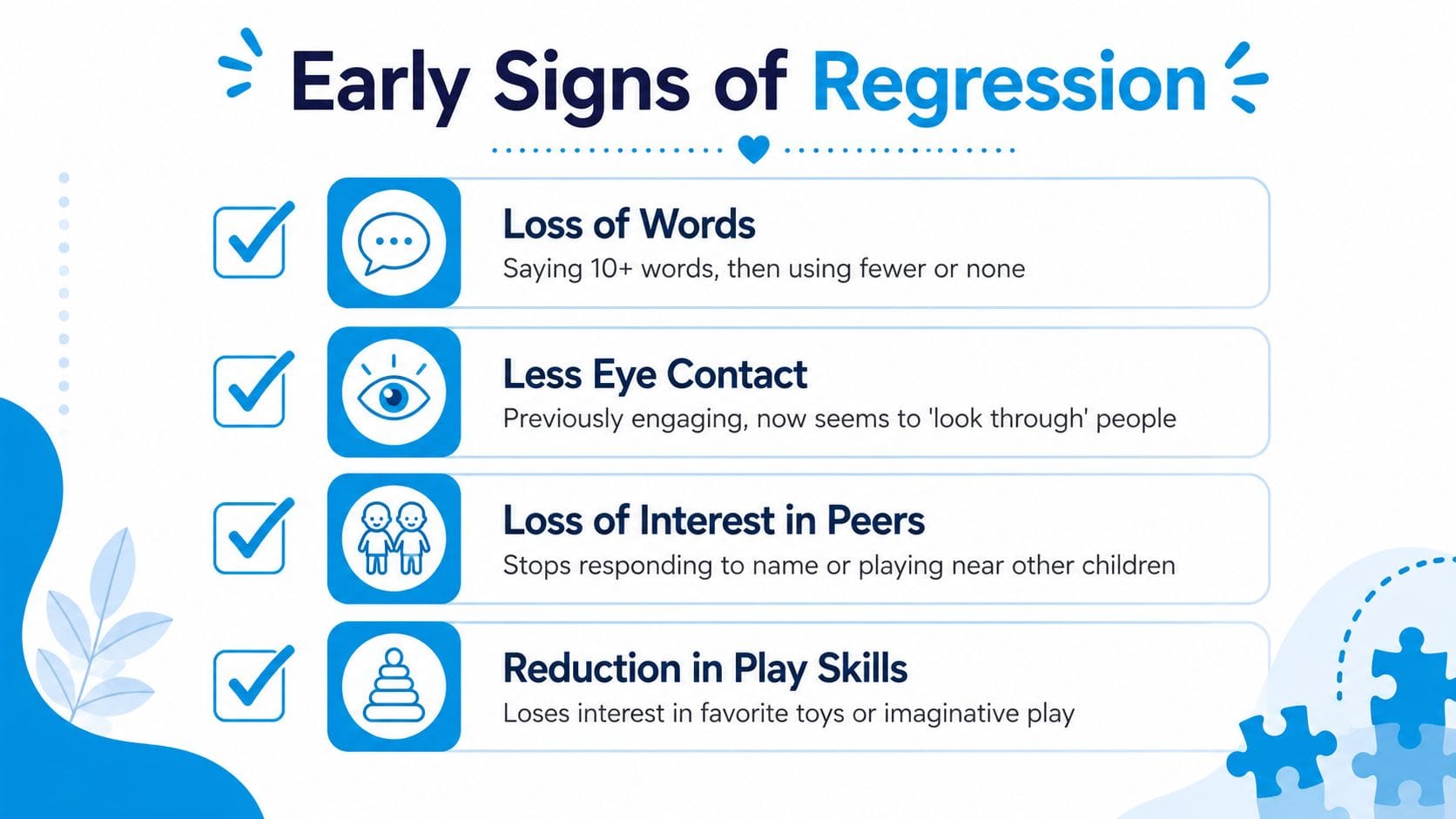
Language loss is one of the clearest changes. A child may stop saying words that were once reliable, babbling may fade, or speech may become thinner and less spontaneous. Social changes can follow close behind. Eye contact may shrink, name response may drop, and a child who once leaned into cuddles may pull away.
Play often changes too. A toddler may lose interest in peekaboo, shared games, pretend routines, or favorite toys that once held attention. Some children also show motor or sensory shifts, like new repetitive movements, new sensitivity to sound or touch, or a different way of moving through the room.
Here's a simple checklist parents can use at home:
- Words that vanish when they used to be used regularly
- Less eye contact than before, especially during familiar interactions
- Weaker response to name or less interest in nearby children
- Less play variety, including reduced pretend play or shared games
- New repetitive behaviors or stronger sensory reactions
Any new loss of skills at any age is worth taking seriously.
The hard part is that each sign by itself can look small. Together, they create a pattern. If you're not sure whether the change is meaningful, track it for a few days with plain descriptions. Write down the exact word that disappeared, the setting where eye contact changed, or the game your child no longer joins.
For a focused look at one skill area that often changes during regression, see joint attention and autism. It can help you notice whether your child is still sharing focus, even when they aren't using words.
How Diagnosis and Evaluation Actually Work
A mother once arrived at a pediatric appointment with a crumpled note in her pocket and a short phone video on her tablet. Her child had stopped using several words, was less responsive to name, and had changed how they played over the past few months. The pediatrician didn't look for one magic answer. Instead, the visit turned into a careful history, a referral, and a plan.
That's how evaluation usually works. There is no single test for regressive autism. A developmental pediatrician or autism specialist looks at the whole picture, including caregiver history, structured observation, and developmental testing. The evaluation may include tools such as ADOS-2, along with broader assessments of communication, play, and adaptive skills.
What to bring to the first appointment
A strong first visit usually starts with clear documentation, not a perfect explanation. Parents can prepare:
- A timeline of skill loss with approximate dates or age ranges
- Short videos showing what the child could do before and after the change
- A list of current concerns, such as words lost, reduced eye contact, or changes in play
- Questions for the clinician, including whether hearing, sleep, or other medical issues need review
If your child's pediatrician is the first stop, describe the change plainly. Say what was present, what disappeared, and how long the change has been going on. That language helps the doctor decide whether to refer to a specialist or developmental team.
There's value in understanding who can make the diagnosis, because the process can feel confusing when several professionals are involved. A clear overview of who can diagnose autism can help you know which appointment does what.
Useful frame: the evaluation is a partnership, not a verdict. You're bringing observations. The clinician is bringing a developmental lens.
Possible Causes and What Prognosis Looks Like
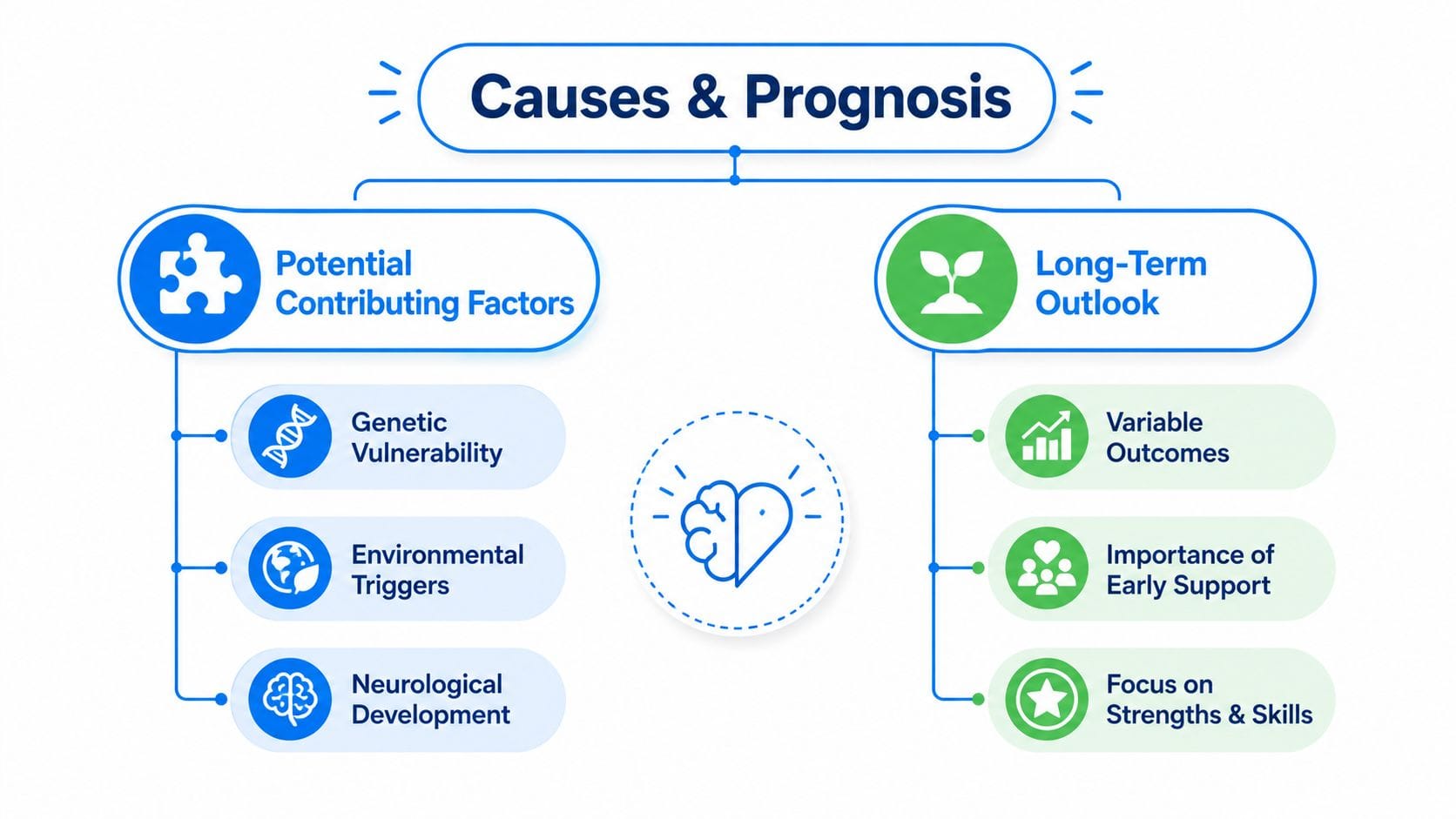
Families often want one clean cause. The science doesn't give that. Current thinking points toward genetic vulnerability interacting with environmental or biological factors, but no single cause explains every case. Some research is exploring neuroimmune and gastrointestinal factors, and those areas remain active because regression seems biologically complex rather than simple or uniform.
That uncertainty can be frustrating, but it also keeps the conversation honest. Regression is not proof that a parent missed a warning sign, and it isn't evidence that one event caused everything. It's a developmental pattern that likely reflects multiple influences working together in early brain development.
What prognosis tends to look like
A multicenter study found that regressive cases had more severe core symptoms and lower developmental quotient than non-regressive cases at the time they were assessed (Frontiers in Psychiatry). That matters because it shows why early support shouldn't wait for a “better phase.”
At the same time, prognosis is not fixed by what was lost. Families and clinicians shape the long-term picture through what happens next, especially when intervention starts early and stays consistent. Regressive and non-regressive children can follow different early paths and still need individualized supports over time.
What parents should hold onto
- Loss is not destiny. The child you're seeing now is the child you can help today.
- Support changes the trajectory. Speech, occupational, and developmental therapies can target the skills that slipped.
- Early documentation helps. Good notes make the first intervention plan more precise.
The most grounded way to think about prognosis is this. The earlier the concern is recognized, the sooner the child can be supported in communication, play, regulation, and daily routines. That doesn't erase the loss, but it gives it somewhere to go.
Your First 30 Days of Action and Tracking
The first month should be practical, not perfect. Start with the people who can move the process forward, then build a record that tells the story clearly.
Who to contact first
Call your child's pediatrician and describe the skill loss directly. Ask whether hearing concerns, developmental screening, or referral pathways should be addressed right away. If your area has early intervention services, contact them too, since they can help even while the diagnostic process is still underway.
If you can get into a developmental specialist, bring your notes with you. A well-organized record often speeds up the visit because the clinician doesn't have to reconstruct the story from scattered memories.
What to log every day
Keep the log short enough that you'll use it. Record:
- Lost words or skills, with examples
- Meltdown triggers, including noise, transitions, demands, or fatigue
- Sleep shifts, such as harder bedtimes or frequent waking
- Diet and appetite changes, especially if they seem tied to behavior
- Sensory reactions, like covering ears, avoiding textures, or distress in crowded spaces
You don't need perfect formatting. You need patterns. A few lines a day can show whether the same triggers keep showing up, or whether the changes are broad and steady.
Several parents find it easier to use a single app instead of scattered notes across paper, texts, and photos. Guiding Growth is one option that centralizes behavior logging, sleep, diet, appointments, and family sharing, and it includes quick voice logging for parents who don't have time to type.
How to make the record useful
Practical rule: write what happened, what came before it, and what happened after it.
That structure helps a clinician connect behavior to context. It also keeps you from over-interpreting one bad day. The goal is to make the next appointment easier, not to become your child's full-time analyst.
Moving Forward With Clarity and Support
Regression can feel like a warning light, but it isn't a conclusion. The most important regressive autism age insight is also the simplest one. Many cases begin around 18 to 24 months, yet skill loss can happen later too, so age never rules it out. What matters is the pattern, the timing, and the response you build next.
Speech therapy, occupational therapy, and autism-informed behavioral supports can all be part of that next step, depending on the child's profile. Just as important are consistent tracking, professional partnership, and family well-being, because those are the levers parents can control.
If you need one place to start, start with a log, a pediatric call, and a clear referral question. Then keep the observations organized so your child's team can act on them. A tool like Guiding Growth can help turn scattered notes into structured insights that are easier to share, review, and use in daily care.
A CTA for Guiding Growth.