You point to a bird outside the window. Your child looks at your hand, not the bird. Later, they bring you a toy, but only so you'll open a stuck lid or turn something on. At story time, they may love the pages, the sounds, or one favorite picture, but the back-and-forth feeling of “Did you see that too?” doesn't always happen.
For many parents, those moments feel confusing. Sometimes they feel lonely. You can sense your child is paying attention to the world, but the way they invite you into that world may look different from what you expected.
That difference often relates to joint attention. In simple terms, joint attention is the ability to share focus with another person. It's one of the foundations of communication, learning, and social connection. In conversations about joint attention and autism, this skill comes up often, but parents usually need more than a definition. They need help understanding what they're seeing, what it might mean, and what they can do next.
Table of Contents
- Your Child's Unique Way of Connecting
- What Is Joint Attention and Why It Matters
- Recognizing Joint Attention Differences by Age
- When to Seek Professional Support
- Evidence-Based Interventions for Joint Attention
- Practical Ways to Nurture Joint Attention at Home
- Tracking Progress and Adapting Your Approach
Your Child's Unique Way of Connecting
A child doesn't need to communicate in a typical way to be trying to connect. That's an important place to start.
Some children connect by pulling your hand toward what they want. Some stand close while they play, as if they want company but not interruption. Some repeat a sound from a favorite video, tap a page they want you to notice, or bring the same object to you again and again. Those actions may not look like classic “showing” or pointing, but they can still tell you something about how your child relates to other people.
Parents often get stuck on one question: “Is my child ignoring me?” Usually, that's not the most helpful question. A better one is, “How does my child invite me into their attention, and when does that happen most easily?”
Joint attention isn't about forcing a child to perform a social skill. It's about noticing how shared attention already begins, even in small ways.
In the context of joint attention and autism, many children don't lack interest in the world or in other people. Instead, they may have difficulty coordinating three things at once: the object, the other person, and the shared moment. That can make daily interactions feel out of sync.
You might notice patterns like these:
- Your child notices details first. They may focus on the wheel of the toy car, the flicker of light, or the exact sound a book makes.
- They use you as a helper. They bring you things to fix, open, or activate, but not always to share enjoyment.
- Their strongest connection shows up around favorite interests. When the topic is trains, water, letters, or music, they may become much more available for interaction.
None of this means your child can't grow in shared attention. It means you're learning the shape of their communication style. That's where support becomes more effective, because it starts from who your child is, not from a script.
What Is Joint Attention and Why It Matters
A shared spotlight
Think of joint attention as a shared spotlight. Two people focus on the same thing, and both know they're sharing that moment. It could happen when a baby looks at a dog, then back at a parent. It could happen when a child points to a spinning fan and checks whether you're noticing too.
That's different from simple attention. A child can look at a toy for a long time without involving anyone else. Joint attention adds the social piece. It says, in one form or another, “Look with me.”
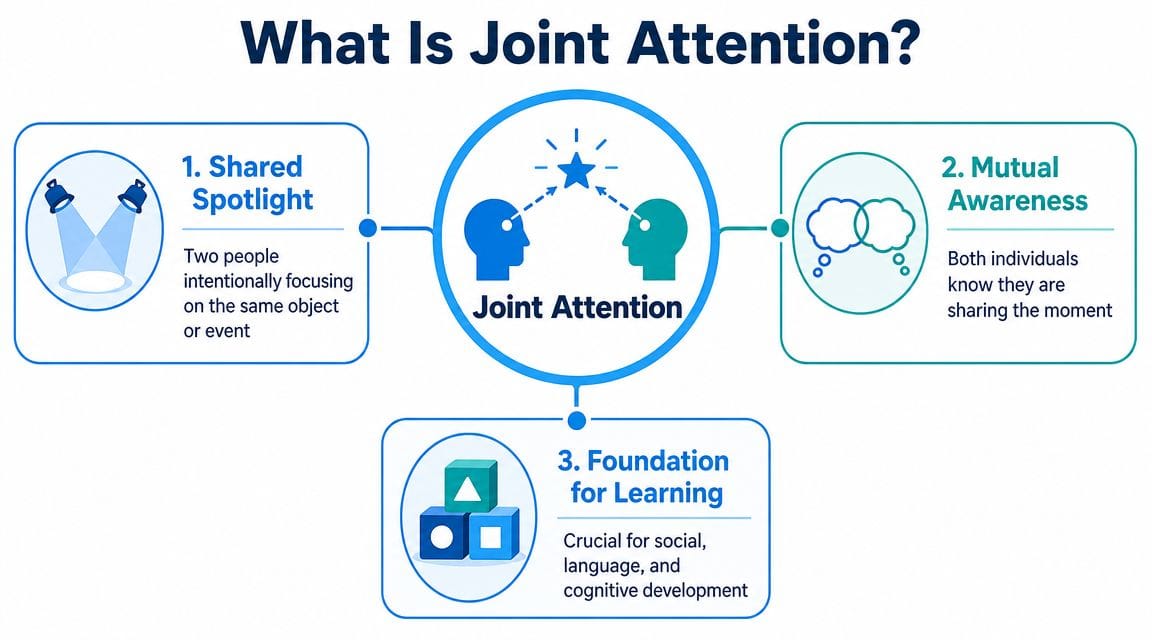
Joint attention usually includes behaviors such as:
- Following another person's gaze or point
- Pointing or showing to direct someone else's attention
- Shifting attention back and forth between an object and a person
- Sharing emotion around what both people are noticing
For many parents, the confusion comes from assuming this always has to involve long eye contact. It doesn't. A quick glance, a body turn, a touch on your arm, or placing an item in your hand can all be part of a shared-attention moment.
If you want a related primer on how children communicate beyond words, this guide to nonverbal social cues for autism parents can help put those small behaviors in context.
Why this skill matters so much
Joint attention matters because children learn through shared moments. When you and your child attend to the same thing, language becomes easier to map onto experience. Social cues become more understandable. Learning becomes less isolated.
Research has treated joint attention as a core early marker of autism, and longitudinal work suggests impairments can be visible by about 8 months of age in infants later diagnosed with ASD. The same body of research notes that joint attention is considered a strong predictor of future language function, social skills, and overall intelligence in autism (research summary on joint attention in ASD).
That doesn't mean one missed point or one quiet toddler tells you everything. It does mean this skill deserves attention because it sits near the center of development.
Practical rule: When a child struggles to share attention, don't assume they aren't interested. Ask what makes sharing hard in that moment.
For autistic children, the “shared spotlight” may work differently. Some children respond when you join their interest, but rarely initiate. Others may share attention in very specific contexts, such as sensory play or preferred topics. Understanding that pattern helps you support communication in a way that feels respectful and useful.
Recognizing Joint Attention Differences by Age
What parents often notice first
Joint attention differences don't always appear as a complete absence of skill. More often, parents notice unevenness.
A child may follow your point to a snack but not to an airplane. They may bring you a tablet because they need help, but never bring you a leaf just to show you. They may share attention beautifully around one favorite activity and seem unreachable in other settings.
Those differences can shift with age. In infancy and toddlerhood, concerns often center on looking, pointing, showing, or responding to name and gestures. In preschool and school-age years, the picture gets more subtle. A child may speak in full sentences and still have trouble coordinating attention during conversation, group learning, or social play.
Joint attention milestones and differences in autistic children
| Age Range | Typical Development Examples | Common Differences in Autism |
|---|---|---|
| Infancy | Looks where a caregiver looks, follows a point, shares interest with smiles or glances | May focus strongly on objects or sensory details without checking another person's face or gaze |
| Late infancy to toddler years | Points to show, brings objects to share, shifts gaze between object and parent | May pull an adult's hand to get help, bring items for function rather than sharing, or look at the hand instead of the target |
| Preschool years | Uses shared attention in pretend play, books, songs, and simple conversation | May respond in familiar routines but rarely initiate shared moments, or only do so around preferred interests |
| School-age years | Coordinates attention during learning, peer conversation, and collaborative play | May miss social cues in group settings, struggle with socially rich learning moments, or share information without checking the listener's focus |
This table is a guide for observation, not a checklist that diagnoses anything on its own.
In school-aged children with higher-functioning ASD, researchers have found that joint-attention processing can differ in specific ways. In one experimental study, children without ASD showed better recognition memory for images studied during initiating joint attention than during responding-to-joint-attention trials, but the ASD group did not show that same enhancement and recognized fewer pictures from the initiating-joint-attention condition than controls (Mundy and colleagues on joint-attention processing). That suggests a difference in how highly social learning contexts are processed, not just a broad memory problem.
A practical takeaway for parents is simple. Look for patterns, not isolated moments.
You may find it helpful to compare what social communication looks like at different ages in this guide to preschoolers vs school-age kids in social communication. Sometimes what feels alarming is a cue to look at developmental stage, context, and communication style more carefully.
When to Seek Professional Support
If you've been noticing ongoing differences in how your child shares attention, it's worth bringing those observations to a professional. That isn't overreacting. It's good caregiving.
Parents are often told to “wait and see,” but waiting without observing closely can leave you feeling stuck. A better path is to gather examples and ask for a fuller developmental look. Start with your pediatrician. From there, you may be referred to a developmental pediatrician, psychologist, speech-language pathologist, or early intervention team.
What makes an evaluation useful
A strong evaluation doesn't reduce your child to one behavior. It looks at the whole picture.
The National Institutes of Health notes that joint attention skills are critical for communication, but deficits are best interpreted alongside a full developmental assessment. They are an important piece of the puzzle, not diagnostic on their own (NIH guidance on joint attention and assessment).
That distinction matters. A child might miss a point because of language differences, sensory overload, anxiety, motor planning challenges, or a broader developmental profile. A clinician helps sort out what's driving the pattern.
Signs it may be time to ask for help
You don't need a perfect list. You need repeated observations that concern you.
Consider reaching out if you notice:
- Shared moments are rare. Your child seldom points, shows, follows gaze, or checks your face during exciting events.
- Communication feels mostly functional. They involve you to get needs met, but not to share interest or enjoyment.
- The pattern shows up across settings. You see similar differences at home, school, therapy, or with extended family.
- You feel uncertain about meaning. You can tell something is different, but you can't tell whether it reflects autism, language delay, or something broader.
For families also thinking about school readiness, broader developmental checklists can help frame conversations with professionals. InchBug's guide to skills for a confident start offers a practical way to think about the many abilities children use in everyday learning environments.
Bring short, concrete examples to appointments. “He doesn't point” is less useful than “When I point to a plane, he watches my finger and goes back to the toy.”
That kind of detail helps professionals see your child more clearly and helps you leave with next steps that fit real life.
Evidence-Based Interventions for Joint Attention
The encouraging news is that joint attention is not only an early marker. It's also a modifiable developmental skill.
Landmark research has shown that preschool children with autism can learn joint attention skills, and those gains are linked to much better language outcomes later on (UNC summary of joint attention research). That finding changed the field because it shifted the focus from “this is missing” to “this can be supported.”
What effective support tends to have in common
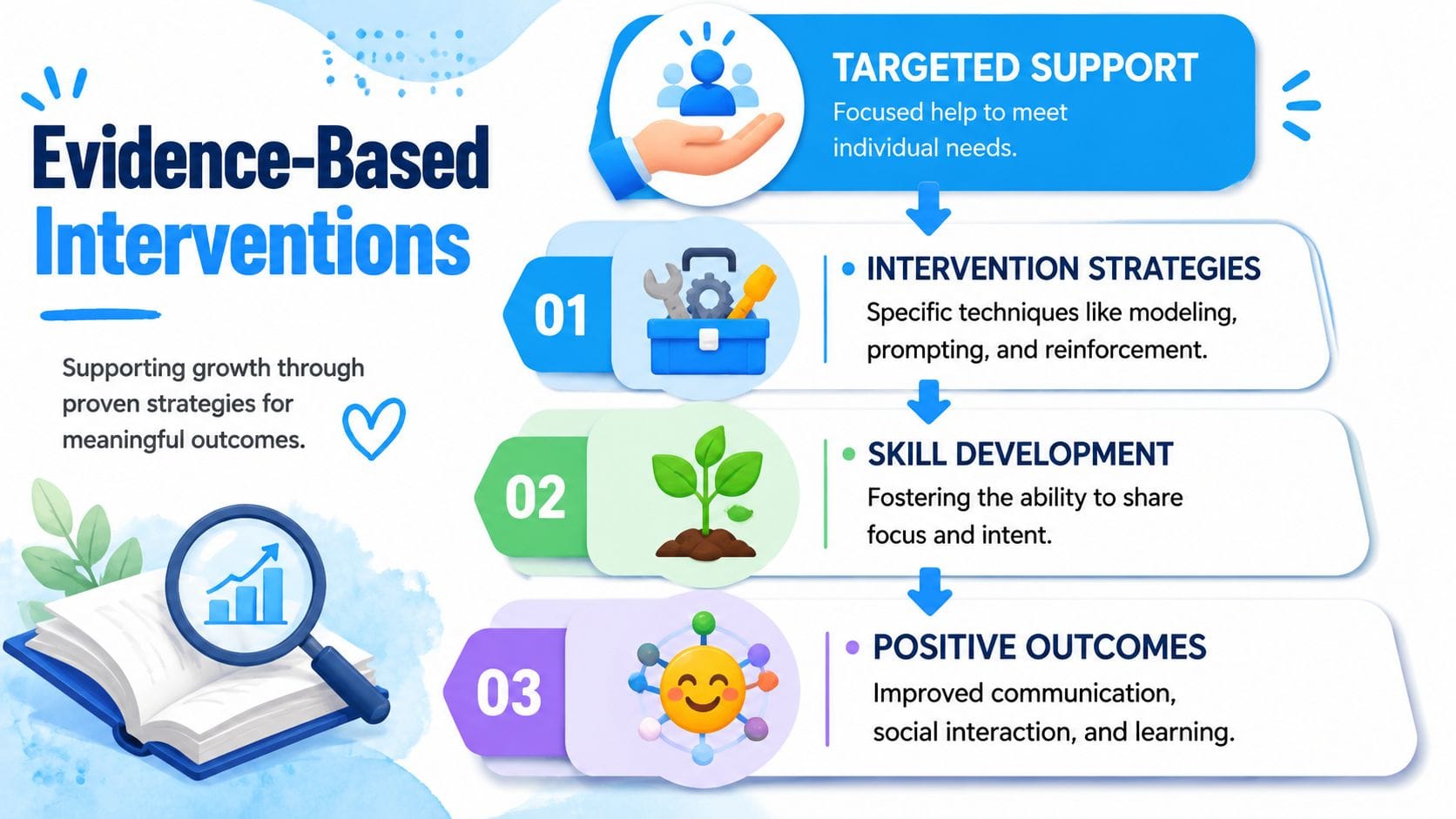
Evidence-based support for joint attention and autism usually shares a few features. It tends to be child-led, relationship-based, and embedded in meaningful activity rather than drilled in isolation.
You'll often see these themes:
- Following the child's motivation. Adults build interaction around what the child already enjoys.
- Using natural routines. Practice happens during play, snacks, books, dressing, movement, or outdoor time.
- Modeling and waiting. The adult shows how to point, show, pause, and share, then leaves room for the child to respond.
- Reinforcing connection. The payoff is the shared moment itself, plus access to something the child values.
This is one reason many clinicians use developmental and naturalistic approaches. The point isn't to force a child into a social script. The point is to make shared attention more understandable, more rewarding, and easier to access.
What this can look like in practice
A therapist might sit beside a child who loves spinning tops. Instead of redirecting immediately, the therapist joins the activity, comments briefly, pauses before spinning again, and waits for any signal that the child wants to continue. That signal could be a glance, a reach, a vocal sound, or handing over the top. The adult then shapes that moment into a more shared interaction.
Another child may respond better during movement games, songs, or sensory routines. For that child, support may involve anticipation, pausing, and predictable turn-taking rather than direct prompts to point or make eye contact.
The strongest interventions don't ask, “How do we make this child look typical?” They ask, “How do we build shared attention in a way this child can use?”
If you want a broader overview of therapy models that align with this philosophy, this page on evidence-based autism interventions can help you compare approaches in practical terms.
Practical Ways to Nurture Joint Attention at Home
You don't have to run therapy sessions in your living room to support joint attention. Most progress starts in ordinary moments.
Start with your child's interests
The fastest way to lose a child's attention is to ignore what already matters to them. The better move is to become a careful observer.
Ask yourself:
- What holds their attention longest
- What sensory experiences they seek out
- Which routines make interaction easier
- When they spontaneously look toward you, touch you, or bring something over
Then join them there. If they love water, sit beside the sink and make your own small splash. If they line up cars, line up one car near theirs and wait. If they watch the same clip repeatedly, sing part of it with them and pause.
A few home strategies work especially well:
- Get at eye level. Not to demand eye contact, but to make your face easier to notice.
- Imitate first. Copying your child's action often feels less intrusive than directing it.
- Use fewer words. Short comments like “Spin,” “More bubbles,” or “You found it” are easier to connect to the moment.
- Pause before helping. That small pause creates room for a glance, gesture, sound, or body shift.
One practical tool some families use is Guiding Growth, a mobile app that lets parents log behaviors, routines, communication patterns, and context in one place. For joint attention, that can help you note which activities lead to the most sharing, whether your child responds differently at home versus school, and which small wins are easy to forget by the end of the day.
Build shared moments into daily routines
Joint attention practice doesn't need special toys. It works best when it fits into what your family already does.
Try these routine-based ideas:
- During snacks: Hold up two choices and wait. If your child looks, reaches, or vocalizes, treat that as communication.
- During books: Point to one picture you know they like. Then stop and watch whether they glance back, touch the page, or lean in.
- During movement games: Pause before the fun part. Wait for any sign they want “more.”
- During outdoor time: Notice what they notice. Follow their focus before trying to redirect it.
Count any real attempt to share. A glance, a hand on your arm, an object dropped in your lap, or a quick smile can all be part of joint attention.
This video offers a helpful visual example of how shared attention can be encouraged in natural interaction:
What matters most is tone. Keep it light. Keep it responsive. If your child turns away, regulate first and try again later. Joint attention grows better in safety than in pressure.
Tracking Progress and Adapting Your Approach
What progress really looks like
Progress in joint attention is easy to miss if you only look for big milestones. Most families notice change in tiny, meaningful shifts.
It might be the first time your child taps your hand and then looks toward a toy. It might be a brief glance after you react to a silly sound. It might be bringing you a book and patting the page they want you to see.
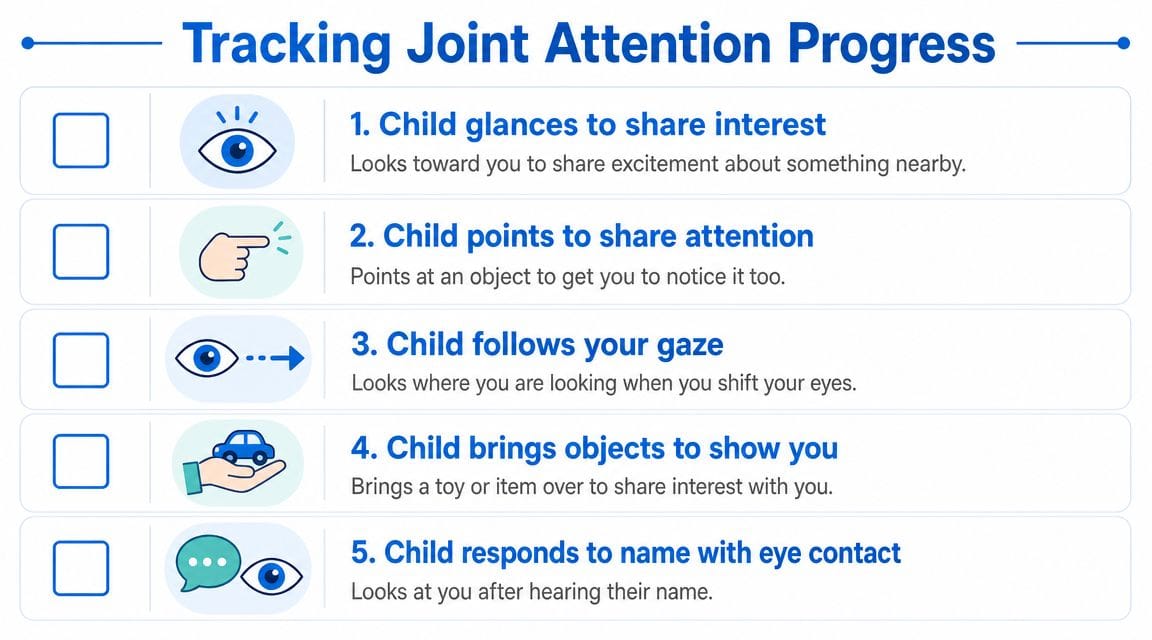
Those moments matter because they show your child is starting to coordinate attention in a more shared way. For many families, the challenge isn't only teaching a skill. It's knowing how to scaffold it across development and track progress in real routines, especially for children who are minimally verbal or overwhelmed by direct social prompting (discussion of tracking and scaffolding in real routines).
How tracking changes your next steps
When you write things down, patterns become clearer. You stop relying on memory and start noticing what works.
Useful things to track include:
- What happened right before the shared moment
- How your child signaled attention
- Which activities led to the most connection
- Whether sensory load changed the outcome
- How different adults responded
That kind of tracking helps you adapt. If your child shares more during movement than during books, lean into movement. If they respond better to pauses than to direct prompts, use more waiting and less talking. If they show attention through object exchange or touch rather than gaze, build on that form instead of dismissing it.
Over time, these notes become useful for teachers, therapists, and pediatric providers too. You're no longer saying, “I think there's progress.” You're saying, “Here's what we're seeing, when it happens, and what seems to support it.”
If you want one place to record those small joint-attention moments, daily routines, and communication patterns without juggling scattered notes, Guiding Growth can help you organize observations and share them with the people supporting your child.