If you're reading this, there's a good chance you've had one of those hard moments. Your child is upset, excited, hungry, or trying to tell you something important, and you can see that they mean something, but you can't quite get to it. That gap can feel heartbreaking.
Parents often tell me the hardest part isn't just the silence. It's not knowing what their child understands, wants, or wishes they could say.
That's where communication devices for nonverbal children can change daily life. Not by forcing speech. Not by replacing your child's personality. By giving them a reliable way to express themselves and be understood.
The first thing I want you to know is that you are not alone in this. About 5 million Americans and 97 million people worldwide may benefit from AAC, or augmentative and alternative communication, according to the American Speech-Language-Hearing Association. AAC includes everything from picture boards to speech-generating devices. If you're new to the topic, this overview of autism communication strategies can also help you place AAC within the bigger picture of connection, regulation, and daily support.
Table of Contents
- Giving Your Child a Voice An Introduction to AAC
- Will a Device Stop My Child from Talking
- The Spectrum of Communication Tools and Devices
- How to Choose the Right Device for Your Child
- Navigating Funding and Access Pathways
- Bringing the Device to Life Practical Implementation
- Frequently Asked Questions About Communication Devices
Giving Your Child a Voice An Introduction to AAC
The first time many families hear “AAC,” it happens in a hard moment. Your child is upset, you know they are trying to tell you something, and neither of you has a reliable way to get the message across. AAC can change that.
AAC stands for augmentative and alternative communication. In everyday terms, it includes any tool or support that helps a child communicate when speech does not fully meet their needs. That might be a picture card, a printed board, a button that plays a recorded message, or a tablet that speaks when your child taps symbols or words.
AAC works like a bridge between what your child wants to say and what they can get out clearly right now. For some children, that bridge is temporary in certain moments. For others, it becomes a long-term communication system. Both are valid.
AAC is broader than many families expect
AAC can help children who do not speak much, but it also helps children who speak inconsistently, lose words when overwhelmed, have trouble planning the movements for speech, or can say familiar words without being able to use them when it counts.
Many parents worry AAC is a last resort. This is significant because that fear can delay support that would reduce frustration and increase participation today. AAC is a communication path, not a sign that hope is shrinking.
AAC is not about lowering expectations. It is about removing barriers so your child can participate.
A child does not need to communicate in only one way to be a successful communicator. Many children use speech, gestures, facial expression, pictures, signs, and a device together. That is called multimodal communication, and it is often exactly what real life looks like.
What AAC can look like in daily life
A toddler hands you a picture of bubbles at bath time.
A preschooler taps “go outside” on a speech app before heading to the door.
An older child uses a device at school, points to choices at home, and types short messages when tired.
Those examples may look simple, but the broader goal is bigger than requesting snacks or toys. AAC helps a child join family routines, answer questions, make choices, protest, comment, joke, and connect with other people. If you want a starting point for building those everyday opportunities, these autism communication strategies for home and school can help you notice where support fits naturally.
The device itself is only one piece. A helpful AAC system is the one your child can access, the adults around them know how to model, and the family can use across home, school, and community routines. That is why the best AAC choice is rarely the fanciest one. It is the one that gets used consistently enough for communication to grow.
Will a Device Stop My Child from Talking
This is the question I hear most often, and it usually comes with fear behind it. If we give my child a device, will they stop trying to talk?
The short answer is no.
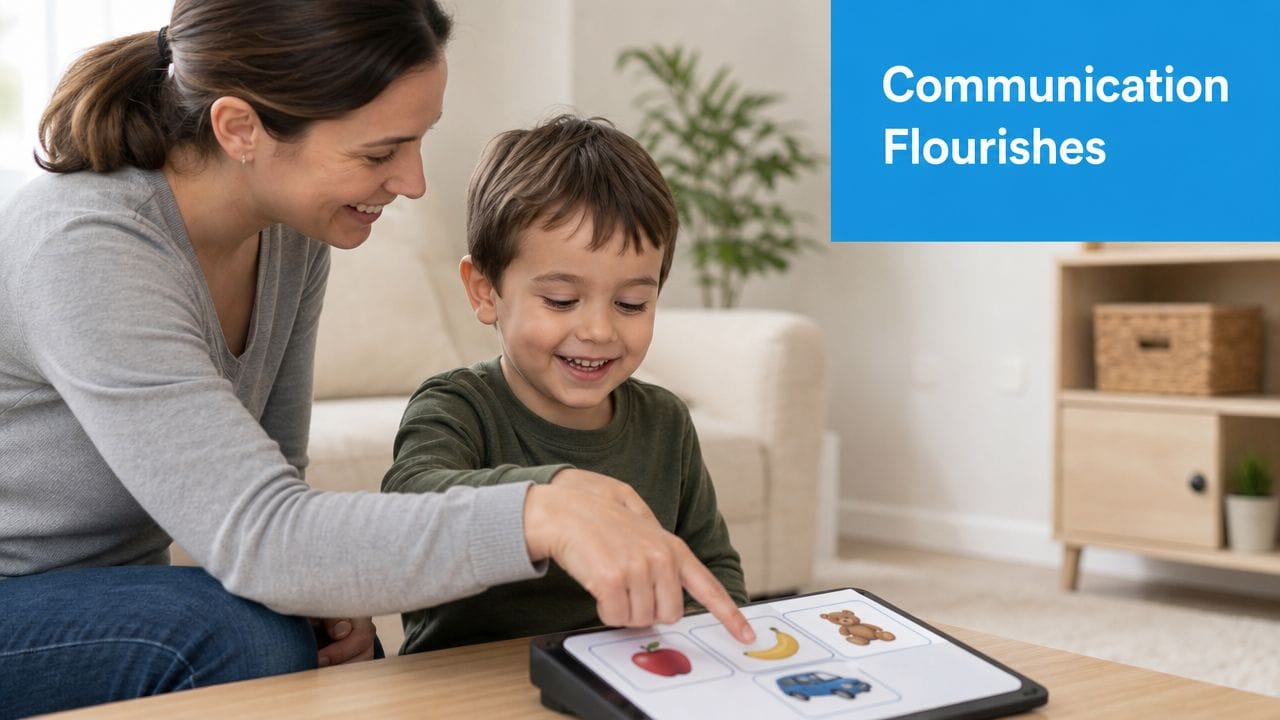
Research has shown that speech-generating devices do not inhibit spoken language. In the study summarized in this review of AAC and spoken language development, nonverbal children who used a speech device all gained spoken language within six months, and they made earlier and more rapid progress when the device was available.
Why AAC often supports speech
When a child doesn't have a dependable way to communicate, every interaction can feel like pressure. They may know what they want but not be able to organize their mouth, body, attention, or words quickly enough. AAC reduces that pressure.
A device can help by:
- Giving language a visual form: Words stay on the screen or board long enough for the child to process them.
- Making success possible sooner: Your child can communicate a real message before speech is fully available.
- Creating repeated models: Adults can point to symbols while speaking, which helps connect spoken words to meaning.
- Lowering frustration: When children can get a message across, they often become more willing to attempt speech too.
AAC is pro-communication not anti-speech
Think of AAC as a bridge, not a replacement. If speech grows, wonderful. If speech stays limited, your child still has a path to connection, choice, learning, and self-advocacy.
Some children use a device and begin saying more words out loud. Some use speech and AAC side by side. Some rely mostly on AAC. All of those outcomes are valid.
Practical rule: Choose the tool that gives your child the most reliable communication today, while staying open to what may grow tomorrow.
If you've noticed your child can say a word one day and not the next, or talk more in one setting than another, this guide to autism speech patterns can help you understand why communication may look uneven across situations.
The Spectrum of Communication Tools and Devices
When families search for communication devices for nonverbal children, they often find long product lists with very little explanation. That makes it hard to know what fits your child.
A better way to think about AAC is by levels of complexity. Some tools are simple and fast to start. Others offer much more language but require more setup and support.
What low-tech really means
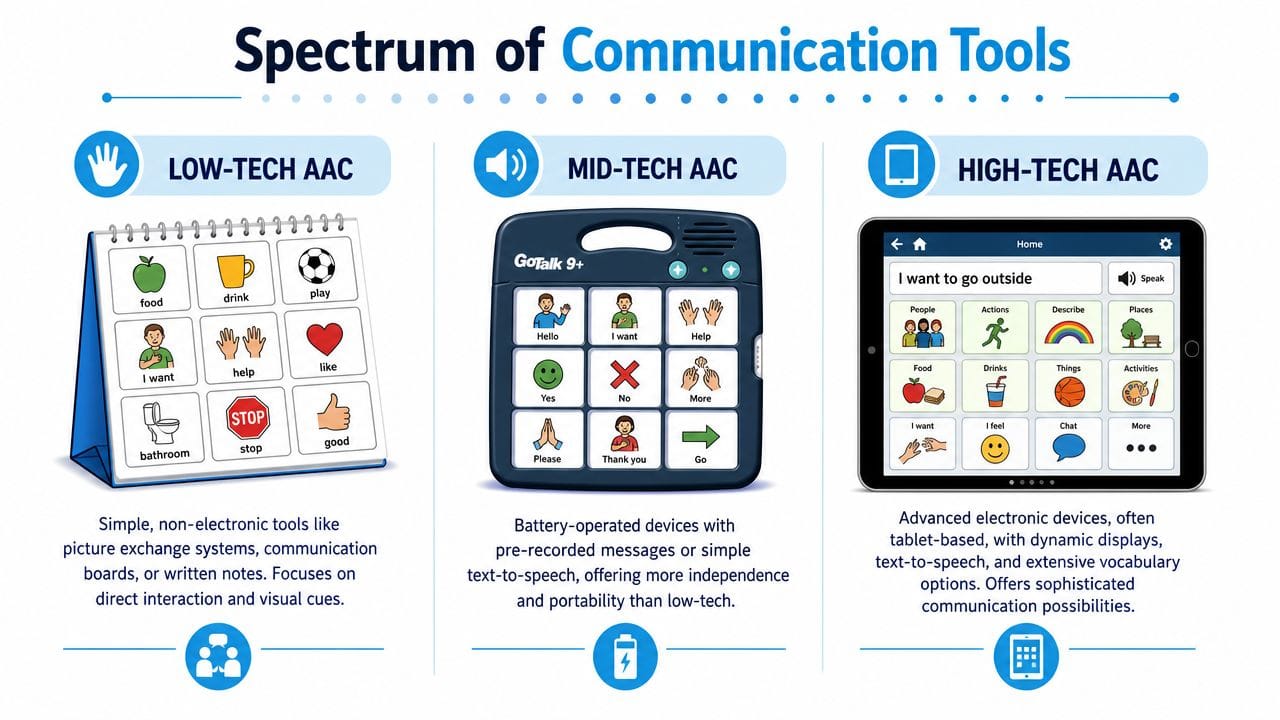
Low-tech AAC includes tools with no batteries or voice output. Common examples are PECS, core boards, choice boards, communication books, and printed visual supports.
These tools are often the easiest place to begin because they're simple, visible, and quick to use. A child can point to “eat,” “help,” “stop,” or “more” without waiting for a screen to load or an app to be programmed.
Low-tech options can work especially well when:
- Your child is new to AAC: There's less to learn at once.
- Adults need something easy to model: Teachers, grandparents, and babysitters can all use the same board.
- You need a backup system: Printed supports still work when devices are forgotten, charging, or unavailable.
When devices add voice and flexibility
Mid-tech AAC usually means a simple electronic device with recorded messages or limited speech output. These can be useful for cause-and-effect learning, routines, or repeated classroom phrases.
High-tech AAC includes speech-generating devices, often called SGDs, and voice output communication aids, sometimes called VOCAs. According to Communication Matters' AAC systems overview, these tools can support both literate and non-literate users, and dynamic-screen systems may also include functions such as text messaging, internet access, and photo viewing.
That matters because a high-tech device isn't just a talking button. It can grow from a few core words into a much broader communication system. A child might start with “more,” “go,” and “all done,” then later move into categories, phrases, spelling, and social conversation.
If your child already uses spoken words inconsistently or benefits from hearing text read aloud, tools outside traditional AAC can sometimes support the larger communication picture too. For families comparing options, this AI dictation tool guide is a useful example of how voice, text, and accessibility tools can overlap for different communication needs.
| Device Type | Examples | Best For | Pros | Cons |
|---|---|---|---|---|
| Low-Tech AAC | PECS, core board, communication book | Early AAC learning, backup communication, simple daily choices | Easy to start, portable, low setup | No voice output, less flexible vocabulary |
| Mid-Tech AAC | Basic voice output buttons, simple recorded-message devices | Repeated routines, participation phrases, cause-and-effect learning | Clear output, simple to use | Limited messages, less language growth |
| High-Tech AAC | Tablet-based speech apps, dedicated SGDs, dynamic-screen devices | Broader language, flexible vocabulary, communication across settings | Can grow with the child, strong customization, voice output | More programming, training, charging, and team consistency needed |
How to Choose the Right Device for Your Child
Parents sometimes ask, “What's the best device?” I usually answer with another question. “Best for what, and best for whom?”
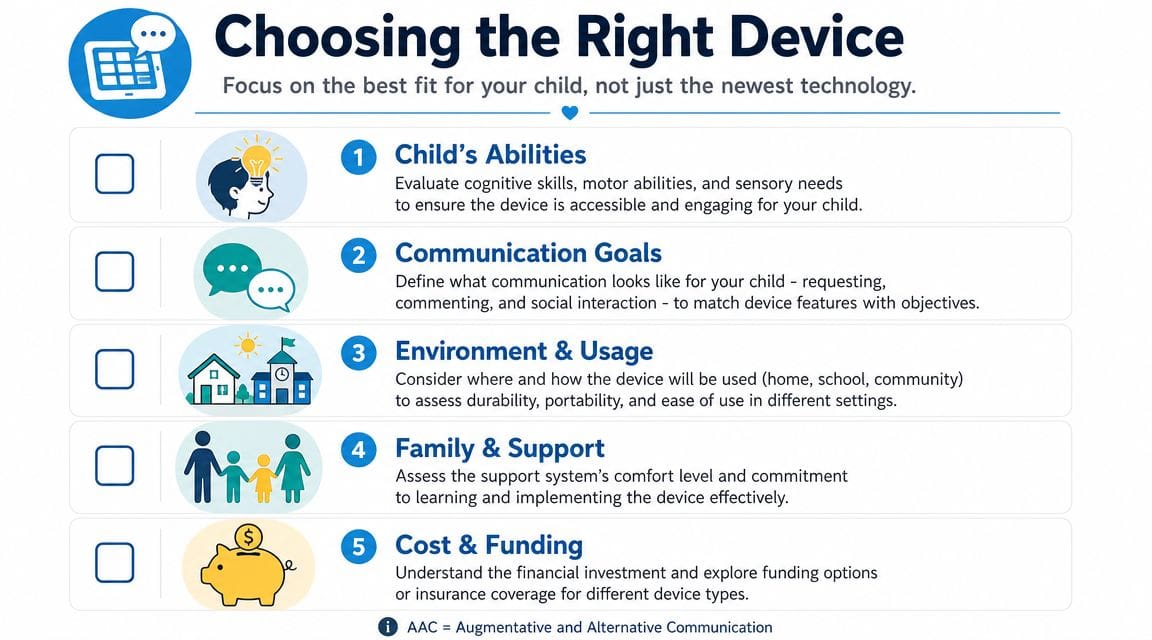
The right AAC tool depends less on brand names and more on fit. A powerful tablet system won't help if your child can't access the screen. A simple board won't be enough if your child needs a larger vocabulary to participate in school and daily life.
Start with access not features
The first question is always how your child will physically use the system. A device is only useful if the child can reliably reach, touch, point, switch, or look at the right target.
As explained in this overview of AAC access methods for nonverbal children, matching the device's access method to the child's motor profile is a primary consideration. Speech-generating devices work well when a child can reliably select items on a screen, while eye-tracking is recommended when hand use is limited.
That leads to practical questions:
- Can your child isolate a finger? If yes, direct touch may work.
- Do they fatigue quickly or swipe accidentally? Larger targets or keyguards may help.
- Is hand use limited? Eye gaze or switch access may be a better match.
- Do visual demands overwhelm them? A simpler layout may be more usable than a busy screen.
A short video can help you see how these choices play out in practice.
Match the tool to the communication job
After access, look at what your child needs the system to do.
Some children need a way to request basic needs. Others need help commenting, asking questions, joining class activities, or communicating during shutdowns and meltdowns. A child who can type may need a different path than a child who is just starting with symbols.
Try sorting your observations into three buckets:
Urgent daily messages
Think about words your child needs right away. Help, stop, bathroom, hungry, hurt, no, more.Social connection
These are words for interaction, not just needs. Hi, look, funny, my turn, I like it.Learning and participation
This includes classroom responses, storytelling, feelings, and shared attention.
Don't choose a device just because it looks advanced. Choose the one your child can access, your team can support, and your daily routines can actually sustain.
It also helps to watch your child at different times of day. Some children can handle more choices when calm and fewer when tired. The best fit often becomes obvious when you stop asking “What's the top device?” and start asking “What helps my child communicate most reliably?”
Navigating Funding and Access Pathways
Once a family finds a likely AAC option, the next stress point is usually access. The process can feel bureaucratic, but it becomes more manageable when you break it into documents, people, and settings.
What to ask for during evaluations
Start with a speech-language pathologist or AAC evaluation team if one is available to you. Ask for recommendations that describe:
- Why AAC is needed: Focus on communication barriers in daily life.
- Which access method fits: Touch, switch, eye gaze, or another method.
- What vocabulary setup is appropriate: Early requesting, core vocabulary, typing, or a mixed system.
- What training is needed: Parent support, school staff support, and setup needs.
Written recommendations matter because schools, insurers, and funding programs often want clear documentation of function, access, and expected use.
Common places families look for support
Families often explore several paths at once:
- School-based support: If a child needs AAC to participate in learning, ask how communication supports will be addressed in the IEP or school plan.
- Private insurance: Some plans require evaluations, trial documentation, or letters of medical necessity.
- State or regional assistive technology programs: These may offer device lending, trials, or application support.
- Therapy clinics and hospital systems: Some teams can guide families through paperwork and vendor coordination.
Keep one folder for evaluations, trial notes, school communication, and funding forms. That simple step can reduce a lot of repeated stress.
A practical mindset helps here. You are not trying to prove that your child deserves communication. You are documenting what they need to access it.
Bringing the Device to Life Practical Implementation
A device can look perfect during an evaluation and still fail at home if no one knows how to use it consistently. This is the part families rarely get warned about.
Effective AAC use depends heavily on implementation after purchase, including caregiver training, school alignment, and setup. As noted in this practical AAC implementation guidance, the best device often isn't the most advanced one. It's the one the child and family can sustain across home, school, and therapy settings.
Model first then expect use
Children don't learn AAC by being handed a device and told to perform. They learn it the same way they learn spoken language. By seeing other people use it meaningfully.
That means adults should model on the system during real life. If your child wants a snack, you might tap “eat” and “more” while saying the words aloud. If they're excited to go outside, you might model “go outside” before opening the door.
Keep the pressure low:
- Use short models: One or two words is enough at first.
- Model during motivating moments: Snacks, swings, favorite songs, bath time.
- Respond to all communication: Gestures, eye gaze, body movement, device taps, and approximations all count.
- Pause and wait: Some children need longer processing time than adults expect.
The device should join your child's life. Your child shouldn't have to stop being themselves to use the device.
Build one shared routine across settings
AAC works better when home, school, and therapy aren't all doing different things. Try to agree on a small shared set of core words, response strategies, and expectations.
A strong starting routine might include:
- One carryover word set: Help, more, stop, go, all done.
- One modeling habit: Adults point to symbols while speaking.
- One simple data habit: Note when the child used the system independently, with help, or not at all.
- One weekly check-in: Share what worked and what fell apart.
Families often benefit from broader support around therapy coordination too. This parent-friendly guide to speech therapy for autism can help you think through how AAC fits with other communication goals.
Progress tracking matters here, not because you need perfect records, but because patterns are easy to miss in the middle of daily life. When you write down where the device was available, what vocabulary was modeled, and when communication broke down, you can make better adjustments. You stop guessing and start seeing.
Frequently Asked Questions About Communication Devices
Parents usually don't need more theory at this point. They need practical answers.
What if my child refuses the device
Refusal doesn't always mean the device is wrong. Sometimes the system is too hard to access. Sometimes adults are using it only during demands. Sometimes the vocabulary isn't motivating.
Start by asking:
- Is the device available during fun moments, not just work?
- Can my child find meaningful words quickly?
- Are adults modeling without pressuring?
If a child resists repeatedly, ask the AAC team to revisit layout, access method, vocabulary, and sensory factors.
How long does progress take
There isn't one timeline. Some children begin using a new support quickly. Others need a long period of observation, modeling, and trust-building before they use it on purpose.
Look for small signs of growth:
- More attention to symbols
- Less frustration during communication breakdowns
- Increased willingness to interact
- Use of one meaningful word or message in the right moment
Those early changes matter. Communication growth often starts before families hear a lot of output.
How do we keep home and school consistent
Pick a very small shared plan. Too much complexity causes drop-off.
Try this:
- Agree on a core set of words everyone will model.
- Use the same response style when the child communicates.
- Send short updates, not long reports. A few lines about what worked is enough.
- Treat the device like the child's voice, not a special therapy tool that stays on a shelf.
Consistency doesn't mean every adult does everything perfectly. It means your child encounters the same basic communication support in more than one place.
Should we keep low-tech supports if we get a high-tech device
Usually, yes. A printed core board, choice board, or visual backup can be helpful when the main device isn't available or when a simpler format works better in the moment.
What if my child speaks sometimes
AAC can still help. Some children need support because speech is unreliable, hard to access under stress, or limited for longer conversations. A child doesn't have to be fully nonverbal to benefit from AAC.
If you're trying to make AAC work in real life, not just during appointments, Guiding Growth can help you keep everything in one place. Parents can track communication attempts, routines, regulation patterns, therapy notes, and daily context without relying on scattered paper notes. That makes it easier to notice what supports your child's communication across home, school, and therapy, and easier to share useful patterns with the people helping your child grow.