A gluten-free diet is not an evidence-based treatment for core autism traits, with a review of six randomized trials involving 143 children and adolescents finding no reliable benefit. Coeliac disease, wheat allergy, and medically evaluated gluten sensitivity remain separate medical reasons to consider avoidance.
For parents, the useful question isn't whether gluten is universally good or bad. It's whether a particular child has a medical problem that needs investigation, and whether changing their food would help without making an already limited diet less adequate.
The relationship between a gluten free diet and autism deserves more than a works-or-doesn't-work answer. A safer approach starts with medical assessment, protects familiar foods, and uses a dated, single-variable trial only when a clinician agrees it's reasonable.
Table of Contents
- What Controlled Trials Found
- Why Gluten Became the Suspect
- When Avoiding Gluten Is Medical
- Keeping a Narrow Diet Safe
- How to Run a Short Gluten Trial
- Logs That Separate Food From Coincidence
- Decide With a Clinician and a Dated Log
What Controlled Trials Found
A gluten-free diet isn't a proven treatment for autism's core characteristics. The controlled trials offer reasons to investigate individual medical concerns, not a reason to remove bread from every autistic child's plate.
What controlled reviews found
| Review | Sample | Main result | Bottom line |
|---|---|---|---|
| Cochrane, two small randomized trials | 35 children, in trials of 20 and 15 | One trial reported a mean difference of -5.60 points in overall autistic traits, with a 95% confidence interval of -9.02 to -2.18 and p=0.001; the other found no significant difference, according to the Cochrane review. | Insufficient evidence; different outcome measures and inconsistent findings prevented meta-analysis. |
| Norwegian trial within that evidence | 20 children aged 5–10, followed for 12 months | No clear difference in cognitive, language, or motor outcomes, as described in the same Cochrane evidence. | Too small to claim a general benefit. |
| 2021 systematic review of six randomized trials | 143 children and adolescents | Core symptoms SMD -0.31, with a 95% confidence interval of -0.89 to 0.27; function and behavior were also nonsignificant in the systematic review and meta-analysis. | Low to very low evidence quality; not supported as a core-autism treatment. |
| Review searching through August 2016 | Six trials, 214 participants | No consistent core-symptom differences; isolated communication and social-interaction findings didn't establish a general effect in the systematic review indexed by PubMed. | Limited evidence; no adverse events were reported in the included trials. |
Why an encouraging result isn't a prescription
The earliest trials weren't smaller versions of a definitive answer. They measured different outcomes and disagreed, making it difficult to know whether an apparent improvement would repeat in another group.
The Norwegian findings also show why outcome labels matter. A change on a rating scale doesn't automatically mean a child gains language, learns more easily, or functions differently in everyday life.
The later review didn't resolve that uncertainty in favor of dietary restriction. Its confidence interval for core symptoms included no effect, and the authors rated the evidence as low to very low quality because of bias, inconsistency, and imprecision.
Practical interpretation: Treat an encouraging trial as a clue to investigate, not a prescription for your child.
Possible benefit and practical risk: Some studies describe gastrointestinal or selected-behavior improvements, but these aren't consistent evidence of changes in core traits. Although the reviewed trials reported no adverse events, limited reporting doesn't establish nutritional safety for a child whose menu is already narrow.
Most of this evidence also concerns combined gluten-free and casein-free diets, not gluten removal alone. Removing dairy and gluten together makes it harder to identify which change, if either, matters.
Food-shopping resources answer a different question from treatment trials. Gym Snack's guide to choosing gluten-free protein for fitness can help an adult understand product choices, but fitness advice isn't a pediatric nutrition plan. Check the medical reason and the child's nutritional needs before changing the kitchen.
Why Gluten Became the Suspect
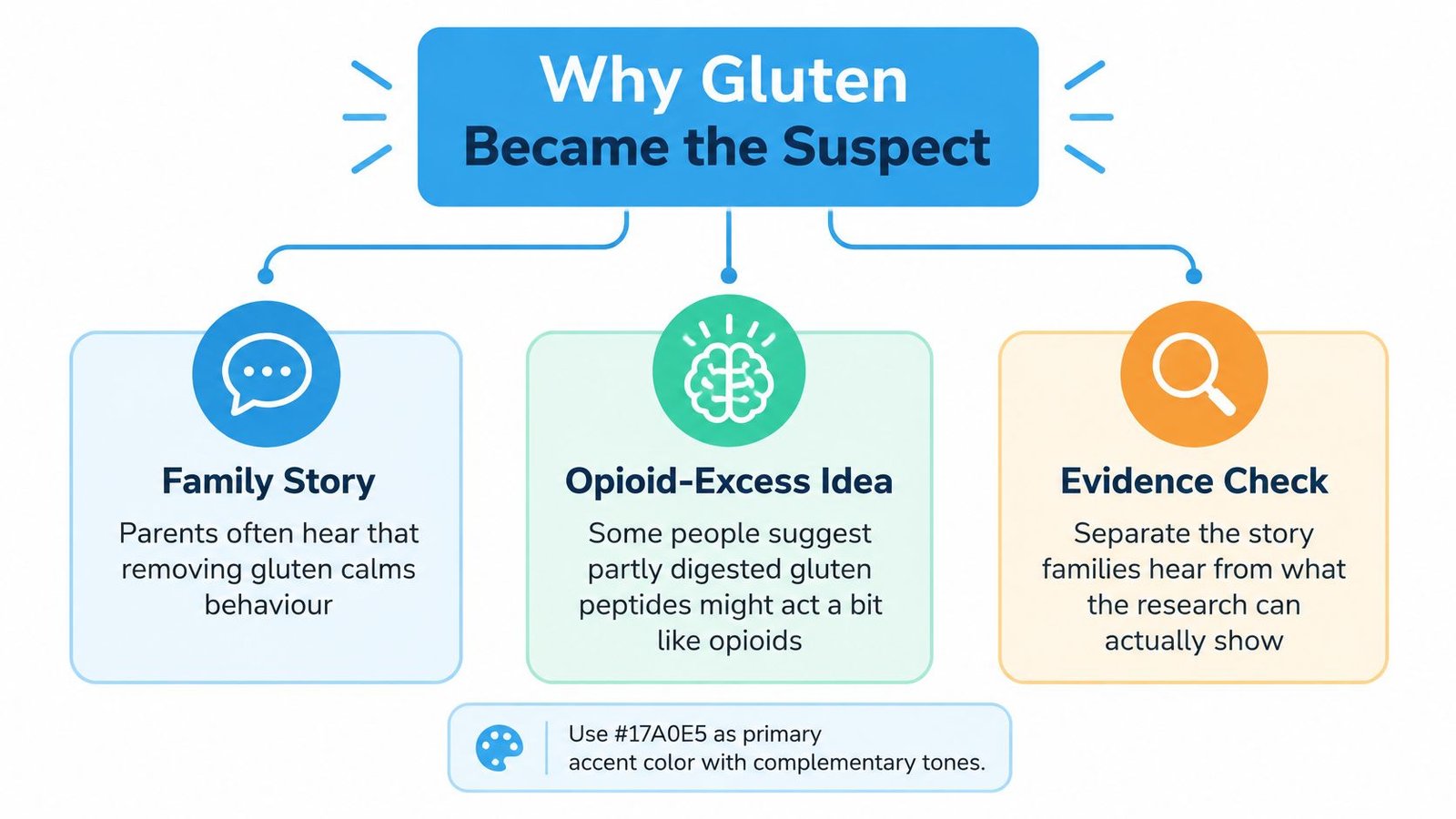
The opioid-excess hypothesis offers a memorable story: partly digested gluten peptides might act a little like opioids and influence behavior. It's an explanation parents may encounter repeatedly, but a plausible-sounding mechanism isn't the same as a demonstrated treatment effect.
Family stories make that theory feel concrete. A parent removes bread, their child seems calmer, and gluten becomes the obvious suspect. The observation may be sincere and important without proving why the change happened.
The diagram separates that story from the question controlled trials can answer.
The same alarm can have different causes
Think of a meltdown as a smoke alarm. The alarm tells you something needs attention, but it doesn't identify whether the cause is pain, constipation, poor sleep, sensory overload, or an unexpected change in routine.
Say a child has abdominal discomfort and becomes distressed around meals. If their discomfort improves after a dietary change, they may sleep more comfortably and cope better with demands. That's a meaningful improvement in well-being, but it doesn't show that gluten caused autism or that removing it changed core autistic traits.
The distinction matters because parents can otherwise end up chasing the wrong outcome. Less pain is worth investigating on its own terms; it doesn't need to be described as less autism.
When several changes happen together
A gluten cut rarely happens in isolation unless someone deliberately plans it that way. A family might also introduce a visual schedule, replace snacks, eat at more predictable times, and spend longer helping the child settle at night.
- Food changes: The child may eat different amounts or lose access to familiar snacks.
- Routine changes: More predictable meals may reduce uncertainty.
- Attention changes: Adults may notice and respond to discomfort sooner.
- Ordinary variation: A difficult stretch may improve regardless of the diet.
These possibilities don't invalidate a parent's observations. They explain why a before-and-after impression can't tell the whole story.
The useful question is therefore narrower than whether gluten affects autism. Ask whether this child has a separate food-related or gastrointestinal problem, and what evidence would distinguish that problem from sleep, pain, or routine-related distress.
When Avoiding Gluten Is Medical
A medical diet and an autism diet aren't the same thing. Confirmed coeliac disease requires gluten avoidance, while IgE-mediated wheat allergy requires avoiding wheat according to an allergy plan. Those needs apply whether or not a child is autistic.
Before any elimination, check an easily missed testing issue: coeliac blood tests need gluten to remain in the diet. Removing it first can make a negative result misleading, so ask the clinician how to proceed before changing meals.
The NICE guidance for autistic children and young people advises against exclusion diets, including gluten-free and casein-free diets, for core autism features, and recommends assessing feeding, growth, and nutritional problems. Its adult guidance similarly advises against gluten-free, casein-free, and ketogenic diets for that purpose.
When gluten avoidance is a medical question
| Situation | Avoid gluten? | First step |
|---|---|---|
| Confirmed coeliac disease | Yes, as lifelong medical treatment | Gastroenterology and a dietitian |
| IgE-mediated wheat allergy | Avoid wheat as the allergy plan states | Allergy clinician |
| Suspected coeliac disease while gluten is still eaten | Don't stop gluten yet | Blood testing on a gluten-containing diet |
| Possible non-coeliac gluten sensitivity | Only after other diagnoses are excluded | Clinician-led, time-limited trial |
| Chronic gut symptoms, rash, or poor growth | Not a home experiment | Pediatric or gastroenterology assessment first |
| Core autism traits without gut or allergy concerns | No | NICE advises against exclusion diets for core features |
| Already very selective eating | Removing a staple creates additional risk | Pediatric dietitian before any cut |
A child with ongoing diarrhea, abdominal pain, poor growth, a concerning rash, or suspected allergy needs assessment rather than a pantry experiment. These symptoms don't identify gluten as the cause by themselves.
Non-coeliac gluten sensitivity also belongs in a clinical discussion. It shouldn't become a catch-all label that prevents investigation of other explanations.
Match label checking to the diagnosis
A wheat-allergy plan and a coeliac plan don't necessarily give identical shopping instructions. Ask the treating clinician which ingredients, precautionary labels, and preparation risks matter for your child's diagnosis.
For the practical reading task, our food label and allergen safety guide provides a place to organize the questions you'll bring to the care team. Rip Van's explanation of how to identify gluten-free cookies is a focused example of checking a familiar packaged food rather than assuming its ingredients from its appearance.
NICE's position isn't a promise that no individual will ever notice a food-related pattern. It's a boundary against prescribing restriction for autism alone, especially when a child already struggles to eat enough variety.
Keeping a Narrow Diet Safe
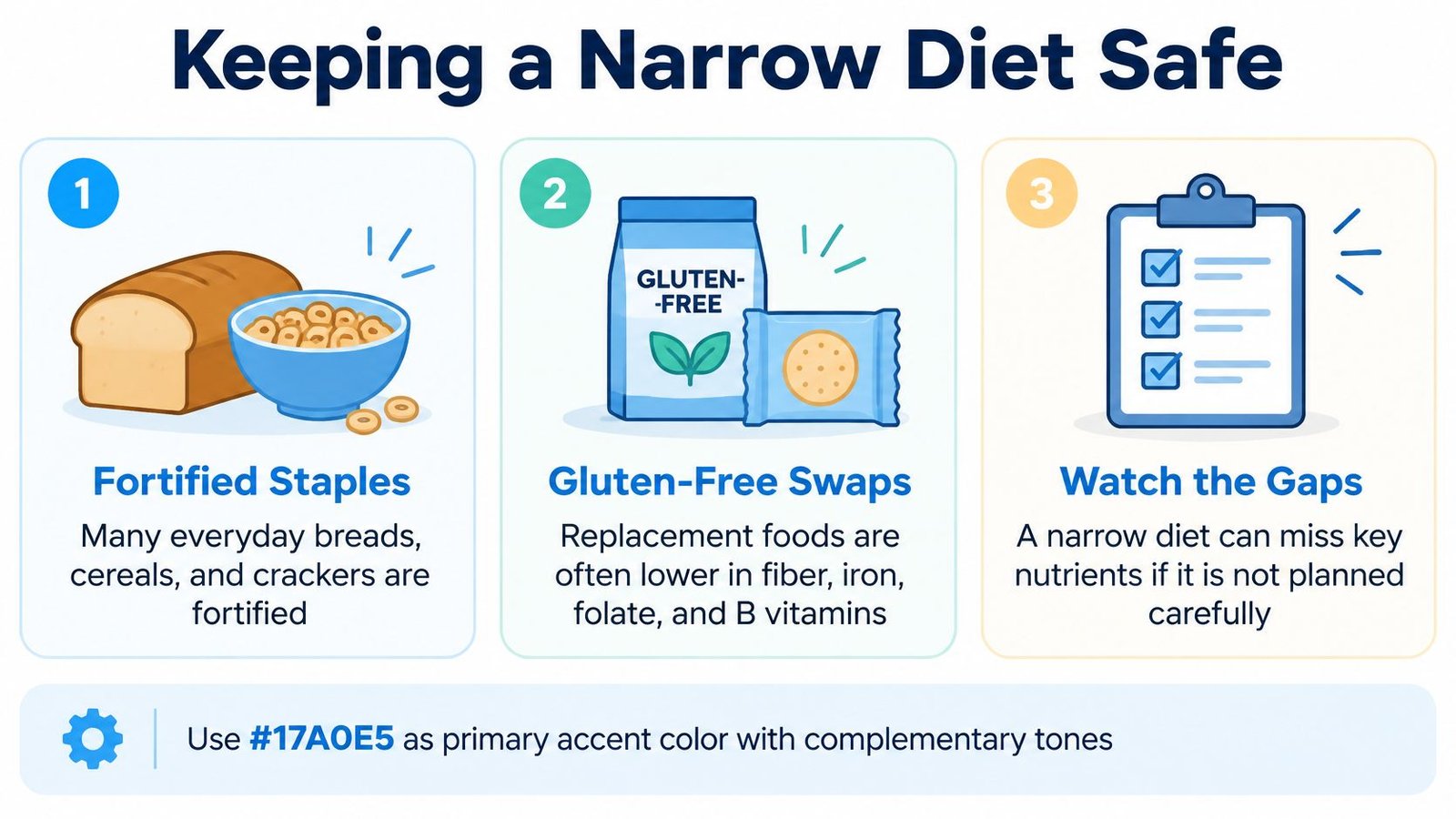
Gluten-free doesn't automatically mean healthier. For a child who relies on a particular toast, cereal, or pasta, removing that food can reduce what they eat, even when the replacement looks nutritionally acceptable on paper.
The British Dietetic Association's autism diet guidance highlights the risks of restrictive eating and exclusion diets, including inadequate energy, fiber, vitamins, and minerals. Removing dairy as well adds concern about calcium and vitamin D.
These are the trade-offs to consider before shopping for replacements.
Protect what the child can actually eat
Many familiar breads, cereals, and crackers are fortified. Gluten-free replacements aren't nutritionally interchangeable, so compare fiber and fortification rather than choosing by the gluten-free claim alone.
A replacement also has to pass the child's sensory test. A different crust, smell, package, or texture can make an apparently similar food unacceptable.
- Keep accepted foods that are naturally gluten-free. Preserve familiar options such as rice, potatoes, eggs, fruit, or beans when the child already eats them and they're appropriate for their medical needs.
- Introduce a similar replacement gradually. Offer it alongside an accepted food rather than removing the dependable meal before you know the substitute works.
- Protect calories and protein. An expensive specialty product isn't useful if the child won't eat it.
- Use a growth chart. Arrange for the care team to review weight and growth rather than relying on clothing fit or appearance.
- Request a nutrient review. A pediatric dietitian can assess energy, fiber, iron, folate, B vitamins, calcium, and vitamin D, and decide whether laboratory testing is warranted.
Build a replacement plan before removing a staple
Say breakfast is the most dependable meal of the day. Preserve its timing, plate, and accepted side foods while testing a suitable alternative, rather than changing the whole breakfast at once.
Parents looking to find dependable gluten-free morning meals can use Just Cook It's recipes as ideas to adapt, not as a requirement to introduce unfamiliar meals. Our dietary and nutrition resources can also help organize feeding questions for professional review.
A gluten-free label doesn't make a very limited menu nutritionally complete.
Before starting, have an accepted-food list, a growth record, a replacement plan, and a named clinician monitoring intake. If the change also means fewer packaged snacks or a more predictable routine, record that too; otherwise, any later improvement will be harder to interpret.
How to Run a Short Gluten Trial
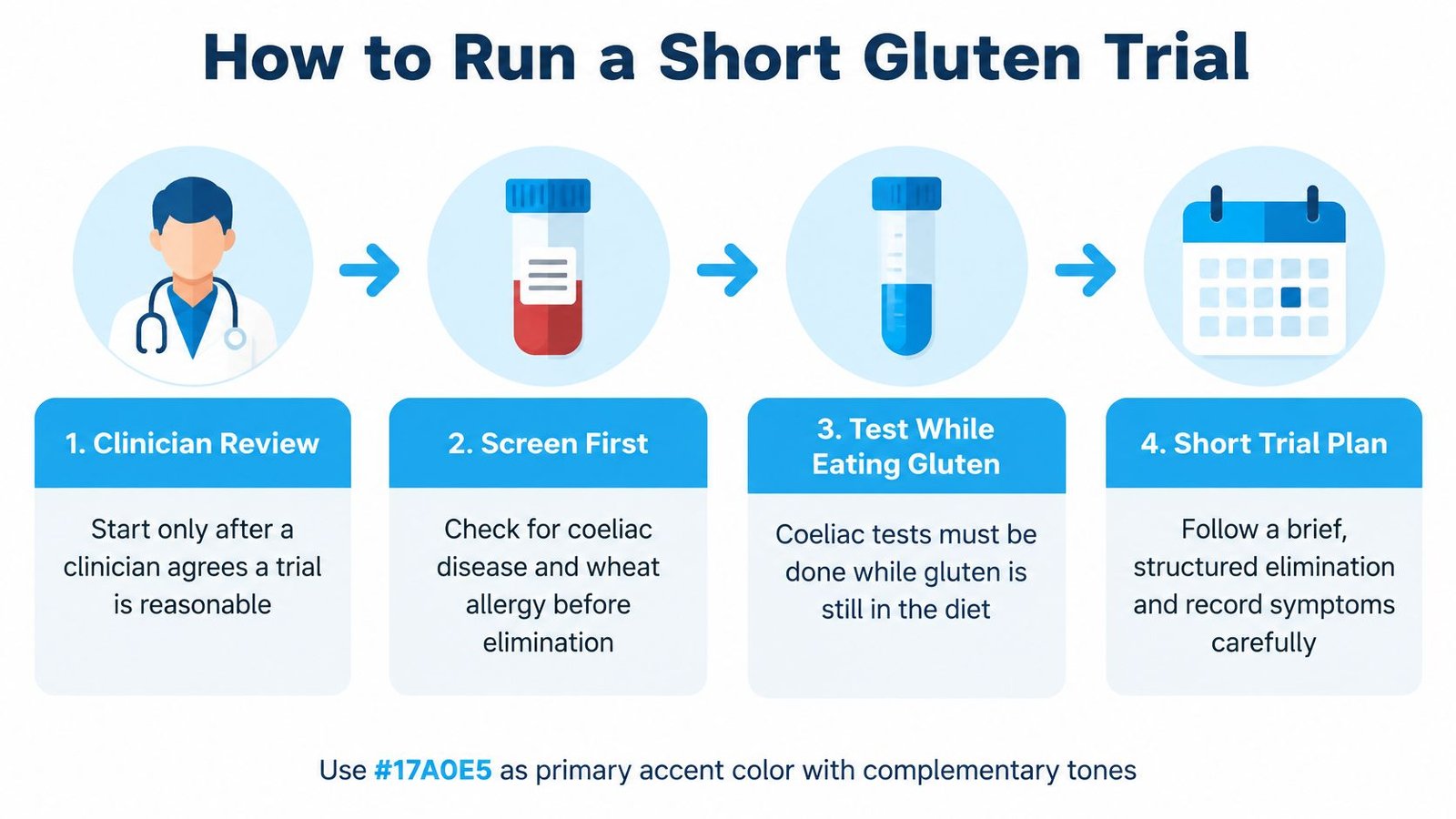
Start only after a clinician agrees that a trial is reasonable. This isn't a substitute for diagnosing coeliac disease or wheat allergy, and a medically necessary avoidance diet shouldn't be stopped just to test a theory at home.
A recent review of gluten-related dietary interventions describes inconsistent findings and supports individualized assessment rather than universal restriction. The practical response is to define the question, change as little as possible, and decide in advance how the result will be reviewed.
The clinical checks come before the elimination.
Agree on the question and the calendar
Complete the medical checks first. Ask whether coeliac testing or allergy assessment is indicated, and keep gluten in the diet until the clinician has given testing instructions. Bring the nutrition plan as well as the symptom concern.
Record a baseline before changing food. A two-week baseline can be a practical starting proposal to discuss with the clinician, not a universal guideline. Choose a period that reasonably represents the child's usual life rather than a holiday, illness, or major school transition.
Choose specific outcomes. Track stool pattern, abdominal pain, sleep, accepted-food variety, a clearly defined target behavior, and clinician-directed growth measures. Replace vague descriptions such as better behavior with an observable event, such as distress during toileting.
Put a stop date on the calendar. The clinician should set the observation period and review date. Don't let a trial become permanent because nobody scheduled the decision.
Change the food variable, not everything else
Remove gluten only if that's the agreed intervention. Don't also remove dairy, start supplements, and introduce a new therapy, because you won't know which change mattered.
Keep bedtime, school routines, and prescribed constipation treatment as steady as reasonably possible. When something unavoidable changes, record it rather than trying to make the week look artificially consistent.
Use the same scoring method throughout. A simple pain description used consistently is more useful than a detailed scale that different caregivers interpret differently.
- Review benefit: Did the predefined symptom change in a meaningful, repeatable way?
- Review nutrition: Is the child still eating enough, with their accepted-food range protected?
- Review alternatives: Did illness resolve, sleep improve, medication change, or food availability shift?
Expectations can influence what adults notice, and behavior naturally varies. A single-variable plan reduces confusion, but it doesn't make a home trial equivalent to a blinded experiment.
Write the stop rule first: Contact the clinician if intake falls, accepted foods shrink, growth becomes concerning, or the agreed outcomes don't improve.
If symptoms improve, let the clinician decide whether and how reintroduction is appropriate. Never deliberately expose a child to a known allergen or reverse prescribed coeliac treatment to create a comparison.
Logs That Separate Food From Coincidence
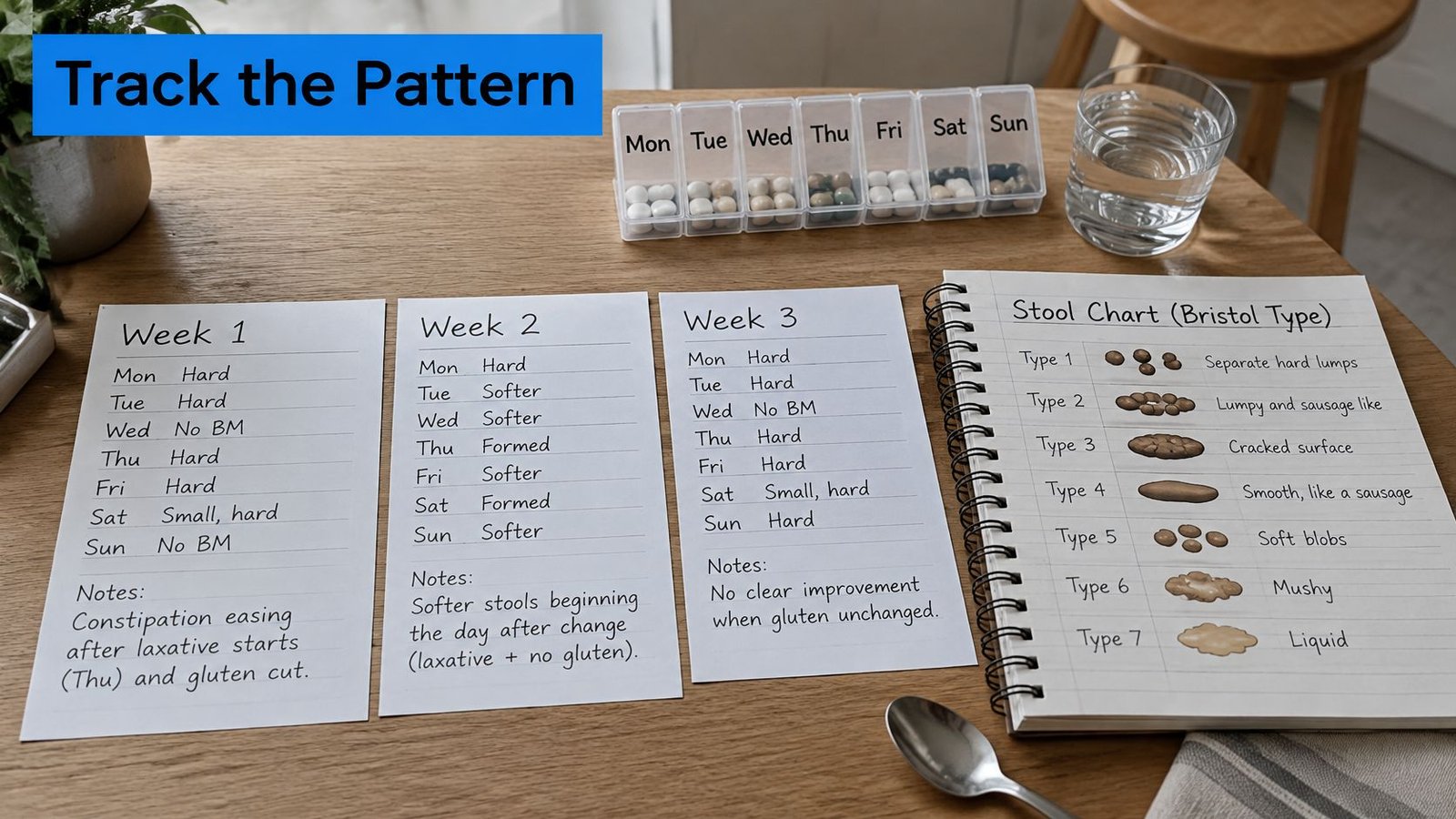
Consider these hypothetical weeks. Each could produce the same parent impression, that their child seemed more comfortable, but the timelines suggest different explanations.
Constipation improves during a diet change. A child starts a prescribed laxative while the family removes gluten. The dated entries show softer stools beginning when the medicine starts, so the parent can't reasonably give gluten removal all the credit.
Distress decreases when bedtime moves earlier. Gluten intake stays unchanged, but the child sleeps longer and has fewer difficult mornings. The pattern gives the care team a reason to examine sleep rather than restrict wheat.
Gut symptoms appear to follow exposure. Abdominal pain and night waking ease during a medically supported trial, then return after accidental wheat exposures. That pattern deserves clinical review, but it still doesn't establish that gluten avoidance treats autism.
Record the details that distinguish explanations
Use the same daily fields during baseline and the trial:
- Food and exposure: Meals, snacks, brands where relevant, and known, absent, or uncertain gluten exposure.
- Gut symptoms: Stool pattern, discomfort, and when symptoms occurred.
- Sleep: Duration, night waking, and unusual bedtime changes.
- Target behavior: Timing, intensity, and what happened immediately beforehand.
- Other changes: Illness, medication, therapy, school demands, and constipation treatment.
A stool record works best when caregivers describe observations consistently rather than relying on labels such as good or bad.
Why sincere impressions still need checking
In a preliminary double-blind randomized crossover trial, 15 autistic children aged 2 to 16 were assessed during a 12-week gluten-free/casein-free diet period; several parents reported improvement, but group-level analysis found no statistically significant effect. The small sample couldn't settle the question, yet the difference between impressions and measured outcomes is instructive.
Parents weren't necessarily imagining a change. They may have noticed something meaningful that wasn't consistent across children, wasn't captured by the outcome measure, or wasn't caused by the diet.
Our guide to identifying food sensitivities can help frame observations as questions for assessment rather than diagnoses. Keep the daily fields aligned with the baseline measures and the written stop rule.
A dated log won't prove causation, but it gives the clinician something more useful than reconstructing a month from memory. It shows what changed, when it changed, and what else was happening.
Decide With a Clinician and a Dated Log
Don't start a gluten-free diet solely because a child is autistic. Do investigate persistent gut symptoms, poor growth, concerning rashes, and suspected allergy with a qualified clinician, completing the appropriate testing before changing the foods needed for accurate results.
The decision isn't a choice between believing parents and believing trials. Parents identify concerns in daily life; clinicians help investigate them; controlled trials tell us whether an intervention deserves broad recommendation.
Comfort is a valid goal in its own right. A child doesn't need to become less autistic for treatment of pain, constipation, or a diagnosed food-related condition to matter.
What to prepare before the appointment
Bring a short account of the problem rather than a long argument for a particular diet. Write down when symptoms began, what makes them concerning, and whether they affect meals, sleep, school, or toileting.
- Current safe foods: List the foods the child reliably accepts, including relevant brands and textures.
- Medical concerns: Note ongoing pain, bowel changes, rash, or growth worries.
- Decision questions: Ask what should be tested, whether elimination is justified, and who will monitor nutrition.
- A review plan: If a trial is supported, agree on outcomes, a stop date, and what would trigger earlier contact.
For the notes families otherwise scatter across memory and group chats, Guiding Growth is our all-in-one mobile app for autism parents, available on iOS and Android. Its four key features, Behavior Tracking, Sleep Monitoring, Diet and Nutrition, and Collaboration, help keep observations about meals, bowel patterns, rough nights, and distress on a shared timeline.
Diet and Nutrition tracks eating habits and helps identify possible sensitivities or preferences affecting well-being and daily routines. Voice Quick Log and meal photos can reduce manual entry, while behavior records capture triggers and outcomes; review captured food details rather than treating a photo as proof that a meal contains no gluten.
Invite a co-parent or caregiver to contribute so important changes aren't lost during a busy week. Before the appointment, select the relevant date range and export a summary for the pediatrician or dietitian.
The app doesn't provide medical advice or diagnose food reactions. Its role is to make the family's observations easier to review, so the next decision rests on a clearer timeline and a safer clinical plan.
Guiding Growth helps you record meals, sleep, bowel patterns, and behavior together instead of keeping separate notes. Before a clinician-supported gluten trial, visit Guiding Growth to start a baseline log and prepare a date-range summary for your child's care team.