You're staring at the parent input form the night before the meeting. Three blank lines for IEP student strengths, and all that comes to mind is "kind, smart, loves trains." You're not wrong. Those words just won't change a goal, service, or accommodation once the team moves on.
Strengths only matter when a teacher can act on them Monday morning. That scale is easy to miss. In the 2022-23 school year, more than 7.5 million students ages 3-21, approximately 15% of all public-school students, received special education or a related service under IDEA, according to the Colorado Department of Higher Education report on students with disabilities. With caseloads that large, vague adjectives disappear.
I recommend a different habit. For each strength, write what you saw, where you saw it, what helped, and how school can use it. The eight examples below for autistic and neurodivergent students cover academic, social, sensory, communication, and adaptive skills. Each gives you observable signs, sample present levels language, and a simple way to back it up with daily logs before the meeting.
Table of Contents
- 1. Strong Visual Processing and Pattern Recognition in Academics
- 2. Deep Focus on Special Interests as a Learning Motivator
- 3. Honesty and Loyalty in Peer Relationships
- 4. Empathy Expressed Through Care for Animals, Objects, or Specific People
- 5. Strong Written Expression and Written Communication Skills
- 6. Precise and Rich Vocabulary with Strong Verbal Reasoning
- 7. Consistency and Strong Routine Adherence in Daily Living
- 8. Independence and Self-Advocacy in Preferred Daily Tasks
- 8 IEP Student Strengths at a Glance
- Turn Daily Observations Into Meeting-Ready Strengths Data
1. Strong Visual Processing and Pattern Recognition in Academics
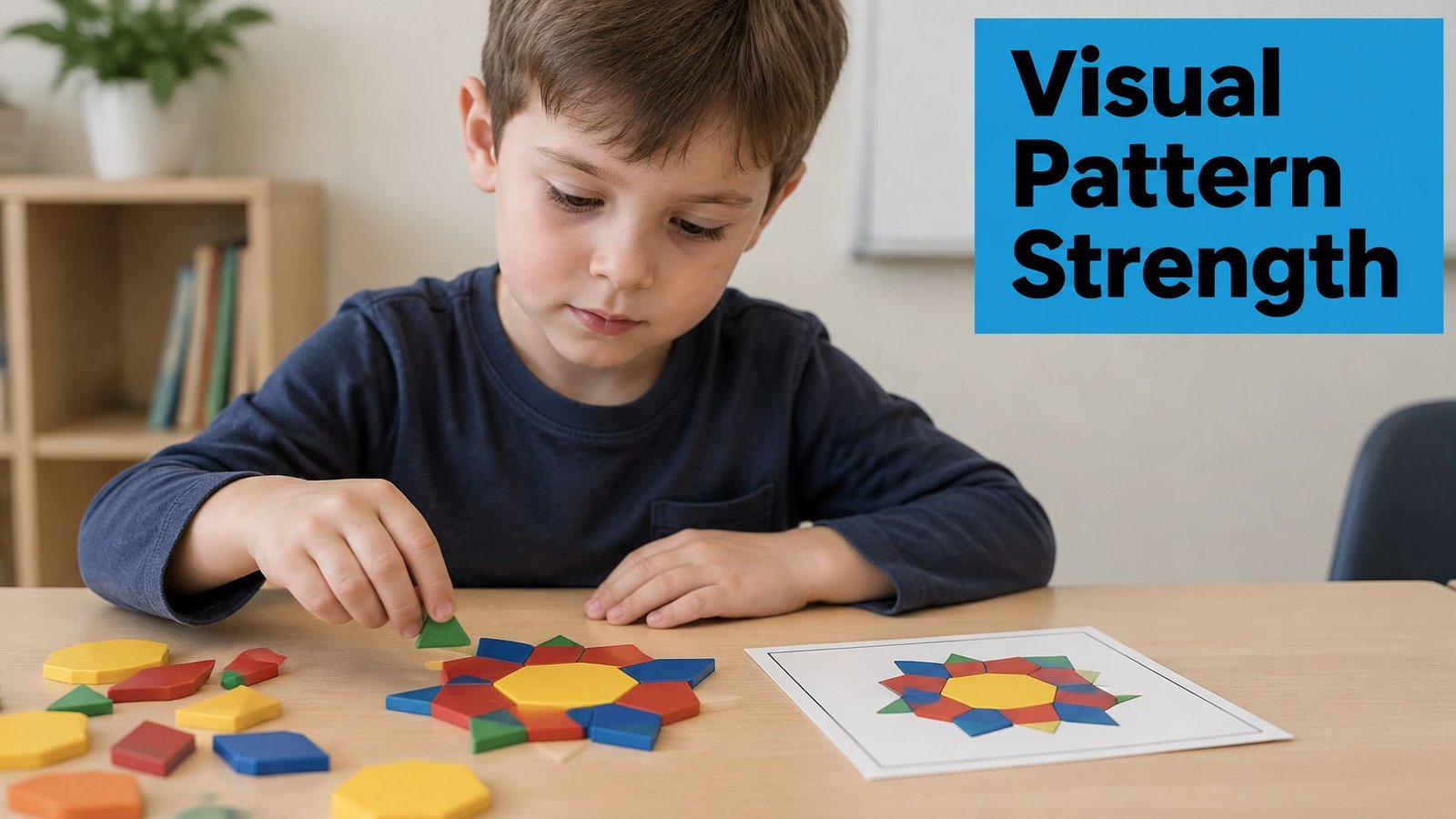
Start here if your child spots what others walk past. Puzzles click quickly. Maps, diagrams, and geometry make sense. Letter and number patterns show up before anyone teaches them.
That profile belongs in the Present Levels of Academic Achievement and Functional Performance (PLAAFP) because it tells the team how to teach, not just what to teach. It also documents an uneven profile. A child can struggle with verbal directions and still reason beautifully on paper.
Make it observable
Compare formats, don't just praise talent. Say a student solves multi-step geometry faster when problems are drawn on a grid. That's evidence for graph paper, graphic organizers, visual timelines, and manipulatives as accommodations, not favors. For reading, a student who notices word families can use that pattern to decode new words. If you want more ways to spot this at home, see these examples of pattern recognition in daily learning.
Watch how a visual approach changes task initiation in this short clip.
Practical rule: Write the condition into the strength. "Good at math" helps no one. "Completes problems when shown on a grid" changes instruction.
Strong IEP writing pairs that condition with a measurable target. Technical guidance in the University of La Verne compilation of IEP quality research uses this structure, "Given a visual schedule and a high-interest topic, the student will initiate and complete a three-step written response in 4 of 5 opportunities across three consecutive probes, measured by a teacher rubric." Steal that format. Ask which visual tools your child already chooses, log completed visual tasks in Guiding Growth, and use Smart Summaries to export a PDF showing the pattern across weeks before you meet.
2. Deep Focus on Special Interests as a Learning Motivator
Your child can talk about weather systems for forty minutes but won't finish a five sentence paragraph about the weekend. That's not a motivation problem. It's useful data about sustained attention.
The strength isn't dinosaurs, trains, or bus routes. It's the depth of concentration, vocabulary, memory, and research skill that grows around the topic. When the IEP names the interest and names how teachers will use it, engagement stops depending on willpower.

Two ways this becomes a goal
- Weather to writing: A student who tracks storms writes a short forecast report. The sentence structure and organization targets stay the same as peers, but the topic carries the work.
- Schedules to math: A student who collects bus timetables practices telling time and multi-step problems with real arrival and departure data.
Don't let the interest sit in a hobby box. As students get older, teams can assess interests for stream selection and think harder about electives and pathways. I also point families to practical ideas on how hobbies help autistic teens explore careers so the conversation doesn't stop at elementary rewards.
Track it plainly for two weeks. Note task completion with the interest versus without it, time on task, and prompts needed. Use Guiding Growth's Quick Log by voice to capture your child explaining a favorite topic in detail, right after it happens. A list of topics is forgettable. A completion pattern is hard for a team to ignore.
3. Honesty and Loyalty in Peer Relationships
"He's a good friend" won't survive the PLAAFP discussion. What does he do?
Many autistic students are direct, honest, and loyal. They say what they mean. They keep promises. They stick with the one or two people they trust, sometimes fiercely. In the right setting, that builds lasting friendships. In the wrong setting, adults misread directness as rudeness and miss the strength underneath.
Describe the setting, not just the trait
Write, "Checks in with the same classmate at lunch recess four days a week and waits if that peer is delayed." Now the team can build on it with a structured peer buddy arrangement or a shared interest club, instead of generic social skills practice. Or take fairness. A student who insists rules apply to everyone can lead a brief game rule review before recess. That's leadership practice with a clear script, and it uses honesty as an asset.
Families often get stuck translating traits into decisions. Resources collected by the Kansas State Department of Education for IEP teams and families highlight that gap between words like creative or kind and usable goals, services, and accommodations. The fix is context.
Log peer interactions in Guiding Growth with setting, people present, and outcome. After a few weeks you'll see which environments support connection and which ones overwhelm it. Bring that pattern, not a character reference. I want teams asking where loyalty already works, then scheduling more of that, with support, on purpose.
4. Empathy Expressed Through Care for Animals, Objects, or Specific People
Please don't let anyone write "lacks empathy" because your child didn't perform concern on cue. Care often looks different. It's quieter, more specific, and tied to particular people, animals, or objects.
A student may be exceptionally gentle with a class pet. Another notices a peer crying and offers a tissue. Another gets distressed when a rule feels unfair to someone else. Those are observable caring behaviors, and they give teachers a starting point for perspective taking that the student already values.
Turn care into instruction
Start with responsibility, not a worksheet. The student who cares for the classroom pet can hold a weekly pet care role, paired with a goal to describe the pet's needs using feeling and need words, such as hungry, calm, or scared. The child who offers a tissue can practice one verbal check-in, "Are you okay," with a visual cue. You're building language onto an existing impulse.
Empathy you can describe in one concrete scene is worth more in an IEP than a paragraph of personality claims.
Document specific moments in the PLAAFP. Who was there, what happened first, what did your child do, and how did the other person respond. Use Guiding Growth's event logging to record those moments with context at home and in the community. Patterns will emerge. Maybe empathy shows with animals before people, or with younger children before peers. That sequence matters for goal order, and it protects your child from a deficit label that was never accurate.
5. Strong Written Expression and Written Communication Skills
Some students say very little in class and then write a clear, detailed page that surprises everyone. Believe the page.
Written communication can be the strongest channel for students who need processing time, dislike eye contact, or lose words under social pressure. Journals, typed messages, emails to teachers, and text based participation all count as communication. If the IEP only measures speech, it will underestimate this child.

Ask for the accommodation in writing
Say a student types answers during class discussion while peers speak. Put typed participation in the IEP as an accommodation, with the same content expectations. Say a student writes detailed journal entries about the school day. Bring samples. They show sequencing, recall, and emotional vocabulary the team may never hear aloud, and they shape smarter communication goals for the next cycle.
This fits IDEA's core structure. The IDEA statute on IEP content requires measurable annual goals for academic and functional needs and a description of how progress will be measured and reported. So attach the strength to a count. Words per entry, complete sentences, or independent typed responses per discussion all work.
Collect samples over time, dated. Ask family members to save messages and journal pages from home. Then use Guiding Growth's Smart Summaries to organize communication events by date before the meeting. If spoken language is also a goal, fine. Pair it with writing as the bridge, don't remove the channel that already works.
6. Precise and Rich Vocabulary with Strong Verbal Reasoning
Your child corrects your word choice at dinner. Annoying at home, valuable at school, if the team knows what to do with it.
Some autistic students build large, precise vocabularies. They define terms exactly, notice errors, and explain rules in complete detail. That supports reading comprehension, science writing, and structured debate. The trade-off is flexibility. Idioms, sarcasm, and loose conversational language can confuse a literal thinker, and that's where instruction should go next.
Pair precision with pragmatic goals
- Rule explainer: A student who explains board game rules accurately takes that role formally, paired with a goal for turn taking language, such as pausing for questions.
- Science writer: A student who uses exact terminology in lab reports works next on recognizing idioms in reading passages, so precision doesn't block figurative text.
Record direct quotes in the PLAAFP. Quotes beat summaries. "Uses advanced vocabulary" is a claim. A sentence your child said about evaporation is evidence, and it lets the speech language pathologist see syntax, word choice, and reasoning at once.
Use Guiding Growth's Alma assistant to think through communication strategies using your child's logged history before the meeting. Bring two or three sharp questions, not a transcript. For example, "Where does literal language break down most, in reading or peer conversation." That question leads to a targeted goal instead of a broad language objective nobody can measure well.
7. Consistency and Strong Routine Adherence in Daily Living
Teams love to call this rigidity. At home, you know it's also reliability.
A student who follows the same steps in the same order can own a morning routine, a hygiene sequence, and a classroom job with very little prompting. Predictability isn't the enemy of independence. For many students, it's the engine of it, especially when the schedule is visual.
Count steps, not compliance
Write, "Completes a two step visual routine on four of five mornings," a format recommended in family guidance from the Center for Parent Information and Resources on present levels. That same guidance stresses strengths, what helps the child learn, what interferes, and objective evaluation data. Follow it. Record steps completed independently out of total steps, prompts given, and time needed.
Then build slowly. A morning checklist goal can add one new step each month while the old steps stay stable. A classroom job like watering plants works when the IEP includes the visual step card, not just the job title. If you want the research framing for families, I recommend this overview showing how consistency improves outcomes for autistic children.
Log routines, sleep, meals, and transitions in Guiding Growth for a few weeks. You'll learn when routines hold and when they collapse, often after poor sleep or a schedule change nobody flagged. Export a Smart Summary showing consistency across weeks, and plan gradual changes from strength, not surprise.
8. Independence and Self-Advocacy in Preferred Daily Tasks
Ask your child what they can do alone, and listen for pride. Making a favorite snack. Packing a backpack in a specific order. Requesting a break before things fall apart. That's self-determination in its earliest, most honest form.
Don't bury it under adult reporting. A strengths list written entirely by parents can produce a warmer IEP and no more independence. Guidance on strengths based transition planning for students with learning disabilities.pdf) makes that point clearly, students need direct instruction to name preferences, request accommodations, and evaluate their own progress. Parent identified strengths and student identified strengths are not the same thing. You need both.
Build from preferred tasks outward
A student who independently packs a lunch they enjoy can work toward planning a simple weekly menu with support. That's choice making, sequencing, and nutrition in one functional goal. A student who hands over a visual break card is already self-advocating. Name it as a strength, keep the card available everywhere, and set the next step, perhaps choosing between two break locations.
My test: Can the student use this strength without you in the room. If not, the IEP goal should teach exactly that transfer.
Include your child in the meeting when possible, even briefly, even by video, writing, or AAC. Log moments of independence and self-advocacy in Guiding Growth, including what helped in that moment. Review a Smart Summary together beforehand so your child can point to progress in their own words. That participation is a skill to teach, track, and celebrate, not a personality trait to hope for.
8 IEP Student Strengths at a Glance
| Strength Area | Domain | How It Shows Up | IEP Application |
|---|---|---|---|
| Visual Processing and Pattern Recognition | Academics | Notices visual details and patterns; performs well with diagrams, maps, puzzles, and structured tasks. | Record examples in the PLAAFP and use visual organizers, timelines, or manipulatives to support measurable goals. |
| Deep Focus on Special Interests | Learning and academics | Builds detailed knowledge and vocabulary through sustained interest, research, and focused attention. | Connect current interests to reading, writing, math, or science goals; review interests and progress regularly. |
| Honesty and Loyalty | Peer relationships | Communicates sincerely, keeps agreements, values fairness, and forms close, dependable friendships. | Document specific social strengths and plan structured peer activities, such as shared-interest groups or buddy opportunities. |
| Empathy and Care | Social-emotional | Shows concern through caring actions toward animals, specific people, or those who are upset. | Record observable examples and build on them with classroom roles or goals for recognizing and communicating feelings. |
| Written Expression and Communication | Communication and academics | Shares ideas clearly through writing, typing, messaging, or text-based communication. | Include writing samples in the PLAAFP and consider typed responses, written instructions, or text-based participation. |
| Precise Vocabulary and Verbal Reasoning | Language and academics | Uses exact words, explains rules or processes clearly, and reasons logically. | Document examples and build language goals around strengths while addressing idioms, implied meaning, or conversational flexibility as needed. |
| Consistency and Routine Adherence | Daily living and independence | Follows familiar steps reliably, uses schedules or checklists, and completes predictable tasks. | Use task analysis and visual supports for functional goals; document independence and plan gradual changes where appropriate. |
| Independence and Self-Advocacy | Daily living and self-determination | Completes meaningful preferred tasks independently and communicates requests for breaks, tools, or support. | Include student input, document self-advocacy examples, and develop goals for choice-making and expressing needs across settings. |
Turn Daily Observations Into Meeting-Ready Strengths Data
The strongest IEP student strengths sections aren't written the night before the meeting. They're built from weeks of small, observable evidence, collected when you weren't trying to sound impressive. You noticed the grid paper helped. You noticed the typing revealed answers. You noticed the break card worked before the meltdown, not after.
That evidence matters because outcomes are still uneven. The National Center for Education Statistics condition of education indicator reported an adjusted cohort graduation rate of 71% for students with disabilities in 2021-22, compared with 87% for all public-school students. Nobody closes a gap like that with nicer adjectives. Teams close it by connecting what a student does well to measurable goals, real accommodations, and transition planning that starts earlier than most families expect.
Transition research points the same way. A 2024 case study in the Journal of Intellectual and Developmental Disability of a Taiwanese high school found that systematically understanding students' strengths, through observation, occupational interest scales, workplace visits, and parent, teacher, and student communication, helped improve employment performance. Notice the method. Evidence from authentic settings, revisited over time. "Good with computers" became preferred tasks, needed supports, and a post-school application a team could plan around.
Here's the workflow I want you to run. For two weeks, log one specific example a day. Keep it short. Behavior, setting, support that helped, outcome. Log strengths across home, school, therapy, and community, because a skill that only appears in one calm kitchen still tells the team something important about conditions. It tells them what to replicate.
Before you walk in
- Pick three strengths: Choose the ones with the clearest evidence and the biggest effect on learning, not the longest list you can produce.
- Attach one request to each: A goal, an accommodation, a service, or a structured opportunity. If nothing changes because of the strength, it will be read as decoration.
- Bring dated proof: Work samples, short logs, and a summary showing frequency over time beat a single great anecdote every time.
Guiding Growth was created as a simple, intuitive autism parenting app that helps parents log a child's day by voice, identify triggers, analyze patterns, and export data backed Smart Summaries as PDFs for IEP meetings. Used for about a minute a day, it turns scattered phone notes into organized evidence, available on iOS and Android. Your child's strengths are only as influential as the evidence behind them. Start collecting that evidence this week, while the moments are still fresh, and let the IEP describe a capable student with support needs, not the other way around.
Spend the next two weeks logging one observable strength a day by voice in Guiding Growth, then export a Smart Summary PDF that shows your child's patterns, preferences, and progress across settings before the meeting. It gives your IEP team dated evidence to build goals and accommodations around, instead of three generic lines on a form. Visit Guiding Growth to start building your meeting ready strengths record today.