Consistency in caregiving plays a crucial role in supporting autistic children. Predictable routines help reduce anxiety, improve emotional regulation, and strengthen learning and skill retention. By creating structured environments, caregivers can provide stability that fosters trust and smoother transitions. Key takeaways include:
- Lower Anxiety: Predictable routines reduce stress and help children feel secure.
- Improved Learning: Repetition strengthens brain pathways, aiding skill retention.
- Fewer Behavioral Challenges: Structured days minimize outbursts and improve emotional control.
- Practical Benefits: Consistency simplifies caregiving, reducing decision fatigue for parents.
Tools like visual schedules and behavior tracking apps can help maintain routines and ensure alignment across caregivers, schools, and therapists. While research supports these strategies, more long-term studies are needed to explore their lasting effects on development.
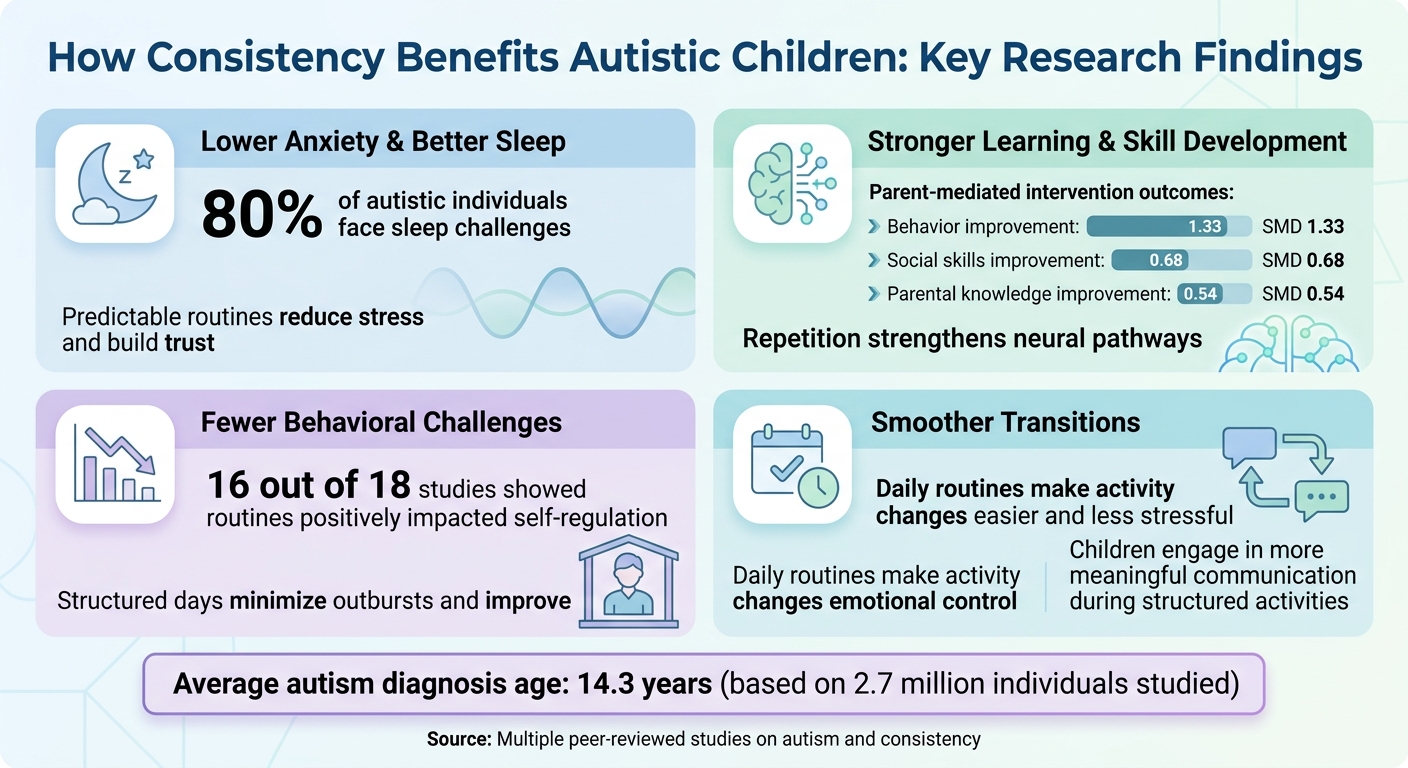
How Consistency Benefits Autistic Children: Key Research Findings
How Consistency Benefits Autistic Children
When caregivers stick to steady patterns in their daily routines, autistic children can experience noticeable improvements in various areas of development. These benefits go beyond making life easier – they directly influence how children grow and adapt to their world.
Lower Anxiety and Better Emotional Control
Predictable routines are like an anchor for autistic children, helping to reduce anxiety and emotional stress. When a child knows what to expect – whether it’s the morning routine or evening wind-down – they can focus on learning and exploring instead of staying on edge. This sense of predictability builds trust between the child and caregiver, creating a foundation for emotional stability.
Research highlights that up to 80% of autistic individuals face sleep challenges. Children who are later diagnosed with autism often show higher rates of difficulty falling asleep or resisting bedtime as infants and toddlers [5]. Establishing consistent bedtime rituals can help ease these struggles, making the day feel more manageable and less overwhelming [2].
In such stable environments, children learn to regulate their emotions better because they aren’t constantly navigating surprises. With less anxiety, they’re more open to learning and developing new skills.
Stronger Learning and Skill Retention
Consistency doesn’t just calm the mind – it reinforces the brain’s ability to learn. Repeating the same daily sequences helps children anticipate what comes next, boosting their confidence and independence. Research shows that parent-mediated interventions with consistent interaction patterns yield impressive outcomes, improving behavior (SMD of 1.33), social skills (SMD of 0.68), and parental knowledge (SMD of 0.54) [6].
Over time, consistently applied rules and routines strengthen the brain pathways that aid decision-making. This means children can apply learned behaviors to similar situations, paving the way for smoother, more regulated daily actions.
Fewer Behavioral Challenges Through Daily Structure
For autistic children, daily routines bring order using a structured daily schedule to what might otherwise feel chaotic [7]. As Purple Ella, an autism advocate, explains:
"I need a daily routine in order to keep in control of my life… If I put in place a routine, then that means everything gets neat and tidy; I know what’s going to happen and I feel in control and I feel calm, and this is what reduces my anxiety to a manageable enough level to be able to function day-to-day." [7]
This sense of control reduces behavioral challenges. When children can predict what’s coming next, they’re better equipped to self-regulate and avoid emotional outbursts [7]. Studies show that increased participation in daily routines is linked to improved behavior and mental health in children, as well as reduced stress for parents of children with neurodevelopmental delays [4].
Even the physical environment plays a role. Keeping toys and personal items organized in specific spots minimizes frustration and helps children feel more in control of their surroundings. These small touchpoints of consistency throughout the day can prevent exhaustion and reduce behavioral challenges [7].
sbb-itb-d549f5b
Why Consistency Works: The Science Behind the Results
Studies show that consistency in caregiving doesn’t just create calm – it actually rewires the brain. By sticking to routines, caregivers can help children develop emotional stability and essential skills.
How Predictability Reduces Anxiety
Predictable caregiving has a profound effect on emotional brain development, helping to lower anxiety levels [1][2]. Over 15 years of research highlights that regular, predictable behavior from caregivers is as critical as the quality of care itself. This stability supports stronger emotional and cognitive development later in life [1]. On the other hand, chaotic or unpredictable environments disrupt these brain circuits, increasing the risk of mental health challenges. For example, something as simple as a consistent bedtime routine or always keeping a toothbrush in the same spot can ease a child’s mind. When children know what to expect, they can focus their energy on learning rather than worrying about what’s coming next [2].
How Repetition Builds Skills
Repetition strengthens neural pathways, creating a foundation for skill development [2]. It’s not about monotonous drilling; it’s about weaving learning into everyday life. For instance, structured programs with 12 sessions of 90 minutes each have been shown to significantly improve behavior (SMD 1.33), social skills (SMD 0.68), and parental knowledge (SMD 0.54) [6]. Repeated, consistent interactions allow both children and parents to grow more confident over time. This strengthening of neural connections also makes transitions between activities smoother and less stressful.
Smoother Transitions Between Activities
Daily routines make activity changes easier and less stressful for children [2][4]. When kids experience the same sequence of events regularly, they begin to anticipate what’s next – even if they haven’t learned to tell time yet [2]. This predictability boosts their confidence and helps them feel more independent. Research also shows that children engage in more meaningful communication during structured activities like reading or playtime compared to unstructured settings [4]. Routines provide a framework that simplifies social interactions, allowing kids to focus on learning and connecting with others.
How to Create Consistency in Daily Caregiving
Building consistency in caregiving takes thoughtful effort. Studies highlight that predictable patterns are more impactful than striving for perfection. Here’s how you can create a stable environment for your child throughout the day.
Using Visual Schedules to Structure the Day
Visual schedules help make time feel more tangible, especially for younger children who may struggle with abstract concepts. Even kids who can’t read yet often grasp the sequence of daily events through pictures [2]. For instance, a simple picture-based schedule showing steps like getting dressed, eating breakfast, and brushing teeth acts as a guide, giving your child a sense of what’s coming next. This predictability reduces anxiety by removing the uncertainty of transitions.
Keep the schedule in a visible spot and refer to it regularly, especially before transitions. For example, if your child knows snack time follows playtime or that bath time leads to bedtime stories, they can feel more at ease instead of staying on edge, waiting for surprises. To reinforce this routine, make sure all caregivers stick to the same plan.
Coordinating Caregiving Across Home, School, and Therapy
Consistency requires teamwork. To avoid sending mixed signals, ensure all caregivers agree on a few simple, positive, and age-appropriate rules. Diane Bales, a Professor and Extension Human Development Specialist at the University of Georgia, emphasizes:
"Adults need to agree on a small number of simple rules for their child. Keep rules short enough to remember, and phrase them positively whenever possible." [2]
Sharing your home routines with teachers and therapists can help your child experience similar expectations across different settings. This alignment strengthens their sense of stability and reduces confusion.
Tracking Behaviors and Routines with Digital Tools
Once routines are in place, tracking them helps maintain consistency. Monitoring what actually happens each day – not just what you intend to happen – can reveal patterns. Tools like Guiding Growth make this process easy by allowing you to log behaviors, meals, sleep, and activities quickly. These logs turn daily observations into useful insights.
For example, Guiding Growth’s Smart Log feature lets you record voice notes about your child’s day. You could say, "Emma had a meltdown at the grocery store at 4 p.m., triggered by a loud announcement", and the tool converts it into structured data. Over time, this data can highlight recurring triggers, pinpoint challenging times of day, and show whether your strategies are working. Sharing these insights with teachers and therapists ensures everyone is on the same page, making it easier to provide consistent support.
What Research Still Needs to Address
While current research highlights the benefits of consistency for autistic children, there are still many unanswered questions about its long-term effects and how it interacts with other developmental factors.
The Need for Long-Term Studies
Most studies on routines and consistency focus on short-term outcomes, leaving a gap in understanding how these benefits play out over a lifetime. For instance, a Swedish study analyzed health records of 2.7 million individuals between 1985 and 2022, uncovering that the average age for an autism diagnosis was 14.3 years [9]. This kind of long-term research is uncommon but crucial to understanding whether early interventions have lasting effects as children grow into adolescence and adulthood.
Another challenge lies in the disconnect between research findings and policy implementation. Many federal statutes are outdated and don’t align with current diagnostic criteria, leading to delays in diagnosis and intervention [8]. Peter Doehring, Ph.D., from the Drexel Autism Institute, explains:
"Variation across programs and districts within and across states and the lack of state reciprocity can result in missed, inaccurate, or delayed identification… which will significantly impact a child’s developmental trajectory and academic outcomes" [8].
These inconsistencies make it difficult to compare long-term outcomes across regions, further emphasizing the need for research that examines how early consistency impacts development over time.
Tracking Connections Between Behavior, Sleep, and Nutrition
Another area that needs attention is how daily routines intersect with other developmental factors like sleep and nutrition. Most research looks at behavior in isolation, but many families believe that sleep issues and diet play a significant role in their child’s development. For example, sleep problems are common among autistic children, and some parents report that certain foods seem to influence behavior. Despite these observations, few studies track how these factors interact with consistent caregiving over extended periods.
Digital tools like Guiding Growth could help close this gap by allowing parents to track behaviors, sleep patterns, meals, and routines in one place. This kind of comprehensive data collection can reveal patterns across domains. For instance, Guiding Growth’s AI can analyze meal photos for nutritional content while also logging behavioral triggers and durations. Over time, these records could show whether high-sugar breakfasts lead to afternoon meltdowns or if protein-rich meals improve emotional regulation. These insights are exactly what researchers need but currently lack the tools to study on a large scale.
Conclusion
Consistency plays a central role in shaping neural pathways and influencing behavior, especially for autistic children. Research highlights that consistent caregiving isn’t just a helpful practice – it’s a key ingredient for fostering growth. Predictable routines can ease anxiety, improve emotional regulation, and create the safe environment children need to thrive. When children understand what to expect, their minds are better equipped to focus on learning and development.
Studies back this up. For instance, a review of 18 studies found that routines positively impacted self-regulation in 16 of them [3]. Similarly, consistent parenting has been shown to significantly improve both behavior and social skills [6]. These findings underline how structured, predictable environments can support brain development and overall well-being.
Of course, maintaining consistent routines amidst the chaos of daily life can be tough. That’s where tools like Guiding Growth come in. This platform helps parents monitor behaviors, sleep patterns, meals, and daily routines, turning scattered observations into actionable insights. Features like AI-powered food analysis and a Smart Log that records events through natural speech make it easier to spot trends and adjust routines. By simplifying the process, Guiding Growth gives caregivers the tools they need to put research-backed practices into action.
FAQs
How consistent is ‘consistent enough’ for routines?
Creating predictable routines – like set times for meals or activities – plays a key role in supporting brain development and emotional regulation in autistic children. These consistent patterns provide a sense of security and stability, helping them navigate their day with greater ease. By sticking to a steady structure, you create an environment your child can depend on, which can lead to positive outcomes over time.
How can I keep routines consistent across home, school, and therapy?
Maintaining steady routines between home, school, and therapy can play a big role in helping an autistic child grow and succeed. Here’s how to make it happen:
- Set clear daily routines: Create a structured schedule for wake-up times, meals, and activities to provide a sense of stability.
- Use visual tools: Charts, pictures, or other visual aids can help reinforce the routine and make expectations easier to understand.
- Stay connected: Regular communication with caregivers, teachers, and therapists ensures everyone is on the same page and routines remain consistent.
This level of consistency can ease anxiety, support emotional balance, and encourage progress in both learning and social interactions.
What should I track to identify meltdown triggers?
Tracking factors like behaviors, surroundings, daily routines, and emotional reactions can help uncover what leads to meltdowns. By observing patterns over time, you can identify specific triggers and gain insights to better handle difficult situations.