When children struggle to recognize internal body signals like hunger, thirst, or a racing heart, it can directly impact their ability to manage emotions. This is called interoception, the body’s way of sensing its internal state. For autistic children, these signals may feel unclear or overwhelming, leading to challenges like emotional outbursts, toileting accidents, or missed hunger cues.
Key points:
- Interoception helps connect physical sensations (e.g., a racing heart) to emotions (e.g., anxiety).
- Autistic children often experience interoceptive signals differently – either too strongly or not at all.
- This disconnect can make it harder to manage emotions, recognize triggers, or meet basic needs.
- Strategies like body scans, mindfulness, and visual tools can help children better understand these signals.
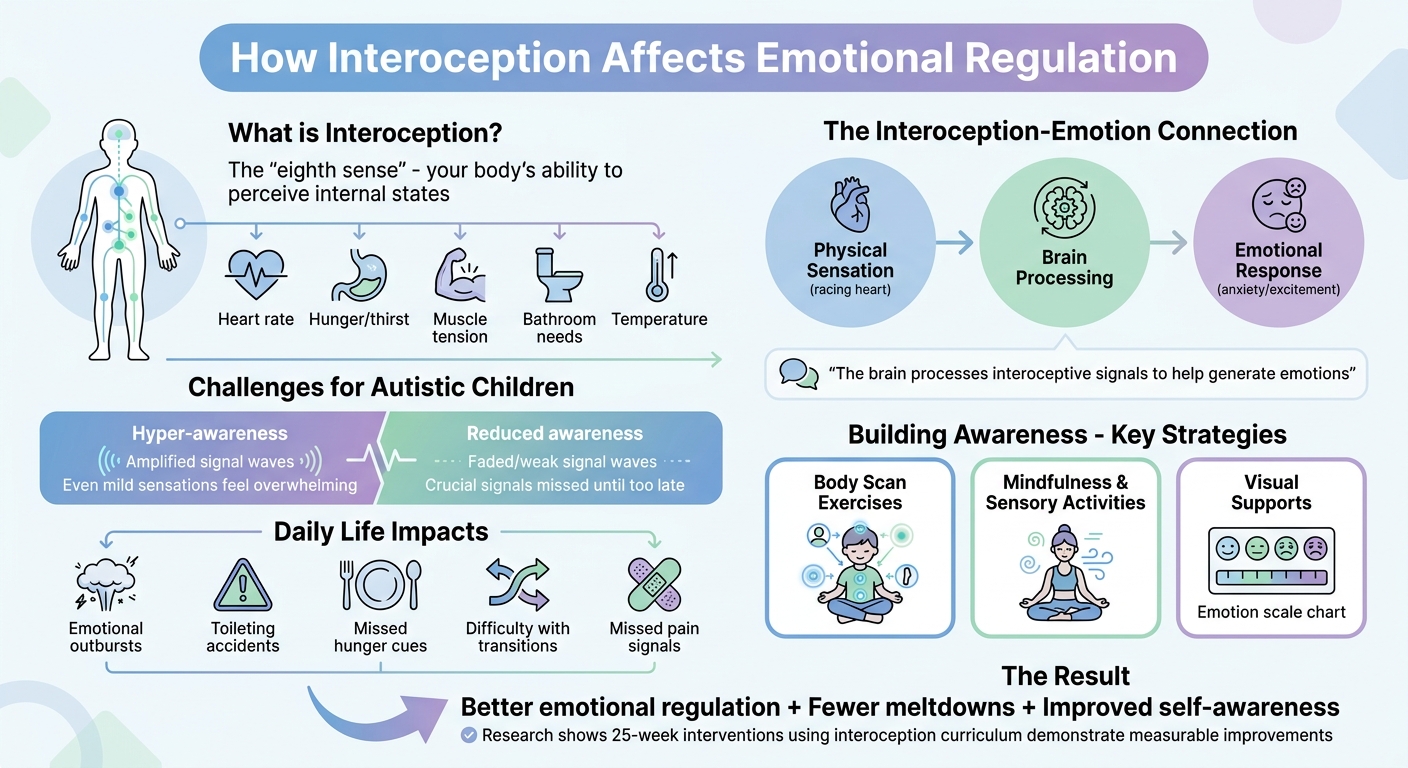
How Interoception Connects Physical Sensations to Emotional Regulation in Children
Autism and Interoception (Developing Body Awareness and Emotional Regulation) | Patrons Choice
sbb-itb-d549f5b
What is Interoception and Why It Matters
Interoception, often referred to as the "eighth sense," is distinct from the five traditional senses we all learn about – sight, hearing, smell, taste, and touch. While those senses help us navigate the external world, interoception focuses inward, allowing us to perceive internal states like hunger, thirst, heart rate, muscle tension, and even the need to use the restroom [2].
This internal sense plays a key role in emotional regulation. For instance, when a child’s heart starts racing, their brain interprets that physical sensation to determine whether they’re feeling anxious, excited, or scared. If these interoceptive signals are unclear or misinterpreted, that connection can falter [3]. A child might feel a tight stomach without realizing it’s nervousness before a big event or experience muscle tension without identifying it as frustration.
"Interoception refers to the ability to perceive the internal state of our body. This includes recognizing signals such as hunger, thirst, pain, and even emotions." – TinyEYE Therapy Services [3]
How Interoception Works
The brain processes interoceptive signals to help generate emotions [3]. For example, physical exertion increases your heart rate and breathing – sensations the brain often links to emotional states like excitement or anxiety [3]. For most people, this connection happens automatically, creating a smooth relationship between physical sensations and emotional responses [3].
Think of interoception as your body’s internal communication system. Receptors throughout the body send signals to the brain about what’s happening inside. The brain uses this information to maintain balance (also known as homeostasis) and guide actions [2]. For instance, a growling stomach signals hunger, prompting you to eat. A racing heart might indicate stress, encouraging you to step back or relax.
However, for some children – especially those on the autism spectrum – this process doesn’t always work as expected, leading to unique challenges.
Interoceptive Challenges in Autistic Children
Autistic children often experience interoceptive signals differently. Some have hyper-awareness, where even mild sensations feel overwhelming [2]. Others experience reduced awareness, meaning they might not notice crucial signals until it’s too late. For example, a child might not realize they’re hungry until they feel faint or miss the urge to use the restroom until an accident happens [2].
These differences aren’t due to a lack of attention but rather variations in sensory processing [3]. A child who “ignores” hunger cues or bathroom signals may genuinely not feel them. On the other hand, a child who seems overly reactive to minor discomfort might be feeling those sensations with an intensity that’s hard to imagine.
The Connection Between Interoceptive Awareness and Emotional Regulation
When children struggle to connect physical sensations – like a racing heart – to emotions such as anxiety, they miss early warning signs that could help them manage their feelings. This challenge ties closely to alexithymia, a condition where individuals have difficulty identifying and describing their emotions [2].
Research highlights the importance of addressing this gap. A 25-week school-based intervention using "The Interoception Curriculum" demonstrated measurable improvements in emotional regulation, using tools like BRIEF-2 and CQIA-2 [3]. By learning to recognize their body’s internal signals, children gain the ability to respond to emotions before they become overwhelming. This connection forms the foundation for strategies that can help children better manage their emotions, which we’ll explore further in later sections.
How Interoceptive Difficulties Affect Emotional Regulation
Emotional Dysregulation and Interoceptive Confusion
When kids struggle to understand their body’s signals, managing emotions becomes a guessing game. For autistic children, early physical cues – like a quickening heartbeat, tight muscles, or shallow breathing – often go unnoticed until stress builds into a sudden meltdown [2].
Declan, an 11-year-old with autism, shares his experience:
"I don’t feel that I am getting upset until I am really, really upset. By then, it’s too late. I can’t control it." [4]
This disconnect between bodily sensations and emotions makes it hard to identify triggers. For example, a racing heart could mean excitement, anxiety, or anger, but without clear interoceptive awareness, pinpointing the cause becomes almost impossible [2].
Rick, a 22-year-old with autism, describes it this way:
"I feel so many things going on inside my body at once, it’s hard to make sense of it all." [4]
For some, hypersensitivity to interoceptive signals can turn even normal bodily sensations into overwhelming anxiety or emotional outbursts [2]. On the other hand, reduced awareness of these signals can mean basic needs like hunger, thirst, or fatigue go unnoticed until irritability or challenging behaviors emerge – often misinterpreted by adults as defiance [2].
These challenges don’t just impact emotional regulation – they extend into everyday life.
Daily Life Impacts of Poor Interoceptive Awareness
Struggles with interpreting bodily signals affect far more than emotions. They disrupt daily routines, self-care, and social interactions. For instance, transitioning between activities can be especially hard for children who don’t realize they’ve hit their sensory limit or are simply too tired [2].
Basic self-care can also be a challenge. Some children may not recognize the need to use the bathroom, leading to accidents. Emma recalls:
"I don’t always feel the need to use the bathroom. When I was in high school I used to go all day without drinking a single drop of water so I didn’t have an accident in front of my friends." [4]
Physical safety is another concern. When pain signals are missed, injuries can go unnoticed. Nick, the parent of a 14-year-old with autism, shares his story:
"My son walked around on a broken leg for two days without a single sign of pain. It wasn’t until I noticed the swelling and bruising that I realised he had a serious injury." [4]
Social interactions can also suffer. Without recognizing internal cues like nervousness or embarrassment, children might react in ways that isolate them from their peers [2].
Understanding these challenges highlights the importance of addressing interoceptive awareness, paving the way for strategies that can help improve these skills.
Strategies to Build Interoceptive Awareness
Helping children understand and manage their emotions starts with teaching them to connect physical sensations with feelings. These strategies offer practical ways to develop that connection, starting with simple, approachable steps.
Body Scan Exercises for Children
Body scans are a great way to help kids notice physical sensations without judgment. Katie Fries, a therapist at All of You Therapy, explains:
"The focus starts with building awareness of bodily sensations in neutral, manageable ways. This might include pausing to notice changes in heartbeat, skin temperature, muscle tension, or breathing." [5]
You can guide your child through this by asking them to notice things like a racing heartbeat, warm hands, or tight shoulders during calm moments. Using tools like a body map, where children can point to where they feel sensations, can make this process more interactive. For kids who have trouble connecting with their bodies, the goal is simply to notice that they feel something – there’s no rush to label or fix it. The key is to go at their pace.
Mindfulness and Sensory-Based Activities
Mindfulness doesn’t have to mean sitting still, especially for autistic children. Movement-based or sensory activities can be an effective way to help them recognize internal signals and connect those to emotions. For instance, you might engage in a movement activity and then reflect together by saying, “I noticed your deep breath – what did you feel?” This kind of reflection helps validate their internal experiences. As Katie Fries puts it:
"When people understand their internal signals, they can begin to trust themselves. They can notice when they’re overwhelmed and take steps to care for themselves before hitting a breaking point." [5]
These practices naturally set the stage for using visual tools, which can further strengthen the connection between bodily sensations and emotions.
Using Visual Supports and Emotion Scales
Visual aids can help kids bridge the gap between what they feel and how they express it. Emotion scales – like charts with faces or numbers to represent different intensity levels – allow children to communicate the strength of their feelings. Pairing these scales with body maps can deepen their understanding of how physical sensations relate to emotions.
For example, tools like the 8 Sensory Systems Poster Set help distinguish external sensory input from internal interoceptive signals [1]. Similarly, resources like the Feel, Try, Learn Activities digital PDF guide kids in identifying sensations, experimenting with responses, and discovering what works best for them [1].
When these tools are used consistently and displayed in familiar spaces, they can help children build a solid vocabulary for their internal experiences, empowering them to better understand and manage their emotions over time.
Supporting Interoceptive Skills in Everyday Life
While structured interoceptive exercises are a great starting point, weaving these skills into everyday life – at home, in school, and out in the community – helps reinforce emotional regulation. A calm, low-stimulus environment paired with consistent progress tracking can empower children to better understand their internal signals and manage emotions more effectively.
Creating Sensory-Safe Environments
The spaces your child spends time in can either support or hinder their ability to build interoceptive awareness. To reduce sensory overload, consider simple adjustments like dimming harsh overhead lights, creating a cozy quiet corner with soft textures, or providing noise-canceling headphones during high-activity times. By minimizing external distractions, children can focus more on their internal sensations.
Visual aids, such as the 8 Sensory Systems Poster Set or interactive board games, can also be helpful tools. Whether used in a bedroom, playroom, or classroom, these resources encourage children to identify and differentiate between internal and external sensations. Using such tools across multiple settings creates consistent learning opportunities and reinforces these skills wherever they are [1].
Tracking Patterns and Progress
Keeping track of your child’s interoceptive skills over time can reveal important patterns. For instance, the Guiding Growth app offers a way to log and analyze behavioral and sensory data all in one place. By recording events like autism meltdowns, sleep quality, meals, and daily activities, you might uncover connections you hadn’t noticed before – like how poor sleep may lead to emotional struggles or how specific foods might heighten body awareness.
A simple daily routine, such as asking your child, “What did you feel today?” can help them start noticing their internal signals. Logging these observations into the app allows you to tailor strategies to their unique needs. Plus, the app’s Smart Summaries feature provides concise, data-driven reports that you can share with therapists or teachers. This kind of consistent tracking not only highlights patterns but also enables professionals to fine-tune interventions based on real-world insights.
Working with Educators and Therapists
To truly embed interoceptive skills into your child’s life, consistency between home and school is key. Using the same tools – like sensation charts or visual supports – across both environments helps children make connections between their emotions and bodily signals no matter where they are.
Katie Fries of All of You Therapy, LLC highlights the importance of professional input:
"A professional can tailor interventions to promote interoceptive awareness and help children develop coping strategies that fit their unique needs." [6]
Keeping open communication with therapists and teachers ensures strategies evolve as your child grows. If you’re using the Guiding Growth app, inviting your child’s care team to collaborate can further enhance this process. They can access logged data and adjust their approaches based on real observations and patterns.
Lastly, don’t underestimate the power of leading by example. Caregivers can model interoceptive awareness by openly sharing their own experiences, like saying, “I feel a little nervous; my hands are sweaty.” This normalizes the process of noticing internal sensations and teaches children its value. By working together with professionals and modeling these behaviors, caregivers can help children translate improved interoceptive awareness into better emotional regulation and fewer meltdowns.
Conclusion
Interoception – your child’s ability to recognize and understand internal bodily signals – plays a key role in emotional regulation. When children learn to connect physical sensations like a racing heart or tense muscles to emotions such as anxiety or frustration, they gain valuable tools to manage their feelings before they escalate. As Katie Fries from All of You Therapy, LLC explains:
"Teaching children to listen to their bodies empowers them to take control of their emotional responses" [6].
As a parent, your involvement goes beyond observing behaviors. You help your child link physical sensations to their emotions, guiding them toward self-regulation. By modeling your own awareness and consistently practicing these strategies, you can help solidify these skills over time.
Tracking patterns is another powerful way to support your child. Tools like the Guiding Growth app allow you to log behavioral events, sleep quality, meals, and daily activities in one place. For example, you might notice that poor sleep aligns with afternoon emotional challenges or that certain foods affect your child’s ability to self-regulate. The app’s Smart Summaries feature creates reports you can share with therapists and teachers, ensuring everyone involved in your child’s care is on the same page.
These efforts create a strong foundation for your child’s emotional growth. By collaborating with educators and therapists, using consistent tools across home and school, and maintaining open communication, you build a cohesive support system. This unified approach leads to better coping mechanisms, fewer emotional outbursts, and greater control over feelings.
With the right strategies and resources, you’re doing more than addressing behaviors – you’re helping your child develop a deeper understanding of themselves. Teaching them to recognize and respond to their internal signals lays the groundwork for self-reliance and improved emotional regulation.
FAQs
How can I tell if my child is under- or over-aware of body signals?
To figure out if your child struggles with recognizing body signals (interoception), pay attention to how they react to sensations like hunger, fatigue, or a fast heartbeat. Under-awareness might look like ignoring these signals altogether, while over-awareness could mean they’re overly sensitive and easily upset by them. Helping kids learn to notice and name these sensations can go a long way in supporting their emotional regulation. If you’re unsure how to approach this, reaching out to a specialist can provide helpful strategies.
What are the fastest ways to teach my child to notice early meltdown signals?
Helping your child notice early signs of a meltdown can start with straightforward activities aimed at recognizing internal body signals like hunger, discomfort, or emotional changes. Using visual aids, such as emotion cards or charts, can simplify the process of linking physical sensations to feelings. With regular practice, these tools can boost their self-awareness, allowing for quicker action to prevent meltdowns.
When should we ask a therapist for help with interoception?
If an autistic child struggles with ongoing interoception challenges that interfere with emotional regulation or daily activities, it may be time to consult a therapist. These difficulties can lead to issues like anxiety, emotional dysregulation, or trouble managing feelings effectively. Therapists can offer tailored approaches, such as occupational therapy or mindfulness techniques, to help address these concerns. Professional support is especially important if emotional reactions remain intense, persistent, or unmanageable despite efforts to use strategies at home.