You sit down the night before an IEP meeting and open the folder of notes. There are screenshots from a group chat, scribbled reminders about difficult mornings, and emails from three therapists. You know your child needs support, but you're not sure which details will help the school team understand what's happening.
Another bookmark won't necessarily solve that problem. The best autism spectrum disorder resources for parents answer different questions: What should I do about a developmental concern? Who can explain school services? How do I judge a treatment claim? Who can listen without needing the whole backstory?
- Starting points and early learning: CDC, HealthyChildren.org, and Autism Navigator.
- Local help and school advocacy: Autism Society and the Center for Parent Information and Resources.
- Research literacy and autistic perspectives: Organization for Autism Research and Autistic Self Advocacy Network.
- Peer support and daily tracking: Parent to Parent USA and Guiding Growth.
Keep your own reflection separate from the record you'll share with professionals. The personal journaling advice from Life Calendar can help with the former. For appointments, prioritize dated observations, your child's communication, supports that helped, and questions that need answers.
Guiding Growth appears alongside these resources because organized daily information makes the others easier to use in a real conversation. The aim isn't to document every moment. It's to arrive with enough context to ask for the right help.
Table of Contents
- 1. Guiding Growth
- 2. CDC Autism Information for Families
- 3. American Academy of Pediatrics HealthyChildren.org Autism Center
- 4. Autism Society of America Helpline and Family Resources
- 5. Organization for Autism Research Family Guides
- 6. Autistic Self Advocacy Network Start Here
- 7. Center for Parent Information and Resources Find Your Parent Center
- 8. Autism Navigator About Autism in Toddlers Course
- 9. Parent to Parent USA Peer Support
- How the Top Autism Spectrum Disorder Resources Compare on Cost, Format, and Best Use
- Turning a Bookmark List Into a Working Routine
1. Guiding Growth
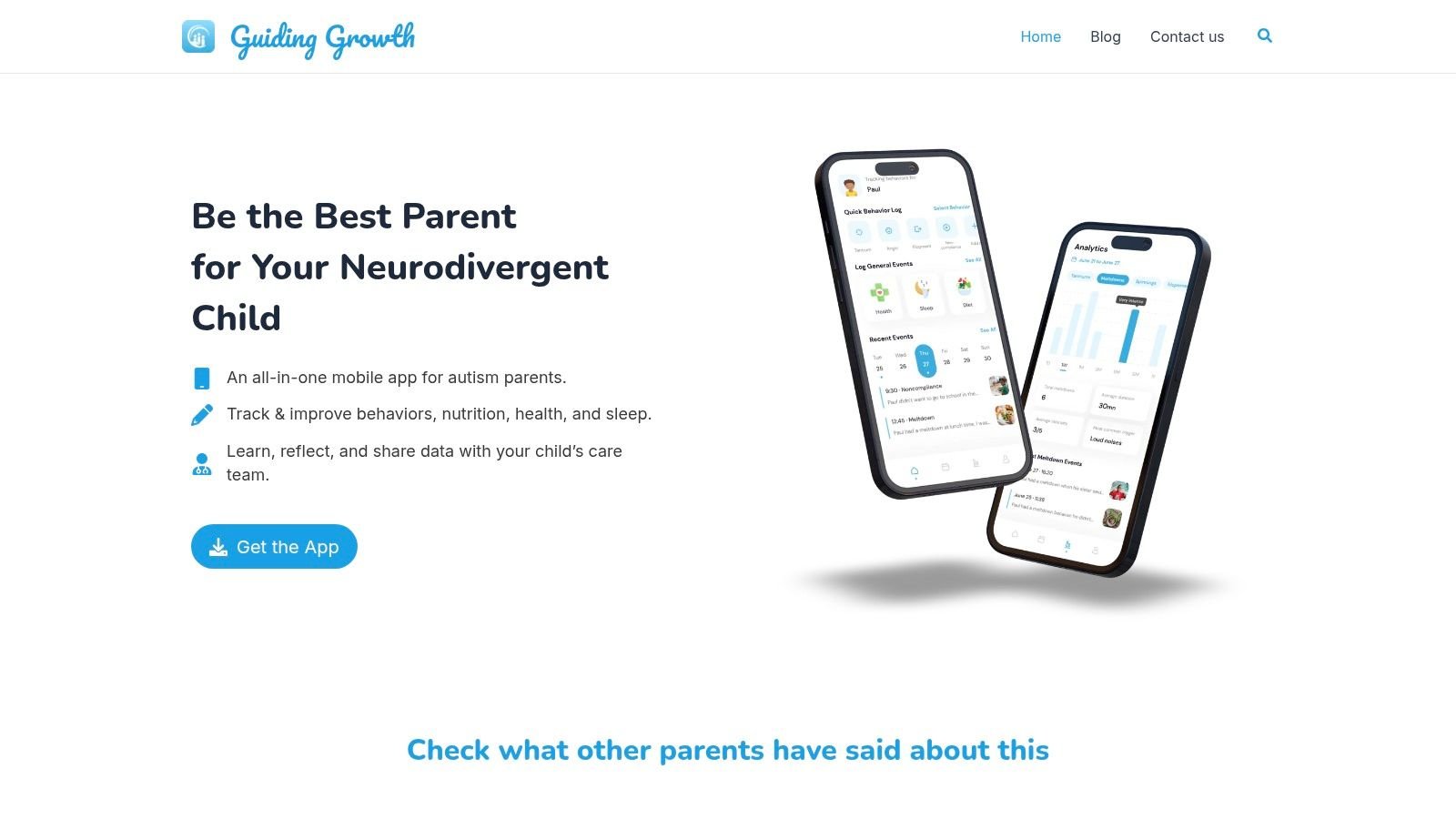
Best weekly job: replacing scattered notes with a shared daily record.
Our Guiding Growth app is available on iOS and Android for parents and caregivers of autistic and neurodivergent children. It brings behavior, sleep, meals, mood, medications, therapies, and appointments into the same child-specific record. Its strongest use is practical: remembering what happened well enough to discuss it accurately.
Quick Log turns a spoken recap into editable entries. You review and correct what it captured before saving, rather than treating automated transcription as unquestionable. Photo-based meal logging can also identify foods and estimate portions and nutrition.
What makes the record useful
Our behavior tracking lets families record context, possible triggers, duration, intensity, location, and who was present. Analytics help surface patterns, while Smart Summaries turn selected records into exportable PDFs for IEP meetings, therapy sessions, and medical appointments. Customizable caregiver permissions and medication reminders support coordination without requiring everyone to manage the whole profile.
- Strongest advantage: Voice logging reduces the typing involved in maintaining consistent notes.
- Useful combination: Sleep, food, health, and behavior records can be reviewed together instead of in separate notebooks.
- Care-team support: Alma, our AI assistant, can draw on the child's profile and history for context-aware suggestions, not medical advice.
- Important limitations: Food estimates and AI suggestions need review. Check current costs and paid-feature access before committing.
Website feedback highlights interest in identifying triggers, sharing information with family, and replacing cumbersome paper records. Those comments describe perceived usefulness, not proof of clinical outcomes.
Use practical autism communication strategies alongside observation, and record how your child communicates preferences and discomfort. A pattern is a question to investigate, not a diagnosis. Don't use tracking to suppress harmless stimming or interpret every difficult moment as a behavior problem.
2. CDC Autism Information for Families
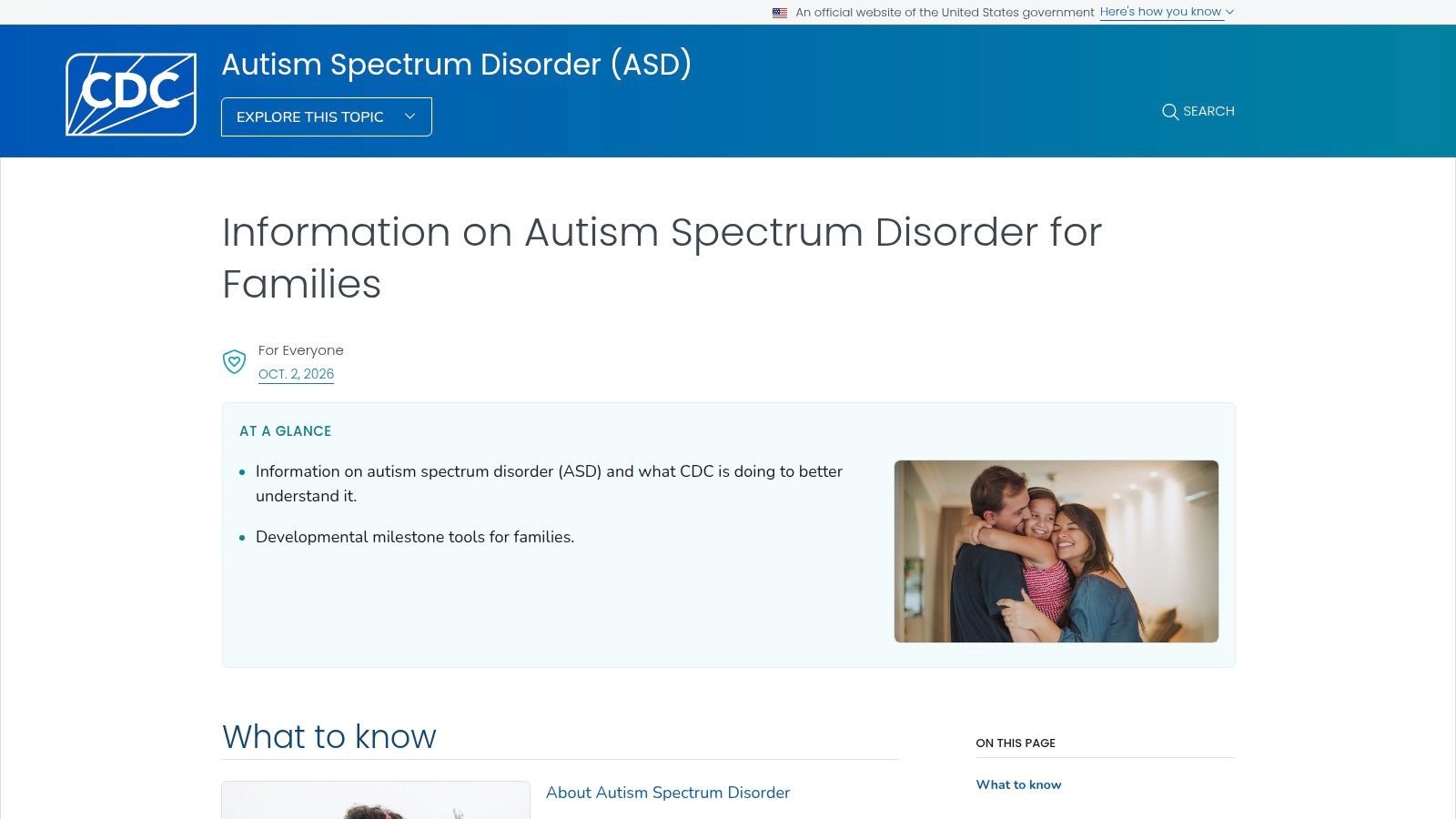
Best weekly job: turning an early concern into a concrete next step.
The CDC's Autism Information for Families is a free national starting point for screening, developmental concerns, interventions, and service pathways. Use it when you need orientation, not a personalized explanation of your child.
The CDC's Learn the Signs. Act Early. materials cover developmental milestones from 2 months through 5 years, and its autism overview directs families with concerns to request developmental screening and contact the appropriate early-childhood or school system.
Use it to make the call
For U.S. children younger than 3, families can contact their early-intervention system directly for an evaluation without a physician referral, according to the CDC's accessing-services guidance. Eligibility and intake are handled locally, so don't assume another family's experience describes your options.
Before contacting a program, write down your concern in observable terms. Describe communication, play, movement, or everyday participation, rather than trying to prove a diagnosis yourself.
- What works: Clear public-health information and a route toward evaluation.
- What falls short: General guidance can't determine eligibility, locate an available appointment, or choose individualized supports.
- Best next action: Save the contact details, make the inquiry, and record the response and follow-up task.
Milestone resources are particularly useful for younger children. They're less useful when your immediate problem is a teenager's school transition or a disagreement about an existing support plan.
3. American Academy of Pediatrics HealthyChildren.org Autism Center
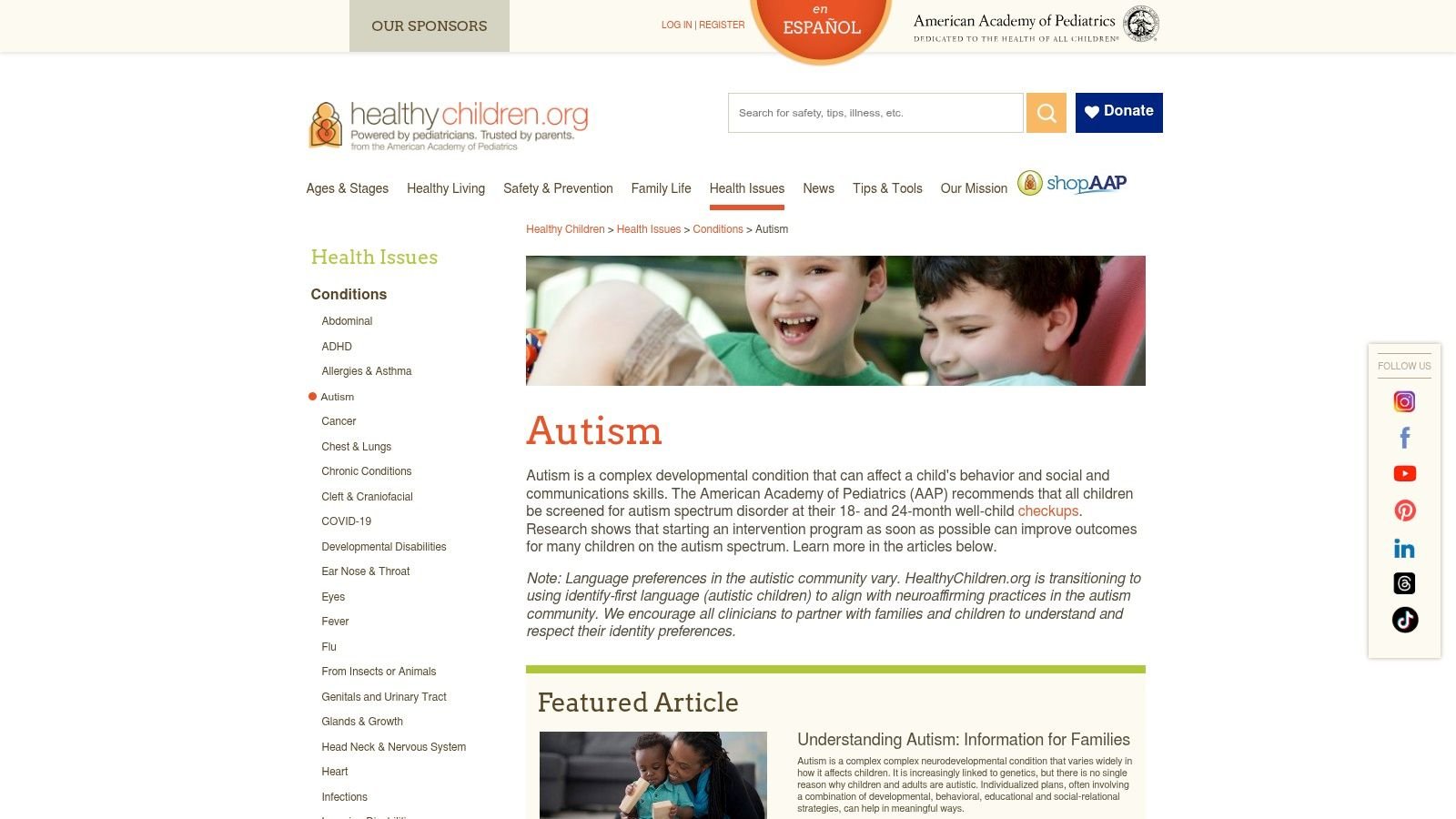
A change in sleep, mood, or communication can raise questions that need more than a general autism resource. HealthyChildren.org can help you prepare a focused question for your child's pediatrician.
The American Academy of Pediatrics' Autism Center offers pediatrician-reviewed articles about evaluation, screening, speech-language therapy, safety, mental health, and autistic teens. It's free to read and covers topics beyond an initial diagnosis.
Don't explain every change as autism
A study of access to child and adolescent mental-health services described autistic children being denied care or not referred when professionals attributed difficulties to autism, applied high assessment thresholds, or lacked pathway knowledge. A concise timeline can help keep a new concern specific.
Note changes from your child's usual sleep, mood, interests, communication, and daily functioning. Ask whether pain, anxiety, depression, medication effects, or another concern needs assessment. Leave diagnosis to the clinician.
Appointment principle: Describe what changed and how it affects daily life. Ask a direct question about the concern.
HealthyChildren.org helps you prepare, but it does not provide an individualized care plan, local referral service, or ongoing peer connection. For questions beyond the appointment, the autism parent resources guide offers another place to look. If there's an immediate safety concern, seek urgent professional help rather than waiting to finish reading or tracking.
4. Autism Society of America Helpline and Family Resources
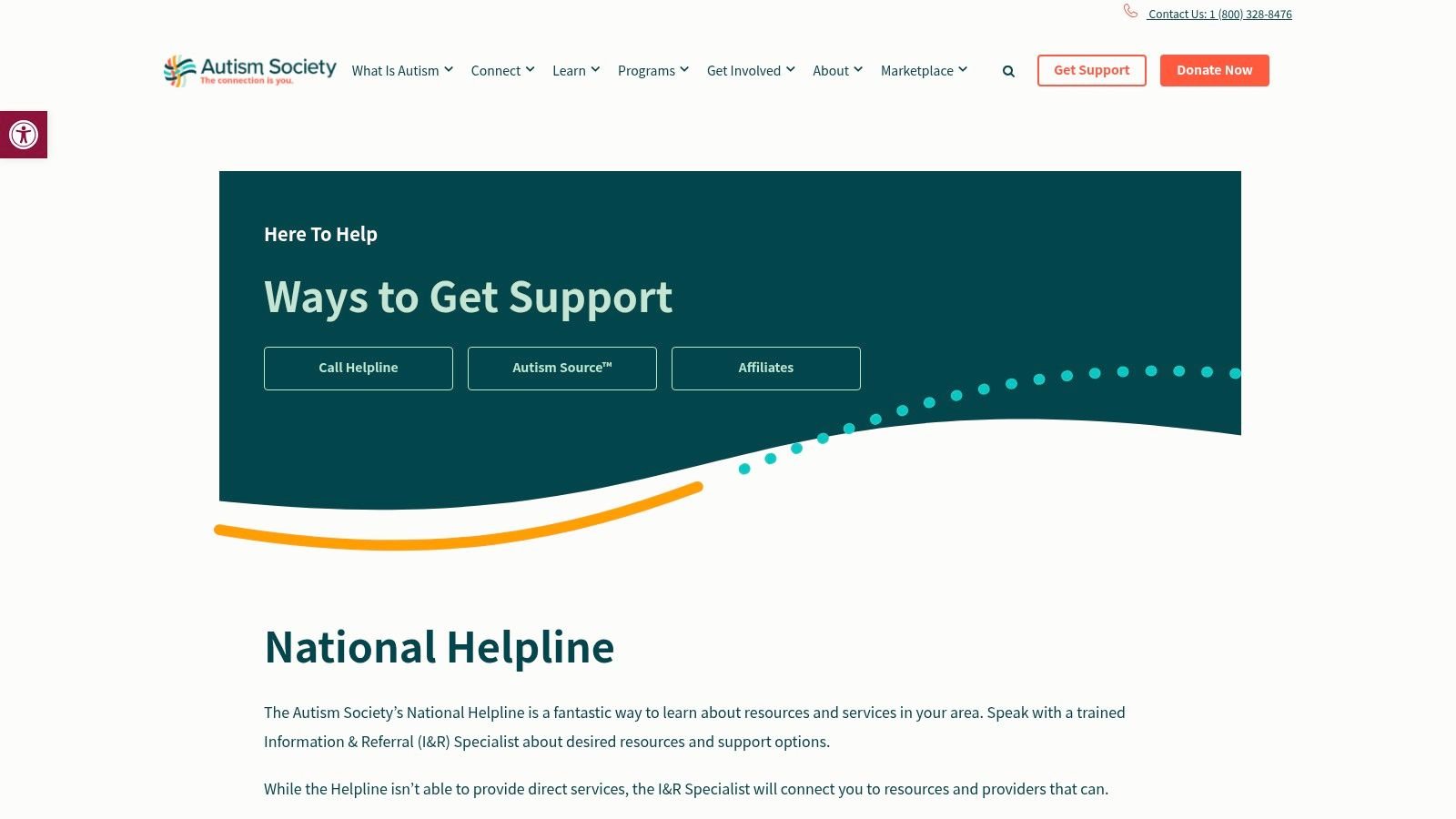
Best weekly job: finding a person who can help you locate local options.
The Autism Society's Information & Referral helpline combines national navigation support with local affiliate connections. It's a better fit than another general article when you need to identify community programs, advocacy resources, or service pathways.
The organization also offers practical materials, including an All About Me healthcare profile, a visual-schedule guide, and a sensory health tracker. These can help you explain communication preferences and support needs without rebuilding the same document for every appointment.
Make a referral request specific
A survey of parents of autistic children found that 82% needed information about currently available services, but only 52% of families needing that information said the need was met, according to the parent-needs study. A useful referral therefore needs more than a provider's name.
- State the constraints: Include location, language, transportation, payment needs, and scheduling limits.
- Name the task: Ask about a particular service, community activity, Medicaid question, or home- and community-based support.
- Confirm the next step: Ask who handles intake and what documentation to prepare.
The limitation is availability. Affiliates offer different programs, and the helpline connects families with resources rather than delivering every service itself. Its helpline page warns of high case volumes and responses that may take over a week.
Don't use it for urgent safety needs. For routine navigation, keep a dated record of contacts and outcomes so an unanswered referral doesn't disappear into your inbox.
5. Organization for Autism Research Family Guides
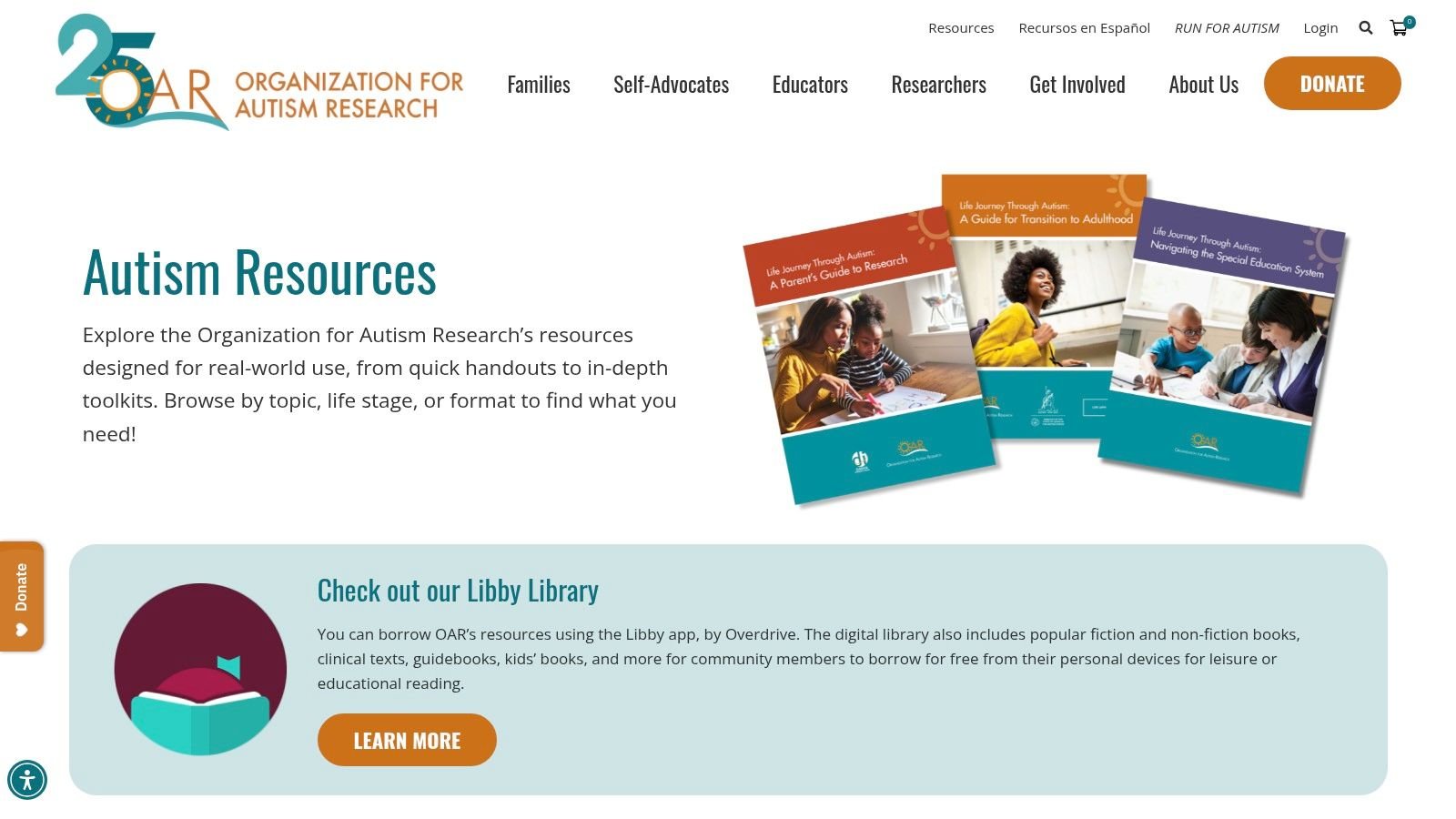
A confident treatment claim can be harder to evaluate than an obviously dubious advertisement. The Organization for Autism Research resource library is useful when you need to slow down, understand the claim, and decide what evidence would matter.
OAR's family guides cover research literacy, assessment, safety, special education, and transition planning. Many are free to download; check the site for print availability and any associated cost.
Evaluate outcomes, not enthusiasm
Start with the research guide when someone recommends an intervention because it worked for another child. Ask who participated, what changed, how outcomes were measured, and whether the changes mattered to the child's daily life.
A systematic review of caregiver e-health interventions reported improvements in outcomes including knowledge, parenting efficacy, and stress, but also identified methodological variation and short follow-up periods. That's the distinction parents need: promising findings aren't the same as certainty about a particular family.
- Ask about benefit: Does the approach support communication, comfort, autonomy, or meaningful participation?
- Ask about burden: What time, money, equipment, and caregiver effort does it require?
- Ask about evaluation: How will the team decide whether to continue, adapt, or stop?
OAR's strength is helping you investigate, not choosing for you. Its publications don't replace individualized case support, and education materials may need interpretation with a teacher or specialist.
I'd use a relevant guide before committing to a major intervention change. Bring the resulting questions to the team instead of bringing a stack of articles nobody has time to discuss.
6. Autistic Self Advocacy Network Start Here
Best weekly job: checking whether the support plan respects the child it's meant to help.
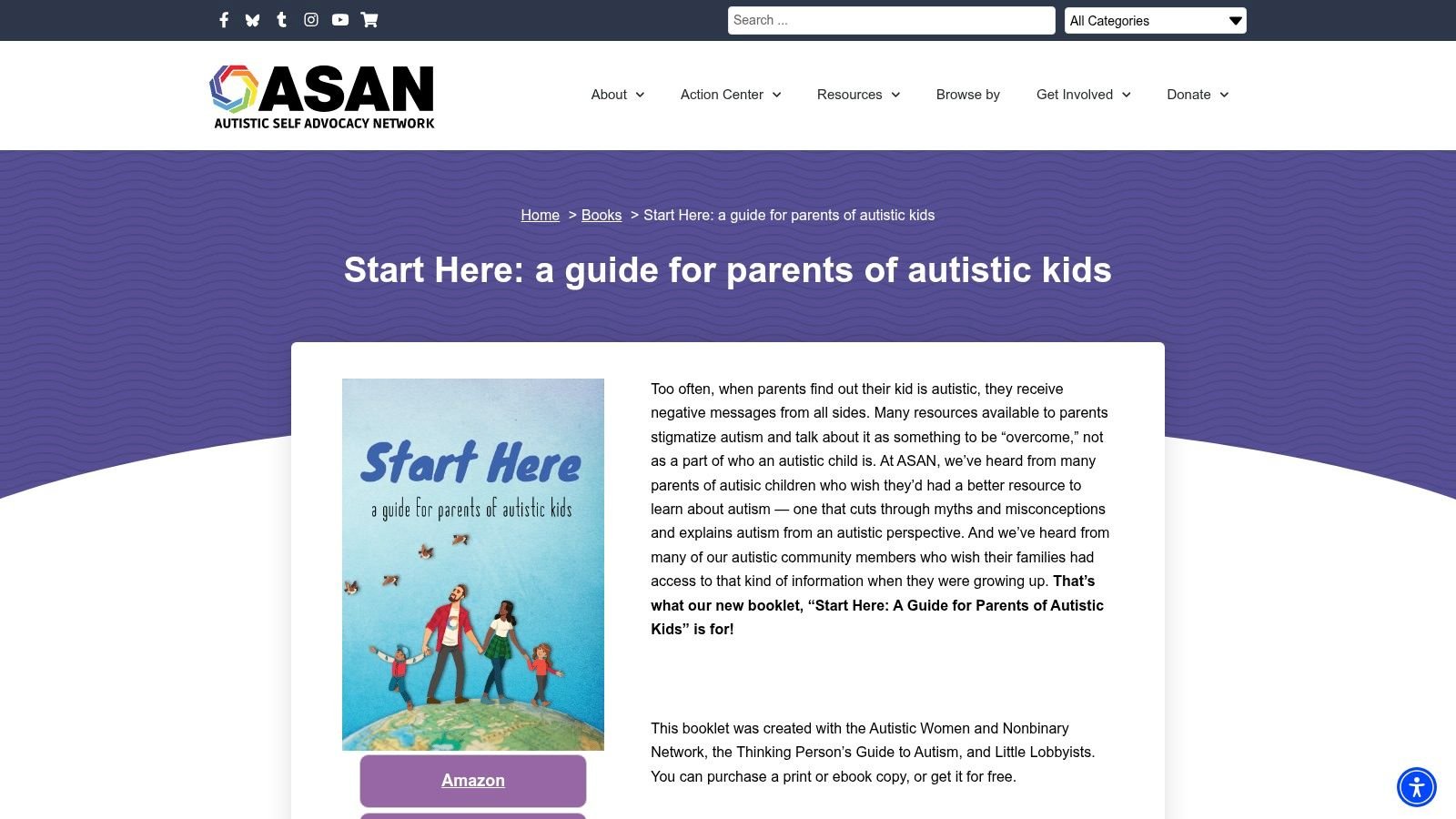
Start Here, ASAN's guide for parents of autistic kids, presents an autistic perspective on autism, next steps, good services, communication, self-advocacy, and presuming competence. It complements clinical information rather than trying to function as a medical manual.
ASAN developed the guide with the Autistic Women and Nonbinary Network, Thinking Person's Guide to Autism, and Little Lobbyists. A free download is available, alongside print and ebook options.
Read it with a real decision in mind
Say a proposed goal focuses on sitting still during an activity. Before accepting it, ask what the child needs to access that activity comfortably and whether movement is preventing participation. The relevant outcome might be communicating a break request or using a preferred seating option, not appearing less autistic.
A quieter child isn't automatically a more comfortable child. Include the child's communication and preferences when judging whether support helps.
This guide is particularly useful for relatives or caregivers whose understanding comes mainly from deficit-focused descriptions. Choose a topic, discuss how it applies at home, and agree on a respectful response to the child's needs.
Its limitation is practical scope. It isn't a directory of local providers, a detailed special-education procedure manual, or an individualized treatment plan.
Use it alongside medical and school resources. Parents need service-navigation knowledge, but they also need to consider whose goals they're pursuing and how the child can participate in those decisions.
7. Center for Parent Information and Resources Find Your Parent Center
The night before an IEP meeting is a difficult time to learn the whole special-education system. The Center for Parent Information and Resources helps you find a Parent Training and Information Center or Community Parent Resource Center that can explain the process.
Best weekly job: preparing for school decisions with locally relevant support. The hub includes early-childhood and transition materials, disability information, and resources for Spanish-speaking and military families.
Bring the decision, not just the diagnosis
Under IDEA, eligible U.S. students are entitled to a free appropriate public education, and an IEP must address present academic and functional performance and measurable goals, as explained by the U.S. Department of Education's parent and family resources. Parents also have procedural safeguards, including access to records, prior written notice, and dispute-resolution options.
A parent center can help you understand those concepts and prepare questions. Give the center a focused description of the decision you're facing.
- Send the relevant documents: Include the current plan, evaluation, or school notice.
- Describe participation: Explain which activities your child can't access and which supports have helped.
- Name your question: Ask what to clarify, document, or request at the meeting.
The trade-off is local variation. CPIR is a hub; the relevant state or community center generally provides direct support, and services and response times differ.
The directory is free to use. It's most valuable when you contact a center before a disagreement becomes urgent, while there's still time to understand the options and organize your records.
8. Autism Navigator About Autism in Toddlers Course
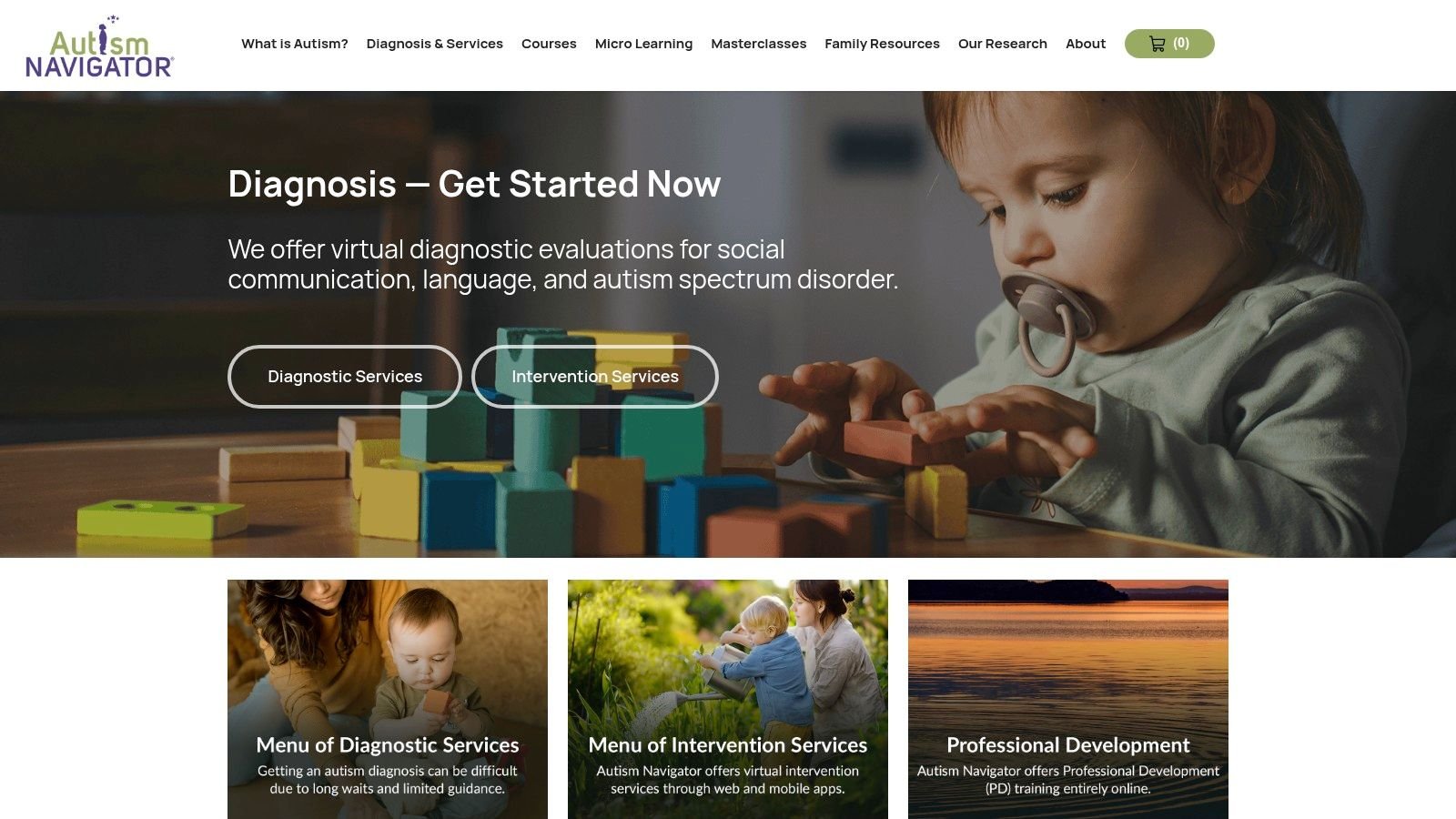
Some developmental concepts are easier to understand through video than through a written description. Autism Navigator offers About Autism in Toddlers, a free, self-paced introductory course with video examples explaining early signs, diagnostic features, and early intervention.
Best weekly job: learning what to notice before discussing a young child's development. Registration is required, and the introductory course includes printable materials and English- and Spanish-language resources.
Watch to learn, not to diagnose
Use the examples to improve the precision of your observations. Instead of deciding whether your child looks like a particular toddler, note what happens during shared play, communication, and familiar routines.
- Useful approach: Watch a manageable portion, then write down questions for an evaluator.
- Unhelpful approach: Repeatedly compare your child with a video until you feel certain about a diagnosis.
- Access distinction: The free introductory course doesn't mean every Autism Navigator family course has the same access or pricing.
The guide to free autism training can help you compare additional learning options without assuming that a longer course is automatically a better fit.
The main limitation is age and purpose. This is an early-identification resource, not a broad answer to school advocacy, adolescent mental health, or ongoing family coordination.
I'd choose it when written milestone descriptions still feel abstract. Don't postpone an evaluation inquiry until you've completed the course, and don't treat the absence of a particular video example in your child as reassurance that no assessment is needed.
9. Parent to Parent USA Peer Support
Sometimes the useful resource is a person who understands why an ordinary phone call feels exhausting. Parent to Parent USA helps families locate member organizations that connect caregivers with trained support parents who have relevant lived experience.
Its network serves families of children with special health-care needs, not only autistic children. Matching and availability are handled by state or local organizations.
Ask for the kind of connection you need
A useful match might involve a similar diagnosis, family transition, language, or service-navigation challenge. Say whether you want emotional support, help thinking through questions, or a conversation about managing caregiving demands.
- What works: Personal connection and practical perspective from another caregiver.
- What varies: Local availability, waiting periods, and the specificity of a match.
- What stays outside its role: Medical recommendations, legal interpretation, and individualized educational advice.
The parent peer support guide offers additional context for choosing and using these connections. Keep professional questions on a separate list so a supportive conversation doesn't become an accidental substitute for qualified advice.
Peer-support boundary: Another parent's experience can suggest a question. It doesn't determine what your child needs.
You also don't need to disclose your child's complete history to receive support. Share what's relevant, protect sensitive details, and notice whether the conversation leaves room for your family's priorities.
This resource is strongest when isolation or decision fatigue is the immediate problem. It won't secure an appointment or settle an IEP disagreement, but it can help you feel less alone while taking those next steps.
How the Top Autism Spectrum Disorder Resources Compare on Cost, Format, and Best Use
| Item | Cost | Format | Best for |
|---|---|---|---|
| Guiding Growth | Paid features may apply; compare current plans in the iOS or Android app store before subscribing. | All-in-one mobile app for iOS and Android | Tracking behavior, sleep, diet, and nutrition; spotting patterns and sharing information with care teams |
| CDC, Autism Information for Families | Free | Online resource hub | Families exploring autism, milestones, and early-intervention options |
| American Academy of Pediatrics, HealthyChildren.org Autism Center | Free | Online articles | Parent-friendly, pediatrician-reviewed information and preparation for health-care conversations |
| Autism Society of America, Helpline and Family Resources | Free resources; service costs vary by location | Helpline, local affiliates, and downloadable tools | Finding local support and organizing health-care information |
| Organization for Autism Research (OAR), Family Guides | Many guides are free; print costs vary | Downloadable and print guides | Understanding research, education, safety, and transitions |
| Autistic Self Advocacy Network (ASAN), Start Here: A Guide for Parents of Autistic Kids | Free download; print and ebook options | Parent guide | Learning about autism from autistic perspectives |
| Center for Parent Information and Resources (CPIR), Find Your Parent Center | Free hub; local services vary | Online directory and resource hub | Finding local support with special education and IEPs |
| Autism Navigator, About Autism in Toddlers Course | Free introductory course; other courses may cost | Self-paced online course with videos | Learning about early signs and intervention in toddlers |
| Parent to Parent USA, Peer Support | Costs and availability vary by local program | Peer-support network | Connecting with parents who have relevant caregiving experience |
Turning a Bookmark List Into a Working Routine
You don't need to use every resource every week. Choose by the job in front of you: national hubs for orientation, local organizations for service navigation, parent centers for school preparation, and peer networks for emotional support. Add research-literacy and autistic-led materials when you're evaluating goals or deciding what advice deserves attention.
Keep the daily record separate from the reading list. Articles explain concepts; dated observations explain what your child is experiencing. Both matter, but they belong in different parts of your preparation.
Start with a manageable plan
- Choose a starting resource this week: Use CDC for developmental next steps, HealthyChildren.org for a health question, or Autism Navigator for toddler-focused learning. Finish with an action, not another open tab.
- Locate a local contact: Find your parent center for a school question or contact the Autism Society about community services. Record whom you contacted and what should happen next.
- Log behavior, sleep, and meals over the next two weeks: Keep entries brief and factual. Include comfortable days, successful supports, and your child's preferences, not only difficult events.
- Prepare the conversation: Select the observations relevant to the appointment and write the decision or assessment you're asking the team to consider.
- Arrange support for yourself: Contact a peer network if you need someone to listen while you work through practical tasks.
The observation period is a planning suggestion, not a reason to delay care. New health symptoms, urgent safety concerns, or a service deadline need action when they arise.
Guiding Growth belongs in this routine as the tracking layer, not the authority over the other resources. The purpose is a shared, exportable picture of the child that supports care-team conversations. It doesn't replace medical advice, professional assessment, or your child's own account of what helps.
Keep interpretation cautious. If difficult afternoons follow poor sleep, bring that pattern to the team as a question. Don't conclude that sleep explains everything, change medication independently, or begin a restrictive diet because events happened close together.
Finally, judge the routine by whether it helps your family. Can another caregiver understand what worked? Can you explain a concern without reconstructing it from memory? Can the school or clinician identify the next useful step?
If not, simplify. A short record used consistently and a relevant contact are more useful than an elaborate system nobody can maintain. The goal is clearer support, not perfect documentation.
Guiding Growth brings voice-based daily logging, caregiver collaboration, and meeting-ready summaries into one place for families raising autistic and neurodivergent children. Visit Guiding Growth to explore how the app can help you organize observations and prepare clearer questions for your next school, therapy, or medical appointment.