Your child pulls your hand toward the kitchen. She isn't asking with words. She's asking with her whole body, and you're left guessing whether she wants juice, a cracker, or the cup on the counter she can't reach.
That reach, point, or hand pull is already communication. A good non verbal activity gives that signal a clearer shape and gives you a reliable way to answer. You don't need long drills. You need short, repeated play where your child starts something, you respond fast, and the same exchange happens again tomorrow in the same spot.
The eight activities below build initiation, gesture, joint attention, facial expression, and imitation. Each one names the skill it targets, a home or classroom version, and a simple way to track whether it's working. Research commonly classifies approximately 25% to 35% of autistic people as nonverbal or minimally verbal after early intervention in childhood, according to a review of minimally verbal communication, but absence of speech isn't absence of communication. Adults who want deeper play-based skills can also look into specialized training for child counselling to support this work.
Table of Contents
- 1. Picture Exchange Communication System (PECS)
- 2. Visual Schedules
- 3. Social Stories
- 4. Mirror and Imitation Games
- 5. Emotion Charades and Facial Expression Matching
- 6. Video Modeling
- 7. Turn-Taking and Gesture Games
- 8. Joint Attention Activities
- How the eight non verbal activities compare by core skill, setting, and materials
- Turning Small Moments Into a Communication Plan
1. Picture Exchange Communication System (PECS)
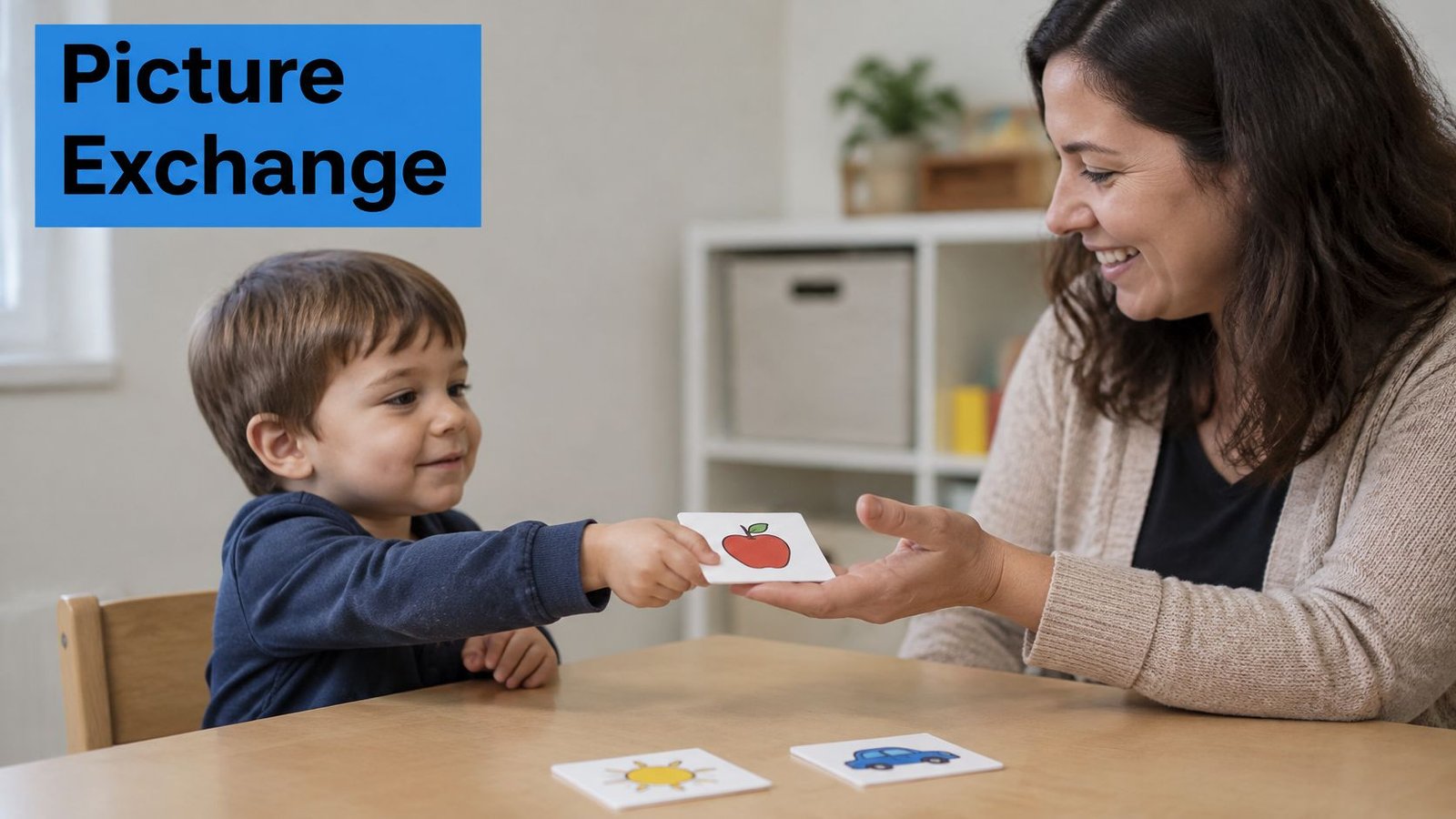
PECS builds initiation. Your child hands you a picture card and gets the item in return. That single exchange teaches the core lesson many nonspeaking children miss in ordinary routines. Starting communication gets a result.
Start with one item your child already reaches for. At preschool snack time, that might be a cracker or juice card kept in a small PECS book by the table. At home, it might be a photo of bubbles or the bath. Keep the set tiny at first, hand over the item immediately, and say its name once without demanding that your child repeat it.
What works and what stalls
- Start with high-preference items: A card for something neutral won't motivate the first exchanges.
- Respond every time at first: Delayed or inconsistent responses teach your child that reaching or crying works faster.
- Expand slowly: Add new pictures only after the first few exchanges happen without hand-over-hand help.
The trade-off is upkeep. Cards get lost, bent, and left in the wrong room, and a book that isn't within reach can't be used. A systematic review summarized by the American Speech-Language-Hearing Association evidence map found AAC interventions produced positive requesting outcomes in 10 of 12 included studies, which is why the early requesting win matters. In Guiding Growth, log which pictures your child uses, where, and whether the exchange was independent or prompted. Review that pattern with Alma before you add vocabulary, so you're expanding from real use, not guessing.
2. Visual Schedules
A visual schedule builds comprehension and calm transitions. Pictures, symbols, objects, or written words show the order of the day. Your child doesn't have to ask what comes next or hold a spoken list in memory.
Say mornings fall apart between dressing and breakfast. Put photos of toilet, teeth, clothes, and breakfast on a strip at your child's eye level, in the same hallway spot every day. She pulls each photo off and drops it in a finished envelope. In class, the same idea works with icons for circle, work, snack, and outside time.
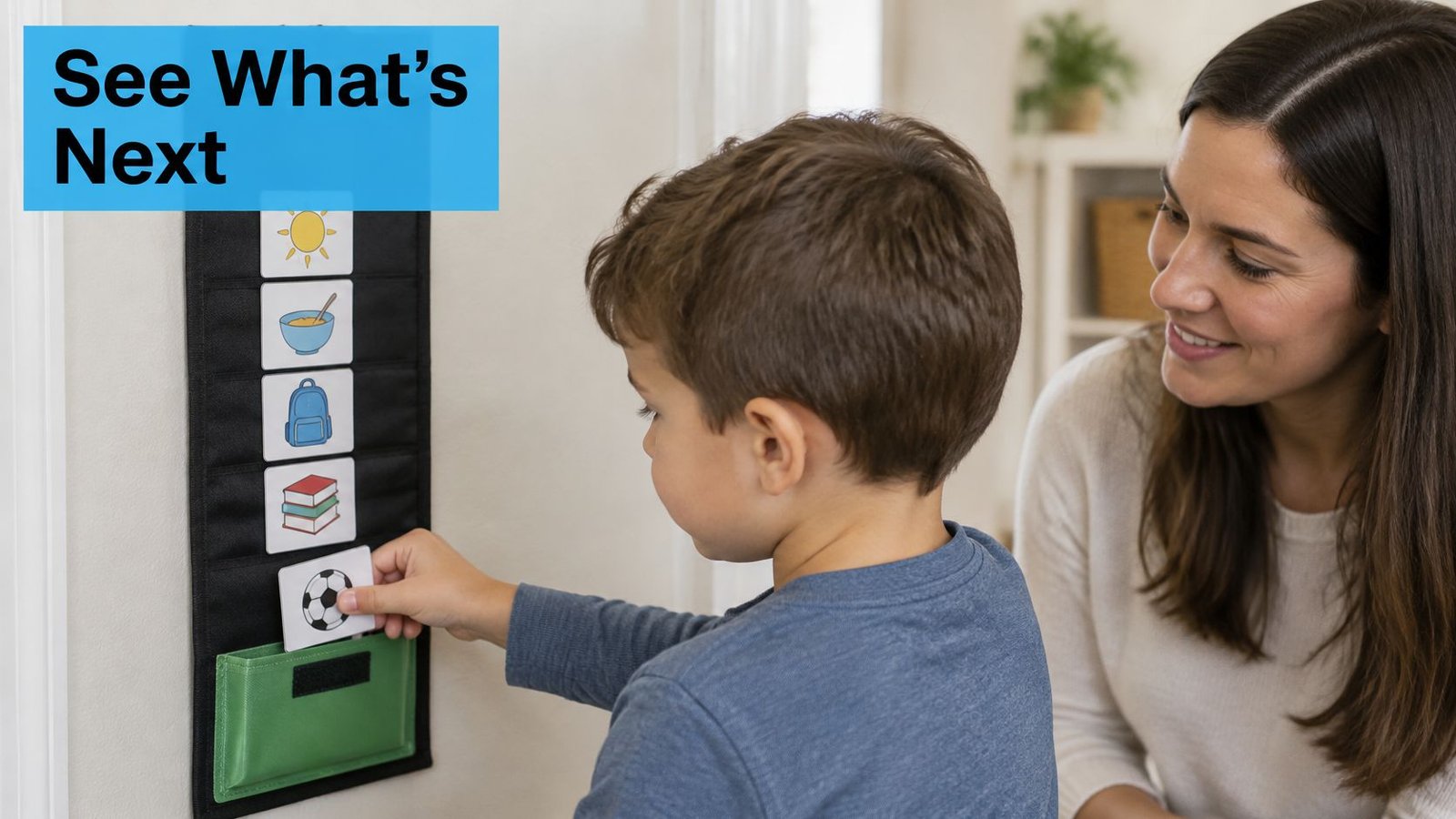
Test the symbols before you rely on them. Point to the toothbrush photo and see if your child heads to the sink or just looks at you. If she doesn't connect photo to action, use the actual object or a photo of her own toothbrush. A schedule she can't read is decoration, not support.
Practical rule: Pair one hard step with a clear next step your child likes. A first-then strip, first shoes then bubbles, beats a long board when a transition is new.
Technology-free supports such as picture-exchange symbols and visual schedules have been associated with increased requesting and social-communicative behavior in the ASHA evidence summary on AAC formats. Record smooth and rough transitions in Guiding Growth with the time and place. After two weeks, you'll see which part of the day needs a clearer visual instead of rebuilding the whole routine.
3. Social Stories
Social Stories build interpretation. Developed by Carol Gray, they're short, personal narratives that describe a situation, the cues to notice, and what your child can do. Used well, they teach what a wave, a frown, a raised hand, or a turned-away body means before your child has to read it live.
Write one for a dentist visit. Use photos of the actual waiting room and chair, name what the tools do in concrete sentences, and give your child a break signal, such as holding up a red card or signing stop. For a birthday party, show friends smiling and clapping, then give two response options your child can do, such as a thumbs up or a wave.
Keep the language usable
Avoid idioms, sarcasm, and long explanations of feelings. Short sentences win. Read the story when your child is calm, not in the car park outside the new place. If you want a step-by-step format, follow this guide to writing Social Stories for autism and keep one situation per story.
The trade-off is specificity. A generic party story won't help at a noisy soft play centre with different rules. It's also worth remembering that nonspeaking doesn't mean not understanding. A 2024 University of Virginia study reported that more than half of a sample of 31 nonspeaking autistic teenagers and adults responded to written-language tasks in ways consistent with literacy. Track the situations that produce the most distress in Guiding Growth, write a story for the top trigger, then compare the next few attempts.
4. Mirror and Imitation Games
Imitation comes before conversation. If your child can copy a clap, a stomp, or a silly face, she can learn that bodies send messages back and forth. That's the rhythm every later exchange depends on.
Sit face to face with no toys competing for attention. Clap once. Pause longer than feels natural. If your child does anything back, a tap, a bounce, an attempted clap, copy her version exactly and smile. Copying her first is often the fastest way in, because you're joining a movement she already owns instead of asking for a new one.
During bath time, make faces in the mirror together and take turns leading. In therapy or class, copy a simple drum pattern, one beat, pause, two beats, then pass the lead. Keep movements big at first. Shoulder shrugs and arm waves are easier to see and copy than finger shapes.
Don't turn this into a test. If you stack five new actions in a row and correct every miss, most children walk away. Two or three successful turns beat ten prompted ones. Nonverbal behaviour spans facial expression, eye gaze, gestures, posture, movement, vocal tone, speaking rate, pitch, volume, physical distance, and timing, as described in research on conversational interaction channels, so count gaze shifts and body turns as responses too. Note new imitations and longer engagement in Guiding Growth, and attach a short video so progress is visible, not just remembered.
5. Emotion Charades and Facial Expression Matching
This non verbal activity builds facial expression reading and production. One person shows an emotion. The other guesses it or finds the matching card. It's structured, predictable practice for a skill that moves very fast in real life.
Start with just happy and worried. Use a mirror so your child can see her own face next to a photo of a familiar adult making the same expression. Then connect each face to a real moment. Happy is bubbles in the garden. Worried is a loud hand dryer. Abstract cartoons alone rarely stick, because your child may learn the card, not the face.
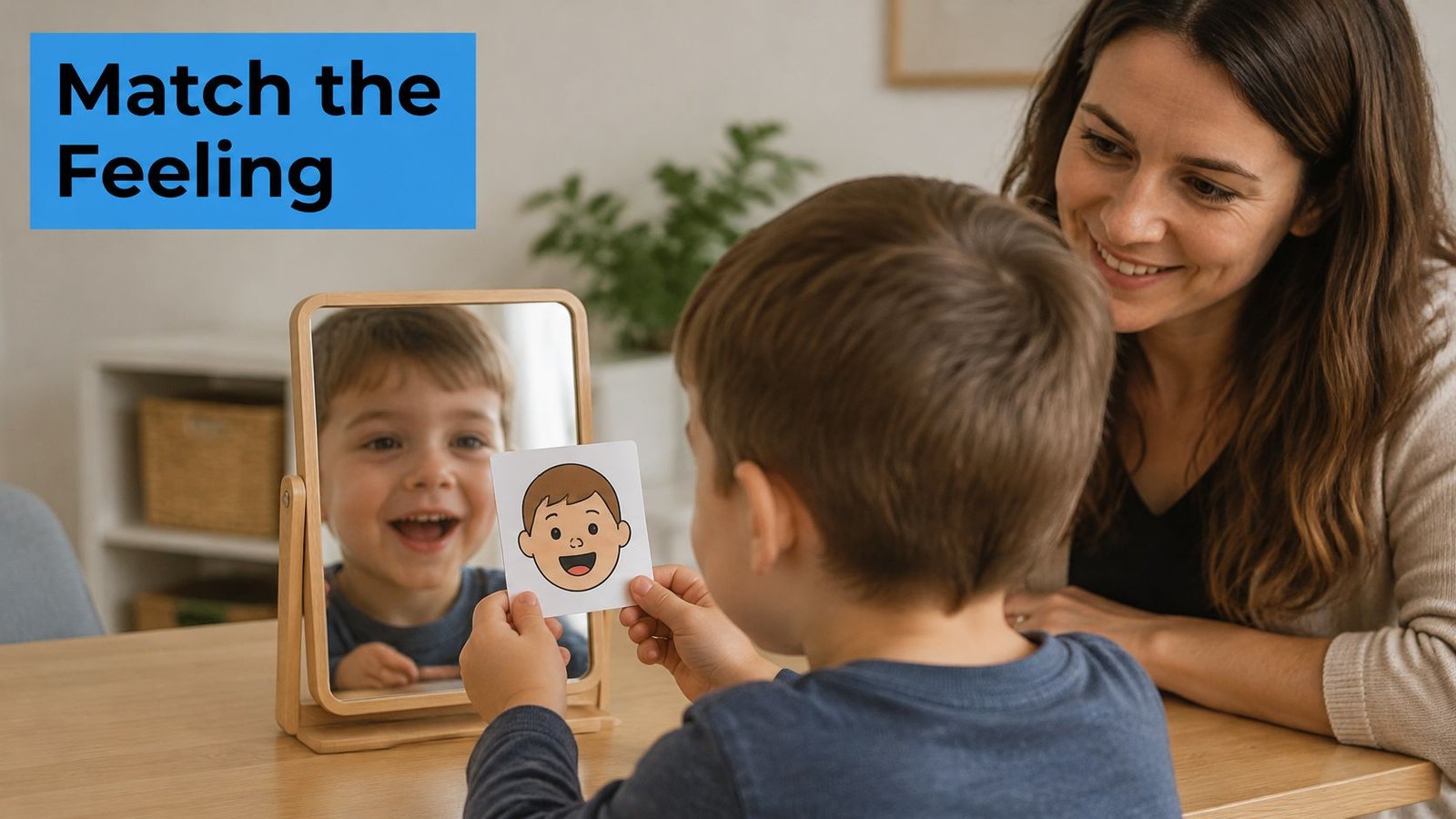
In a classroom, a peer acts out surprised or frustrated and students hold up the matching card. Keep turns short and let your child be the actor early, not only the guesser. Making a face teaches different information than naming one. For more cue-by-cue support, use this nonverbal social cues guide for autism parents alongside the game.
Be careful with the claim that communication is mostly faces. The often-quoted breakdown traces to two studies published in 1967 by Albert Mehrabian and colleagues, and a 1997 review of the 7-38-55 rule argued those experiments didn't justify treating it as a universal law. Faces matter most when words and delivery conflict. Log emotions your child shows during the day through Quick Log in Guiding Growth, then review patterns with Alma to choose the next two expressions to practise.
6. Video Modeling
Video modeling builds observation of a complete social move. You record a short clip of a child, sibling, or adult performing one target action. Your child watches it, then practises in the natural setting while the sequence is fresh.
Record a sibling tapping a parent's arm, holding up a toy car, and waiting for help to wind it up. Keep it under a minute. Show it right before playtime, not hours later as a correction. Then create the exact opportunity, same toy, same room, same adult position, and praise any part your child copies.
Where video helps and where it doesn't
Video works best for visible, repeatable actions such as waving at arrival, handing over a break card, or waiting with hands on a mat. It works poorly for fast group play where peers change the rules mid-game. Your child may copy the clip perfectly and still not know what to do when a classmate responds differently.
Film the successful version only. A clip that includes prompts, mistakes, and adult correction teaches the whole messy sequence, not the clean skill.
Computer-vision work shows why breaking behaviour into parts matters. The NVI benchmark for nonverbal interaction contains 13,711 images and 72,000 social interactions, with 22 atomic nonverbal behaviors organized into five interaction types. You don't need that detail at home, but do separate gaze, gesture, posture, and partner response when you review a clip. Store the video as an attachment on the related event in Guiding Growth so teachers and therapists see exactly which version your child practised.
7. Turn-Taking and Gesture Games
Turn-taking games build watching, waiting, and responding. Conversation fails without those three moves, even when a child later gains words. A ball rolled back and forth across a table teaches the same structure with no language demand at all.
Sit opposite your child with knees making a small barrier so the ball stays in play. Roll it, put your hands flat on the table to show you're waiting, and don't chase a slow return. Count turns out loud with your fingers if numbers motivate her. End with the same clear signal every time, such as a high five and putting the ball in a finished box.
- Rolling and sending games: Balls, cars on a track, and beanbags into a bucket give a clear send and return.
- Gesture Simon Says: Use clap, wave, point, and hands up. Drop the trick elimination rule at first. It punishes the child who's still learning to watch.
- Pointing exchanges: You point to a picture in a book, pause, and wait for a touch, look, or point back.
The trade-off is pacing. Adults speed up when a child is slow, and that steals the turn you're trying to teach. A review summarized in an ASHA evidence map on AAC for minimally verbal children reported gains in gesture, eye contact, and the number of communication turns for a majority of participants across several measures. Track in Guiding Growth how many turns your child completes and what helps her stay, then use Smart Summaries to share that at the next therapy session.
8. Joint Attention Activities
Joint attention builds shared focus. Your child looks where you look, points to show you something, or checks your face after noticing something interesting. It's not just looking at the same toy. It's knowing you're both attending to it together.
Bubbles are the simplest starter. Blow a few, point, look from the bubbles to your child, and wait several seconds before blowing more. That pause is the activity. If she looks at the bubbles, glances at you, reaches, or vocalises, blow more immediately. You've just rewarded sharing attention, not just chasing bubbles.

With a picture book, point to an animal and stop reading. Wait for a look, touch, or body shift before you name it. Light-up toys, wind-up animals, and a favourite song paused mid-line create the same opening. For a deeper breakdown of response types, see this joint attention and autism guide.
Don't manufacture this with items your child doesn't care about. Use her current favourite object, even if it's a spinning lid rather than an educational toy. Brief looks count. Demanding sustained eye contact turns a sharing moment into a compliance task and usually kills it. Record moments of shared attention in Guiding Growth as short notes with the object and setting. Over a month, you'll learn which materials reliably produce engagement and which only work in a clinic room.
How the eight non verbal activities compare by core skill, setting, and materials
| Item | Core Nonverbal Skill | Best Setting | Materials Needed |
|---|---|---|---|
| Picture Exchange Communication System (PECS) | Initiating communication by exchanging pictures | Home or school routines | Picture cards and a communication book or board |
| Visual Schedules | Understanding activity sequences and transitions | Home, school, or community routines | Pictures, symbols, objects, or written schedule |
| Social Stories | Interpreting social cues and preparing responses | Before social situations or in calm moments | Personalized story, optionally with photos or visual supports |
| Mirror and Imitation Games | Imitation, shared attention, and turn-taking | Play at home, therapy, or on the go | No materials required |
| Emotion Charades and Facial Expression Matching | Recognizing and expressing emotions nonverbally | One-to-one or small-group play | Emotion cards and optionally a mirror |
| Video Modeling | Observing and practicing gestures and social responses | Before or during a target activity | Short video and a phone or tablet |
| Turn-Taking and Gesture Games | Watching, waiting, and responding with gestures | Home, therapy, or group play | Enjoyable play objects; optional visual cues or timer |
| Joint Attention Activities | Following gaze and pointing, and sharing focus | Play routines or shared reading | Engaging objects such as bubbles, toys, or picture books |
Turning Small Moments Into a Communication Plan
Don't run all eight activities. Pick two or three that match the gap you see most often. If your child rarely starts an exchange, begin with PECS and joint attention. If transitions cause the most distress, start with a visual schedule and one Social Story for the hardest routine. If she watches people but doesn't join in, choose mirror games and turn-taking.
Run the same activity in short bursts in the places where communication happens. A skill that appears only at a therapy table hasn't yet become communication. You want to know whether your child uses the card with grandma, points to share at school, or copies a gesture with a sibling. That spread across people and settings is the result that matters.
Judge progress more broadly than requests. A 2025 systematic review of speech-generating-device interventions found 14 of 20 studies primarily targeted requesting, while only six addressed a broader range of communication functions. Your child also needs ways to refuse, comment, ask, share an experience, and repair a misunderstanding. Track those functions by name. More button presses for snacks can look like progress while your child still has no reliable way to say stop, help, or look at this.
Choose supports by fit, not by what's newest. A 2025 study of eight autistic children with complex communication needs found every participant showed proficiency with at least one AAC modality, and caregiver preferences generally aligned with the child's preferences. That means your tracking should separate independent use from prompted use, note the partner and setting, and record whether the message was understood. Apparent success under constant prompting isn't the same as your child communicating on her own.
Keep logging light enough that you'll still do it in month three. An evidence review in research on AAC abandonment and barriers reports approximately 30% to 50% of AAC users abandon or substantially underuse their systems. Burden kills good systems. Use voice notes, short structured entries, and photos in Guiding Growth instead of writing essays after bedtime. Log the activity, what happened just before, your child's signal, your response, and whether it worked.
That record changes meetings. Instead of saying communication seems a bit better lately, you can show that bubble play produced shared looks at home but not at school, that a new picture is used independently at snack, or that mirror games hold attention for six turns with dad and two with an unfamiliar adult. Teachers, therapists, and pediatricians can act on that. They can't act on a general impression. Small moments, recorded consistently, become a plan your whole team can follow and adjust.
Start with one activity this week, log each attempt in Guiding Growth with the context, your child's signal, and what happened next, and bring the pattern to your next therapy session or IEP meeting as a clear summary. Visit Guiding Growth to set up your child's profile and turn these play moments into data your whole care team can use.