It's 2 a.m., you're on the edge of your child's bed again, and you're trying to work out whether this is the fourth bad night in a row or the fifth. A tracker the next morning says your child slept fine. You know that isn't true. That gap is where best sleep tracking for autistic kids starts, not with buying a more expensive device, but with understanding what these tools can and can't see.
Table of Contents
- Why Sleep Tracking Feels Different for Autistic Children
- What Sleep Trackers Actually Measure (and What They Don't)
- Comparing the Main Sleep Tracking Methods
- A Practical Comparison Across Family-Friendly Criteria
- The Quiet Wakefulness Problem Most Comparisons Miss
- Reading Sleep Data as a Trend, Not a Verdict
- Connecting Sleep to the Rest of Your Child's Day
- Practical Next Steps and Common Questions
Why Sleep Tracking Feels Different for Autistic Children
Most buying guides start with the wrong question. They ask which watch or ring is most accurate for a healthy adult sleeping alone. Your question is different. You need to know whether a method will still be in use in eight weeks, whether your child will tolerate it at midnight, and whether it tells you anything useful about settling, waking, and the next day at school.
That's the standard I'd use. The best sleep tracking setup is the one your family will keep using consistently. A perfect device that your child rips off, or an app you stop opening after three nights, gives you no pattern at all.
Sleep problems aren't a side issue here
You're not tracking for curiosity. Reviews estimate that 40% to 83% of autistic people experience some form of sleep problem, and another systematic review found reported prevalence between 64% and 93% in several child-focused studies, as summarized in the review of sleep problems in autistic people. With numbers like that, sleep belongs in your child's daily record, not in a vague recollection at a pediatric appointment six months later.
If you're trying to understand the triggers behind those nights, start with common causes of night waking in autistic kids before you spend money on hardware. For older children especially, it's also worth reading about sleep problems linked to teen anxiety from Uptown Psychology, because anxiety can look like simple bedtime resistance and it changes what you should be logging.
Laboratory testing doesn't solve this easily either. Overnight lab studies can be costly and burdensome, and they're particularly hard for autistic participants who may not tolerate unfamiliar rooms, wires, or interrupted routines. That pushes most families toward home monitoring, where comfort and routine matter as much as sensor quality.
My rule for families: Don't chase nightly precision. Chase a record you can keep for months, because the pattern across weeks is what helps you and your child's clinicians make decisions.
Treat sleep as a repeated daily variable, like food, medication, or sensory load. Once you see it that way, the marketing claims about detailed sleep stages matter far less than whether you captured bedtime, settling time, awakenings, and how your child functioned the next morning.
What Sleep Trackers Actually Measure (and What They Don't)
A consumer tracker tries to do four jobs, and it isn't equally good at them. It detects sleep versus wake, estimates sleep stages like light, deep, and REM, counts awakenings, and rolls everything into a single sleep score. The first job is the most reliable. The other three get progressively shakier.
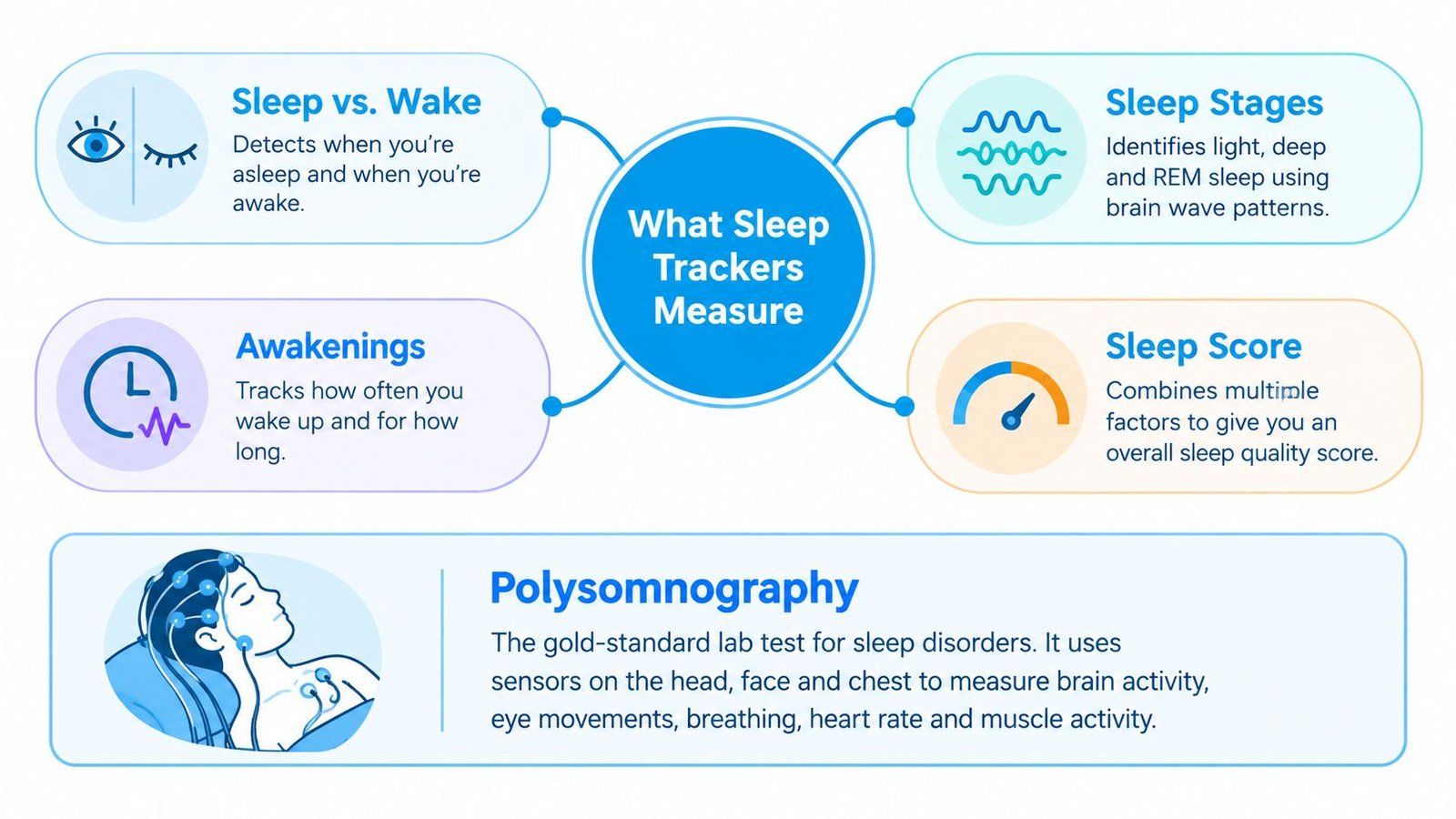
The clinical reference is polysomnography, or PSG. It's a lab test using sensors on the head, face, and chest to measure brain activity and other signals directly. A watch or ring doesn't measure brain waves. It infers sleep from movement, heart rate patterns, and similar indirect signals, then guesses what stage your brain was probably in.
Sleep detection is strong, stage detection isn't
In a laboratory study, 35 healthy adults wore an Oura Ring, Fitbit, and Apple Watch overnight during PSG, and all three devices achieved at least 95% sensitivity for detecting sleep versus wake, according to the 2024 polysomnography comparison of Oura, Fitbit, and Apple Watch. In plain terms, when someone was asleep, the devices usually said so.
Stage accuracy was another story in that same work. Sensitivity ranged from 50% to 86% across devices and stages, and the duration errors were large enough to mislead you. Fitbit overestimated light sleep by 18 minutes and underestimated deep sleep by 15 minutes, while Apple Watch overestimated light sleep by 45 minutes and underestimated deep sleep by 43 minutes.
Those were healthy adults, not autistic children. Don't generalize those numbers directly to your child. If a device struggles to separate deep from light sleep in cooperative adults in a lab, you shouldn't trust its REM chart for a child who stimmed in bed, got up twice, and ended the night in your room.
- Sleep versus wake: Useful for broad duration and routine trends
- Sleep stages: Estimates only, never treat a single night as fact
- Awakenings: Often undercounted, especially brief or quiet ones
- Sleep score: A brand's own formula, not a clinical measure
Comparing the Main Sleep Tracking Methods
Look at the bedside first, then at the specs. Sensory tolerance, whether your child leaves the room at night, co-sleeping, skin sensitivity, and charging routines will decide your shortlist faster than any accuracy claim.
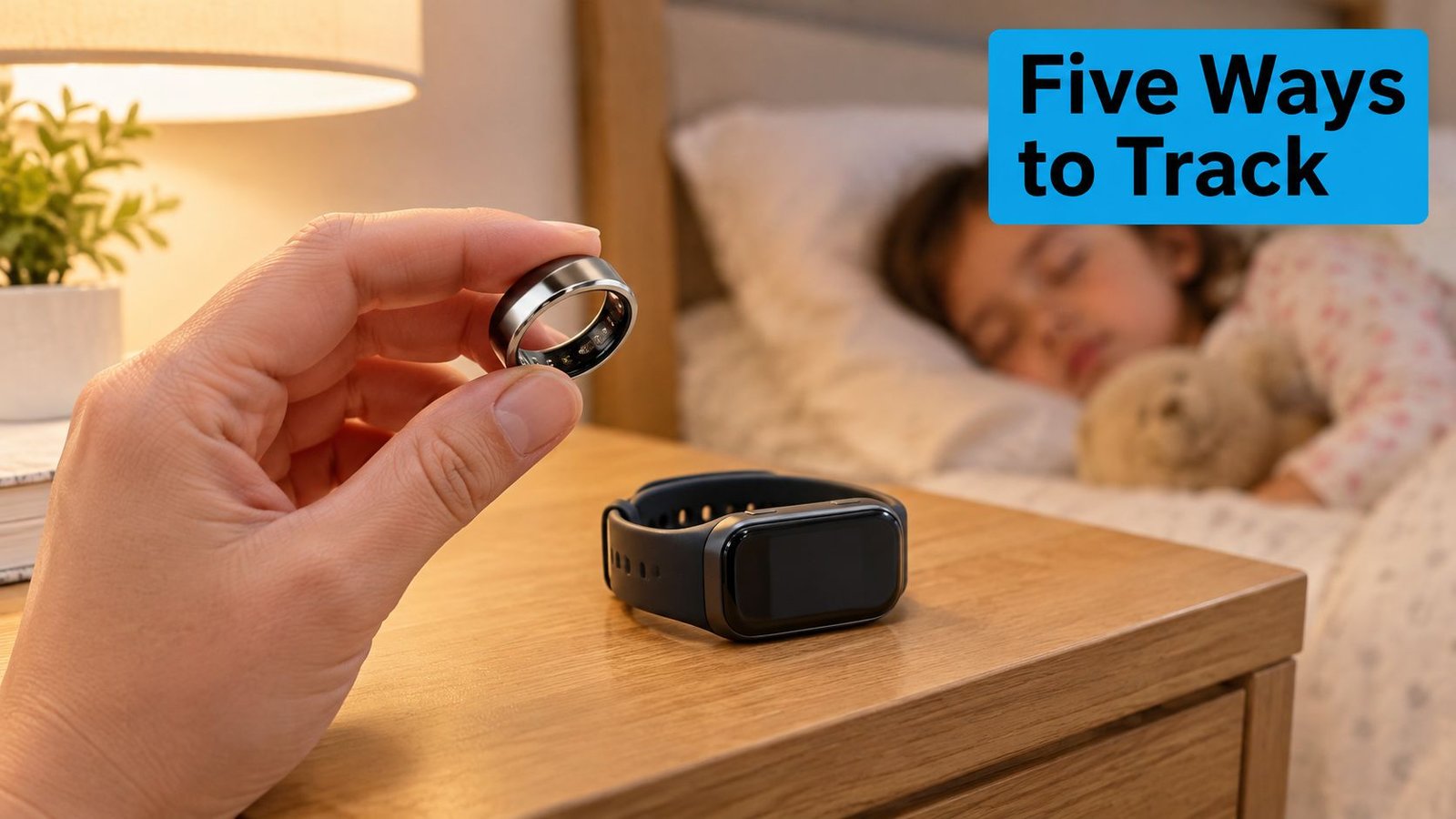
Wrist wearables like Fitbit and Apple Watch are the default recommendation in mainstream guides, and they're my last resort for many autistic kids, not my first. A strap that's fine at 7 p.m. can become intolerable at 1 a.m. If your child picks at seams, hates tight bands, or removes anything unfamiliar, you'll get missing data on the worst nights, which are exactly the nights you need. They suit older children who already wear a watch willingly.
Smart rings remove the strap and screen, so some children tolerate them better. But sizing is a real problem for small hands, a loose ring gives poor signal, and a child who mouths objects shouldn't be sleeping with one. I'd only consider a ring for an older teen who actively wants it.
Low-contact options often win in real homes
Under-mattress sensors put nothing on your child's body. That's a genuine advantage if sensory tolerance is the barrier. The tradeoffs are movement from a co-sleeping parent or sibling muddying the signal, and a child who ends up on the floor or in your bed disappearing from the record entirely.
Audio monitors repurposed from baby years capture sound, crying, and calling out. They miss silent wakefulness completely, but they do answer a practical question many parents have, which is whether their child called out, got distressed, or left the room. For a child with elopement risk, an alert matters more than a sleep stage.
Watch how phone and wearable tracking works in practice before you commit to a setup your child has to wear.
A diary or app log is the least glamorous option and, for most families I talk to, the most sustainable. You record what you observed, bedtime, how long settling took, awakenings you saw, wake time, and next-day functioning. It won't detect a waking you slept through. It also won't invent deep sleep minutes, and it asks nothing of your child at all.
A Practical Comparison Across Family-Friendly Criteria
Forget headline accuracy. Judge these methods on wake-detection performance, missing-data rate, battery life, and whether you can export the raw time-series data. A label like AI sleep score tells you nothing about any of that.
The validation record is humbling. In a clinical comparison against PSG, sleep-detection sensitivity reached 96.66% and 96.04% for two tested devices, while wake-detection specificity was only 39.09% and 44.76%, so the devices overestimated total sleep time and sleep efficiency and underestimated sleep latency and wake after sleep onset, as reported in the clinical comparison of consumer activity trackers against polysomnography. Total sleep time error itself ranged from 5.3% for Fitbit Versa to 14.3% for Garmin Vivosmart in a separate multi-device evaluation.
Comparing Sleep Tracking Methods for Autistic Children
| Method | Sensory fit | Wake-detection performance | Logs caregiver observations | Exportable data | Battery and burden |
|---|---|---|---|---|---|
| Wrist wearable | Poor for strap-sensitive kids, fine if already worn | Weak on quiet wakefulness | No, automated only | Usually yes, varies by brand | frequent charging, must be worn nightly |
| Smart ring | Better than a strap, sizing limits younger kids | Weak on quiet wakefulness | No | Usually yes | Multi-day charge, easy to lose |
| Under-mattress sensor | Excellent, nothing on the body | Weak, co-sleeping confounds it | No | Varies | Low nightly burden after setup |
| Audio monitor | Excellent, nothing on the body | Misses silent waking entirely | Partial, you interpret sounds | Rarely structured | Low, but you review it yourself |
| Diary or app log | Excellent, no device for the child | Only records what you observed | Yes, that's the whole point | Depends on the app | No charging, needs your consistency |
Notice what's missing from every commercial row. Almost none of these tools were validated specifically in autistic children. Pediatric testing is uncommon, and autism-specific testing is rarer still. You're extrapolating from adult data every time, so don't pay a premium for stage detail that was never proven in your child's population.
My practical ranking for most families is diary first, under-mattress second, wearable only if tolerated. That ordering puts the least burden on your child and gives you the contextual notes, illness, medication timing, who was in the room, that no sensor captures.
The Quiet Wakefulness Problem Most Comparisons Miss
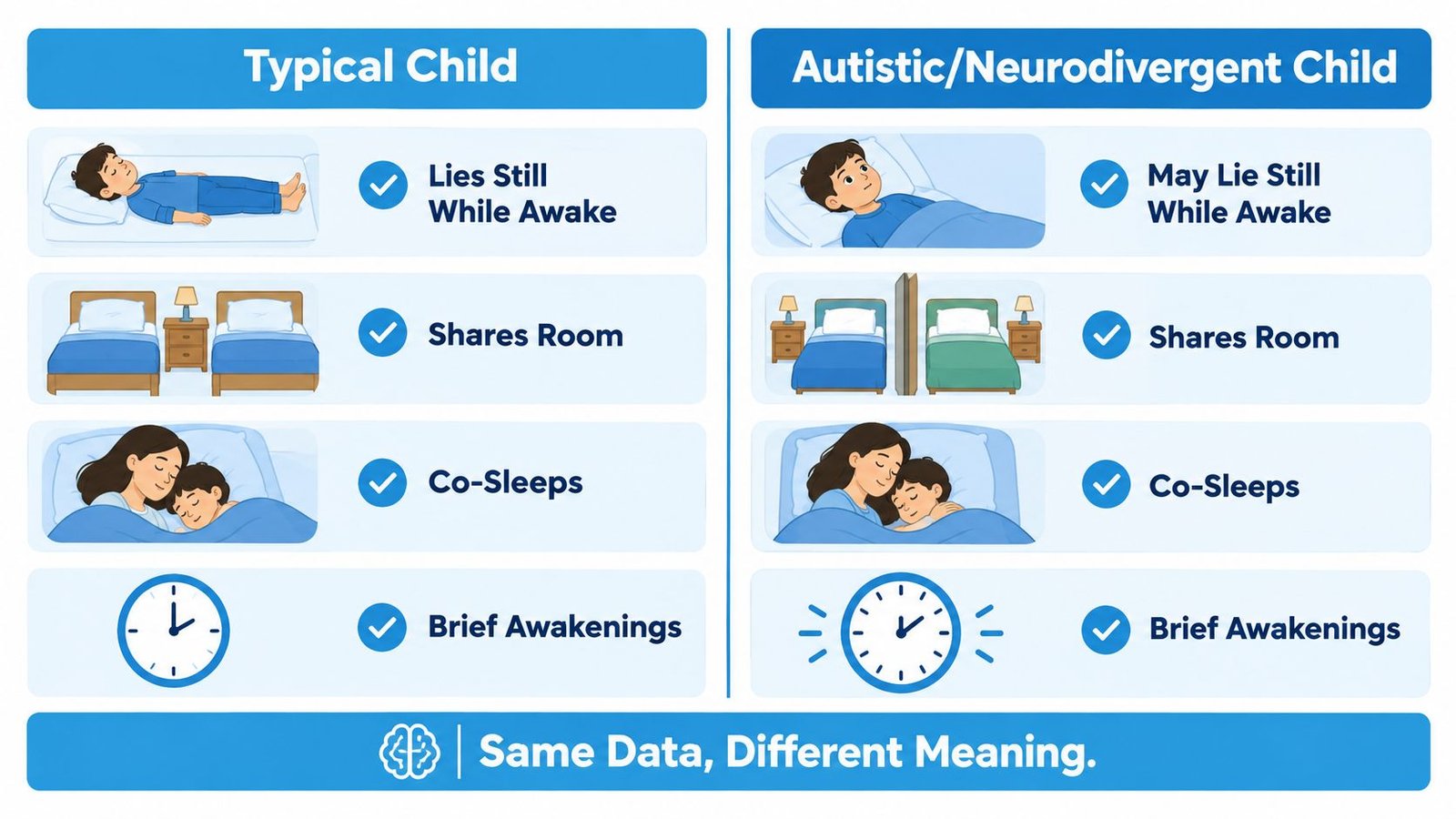
This is the failure mode that matters most for your child, and product rankings almost never lead with it. Many trackers classify quiet wakefulness as sleep. Your child lies still, eyes open, maybe listening or worrying or waiting, and the device scores it as a solid block of rest.
The evidence is consistent. An under-mattress sensor evaluation found 83% overall sleep and wake classification accuracy, with sensitivity of 95% but specificity of only 37%, and it overestimated total sleep time by a median 48 minutes while underestimating wake after sleep onset by 54 minutes, according to the 2025 under-mattress sensor evaluation. Sensitivity means catching real sleep. Specificity means catching real wakefulness. That sensor was good at the first and poor at the second.
Why this hides exactly what you need to see
Autistic and neurodivergent children may lie still while awake, wake briefly without moving much, have sensory-related night waking, or share a room with a caregiver. Every one of those situations feeds the false-positive problem. Your tracker reports a consolidated night. Your child was awake for long stretches. You then sit in an appointment describing exhaustion while holding data that contradicts you.
The range across devices is wide, too. Evaluating 11 consumer sleep trackers across two institutions, with 3,890 hours of tracker recordings compared against 543 hours of PSG data, researchers found the strongest device reached a macro F1 score of 0.69 for sleep-stage classification while the weakest scored 0.26, where scores closer to 1 mean better agreement, in the two-institution evaluation of 11 consumer sleep trackers. Average performance even shifted slightly between testing sites, with macro F1 values of 0.4973 and 0.4876.
A tracker that calls quiet wakefulness sleep doesn't just add noise. It erases the fragmentation pattern you bought it to find.
So stop comparing deep sleep and REM charts. Ask instead how a method handles a still, awake child, and whether it lets you record what you saw alongside its estimate. The best tracker may be the one that creates the least family burden and supports consistent logging, not the one claiming the most detailed stages. I believe that's true for most households reading this.
Reading Sleep Data as a Trend, Not a Verdict
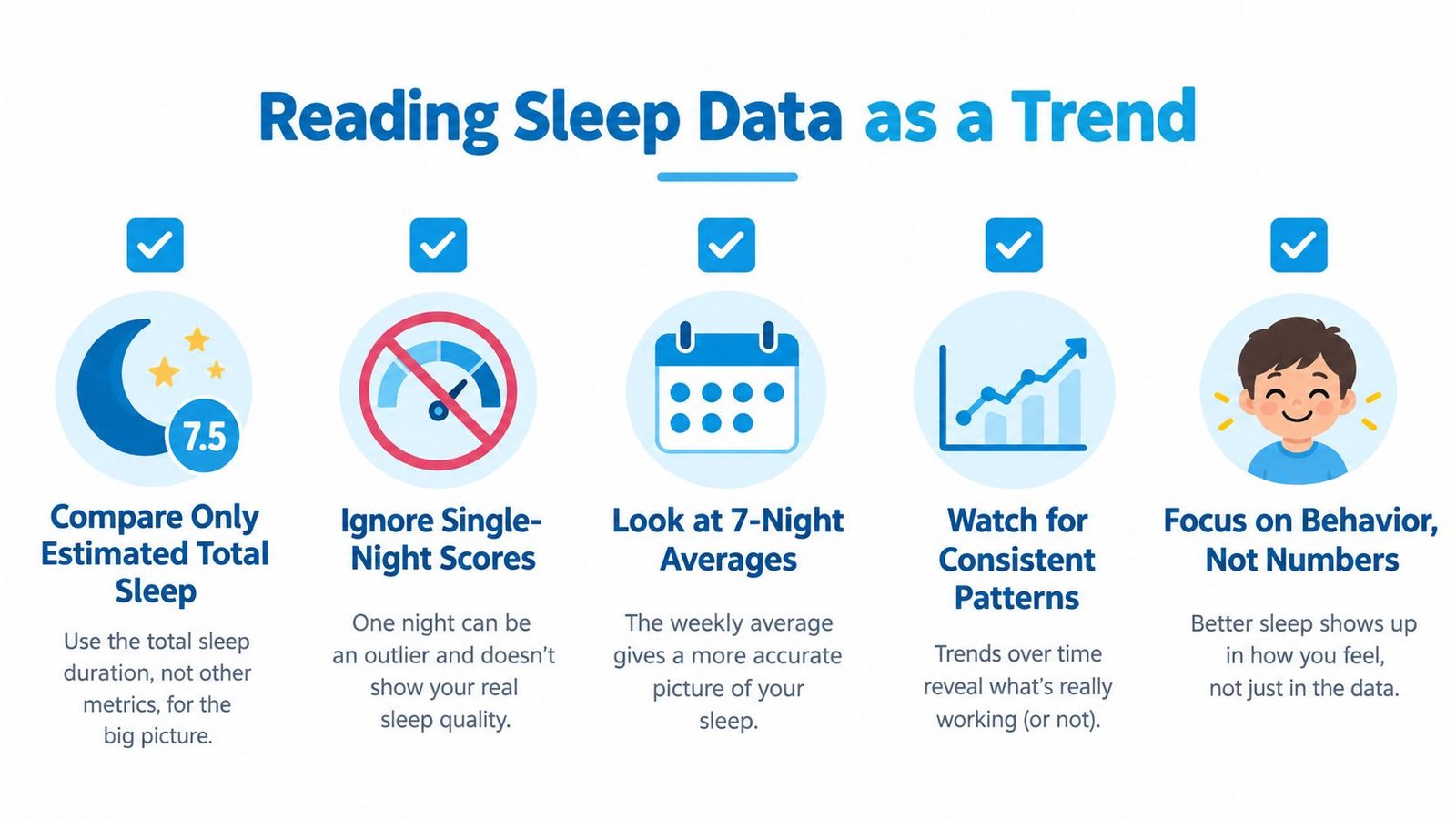
One night tells you almost nothing. Devices disagree with each other, and they disagree with themselves across different kinds of nights. A comparative study of four consumer trackers found differences between devices for sleep duration or stages on a single night could average as much as 1 hour 36 minutes, reported in the comparative study of four consumer sleep trackers. If two devices on the same child can differ by that much, a single reading isn't a verdict.
Meta-analysis puts scale on the error. Covering 24 studies and 798 participants, wrist-worn devices differed from PSG by an average of 16.854 minutes for total sleep time, 4.691 percentage points for sleep efficiency, 2.574 minutes for sleep latency, and 13.255 minutes for wake after sleep onset, as found in the 2025 meta-analysis of wrist-worn sleep devices. Read every nightly number as an estimate with real error bars.
What to compare, what to ignore, what to write down
- Compare across nights: Bedtime, wake time, estimated total sleep, and how many awakenings you observed
- Ignore as marketing: Single-night REM or deep sleep percentages and proprietary scores
- Use the same method: Switching devices resets your baseline and breaks the trend
- Look at weeks: A seven-night or monthly view shows what one rough Tuesday can't
Pair every reading with short context. Note the bedtime routine, how long settling took, sensory events that evening, illness, medication or supplement timing, screen time before bed, co-sleeping, and next-day mood and behavior. That context is what turns a shaky estimate into an interpretable pattern.
Know when to stop shopping and start talking to a clinician. If you see a persistent pattern of prolonged settling, frequent waking, loud snoring, or a child who's struggling badly in the daytime despite apparently adequate sleep, bring your log to your pediatrician or a sleep specialist. A consumer device can't diagnose insomnia, sleep apnea, or a sleep-stage problem. Persistent discrepancies between what you observe and what the device reports are a reason for that conversation, not a reason to buy a third tracker.
Connecting Sleep to the Rest of Your Child's Day
Sleep data on its own rarely answers the question you're asking. You want to know whether sensory-heavy days lead to fragmented nights, whether short sleep predicts tomorrow's meltdowns, and whether a medication timing change altered settling. A single-purpose tracker can't answer any of those, because it never saw the day.
Autism-focused research points toward multi-source home monitoring for exactly this reason. The Simons Sleep Project assembled more than 3,600 nights of data from 102 autistic adolescents aged 10 to 17 and 98 non-autistic siblings using EEG headbands, smartwatches, under-mattress sensors, and parent sleep diaries, and it reported that objective measures such as total sleep time were more accurate and reliable than parent-reported measures, described in the 2025 Simons Sleep Project findings. Notably, sleep-onset latency was the only objective measure examined that significantly differed between autistic adolescents and siblings.
You don't need four devices. You need one place where sleep sits beside the rest of the day. Guiding Growth is one option built for that workflow. A parent describes the day out loud, and the app extracts structured entries for sleep, behavior, meals, mood, screen time, and medications, which the parent reviews before saving. Sleep duration and quality then sit next to behavior triggers, sensory events, and therapy sessions, and the app can generate summaries for pediatric, therapy, or IEP meetings. It functions as a tracking and organization tool, not a source of medical conclusions.
Pattern questions worth asking
- Settling after busy days: Do high sensory load days predict longer time to fall asleep
- Food and nights: Do particular meals or supplements cluster with restless nights
- Short sleep and behavior: Do difficult days follow fragmented nights more than they precede them
Environment belongs in that record too. If you're adjusting the room itself, ways to build a sensory-friendly sleep environment covers lighting, sound, and bedding changes you can log as interventions and then watch in your trend data. Change one thing at a time, note the date, and give it enough nights to judge. That's how a log earns its keep.
Practical Next Steps and Common Questions
Start tonight with the lowest-burden option. Log bedtime, estimated sleep onset, awakenings you noticed, wake time, naps, and one line on morning functioning. Add a wearable or mattress sensor later only if your child tolerates it and you still have unanswered questions.
How long before I look for patterns? Give it a few weeks of consistent entries. One week shows routine, a month shows whether difficult days cluster after short or fragmented nights. Consistency with the same method matters more than adding sensors.
What if the tracker disagrees with what I saw? Trust your observation and write it down. Devices detected more than 90% of sleep epochs but had wake specificity ranging from 29.39% to 52.15% with only fair to moderate agreement with PSG, as shown in the six-wearable validation against polysomnography. Your note is data, not an anecdote to apologize for.
Can I share consumer scores with clinicians? Share the timeline, bedtimes, wake times, observed awakenings, and your notes. Present device stages as estimates. A clear trend is useful in an appointment, a REM percentage isn't.
Where does routine fit in? Tracking won't fix settling on its own. Pair your log with a predictable wind-down, and if communication is a barrier, building a sleep routine for nonverbal kids gives you visual and sensory approaches that don't depend on verbal negotiation.
The core recommendation stays simple. Best sleep tracking for an autistic child is the routine your family can sustain inside your existing day, not the device promising the most detailed score. Start low-contact, log context, and escalate to a clinician when the pattern persists.
If you're tired of sleep notes scattered across apps, texts, and memory, Guiding Growth lets you record sleep, behavior, meals, mood, and medications by voice in about a minute, then turns those entries into patterns and meeting-ready summaries you can share with your child's care team. Start logging tonight's bedtime, settling time, and awakenings there, and build the trend that helps you make decisions.