You're trying to get dinner ready when your child starts screaming. Yesterday, the same thing happened after you put a worksheet on the table. The behavior looks familiar, but the support your child needs may be completely different.
At dinner, your child might be reacting to the extractor fan, asking for food, or struggling to stop a preferred activity. During homework, they might need help understanding the task. The same outward behavior doesn't automatically have the same function. Responding to every episode with the same strategy can miss what your child is communicating.
These antecedent behavior consequence examples show how to separate what happened before an action, the action itself, and what followed. That gives you something more useful than a label such as defiant or attention-seeking.
Start with observation, not a verdict. An ABC record helps you develop a hypothesis, not prove a cause. Your job isn't to diagnose your child's behavior during a difficult moment. It's to capture enough detail that you and their care team can plan better support.
Table of Contents
- 1. ABC Data Collection (Antecedent-Behavior-Consequence Recording)
- 2. Attention-Maintained Behavior When a Child Interrupts Adult Conversation
- 3. Escape-Maintained Behavior When a Child Refuses Difficult Tasks
- 4. Tangible-Maintained Behavior When a Preferred Item Is Denied
- 5. Sensory-Maintained Behavior During Quiet Times
- 6. Transition-Related Behavior When Play Ends
- 7. Sensory Overload in Public Spaces
- How Each ABC Pattern Starts, Ends, and Responds
- Turn One Example Into a Pattern You Can Use
1. ABC Data Collection (Antecedent-Behavior-Consequence Recording)
An ABC entry is a short account of an observable sequence. The antecedent comes immediately before the behavior. The consequence comes immediately afterward. Consequence doesn't mean punishment, and it doesn't have to be something an adult intended.
Use this visual to keep those parts separate.
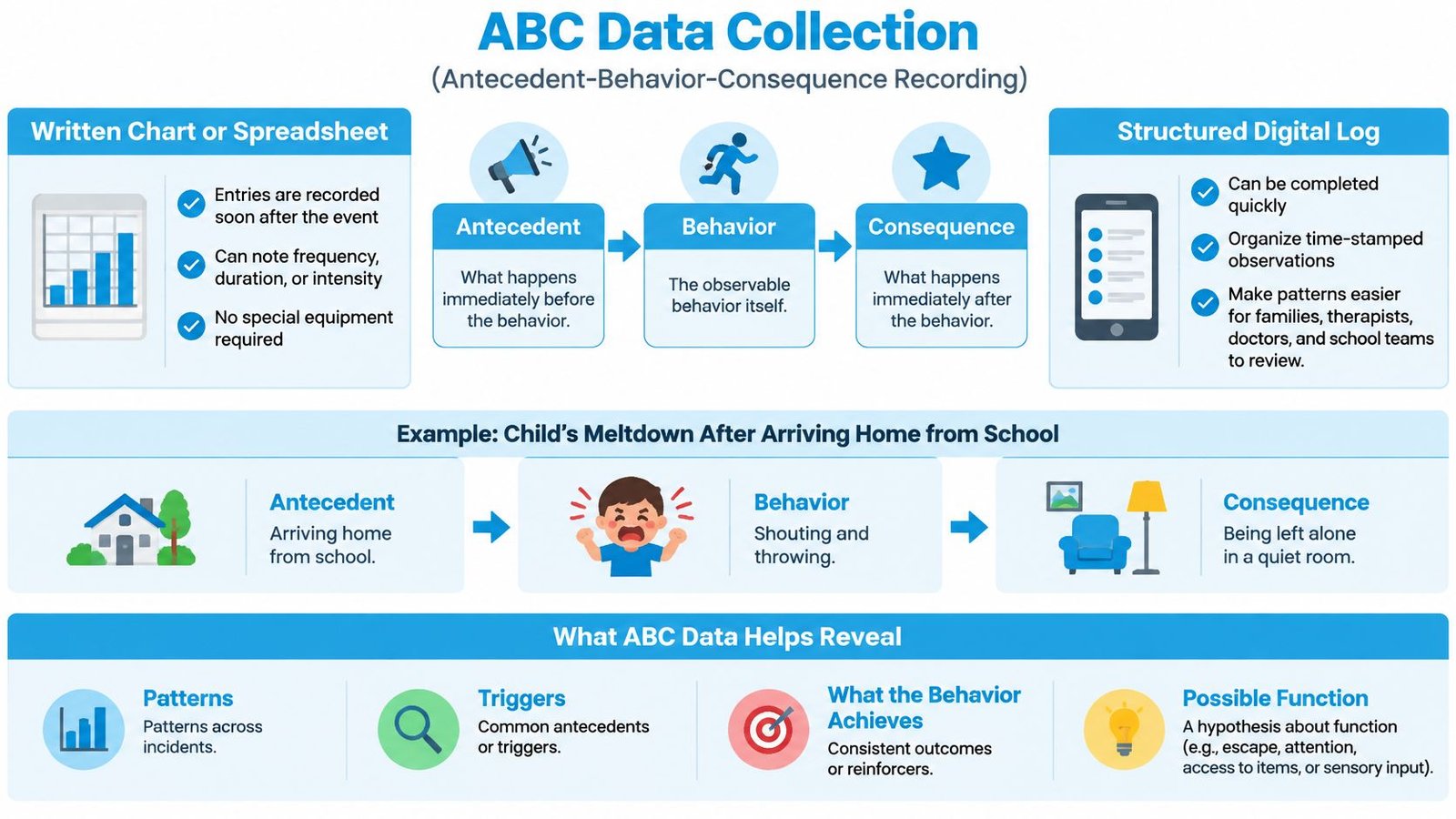
Consider a child arriving home from school:
- Antecedent: A caregiver asks the child to unpack their schoolbag.
- Behavior: The child shouts and throws the bag toward the wall.
- Consequence: The caregiver stops asking and offers a quiet room.
The immediate antecedent is the unpacking request. The school day, journey home, hunger, and noise are background conditions worth recording, rather than interchangeable explanations.
Write what another person could recognize
Replace angry with throws the schoolbag toward the wall. Our guide to operational definitions of behavior explains how to make descriptions observable and consistent.
Behavioral assessment depends on measurable actions and demonstrated effects, rather than assumptions, principles established in Baer, Wolf, and Risley's foundational applied behavior analysis paper.
This video offers another way to understand the sequence.
Next step: Record the next occurrence soon afterward, including the request, exact action, adult response, and relevant background conditions. Leave the function undecided until you can compare repeated observations.
2. Attention-Maintained Behavior When a Child Interrupts Adult Conversation
Your phone rings, and your child starts pulling your sleeve. You turn away from the call and speak to them. That sequence may suggest that access to your attention matters.
It doesn't mean your child is manipulative. They may lack a reliable way to check that you're available, request connection, or understand how long a conversation will last.
- Antecedent: You begin speaking on the phone and look away.
- Behavior: Your child pulls your sleeve and calls your name repeatedly.
- Consequence: You pause the call, turn toward them, and respond.
Make connection easier to request
Teach a signal your child can already manage, such as touching your arm, handing you a picture, or using their communication device. Respond promptly during practice. A waiting card won't help much if your child hasn't learned what it means or when attention will return.
Caregiver-mediated functional communication training focuses on teaching an accessible response that achieves the same outcome as challenging behavior, as described in this functional communication training study protocol.
Practical rule: Don't make the replacement request harder than the behavior you're hoping it will replace.
Offer focused attention before predictable busy periods, too. Noncontingent reinforcement explains the distinction between providing attention proactively and waiting for a difficult episode.
Ignoring screaming is a poor starting plan. Check for pain, fear, urgent needs, and communication difficulty first.
Next step: Practice an easy attention signal while you're available, then log whether your child uses it when your attention shifts elsewhere.
3. Escape-Maintained Behavior When a Child Refuses Difficult Tasks
Task refusal can tell you something about the task. Before treating it as a motivation problem, check whether your child understands the instruction, has the required skill, and can comfortably manage the materials.
A visual prompt can make the next action clearer without adding more spoken instructions.
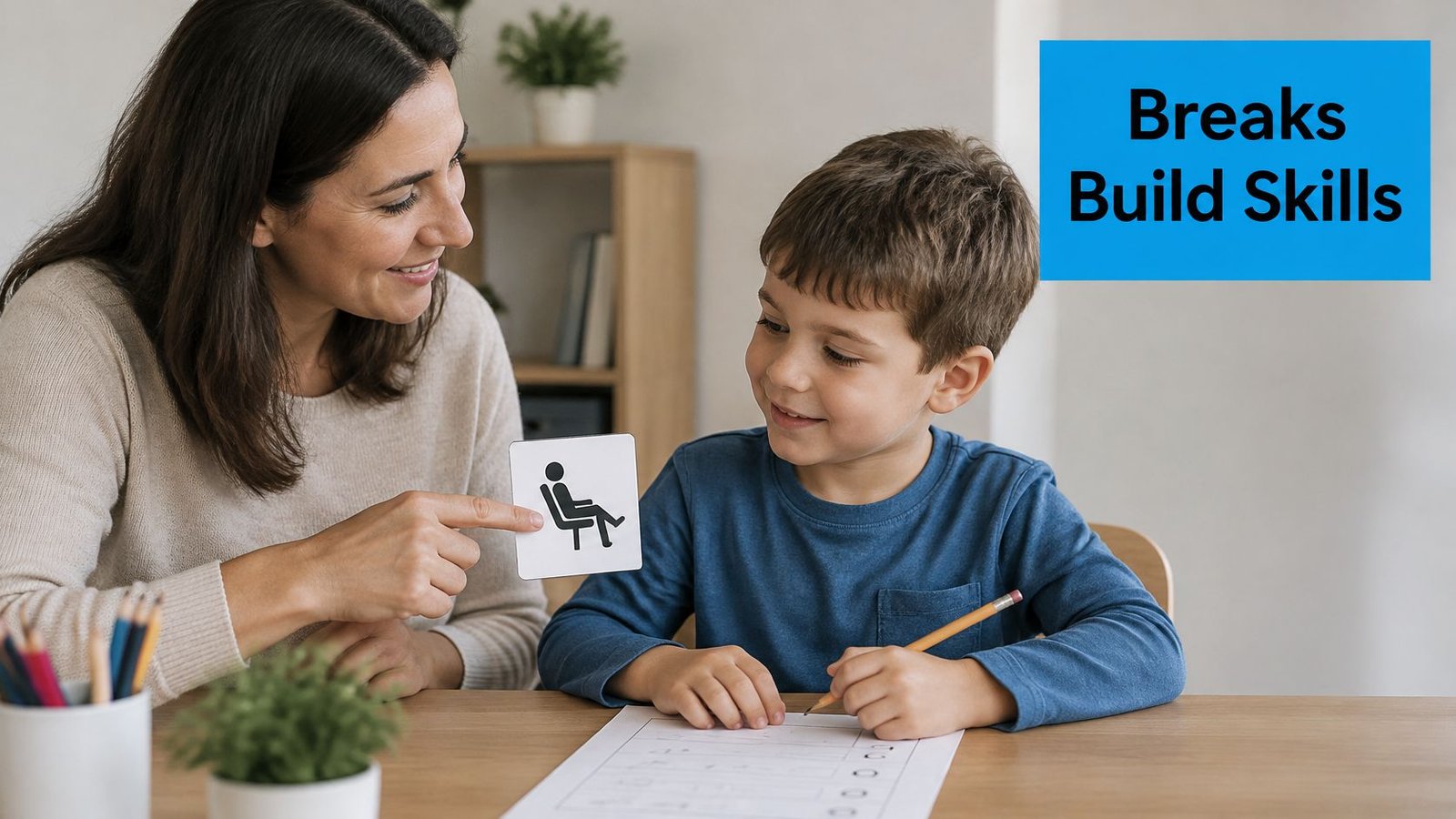
Say a writing activity repeatedly ends this way:
- Antecedent: An adult places a writing worksheet on the desk.
- Behavior: The child pushes the sheet away, cries, and leaves the chair.
- Consequence: The adult removes the worksheet.
Task removal makes escape a plausible hypothesis. It doesn't tell you whether the difficulty is handwriting, language comprehension, pain, fatigue, or the amount of work.
Change the task and teach a way out
Offer a smaller starting point, a choice of writing tools, or a different response format. Teach an accessible request for help or a break, and make sure adults honor it reliably. A first-then board should clarify the plan, not force a child through distress.
A classroom study of function-based intervention supports matching antecedent changes and reinforcement to the assessed function. It also illustrates why procedures involving extinction require trained professional oversight, rather than improvised persistence at home.
Next step: Compare what happens when you offer help, shorten the task, or provide a requested break. Bring the observations to the school team instead of assuming that task removal confirms the function.
4. Tangible-Maintained Behavior When a Preferred Item Is Denied
The tablet turns off, your child screams, and someone switches it back on. Access to the tablet may be the relevant outcome, but the sequence needs careful recording.
In the ABC framework, reinforcement describes how an outcome affects future behavior, not whether a caregiver meant to reward it. The NCBI Bookshelf overview of behavioral principles explains the relationship between environmental events, observable actions, and consequences.
For a typical tablet scenario, separate the parts:
- Antecedent: The caregiver ends tablet access and puts the device away.
- Behavior: The child screams and hits the sofa.
- Consequence: The caregiver returns the tablet.
Separate asking from availability
Teach a request your child can use easily, such as a sign, picture, spoken word, or device button. Then make the response predictable. Sometimes the request can produce access; sometimes you'll need to acknowledge it and show when access will be available.
A visual timer can help explain an agreed endpoint. It won't make an unexpected ending comfortable by itself, especially if adults regularly change the rule.
A request can be valid even when the answer isn't immediate access.
Avoid teaching that communication works only after escalation. Practice requests while your child is comfortable, and coordinate the response across caregivers. Never withhold food, water, comfort, or a communication device to enforce a behavior plan.
Next step: Log the item, how access ended, any request your child made, and what happened afterward. Compare those entries with occasions when the same item was unavailable without distress.
5. Sensory-Maintained Behavior During Quiet Times
A child rocks while looking at a book. Another flaps their hands while waiting. Neither action automatically needs intervention. Start by asking whether the behavior helps your child regulate, causes injury, or prevents something they want to do.
An ABC entry might look different here because the consequence may not involve another person:
- Antecedent: The child waits in a quiet room with little movement available.
- Behavior: The child rocks back and forth.
- Consequence: The movement continues, potentially providing sensory feedback.
That sensory explanation remains a hypothesis. You can observe the rocking, but you can't directly observe the child's internal experience.
Sensory tools should offer choice, rather than become a way to stop harmless movement.
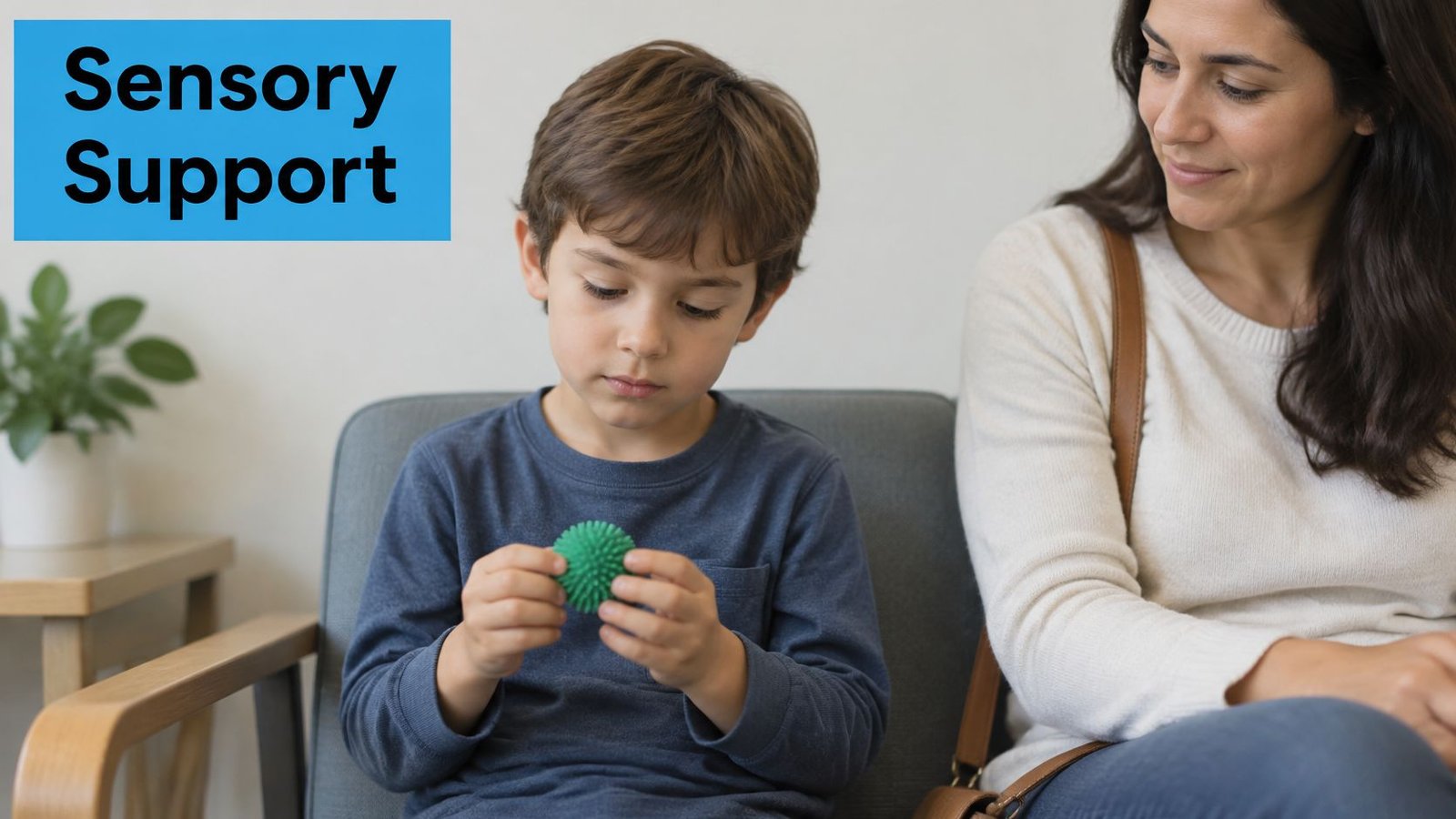
Support regulation without demanding stillness
If your child wants an alternative, offer something that matches their preference. A textured object provides different input from rocking, so it isn't automatically an equivalent substitute. Let your child show you what feels useful.
A wobble cushion may suit some children during seated activities. Others may prefer standing, moving between activities, or continuing to rock safely. Ask an occupational therapist for individualized guidance before changing established sensory routines.
Don't measure success only by whether movement stops. Notice comfort, engagement, communication, and the child's willingness to use the support.
Next step: Record the setting and whether the movement interferes with safety or participation. If it's harmless and helpful, support it rather than setting a goal to eliminate it.
6. Transition-Related Behavior When Play Ends
Leaving the playground involves more than stopping movement. Your child may be losing a preferred activity, facing uncertainty about what comes next, or being asked to move into a difficult routine.
A transition is a context, not a separate behavioral function. The relevant outcome might be continued play, escape from the next activity, or relief from an unpredictable change.
- Antecedent: You announce that it's time to leave the playground.
- Behavior: Your child cries, drops to the ground, and holds the climbing frame.
- Consequence: You delay leaving and allow more play.
The review of caregiver-implemented functional assessment describes how repeated transition-demand sequences can inform a function hypothesis, while emphasizing that descriptive records don't establish causation.
Make the ending understandable
Show what happens next before play begins. Use a visual schedule, a predictable warning, and an endpoint your child can recognize. A guide to timers for autism can help you choose a format that makes remaining time clearer.
A timer isn't helpful just because an adult can read it. Your child needs to understand the signal, and a loud alarm may add distress.
Useful distinction: Leaving more willingly and remaining distressed but silent are not the same outcome.
Teach a manageable request for help or additional time when that option is available. Also record successful transitions, including which supports were present.
Next step: Try a consistent transition routine and compare comfort, requests, and completion across similar outings. Record what changed rather than crediting the timer automatically.
7. Sensory Overload in Public Spaces
Your child covers their ears near a store's checkout, screams, and pulls toward the door. Leaving may provide relief from an uncomfortable environment. That doesn't make leaving the wrong response.
Here's the observable sequence:
- Antecedent: The family enters a crowded checkout area with announcements and scanner sounds.
- Behavior: The child covers their ears, screams, and moves toward the exit.
- Consequence: The caregiver takes them outside, where it's quieter.
Escape from sensory discomfort is a plausible explanation. But hunger, pain, fatigue, an unexpected delay, or difficulty communicating may also matter. An Association for Science in Autism Treatment assessment comparison highlights how observers can reach different interpretations of surrounding events.
Plan access to relief
Offer noise-reducing headphones if your child finds them comfortable. Preview the visit with photos, choose a less crowded period when possible, and keep an exit available. Don't require your child to tolerate overwhelming conditions to prove they can finish the trip.
Comfort items may also help. Guidance on choosing toys for sensory regulation can give you ideas, but let your child's preferences determine what you bring.
Longer visits aren't automatically better. A comfortable visit with an easy way to communicate leaving may be more useful than extending time through distress.
Next step: Record the specific area, sounds, crowding, early signs of discomfort, and what helped. Use those details to plan a more manageable visit, not to test how much distress your child can endure.
How Each ABC Pattern Starts, Ends, and Responds
| Item | Typical Antecedent | Typical Consequence | Key Strategy |
|---|---|---|---|
| ABC Data Collection (Antecedent-Behavior-Consequence Recording) | Events immediately before a behavior | Events immediately after a behavior | Record linked observations soon after they occur |
| Attention-Maintained Behavior: Interrupting During Adult Conversation | Adult attention is unavailable or directed elsewhere | Adult responds to the child | Schedule attention and teach an appropriate way to request it |
| Escape-Maintained Behavior: Refusing Difficult Tasks | A difficult, unpredictable, or unwanted task | The task is removed or postponed | Adjust task demands and teach a request for a break |
| Tangible-Maintained Behavior: Meltdown When a Preferred Item Is Denied | A preferred item is denied, delayed, or limited | Access to the item or activity | Teach a clear request and use predictable access |
| Sensory-Maintained Behavior: Hand Flapping and Rocking During Quiet Times | Waiting, boredom, or low sensory input | Sensory stimulation continues | Offer a suitable sensory alternative |
| Transition-Related Behavior: Refusal When Play Ends | A signal that play or another activity is ending | Play continues or the preferred activity returns | Use advance warnings, visual schedules, or timers |
| Sensory Overload in Public Spaces: Leaving Stores or Crowded Areas | Noise, crowds, bright lights, or other intense sensory input | The child leaves or sensory input is reduced | Prepare with sensory supports and plan quieter, shorter outings |
Turn One Example Into a Pattern You Can Use
Choose a behavior that repeats during a familiar routine. Define it in terms another caregiver could recognize, then record the immediate antecedent, observable behavior, and immediate consequence. Add background information such as sleep, illness, hunger, communication demands, and changes in routine.
Review the entries after you've collected observations across comparable situations. Look for consequences that recur, but don't assume the most common consequence proves the function. Adults may respond similarly to very different needs.
Compare explanations, not just incidents
For a worksheet followed by crying and task removal, consider competing explanations. Your child might need help understanding the work, a less painful writing method, or relief from an exhausting day. The record becomes more useful when you include occasions where the task went well.
Look for changes in:
- Distress: How long it lasts and how intense it appears.
- Communication: Whether your child independently requests help, attention, an item, or a break.
- Participation: Whether the routine becomes more comfortable and manageable.
- Adult support: What caregivers changed before the difficult moment.
Our Guiding Growth mobile app supports this process with voice-first Quick Log, structured behavior tracking with triggers and location, and Smart Summaries for school or clinical meetings. Review saved entries to check that the antecedent and consequence were captured accurately. The app doesn't provide medical advice, so bring your observations and possible explanations to your child's care team.
Don't wait for a full log if behavior involves injury, sudden unexplained changes, or suspected pain. Seek appropriate professional help and prioritize immediate safety.
The goal isn't a perfectly completed record or a quieter child at any cost. It's a clearer understanding of what your child needs and a more reliable way for them to communicate it. Start with a routine you can observe, make a manageable support change with your care team, and keep recording both comfortable moments and difficult ones.
Our mobile app brings daily observations, behavior triggers, and meeting-ready summaries into one place. Visit Guiding Growth to start recording ABC patterns and prepare clearer information for your child's next school or clinical conversation.