Ask three adults who watched the same hard afternoon and you'll get three different stories. One says the child was defiant. Another says he had a bad day. A third says it wasn't that bad. None of those accounts tells a therapist what happened, how long it lasted, or whether it's happening more this month than last.
That's a measurement problem before it's ever a behavior problem. An operational definition swaps a label for something two people can watch and agree on: what the behavior looks like, when it starts, when it stops, and what doesn't count. The scale is real. Autism prevalence among U.S. children aged 8 was 32.2 per 1,000 in 2022, about 1 in 31 across 16 surveillance sites (CDC surveillance summary). And a 2025 systematic review found that autism intervention studies often list examples of problem behavior without definitions a reader could use to decide whether a specific instance met the criteria (systematic review of behavior definitions).
What follows is seven operational definition of behavior examples, each dissected the same way: the exact wording, why it works, where it breaks, and how to turn the log into something you can hand across a table.
Table of Contents
- 1. Meltdown Duration and Intensity Definition
- 2. Stimming (Hand Flapping) Frequency Definition
- 3. Elopement Operational Definition
- 4. Physical Aggression Operational Definition
- 5. Compliance with a Direction Operational Definition
- 6. Mand (Requesting) Operational Definition
- 7. Sleep Onset Latency Operational Definition
- 7 Operational Definitions of Behavior at a Glance
- From Definitions to Data You Can Bring to a Meeting
1. Meltdown Duration and Intensity Definition
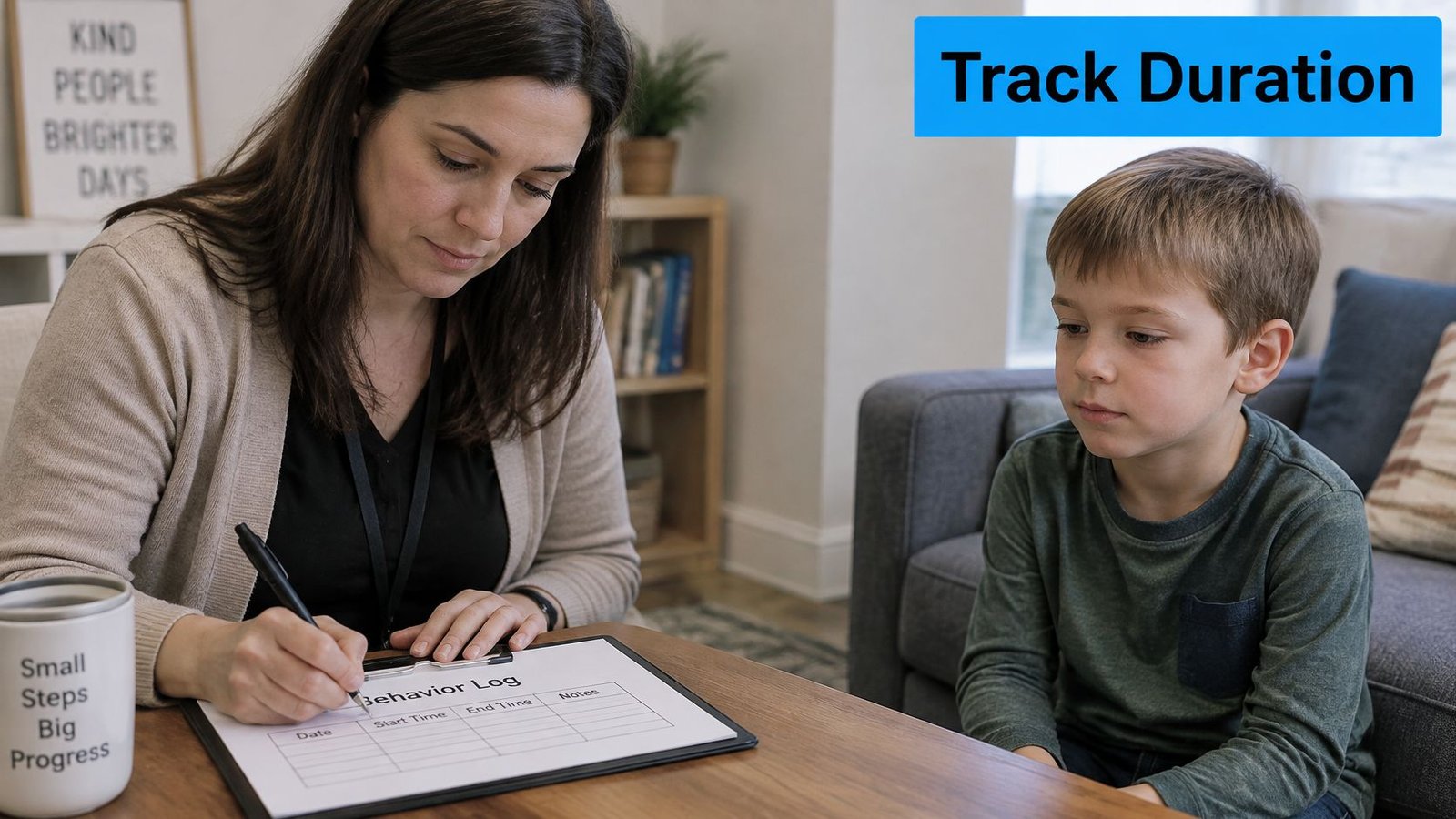
A meltdown isn't one behavior. It's a cluster of them, and without a start and stop rule every adult in the child's life will time it differently.
Wording that holds up: Starts when the child screams, cries, or throws objects after a demand or transition is presented, and ends when the child has been calm for at least 2 consecutive minutes.
The two-minute calm window does the heavy lifting. Without it, an episode ends whenever the adult's patience does. With it, the clock runs through a brief pause and stops only at real recovery. Add a 1 to 3 intensity rating with one concrete example per level and Tuesday becomes comparable to Sunday.
Where this definition breaks
The IRIS Center at Vanderbilt is blunt about boundaries. A usable definition states what counts and what doesn't, which is how a label like disrespectful becomes eye rolling or turning away from the speaker (IRIS Center on defining behavior). Meltdown definitions fail in the same place. A child who goes silent and still isn't melting down. That's a shutdown, and logging it as a mild meltdown corrupts every trend you build afterward.
- Post the wording everywhere: tape it inside a kitchen cabinet and in the classroom binder so nobody works from memory.
- Lock the intensity scale: severe means the child can't be redirected for the episode, mild means one prompt brings them back.
- Log the antecedent and what followed: "bath after iPad" tells you more than "another meltdown."
- Keep one log across settings: Guiding Growth stores trigger, intensity, duration, location, and who was present, then groups entries by time of day so patterns surface without a spreadsheet.
One parent's week of entries showed most meltdowns starting within 15 minutes of screen time ending. That's a transition problem with a plan attached. A school team that adopts the same wording gets an aide and a parent recording the same event the same way, which is the only thing that makes a behavior plan reviewable. Teams building differentiated instruction for autistic homeschoolers hit the identical wall, because the person running the day needs criteria they can apply mid-lesson.
2. Stimming (Hand Flapping) Frequency Definition
Hand flapping is regulation, not a symptom to stamp out. The count you keep should answer a better question than "how do we stop it": when does he need it most?
Wording that holds up: Rapid up-and-down or side-to-side movement of one or both hands at or above waist level, lasting at least 3 seconds, counted as one episode each time the hands stop for more than 3 seconds.
The pause rule is the whole definition. Without it, two minutes of flapping with three micro-pauses is either one episode or four, depending on who's holding the clicker. Settle the rule before day one and don't redraw it mid-week.
Count it per activity block
Rates beat raw totals. Thirty minutes in the car, twenty minutes of independent work, the queue at the pharmacy: each block gives you a comparable rate. Log the sensory conditions next to the count (loud radio, fluorescent lights, a crowded aisle) and patterns show up within days.
Context changes what a number means. A 2025 observational coding study analyzed 245 caregiver-implemented administrations involving 114 English-speaking participants and relied on videotaped, blinded coding because caregiver reports shift with setting and interpretation (Developmental Medicine & Child Neurology). At home that translates to one habit: write the setting down, or the count is unusable.
- Pair every count with a setting: a number without context is a number you can't act on.
- Note what happens afterward: did she settle, ask for a fidget, or leave the room?
- Watch for masking, not just volume: if flapping drops because she's suppressing it at school, you're measuring compliance, not comfort.
- Line stims up against sleep and meals: Guiding Growth keeps those entries on one timeline, which is where sensory load and food start connecting.
If you're still sorting out what counts, the breakdown of hand flapping and what drives it covers the line between regulation and self-injury.
3. Elopement Operational Definition
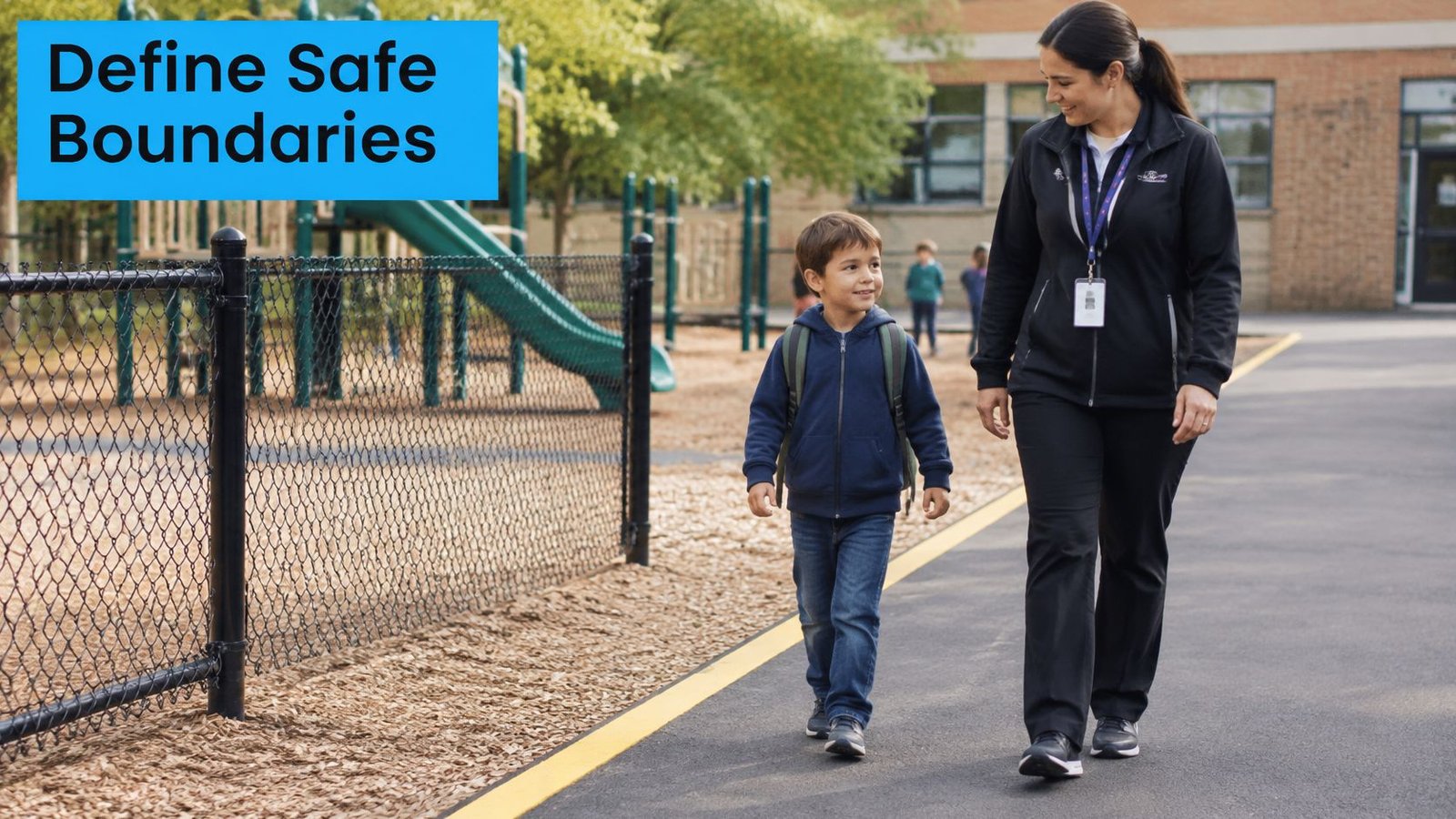
Elopement is the one on this list where a vague definition is a safety problem. "He wandered off" tells a first responder nothing. The definition has to name a physical line.
Wording that holds up: Child moves beyond the marked boundary of the home yard, classroom door, or store aisle without an adult's verbal permission, measured by the child crossing the line with at least one foot.
The one-foot rule ends the argument about a child hovering on the threshold. It also forces you to draw the boundary somewhere visible: a fence, a taped line, the edge of the rug by the front door.
Pair the definition with an ABC record
Antecedent, behavior, consequence gives the event a structure. The University of Nebraska's ABC materials define the antecedent as the conditions immediately before the behavior and the consequence as what happens afterward, with the behavior itself matched to the written definition (UNL MediaHub on ABC recording). For elopement, the antecedent is usually a transition, a denied request, or a noise the adult didn't register as loud.
- Draw the boundary on a simple map: hand a copy to every adult who supervises the child, including grandparents and sitters.
- Log time, people, and what changed: the difference between a 4 p.m. exit and a 7 p.m. exit matters.
- Review weekly, not monthly: elopement data goes stale fast and safety plans need current numbers.
- Bring it to the professionals: Guiding Growth records location and antecedents, then exports a summary for safety meetings, IEP reviews, and pediatric appointments.
A family that logged every unsupervised door-opening for two weeks found most of them clustered around the 4 p.m. transition home. A school team that defines elopement as crossing the classroom or playground boundary reviews incidents every Friday. Same principle, different building, and both now have a time and a place to work on instead of a general worry.
4. Physical Aggression Operational Definition
"Acting out" describes how an adult felt, not what a child did. Aggression needs the contact named, the force named, and a line between what counts and what doesn't.
Include and exclude: Counts as hitting, kicking, pushing, or biting another person's body with enough force to make contact. Does not count as accidental contact during play, a high five, or movement made to escape a hold.
Both lists matter. Leave out the exclusions and staff log roughhousing and handshakes, which makes the trend line look like an emergency that never happened.
Precision pays off in reproducibility. In a clinical behavior-analysis case where aggression was defined narrowly as head-butting another person, two independent observers working from recordings reached mean agreement of 99.6% for aggression and 99.9% for property destruction (PsycNet record of the case). Narrow definitions produce data a team can defend in a meeting.
Decide the counting unit first
Is one hit one event, or are three hits in a row one episode? Either answer can work, and both fail when each adult picks their own. Choose a rule (every contact counts, or an episode ends after 30 seconds without contact), write it above the data sheet, and reopen it if two adults score the same video differently.
A behavior team counting hits during lunch found most of them clustered when a child was seated beside a noisy group. A parent using the same definition at home and at school could show a pediatrician exactly how frequency moved after a medication change. Without the shared wording, that conversation becomes two people trading impressions.
- Write exclusions into the definition, not into a side note.
- Record the sequence before and after each incident, since the trigger is usually an interaction rather than a mood.
- Train every adult on the same examples before anyone collects a baseline.
- Tag events in Guiding Growth with trigger, location, and who was present so the pattern travels to the care team intact.
5. Compliance with a Direction Operational Definition
Compliance is where definitions often go wrong, because "he didn't listen" can mean a two-second delay, a flat refusal, or a child who never heard the request over the dishwasher.
Wording that holds up: Adult gives a single clear direction, such as "put your shoes on." Compliance is scored if the child begins the action within 5 seconds and completes it within 2 minutes without additional prompts.
That wording forces three decisions before data collection starts: what the direction is, how long the child has, and whether repeats count. Change any one of them and your percentages stop being comparable. I'd rather see a family track one routine, bedtime or shoes, than five routines with drifting rules.
Definition quality and logging workflow fail together
A study on a psychiatric unit serving children with intellectual and developmental disabilities found initially moderate-to-low interobserver agreement, then improvement after researchers introduced clearer simplified definitions, individualized observation procedures, clickers, and signals marking the end of intervals (PMC case study on observation accuracy). The strongest gains came when the system fit the person and the setting. A perfect definition nobody can apply while holding a toddler's hand still fails.
- Fix the prompt count: decide whether one verbal repeat is allowed before the trial is scored as not followed.
- Separate questions from refusals: asking for clarification isn't noncompliance, and for a child with pathological demand avoidance the distinction changes the whole plan.
- Track the percentage followed, not the number of refusals, so the trend reflects the whole day.
Say a parent tracks bedtime directions and offers a two-choice option (shoes first or teeth first). Rate climbs from 40 percent to 70 percent over two weeks. That's the kind of change a team can see, question, and build on, and it started with a five-second rule.
6. Mand (Requesting) Operational Definition
Did the child ask, or did an adult pull the word out of them? That split decides whether the count shows communication growth or prompt dependence.
Wording that holds up: Child uses a word, sign, picture card, or device to ask for a specific item or action within 5 seconds of that item being available. Score the request as independent only when no model, gesture, or "what's this?" comes first. Prompted requests go in a second column.
A mand is a request reinforced by the specific item or action it asks for, the term B. F. Skinner introduced in Verbal Behavior in 1957. The five-second window and the form rule make the count observable. A child who echoes "cracker" after an adult says it has not manded yet. Fold those echoes into the independent total and the graph stays flat while the child is learning to ask.
Where the wording breaks
The prompt stays invisible unless you write it down. Holding up a cracker and asking "what's this?" is a model, not a request the child started. The IRIS Center at Vanderbilt asks whether two or more observers would identify the behavior the same way across time and settings, and recommends stating what does not count when the line is fuzzy (IRIS Center on measuring behavior). A mand definition with no independence rule fails that test at the first snack.
Name the form before day one: speech only, sign plus speech, or any modality including a device. Count chances as well as requests. Three requests out of four chances reads differently from three requests across a whole day. Give the speech-language pathologist the prompted-versus-independent split so new vocabulary follows the numbers.
Track requests as a custom behavior in Guiding Growth, then export a Smart Summary to share the data at IEP and specialist meetings. The summary should show independent and prompted counts side by side, not one blended total.
A parent and therapist counting independent snack and toy requests saw the independent column climb after a picture system went in. A teacher using the same rule for help during math could point to the week a help card on the desk replaced adult models. Both sheets answer one meeting question: is the child getting better at asking, or better at waiting for a prompt?
If requesting is still unreliable, functional communication training shows how a taught request can take over the job a challenging behavior used to do.
7. Sleep Onset Latency Operational Definition
How many minutes from lights-out to sleep could you defend at a pediatric visit? By morning, the night has usually shrunk to "up forever" or "not too bad," and neither version is usable.
Wording that holds up: The interval starts when the child is in bed, the lights are off, and the adult has left the room. It ends when the child has been quiet and still for 10 consecutive minutes. Record the result in minutes.
That wording is a latency measure: one clear antecedent, then the time until a defined onset. The IRIS Center describes latency recording as the time between an antecedent and the onset of behavior, and duration recording as starting a timer when behavior begins and stopping it when it ends (IRIS Center on recording methods). Interval methods produce percentages instead. Keep the three methods separate.
Where quiet-and-still breaks down
Quiet and still is a proxy, not sleep. A child can lie awake in the dark and still hit the ten-minute mark. When that happens, write "awake but still" on the entry and leave the definition alone. A parent who returns to the room resets the clock. Log those check-ins, or the latency looks shorter than the night was.
- Start the timer at lights out, not at the start of the story.
- Write the routine steps beside the number: bath, book, songs.
- Bring two weeks of minutes to the pediatrician, because a long latency can have a medical cause worth ruling out.
- Track it in Guiding Growth, which logs sleep duration and quality next to behavior and meals so the connections are visible.
Two weeks of entries showed an average latency of 45 minutes on school nights and 20 minutes on weekends. That comparison pointed at the morning schedule rather than the bedtime routine. A sleep tracker journal holds those nights in one place so the same comparison can go into the appointment.
7 Operational Definitions of Behavior at a Glance
| Behavior | What Is Measured | Key Criterion | Best For |
|---|---|---|---|
| Meltdown duration and intensity | Duration, intensity, and antecedent | Observable start and end markers; consistent intensity scale | Comparing episodes and identifying triggers over time |
| Stimming (hand flapping) frequency | Episode frequency or duration in context | Defined movement and pause rule between episodes | Understanding when stimming changes and what sensory needs may be involved |
| Elopement | Events, time, location, and antecedents | Crossing a clearly defined boundary without permission | Safety planning and identifying high-risk settings or times |
| Physical aggression | Contact incidents and events before and after | Specific actions that make contact; exclusions for accidental or protective contact | Identifying patterns and informing behavior support plans |
| Compliance with a direction | Percentage of directions followed | Clear direction, response window, and prompt limit | Assessing how routines or supports affect responses to requests |
| Mand (requesting) | Independent and prompted requests | Defined communication form and requested item or action | Tracking communication growth and informing therapy goals |
| Sleep onset latency | Minutes from bedtime to sleep onset | Defined start point and consistent sleep-onset criterion | Tracking bedtime patterns and sharing useful data with clinicians |
From Definitions to Data You Can Bring to a Meeting
The method is repeatable and it fits on an index card. Pick one behavior. Write observable start and end criteria, plus two examples and two nonexamples. Agree on the wording with every adult who records it. Log for two weeks without changing the rules midstream. Then look at the trend before you look at a single incident.
That last part matters because behavioral support is still hard to access. In a 2024 study of 423 caregivers of adolescents and adults with profound autism, 47.3% identified behavioral support as an unmet service need (Journal of Autism and Developmental Disorders). When help is scarce, the meeting where you ask for it carries more weight, and organized records are what make that ask concrete.
For a therapy or IEP audience, bring the definition itself, not only the graph. Showing a team the written criteria, plus a note about how you decided what doesn't count, does more than a recounting of the worst day. It tells them you're measuring the same thing they are. If you're drafting a plan document, this guide to how to write a treatment plan pairs well with your data.
The rule I'd give any family: one behavior, one written definition, two weeks of consistent entries, then a conversation with evidence on the table.
Guiding Growth turns those definitions into structured entries with triggers, duration, intensity, location, and who was present, then builds a Smart Summary for an IEP review, a 504 meeting, or a new specialist.
Guiding Growth gives you one place to log behaviors the way this article describes them, with customizable behavior lists, triggers, intensity, duration, and purpose fields, and a summary you can export as a PDF before a meeting. Start with the single behavior that costs your family the most, define it in writing, and log it for two weeks at Guiding Growth. You'll walk into the next appointment with a pattern instead of a memory.