You notice a fresh bruise on your child's forehead after school, or a raw patch on the wrist that wasn't there at breakfast. You ask what happened. The answer is a shrug, a meltdown, or silence. You're left holding two worries at once: is this injury serious, and will it happen again tomorrow?
That uncertainty is common when families first meet self-injurious behavior in autism. The useful move isn't to invent one cause. It's to name the action clearly, keep your child safe in the moment, and build a record a care team can use.
Table of Contents
- Forms of Self-Injurious Behavior in Autism
- How Common Self-Injury Is and How Long It Lasts
- Functions Behind Each Self-Injurious Episode
- What to Do During an Episode
- What Makes Self-Injurious Behavior Worse
- How to Track Each Episode Step by Step
- Working With Professionals on a Functional Plan
- Confirm Urgency and Book the Right Review
Forms of Self-Injurious Behavior in Autism
Say you find a purple mark above your child's eyebrow on a Tuesday evening. Before you decide it was a fall, a classmate, or "just autism," describe what you saw. Self-injurious behavior (SIB) means actions that physically harm a person's own body. The National Autistic Society estimates that about half of autistic people engage in SIB at some point in life.
SIB is a behavior, not a diagnosis. One form can have several causes, and two children who bang their heads may need different responses. Force, how often it happens, and which body part is involved decide whether the same action is mild or dangerous.
| Behavior | What It Looks Like | Injury to Watch For |
|---|---|---|
| Head banging | Striking the head against walls, floor, or furniture | Bruising, swelling, possible head injury |
| Hand or arm biting | Biting own hand, wrist, or forearm | Broken skin, bruising, infection risk |
| Skin picking | Repeated picking at skin, scabs, or nails | Open sores and infection |
| Hair pulling | Pulling hair from scalp, eyebrows, or body | Scalp soreness and bald patches |
| Scratching or pinching | Scratching or pinching own skin | Scratches, broken skin, marks |
| Forceful slapping | Hitting own face or body with a hand | Bruising and facial swelling |
| Eye gouging | Pressing or poking the eyes | Eye injury, needs urgent care |
| Self-cutting | Cutting skin with sharp objects | Deep wounds, needs urgent medical review |
Use that table as a checklist. Write the behavior in plain words: "hit the right side of the head on the sofa arm, three times, left a lump." Eye gouging and self-cutting need urgent medical review, which the safety check later in this article spells out. Don't decide what the behavior "means" until you can describe it.
How Common Self-Injury Is and How Long It Lasts
A 2020 review of 37 papers covering 14,379 autistic participants estimated pooled SIB prevalence at 42% (95% confidence interval 38% to 47%), as reported in PubMed Central. This describes a common support need across studies, not what will happen for any one child.
Estimates vary because studies use different age groups, settings, questionnaires, observation periods, and definitions. The review also found a SIB-specific pooled odds ratio of 3.18 (95% CI 2.45 to 4.12). Taken together, these findings indicate substantially higher odds of self-harm among autistic people than among non-autistic people. They describe a group-level pattern, not an individual forecast.
| Measure | Figure | What It Means |
|---|---|---|
| Pooled prevalence across 37 studies | 42% (95% CI 38%–47%) | A common support need, not a prediction for every child |
| Odds of self-harm versus non-autistic people | Substantially higher | Supports routine monitoring |
| SIB-specific pooled odds ratio | 3.18 (95% CI 2.45–4.12) | Odds are elevated when SIB is studied directly |
| Persistence over about three years | 77.8% of those who showed SIB at baseline | Repeated measurement gives more context than one incident |
| Autism-related emergency visits for intentional self-injury | 2.3% (US data, 2016–2020) | Some injuries require emergency care, so include medical risk in planning |
A difficult week cannot show how long a pattern will continue. In a three-year cohort, caregivers of 67 autistic people, whose median age was 13.5 at the start, were followed up. SIB remained present in 77.8% of those who had it at baseline, according to a prospective study. A record of each behavior over time can show whether its frequency or circumstances are changing.
Intentional self-injury also appears in emergency care data. It accounted for 2.3% of emergency-department visits among patients with an autism-spectrum diagnosis in U.S. data from 2016 to 2020, reported in Injury Epidemiology. Because each behavior can follow its own pattern, noting what happened, when, and what followed can help a care team assess the risks and plan support.
Practical rule: Record nonsuicidal self-injury separately from any talk of wanting to die. They are clinically different, and suicidal thoughts need their own urgent assessment.
Functions Behind Each Self-Injurious Episode
It is time to leave the park, and your child starts hitting their head. Later that week the same child bites a hand before dinner, belly hard, food refused. Two injuries, one child, and they may not be doing the same job.
A behavior works like a household alarm. The sound is familiar, but burnt toast and a real fire need different responses. Escape, pain, noise, or a need the child cannot say yet can each set off the same mark on the skin. One label for every episode hides which switch was flipped.
Clinicians usually test a short list of functions, one episode at a time. The same child can head-bang to get out of a task and bite when something hurts. Notes on what started the episode, what stopped it, and what else was going on are the evidence a care team uses to check those ideas. Safety comes before any guess about function.
| Function | What It Looks Like | Question to Ask |
|---|---|---|
| Escape from demands or transitions | Episodes start at hard requests and stop when the demand is removed | Does it ease once that demand or transition stops? |
| Attention or a preferred item | Episodes follow loss of attention or removal of an item | Does it start when attention or the item goes away, and ease when they return? |
| Sensory reinforcement | Episodes tied to too much or too little input | Does it cluster in very loud or very quiet settings, and change when the input changes? |
| Communication difficulty | Episodes occur when a need cannot be expressed | Is there a way to ask that the child can actually use in that moment? |
| Anxiety or emotional overwhelm | Episodes come before changes, crowds, or new places | Does it follow a known stressor? |
| Repetitive movement | Episodes occur alongside repetitive motor patterns | Does injury appear during that movement, with no separate trigger you can see? |
| Physical discomfort | Episodes linked to toothache, constipation, reflux, earache, or headache | Are there signs of pain or illness? |
Repetitive movement can sit beside these functions. It is not automatically the reason for the injury. Record whether the movement is the same one you see when the child is calm, or whether injury starts only then. Stimming in another diagnosis is a separate subject: understanding self-stimulatory behavior in ADHD is about ADHD, not about why an autistic child is getting hurt.
A 2025 study of 582 autistic youth aged 3 to 19 found that 30% to 50% of caregivers reported at least slight concern about biting, scratching, hitting the head or face, head-banging, or skin-picking. Each behavior type linked differently to dysregulation, sensory hypersensitivity, age, sex, IQ, and language. Different forms do not share one explanation, so a single label will not cover every episode.
Two patterns that look alike and aren't
Head banging after transitions. Episodes cluster when you say it is time to leave the park or start homework, and they ease once the demand drops. That pattern points toward escape. It is a hypothesis to test with the next few logs, not a fixed trait of the child.
Biting around meals. Marks show up before dinner, with a hard belly, refusal of food, or a history of constipation. Pain and discomfort belong on the list before anyone treats the bite as a bid for attention.
Write the before, during, and after for this episode, then match it to one row in the table. A universal sensory kit, or a punishment, skips that match. The question to carry to the care team is simple: what is this behavior doing for this child, this time?
What to Do During an Episode
Analysis waits until your child is safe. Work through these steps in order.
- Keep everyone safe. Move your child away from hard edges, take away objects that could cut or bruise, and stay close without crowding.
- Lower the pressure. Pause the demand or the transition, or offer a quiet space, if that matches the plan your care team already wrote. Our guide to de-escalation techniques for autism meltdowns covers calmer pacing once the room is safe.
- Protect the head and body. If you can do it safely, place a cushion between the head and a hard surface. Don't hold or restrain your child unless you've been trained to do so.
- Skip lectures and punishment. Talking about the behavior rarely helps while it's happening. A steady, quiet voice is enough.
- Check for injury as soon as it's safe. Look for bleeding, swelling, eye or head injury, and signs of pain.
- Call emergency services now if bleeding won't stop, you suspect a head or eye injury, or the person says they want to die.
Once your child is calm, write what happened and follow any plan the team has already agreed. Immediate safety is the job of this moment. The record you keep afterward is what turns one episode into useful evidence.
What Makes Self-Injurious Behavior Worse
A behavior may begin for one reason and intensify when other pressures build. These factors can be associated with injury without proving its cause, and different behaviors may follow different patterns.
In a U.S. sample of 1,892 autistic youth, distress related to insistence on sameness was the strongest predictor of total self-injurious behavior (SIB) scores. Sensory hypersensitivity and sensory-seeking were associated with SIB across categories, according to a machine-learning analysis. Sensory demands, disrupted sleep, and changes to routines may all add strain. Sleep difficulties can also accompany emotional and behavioral challenges, and sleep disruption has been linked with repetitive behaviors.
A week that stacks
A child sleeps poorly on Sunday. On Monday, roadworks change the school route, and lunch is loud. By Wednesday, self-injury happens more often than it did the week before. The sequence does not prove that any one factor caused the episodes. It gives the family and care team a pattern to examine: poor sleep, a disrupted routine, and sensory load may have overlapped.
Reducing injury may involve changing the setting and supporting the caregiver, alongside addressing the behavior itself.
Look for factors that tend to come before each type of episode. A predictable route or steadier sleep may reduce some sources of strain, while lowering sensory demands in a difficult room may help with others. Consider each behavior as its own pattern rather than assuming one trigger explains them all. Family observations can help a care team test possible explanations and plan support. If someone mentions wanting to die, seek immediate professional help.
How to Track Each Episode Step by Step
A useful diary records what happened before, during, and after, plus time, place, who was there, and how your child seemed. The National Autistic Society's guidance, summarized in a clinical bookshelf review, recommends bringing those notes to a GP or dentist, and notes that predictable routines and varied activities may lower anxiety, boredom, and chances to self-injure.
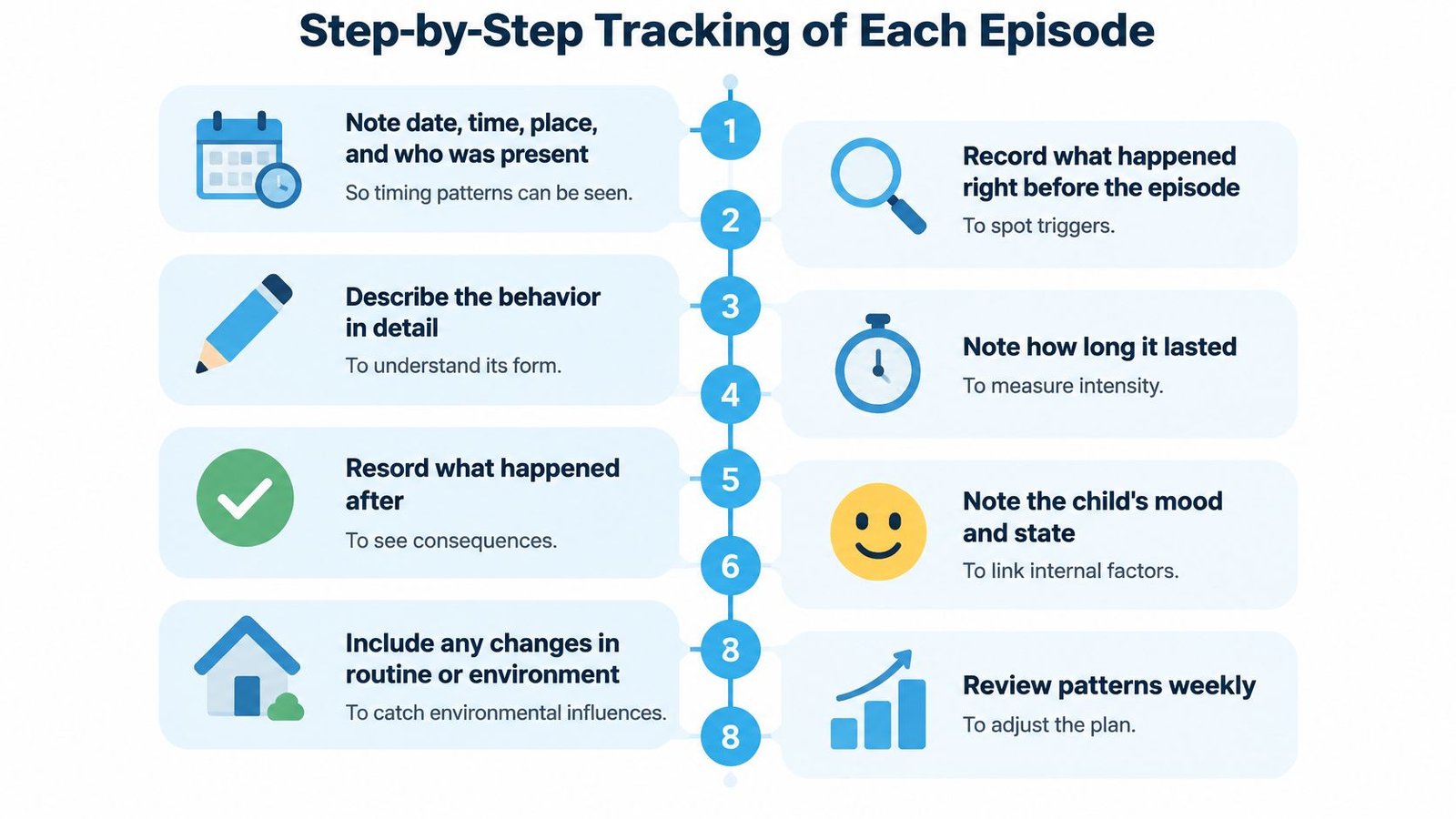
- Note date, time, place, and who was present. Timing patterns only appear when the clock and the room are written down.
- Record the 30 minutes before. Include demands, transitions, noise, routine changes, and meals, because the trigger is often earlier than the hit.
- Describe the behavior in plain terms. Body part, force, number of hits or bites, and whether it repeated. Skip labels such as "attention-seeking."
- Log intensity and duration. Use mild, moderate, or severe, and time from the first action until calm, so weeks can be compared.
- Record what came after and what seemed to help. A break, a quieter room, or removing a demand tells you which consequence traveled with the episode.
- Check for injury and illness. Bruising, bleeding, swelling, head or eye injury, pain, or fever can be the reason, not a side note.
- Add background variables. Sleep the night before, meals, medication changes, screen time, and recent routine changes show the stack around the episode.
- Review the week before the next appointment. Look for repeated times, places, and triggers so the visit starts with a pattern, not a memory.
Keep every entry factual so another caregiver can read it the same way. A behavior log for parents is one way to stop notes living in three different apps. Guiding Growth was created as a simple, intuitive autism parenting app that provides tools to help parents identify triggers, analyze patterns, and make informed decisions. Voice logging, customizable triggers, attachments, and a pattern view can hold this kind of before-during-after record. Interpretation and treatment stay with qualified professionals.
Working With Professionals on a Functional Plan
Your notes don't replace a clinical assessment. They give the team something better than a recalled "bad month."

NICE guidance for autism in under 19s says clinicians should reassess the care plan when behavior changes, and look again at mental health, physical health, communication, and the environment. If SIB continues after those contributors are addressed, first-line treatment is a psychosocial intervention informed by functional assessment. The plan targets what maintains the behavior. It doesn't only try to suppress the visible form.
What an individualized plan can look like
If episodes reliably follow hard requests and stop when the demand is removed, the team may teach a workable way to ask for help or a break, ease the task, and reinforce that communication. A short functional behavior analysis example shows how that logic is written down. If the behavior is sensory-maintained, clinicians may test safer competing activities and changes to the room, rather than one sensory strategy for every child.
Measurement should use an operational definition and repeated data: frequency or rate, duration, tissue damage, communication responses, and exposure to the relevant antecedents. Set a baseline, then repeat it. NICE advises against using a risk score to predict whether self-harm will happen again. Monitoring combines direct observation, injury checks, caregiver reports, and clinician judgment.
Antipsychotic medication is considered only when psychosocial or other interventions aren't enough, or can't be delivered because the behavior is severe.
Bring these questions to the first review:
- Which functions have already been ruled out?
- Were pain, dental problems, and other physical causes checked?
- What data does the team want between visits?
- How often will the plan be reviewed if the pattern shifts?
Confirm Urgency and Book the Right Review
If bleeding won't stop, you suspect a head or eye injury, or your child talks about wanting to die, get emergency help now. Everything else can be sorted by how fast it needs a person, not by how frightened you feel.
| Situation | Action | Timing |
|---|---|---|
| Bleeding that will not stop, deep wounds, suspected head or eye injury | Call emergency services or go to the emergency department | Now |
| Injury that may need stitches, signs of infection, or repeated injury to the same spot | Call GP or pediatrician | Same day |
| Mention of wanting to die, suicidal thoughts or intent | Contact emergency services or a crisis line; separate risk assessment is needed | Now |
| Rising frequency or intensity, new injuries, or a pattern change after a medication or routine change | Book a review with the care team | Within days |
| Stable, mild episodes with a known trigger | Keep the log and review at the next scheduled visit | Next appointment |
Nonsuicidal self-injury and suicidal thoughts are different problems. A mention of suicide needs emergency services or a crisis line and its own risk assessment. Don't fold that into a behavior chart.
For concerns that aren't an emergency, bring two to four weeks of records to a GP or pediatrician. Ask for a functional assessment. Agree what will be measured and how often you'll repeat it. Use the next scheduled visit when the pattern is stable and already known.
Behavior Tracking lets parents track meltdowns, shutdowns, demand avoidance, and any other challenging behaviors. Guiding Growth also lets parents manage medications, doctor appointments, and therapy sessions all in one place, so sleep notes and visit dates sit with the episode log. The app doesn't give medical advice. Reading the pattern stays with qualified professionals.
Book the review this week if the table says "within days" or sooner. Bring the summary. Write the four questions before you walk in, so the appointment spends its time on the plan rather than on reconstructing the month.
Guiding Growth gives families one place to log self-injurious episodes with triggers, intensity, and duration, then turn those notes into a summary for the next appointment. If you're trying to see whether sleep, demands, or pain travel with the behavior, start a shared log instead of relying on memory. Visit Guiding Growth to set up tracking for your child.