An elimination diet removes one food or a small group of foods for a defined period, often 2–8 weeks, while symptoms are tracked, then adds foods back individually to see which bring symptoms back, under clinical supervision.
If someone feels better after cutting out a food, how do they know the food caused the problem? That's the missing question behind many restrictive diets. For parents of autistic and neurodivergent children, the answer matters because a dietary change can affect comfort, familiar routines, and an already limited menu.
Table of Contents
- What an Elimination Diet Is and Why Clinicians Use It
- Elimination Diets and Autism Research
- Nutrition Risks and When Clinical Guidance Matters
- The Three Phases and How to Run a Trial
- Reading the Results and What Comes Next
- Confirm the Plan With a Clinician Before You Start
What an Elimination Diet Is and Why Clinicians Use It
An elimination diet is a planned test of a suspected food, not a list of foods to avoid. Think of it as detective work: the food is the suspect, the symptom record is the evidence, and reintroduction is the verification step. Without that final step, a family may keep restricting a food without knowing whether it matters.
The defining features are targeted and temporary. A clinician identifies what's worth investigating, arranges nutritionally appropriate substitutes, and decides how the result will be assessed. It isn't a permanent clean-eating plan, and removing more foods doesn't automatically produce a clearer answer.
An elimination plan can still include varied, enjoyable meals.

Different questions need different trials
A single-food trial investigates a particular suspicion, such as symptoms after cow's milk. A broader food-group trial removes a selected set, potentially including milk, eggs, soy, wheat, nuts, and fish or shellfish. These aren't interchangeable starting points.
Clinicians use elimination for food allergy, food intolerance, and selected gastrointestinal conditions. For eosinophilic esophagitis, a traditional six-food elimination diet removes milk, wheat, soy, egg, nuts or peanuts, and fish or shellfish, with monitoring over roughly 4–6 weeks, as described in clinical guidance on food elimination.
Food allergy involves the immune system. Food intolerance doesn't involve the same allergic mechanism and commonly concerns digestion and the amount consumed. Stomach pain alone can't tell a parent which explanation applies.
Why feeling better isn't a diagnosis
The NIAID food allergy guidelines cite estimates of food allergy in approximately 6% of young children and up to 4% of adults in North America and identify the double-blind, placebo-controlled oral food challenge as the diagnostic gold standard. An oral food challenge introduces increasing amounts under medical supervision, with emergency treatment available. Not every clinical challenge is double-blind, but suspected allergy requires an appropriately supervised assessment.
Say a child has recurring stomach pain and their family suspects dairy. Rather than banning milk, the clinician considers the symptom history, plans a suitable replacement, and sets a review point. Improvement during avoidance provides a clue, not a final diagnosis.
Practical rule: Ask what question the restriction will answer before deciding what to remove.
The purpose is to identify the cause of symptoms while keeping as much food variety as safely possible, not to turn a suspicion into indefinite avoidance.
Elimination Diets and Autism Research
Research doesn't establish gluten-free or casein-free diets as treatments for autism. The evidence is small and methodologically limited, so confident promises go beyond what the trials can support. That doesn't mean a parent's observations should be dismissed; it means those observations need a carefully defined clinical question.
What the major autism diet reviews found
| Review | Trials | Participants | Main finding |
|---|---|---|---|
| Cochrane review | 2 randomized trials | 35 | Could not be pooled; one trial found fewer autistic traits, the other no significant difference |
| Systematic review and meta-analysis | 6 randomized trials | 143 | No meaningful benefit on clinician-rated core symptoms, parent-reported functioning, or behavioral difficulties; low to very low evidence quality |
| American Academy of Pediatrics systematic review | 19 randomized trials across nutritional approaches | Not specified in the review summary | Little evidence for supplements or dietary therapies overall; challenge-food studies showed no effect on behavior or gastrointestinal symptoms, with insufficient evidence for firm conclusions |
These reviews aren't equivalent collections of diet trials. The American Academy of Pediatrics review covered supplements and other nutritional approaches as well as gluten- and casein-free diets. Its broader scope shouldn't be mistaken for a large body of evidence supporting elimination.
The meta-analysis also raised the possibility of more gastrointestinal adverse effects. Meanwhile, the Cochrane review found that potential harms and disadvantages weren't adequately reported. Limited evidence of benefit isn't evidence that a restrictive diet is harmless.
Comfort and autism traits aren't the same outcome
A child who has less abdominal pain may sleep more comfortably, participate more readily, or become less distressed around meals. A parent may reasonably notice a change in behavior. That observation doesn't establish that the diet changed autism itself.
The useful question is specific: did a particular dietary exposure contribute to pain, bowel symptoms, sleep disruption, or another measurable difficulty? A clinician may investigate when there are documented gastrointestinal symptoms, suspected allergy or intolerance, or a reproducible food–symptom pattern.
For background on the foods involved, our guide to gluten-free and casein-free diets explains the distinction between those restrictions.
Take a child's discomfort seriously without making autism the condition the diet is supposed to treat.
A clinical decision should weigh the child's symptoms, accepted foods, nutritional needs, and burden on the family. It shouldn't start from the assumption that every autistic child needs the same diet.
Nutrition Risks and When Clinical Guidance Matters
Remove a food and you remove everything it carried. Drop cow's milk and a child loses a leading source of calcium, vitamin D, and protein unless another food carries that load. A replacement plan does the structural work of the diet, and it deserves as much attention as the search for the trigger.
Nutrients to plan for when foods are removed
| Food removed | Nutrients at risk | Replacement to plan |
|---|---|---|
| Cow's milk | Calcium, vitamin D, protein | Fortified alternatives or dietitian-planned substitutes |
| Wheat | Fiber, B vitamins, iron | Fortified grains and legumes chosen by a dietitian |
| Eggs | Protein, choline | Dietitian-planned protein sources |
| Fish or shellfish | Omega-3 fats, iodine | Clinician-approved sources |
| Soy | Protein, calcium if fortified | Fortified alternatives chosen with a clinician |
The table is a set of planning prompts, not a prescription for interchangeable foods. A replacement has to fit the child's age, allergy history, overall intake, and willingness to eat it. A substitute that looks adequate on paper does nothing if the child consistently refuses it.
Pediatric guidance on nutritional risks during elimination emphasizes that nutritional adequacy can decline as restrictions become broader or last longer. Children need sufficient energy, protein, and micronutrients for growth and neurodevelopment, which makes unnecessary exclusions costly.
Protect accepted foods and adequate intake
For autistic and neurodivergent children with selective eating, a familiar food may supply a substantial part of daily intake. Removing it can increase refusal rather than lead naturally to a new alternative. A dietitian can help hold onto calories and nutrients while building a replacement menu the child will accept.
Elimination regimes can be hard for families to sustain, and a narrowed diet can drift out of balance over weeks. Restrictive eating can also worsen or trigger eating disorders in some children. Existing malnutrition, weight concerns, or a history of disordered eating deserve particular attention before any trial begins, and they may change whether a trial is reasonable at all.
Monitor more than the symptom that prompted the diet:
- Accepted foods and portions: Record what the child eats, not just what's offered.
- Weight or growth: Agree with the clinician on appropriate monitoring.
- Bowel patterns and supplements: Note changes, doses, and products used.
- Adverse reactions: Document new symptoms and follow the agreed safety plan.
A food log can show that symptoms followed a meal, but it can't establish cause by itself. Delayed symptoms, illness, medication changes, and different routines can make a pattern appear stronger than it is.
Our dietary and nutrition resources offer further context for thinking about food intake alongside daily routines.
Clinical guidance from the outset keeps the child nourished and keeps the trial interpretable. A result is only readable if the diet behind it was sound.
The Three Phases and How to Run a Trial
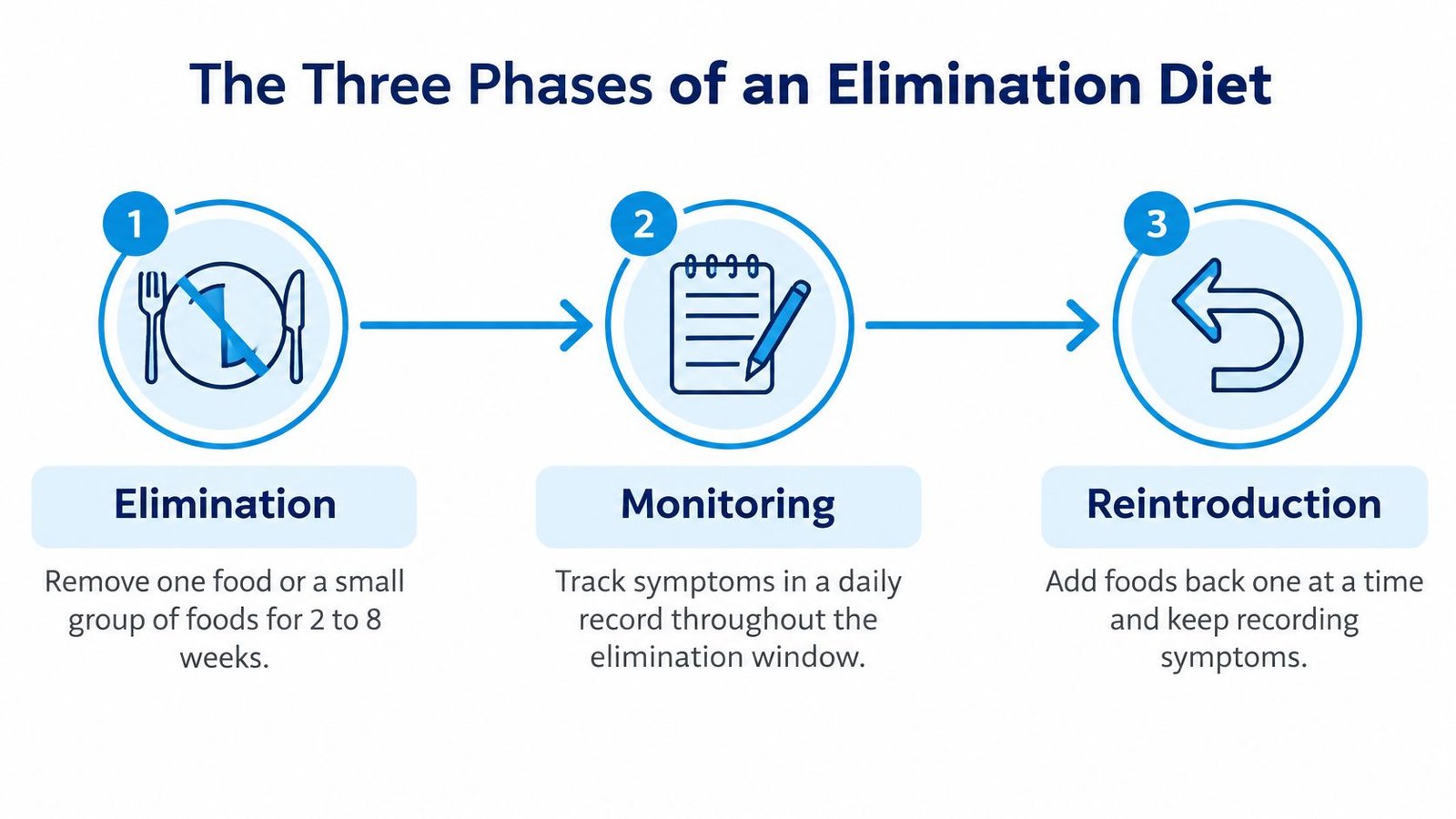
The process has elimination, monitoring, and reintroduction, but monitoring isn't something that waits until removal is complete. It begins with a baseline and continues across the entire trial. A clinical overview of elimination diets describes this as an individual diagnostic experiment: change the suspected exposure while keeping other influences as stable as possible.
The three phases of an elimination diet
| Phase | What happens | Typical duration | What to record |
|---|---|---|---|
| Elimination | Remove the suspected food or group and substitute nutritionally equivalent foods | 2–8 weeks, depending on the reaction being investigated | Intake, substitutes used, symptom frequency |
| Monitoring | Track the target symptom against sleep, illness, medication, and stress | Throughout, starting before removal | Daily symptom description or score, timing, context |
| Reintroduction | Add back foods individually and watch for returning symptoms | Clinician-set; observation may span several days per food for delayed symptoms | Reaction, timing, amount, outcome |
The timeline shows the sequence, while the daily record connects the stages.
Build a plan you can follow
For example, suppose a clinician agrees to a four-week cow's-milk trial for a child with recurring stomach pain. The dietitian selects fortified soy milk because it's appropriate for this particular child, and the parent records pain daily. This is a hypothetical plan, not a recommended duration or substitute for every child.
- Name the suspected trigger and target symptom. Choose something observable, such as stool frequency, abdominal pain, eczema severity, nighttime waking, or behavior duration. Avoid a vague target such as doing better.
- Record a baseline before changing food. For example, the clinician might request one to two weeks of meals, symptoms, sleep, illness, and medications. The baseline gives the family something concrete to compare against.
- Plan removal and substitutes first. Ask a clinician or dietitian which ingredients count, how to read relevant labels, and what the child can eat instead.
- Keep the trial focused. Follow the agreed window without simultaneously changing several foods, supplements, or routines. Record unavoidable changes.
- Log timing and context daily. Note what was eaten, the amount, when symptoms started, and relevant events. Don't reconstruct the week from memory.
- Follow the clinician's reintroduction instructions. Use the specified food, amount, setting, and observation window. Home reintroduction isn't appropriate for every suspected reaction.
- Use the safety stop rule. Stop and seek urgent medical care for hives, swelling, wheezing, repetitive vomiting, or breathing difficulty. Never reintroduce a food associated with previous anaphylaxis at home.
For additional background, gut health tips from Yuve discuss identifying possible food sensitivities. Use general reading to prepare questions, not to replace the clinician's instructions.
Our guide to identifying food sensitivities can also help you organize observations before an appointment.
This video offers another way to approach the topic.
Elimination alone doesn't prove allergy. The clinically reviewed response to reintroduction, or a supervised challenge when indicated, provides the verification needed to interpret the initial improvement.
Reading the Results and What Comes Next
A trial doesn't always produce a simple yes or no. The clinician needs to consider whether the plan was followed, whether the observation window suited the symptoms, and whether anything else changed. The next step should follow the pattern observed, not the family's understandable hope for a clear explanation.
When removal doesn't identify a trigger
Symptoms don't change during removal. The suspected food becomes a less likely explanation, although the clinician should review the trial before drawing a conclusion. Under their advice, the restriction can end and the food can return rather than being avoided indefinitely.
Symptoms improve but don't return during reintroduction. This doesn't establish the food as the cause. Better sleep, recovery from an infection, medication changes, reduced stress, or ordinary symptom fluctuation may explain the improvement.
Don't respond to an unclear result by automatically removing more foods. That creates a different experiment and can make the original question harder to answer.
When symptoms return
Symptoms recur during clinician-planned reintroduction. A repeatable food–symptom pattern deserves clinical review. The clinician may recommend a supervised oral food challenge, further evaluation, or planned avoidance with nutritionally adequate substitutions.
Symptoms return during an approved home reintroduction, or a reaction is severe. Stop the test and follow the agreed response plan. Seek urgent assessment for possible allergic symptoms rather than repeating the exposure to check whether it happens again; for mild delayed symptoms, contact the clinician before proceeding.
A confirmed trigger needs a management plan, not just a place on a forbidden-food list.
That plan should describe what to avoid, acceptable substitutes, and when the diagnosis or restriction should be reviewed. Confirmation doesn't automatically mean lifelong avoidance, but only the treating clinician can advise whether and when reassessment is appropriate.
Keep the dated record, including days when nothing happened. Bring meal details, symptom timing, substitute foods, and contextual notes to the appointment. A pattern across ordinary days gives the clinician more useful information than a memory centered on the most difficult evening.
If the result remains uncertain, that's a reason to reassess the question, not a failure by the parent or child. Sometimes the most useful outcome is learning that a major food doesn't need to remain restricted.
Confirm the Plan With a Clinician Before You Start
Before removing a major food, book a visit with your child's pediatrician, allergist, or dietitian. Bring a one-page plan naming the suspected food, target symptom, baseline observations, and proposed duration. Leave space for the clinician to change the plan or recommend a different assessment.
You don't need to arrive with a diagnosis. You need a clear account of what you've noticed and what you want to understand.
Questions to take to the appointment
- Which food should we investigate first? Explain the pattern that prompted your concern.
- How long should removal last? Ask what would count as improvement and when to stop an unhelpful trial.
- What substitutes are appropriate? Include foods your child will realistically accept.
- Where and how should reintroduction happen? Get written instructions and a reaction-response plan.
A diet doesn't need to be permanent to be useful. The clinician may decide that an oral food challenge or another investigation is more appropriate than starting with home dietary changes.
Our Diet and Nutrition tracking in Guiding Growth records a child's eating habits and helps identify possible sensitivities or preferences that may affect well-being and daily routines. Use the dated record to support the appointment, not to diagnose a food reaction. The app doesn't provide medical advice, and the clinician makes the testing and treatment decisions.
Guiding Growth gives parents and caregivers a place to record meals alongside symptoms, sleep, and behavior during a clinician-guided elimination trial. Available on iOS and Android, it can help you bring an organized history to your child's next appointment. Visit Guiding Growth to start keeping that record before changing your child's diet.