If a child sleeps better after changing meals, does that mean the diet changed autism, or that the child is more comfortable? That distinction matters when families consider a gluten-free, casein-free diet, often shortened to GFCF.
Digestive symptoms deserve attention in their own right. But a diet that helps an individual child tolerate food isn't automatically an autism treatment, and removing familiar foods can create nutritional problems. The useful question isn't whether the diet sounds promising. It's whether there's a medical reason to try it, a safe replacement plan, and a clear way to judge the result.
Table of Contents
- What a Gluten-Free Casein-Free Diet Removes
- What Randomized Trials Found for Autism Symptoms
- Benefits, Risks and Costs to Weigh
- When an Elimination Trial Is Justified
- Nutrition Gaps to Plan For
- How to Run a Supervised Trial and Track Results
- Take a Tracked Record to Your Next Appointment
What a Gluten-Free Casein-Free Diet Removes
A gluten-free, casein-free diet removes gluten, the proteins found in wheat, barley and rye, and casein, the main protein in milk. When clinicians use it to investigate symptoms without an established lifelong indication, it should be a time-limited trial, not an indefinite default.
The diet involves separate gluten and milk checks. A gluten-free biscuit may contain butter or milk powder. A dairy-free bread may still contain wheat. Neither claim, on its own, establishes that a food meets both restrictions.
Label terms that signal gluten or casein
| Ingredient group | Common foods | Label clue |
|---|---|---|
| Wheat, barley, rye, malt | Bread, pasta, cereal, beer, malt vinegar | Wheat, barley, rye or malt in the ingredient list |
| Oats | Oatmeal, granola, some baked goods | Cross-contact risk unless labelled gluten-free |
| Milk, whey, casein, caseinates | Milk, cheese, yogurt, butter, some breads and processed meats | Milk, whey, casein or caseinate in the ingredient list |
| Gluten-free claim | Packaged foods | Under 20 ppm in the US; does not cover casein |
Whey appears in the table because it's a milk-derived ingredient that families excluding dairy need to notice, not because whey and casein are identical. Similarly, oats need a separate check because contact with gluten-containing grains during production can complicate their use.
What a gluten-free label actually means
In the United States, the FDA's gluten-free food labelling rule requires unavoidable gluten to remain below 20 parts per million, with 20 ppm equivalent to 20 milligrams per kilogram of food. That threshold concerns gluten, not casein, and it doesn't mean a product contains absolutely no gluten.
At the shop, use a consistent sequence:
- Read the full ingredient list. Check the actual ingredients rather than relying on packaging colours or front-label claims.
- Read the allergen statement. Look specifically for wheat and milk, while remembering that the ingredient list also matters for barley and rye.
- Look for may-contain warnings. Discuss how to handle cross-contact statements with the clinician managing a diagnosed condition.
Our food label and allergen safety guide provides a practical companion for these checks. Label reading tells you what a product contains, not whether removing it will help your child.
What Randomized Trials Found for Autism Symptoms
Controlled trials haven't established a reliable improvement in core autism symptoms from a GFCF diet. Some analyses find changes in selected outcomes, but those findings don't justify treating the diet as effective for autistic children generally.
Randomized trials compare children assigned to different diets rather than asking whether children changed after starting one. That distinction helps separate dietary effects from development, changes in support, and ordinary variation.
What the main trials and reviews found
| Review or trial | Year | Participants | Main finding |
|---|---|---|---|
| Systematic review of six randomized trials | 2017 | 214 children | No significant difference in core symptoms on standardized scales, with few exceptions |
| Meta-analysis of eight randomized trials, described alongside that evidence | 2021 | 297 participants, 144 diet and 153 control | Possible small effects on stereotyped behaviour, SMD −0.41, and cognition, SMD −0.46 |
| Systematic review and meta-analysis of six trials | 2021 | 143 participants | No significant effect on clinician-rated core symptoms, SMD −0.31; 95% CI −0.89 to 0.27 |
| Systematic review of randomized trials | 2022 | 11 trials, mostly small samples | Efficacy unsubstantiated; larger, better-designed trials needed |
| Cochrane summary of one randomized trial | 12-month trial | 20 children aged 5–10 | No clear differences in cognitive, linguistic or motor abilities |
The earlier systematic review found isolated positive results, not a consistent improvement across standardized assessments. The larger pooled analysis suggests possible changes in repetitive behaviour and cognitive scores, rather than a broad treatment effect.
The other meta-analysis couldn't establish a clinician-rated core-symptom benefit. The later review emphasized weaknesses in study design, while the small trial summarized by Cochrane couldn't provide a dependable answer for the wider population.
Reading the statistics without overreading them
A standardized mean difference, or SMD, puts results from different assessment scales onto a comparable scale. Zero means no average difference between groups; a value near zero suggests limited separation.
A confidence interval shows the uncertainty around the estimate. When it crosses zero, the findings remain compatible with no difference. Think of a weighing scale whose uncertainty is too large to distinguish similar weights, not a scale proving that the objects are identical.
Small samples make results less stable. Dietary studies also have difficulty with blinding: parents usually know what their child is eating, and expectations can influence ratings even when families report accurately.
A 2025 review published in the Brunei International Medical Journal found the diet effective in 30% of included studies, while 70% found no significant effect, with mixed reports of mild behavioural or gastrointestinal improvements. Those percentages describe studies, not a child's chance of benefiting.
A positive finding in a small study is a reason to investigate, not a promise to families.
The practical conclusion is individualized, measured evaluation where clinically justified, not routine dietary restriction across the autistic population.
Benefits, Risks and Costs to Weigh
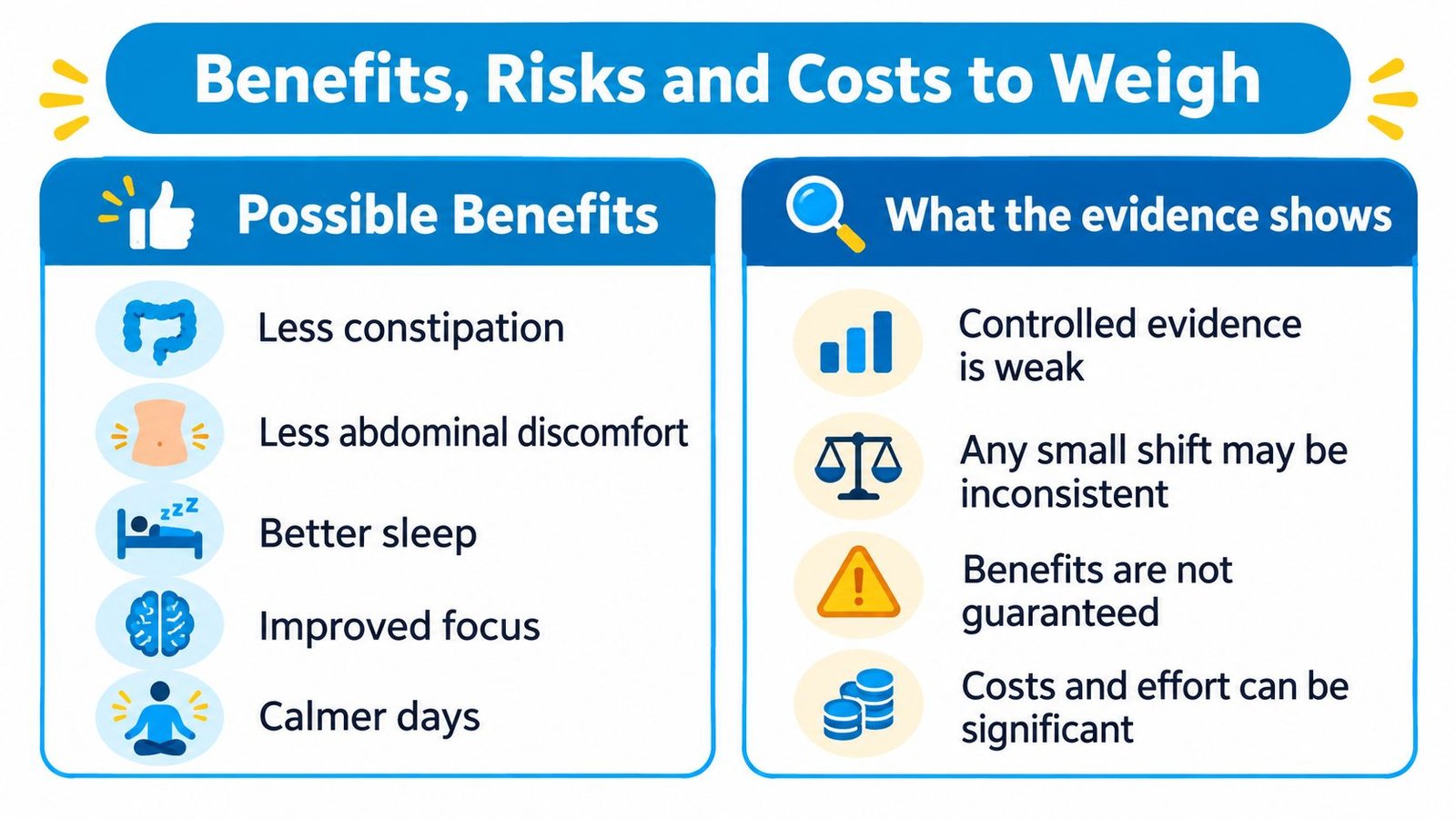
Families often hope for less constipation, less abdominal discomfort, better sleep, improved focus and calmer days. Those are meaningful goals, but controlled evidence for achieving them through a combined GFCF diet remains weak. They're possibilities to investigate, not expected benefits.
This comparison separates family hopes from what can reasonably be promised.
Digestive symptoms can worsen
A 2021 systematic review and meta-analysis of six trials involving 143 participants reported a possible increase in gastrointestinal adverse effects, with a relative risk of 2.33, although the confidence interval was wide. That uncertainty means the estimate isn't a dependable prediction for an individual child.
Relative risk also isn't the same as the proportion of children affected. Without a clear baseline risk, families can't translate that figure into a personal probability. The useful clinical message is simpler: watch for worsening stomach symptoms rather than assuming restriction must improve digestion.
The cost isn't only at the checkout
A 2025 grocery-price analysis reported by Food & Wine, using Walmart, Kroger and Target prices collected in December 2024 and January 2025, found that gluten-free shopping increased monthly grocery costs by $111.20, equivalent to 12%, compared with standard products. That analysis wasn't a complete estimate of a combined gluten-free and casein-free household diet; dairy substitutes may add further expense.
Other costs show up in family routines:
- Preparation time. Parents may spend longer checking ingredients, packing lunches and cooking separate meals.
- Participation. School lunches, birthday parties and restaurant visits can require advance arrangements.
- Food acceptance. A replacement that looks similar may have a texture or flavour the child won't accept.
- Nutritional coverage. A substitute can satisfy the exclusion rules without replacing the nutrients in the original food.
Nutrient loss is the larger clinical concern. Replacing familiar staples without checking their nutritional contribution can make an already difficult feeding situation harder.
Keep the comparison personal. If a hoped-for improvement matters enough to change family meals, write it down from the first week rather than relying on a general impression at follow-up. Continuing restriction should require a benefit that still outweighs the financial, nutritional and social costs.
When an Elimination Trial Is Justified
Before changing meals, ask: Is there a medical reason to remove these foods? An autism diagnosis alone isn't a documented indication for a combined elimination diet.
A clinical discussion should distinguish suspected food-related symptoms from a confirmed condition. The systematic review of GFCF diets in autistic children supports caution about using dietary restriction as a general autism intervention rather than an individualized decision.
Bring the child's food history and symptom concerns to that discussion.

When an elimination trial has a medical basis
| Situation | Medical basis | Next step |
|---|---|---|
| Confirmed celiac disease | Gluten must be avoided for life | Test before gluten is removed; strict cross-contact control |
| Wheat allergy or cow's-milk allergy | Documented allergy | Diagnosis-based exclusion planned with a dietitian |
| Non-celiac gluten sensitivity or repeatable GI symptoms | Symptoms linked to specific foods over repeated episodes | Time-limited, clinician-supervised trial |
| Restricted eating already present | Higher nutritional risk | Dietitian review before any change |
| Autism diagnosis alone | No documented medical indication | Routine use not recommended; discuss with clinician |
Match the restriction to the diagnosis
Suspected celiac disease needs testing before gluten withdrawal. Removing gluten can reduce diagnostic accuracy, so don't begin a home trial while waiting to discuss testing. Once celiac disease is confirmed, gluten avoidance is treatment for that condition, not an experiment in changing autism.
A wheat allergy or cow's-milk allergy calls for diagnosis-specific advice. A child who needs one exclusion doesn't automatically need the other, and allergy-related food challenges shouldn't be attempted independently.
Repeatable gastrointestinal symptoms may justify further evaluation and a supervised trial. Non-celiac gluten sensitivity shouldn't become a catch-all explanation before the clinician considers other causes.
For a child who already accepts very few foods, nutritional review comes first. Removing the only accepted breakfast or main source of energy without a workable alternative can leave the family with no practical feeding plan.
This video can serve as a starting point for questions to bring to the child's clinician.
Cross-contact precautions must also match the medical situation. They're essential for confirmed celiac disease, but imposing the same household restrictions without a gluten-related disorder can add unnecessary work.
Decision rule: Treat a diagnosed food-related condition because it needs treatment, not because the child is autistic.
The child's clinician should determine which situation applies and set the trial length. Parents provide indispensable observations, but they shouldn't have to make the medical decision alone.
Nutrition Gaps to Plan For
Removing gluten and casein is a nutrition-planning problem, not just a shopping substitution. Wheat-based foods and dairy can contribute nutrients that replacement products don't supply in comparable amounts.
The systematic review of gluten-free and casein-free diets highlights the need to consider nutritional adequacy alongside uncertain benefits. Refined gluten-free products may provide less fiber, iron, folate and protein, while removing dairy can reduce calcium, vitamin D, phosphorus, iodine and high-quality protein.
Nutrients lost when wheat and dairy are removed
| Nutrient | Lost when removing | Replace with |
|---|---|---|
| Fiber | Wheat breads and cereals | Legumes, vegetables, fruit, certified gluten-free whole grains |
| Iron | Wheat-based cereals and breads | Meat, fish, legumes, fortified gluten-free cereals |
| Folate | Wheat-based cereals | Legumes, leafy greens, fortified cereals |
| Protein | Wheat and dairy | Eggs, meat, fish, legumes, quinoa, buckwheat |
| Calcium | Milk, yogurt, cheese | Fortified alternatives with labelled calcium, canned fish with bones |
| Vitamin D | Milk and fortified dairy | Fortified alternatives with labelled vitamin D, fatty fish |
| Iodine | Milk and dairy | Iodized salt, fish; confirm the plan with a dietitian |
| Phosphorus | Dairy and some breads | Meat, fish, eggs, legumes |
These are replacement options, not a menu every child must accept. A dietitian needs to work with the child's actual foods, portion sizes and sensory preferences.
Preserve accepted foods and nutritional coverage
A child who accepts a particular yogurt may reject a plant-based version because it feels thinner or smells different. Repeatedly offering rejected substitutes doesn't guarantee adequate intake. The replacement must be both nutritionally suitable and realistically eaten.
Read fortified-alternative labels for calcium, vitamin D and protein rather than assuming all plant-based drinks are equivalent. Fortification and labelling differ across countries, so check the product sold locally.
Build school-meal participation, cultural dishes and familiar safe foods into the plan. Our dietary and nutrition resources can help organize the questions to bring to a nutrition appointment.
Monitor the child, not just the exclusions
NICE guidance on supporting autistic children and young people warns that restricted diets and feeding problems can cause serious nutritional deficiencies and recommends assessment of growth and nutrition, with blood tests when needed.
Agree on monitoring before elimination:
- Baseline intake and growth. Review accepted foods, usual portions, weight, height and BMI percentile with the care team.
- Daily tolerance. Notice constipation, hydration and whether the child is eating enough.
- Follow-up variety. Record whether the accepted-food list is expanding, stable or shrinking.
If supplements are being considered, Vitamin Planet's explanation of choosing combined or separate mineral supplements can help frame questions about formulations. It doesn't replace a pediatric assessment of which nutrient, if any, the child needs.
For a discretionary trial, continued restriction should depend on measurable benefit that outweighs nutritional, financial and social costs. A medically required exclusion needs ongoing nutritional support instead of an unsupervised decision to stop.
How to Run a Supervised Trial and Track Results
A useful trial tests a specific question: Does the planned dietary change improve the agreed outcome without creating unacceptable problems? It doesn't ask whether the child seems generally better.
Use this process with the clinician, adapting it to the child's diagnosis. A combined elimination is appropriate only if that is the agreed plan; it shouldn't override a narrower, diagnosis-specific approach.
Agree on the plan before changing meals
Name the supervisors and the end date. Usually this means the pediatrician and a pediatric dietitian. If you need help arranging care, you can find nutrition therapy support through Providers for Healthy Living and confirm whether the service fits your child's pediatric needs.
Choose two or three separate targets. For example, use stool frequency or pain days for digestion, night wakings for sleep, and a clearly defined meltdown count for behaviour. Keep them in separate columns rather than combining them into a wellbeing score.
Record a baseline before elimination. As a practical starting plan, discuss at least two weeks of unchanged meals with the clinician. Use the same definitions you'll use during the trial, including what counts as a pain episode or night waking.
Make the agreed dietary change. If the clinician recommends removing gluten and casein together, use the replacements already planned. Keep therapies and routines steady where possible, and document unavoidable changes.
The visual below summarizes the supervision, implementation, tracking and review process.
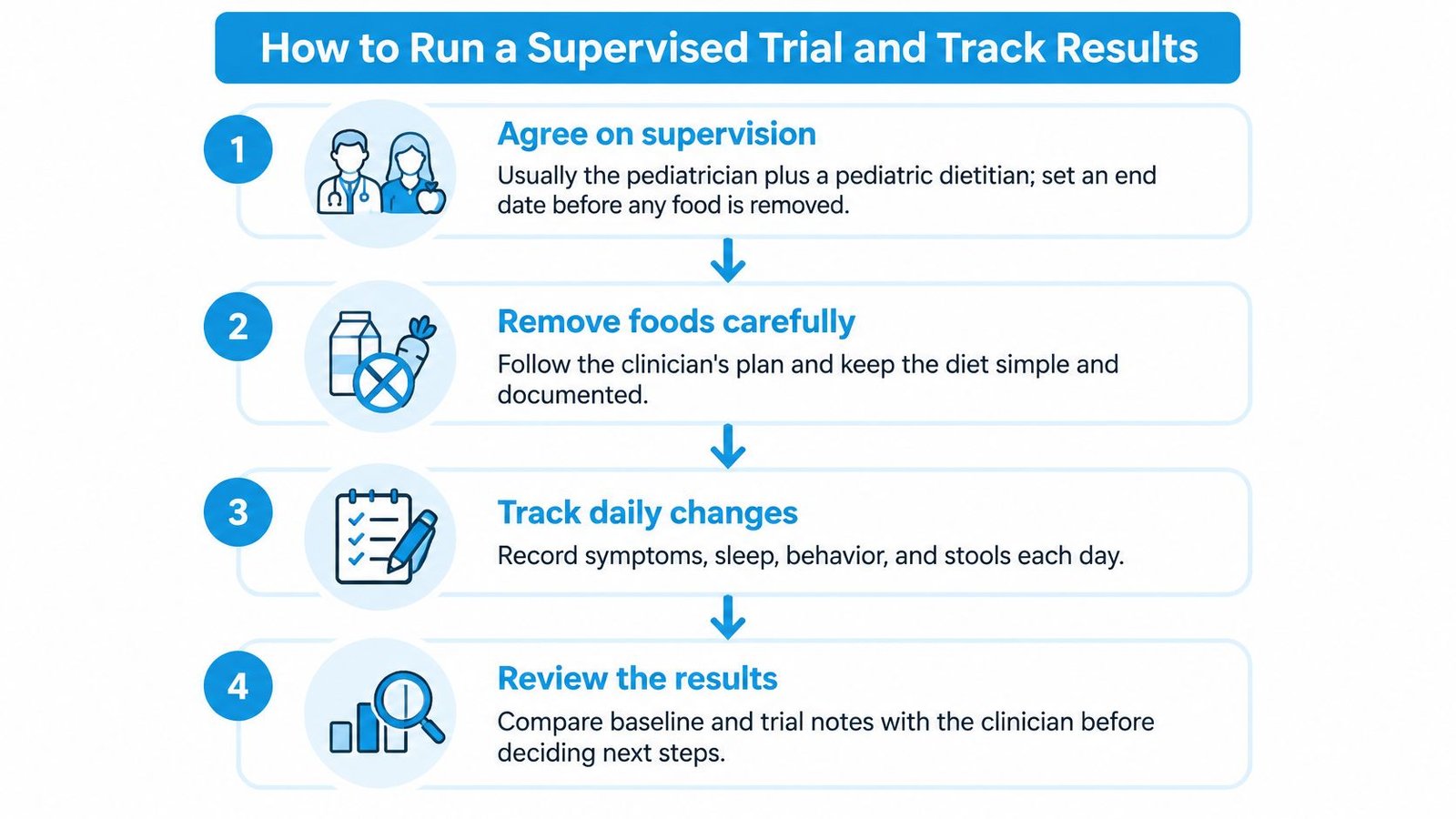
Keep a dated daily record. Include meals, bowel pattern, sleep and behaviour, plus illness, medication changes or disrupted routines. Our guide to identifying food sensitivities can help you distinguish observations worth discussing from assumptions about a trigger.
Review each target against its own baseline. On the agreed end date, compare digestion with digestion and sleep with sleep. Don't substitute a memorable good day for the full record.
Plan any reintroduction with the clinician. If the trial ends, introduce foods individually according to the agreed plan. Never use home reintroduction to test a diagnosed allergy or restart gluten in confirmed celiac disease without medical direction.
Interpret changes narrowly
Suppose stool pattern becomes more comfortable and sleep improves, but meltdown counts remain unchanged. That supports a possible digestive or comfort-related benefit. It isn't proof that core autistic traits changed.
Treat a single good week as noise until the broader record supports a sustained difference. Development, expectations and changes outside meals can all complicate interpretation.
Stop early and contact the clinician if weight or growth falters, eating variety shrinks further, or stomach symptoms worsen.
Don't extend a discretionary trial past its review date without a measured benefit and an acceptable safety assessment. Continuing because stopping feels disappointing isn't the same as demonstrating that the diet helps.
Take a Tracked Record to Your Next Appointment
Bring a record to the next medical visit rather than starting or stopping dietary restrictions alone. Clear observations make it easier to distinguish a digestive concern, a feeding problem and a question about autism-related characteristics.
Take these actions before changing meals:
- Book a pediatric appointment. Review symptoms and ask whether there's a medical indication for exclusion or testing.
- Request a pediatric dietitian referral. Work out how to preserve adequate intake before removing familiar foods.
- Bring dated observations. Include meals, bowel pattern, sleep and behaviour, including days when nothing unusual happened.
Put the observations in one place
Guiding Growth is our all-in-one mobile app for autism parents to track and improve behaviours, nutrition, health and sleep. Our Diet and Nutrition tracking records a child's eating habits and helps identify possible sensitivities or preferences that may affect wellbeing and daily routines.
You can describe the day through voice logging, review the organized entries, and use photo-based meal logging with allergen tracking to document meals. Check captured food details against packaging and what was served, especially when a medically required exclusion is involved.
Smart Summaries can organize selected entries into a report that you can export as a PDF for an appointment. The app doesn't provide medical advice or diagnose food sensitivities; the clinician makes the call.
A clear, dated record won't answer every question by itself. It turns guesswork into a useful conversation with the people who can assess the child's health and decide what happens next.
Guiding Growth helps you keep meals, bowel patterns, sleep and behaviour together while you're discussing a possible gluten-free, casein-free diet with your child's care team. Visit Guiding Growth to start a dated record and prepare an appointment-ready summary before making dietary changes.