“Find a bigger reward” is the most common advice for autism and motivation, and it's often the wrong first move. A stronger prize won't help if a room is too loud, the first step is unclear, questions are coming too fast, or your child is anxious about making a mistake.
Low engagement is useful information. Before you increase an incentive, ask what's making participation costly right now. Then change one thing, the setting, the starting step, the communication method, or the reward itself, and watch what happens.
Table of Contents
- Spot the Cause Behind Low Motivation
- Why Autistic Motivation Works Differently and How to Test Rewards
- How Executive Function Affects Starting and Switching
- How Sensory Load and Anxiety Drain Engagement
- When to Push, Change the Goal, or Pause
- When Low Engagement Needs a Professional Check
- Start a Motivation Log This Week
Spot the Cause Behind Low Motivation
| Observed behavior | Likely factor | First check |
|---|---|---|
| Refuses or melts down in busy rooms, near bright lights or loud appliances | Sensory overload | Compare engagement in quiet versus noisy settings |
| Freezes or stalls when a task starts or when switching activities | Executive function (starting and switching) | Break the task into a visible first step and use a timer |
| Withdraws after mistakes, with new people or when expectations are unclear | Anxiety or uncertainty | Check whether a visual schedule or preview reduces withdrawal |
| Engaged with a favorite topic but ignores praise or tokens | Reinforcer mismatch | Test different preferred objects, activities and ways of delivering reward |
| Participates at home but not at school | Environment or social stress | Log location, people, noise and transitions for two weeks |
| Shuts down when questions come quickly | Communication demand | Reduce verbal demands and offer a written, picture or choice-based option |
Read this table as a starting point for observation, not as a diagnosis. The same refusal can reflect several causes at once, for example sensory load plus an unclear first step.
Run the first check for one or two weeks before you decide a strategy has failed. Change only one condition at a time, such as the seat, the preview, or the reward, so you can tell what helped.
Look for a pattern, not a verdict
A single difficult afternoon tells you very little. Sleep, hunger, illness, a substitute teacher, or an unexpected transition can drain a child for reasons that won't repeat tomorrow.
A pattern across settings is more informative. If your child starts work in a quiet kitchen but freezes in a noisy classroom, the difference is probably not willingness. If they refuse with one communication method but respond to pictures or choices, the demand itself deserves attention.
Treat the behavior as a clue about the conditions around your child, not as proof of their character.
That shift protects your child from labels like lazy or defiant. It also gives home and school teams something concrete to test instead of arguing about effort.
Why Autistic Motivation Works Differently and How to Test Rewards
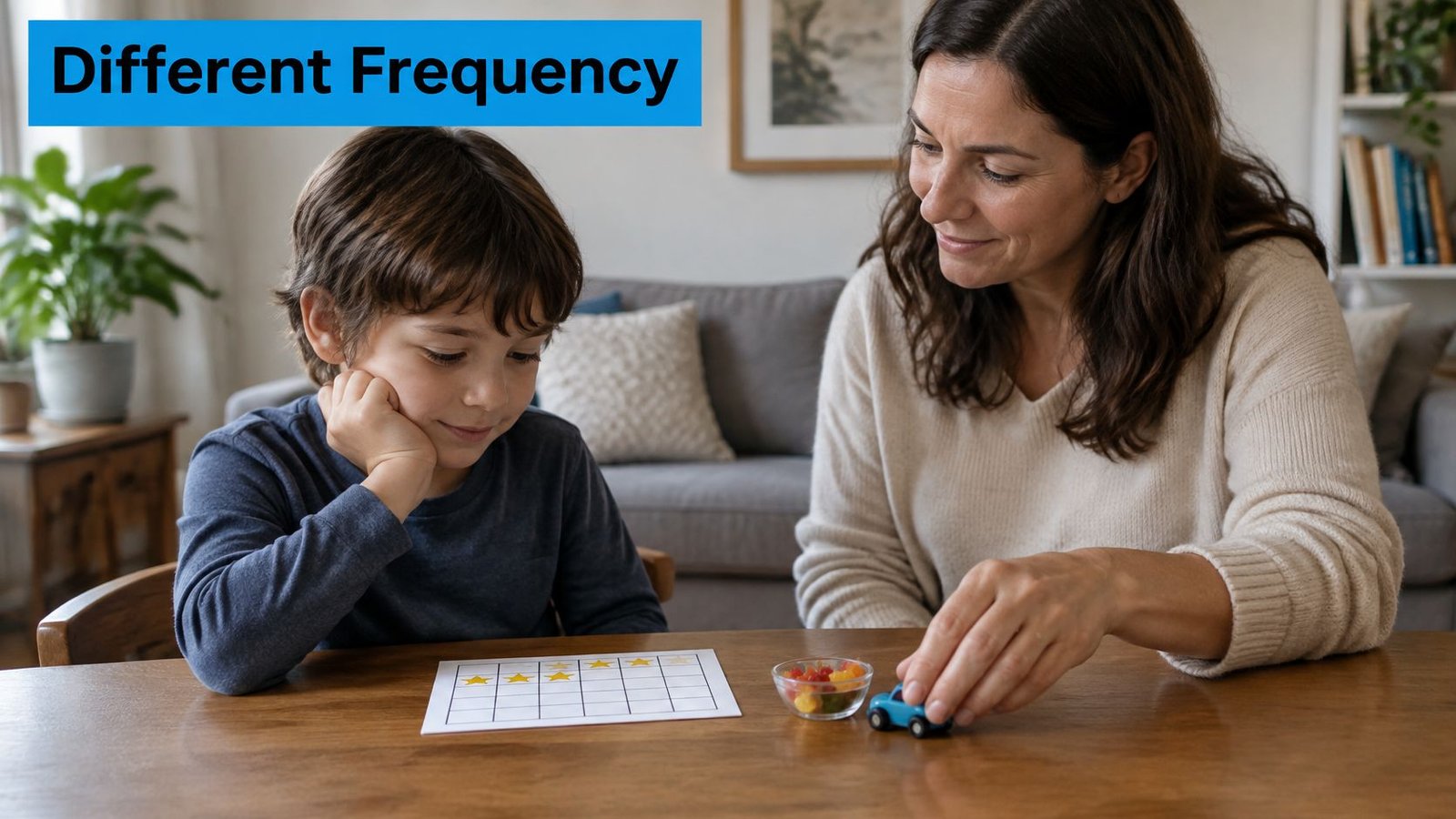
Think of motivation like a radio signal. The signal can be strong while tuned to a different frequency, so a child who ignores praise may work intensely for something connected to a deep interest.
A visual reward system only helps when the reward itself matters to your child.
A profile, not an absence
A review of reinforcement learning in autism describes autistic motivation as a profile of reward sensitivity rather than a global absence of motivation. Social rewards such as praise, facial expressions, and interaction may have weaker or less consistent effects for some autistic children than nonsocial rewards, while highly preferred interests can produce stronger engagement.
That review also reports that the number of socially mediated reinforcers a child enjoys predicts better intervention outcomes, whereas reliance on automatic reinforcers predicts poorer outcomes. Don't abandon praise. Pair it at first with a reliably preferred consequence, then gradually let natural social interaction carry more of the value.
There's no shortcut test. The same review notes that no single physiological or behavioral marker reliably identifies reduced motivation across autism, so you need to test the activity, person, delay, effort, and setting separately.
Test preferences in three steps
- List free choices. Write down the items, activities, people, and places your child chooses when nobody is directing them.
- Pair two at a time. Offer two possible reinforcers against the same target task and note latency, duration, and whether the response was spontaneous or prompted.
- Test choice itself. On some trials, let your child choose among three preferred reinforcers. On others, let the adult choose and compare performance.
That third step matters because choice helps some children and makes no difference for others. A preference-assessment study of three young autistic children used paired-stimulus assessments to identify six highly preferred items for each child, then compared child-selected and therapist-selected reinforcers during discrete-trial teaching. One child showed improved performance and motivation when allowed to choose, while choice didn't change intervention effectiveness for two children.
This short video is useful for seeing how adults can notice preferences instead of guessing from a standard reward list.
| Reinforcer | Often works when | Watch for |
|---|---|---|
| Preferred object or toy | Used briefly and tied to the target task | Becomes a distraction if always visible |
| Access to a special interest | Offered as an earned break after the task | Overuse can crowd out other activities |
| Choice of task order or reward | The child has agency over the next step | Too many options can overwhelm |
| Sensory input such as movement or deep pressure | The child regularly seeks that input | Must be safe and agreed with the care team |
| Social praise or attention | The child already responds to it in similar settings | May be weak or ignored for some children |
| Short planned break | The task is long or demanding | Breaks can become avoidance if unplanned |
Follow three delivery rules. Give the reward immediately after the target behavior, keep it short and specific to that behavior, and rotate options before they lose value. If engagement drops, check delay and effort before assuming the item no longer works.
How Executive Function Affects Starting and Switching
A child can want the finished result and still be unable to begin. Executive function is the brain's planning, starting, switching, and stopping system, and each stage can become its own obstacle.
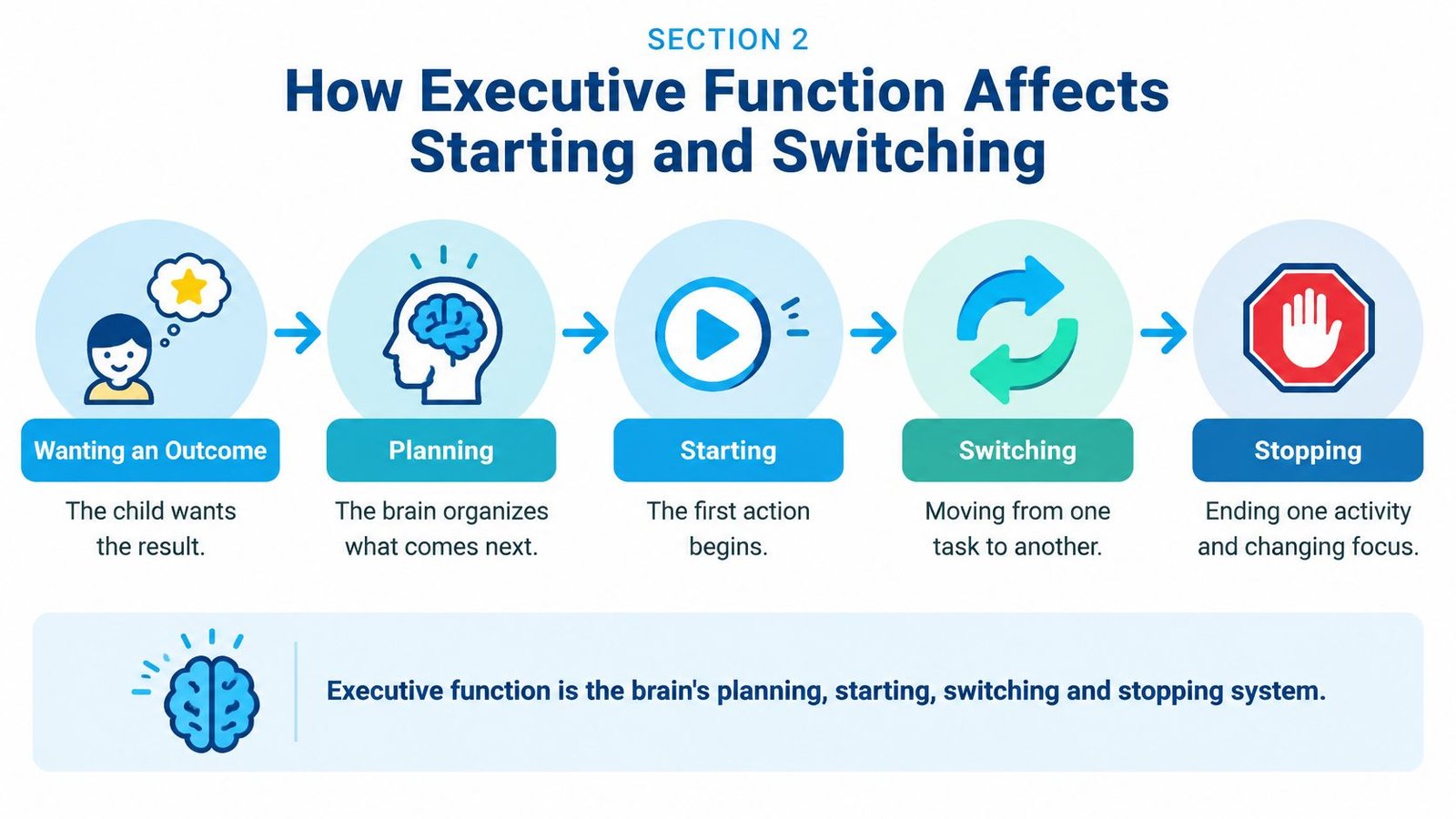
Three places children get stuck
Freezing at the start often means the task arrives as one large, vague demand. “Do your homework” requires your child to choose materials, find the page, understand the first question, and begin writing. Shrink the entry point to one physical action, such as “open the folder and put your pencil on question one.”
Stalling at transitions is different. Your child must stop a preferred activity, tolerate the gap, and enter a new sensory and social setting. A visible timer, a warning with a specific finish point, and a familiar bridge activity can lower that cost, and our guide to autism and time management covers practical ways to make time easier to see.
Losing the thread happens when several steps must be held in mind. Put the sequence outside your child's head with a picture strip or checklist before work begins, then let them mark off each step. The support should reduce memory load, not add another performance to manage.
Make the first step smaller than feels necessary
Say a seven-year-old refuses homework for twenty minutes, then completes a two-item checklist within a minute. The knowledge didn't suddenly change. The checklist removed planning from the starting moment and made success visible almost immediately.
Your child may need a tiny start for writing, a timer for leaving the park, and a checklist for packing a school bag. Those are separate executive demands, so don't expect one support to solve all three.
Practical rule: If your child can't start, don't make the reward bigger first. Make the first action smaller, clearer, and easier to see.
How Sensory Load and Anxiety Drain Engagement
Sensory load works like a tank filling through the day. Fluorescent lights, hallway noise, clothing textures, crowded transitions, and background conversations each add a little more, until an ordinary request arrives when your child has nothing left.
From the outside, that can look like disinterest. Your child may cover their ears, go quiet, refuse, seek movement, or melt down over a request they handled yesterday. The task didn't necessarily change. Their available capacity did.
The setting may be the intervention
A national survey of 200 autistic children and adolescents in the Netherlands found that problems in the school's physical environment were the only measured factor significantly associated with reduced school participation. Child and family variables were not significant predictors in that survey.
That finding changes the order of problem solving. Before you intensify incentives, compare participation across rooms, seats, times of day, and transition routes, as outlined in our resource on managing sensory overload. A quieter environment isn't merely comfort. It can be the condition that makes learning possible.
Anxiety adds a second cost. Unclear expectations, unfamiliar people, fear of mistakes, and not knowing when something will end force your child to spend energy predicting what comes next. If you want a plain-language explanation of how demands accumulate, the DeTalks guide to mental overload is a helpful companion when you're mapping what happens before shutdown.
Three changes to test
- Move the seat. Place your child away from the door, high-traffic areas, and direct flickering light, then compare task starts for several days.
- Reduce transition noise. Offer noise-reducing headphones for hallways, assemblies, cafeteria entry, or bus time rather than waiting for distress.
- Preview the sequence. Show the day's order, name any changes early, and identify where breaks will happen before work begins.
Don't call a child unwilling until you've checked whether participation improves when the environment costs less. That comparison is often the most respectful, and most useful, motivation test you can run.
When to Push, Change the Goal, or Pause
More reward doesn't always mean better support. A child who completes work while crying, masking distress, or needing a long recovery afterward hasn't had a successful motivation intervention. They've complied at a high emotional cost.
A review in Social Cognitive and Affective Neuroscience summarizes a 2025 study in which contingent rewards improved cognitive-task performance in both autistic and non-autistic youth. The same review notes that reward processing has not been directly linked to autistic people's perceived self-determination, so better task scores don't prove that a child feels autonomous or that the goal matters to them.
Choice can change that equation. The review describes a small study of three autistic students in which offering choices about instructional tasks and reinforcement options consistently reduced aggressive behavior. It also describes a self-determined learning intervention in which young people maintained skills they had selected as their own targets, a principle also reflected in practical advice on building lasting goal-setting habits for teenagers.
Use a three-way decision
- Push gently with support. Continue when your child accepts the goal, can recover quickly after difficulty, and shows some initiation or satisfaction. Keep the reward immediate and the next step clear.
- Change the goal or offer genuine choice. Act when refusal repeats across otherwise manageable settings. Let your child choose the order, material, partner, response method, or which of two meaningful goals comes first.
- Pause. Stop when you see escalating distress, shutdown, aggression, tears, attempts to leave, or a clear withdrawal of assent. Recovery and safety come before task completion.
Track more than finished work. Record choice, initiation, affect, recovery time, refusal, and whether your child selected or accepted the goal. Those details help you distinguish productive effort from compliance that leaves your child depleted.
When Low Engagement Needs a Professional Check
Contact your child's pediatrician, care team, or school psychologist when low engagement looks new, broad, or persistent. Don't wait for home strategies to solve a possible medical or mental health problem.
Signs that deserve prompt attention
- Sudden loss of interest in activities your child previously enjoyed
- New sleep or eating changes alongside withdrawal or irritability
- Visible pain, illness, or physical discomfort that your child may not be able to describe
- Loss of established skills, including language, self-care, or learning skills
- Distress across all settings that continues for several weeks despite reasonable changes
A checkup can help rule out hearing or vision problems, pain, illness, and medication side effects. Those causes are easy to miss when adults focus only on rewards, routines, or behavior plans.
Bring concise evidence to the appointment. List the behaviors you've seen, where and when they occur, what changed around the same time, and which strategies you've already tried. Dates and examples help a clinician see whether the pattern is situational or developing across your child's whole day.
For a non-speaking or minimally speaking child, communication difficulty can look exactly like unwillingness. Ask the team about picture-based supports, choice boards, speech-generating tools, or other augmentative options that let your child refuse, request help, and answer without heavy speech demands.
This guide can help you organize observations and questions. It doesn't replace your child's care team or medical advice.
Start a Motivation Log This Week
Don't change three strategies this week. Start a 14-day motivation log for one target behavior and let the pattern tell you what to change first.
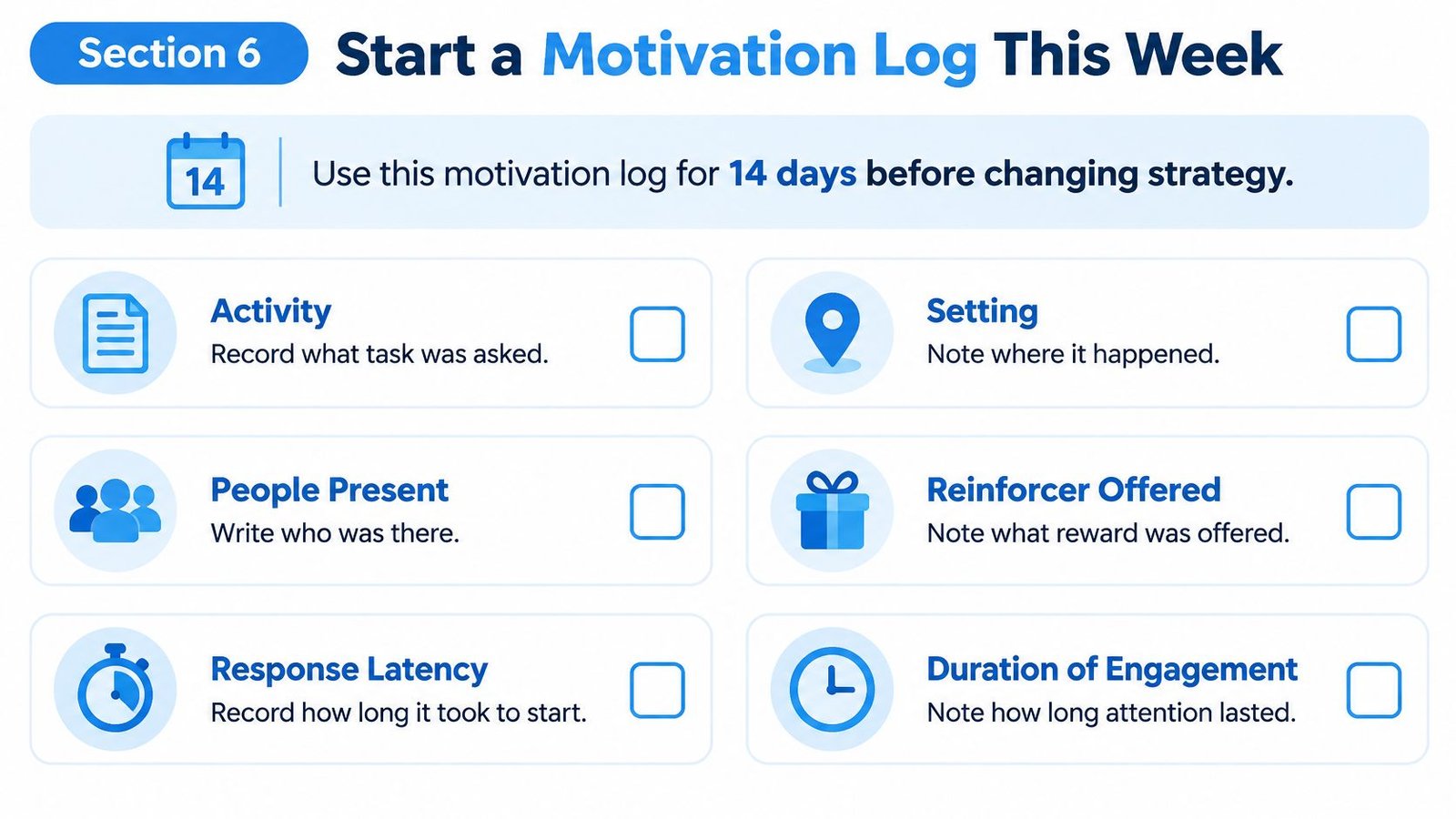
For each entry, record the activity, setting, people present, reinforcer offered, response latency, duration of engagement, and whether the response was spontaneous or prompted. Add noise, transitions, sleep, communication method, and recovery time when those factors might matter.
The 12-week SUCCESS randomized pilot trial included 25 autistic children aged 4 to 6, with 11 children in a motivation-based peer-group and parent-training intervention and 14 children receiving treatment as usual. Children receiving SUCCESS made more frequent peer initiations, including prompted and unprompted requests, and showed gains in clinician-rated social functioning, while parent-rated measures didn't show the same differential effect.
That split is the logging lesson. Separate results by initiation type, partner, setting, and who is rating progress, because gains may appear in structured sessions before they generalize at home. One aggregate score can hide the very pattern you need.
Your 14-day checklist
- Pick one target behavior. Choose something observable, such as starting homework or initiating a request.
- Log for 14 days. Keep entries brief and consistent rather than detailed only on difficult days.
- Review by setting and reinforcer. Compare latency, duration, prompts, and recovery.
- Change one variable. Adjust the environment, first step, choice, or reward, not all four.
- Bring the summary. Share it at the next therapy session or IEP meeting using our behavior log for parents as a reference for what to capture.
Guiding Growth was created as a simple, intuitive autism parenting app that provides tools to help parents identify triggers, analyze patterns, and make informed decisions. Its Behavior Tracking lets parents track meltdowns, shutdowns, demand avoidance, and any other challenging behaviors, and the app lets parents manage medications, doctor appointments, and therapy sessions all in one place. It supports your observations, but it doesn't replace your child's care team or medical advice.
Start your 14-day log in Guiding Growth by recording one target behavior with its setting, reinforcer, latency, and duration each day. You'll build a clear pattern across home, school, and therapy that you can review yourself and share at appointments or IEP meetings instead of relying on memory.