You're watching your child spin in the living room again. Maybe they're smiling and steady, arms stretched wide, clearly enjoying the movement. Or maybe they seem far away, circling and circling while you wonder whether you should interrupt, redirect, or worry.
That mix of curiosity and concern is so common. Parents often notice spinning because it stands out. It's visible, repetitive, and hard to ignore. Sometimes it looks playful. Sometimes it looks intense. Often, it's both confusing and emotionally loaded because you're trying to answer a much bigger question than “Why are they spinning?”
The better question is usually, “What is my child's body trying to do right now?” Spinning can be a way to play, a way to regulate, a way to cope, or a way to communicate when words aren't enough. When you start from that mindset, the behavior becomes less mysterious and much more workable.
Table of Contents
Introduction Why Your Child's Spinning Caught Your Attention
You look up in the middle of a birthday party and see your child turning in tight circles near the wall. Other children are moving from game to game. Your child seems absorbed in the motion itself. You may feel two things at once. Curiosity and concern.
That reaction makes sense.
For many parents, spinning stands out because it does not fit neatly into the usual categories of play, distress, or excitement. It can look purposeful without being easy to read. A child may seem calm while spinning, or hard to reach, or suddenly more organized afterward. From the outside, those details are easy to miss. From a parent's point of view, they are often the reason the behavior sticks in your mind.
Spinning on its own does not tell you whether something is harmless, helpful, or a sign that your child needs more support. Context matters. Frequency matters. What happens right before and right after matters too.
That is the piece many guides skip.
Instead of asking only, “Is this normal?” it helps to ask, “What job is this behavior doing for my child?” A thermometer gives you a number. It does not explain the illness. Spinning works in a similar way. It is a visible signal, but you still need a little more information to understand what the body is trying to do.
Parents often get pulled toward two extremes. One is brushing it off completely. The other is treating every episode like a warning sign. A more useful starting point is careful observation. If you track sensory triggers and patterns over time, you can begin to sort out whether your child is seeking movement, coping with overload, expressing excitement, avoiding a demand, or trying to reset after stress.
This matters even more when a child's needs show up in movement before they show up in words. For families building a broader communication support system, tools that support expression, including accessibility pricing for Voicy, can be one practical piece of that picture.
You do not need to decode everything in one moment. You only need to start noticing with a clear framework. Once spinning becomes information instead of a mystery, your next steps usually feel much more manageable.
Understanding the Why Behind Spinning in Autistic Children
Some children spin because it feels good. Some spin because their bodies need help settling. Others do it when they're overwhelmed, excited, frustrated, or trying to block out too much input. The behavior can look similar from the outside while serving very different functions.
Spinning is often a form of stimming
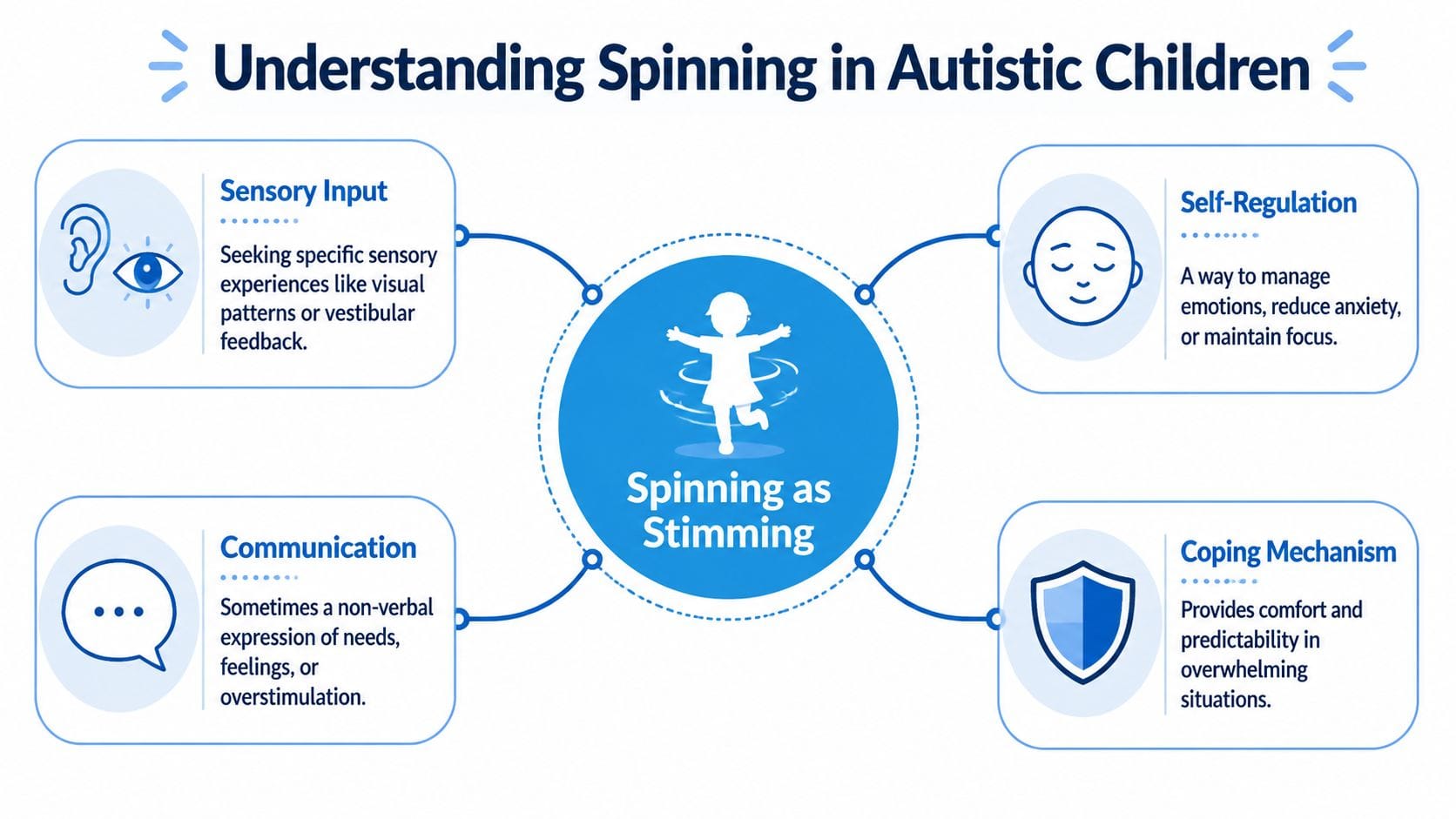
In autism, spinning is commonly described as stimming, short for self-stimulatory behavior. That term sounds technical, but the basic idea is simple. People repeat certain movements or sounds because those actions help their nervous system do something useful.
Adults do versions of this too. We pace while thinking. We tap a pen. We jiggle a leg in meetings. A child who spins may be doing the same kind of self-regulation, just in a more obvious, full-body way.
Expert guidance from the National Autistic Society explains that spinning can provide vestibular input, which may help some children regulate arousal, manage anxiety, or counter sensory overload. It may be beneficial and often harmless unless it becomes disruptive or dangerous, as described in their guidance on stimming and repeated movements.
If you're trying to sort out whether spinning is tied to noise, transitions, overwhelm, or another sensory pattern, this guide on identifying sensory triggers in autism can help you think more clearly about what may be driving it.
The vestibular system and emotional regulation
The vestibular system is the body's movement and balance system. It helps a child know where their body is in space and how it's moving. For some children, spinning gives strong input to that system. That input can feel organizing, energizing, soothing, or focusing.
Here are a few common reasons spinning may happen:
Sensory seeking: Some children actively look for intense movement because their body seems to need it.
Emotional regulation: Spinning may show up when a child is anxious, excited, or trying to come back to center.
Communication without words: A child who can't easily say “this is too much” or “I need a break” may communicate through movement.
Predictability: Repetition can feel safe when the world feels noisy, fast, or confusing.
Practical rule: Instead of asking only “How do I stop this?” ask “What is this doing for my child?”
That question changes everything. It leads you toward support, not shame.
Playful Twirling vs Repetitive Spinning
Parents often ask whether they're seeing normal play or something more significant. That's a reasonable question, but the answer usually isn't found in the spinning alone. It's found in the pattern around it.
What parents usually notice first
Playful twirling usually appears as part of a broader moment. A child is dancing, pretending, laughing with siblings, or copying something they saw. It tends to have a social or imaginative quality. The spinning starts and stops naturally.
Repetitive spinning that deserves closer observation often has a different feel. It may happen when the child is stressed, during transitions, in loud spaces, or in a very ritualized way. It can be hard to interrupt, or the child may return to it immediately after being redirected.
One frequently cited observational figure reports that 8.56 out of 10 children with autism spin, compared with 1.70 out of 10 children with other developmental delays. That isn't a population-wide prevalence estimate, but it does help explain why spinning has long been treated as a visible self-stimulatory behavior that warrants contextual observation in autism-related practice, as discussed in this overview of spinning in kids with autism.
Observing Spinning Behaviors
| Observation | Often seen in Playful Twirling | Often seen in Repetitive Spinning (Stimming) |
|---|---|---|
| Purpose | Part of fun, dancing, pretending, or social play | Helps regulate, cope, or seek sensory input |
| Context | Appears during games or shared activities | May appear during stress, waiting, transitions, or overload |
| Duration | Short, flexible, easy to move on from | More prolonged or repeated across the day |
| Interruption | Child usually stops without much distress | Child may resist stopping or quickly restart |
| Social quality | Often shared, interactive, playful | Can be solitary or inwardly focused |
| Emotional state | Usually light and easygoing | May happen during anxiety, excitement, frustration, or shutdown recovery |
A few examples make this easier to picture.
A preschooler who spins twice while pretending to be a ballerina, then runs off to build with blocks, is likely using spinning as play.
A child who spins every day after school in the same corner, especially after noise and social demands, may be using spinning to decompress.
A child who spins during grocery store trips, in checkout lines, and during transitions into bedtime may be showing you that uncertainty or sensory load is building.
Context matters more than the movement by itself.
That's why autism and spinning can't be reduced to a yes-or-no checklist. Frequency, setting, interruption response, and what the child seems to get from it all matter more than whether the child ever spins at all.
Assessing Safety and Creating a Safe Space for Spinning
The first goal usually isn't to stop spinning. The first goal is to make sure the child can meet that need safely.
Safety comes before suppression
Expert guidance stresses the difference between a harmless self-regulation strategy and a safety issue. Unsafe stims may need safer replacements and environmental changes, especially when a child seeks very intense sensory input such as excessive whirling that could lead to falls or injury, as noted by the Raising Children Network in its guidance on stimming.
That distinction matters. A child who spins briefly on carpet and stays balanced is very different from a child who spins near sharp furniture, crashes into walls, or gets so dizzy that falls become likely.
If you're setting up your home with regulation in mind, these autism sensory room ideas can help you think through calming spaces, movement options, and safer ways to meet sensory needs.
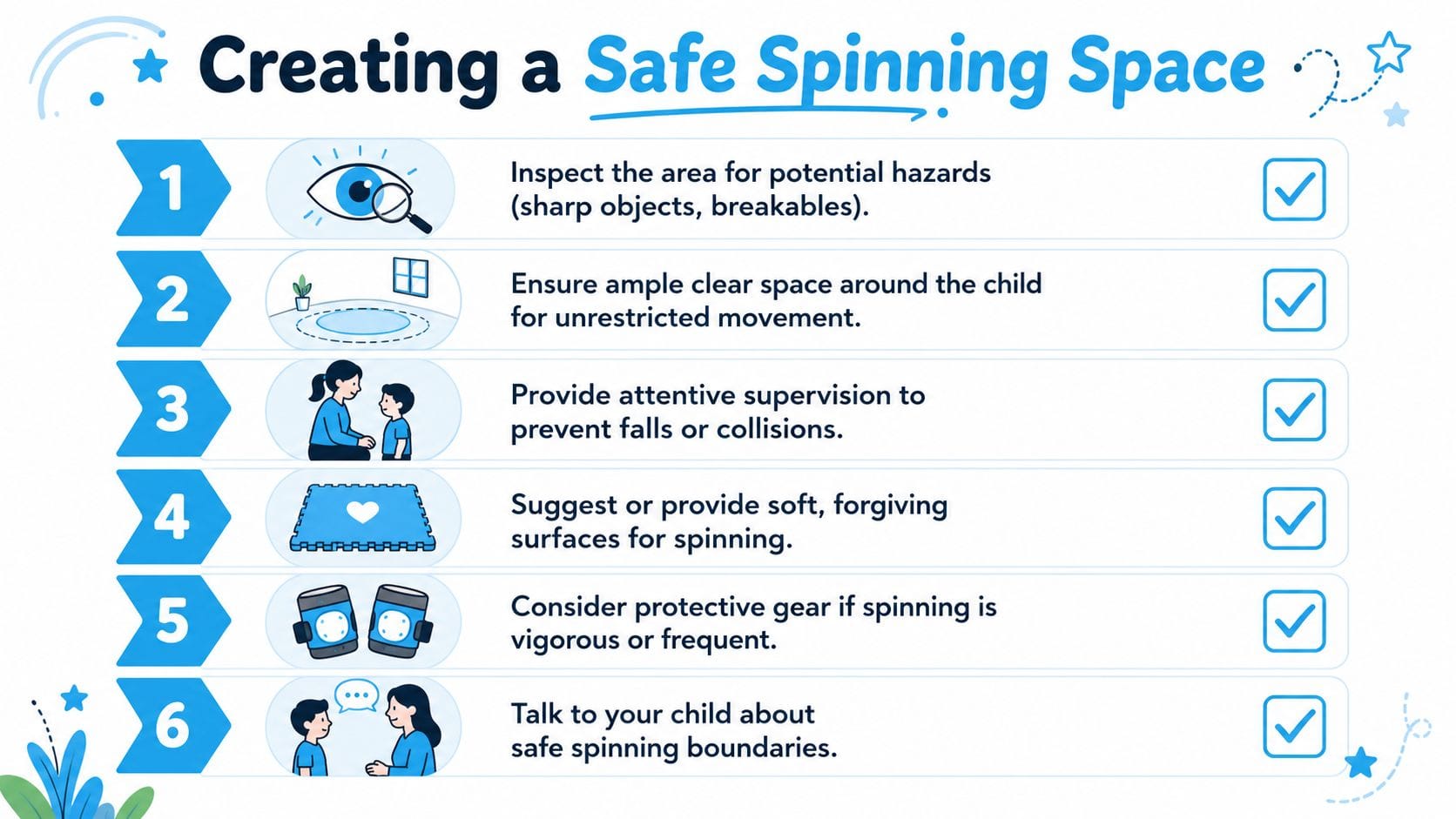
A simple home safety checklist
Use this as a practical filter when your child spins often:
Clear the area: Move breakables, hard-edged furniture, and clutter out of the immediate space.
Choose softer surfaces: Carpet, foam mats, grass, or other forgiving surfaces are easier on bodies than tile or concrete.
Watch balance after spinning: Notice whether your child stops safely or stumbles and crashes.
Look at location, not just behavior: Spinning in an open room is different from spinning near stairs, counters, or street traffic.
Consider timing: If spinning regularly disrupts meals, school tasks, bedtime, or toileting, the issue may be functional even if it isn't dangerous.
Offer a designated place: Some children do well with a clear “spin here” area or a routine movement break.
Parents often feel that allowing spinning means giving up boundaries. It doesn't. You can accept the need and still shape the conditions around it.
For example, “You can spin on the rug” is a boundary. “Not near the coffee table” is a boundary. “Let's do big movement before homework” is a proactive plan, not permissiveness.
Supportive Responses How to React in the Moment
When a child is spinning, your response can either lower stress or add more of it. Most children don't do better when adults rush in with alarm, criticism, or force.
What helps in the moment
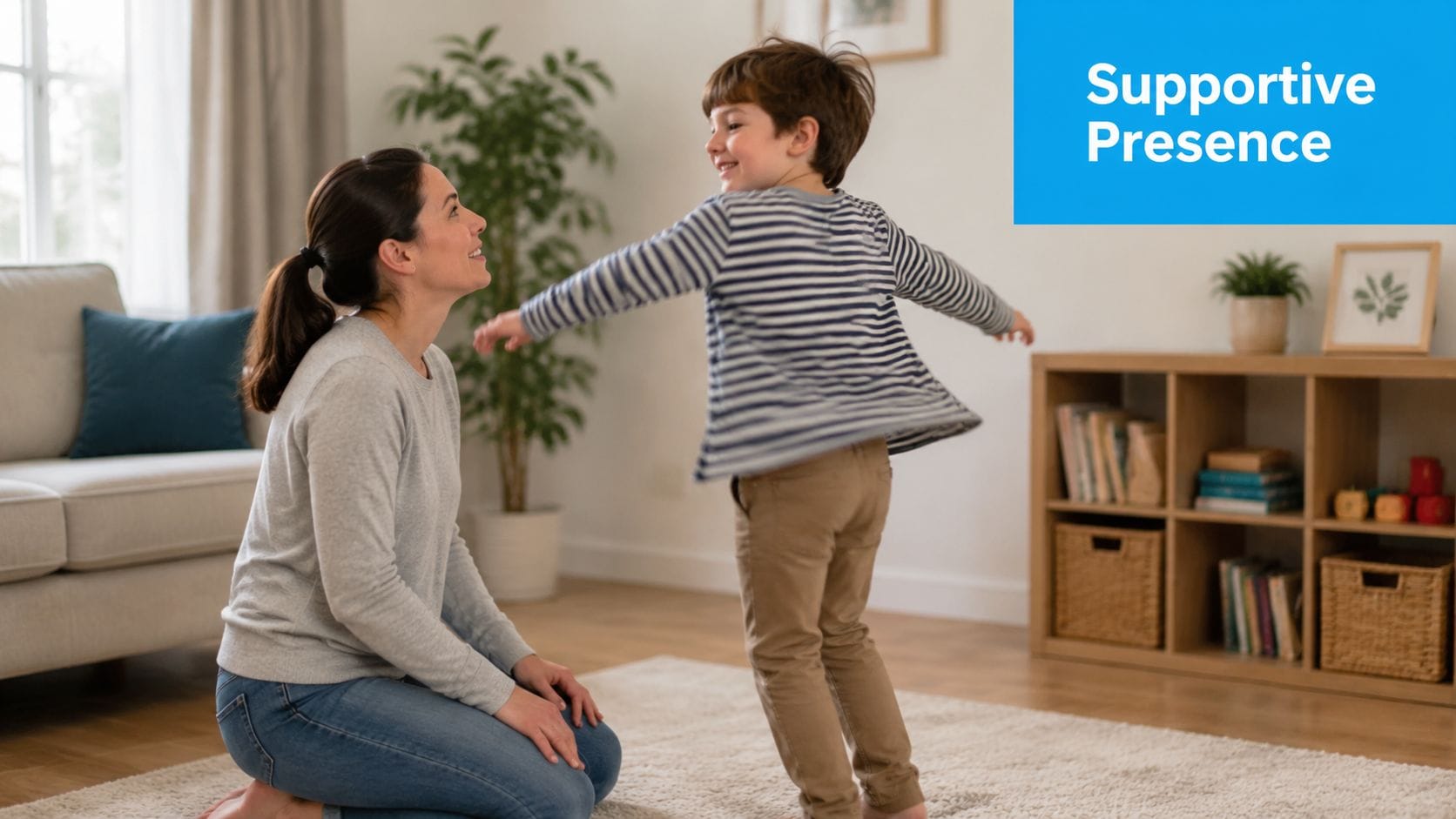
Start with your own body. Slow your voice. Lower your shoulders. Move closer only if your child tolerates that well. If the spinning is safe, lead with observation before direction.
Helpful phrases often sound like this:
Name what you see: “Your body really wants to spin right now.”
Acknowledge the need: “I think you need movement.”
Set a safety boundary calmly: “Let's move to the rug.”
Offer a next option: “After spinning, we can do squeezes or jumps.”
Sometimes joining briefly can reduce shame and build connection. I don't mean making a spectacle of it. I mean showing with your body language that you're not afraid of your child's regulation needs. A quick shared spin, a smile, or kneeling nearby can say, “I'm with you.”
Some children can stop more easily when they feel understood first.
What tends to make spinning harder
Certain adult responses usually increase distress:
Shaming language: “Stop that, you look weird.”
Physical control without warning: grabbing, yanking, or forcefully restraining unless immediate safety requires intervention
Rapid-fire questions: too much language when a child is already overloaded
Treating the behavior like defiance: assuming the child is choosing it to be difficult
If you're supporting a child with frequent regulation needs, your own energy matters too. Many parents benefit from resources that offer help to prevent caregiver burnout because calm responses are much harder to access when you're running on fumes.
A simple do-this-not-that pattern can help:
| Do this | Instead of this |
|---|---|
| Stay calm and close | Reacting with panic |
| Move the child toward safety | Demanding instant stopping from across the room |
| Use few words | Giving a long lecture |
| Validate the need | Calling it bad behavior |
| Redirect after regulation | Redirecting before the child is ready |
The aim isn't to approve of every circumstance. It's to become a steady person your child can borrow calm from.
How Tracking Patterns Can Reveal Your Child's Needs
One day of spinning can feel confusing. Two weeks of notes often makes it much clearer.
Parents often tell me, "It seems random." Then they start writing down a few details, and the pattern starts to come into focus. Spinning may show up after school, during waiting, after a loud sound, or right before a hard transition. That pattern matters because the same behavior can serve very different jobs for different children. For one child, it may help the body wake up. For another, it may be a way to shut out noise and reset.
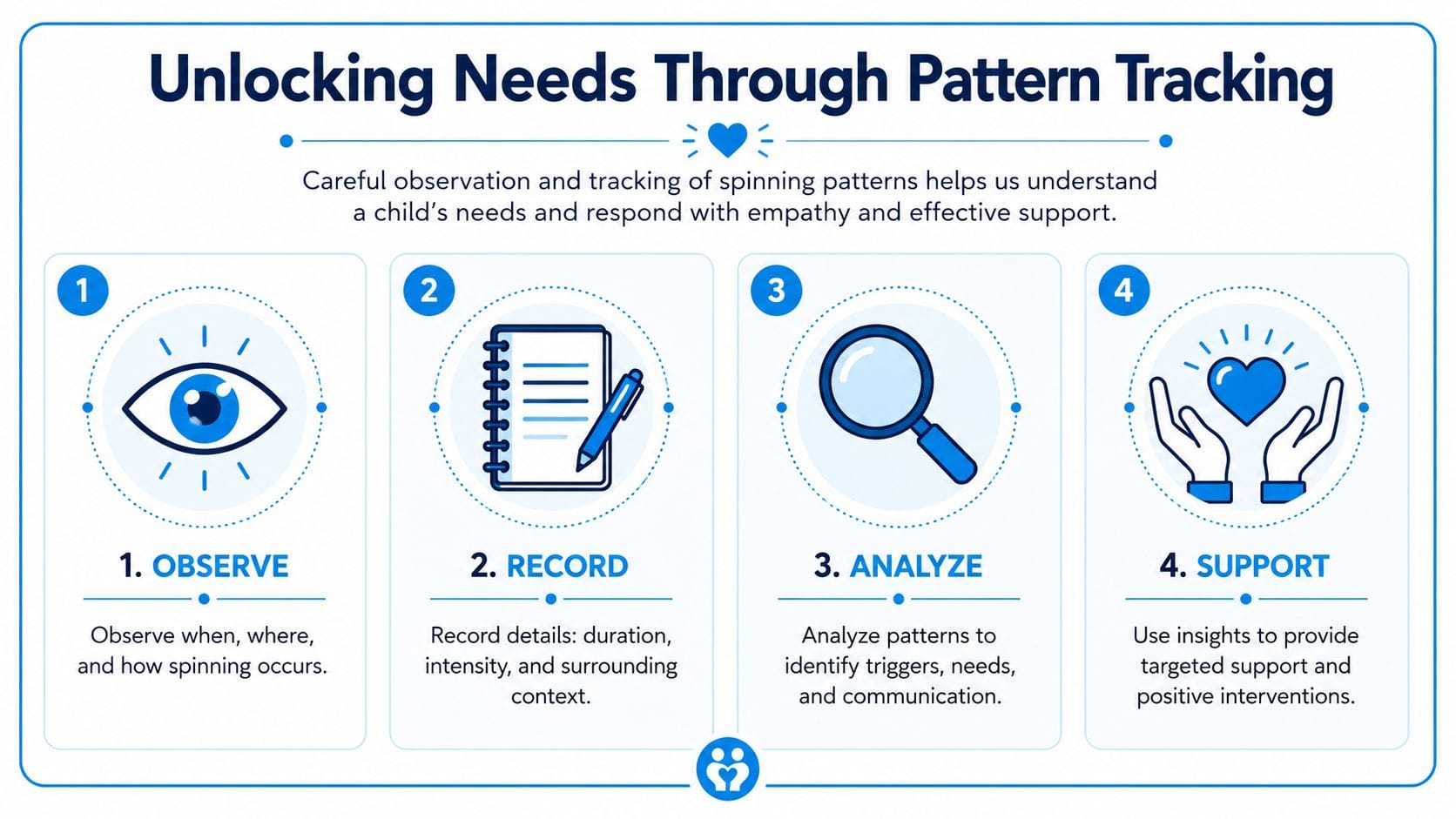
What to track
You do not need a long chart or a perfect system. A few consistent notes are usually enough to help you spot the "why."
Useful details include:
What happened right before: loud noise, transition, denied request, waiting, excitement, fatigue, hunger
When it happened: after school, before dinner, during bedtime, in busy stores, while siblings were active
How long it lasted: a few seconds, several minutes, repeated on and off, hard to interrupt
What it looked like: playful twirling, fast repetitive spinning, spinning with humming, spinning while watching objects
What happened after: calmer body, more upset, easier transition, fall, crying, retreating to a quiet space
Why simple logs beat memory
Memory is helpful, but it has blind spots. It tends to hold onto the hardest moments and skip over the quieter ones. A short log gives you something steadier to work from.
That matters because patterns are often subtle at first. You may notice that spinning happens more on poor-sleep mornings, during crowded errands, or in the 20 minutes after getting home. You may also notice the opposite. Your child spins, then becomes more settled and able to join the next activity. That is very different from spinning that builds into distress.
A notebook works. A notes app works. Guiding Growth can also be used to log behaviors, routines, sleep, and triggers in one place, including quick voice notes when your hands are full. The method matters less than the habit.
Try a short entry like this:
3:40 p.m. Home from school. Spun in hallway for several minutes after younger sibling started crying. Covered ears first. Calmed after going to bedroom and bouncing on bed.
That small note gives you a lot to work with. It suggests noise may have come first. It shows the spinning may have been part of calming, not misbehavior. It also points toward supports that fit this child, such as a quieter after-school routine, earlier decompression time, or a movement option in the bedroom.
Over time, your notes can help you sort spinning into practical categories. Is it showing up with sensory overload? During excitement? In boring waiting periods? As part of a transition ritual? This is the part many generic guides miss. Tracking does not just document behavior. It helps you test your best guesses so your response can match your child's actual need.
If your notes start raising bigger questions about development, it may help to read about who can diagnose autism and what each professional looks for. If you are also exploring local evaluation paths, these autism assessment options can help you compare next steps.
When to Share Your Observations with a Professional
You may have a moment when your notes stop feeling like simple observations and start feeling like a pattern. For example, you realize the spinning is showing up every day after school, or it is getting so intense that your child bumps into walls, falls, or seems hard to reach. That is usually the point where it helps to bring in another set of eyes.
Your tracking is useful here for one big reason. It turns a vague worry into a clearer picture. A professional can do much more with, "It happens after loud transitions, lasts several minutes, and settles with heavy work," than with, "My child spins a lot."
Patterns that deserve follow-up
Spinning is more worth discussing with a professional when it is frequent, intense, unsafe, or gets in the way of daily life. The behavior itself is only one piece of the puzzle. What matters just as much is what comes before it, what it looks like in the moment, and what happens after.
Consider sharing your observations if you notice:
Safety concerns: falls, collisions, spinning near stairs or hard surfaces, or repeated dizziness
Clear distress: spinning seems to show up when your child is overwhelmed, scared, or struggling to recover
Interference with daily routines: school, sleep, meals, toileting, learning, or family activities are regularly disrupted
A meaningful change: the spinning becomes harder to interrupt, more intense, or starts happening in new places
Other developmental concerns: differences in communication, social connection, play, or other repetitive behaviors are also on your mind
A helpful way to picture this is a fever. A single number does not tell the whole story. You also look at the child's energy, comfort, eating, and how long it has been going on. Spinning works in a similar way. Frequency matters, but context matters too.
How your notes can improve appointments
Good notes help a professional sort out whether the spinning looks more like sensory seeking, stress relief, a transition habit, or a sign that your child needs more support in another area.
Bring a few short examples if you have them. Videos can help too, if your provider welcomes them. You can also bring questions like these:
What patterns stand out to you in these notes?
Does this look more like regulation, distress, or a mix of both?
Would an occupational therapy evaluation help us understand this better?
What should we address first: safety, sensory needs, communication, or routines?
If you are sorting through next steps, this guide to who can diagnose autism and what each professional does can help you decide where to start. Families who are also comparing local autism assessment options often find it useful to look at evaluation paths before booking appointments.
You do not need to arrive with the answer. You are gathering clues, not writing a final report. That shift alone can take a lot of pressure off.
As you have seen throughout this article, the goal is not to stop every spin. The goal is to tell the difference between a behavior that helps your child regulate and a pattern that signals a bigger need. Once you can see that difference more clearly, your support becomes calmer, more specific, and more effective.
If you want one place to log spinning, sleep, triggers, routines, and share patterns with caregivers or clinicians, Guiding Growth offers a practical way to turn daily observations into useful insight.