It's 6:30 p.m. You've asked your child to start homework, clear their plate, or take one bite of a new food. Within seconds, the room changes. Maybe they cry, bolt, hide under the table, throw the pencil, or go completely quiet and shut down. You're not trying to be harsh. You're trying to get through ordinary daily tasks without everything falling apart.
If you've heard a therapist mention escape extinction ABA, you may already feel torn. The name sounds technical. The idea can sound simple when someone says it quickly. But for parents living through the moment, there's nothing simple about holding a demand in place while your child is overwhelmed. You may be wondering whether this is standard practice, whether it's safe, and whether there are better options.
Those are reasonable questions. Parents need more than definitions. They need a clear explanation of what this procedure is, why some clinicians use it, where it can go wrong, and how to protect a child's safety and dignity while making decisions. If you need broader support for the emotional side of parenting through these hard moments, this guide on Advice for autism parents offers helpful perspective. If meltdowns are part of the picture at home, a practical read on how to help autism meltdowns can also help you sort out what your child may be communicating.
Table of Contents
- Introduction A Common Challenge for Parents
- What Is Escape Extinction in Simple Terms
- How Escape Extinction Works and Why It Is Used
- The Evidence and the Risks What Parents Must Know
- Ethical Concerns and Safer Skill-Building Alternatives
- Your Role Collaborating and Tracking for Safety
- Conclusion From Understanding to Actionable Steps
Introduction A Common Challenge for Parents
A lot of families end up here after months of the same exhausting pattern. A child is asked to do something they don't want to do, or can't yet do comfortably. The demand might be brushing teeth, writing a sentence, getting dressed, transitioning off a screen, or sitting at the table. The behavior that follows may look defiant from the outside, but parents often know it's more complicated than that.
Sometimes the child is trying to escape the task itself. Sometimes they're trying to escape anxiety, confusion, sensory overload, pressure, or the fear of getting it wrong. That difference matters. It changes how a thoughtful adult should respond.
Why this term comes up in therapy meetings
When professionals talk about escape extinction, they're usually talking about what happens when a child has learned that a behavior successfully gets a demand removed. If screaming ends homework, or dropping to the floor ends the transition, the behavior can keep happening because it “works” to make the task go away.
That's the context where parents may hear the term for the first time. And that's often where confusion starts, because the phrase can sound colder than the actual situation feels.
A worried parent usually isn't asking, “What's the textbook definition?” They're asking, “What happens to my child if we do this?”
Why a balanced explanation matters
This topic is controversial for good reason. Some clinicians view it as a valid tool in limited situations. Others are moving away from it because of safety concerns, emotional distress, and the risk that it gets applied like forced compliance instead of thoughtful support.
If your child's team has raised this approach, you don't need to choose between blind trust and total rejection. You can ask better questions. You can look for signs that a plan is careful or careless. You can insist that any intervention respect your child's communication, nervous system, and safety.
What Is Escape Extinction in Simple Terms
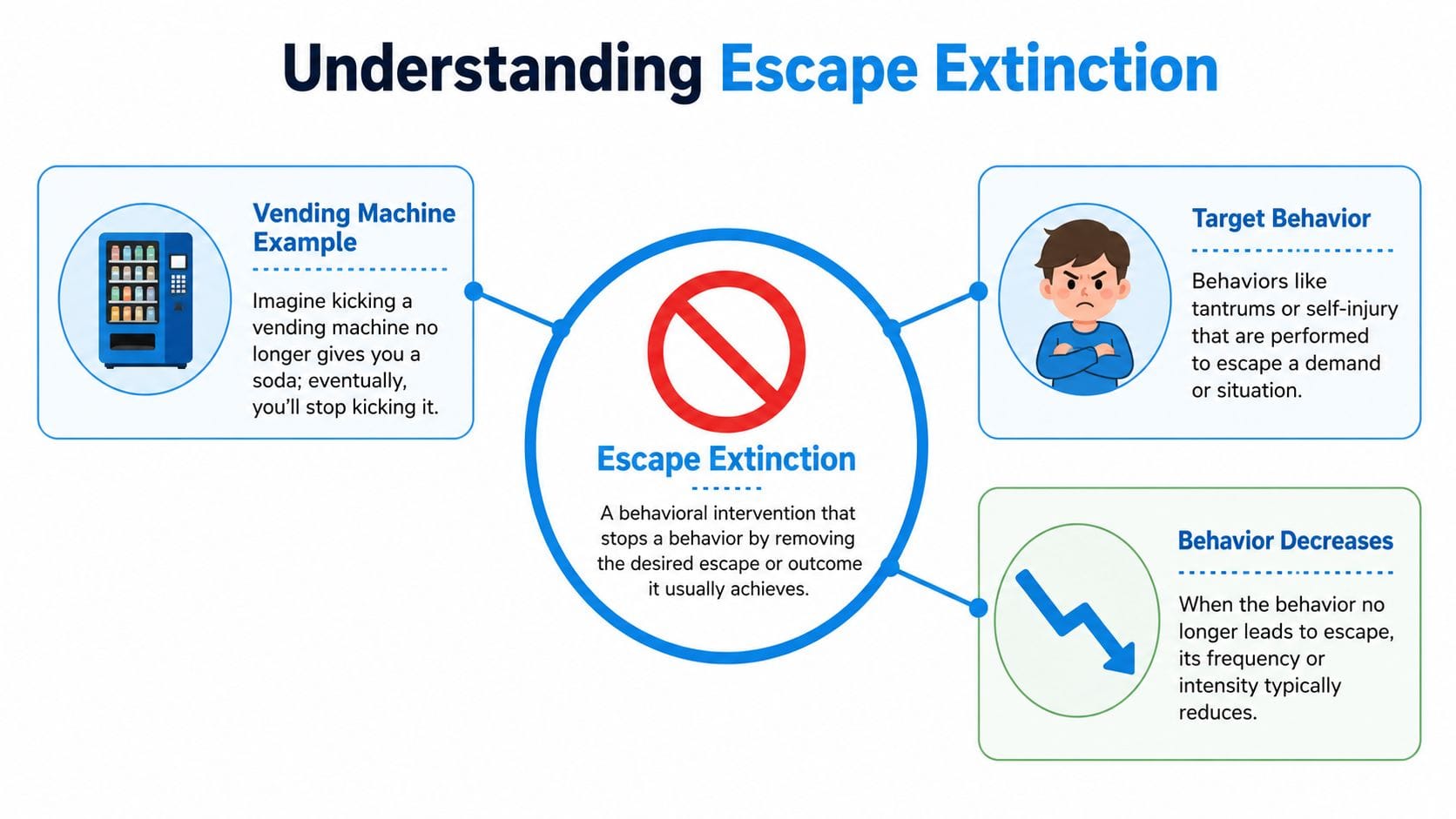
The easiest way to understand escape extinction is to think about a broken vending machine. If someone kicks the machine and it used to drop a soda, the kicking might continue because it worked before. If kicking no longer gets the soda, the behavior may eventually stop because the expected payoff is gone.
That's the basic logic behind escape extinction ABA. The “payoff” is not a toy or a snack. It's getting out of a demand.
The basic idea
A plain-language definition from Applied Behavior Analysis EDU's explanation of extinction in ABA states that escape extinction is a specific ABA procedure applied only when a behavior is functionally maintained by escape from a demand or task, meaning the individual engages in the behavior to avoid completing it; during implementation, the task is not removed but remains in place until completion, teaching that the challenging behavior does not result in avoidance.
In daily life, that could sound like this:
- Homework example: A child rips the worksheet because worksheets usually get put away after that.
- Teeth brushing example: A child screams and brushing stops.
- Food example: A child pushes the spoon away and the meal ends.
In escape extinction, the adult doesn't let the problem behavior end the demand. The key idea is not “make the child obey.” The key idea is “don't let the behavior keep working as an escape route.”
A short visual explanation can help if this concept still feels abstract.
What it is not
Parents often hear the word extinction and think it means ignoring a child. That's not accurate here.
Escape extinction is not the same as:
| Approach | What it means |
|---|---|
| Punishment | Adding a consequence to reduce behavior |
| Ignoring | Withholding attention and stepping back |
| A universal solution | Using the same response for every meltdown or refusal |
| Proof of willful behavior | Assuming the child is simply choosing to be difficult |
Practical rule: If the child's behavior isn't actually maintained by escape from a demand, then escape extinction isn't the right label and may not be the right intervention.
That's why parents should be cautious when the term gets used casually. If a child is melting down because of pain, sensory overwhelm, confusion, or lack of communication, the answer may be support, adjustment, and skill-building, instead of keeping the demand in place.
How Escape Extinction Works and Why It Is Used
Escape extinction is built on a very specific chain of events. A demand is presented. The child engages in a behavior that has historically resulted in escape. The adult does not remove the demand because of that behavior. Over time, if the behavior no longer produces escape, the behavior may decrease.
That's the theory. In practice, it should never begin with the demand itself. It should begin with assessment.
The first step is always assessment
A clear technical summary from this discussion of escape extinction and BCBA exam concepts states that critical technical specifications mandate that escape extinction must never be implemented without a prior Functional Behavior Assessment (FBA) to confirm escape is the primary function, and requires documented baseline data. An essential benchmark is the expectation of an “extinction burst,” where behavior intensity temporarily escalates before fading; consistency during this burst is the primary determinant of success.
That sentence carries several important ideas parents shouldn't miss:
- The team needs an FBA first. A therapist shouldn't guess that the behavior is escape-maintained.
- The team needs baseline data. They need to know what the behavior looks like before any plan starts.
- An escalation is expected. Families should never be surprised by that possibility.
- Consistency matters. If one adult removes the demand during the hardest moment, that can strengthen the behavior.
What the procedure looks like
In a controlled plan, the sequence often looks like this:
- A clear demand is presented. Not a vague “be good,” but something observable like “put the pencil on the paper.”
- The child reacts. This might be crying, refusal, dropping, throwing, or another behavior the team has identified.
- The adult keeps the task available. The demand doesn't disappear because of the problem behavior.
- A safer alternative is prompted and reinforced. For example, asking for help, requesting a break, or completing a smaller step.
That last point matters more than many parents are told. Ethical practice doesn't leave a child with no way out except distress. It should pair any extinction-based procedure with teaching a replacement response.
If a plan only says “don't let them escape,” it's incomplete. A child needs a safe, functional way to communicate, pause, or get support.
Where parents get confused
Parents often think consistency means emotional hardness. It doesn't. A calm voice, shorter demands, visual supports, and a regulated adult still matter. Consistency means the team responds the same way to the target behavior, not that they become robotic.
Another common confusion is assuming every refusal should be pushed through. That's not safe thinking. A child who is scared, overloaded, ill, or dysregulated may need the task adjusted, postponed, or broken down. Procedure should never replace judgment.
The Evidence and the Risks What Parents Must Know
Some families are told escape extinction “works,” and that's where the conversation ends. It shouldn't end there. Parents deserve the full picture, including what the research suggests and what the procedure can cost a child when it goes poorly.
What the research suggests
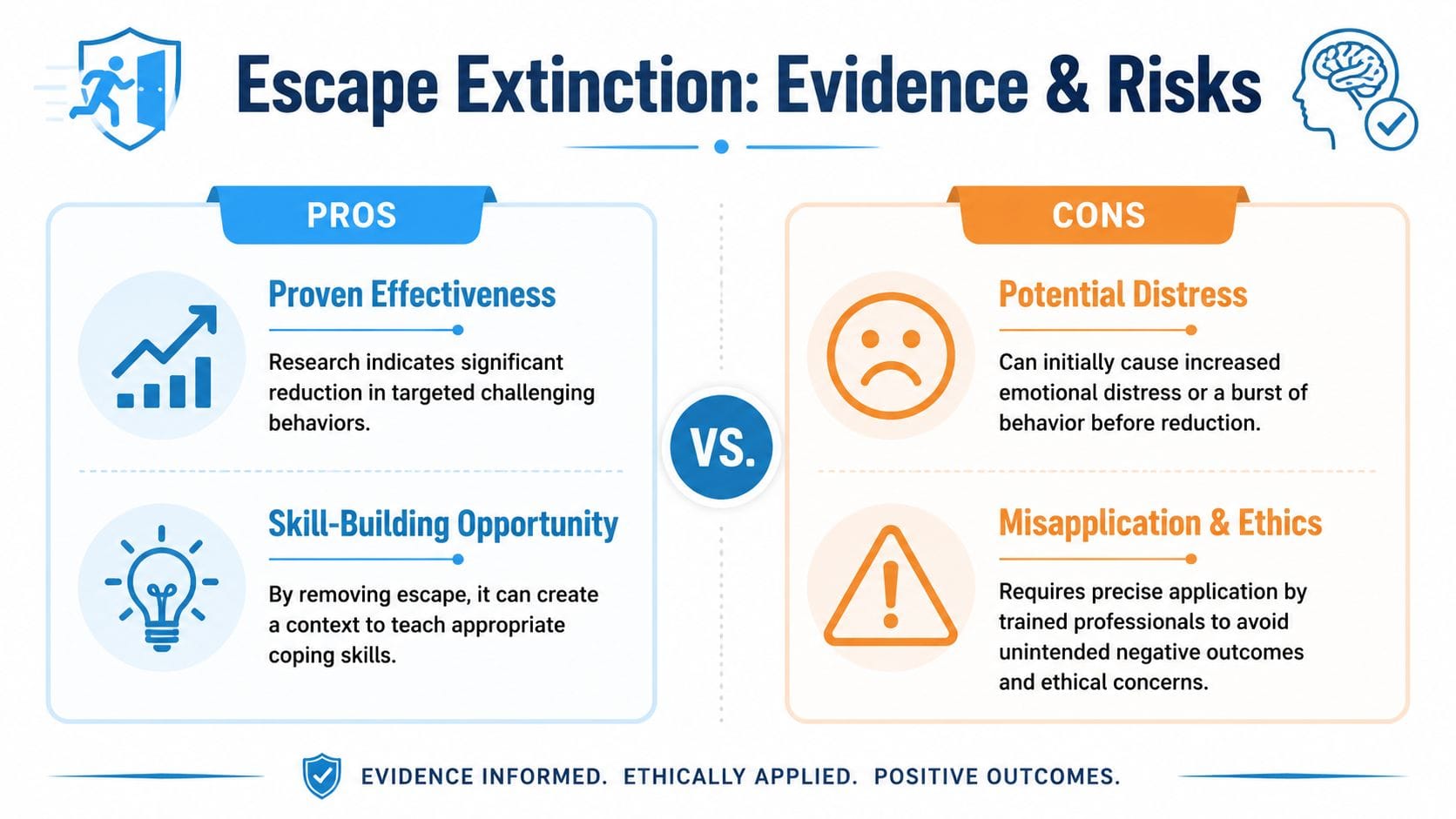
A summary published by Links ABA on extinction in ABA reports that escape extinction has been shown to reduce problem behaviors in approximately 89% of cases, but research indicates that extinction bursts, intense increases in behavior frequency, duration, or severity, occur in about 70% of implementations, posing potential risks for aggression or self-injury.
Those two numbers belong together. They should never be separated.
A parent hearing only the first number may think, “So this is effective.” A parent hearing both numbers understands the harder reality. A procedure can reduce a behavior and still carry serious short-term risk.
Why the risk conversation matters
When families are considering this approach, the main question isn't only whether the target behavior might go down. The more urgent question is what happens during the period before that reduction, and whether the child can move through that period safely.
Risks can include:
- Escalation in intensity: The child may scream louder, resist harder, or become more desperate before the behavior fades.
- Aggression or self-injury: Some children may become unsafe during the burst phase.
- Emotional distress: Even when no injury occurs, the procedure can be highly upsetting.
- Misreading the behavior: A team may label distress as noncompliance when the child is overwhelmed.
Parents should ask for the safety plan before they ask about the expected outcome.
There's another layer many people miss. Broader reviews summarized in the same Links ABA material also note that alternatives to escape extinction often perform well, and that escape extinction may not always add substantial benefit compared with antecedent changes or differential reinforcement strategies. That doesn't mean it never has a place. It means its use should be thoughtful, limited, and weighed against less intrusive options.
Ethical Concerns and Safer Skill-Building Alternatives
The strongest criticism of escape extinction today isn't about terminology. It's about lived experience. Many parents and professionals worry that in practice, the procedure can slide into something more coercive than therapeutic.
Why families hear the phrase forced compliance
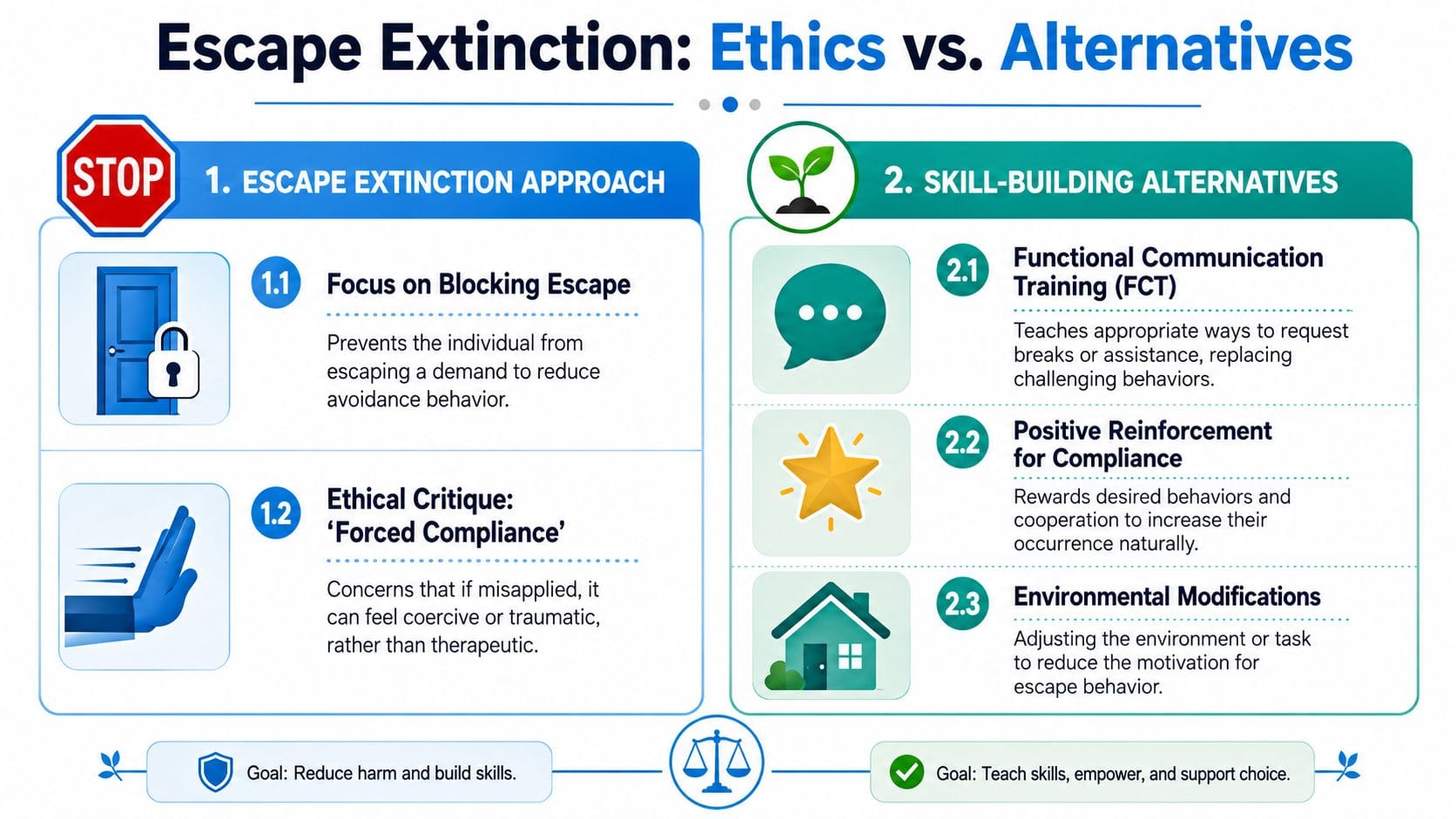
A growing concern summarized in this discussion from the ABA community about what people hear when they hear escape extinction is that a growing trend is the ethical backlash against escape extinction due to its conflation with “forced compliance”. Recent ethical alternatives explicitly reject traditional escape blocking and forced prompting, instead using “wait-out” procedures to reduce escape-maintained behavior without physical coercion, a distinction rarely clarified in mainstream materials.
That concern makes sense from a parent's point of view. If “escape extinction” is translated into real life as blocking the doorway, repeating the demand over and over, physically guiding compliance, or refusing to recognize panic, many families won't experience that as support. They'll experience it as pressure.
Some of the confusion comes from the gap between a narrow technical definition and the way people carry it out on the floor, at the table, or in a classroom. That's where ethics live. Not in the label, but in the procedure as the child experiences it.
What compassionate alternatives look like
Modern, skill-based care often shifts the focus from “stop escaping” to “teach a better way to ask, cope, or participate.” Two of the most important approaches are Functional Communication Training (FCT) and Differential Reinforcement of Alternative behavior (DRA).
Here's what those can look like in plain language:
- FCT teaches communication. Instead of bolting from math, a child learns to say “help,” “break,” or “one more minute.”
- DRA reinforces the replacement. The adult responds quickly when the child uses that safer alternative.
- Environmental changes lower the need to escape. A task can be shortened, visualized, or made more predictable.
- Demand fading builds tolerance gradually. The child starts with a manageable amount, not the full hard task all at once.
This kind of approach often feels more respectful because it assumes the behavior is solving a problem for the child. The adult's job is to teach a better solution.
A lot of parents also need support for themselves during these moments. Holding boundaries while staying calm is hard, especially if your child's distress triggers your own. Resources on developing parental emotional regulation skills can be useful alongside behavior support. For families wanting a gentler framework, these positive behavior support strategies can help you think beyond pure extinction models.
“Teach the child what to do instead” is often a more humane and more durable starting point than “show the child that escape won't work.”
Your Role Collaborating and Tracking for Safety
Parents are often treated like implementers. In reality, they are the people most likely to notice the early warning signs that a plan is helping, backfiring, or becoming unsafe.
That role gets even more important when a behavior plan involves escape-maintained behaviors. A clinician may see a child for a limited block of time. Parents see bedtime, school refusal, toothbrushing, mealtime, transitions, illness, poor sleep, and the aftermath of hard sessions. That broader picture matters.
Parents are not passive observers
A clinical review shared by Achieve Beyond on reducing escape without escape extinction emphasizes that practical, actionable data requires that all stakeholders (parents, teachers, therapists) maintain 100% consistency, as even one inconsistency can reinforce the challenging behavior. This data is critical for the risk-benefit analysis, as the intervention carries risks of dangerous behavior bursts and potential emotional harm.
That means your observations are not extra. They are part of the safety system.

What to track and why it matters
If a team is considering or using any plan related to escape behavior, parents should log what they see. A scattered memory at the next meeting isn't enough. Patterns become clearer when they're written down consistently. This guide on how to track and understand behavioral triggers gives a good starting point for what to notice.
Useful things to track include:
- What happened right before the behavior: Was it a worksheet, a transition, a sound, a food, or a rushed instruction?
- What the behavior looked like: Crying, eloping, hitting, dropping, freezing, self-injury, or shutdown can mean different things for safety planning.
- How intense it was: Mild refusal is different from panic or aggression.
- How long it lasted: A brief protest and a prolonged event are not the same clinical picture.
- What adults did next: Did they reduce the task, repeat it, physically guide, offer help, or allow a break?
- What happened after: Did the child recover, escalate later, avoid the next demand, or show lingering distress?
A short table can make this easier to picture:
| What to note | Why it matters |
|---|---|
| Antecedent | Shows which demands or settings trigger escape behavior |
| Behavior topography | Helps separate refusal from panic, overload, or risk |
| Adult response | Reveals whether the plan is actually consistent |
| Outcome | Shows whether the child escaped, communicated, or completed a step |
| Recovery pattern | Helps judge emotional cost, not just task completion |
Good data protects children. It helps parents say, “This is improving,” “This is too much,” or “This needs to change.”
When parents bring organized notes to the team, the conversation changes. Instead of “I feel like it's worse,” you can say, “The behavior is now happening during dressing, meals, and homework, and recovery is taking much longer.” That's the kind of information that helps a team reconsider whether a plan is appropriate.
Conclusion From Understanding to Actionable Steps
Escape extinction ABA is not a small or neutral procedure. It's a specific intervention for behavior maintained by escape from demands, and it carries meaningful risk. Some teams still use it in limited situations. Many are moving toward approaches that teach communication, reduce distress, and build tolerance with more compassion.
For parents, the most important shift is this: you don't have to accept vague language or rely on reassurance alone. Ask whether an FBA was completed. Ask what the replacement skill is. Ask how safety will be protected if behavior escalates. Ask how the team will know when to stop.
Knowledge matters, but observation matters just as much. Your records of triggers, intensity, adult responses, and recovery can help the care team see what's happening, not what they hope is happening. That's how informed decisions get made.
If you want one place to organize those daily observations and turn them into useful patterns, Guiding Growth can help. It gives parents a practical way to log meltdowns, shutdowns, demand avoidance, routines, and context so you can collaborate with therapists and make safer, better-informed decisions for your child.