You're up at night again, listening for the thump. Maybe your child has already hit the wall, the crib, the floor, or the side of the bed, and you're trying to decide whether to rush in, hold them, or just stand there in shock for a second too long. Head banging and autism can feel frightening because it's loud, sudden, and personal, like your child is hurting themselves in front of you and you still don't know why.
The hardest part is that there usually isn't one simple answer. Sometimes head banging is about sensory regulation, sometimes it's communication, sometimes it's frustration or anxiety, and sometimes it's pain. In autism, self-injurious behavior is common enough that clinicians treat it as a serious support need, not a random bad habit. A major 2020 meta-analysis pooled 14,379 participants across 37 studies and found a 42% lifetime prevalence of self-injurious behavior in autism, which gives us a strong anchor for understanding how often head banging sits inside that broader pattern (Apex ABA summary of the meta-analysis).
What parents usually need first is not jargon. They need a way to keep their child safe tonight, a way to tell whether the behavior might be pain, and a way to notice patterns that can lead to change. That's where clear observation, simple tracking, and the right professional support start to matter more than guesswork.
Table of Contents
- The Moment Your Child Hits Their Head Against the Wall
- What Head Banging Really Is
- Why Autistic Children Head Bang
- When Head Banging Signals Pain Instead of Sensory Need
- How to Track Head Banging Episodes
- Evidence-Based Strategies That Help
- When to Seek Professional Help and How to Collaborate
- Head Banging as Data, Not Defiance
The Moment Your Child Hits Their Head Against the Wall
At 3 a.m., the house is dark and quiet except for the sound you never wanted to hear. Your child is awake, upset, and hitting their head again, and you're moving between panic and problem-solving so fast that it's hard to think clearly. You're not overreacting, and you're not alone.
What parents want in that moment is simple. They want to know whether this is an emergency, whether they should change something in the room, and whether this behavior means something deeper is going on. They also want reassurance that this can be understood, because behavior that causes injury feels different from ordinary tantrums or stubbornness.
Head banging in autism is best understood as part of self-injurious behavior, often shortened to SIB. That category includes more than one action, and the behavior itself can look different from child to child, but the common thread is that the child is harming their own body in some repeatable way. In the rest of this guide, that distinction matters because it changes the question from “Why is my child doing this to me?” to “What is my child's body trying to communicate?”
Practical rule: If you can stay calm enough to observe the pattern, you're already doing something useful. You're gathering information that can guide safety decisions, medical evaluation, and later treatment.
This guide moves in the same order a worried parent usually does. First comes the definition, then the reasons it happens, then the pain check, then the tracking habits that turn scattered episodes into usable information. Along the way, there's a simple way to think about how a tracking app like Guiding Growth can help you collect what matters without relying on memory at the worst possible moment.
What Head Banging Really Is
Head banging is one form of self-injurious behavior. Clinicians group it with related actions because the body movement is only the visible part of the story. Head banging is the storm you see, while SIB is the whole climate system that can also include skin scratching, self-hitting, hair pulling, biting, and hitting against hard objects (Autism Society). That broader category matters because the same child may switch between forms, especially when the underlying need is unchanged.
Why clinicians don't treat it in isolation
Head banging is clinically meaningful when it's persistent, frequent, intense, or tied to developmental disability or limited communication. The behavior itself isn't unique to autism, and it can show up in typically developing toddlers too. What changes the concern level is the pattern over time, the impact on safety, and whether the child seems stuck using it instead of a safer way to regulate or communicate.
A helpful research anchor comes from a review of autism-related self-injury that noted about 18.3% of children with ASD were engaging in SIB at a very young age, including head banging, and other studies reported 50% of people with ASD having engaged in SIB in the previous month (PMC review). Another clinical review describes SIB severity on a continuum from mild and infrequent to severe and chronic, which is why repeat impact isn't something to brush off (PMC clinical review).
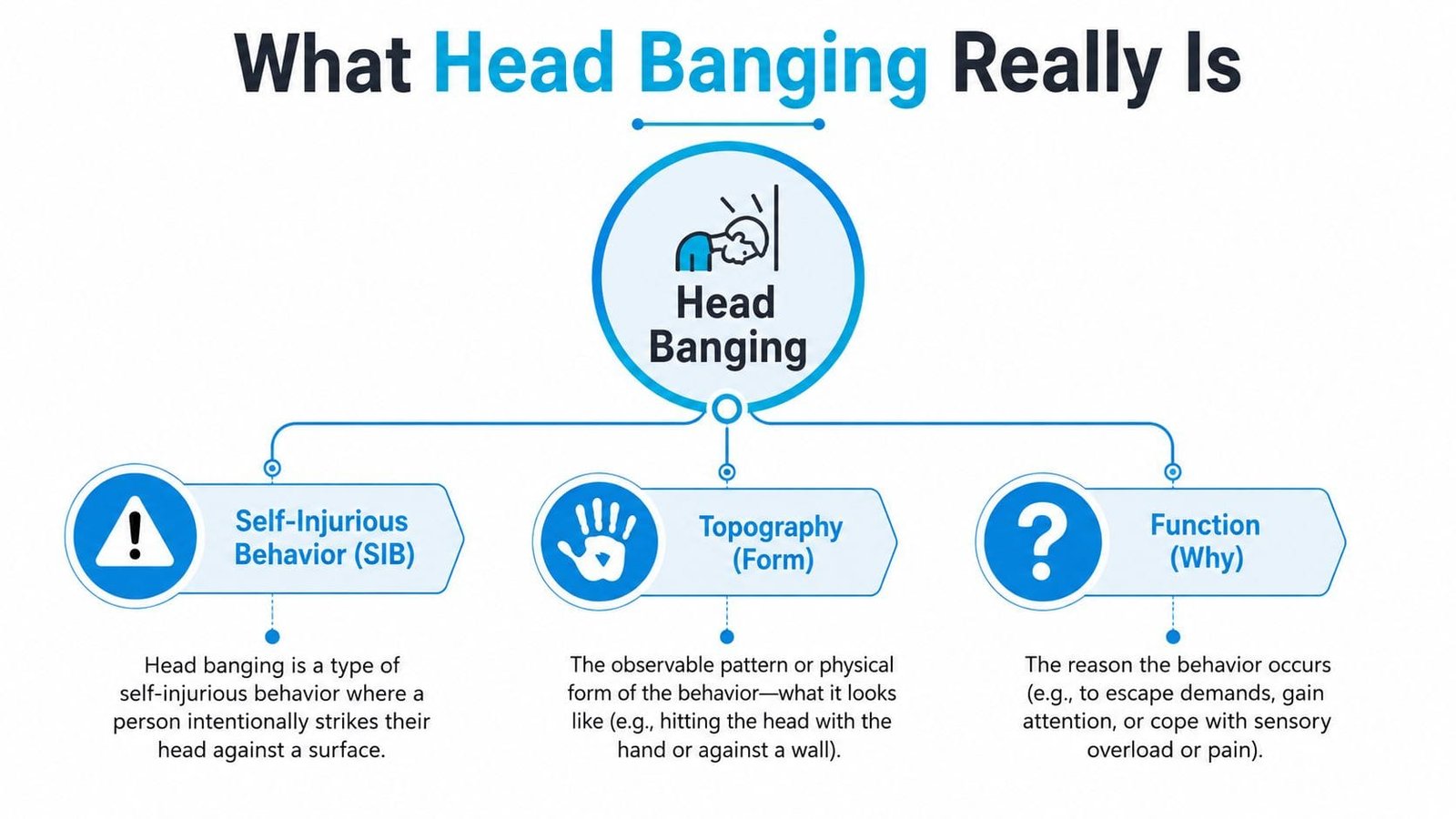
That is why baseline tracking matters. A behavior diary is not busywork, it's the start of functional understanding. If the pattern changes with sleep, noise, demands, or pain signs, you want that information before you try to label the behavior as sensory, emotional, or medical.
For a plain-language definition of repetitive behavior in autism, the term used in many care plans is explained in more detail in the stereotyped behavior definition guide.
Why Autistic Children Head Bang
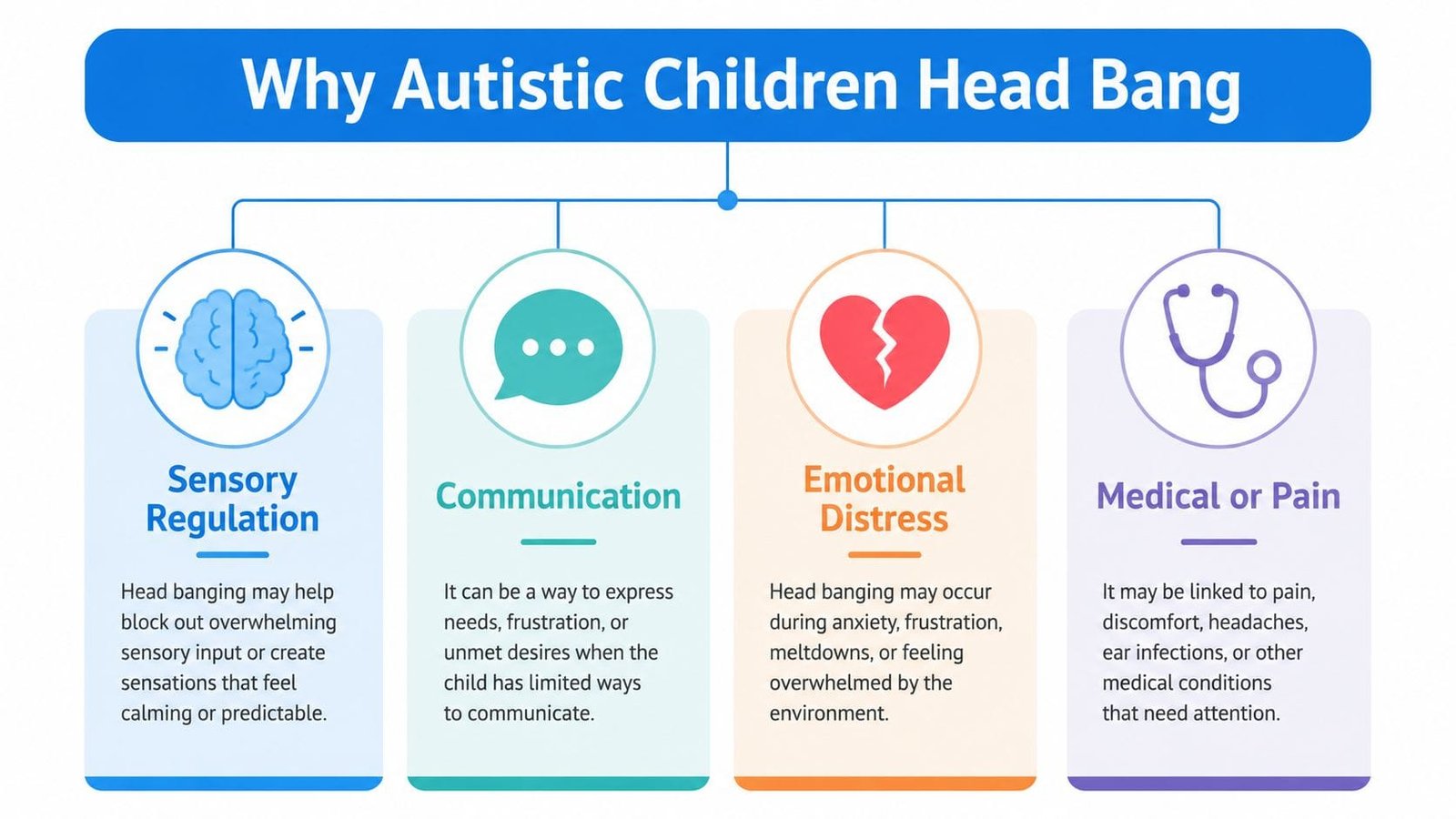
Head banging usually has more than one possible function, and the mix can change from day to day. A child may head bang for sensory regulation in the morning, then use the same behavior later when they are frustrated or in pain. That is why a single-cause explanation often leaves families with more confusion than clarity.
Sensory, communication, emotion, and pain
A child who seems under-responsive may head bang to seek strong input. The movement creates a predictable burst of sensation through the body, which can feel organizing when the nervous system is under-stimulated. Another child may do the same thing when overwhelmed, because intense input can cut through a flood of noise, light, or social demand. A tracking tool such as sensory-seeking behaviors can help parents see whether these episodes cluster around low stimulation, busy settings, or transitions.
Communication can look very different. If a child does not yet have an easy way to say “I'm done,” “I need help,” or “this hurts,” head banging can become a blunt signal. The child is not choosing a better or worse behavior, they are using the one that changes the situation fast enough.
Emotional distress matters too. Frustration, anxiety, and the feeling of being trapped can show up as physical action when words are not available. Some children seem to get relief from the impact itself, not because they want injury, but because strong sensation can interrupt a wave of distress. When parents log what happened right before and right after, the pattern often becomes easier to read than a single episode viewed in isolation.
Medical triggers belong in the same conversation. Pain from a middle ear infection, migraine, reflux, dental pain, constipation, or other discomfort can be hard to spot in a child who cannot localize or describe what hurts, as noted by the Autism Society note. That is why head banging is best viewed as multifactorial, not as proof of one cause. A behavior log can help separate these possibilities by showing whether episodes line up with meals, sleep, illness, noise, or a change in routine.
A child's body can be saying several things at once. The job is not to guess the one correct story on day one. It is to watch closely enough to separate the clues.
For families trying to sort out sensory clues from everything else, the Autism UK guidance offers a plain-language explanation of self-injurious behavior and why it can show up in different forms. That kind of framework can make the pattern easier to name when you are looking at a week of scattered observations instead of one isolated moment.
When Head Banging Signals Pain Instead of Sensory Need
Some of the most important cases are the ones parents almost miss. A child who suddenly starts head banging after being calm for weeks may be trying to cope with pain they cannot describe, not just reacting to sensory overload.
A practical decision rule for the moment
Start with the timeline. If the behavior is new or sudden, clusters around meals or sleep, or comes with face touching, ear pulling, refusal of food, or posture changes, pain deserves serious attention. That pattern does not prove a medical cause, but it shifts the question away from sensory regulation alone and toward a health check.
The common drivers most often worth thinking about are middle ear infection, migraine, reflux, dental issues, constipation, and headache. These are easy to miss in minimally verbal children because the child may not point to the right place or connect the discomfort to the behavior. A child can look “behavioral” while being medically uncomfortable.
A simple tracking app can make those clues easier to see. When notes about timing, sleep, meals, and symptoms sit together in one place, patterns that felt random in the moment start to line up.
Red flags that warrant a same-day call
- Injury or bleeding: Any episode that breaks the skin, causes swelling, or leaves bruising needs attention.
- Escalating pattern: More frequent or more intense head banging than usual should be taken seriously.
- Accompanying illness signs: Vomiting, dizziness, loss of balance, or a clear change in alertness should not wait.
- Eating or sleeping changes: If the behavior clusters with refusal of food or trouble settling for sleep, ask about pain.
- New face or ear behaviors: Repeated ear pulling, face rubbing, or holding one side of the head can point to discomfort.
Independent autism guidance notes that self-injurious behavior can be driven by pain and recommends professional evaluation when the behavior is difficult to manage or creates risk of harm (Autism Society note). That is the piece many parent-facing articles skip, even though the response changes completely when pain is the driver.
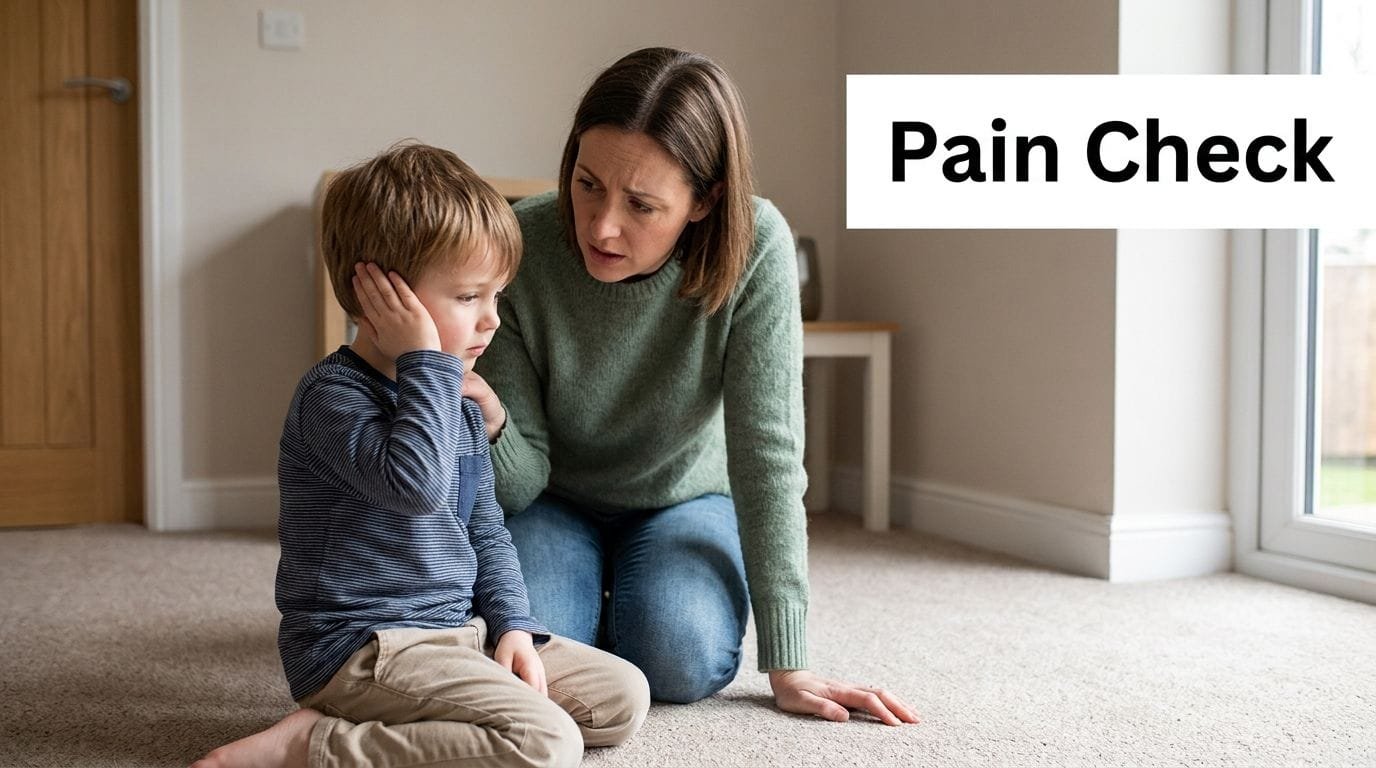
If the pattern feels confusing, it helps to log exactly when the behavior happens, what came right before it, and what else the child was showing. Pain-driven and sensory-driven episodes can overlap, but a solid record makes a pediatric conversation much more precise. Tools that turn scattered observations into a clear visual timeline, such as how to visualize behavior data in Guiding Growth, can help families see whether the same triggers keep showing up.
How to Track Head Banging Episodes
Tracking is what turns a frightening episode into useful information. Memory gets blurry fast when you're tired, and a few days later it's easy to forget what happened before the behavior, not just during it. A simple log gives your child's care team something concrete to work with.
Start with ABC, then make it specific
The classic framework is Antecedent, Behavior, Consequence. Antecedent means what happened right before. Behavior means what head banging looked like. Consequence means what happened immediately after, including your response, the environment, and whether the child calmed, escalated, or shifted to another activity.
For head banging, those three pieces are only the beginning. You also want time of day, setting, demand level, sensory load, sleep the night before, food or medication timing, illness signs, and what immediately followed the episode. Those details help a behavior analyst or therapist see whether the behavior clusters around transitions, fatigue, discomfort, or sensory overload.
Real-time logging is far better than trying to reconstruct the day at bedtime. A phone note, voice log, or structured app entry captures more truth than memory usually can. Guiding Growth is one option families use to log behavior, triggers, intensity, duration, routine, sleep, and shareable reports in one place, which can make the next conversation with a clinician much easier.
| What to Log for Every Head Banging Episode | ||
|---|---|---|
| Category | What to Record | Why It Matters |
| Antecedent | What happened right before, including demand, noise, transition, or interruption | Shows likely triggers |
| Behavior | Where the child hit, how often, intensity, and duration | Establishes the baseline |
| Consequence | What you did, what others did, and how the child responded | Helps identify maintaining factors |
| Context | Time, setting, sleep, food, medication, and illness signs | Spots pattern links |
A practical guide to turning notes into usable charts is the best ways to visualize data guide. Once the pattern is visible, you're no longer guessing whether “it happens more on hard days.” You can see it.
Evidence-Based Strategies That Help
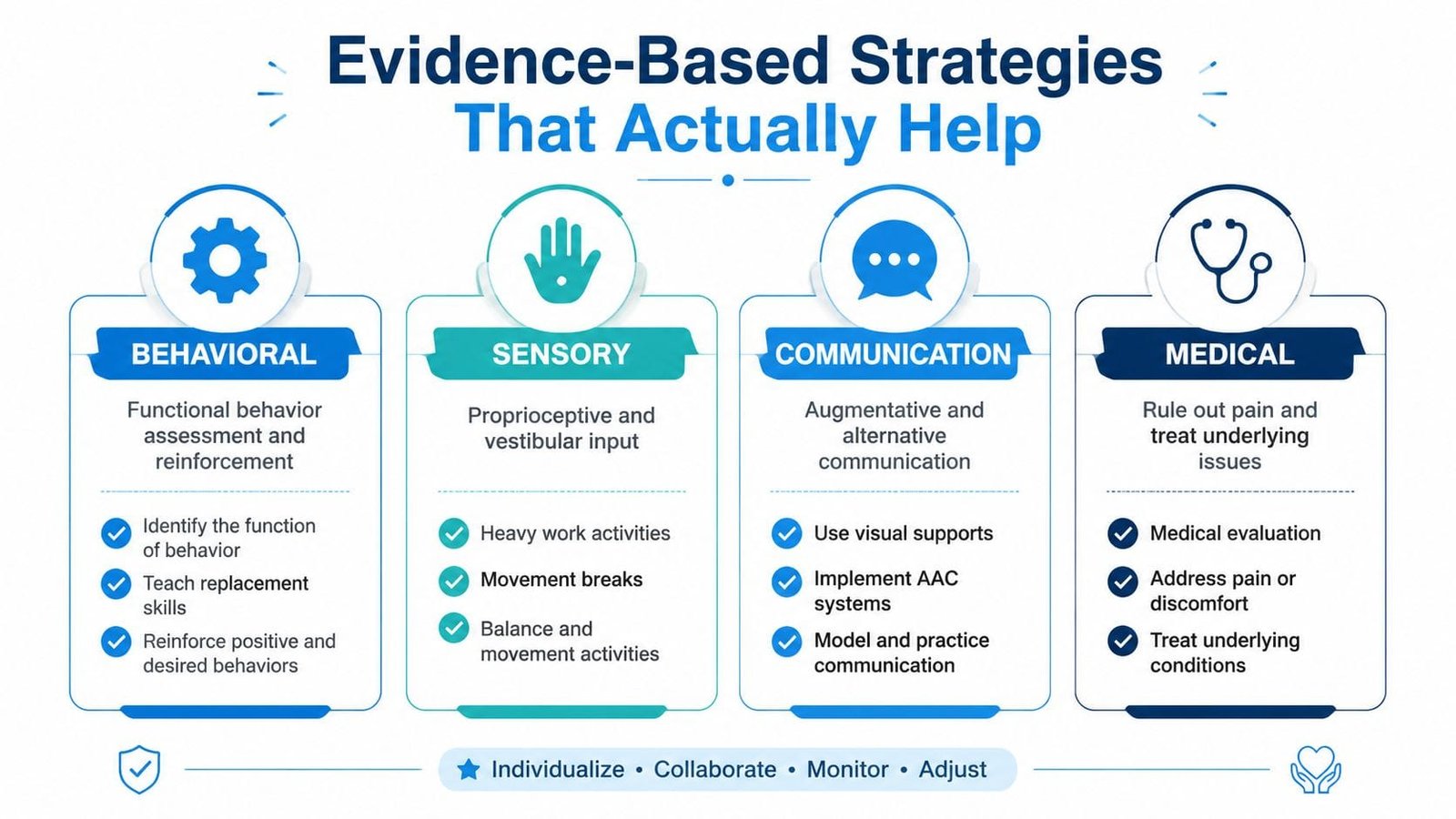
A child who bangs their head usually needs support from more than one direction. If sensory overload, communication frustration, and physical discomfort are all part of the picture, one strategy alone can leave the other pieces untouched. Families make better progress when they match the response to the function of the behavior, then track what changes over time.
Four lanes families and teams often use
Behavioral support starts with a functional behavior assessment, then builds a plan around why the behavior is happening. That can mean changing what happens before the behavior, teaching a safer replacement, and reinforcing the new skill more consistently than the old one. In many families, this work is delivered through ABA frameworks, but the important part is the function-based plan.
Sensory support can include movement breaks, compression or deep pressure, weighted input, and environment changes that lower overload. These strategies work best when they fit the child's actual sensory profile, not when they are used because they sound calming in general. A blanket or a break that helps one child may do very little for another, which is why observation matters.
A tracking app like Guiding Growth helps here by turning scattered notes into a clearer pattern. If you record the time, setting, and what happened right before and after an episode, you can see whether sensory support is reducing the behavior or missing the actual trigger.
Communication support may involve augmentative and alternative communication, visual schedules, or core word boards. The goal is to make it easier for the child to say “stop,” “help,” “break,” or “pain” before head banging becomes the default signal. A speech-language pathologist can help shape that system so it works in real life, not just in therapy.
Medical support matters when tracking suggests pain, sleep disruption, or a health change. Some children need a medication discussion with a physician, but that conversation is much more useful when it is backed by structured logs instead of a vague “it seems worse lately.” If you need a place to compare daily patterns with interventions, a tracker can keep the evidence in one place and make follow-up easier.
The right intervention is the one that fits the function and can be measured over time. If you cannot see whether it is helping, you cannot know whether to keep it.
For families who need a structured place to hold those logs, the publisher's app, Guiding Growth, centralizes behavior tracking, sleep, routines, and shared notes in one place, which can make strategy review far less messy. If you are working through formal behavior support planning, the PracticeReady compliance guide is a useful reference for understanding how plans are put together.
When to Seek Professional Help and How to Collaborate
Some behaviors need a bigger team. If head banging causes any injury that breaks skin, lasts longer than a few minutes, is getting more frequent or intense, shows up with new self-injurious behaviors, or starts interfering with sleep, learning, or family life, it's time to involve professionals. That threshold is about safety, but it's also about avoiding delay while the pattern gets stronger.
Who to involve and how to prepare
A functional behavior assessment is often the starting point. It asks what happened before the behavior, what the child got from it, and what variables might be maintaining it. Behavior analysts, occupational therapists, speech-language pathologists, developmental pediatricians, and child psychiatrists may all be part of the picture depending on what the data suggests.
Bring your logs. Not a summary in your head, actual records. If you've used a tracker with timestamps, notes, and reports, the conversation usually becomes faster and more precise because the team can see patterns instead of guessing from one hard day.
A respectful way to open the conversation is simple: “I've been tracking the episodes, and I'd like help understanding the pattern and ruling out medical causes.” If you're working through formal behavior support planning, the PracticeReady compliance guide is a useful reference for understanding how structured positive behavior support is often documented and coordinated.
Caregiver strain is real, and it matters. The most effective plans fail if the adults are exhausted, so ask for help early rather than waiting until the whole household is underwater.
Head Banging as Data, Not Defiance
Head banging can feel like the most upsetting thing your child does, because it's the one behavior that seems to cross from hard into alarming in a single second. But once you start looking at it as data, not defiance, the picture changes. Each episode can point toward a need, a trigger, or a medical issue that your child can't yet explain in words.
That shift doesn't make the behavior harmless. It makes it usable. You can track patterns, rule out pain, try supports that fit the function, and bring cleaner information to the people who can help. The goal isn't to become a perfect recorder, it's to become a parent who can notice what matters quickly enough to act on it.
If you want one habit that changes the rest of the work, make it this: log the episode while it's fresh, include the context, and share the pattern with your child's team. A tool like Guiding Growth can help you keep behavior, sleep, routine, and team notes together so the next step is based on evidence, not exhaustion.
If you're ready to turn scattered notes into a clearer plan, try Guiding Growth. It helps parents track head banging, sleep, routines, and other behavior patterns in one place, then share those observations with the people supporting their child. That makes it easier to spot triggers, rule out pain, and build a plan you can follow day to day.