You're probably reading this after a hard moment. Maybe your child is halfway dressed, one shoe is missing, breakfast is untouched, and a simple reminder somehow turned into tears, yelling, or total shutdown. By the time school drop-off happens, if it happens on time, you already feel like you've failed the day before it started.
That feeling is common in families living with ADHD. So is the exhaustion that comes from repeating the same instruction, dealing with impulsive behavior that seems to come out of nowhere, and trying to stay calm when your own nervous system is already overloaded. Parents don't need more blame. They need methods that work in real life, on ordinary weekdays, when everyone is tired.
Learning how to parent a child with ADHD starts with one important shift. Stop asking, “How do I get my child to behave?” Start asking, “What structure, support, and skill-building will help my child succeed more often?” That change moves parenting from constant reaction to something steadier and more effective.
Table of Contents
- From Chaos to Calm A New Approach to ADHD Parenting
- Building a Predictable World with Structured Routines
- Using Positive Behavior Strategies That Build Skills
- How to Build a Collaborative Care Team for Your Child
- Tracking Progress and Making Informed Decisions
- Caring for the Caregiver Your Well-Being Matters Most
- Frequently Asked Questions About Parenting a Child with ADHD
From Chaos to Calm A New Approach to ADHD Parenting
A typical morning in an ADHD household often looks confusing from the outside and painfully familiar from the inside. You ask your child to get dressed. They start, then wander off. You remind them to brush teeth. They notice a toy, then melt down when you rush them. By 8 a.m., everyone is dysregulated.
Parents often assume this means they aren't being firm enough or consistent enough. Usually, that's not the actual problem. The problem is that ADHD makes it harder for children to hold steps in mind, shift between tasks, manage time, and regulate emotion under pressure. A child can know the routine and still fail to execute it in the moment.
That matters because raising a child with ADHD can be five times more expensive than raising a neurotypical child, with average annual costs reaching over $15,000 due to therapy, specialized support, and medical care, according to ADDitude's ADHD statistics summary. When families are making that level of emotional and financial investment, they need strategies that are sustainable, not trendy.
Parenting an ADHD child works better when you design the environment instead of relying on repeated correction.
The most effective approach is less about control and more about external support. Children with ADHD do better when expectations are visible, transitions are cued, tasks are broken down, and adults respond with calm predictability. That doesn't mean permissive parenting. It means disciplined parenting that matches the child's actual developmental needs.
What calm actually looks like
Calm doesn't mean a quiet house. It means a house where the adults stop improvising every crisis.
A calmer ADHD home usually includes:
- Clear expectations: One task at a time, stated directly.
- Repeatable routines: The same order for mornings, homework, and bedtime.
- Fewer lectures: Long explanations tend to lose the child before the point lands.
- Planned responses: Adults know what they'll do when a child refuses, stalls, or escalates.
What doesn't work well
Some common parenting habits sound reasonable but create more friction:
| Approach | What usually happens |
|---|---|
| Repeating instructions from another room | The child tunes out or forgets halfway through |
| Giving a five-step direction | The first step may happen, the rest usually won't |
| Waiting until behavior gets bad to respond | The whole house is already dysregulated |
| Using shame to motivate | The child feels worse, not more capable |
Hope matters here. Children with ADHD can build real skills. Families can reduce conflict. But the shift happens when parents stop chasing perfect behavior and start building systems that make success more likely.
Building a Predictable World with Structured Routines
Structure helps ADHD children borrow organization from the environment. Without that external support, many daily tasks stay stuck in the child's head as a vague blur of “I know I'm supposed to do something.”
Start with one pressure point
Don't rebuild the whole day at once. Pick the part of family life that breaks down most often. For many families, that's the morning rush. For others, it's homework or bedtime.
Build the routine in the exact order the child needs to do it. Keep it concrete. “Get ready” is too broad. “Toilet, get dressed, eat breakfast, put folder in backpack, shoes on” is usable.
If mornings are rough, a visual routine like the one in this morning routine visual schedule guide can reduce the number of verbal prompts you need to give. That matters because many children stop processing after too many reminders.
Use visible tools instead of repeated verbal prompts
A strong routine usually includes three things working together:
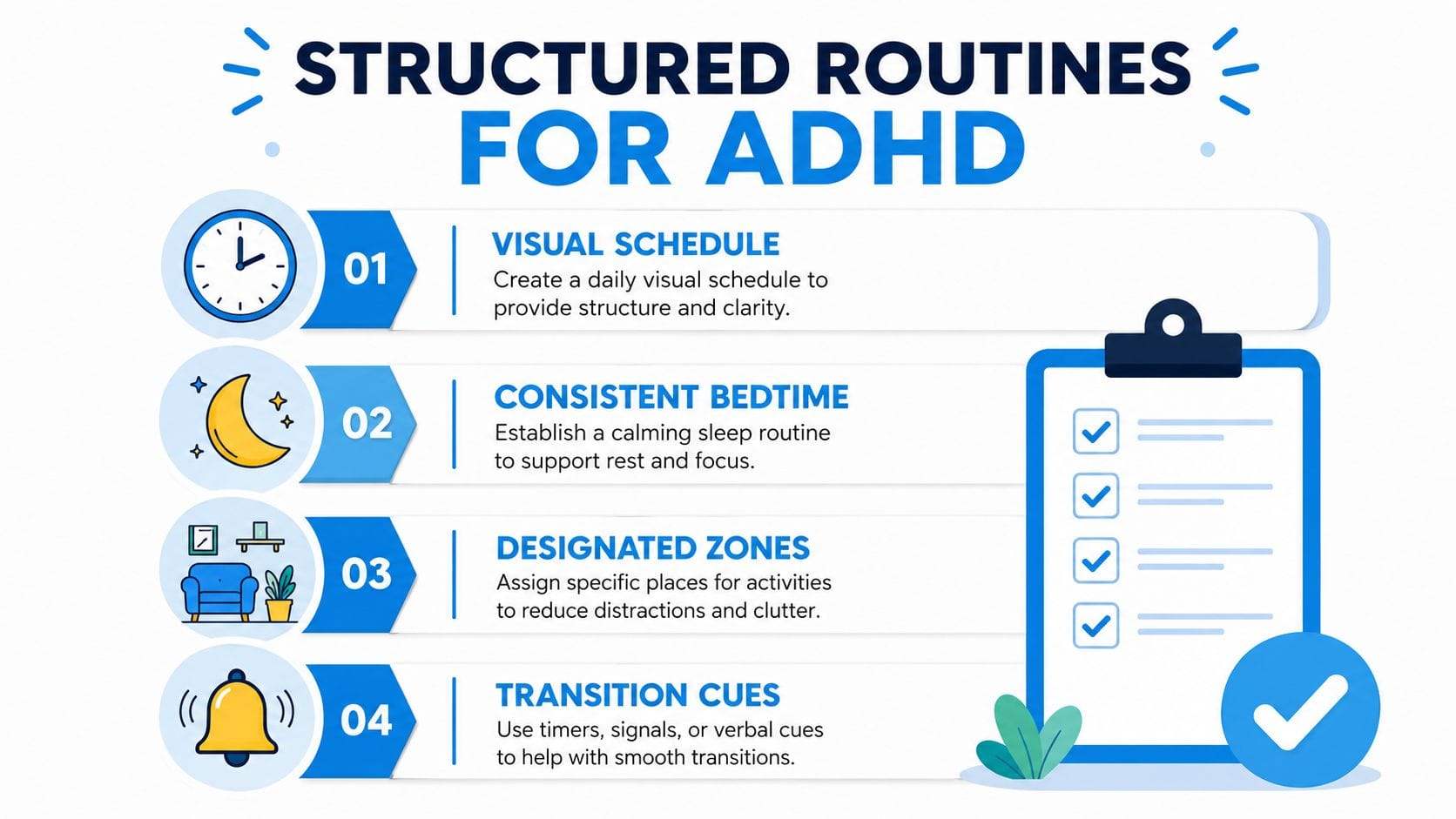
- Visual schedule: Put it where the task happens, not where you wish your child would remember it.
- Timer: Use it for transitions, starting, and checking progress.
- Designated zones: Backpack by the door. Homework in one spot. Pajamas in one drawer.
For homework, one practical rule is a five-minute break for every 30 minutes of activity, based on guidance from the Royal Children's Hospital fact sheet on helping children with ADHD at school and home. That 1:6 break-to-work ratio helps manage fatigue and keeps tasks from turning into battles of endurance.
Practical rule: Breaks work best when they're planned before the child is overwhelmed, not offered after the meltdown starts.
Another useful tool is a progress check timer. During homework, the goal isn't to hover. The goal is to interrupt drift before it becomes total derailment.
A routine that is realistic beats a routine that is impressive
Parents often create schedules that look beautiful but ask too much of the child and the adult. A workable routine is usually shorter and simpler than what you first imagine.
Try this pattern:
Name the sequence
Keep it to a handful of visible steps.Shrink the task
If your child gets stuck, the task is too big. “Clean your room” becomes “put dirty clothes in basket.”Cue the transition
Give a warning, then start the timer.Protect the reward
Let the child experience that finishing the routine leads to something positive, like free time, a preferred activity, or a calmer evening.
Children with ADHD don't usually resist structure because they hate structure. They resist structure that feels unpredictable, oversized, or loaded with criticism. Good routines feel possible. That's why they work.
Using Positive Behavior Strategies That Build Skills
When parents are worn down, punishment starts to feel efficient. You raise your voice, threaten a privilege, and hope the child finally takes you seriously. The problem is that fear may stop a behavior in the moment, but it rarely teaches the skill the child was missing.
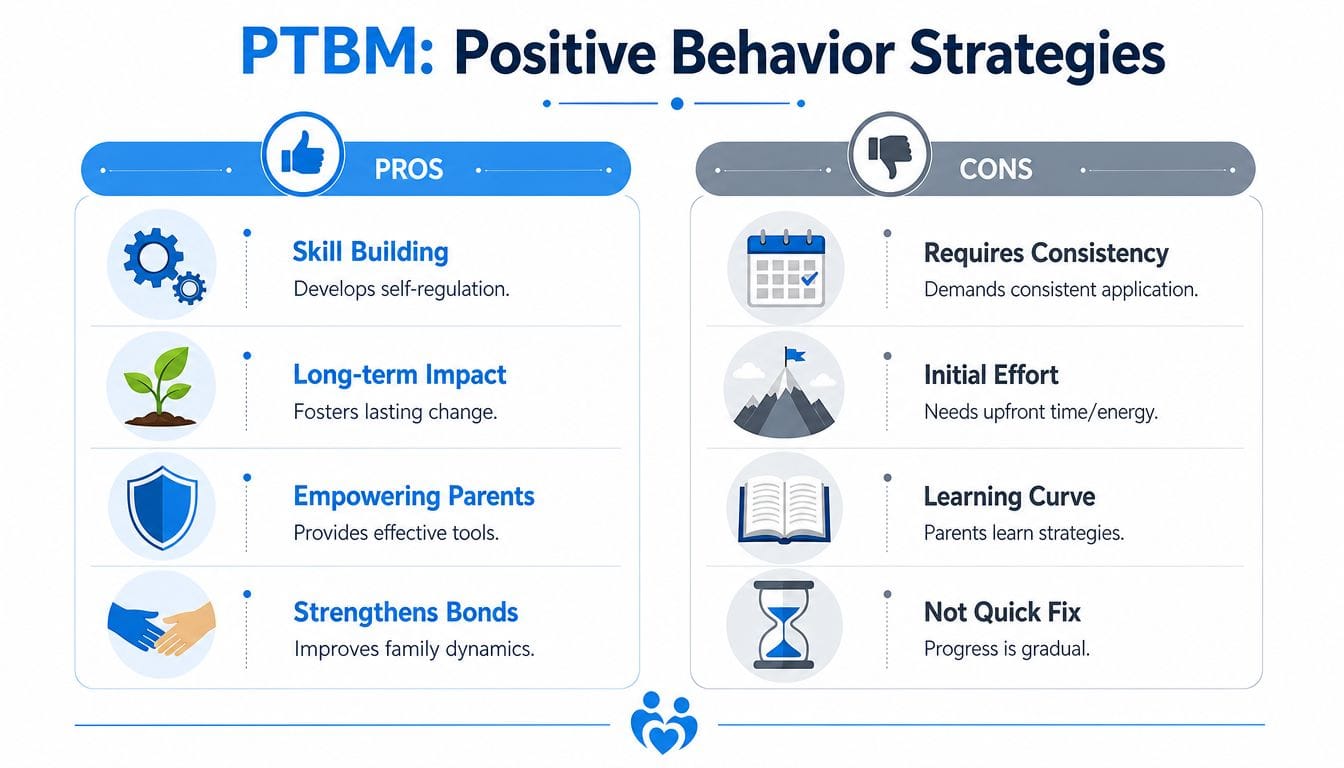
Parent training in behavior management is still the clearest framework we have for home behavior support. The CDC guidance on behavior therapy for ADHD notes that parent training in behavior management has a 70 to 80 percent success rate when parents use a clear formula of specific commands, immediate positive reinforcement, and consistent consequences. One key detail is the 6:1 ratio, meaning six positive interactions for every one correction.
Why punishment alone usually backfires
Children with ADHD often hear more correction than encouragement. Over time, that changes the emotional climate of the house. The child expects criticism. The parent expects resistance. Both walk into the interaction braced for conflict.
A better approach is proactive. You teach the expected behavior before the problem happens, notice it quickly when it appears, and respond in a way that makes the right behavior worth repeating.
That means:
- Give short commands: One sentence. One action.
- Reinforce immediately: Don't save praise for the end of the day.
- Keep consequences predictable: Not dramatic, not emotional, and not invented on the spot.
If your child struggles with task initiation or procrastination, some families also benefit from adapting practical tools like body-doubling, short focus sprints, and reduced-friction task starts. AIDictation's ADHD strategies offers a useful adult-focused lens that parents can modify for older children and teens.
What effective behavior support looks like at home
The phrase “good job” is kind, but it's often too vague to teach anything. Specific praise is more powerful because it tells the child exactly what worked.
Compare these:
| Less effective | More effective |
|---|---|
| “Good job.” | “You put your backpack by the door the first time I asked.” |
| “Stop messing around.” | “Sit in your chair and do problem one.” |
| “Why do I always have to remind you?” | “You started before the timer ended. Nice work.” |
Here's the real-life version of positive support:
- Before the task: “Shoes on now.”
- During the task: “You started right away.”
- After the task: “You finished before we left. That helped the whole morning.”
Catch effort early. ADHD kids often need reinforcement at the starting line, not just at the finish line.
Many parents also need a way to stay consistent when they're tired. Behavior plans fail when they live in your head. Put the strategy somewhere visible, keep the target behavior narrow, and review what happened after the fact. A structured tool like positive behavior support strategies for families can help parents think in patterns instead of reacting in the moment.
What works better than lectures
A lot of family conflict comes from too much language. The child is already overloaded. The parent adds a long explanation. Nobody feels heard, and the task still doesn't happen.
Use this instead:
Say less
“Put the plate in the sink.”Praise specifically
“You did that without arguing.”Correct calmly
“Screen time is later, after homework.”Reset fast
Don't turn one difficult moment into a two-hour mood.
Positive behavior support isn't soft. It's precise. It asks the adult to lead with more intention and less emotion. That's what makes it effective.
How to Build a Collaborative Care Team for Your Child
No parent can carry ADHD support alone. The child moves through multiple environments, and each one affects behavior, stress, and learning. When school, home, and therapy all pull in different directions, the child usually pays the price.

A good care team doesn't require everyone to agree on everything. It requires shared goals, useful communication, and practical consistency. For one child, that may mean a classroom teacher, school counselor, pediatrician, and parent. For another, it may also include an occupational therapist, behavior specialist, tutor, or grandparent who handles after-school care.
What to bring into school meetings
Walk into meetings with examples, not general frustration. “He's struggling” is true, but it's hard for a school team to act on. “He loses the first ten minutes after transitions and shuts down when directions are given verbally to the whole class” gives the team something concrete.
Bring a short list that includes:
- Patterns you've noticed: Tough times of day, common triggers, tasks that reliably go better.
- What already helps: Movement breaks, visual instructions, reduced verbal overload, seating changes.
- Your priority goals: Fewer homework battles, smoother transitions, better emotional recovery after mistakes.
If your child has an IEP or 504 plan, ask for supports that match actual barriers. Visual instructions, chunked assignments, movement opportunities, reduced copy demands, and transition cues are often more useful than vague language about “extra support.”
The most productive school meetings focus on what the child needs to access learning, not on who's at fault for the current struggle.
Scripts that lower defensiveness and increase teamwork
School communication improves when parents lead with observation and partnership. These openings tend to work:
- To a teacher: “I'd love to compare notes about what helps him start work successfully.”
- To a therapist: “We're seeing resistance at home during transitions. What language are you using that we can mirror?”
- To a caregiver: “The goal isn't perfect compliance. It's a calmer routine with fewer escalations.”
Parents often benefit from seeing another clinician explain how home and school supports can line up in practice. This short discussion is a useful starting point:
Consistency doesn't mean every adult uses identical words. It means the adults respond from the same basic playbook. The child should experience similar expectations, similar cues, and similar reinforcement across settings. That's when support starts to compound instead of clash.
Tracking Progress and Making Informed Decisions
Parents often ask whether a therapy, routine change, school support, or medication is helping. The honest answer is that memory alone usually isn't enough to tell. Hard weeks blur together. One good day can make a struggling plan look better than it is, and one bad morning can make a helpful support feel useless.
That's why tracking matters. Not obsessive tracking. Useful tracking.

What to track without overcomplicating it
Pick a handful of daily markers that affect function and family stress. Keep them simple enough that you'll consistently record them.
A useful home tracking list might include:
| Area | What to note |
|---|---|
| Sleep | Bedtime, rough night, easy wake-up or hard wake-up |
| School day | Focus, transition difficulty, teacher feedback |
| Mood | Irritable, steady, tearful, explosive, shut down |
| Homework | Start time, length, friction level, completion |
| Meltdowns | What happened before, during, and after |
| Appetite or medication timing | Only if relevant to your child's care plan |
The point isn't to create a research project. The point is to get enough information that patterns become visible.
How to use patterns instead of guesswork
Once you collect a bit of data, questions become easier to answer. Is homework worse on days with poor sleep? Does the child do better when work starts after a short decompression period? Are meltdowns tied to hunger, transition demands, or long verbal instructions?
For schoolwork, check-ins can be especially helpful. The Mayo Clinic Health System article on managing ADHD in children recommends using a timer to prompt the child to show progress on homework two to four times per hour, with brief brain breaks in between. That creates a practical rhythm for both support and observation.
A good tracking system should answer three questions:
- What happened right before the problem
- What adult response followed
- What outcome came next
If you want one place to organize those observations over time, a dedicated behavior tracking app for parents and caregivers can make decision-making much clearer than scattered notes or half-remembered details. Parents don't need more information. They need cleaner signals.
Good decisions come from patterns, not from whichever moment felt biggest that week.
This is especially true when you're discussing treatment changes with a clinician. Clear notes about sleep, appetite, attention, homework tolerance, and emotional regulation give you a stronger foundation than “I think things are a little better.” Precision leads to better conversations.
Caring for the Caregiver Your Well-Being Matters Most
A child with ADHD needs a regulated adult nearby. That's hard to provide when the adult is depleted, overstimulated, behind on everything, and internally blaming themselves for not handling it better.
Many parents hear advice that sounds good on paper and impossible in practice. Make a chart. Prepare ahead. Stay consistent. Track everything. Those suggestions assume the parent has the executive capacity to build and maintain the system. Many don't.
When the parent brain is also overloaded
This is one of the most overlooked realities in ADHD parenting. About 25 to 50 percent of parents of children with ADHD also have ADHD themselves, as noted in Cartwheel's resource on raising a child with ADHD. That changes the conversation completely.
If you also struggle with planning, follow-through, time blindness, or emotional reactivity, traditional parenting advice can feel like being assigned a second full-time job. The answer isn't to try harder. The answer is to reduce load.
Low-demand support works better than perfect systems
Parents who are neurodivergent often do best with supports that are fast, external, and forgiving.
That may look like:
- Voice notes instead of typed logs: Faster capture means you're more likely to use the system.
- One shared family command center: Fewer notebooks, fewer apps, fewer places to lose information.
- Default routines: The same breakfast, the same backpack spot, the same homework sequence.
- Tiny reset practices: Sit down. Drink water. Lower your voice. Restart with one instruction.
Self-care is often framed as a spa-day concept. In ADHD families, it's more practical than that. It's medication management for the parent if needed. It's sleep protection. It's getting support from another adult before resentment builds. It's deciding that not every battle deserves your last ounce of energy.
A burned-out parent can still love deeply, but burnout makes calm consistency much harder to deliver.
If you're learning how to parent a child with ADHD while also managing your own neurodivergence, be careful with shame. Shame doesn't build systems. It only drains the little energy you had left. Use less effortful tools, lower the number of moving parts, and treat your own support needs as part of the care plan, not a distraction from it.
Frequently Asked Questions About Parenting a Child with ADHD
How do I parent a child with both ADHD and autism
This is a common point of confusion because standard advice can conflict. An overlap of ADHD and autism appears in 30 to 50 percent of cases, according to Xyla Health's discussion of parenting a child with ADHD and autism. A rigid ADHD-style structure may help one child focus but push an autistic child into demand avoidance or sensory overload.
Start with co-regulation. Reduce sensory stress, keep language concrete, and allow flexibility inside the routine. The goal is not blind compliance. The goal is usable support that respects both attention needs and sensory needs.
How should my approach change as my child gets older
With younger children, parents do more external structuring. With older children and teens, the work shifts toward shared problem-solving and gradual independence. Keep supports visible, but involve your child in designing them.
For parents raising older neurodivergent kids, it can help to also understand how ADHD language evolves across the lifespan. This guide for neurodivergent adults from Be Your Best Self & Thrive Counseling, PLLC gives useful context for how people understand attention differences beyond childhood.
How do I talk to my child about ADHD without making them feel broken
Keep it simple and respectful. ADHD is not a character flaw. It means the brain handles attention, impulses, and regulation differently. Explain both the struggles and the strengths.
Say what's true. “Some things are harder for your brain, so we use tools to help.” That framing protects dignity while building self-understanding.
If you want one place to simplify routines, log behaviors, notice patterns, and share information with the adults supporting your child, Guiding Growth can help reduce the guesswork and mental load that so often come with ADHD parenting.