You check the baby monitor, see your infant stiffen and arch backward in their sleep, and your stomach drops. Many parents have this exact moment. It looks uncomfortable, sometimes dramatic, and it can be hard to tell whether you're seeing a normal baby movement or a sign that something hurts.
The reassuring part is that infant arching back while sleeping is usually treated as a symptom, not a diagnosis. In many babies, it fits into ordinary patterns like reflux, gas, startle reflexes, or general discomfort. One pediatric source states that 98% of normal babies have some degree of regurgitation (clinical discussion of infant arching and regurgitation). That doesn't mean you should ignore what you see. It means the first question is usually, "What else is happening around it?"
Table of Contents
- Why You Might See Your Baby Arching Their Back
- Common and Normal Reasons for Back Arching
- Gentle Soothing Strategies to Promote Peaceful Sleep
- Red Flags When to Contact Your Pediatrician
- Tracking Episodes to Support Your Child's Health
- Trusting Your Instincts and Finding Peace of Mind
Why You Might See Your Baby Arching Their Back
When a baby arches during sleep, parents often jump straight to worst case scenarios. That's understandable. Back arching can look forceful, especially on a monitor where you only catch a few seconds and can't feel whether your baby settles right after.
In practice, clinicians usually treat this behavior as a clue, not a standalone condition. The clue might point to a baby stretching, reacting to gas, shifting during light sleep, startling, or feeling discomfort after a feed. The context matters more than the movement by itself.
Practical rule: Ask "What happened before, during, and after the arching?" That question is often more helpful than the arching alone.
A brief episode is often less concerning when your baby stays settled, breathes normally, feeds reasonably well, and returns to sleep. Concern rises when arching happens repeatedly and comes with other problems such as distressed crying, trouble feeding, or developmental worries.
Many parents also get confused because the same movement can show up in different situations. Some babies arch when crying, some during feeding, some while stretching, and some while drifting into or out of sleep. The same body shape can have very different meanings.
A calmer way to think about infant arching back while sleeping is this:
- Sometimes it's movement: your baby is stretching, startling, or learning how their body works.
- Sometimes it's discomfort: gas, reflux, or being overtired can make babies stiffen and extend.
- Sometimes it's a pattern worth discussing: repeated episodes with feeding struggles or obvious distress deserve a pediatric review.
Common and Normal Reasons for Back Arching
A baby can arch for ordinary reasons that have nothing to do with a serious problem. The challenge is that normal infant movement is often abrupt, stiff, and dramatic, especially when you catch only a few seconds of it on a monitor. Guidance for parents from Pampers notes that back arching can happen during stretching, crying, feeding, or sleep, and that the bigger concern is persistent arching paired with other symptoms, not a brief movement by itself (pediatric overview of baby back arching).

Stretching and sleep transitions
Young babies move in bursts. Their nervous system is still learning how to coordinate signals, so a simple stretch can look much larger than an adult expects.
You may see the chest lift, the head tip back, the legs straighten, and then everything soften again. That sequence can look alarming, but if your baby relaxes, keeps normal color, and settles back to sleep, it often fits with ordinary stretching or a light-sleep transition.
The startle reflex can look similar. A sound in the room, a shift in position, or even a sensation in the stomach can trigger a whole-body response. Arms may fly out. The trunk may stiffen. The back may arch for a moment and then release.
Mild discomfort after feeds or during routines
Babies also arch when something feels off in their body. Body language often comes before crying.
Gas is a common example. A baby with a tight, bubbly belly may tense the middle, pull or straighten the legs, and push backward. Reflux can also lead to stiffening or arching, especially after feeds when milk and stomach contents are more likely to come back up. If you are also sorting through questions about choking sounds, reflux, or breathing concerns at night, this explanation of the acid reflux and sleep apnea connection may help you frame what to ask your pediatrician.
Overtired babies can arch too. Instead of easing into sleep, some babies become physically rigid, cry harder, and resist being held in the position they usually accept. Others arch during diaper changes or getting dressed because they dislike the sudden temperature change, the flat surface, or the interruption.
Four patterns parents commonly notice
These examples can help you match what you are seeing to a likely everyday cause:
- After a feed: your baby stiffens, arches once or twice, burps, and then looks more comfortable.
- During light sleep: your baby startles, extends, arches briefly, and drifts back off within moments.
- At bedtime: your baby seems exhausted but becomes rigid, cries, and arches while trying to settle.
- During diapering or dressing: your baby pushes backward against the surface and calms once the routine ends.
How to tell whether a pattern looks reassuring
A single episode gives only part of the story. A pattern gives your pediatrician something useful to work with.
| Situation | More reassuring | Worth watching closely |
|---|---|---|
| Sleep transition | Brief arch, quick release, baby settles | Repeats often with crying, hard waking, or poor settling |
| After feeding | Improves with burping, upright holding, or time | Ongoing discomfort, frequent spit-up with distress, refusal to feed |
| General movement | Stretching, wiggling, normal breathing and color | Arching with unusual stiffness, poor responsiveness, or breathing changes |
One helpful approach is to track the same details each time: what happened right before, how long the arching lasted, whether it followed a feed, and what helped it stop. Parents who want a clearer way to spot repeat triggers often find it useful to learn how to identify sensory triggers and patterns in daily life. The same pattern-tracking mindset can make baby sleep behaviors feel less mysterious and give you cleaner notes to bring into a pediatric visit.
That record matters. When you can show, "This happens mostly within 20 minutes of a feed," or "It only shows up during light sleep and ends quickly," you move from a worrying observation to something actionable.
Gentle Soothing Strategies to Promote Peaceful Sleep
You get your baby fed, changed, and sleepy. Then, just as you lower them into the crib, their back stiffens and their body curves away from the mattress. That moment can feel alarming. In many cases, the goal is not to stop every movement. The goal is to notice what your baby may be reacting to and respond in a calm, predictable way.

Start with the easiest possible reset
A baby who arches before sleep is often showing tension, discomfort, or overload. Their body is acting like a spring that has tightened up. Your job is to reduce whatever is winding that spring.
Start with one change at a time so you can tell what helps.
- Pause to burp well: Some babies settle once trapped air comes up, especially if arching shows up during or after a feed.
- Hold upright while awake after feeding: A quiet upright cuddle can ease the feeling of fullness for babies who seem uncomfortable after eating.
- Check for small physical irritants: A twisted pajama seam, snug waistband, damp diaper, or scratchy tag can bother a baby more than you might expect.
- Use gentle body calming: Slow rocking, bicycle legs, or a light tummy massage may help if gas seems to be part of the pattern.
- Lower stimulation before bed: Softer light, less noise, and slower handling can help a tired baby settle instead of stiffen.
One useful question is: does your baby look more comfortable after this step, or only distracted for a minute? Comfort usually lasts longer than distraction.
Build a short, repeatable wind-down routine
Bedtime goes better when the steps happen in the same order each night. Babies do not understand schedules the way adults do, but their nervous systems respond to patterns. A familiar sequence can make the body feel safer and less reactive.
A simple routine often works well:
- Feed in a calm setting.
- Burp without rushing.
- Hold upright for a short period while awake.
- Keep the room quiet and dim.
- Place baby on their back on a firm, flat sleep surface.
Safe sleep still comes first. Even if reflux is on your mind, soothing should happen before sleep or during awake time, not by changing your baby's sleep position. The American Academy of Pediatrics recommends placing babies on their backs for sleep on a firm, flat surface, including babies with reflux (AAP safe sleep recommendations).
Some parents like a week-by-week reference for typical settling rhythms. This overview of Bornbir's baby sleep advice can help you compare what you're seeing with ordinary newborn sleep patterns.
If bedtime seems to be the trigger, study the hour before bed
Sometimes the arching is less about sleep and more about how your baby arrives at sleep. A rushed feed, bright lights, extra handling, or staying awake a little too long can all raise tension.
Look at the hour before bedtime like a chain of small events. If one link keeps showing up before the arching, that is useful information.
Try this calm reset:
- lower the lights
- keep voices soft
- slow your movements
- avoid extra passing from person to person
- finish diaper and clothing changes before your baby becomes overtired
- give your baby a brief pause if they seem overstimulated
For families who want help adjusting light, sound, clothing, and routine, this guide to a sensory-friendly sleep environment offers practical ideas you can test at home.
Turn what you see into notes you can use
Soothing works best when it is paired with tracking. Otherwise, every hard bedtime can blur together.
A simple log in our app can help you record when the arching happened, what came right before it, how long it lasted, what you tried, and what worked. That gives you more than a worried memory. It gives you a pattern. If your pediatrician asks, "Does this happen after feeds, during light sleep, or only when overtired?" you will have a clearer answer.
That shift matters. You move from "something seems off" to "this happens most often within 15 minutes of the last feeding, and upright cuddling usually helps."
This video offers a helpful visual on gentle baby soothing techniques:
Red Flags When to Contact Your Pediatrician
Most back arching is not an emergency. Still, some patterns deserve medical attention because the movement is part of a larger symptom cluster.
When arching may point to more than simple discomfort
One important example is Sandifer syndrome, a reflux-related movement disorder. Medical guidance notes that babies with this condition may arch their backs and throw their heads back, and the episodes are often brief and sudden, usually happen after the baby eats, and typically resolve before age 2 (Sandifer syndrome overview for parents).
Sandifer syndrome matters because it can look frightening and may be mistaken for a neurologic problem. The key is not to diagnose it yourself. The key is to notice whether the arching is repetitive, strongly linked to feeding, and paired with distress or feeding trouble.
Another clinical clue is persistence. When arching is frequent and unexplained, or when it comes with poor feeding, painful crying, or developmental concerns, it deserves a closer look from your pediatrician. In some reflux-related cases, clinicians may use multichannel intraluminal impedance (MII) with pH testing to measure reflux in the esophagus objectively (reflux testing and infant arching overview).
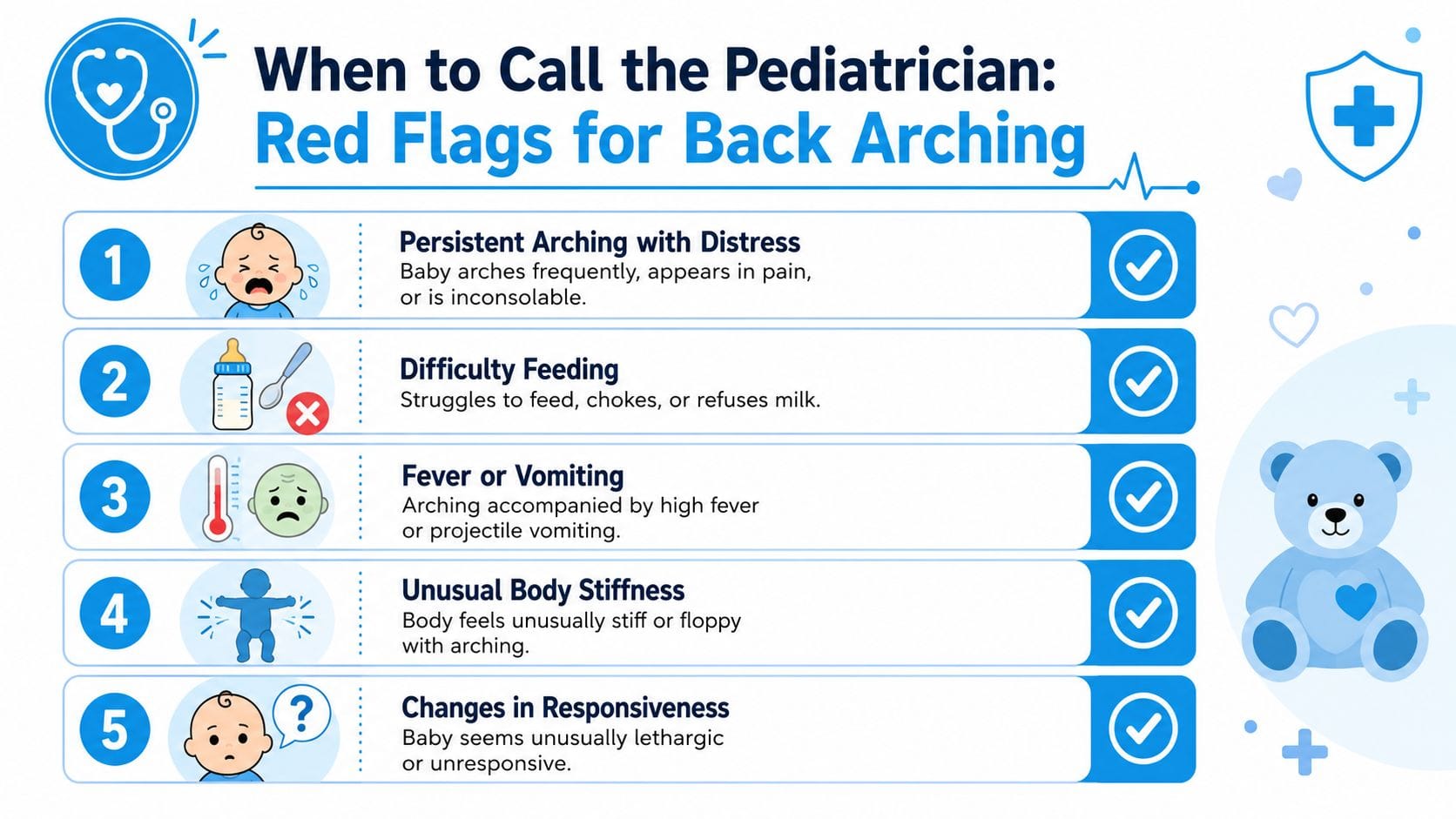
A practical red flag checklist
Call your pediatrician if you notice any of the following:
- Frequent arching with obvious pain: your baby seems hard to console, cries sharply, or looks distressed during episodes.
- Feeding problems: your baby refuses feeds, struggles through them, or seems uncomfortable every time they eat.
- Episodes that are strongly feed-related: especially if the posture is sudden, repetitive, and includes head throwing back.
- Changes in tone or responsiveness: your baby seems unusually stiff, floppy, very sleepy, or difficult to engage.
- Developmental concern alongside arching: you have a broader worry about how your baby is moving, feeding, or responding.
If your instinct says, "This is happening too often to ignore," that's a good enough reason to call.
A short video of an episode can be helpful for the appointment, especially if the behavior is hard to describe in words.
Tracking Episodes to Support Your Child's Health
Parents often arrive at the pediatrician's office with a real concern but fuzzy details. That's normal. Sleep deprivation makes everything blur together. Still, the more specific your observations are, the easier it is for a clinician to tell the difference between normal infant behavior, reflux discomfort, and a pattern that needs workup.
What doctors find most useful
A vague report like "my baby arches a lot" is less helpful than a pattern such as:
- Timing: during sleep, after feeds, or while being laid down
- Frequency: occasional, clustered, or happening most days
- Duration: a quick arch and release, or a more prolonged episode
- Associated signs: crying, spit-up, coughing, feeding refusal, stiffening, or quick recovery

A simple tracking template
You don't need a complicated spreadsheet. A notes app, paper log, or a structured tracker can work well if you keep it consistent for a few days.
Write down:
- When it happened
- What happened right before it
- Whether a feed was involved
- How your baby looked during the episode
- What helped, if anything
Short, repeatable notes beat long memory-based summaries.
If structured observation tends to help you feel more grounded, this guide on sleep tracking for autism parents offers a practical framework that can be adapted for infant sleep concerns too. The same principle applies. Clear patterns lead to better conversations and more confident decisions.
Trusting Your Instincts and Finding Peace of Mind
Most cases of infant arching back while sleeping come down to normal movement, temporary discomfort, or an immature digestive system. A smaller group of babies show patterns that deserve a pediatric assessment, especially when arching is frequent, distressing, or clearly tied to feeding problems.
You don't need to choose between panic and dismissal. The middle ground is observation. Watch for context, try gentle soothing, keep sleep positioning safe, and contact your pediatrician if the pattern feels persistent or unusual.
Parents are often the first to notice what matters. That doesn't make you anxious. It makes you attentive.
If you'd like one place to organize sleep notes, symptom patterns, routines, and questions for appointments, Guiding Growth can help you turn stressful observations into clear records you can use.