Raising a child with autism can be emotionally and physically demanding, often leaving parents overwhelmed. Stress stems from managing challenging behaviors, navigating complex systems for care, and balancing financial and personal responsibilities. Over 80% of parents report feeling stretched beyond their limits, with nearly 19% meeting criteria for provisional PTSD. To manage stress effectively:
- Identify Triggers: Understand stress sources like meltdowns, sleep deprivation, or financial strain.
- Practical Solutions: Use tools like visual schedules, cognitive reframing, and short-term respite care.
- Self-Care: Dedicate 10–15 minutes daily to activities you enjoy, practice mindfulness, and reflect on small wins.
- Support Networks: Connect with other parents, join support groups, and seek professional help when needed.
- Behavior Tracking: Tools like apps can help log patterns, offering insights for better interventions.
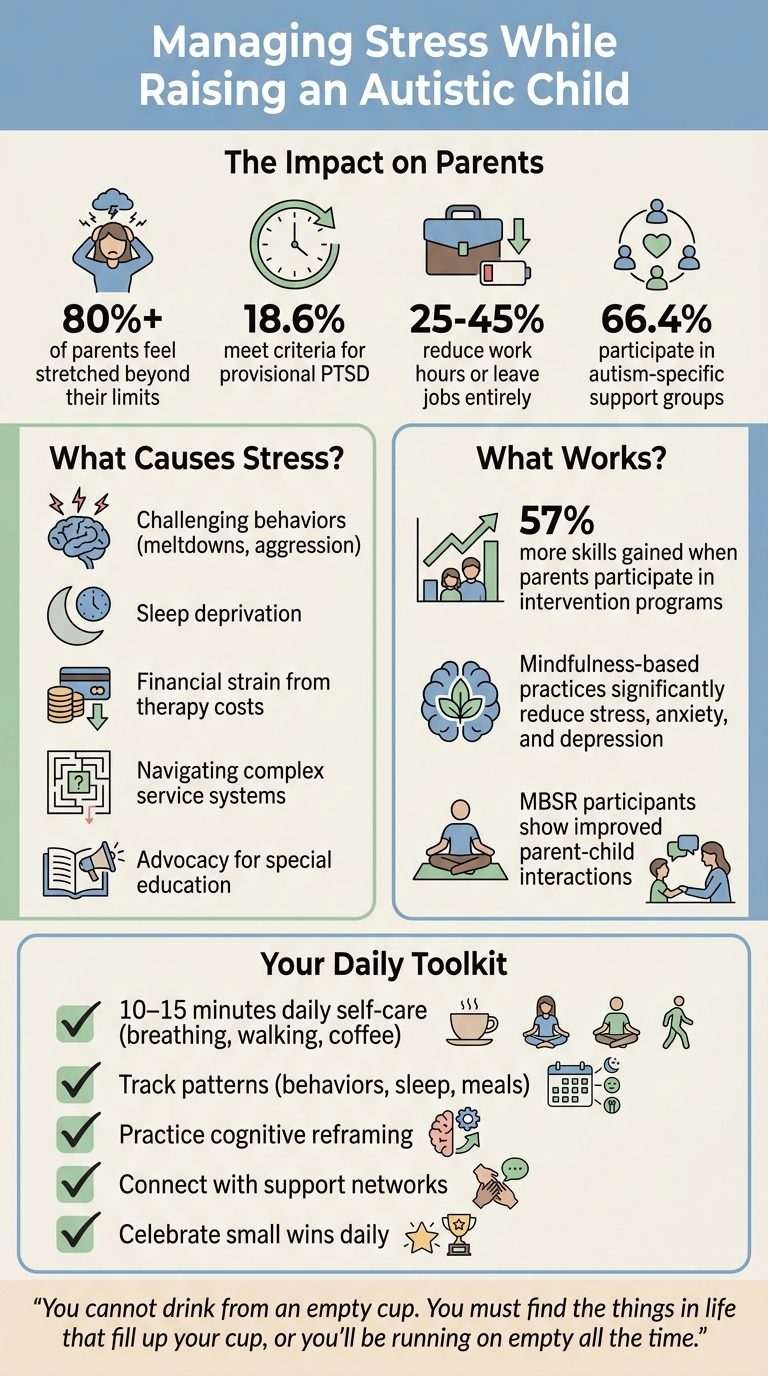
Stress Statistics and Self-Care Strategies for Parents of Autistic Children
Identifying and Managing Stress Triggers
Common Sources of Stress
Figuring out what sets off your stress is a key step in handling it better. For parents of children with autism, some of the biggest stressors come from challenging behaviors like aggression, meltdowns, defiance, and elopement. These behaviors often arise because kids have trouble communicating their pain or needs, leading to frequent tantrums [1][2].
But it’s not just about daily struggles. Larger systemic issues pile on more pressure. Parents often face the daunting task of navigating complicated service systems, pushing for special education accommodations, and covering therapy costs that insurance doesn’t always pay for. This financial and emotional strain can be overwhelming [1][4]. In fact, between 25% and 45% of parents report cutting back on work hours or even leaving their jobs entirely to meet caregiving demands [3]. Add in chronic sleep deprivation, and the stress can feel insurmountable. Physical signs like muscle tension and shallow breathing are often clues that stress is taking a toll [3][4].
Knowing these triggers can help you take specific, actionable steps to lighten the load.
Practical Steps to Reduce Stress
One way to ease the chaos is by using visual schedules. These tools help clarify daily routines and transitions, reducing anxiety for both you and your child [3][4].
Another helpful approach is cognitive reframing. Instead of seeing challenging behaviors as permanent issues, try viewing them as problems you can solve. For example, Maria Ott, a parent in Maryland, found success by reframing public stigma. She regularly brought her daughter, Hannah, into social settings, which not only built Hannah’s resilience but also fostered a sense of community support [1].
Short-term respite care can be a lifesaver. Services like those provided by the ARCH National Respite Network offer caregivers a much-needed break. Even carving out just 15 minutes a day for something you enjoy can help recharge your energy and keep you going [3].
sbb-itb-d549f5b
Creating a Self-Care Routine That Works
Daily Self-Care Practices
Taking care of yourself isn’t just a luxury – it’s a necessity. When your energy is drained, it becomes much harder to face daily challenges or show up for your child in the way you’d like.
Start with the basics: stick to regular exercise, eat a balanced diet, and aim for consistent sleep. Even dedicating just 10–15 minutes a day to something simple, like deep breathing, sipping your favorite coffee, or taking a short walk, can give you a much-needed energy boost. This "15-Minute Rule" is a quick, manageable way to recharge.
"You cannot drink from an empty cup. You must find the things in life that fill up your cup, or you’ll be running on empty all the time." – Links ABA [3]
Another tip? Make a list of activities that bring you joy – like soaking in a warm bath, diving into a good book, or listening to your favorite playlist – and make it a point to do at least one of them every day or so. At the end of your day, take a moment to reflect on your "daily wins." Jot down what you accomplished, no matter how small it seems. This practice can help you stay motivated and balance out those nagging feelings of "not doing enough."
Dr. Amy Keefer, a clinical psychologist at Kennedy Krieger Institute, emphasizes the importance of celebrating progress:
"I think the parents who do best are the ones who can celebrate each achievement and developmental gain as it occurs, and who aren’t focused on an ultimate outcome of where the child needs to end up" [1].
Practicing self-compassion and acceptance can also help ease the anxiety that comes from comparing your child’s progress to others. Pair these habits with mindfulness techniques to further reduce stress.
Relaxation and Mindfulness Methods
Mindfulness can be a game-changer for managing stress, and the best part? It doesn’t have to take up a lot of time. Studies show that mindfulness-based practices can significantly lower stress, anxiety, and depression in parents [3]. These techniques help you stay grounded in the present, giving you a break from the constant worry about what lies ahead.
You can begin with something as simple as mindful breathing. Focus on the sensation of air flowing in and out of your body. For a fun twist – especially if you want to involve your child – try using a feather or tissue to visualize your breath. Just 10 minutes of mindful breathing can improve your sleep and help you feel more relaxed.
Another quick method is a 5-second body scan. Take a moment to check in with areas where you might be holding tension, like your shoulders, jaw, or hands. Noticing and releasing that tension can bring instant relief. You might also experiment with sound meditations using tools like chimes or a singing bowl to help refocus your mind.
In 2020, a study led by Amy Weitlauf, PhD, at Vanderbilt University Medical Center, highlighted the benefits of mindfulness. Published in Pediatrics, the research involved parents of children under 36 months with autism. Those who participated in Mindfulness-Based Stress Reduction (MBSR) alongside the Early Start Denver Model reported noticeable improvements in both their stress levels and interactions with their children [5].
Lastly, work on shifting negative self-talk. When you catch yourself thinking, "I’m failing as a parent", try reframing it into something more supportive, like, "I’m doing my best, and that’s enough", or "I can handle this." These small mental adjustments can help you feel more in control and capable, even during tough moments.
How To Manage STRESS While Taking Care of Your Autistic Child | India Autism Center

Using Tools and Support Networks
Managing the daily challenges of parenting a child with autism becomes more approachable when you combine self-care strategies with practical tools and a strong support network.
Tracking Patterns with Guiding Growth

Sometimes, daily struggles can feel like a puzzle with no solution. But tracking your child’s behaviors, routines, and triggers can turn confusion into clarity. Instead of asking, “Why is this happening?”, you can shift to, “What steps can we take?”
Tools like Guiding Growth are designed to help parents log and analyze key aspects of their child’s day, such as behaviors, sleep patterns, meals, and potential triggers. For example, you might notice that afternoon meltdowns often follow skipped meals or that disruptive behaviors correlate with nights of poor sleep. The app tracks details like triggers, duration of incidents, sleep quality, and dietary habits. Over time, these logs reveal patterns that can guide more evidence-based autism interventions.
Having this data doesn’t just help you understand your child better – it also equips you to advocate more effectively. Whether you’re meeting with therapists, doctors, or school staff, presenting specific, tracked information can lead to more tailored and effective strategies.
Another benefit? Seeing progress, even in small increments, can be incredibly motivating. For instance, reviewing your logs might show that meltdowns dropped from five to three in a week or that your child tried two new foods. These small wins are worth celebrating. As Dr. Amy Keefer has pointed out, tracking progress is essential for maintaining optimism and focus. Plus, sharing these insights with other parents can strengthen your connection to a community that understands your journey.
Connecting with Other Parents
While tools like Guiding Growth help you understand your child’s patterns, connecting with other parents who are navigating similar challenges can provide emotional and practical support. For many parents, these shared experiences are invaluable. In fact, about 66.4% of caregivers participate in autism-specific support groups, with participation rates climbing when clinicians recommend them. Research also shows that parents involved in intervention programs often gain more skills for supporting their child – 57% more, according to a review of over 20 studies [6].
There are plenty of ways to find this kind of support. Local, in-person groups often meet at community centers, clinics, or through organizations like the Autism Society, and many of these gatherings are free or low-cost. If attending in person isn’t feasible due to childcare or transportation issues, online options like forums, social media groups, and virtual meetups on platforms like Zoom can be a great alternative.
For parents juggling work and caregiving, it might be worth discussing flexible arrangements with your employer. Adjusting your schedule could make it easier to participate in these valuable support networks [3].
Getting Professional Help and Building Your Plan
Working with Mental Health Professionals
While self-care and a strong support network are essential, sometimes professional help is the missing piece in managing stress effectively. Recognizing when to seek professional guidance can be tough, but there are certain red flags you shouldn’t ignore. If daily life feels overwhelming or basic tasks seem unmanageable for you or your family, it’s time to reach out for help [4]. Chronic stress doesn’t just affect your mind – it can take a serious toll on your body, impacting your cardiovascular, immune, and digestive systems [1].
Your first step can be a visit to your general practitioner. They can help craft an initial stress management plan and refer you to specialists [4]. Therapists trained in Cognitive Behavioral Therapy (CBT) or Mindfulness-Based Stress Reduction (MBSR) are particularly effective. For example, research shows that parents who participated in MBSR alongside their child’s therapy experienced better outcomes in managing stress and improving parent-child interactions compared to those who only focused on their child’s intervention [5]. If caregiving stress is tied to trauma – and it often is, with nearly 18.6% of parents of autistic children meeting criteria for provisional PTSD – therapies like Eye Movement Desensitization and Reprocessing (EMDR) can be especially beneficial [3].
"You are not alone."
- Dr. Amy Keefer, Clinical Psychologist, Kennedy Krieger Institute [1]
Another valuable resource is working with Board Certified Behavior Analysts (BCBAs). They can provide strategies for managing challenging behaviors, which are a major source of stress for many parents [2]. Additionally, programs like Medicare Waiver Funding can help cover the cost of respite care, offering you much-needed breaks [3]. Combining these professional tools and resources allows you to create a well-rounded, adaptable stress management plan.
Building Your Stress Management Plan
Once you’ve consulted professionals, the next step is to create a stress management plan that fits your unique needs and circumstances. This plan should integrate mindfulness practices, self-care routines, tracking tools, a support network, and professional advice – making it both actionable and tailored to your life.
One option to consider is enrolling in structured programs like the MYmind program, which offers nine weekly 90-minute sessions aimed at reducing anxiety and depression in parents [3]. Studies involving over 600 participants have shown that mindfulness-based approaches can significantly lower parental stress, anxiety, and depression [3]. Tools like Guiding Growth can also help you track behavioral patterns and stress triggers, giving you clearer insights to share with professionals and helping you pinpoint what’s working.
Building a strong support network is equally important. This network should include emotional support from family and friends, practical advice from schools and professionals, and connections with online communities [2]. If caregiving responsibilities are impacting your work, consider having an open conversation with your employer about flexible arrangements or adjusted hours. For many parents of autistic children – between 25% and 45% – work hours are reduced or jobs are left altogether, so these discussions can make a difference [3].
Lastly, practice cognitive reframing to shift your mindset. Instead of asking, “Why is this happening to me?” try focusing on, “What can I do to address this?” Reframe challenges as opportunities to find solutions rather than seeing them as obstacles [2]. Dedicate at least 15 minutes a day to self-care [3], and stick to a realistic daily schedule to reduce chaos and stay on track [3]. Remember, your plan isn’t static – it will grow and change as your child’s needs and your life circumstances evolve.
Conclusion
Raising a child with autism comes with its own set of challenges, but having a tailored plan can make the journey more manageable. The strategies discussed here – like recognizing stress triggers, tracking daily patterns, building a strong support system, and seeking professional guidance – work best when adapted to fit your family’s unique needs.
One key takeaway: don’t forget about self-care. Over 80% of parents with autistic children report feeling "stretched beyond their limits" [3]. Taking even 15 minutes a day for mindfulness or physical activity can make a noticeable difference in your well-being.
Tracking behaviors and routines can also bring clarity to what might feel like chaos. By monitoring sleep, nutrition, and daily habits, you turn overwhelming situations into actionable insights. Tools like Guiding Growth make it easier to organize this information and communicate effectively with healthcare providers.
Another critical piece is building a support network. Whether it’s connecting with other parents, working with mental health professionals, or arranging respite care, having people you can lean on is essential to avoid burnout. Dr. Amy Keefer offers valuable perspective:
"The parents who do best are the ones who can celebrate each achievement and developmental gain as it occurs, and who aren’t focused on an ultimate outcome of where the child needs to end up" [1].
FAQs
How do I know which stress triggers matter most?
To better understand what drives your stress, pay attention to situations that repeatedly push your stress levels higher. For parents of autistic children, common stressors often revolve around concerns like the lifelong nature of autism, worries about social acceptance, or feeling unsupported.
A helpful approach is to monitor how you react – both emotionally and physically – to specific events, such as managing behavioral challenges or dealing with isolation. Tools like journaling or stress-tracking apps can make it easier to identify recurring patterns. Once you spot these, it becomes simpler to focus on the triggers that need your attention first.
What can I do when I have no time for self-care?
If you’re pressed for time when it comes to self-care, even small actions can have a positive impact. For instance, try incorporating quick mindfulness practices or deep breathing exercises into your daily activities to help reduce stress. You can also use tools like the Guiding Growth app to monitor your child’s behaviors and spot patterns, which can simplify caregiving tasks. Taking just a few minutes for yourself – perhaps during your child’s nap or quiet time – can go a long way in helping you feel refreshed.
How can Guiding Growth help me spot patterns and reduce stress?
Guiding Growth simplifies the process of monitoring your child’s well-being by letting you track their behaviors, health, sleep, nutrition, and activities all in one spot. By organizing this information, it becomes easier to spot patterns that reveal important insights about their development. This clarity empowers you to make better decisions, have more productive conversations with healthcare providers, and feel a greater sense of control – helping to reduce the stress that comes from not knowing.