You may be in that uncomfortable stretch of time where you've noticed a lot, but you still don't have a clear answer. Your child may be bright, funny, and deeply themselves, yet something feels different. Maybe they don't respond to their name consistently, seem overwhelmed by noise, line up toys in a very specific way, or struggle more than expected with back-and-forth interaction. Then you ask around and get five different opinions. A family member says, “They'll grow out of it.” A teacher says, “It might be worth checking.” Your pediatrician suggests a screening. You're left wondering what actually counts.
That uncertainty is hard. It can also be the beginning of something helpful.
A diagnosis is not about putting your child in a box. It's about gathering enough information to understand how they experience the world, what support they may need, and who is qualified to make that call.
Table of Contents
- Your Journey to Clarity Starts Here
- Understanding Screening Versus Formal Diagnosis
- The Professionals Qualified to Diagnose Autism
- What to Expect During a Diagnostic Evaluation
- How to Prepare for Your Child's Evaluation
- Organize Your Journey with the Guiding Growth App
- After the Diagnosis What Are the Next Steps
Your Journey to Clarity Starts Here
A lot of parents arrive here after months, or even years, of second-guessing themselves. They've noticed patterns at home that don't always show up in a doctor's office. They've kept mental notes about speech, play, sleep, meltdowns, sensory needs, or social differences. But they still don't know whether those observations point to autism, another developmental difference, or nothing more than a child with an uneven profile.
That doesn't mean you've missed something. It means you're paying attention.
The question who can diagnose autism matters because the answer shapes what kind of evaluation your child gets. A thoughtful assessment isn't a quick opinion. It's a clinical process that looks at developmental history, behavior, communication, and how your child functions across settings.
A strong evaluation doesn't start with a label. It starts with careful listening.
Parents often feel pressure to “get the right answer fast.” In practice, the better mindset is to gather clear information. That gives you something more useful than reassurance alone. It gives you a path.
Understanding Screening Versus Formal Diagnosis
Parents hear the word “screening” all the time, and it's easy to assume that a screening is basically the same as a diagnosis. It isn't.
A screening is a brief check for signs that a child may need a closer look. It might happen at a pediatric visit, through a questionnaire, or after concerns from school or daycare. A screening can be helpful, but it does not confirm autism.

A formal diagnosis is much more complete. According to the CDC, autism assessment is typically based on two data streams: caregiver developmental history plus direct professional observation, which is why a primary care screening is treated as a triage step and a positive screen should lead to referral for a specialist evaluation based on DSM-5 criteria (CDC autism diagnosis guidance).
What a screening can and can't do
A screening can tell you, “This child may need further evaluation.” It cannot tell you, “This child definitely has autism.”
That distinction matters when parents hear comments like these:
- From a pediatric office: “The screening suggests follow-up.”
- From a preschool teacher: “We're seeing social communication differences.”
- From family: “They act just like their cousin did.”
Each of those may point to a real concern. None of them is a diagnosis.
If you want an early starting point for sorting concerns, a parent-facing tool like the autism and ADHD test guide can help you organize what you're seeing before you speak with a clinician. It still doesn't replace a diagnostic evaluation, but it can make your observations easier to describe.
Why the formal evaluation matters
A full evaluation is where a clinician determines whether your child meets the diagnostic criteria for autism. That process also helps rule out, or identify, other explanations that can overlap with autism, such as language delays, anxiety, ADHD, developmental differences, or co-occurring conditions.
Practical rule: Treat screening as a flag, not a finish line.
This is often where parents feel relief. Not because every answer is easy, but because the process becomes clearer. You stop chasing opinions and start gathering evidence from the right people.
The Professionals Qualified to Diagnose Autism
The short answer is this. Autism is commonly diagnosed by licensed clinicians with specialized training, not by just any doctor or school professional.
In the U.S., a medical diagnosis of autism is commonly made by a psychologist, developmental pediatrician, or other specialized physician. The Autism Society notes that diagnosis is based on developmental history and symptom patterns, so it requires a licensed clinician with specialized training rather than a general medical opinion alone (Autism Society screening and diagnosis guidance).
Who usually makes the diagnosis
Different clinicians come to the same question from different training backgrounds.
A developmental pediatrician often looks at the whole developmental picture. They may evaluate communication, behavior, milestones, learning profile, and other developmental concerns together.
A child psychologist or clinical psychologist often focuses closely on behavior, social communication, testing, and diagnostic assessment. In many communities, psychologists are among the professionals parents see most often for autism evaluations.
A child psychiatrist may diagnose autism too, especially when there are questions about mood, behavior, anxiety, attention, or other mental health concerns alongside social communication differences.
A pediatric neurologist may become involved when there are additional neurological questions, such as seizures, regression, unusual motor concerns, or a more complex developmental picture.
Some families also hear from speech-language pathologists, occupational therapists, teachers, or early intervention providers first. These professionals can identify concerns and provide valuable observations. They usually do not make the formal medical diagnosis on their own.
Who's Who in Autism Diagnosis
| Professional | Focus Area | What They Do in an Evaluation |
|---|---|---|
| Developmental pediatrician | Child development across settings | Reviews milestones, behavior, communication, medical background, and overall developmental profile |
| Psychologist | Behavior, cognition, social communication, standardized assessment | Conducts interviews, observations, and testing to determine whether autism criteria are met |
| Child psychiatrist | Autism with emotional, behavioral, or psychiatric overlap | Assesses symptom patterns and considers co-occurring mental health concerns |
| Pediatric neurologist | Brain and nervous system concerns affecting development | Evaluates neurological factors that may add context to the diagnostic picture |
Parents often ask which one is “best.” Usually, the better question is: Who in my area has solid autism-specific training and experience with children like mine?
For some families, it's also useful to read about a holistic approach for children's neurotype, especially when autism and ADHD traits seem to overlap in everyday life. That kind of perspective can help parents ask better questions during referrals.
When a team approach is used
Sometimes one clinician handles the evaluation. Sometimes a multidisciplinary team does it together. That may include a psychologist, physician, speech-language professional, or other developmental specialist.
A team approach can be especially helpful when a child has a more mixed presentation, uneven communication skills, or multiple concerns that affect how symptoms appear. Parents who want a clearer picture of how coordinated care can work may find this overview of collaborative autism care teams useful.
The title matters less than the training. The question to ask is whether the clinician regularly evaluates autism and knows how it presents in children with different communication styles and support needs.
What to Expect During a Diagnostic Evaluation
Many parents dread the evaluation because they don't know what the day will look like. The good news is that a thoughtful autism evaluation is usually designed to learn about your child, not to pressure them.
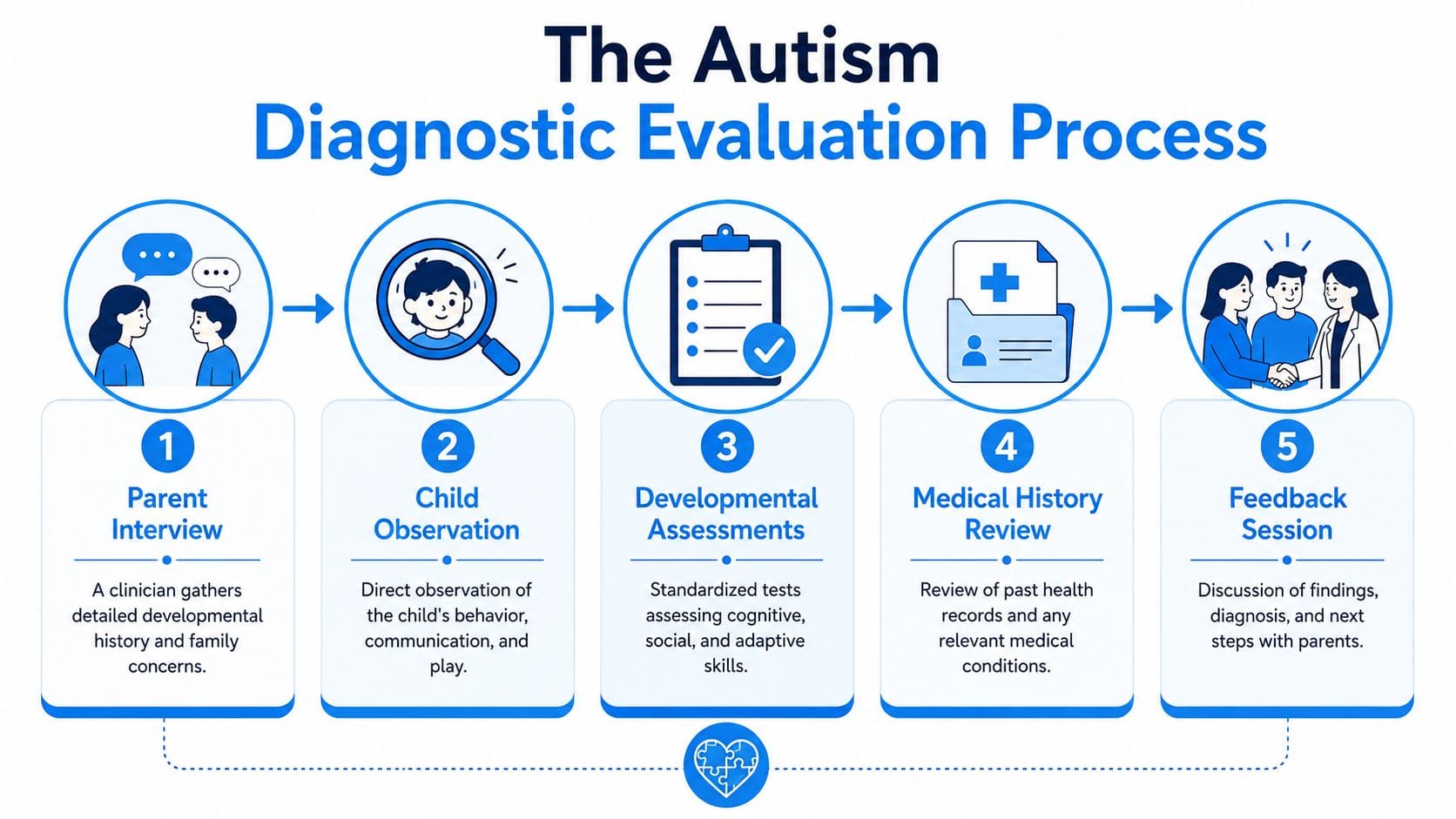
This visual gives a simple overview of the flow.
What happens in a full evaluation
A detailed evaluation often includes several parts rather than one quick appointment.
Parent interview
The clinician asks about pregnancy and birth history, early milestones, language development, play, social interaction, behavior patterns, sensory differences, school concerns, and family history.Direct observation of your child
The evaluator watches how your child communicates, responds, plays, shares attention, handles change, and uses gestures or language.Standardized assessments
A formal diagnosis relies on standardized, evidence-based tools. The Autism Diagnostic Observation Schedule, or ADOS, is a well-known structured tool used by trained clinicians, and best practice involves a thorough assessment using multiple methods including self-report, parent or informant report, diagnostic interviews, and direct observation (adult autism diagnostic guidance summary).Review of records and other input
School notes, therapy reports, past evaluations, and medical history can all help the clinician build a fuller picture.Feedback session
The clinician explains findings, answers questions, and discusses next steps.
This video may also help make the process feel more familiar before you go to an appointment.
Why clinicians use more than one method
Children don't always show everything in one room, on one day, with one person. Some children are quiet and cautious. Some mask their difficulties. Some are more comfortable at home than in a clinic. That's why a skilled evaluator gathers information from several angles.
A parent might report that their child scripts movie lines at home, melts down when routines change, and avoids peer interaction. In the office, the same child may seem calm, verbal, and cooperative. Neither picture is false. The clinician's job is to understand both.
- Parent report adds context: It shows patterns across time and settings.
- Observation shows behavior in real time: It lets the clinician see interaction directly.
- Structured tools create consistency: They help the evaluator look at specific domains in a careful way.
A good evaluation asks, “What is this child communicating through their behavior?” not “Can this child perform on command?”
How to Prepare for Your Child's Evaluation
Preparation helps most when you think of it as collecting useful evidence, not cramming for a test. Your child doesn't need to rehearse. You do need to bring the clearest picture you can.
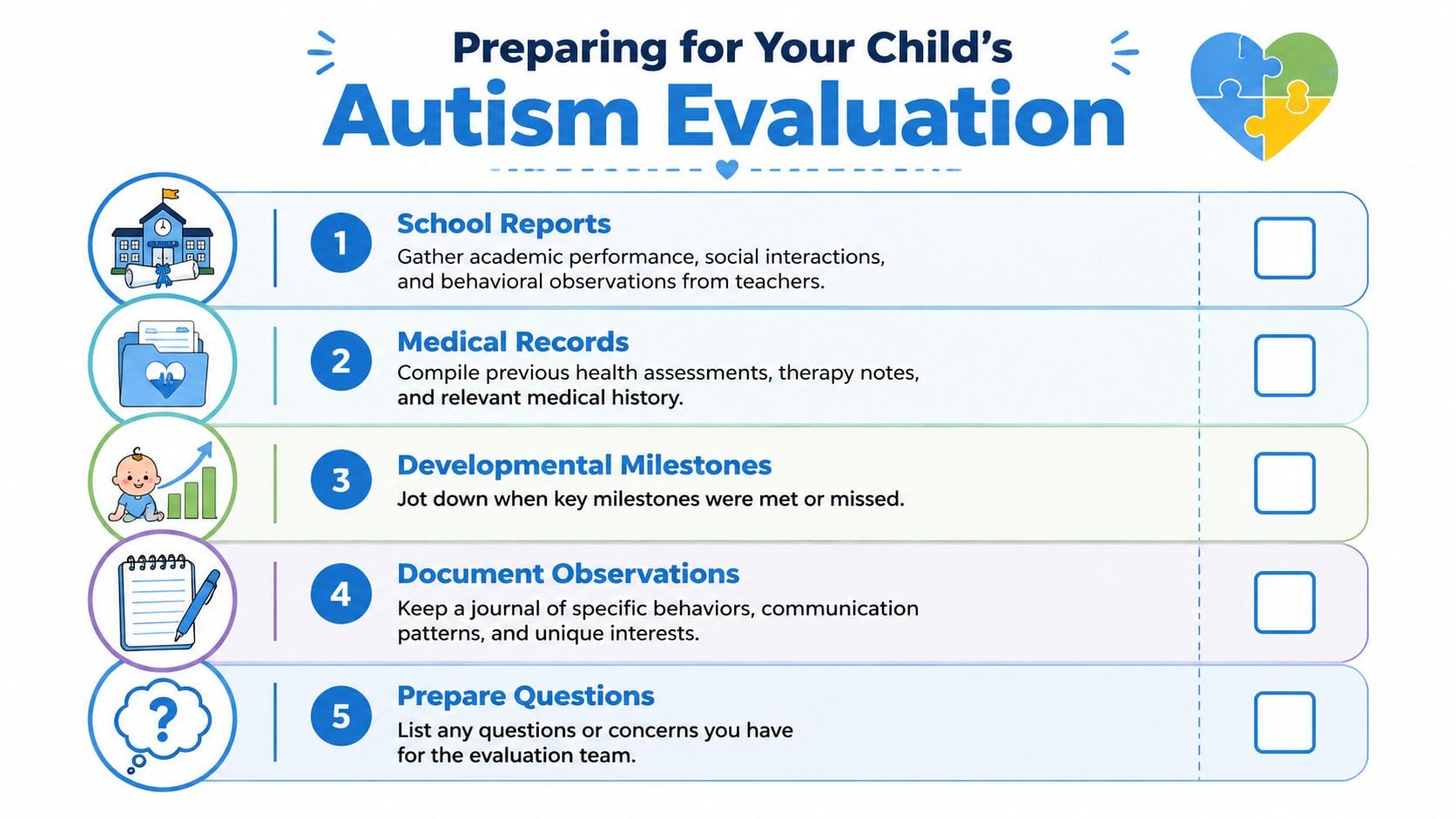
What to gather before the appointment
Start with paperwork, but don't stop there. The most helpful file is one that combines records with real-life examples.
- School information: Bring report cards, teacher comments, behavior notes, IEP paperwork if your child has it, and any written concerns about social or communication skills.
- Medical records: Include prior evaluations, therapy notes, hearing results, and developmental referrals.
- Milestone notes: Write down when you first noticed concerns about speech, play, eye contact, flexibility, sensory needs, or repetitive behavior.
- Family questions: Make a short list of what you most want answered.
Parents often find that once they sit in the appointment, they forget half of what felt important at home. Written notes help.
For a practical system, this guide on how to organize autism records for evaluations can make the paperwork side feel less overwhelming.
What to write down as you observe your child
The strongest parent input is usually specific. “He struggles socially” is honest, but broad. “She covers her ears during hand dryers, avoids group songs, and repeats the same phrase when upset” gives a clinician much more to work with.
Try to note:
- Communication patterns: Single words, phrases, echolalia, gestures, pointing, asking for help, back-and-forth conversation
- Social interaction: Response to name, shared enjoyment, pretend play, interest in peers, eye contact patterns
- Behavioral patterns: Repetitive movement, insistence on routines, intense interests, difficulty with transitions
- Sensory experiences: Sounds, textures, clothing, lights, food preferences, movement seeking
- Daily regulation: Sleep, eating, toileting, meltdowns, recovery time, triggers
A short example is enough. You don't need polished language. You need moments that are real.
Bring examples, not conclusions. “He spins the wheels on toy cars and gets upset if I move them” is more useful than “I think he has autism because he plays differently.”
If you can, jot down what happened before, during, and after a hard moment. That sequence often tells the story more clearly than the moment alone.
Organize Your Journey with the Guiding Growth App
Parents are often told to “keep track of things,” but in real life that usually becomes sticky notes, phone photos, half-finished notes apps, old appointment papers, and memories that blur together after a stressful week.
That scattered information still matters. It just needs structure.

Why your own records matter
Clinicians see your child for a limited slice of time. You see patterns across mornings, mealtimes, school pickup, bedtime, family events, and therapy days. That perspective is valuable when it's recorded clearly enough to share.
A structured tracking tool can help you notice things you might otherwise miss, such as:
- Behavior and trigger patterns: meltdowns after crowded settings, shutdowns after school, repetitive language during stress
- Sleep and routine links: hard nights followed by more dysregulation the next day
- Food and sensory patterns: narrow food preferences, texture avoidance, distress around certain smells or sounds
- Care coordination: appointments, notes, medications, therapy recommendations, and provider follow-up all in one place
What structured tracking can look like
One option parents use is Guiding Growth, a mobile app built to centralize behavior logging, routines, sleep, diet, appointments, and shared notes for families supporting neurodivergent children. Instead of trying to remember “a lot of little things,” you can log specific behaviors such as meltdowns, shutdowns, echolalia, hand flapping, or demand avoidance along with context, triggers, and outcomes.
That matters during an evaluation because organized observations are easier for clinicians to interpret than a general statement like “we've had a rough few months.”
A parent might log that their child slept poorly, skipped a preferred breakfast, became distressed by a fire drill at school, then had a prolonged meltdown during the transition to homework. Another entry might show repetitive humming and pacing before dinner on several nights in a row. Taken together, those notes don't diagnose autism. They do help create a more accurate picture of regulation, communication, sensory load, and daily functioning.
The app can also help when multiple adults share care. A grandparent, co-parent, therapist, or babysitter may each notice different parts of the same pattern. When those observations live in one place, families can walk into evaluations better prepared and less dependent on memory alone.
After the Diagnosis What Are the Next Steps
The report meeting can bring relief, grief, validation, confusion, or all of those at once. Whatever you feel, it's a normal response to new information about your child.
A diagnosis is not the end of the process. It's the point where planning becomes more specific.
First steps after the report
Start by reading the report slowly. Highlight terms you don't understand. Circle recommendations that need action. If the clinician offered follow-up time for questions, use it.
Then focus on the supports that fit your child's actual needs.
- Therapy recommendations: These may include speech, occupational, developmental, behavioral, or other services depending on the report.
- School coordination: Share the evaluation with your child's school and ask what support process is available.
- Family support: Some parents benefit from counseling or parent support groups while they adjust and learn.
If emotional support would help you stay grounded during this period, local services such as Autism counselling Grande Prairie can give families a place to process the diagnosis and next steps in a practical way.
How to move forward without rushing
You do not need to solve your child's entire future this week.
The most useful next step is usually small and concrete. Book the therapy intake. Email the school. Ask for the full report if you only received a summary. Start a folder for recommendations. Keep tracking what helps and what doesn't.
Some families also continue to document sleep, behavior, food, and therapy progress after diagnosis because support plans work better when they're adjusted to real life rather than assumptions. What you learn in the months after diagnosis can be just as important as what happened during the evaluation.
What helps most after diagnosis is not speed. It's coordination, clarity, and a steady record of what your child needs.
If you want one place to organize notes, routines, behaviors, appointments, and care updates as you move through evaluation and support planning, Guiding Growth can help you keep everything together in a format that's easier to use and share.
Drafted with Outrank app