Noise-canceling headphones can help autistic children manage sensitivity to sound, reducing anxiety and improving focus in noisy environments.
Here’s how to choose the right pair:
- Understand Sensory Needs: Identify your child’s sound triggers (e.g., low-frequency hums, sudden loud noises) and typical environments where headphones will be used.
- Pick the Right Type:
- Passive earmuffs: Great for younger kids, block sudden loud noises, no batteries needed.
- Over-ear ANC headphones: Better for older kids, block steady background noise like chatter or engine hum.
- In-ear earbuds: Suitable for teens, discreet and portable.
- Prioritize Safety: Look for volume-limiting features (max 85 dB) and transparency modes for hearing important cues.
- Comfort Matters: Lightweight, adjustable headbands, and soft cushions are essential for long-term wear.
- Introduce Gradually: Start in a calm setting, pair use with enjoyable activities, and avoid overuse to prevent dependency on silence.
Quick Tip: Keep a sensory log to track patterns and adjust the choice if needed.
Below is a comparison of headphone types to help with your decision:
| Headphone Type | Age Suitability | Noise Reduction | Cost | Best Use Case |
|---|---|---|---|---|
| Passive Earmuffs | All ages | High (sudden noises) | $20–$30 | Fireworks, preventing meltdowns, loud events |
| Over-Ear ANC | Ages 8+ | High (steady noise) | $299–$399 | Classrooms, travel, study |
| In-Ear Earbuds | Teens | Moderate to high | Varies | Daily use, social settings |
Choosing the right headphones can make noisy environments more manageable for your child, giving them a tool to better navigate sensory challenges.
Understanding Your Child’s Sensory and Daily Needs
Identifying Sound Triggers and Sensory Preferences
Before diving into headphone specs, it’s crucial to identify what sounds can trigger your child. Noise sensitivity is common, with up to 70% of autistic children experiencing reduced sound tolerance [5]. However, the specific triggers can vary greatly.
For some, constant low-frequency noises – like the hum of an HVAC system, outside traffic, or a refrigerator – can be overwhelming. Others may react more to sharp, sudden sounds, such as school bells, fire alarms, or hand dryers in public spaces. Active Noise Cancellation (ANC) works well for reducing steady background noise, while passive isolation is better at blocking out sudden, high-pitched sounds [3][6].
Pay attention to signs like covering ears, leaving rooms abruptly, irritability, or even shutting down. These behaviors can help clue you in on specific triggers [3]. A helpful tip is to keep a simple log for a week, noting where you are, the noises present, and your child’s reactions. This can uncover patterns you might not have noticed otherwise.
Thinking About When and Where Headphones Will Be Used
The environment and frequency of headphone use should guide your choice of features. For example, if your child needs headphones in the classroom, ANC with a transparency or "Aware" mode is ideal. This setup filters out background noise while still allowing them to hear important cues, like a teacher’s voice [3][8]. On the other hand, for outings to grocery stores, malls, or other crowded places, high passive noise reduction (look for an SNR rating of 27dB or more) is often better at handling sudden, loud noises like announcements or clattering [3].
| Setting | Main Noise Challenge | Recommended Feature |
|---|---|---|
| Classroom | Background chatter, HVAC hum | ANC with Transparency/Aware mode |
| Supermarket | Sudden PA systems, clattering | High passive noise reduction (SNR 27dB+) |
| Public transit | Constant engine drone, screeching | Hybrid ANC (active + passive) |
| Social events | Overwhelming volume, need to converse | High-fidelity earplugs (e.g., Loop Experience) |
| Home | Vacuum, blender, appliances | Passive ear defenders or ANC |
One key point: avoid prolonged headphone use in quiet settings. The SENDPath UK Guide emphasizes:
"The goal, over time, should be building tolerance and having protection available as a tool – not developing a dependency on complete silence to function." – SENDPath UK Guide [3]
Using headphones strategically – only during truly challenging moments – helps prevent the auditory system from becoming overly sensitive. If overused, even previously tolerable sounds can become new triggers [3][5]. By tailoring headphone use to specific environments, you’ll be better equipped to meet your child’s sensory needs without creating new challenges.
sbb-itb-d549f5b
The Best Noise-Cancelling Headphones for Autistic Kids in 2024
Choosing the Right Headphone Type and Features
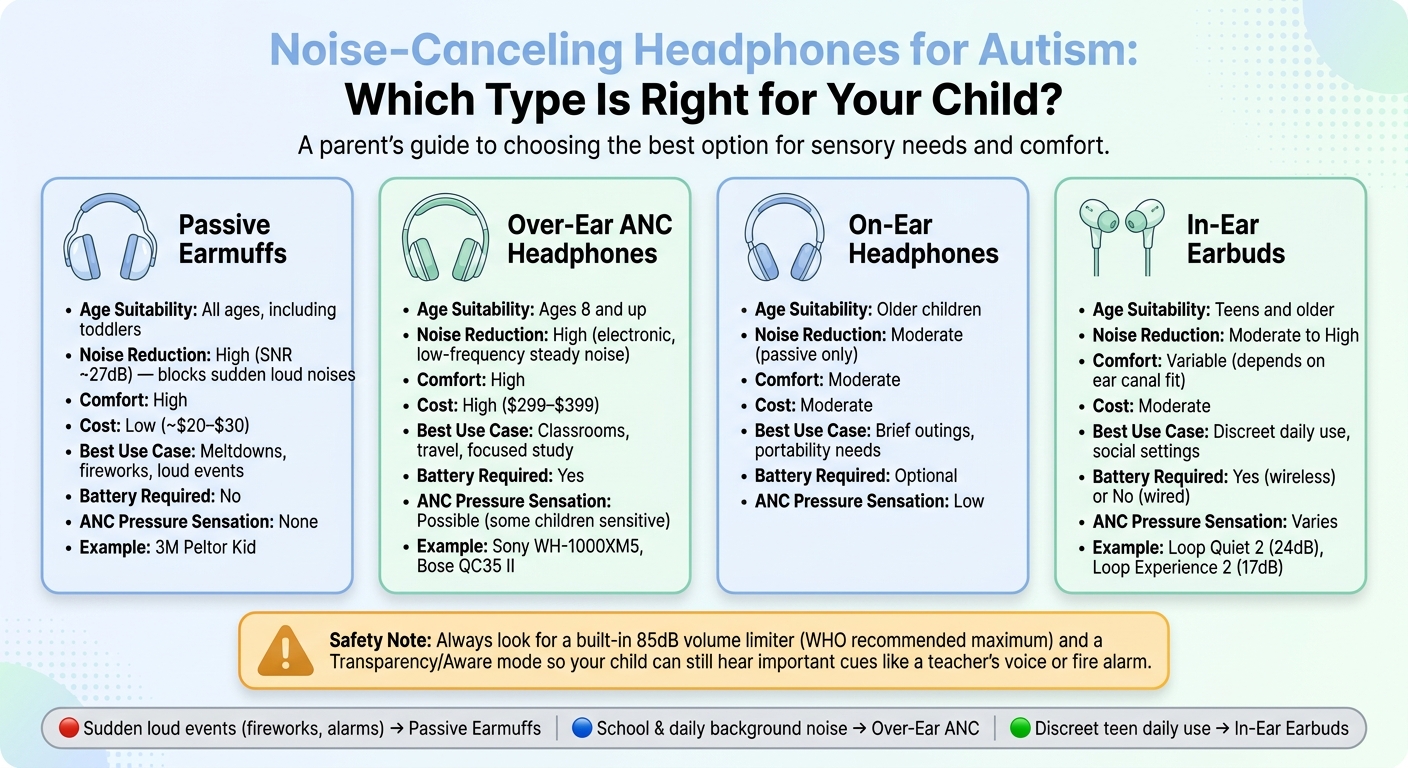
Noise-Canceling Headphones for Autism: Which Type Is Right for Your Child?
Comparing Headphone Types: Pros and Cons
Once you’ve identified your child’s specific sensory triggers and daily environments, the next step is to match that information with the right type of headphones. Each type addresses different sensory needs and situations.
| Headphone Type | Age Suitability | Noise Reduction | Comfort | Cost | Best Use Case |
|---|---|---|---|---|---|
| Passive Earmuffs | All ages, including toddlers | High (SNR ~27dB) | High | Low (~$20–$30) | Autism meltdowns, fireworks, or loud events |
| Over-Ear ANC | Ages 8 and up | High (electronic, low-freq) | High | High ($299–$399) | Classrooms, travel, focused study |
| On-Ear | Older children | Moderate | Moderate | Moderate | Brief outings, portability needs |
| In-Ear Earbuds | Teens and older | Moderate to high | Variable | Moderate | Discreet daily use, social settings |
Passive earmuffs – such as the 3M Peltor Kid (rated 5/5 for durability) – are a great option for younger kids. They don’t require batteries, effectively block sudden loud noises, and can endure rough handling. On the other hand, over-ear ANC headphones, like the Sony WH-1000XM5 or Bose QuietComfort 35 II, excel at filtering steady background noise like classroom chatter or engine hum. However, these are better suited for older children as they can be fragile for younger users [3][1].
Some children may find ANC (Active Noise Cancellation) uncomfortable due to the subtle “pressure” sensation it creates in the ears. In these cases, passive earmuffs or high-fidelity earplugs might be better alternatives. Options like the Loop Quiet 2 (24dB reduction) or Loop Experience 2 (17dB reduction) are ideal for environments where speech needs to remain audible [3].
Once you’ve chosen a type, it’s essential to ensure the headphones provide adequate hearing protection and meet safety standards.
Safety and Hearing Protection
When selecting headphones, safety features are just as crucial as functionality. Volume-limiting technology is a must. The World Health Organization recommends a maximum of 85 dB for safe listening [1][6]. Since children with autism may not self-regulate volume effectively – especially when using headphones to block distressing noises – a built-in 85dB limiter is more dependable than relying on software settings.
Another critical feature is Transparency or Ambient mode, which allows important sounds – like a teacher’s instructions, a car horn, or a fire alarm – to filter through without removing the headphones [6][9]. Sarah Mitchell, MS, BCBA, from Bluebell ABA, explains:
"Noise-canceling headphones help autistic individuals manage sensory overload by creating a buffer from the outside world… allowing the user’s brain to process information without becoming overwhelmed." [6]
This balance ensures that while disruptive noise is reduced, essential safety cues remain audible.
Comfort and Fit
Even the most effective headphones can become unusable if they aren’t comfortable, especially for children with tactile sensitivities. Prioritizing comfort features is key to ensuring long-term use.
| Comfort Feature | Importance | What to Look For |
|---|---|---|
| Weight | Heavy headphones can cause neck fatigue and sensory discomfort | Under 200g for children under age 10 [3] |
| Clamp Force | Excessive pressure can lead to headaches or meltdowns | Flexible headbands; adjustable frames [1] |
| Cushion Material | Certain fabrics may irritate skin or trap heat | Memory foam, breathable leatherette, or silicone [9][1] |
| Adjustability | Ensures a proper fit for different head sizes | Ratcheting sliders or multi-point adjustment [1] |
If the headphones feel too tight, gently bending the headband outward can help reduce pressure while maintaining a good acoustic seal [3][1]. Small adjustments like this can make all the difference in whether a child feels comfortable wearing them.
Introducing Headphones and Tracking Their Impact
How to Introduce Headphones Gradually
The way you introduce headphones to your child can make all the difference. Start in a calm and familiar environment – like home – and give your child time to explore the headphones before expecting them to wear them. A good first step is using them briefly during an activity they already enjoy, like watching a favorite show or playing on a tablet. This helps create a positive connection instead of making the headphones feel like a stressor [5][1].
Another helpful tip? Try wearing the headphones yourself first. Seeing you use them can make the experience feel more normal [5][3]. You can also let your child personalize their pair – decorating with stickers or picking a favorite color can make the headphones feel special and encourage them to give it a try [1].
Once they’re comfortable wearing the headphones for short periods, gradually introduce them in specific settings – like a grocery store, a bus ride, or a crowded family gathering. However, avoid constant use in quiet environments. Overuse can lead to the auditory system adjusting in a way that might make everyday sounds seem even louder when the headphones come off [3][5]. Always let your child know they’re in control and can take the headphones off whenever they need to. This sense of autonomy helps reduce anxiety and builds long-term acceptance [3].
"Never pressure your child to wear the headphones. If they resist, take a break and try again later. Respecting their boundaries helps build long-term acceptance." – Steady Steps ABA [5]
This gradual approach not only helps your child get used to the headphones but also sets the stage for tracking how they impact behavior.
Monitoring Behavior and Adjusting Your Choice
After introducing the headphones, pay close attention to how your child responds. Look for signs that they’re helping – like staying calmer in noisy places, being more willing to participate in activities they used to avoid, or even reaching for the headphones on their own when feeling overwhelmed [7][5]. Improvements don’t always have to be big; subtle changes, like fewer meltdowns or better focus at school, are just as important.
On the flip side, watch for signs that something might be off. If your child becomes irritable while wearing the headphones or frequently tries to take them off, it might be time to reassess [2][10]. Some children might find the faint “pressure” from Active Noise Cancellation (ANC) uncomfortable – in these cases, passive earmuffs might be a better option [4][5].
Keeping a sensory log can be incredibly useful for spotting patterns over time. Apps like Guiding Growth let you record detailed observations, including triggers, intensity, duration, and location of behavioral events. Over time, this data can reveal which environments are still challenging, whether meltdowns are happening less often, and how your child is adapting across different situations. Plus, having these records makes it easier to share meaningful updates with an occupational therapist or BCBA who’s helping you fine-tune your sensory strategies [1][5].
"Noise-cancelling headphones will not solve sensory processing differences, but for many people they create a meaningful buffer – enough to stay present, stay focused, and participate." – Assistive Tech Australia [2]
If, after consistent use, the headphones don’t seem to be making a noticeable difference, it might be time to reevaluate. Consider whether a different type – such as passive noise reduction or a different fit – might better suit your child’s needs. The comparison table from the earlier section can help guide your decision.
Conclusion: Choosing Headphones That Work for Your Child
Finding the right headphones for your child is a process that requires attention to their unique sensory needs. Start by identifying their sensory triggers and selecting headphones that match those requirements. Look for lightweight, cushioned models with built-in volume limits of 85 dB for safety and comfort[9][1]. If active noise cancellation feels overwhelming, consider passive earmuffs as an alternative[4][5]. Introducing headphones gradually and in a positive context can make all the difference.
As mentioned earlier, pairing headphones with enjoyable activities helps build acceptance over time. Allowing your child some control over when and how they use the headphones can also encourage long-term use. As the SENDPath Guide explains:
"The goal, over time, should be building tolerance and having protection available as a tool – not developing a dependency on complete silence to function." – SENDPath Guide[3]
Pay attention to how your child responds. Their behavior will give you the clearest indication of whether a particular pair of headphones is working. If the fit, noise cancellation, or level of isolation isn’t right, don’t hesitate to make adjustments. Sensory preferences can change, so flexibility is key[9][5]. Choosing brands with generous return policies can help you experiment without financial stress.
While headphones won’t eliminate sensory challenges, they can give your child more control over their surroundings. By carefully selecting and monitoring their use, you can help your child navigate sensory experiences with greater confidence and comfort.
FAQs
How do I know if my child needs ANC or passive earmuffs?
Choosing between active noise cancellation (ANC) and passive earmuffs comes down to your child’s sensory needs and the type of environment they’re in.
Passive earmuffs rely on thick padding to block out noise, making them a good choice if your child is sensitive to the humming or pressure often associated with ANC. On the other hand, ANC headphones are designed to counteract low-frequency sounds, like traffic or background noise, using anti-noise technology. This makes them especially useful for environments with constant noise.
Many families find it helpful to have both options on hand – passive earmuffs for quick, simple relief and ANC headphones for more regular, day-to-day use.
What SNR rating works for sensory overload situations?
An SNR (Signal-to-Noise Ratio) rating of 27dB is commonly suggested for managing sensory overload, as it offers solid passive noise reduction. While active noise cancellation (ANC) is more effective at reducing steady, low-frequency sounds, passive options with a 27dB rating work well to block out excessive environmental noise. The platform Guiding Growth supports parents in monitoring sensory experiences, helping them make informed choices between ANC technology and high-SNR passive solutions based on their child’s specific needs.
How can I prevent my child from relying on headphones all the time?
Using headphones can be a helpful tool for managing sensory overload, but it’s important to use them thoughtfully. Instead of relying on them all the time, reserve their use for particularly challenging situations. Overuse might make it harder for your child to adapt to everyday sounds or develop natural coping mechanisms.
To strike a balance, try gradually introducing them to tolerable sound levels. This process, often called desensitization, can be more effective when done in collaboration with a therapist. Keep an eye on their progress, and make it a point to have open conversations about their experiences. This approach can help ensure they stay socially connected and engaged with the world around them.