From Guesswork to Growth: A Parent's Guide to FBA
Feeling overwhelmed trying to understand why a certain behavior keeps happening? You're not alone. Many parents end up with scattered notes, vague memories, and a growing sense that they're always reacting too late. One rough morning blends into the next, and it starts to feel impossible to tell what's triggering what.
A functional behavior analysis example helps turn that fog into a pattern you can use. In school guidance under IDEA, an FBA is treated as a structured, data-driven process. It starts with an observable, measurable definition of the behavior and uses multiple sources such as observations and interviews. That same guidance recommends tracking frequency, duration, conditions, location, and the people involved, then analyzing what happened before the behavior, the behavior itself, and what followed it in IDEA guidance on functional behavioral assessments.
That matters because behavior support works better when you stop guessing and start identifying function. Instead of asking, “How do I stop this?” you ask, “What is this behavior doing for my child right now?” That shift changes everything.
The examples below move fast and stay practical. Each one walks through a complete, end-to-end pattern from ABC clues to function-based support you can track over time. If you use a tool like Guiding Growth, you can turn those daily observations into something much easier to review with therapists, teachers, and caregivers.
Table of Contents
- 1. School-Based FBA for Classroom Disruptive Behavior
- 2. FBA for Meltdowns and Shutdown Episodes in Autistic Children
- 3. FBA for Demand Avoidance and Pathological Demand Avoidance PDA
- 4. FBA for Selective Eating and Food-Related Behaviors
- 5. FBA for Sleep Disturbances and Behavioral Insomnia
- 6. FBA for Echolalia and Repetitive Speech in Autistic Communication
- 7. FBA for Stimming and Sensory Behaviors in Autism
- 7-Case Functional Behavior Analysis Comparison
- Your Action Plan Turning FBA Insights into Daily Support
1. School-Based FBA for Classroom Disruptive Behavior
A common school referral starts with behaviors like calling out, leaving a seat, joking during instruction, or wandering during transitions. Adults often describe the child as “disruptive,” but that label isn't enough to build support. The useful question is what happens right before and right after the behavior.
In school-based FBA practice, the strongest starting point is objective definition and direct observation. One state sample case shows how behavior analysts document antecedents, setting events, and consequences before building a behavior intervention plan, then track frequency, duration, and replacement behavior over time in this FBA technical case example. That structure is what keeps teams from chasing opinions.
What the data usually shows
A student may call out most often during whole-group lessons because teacher attention follows immediately. Another may leave their seat during writing because the task feels hard and walking around delays the demand. A third may make repetitive noises during independent work because the sensory environment feels dull or uncomfortable.
Practical rule: Don't treat all classroom disruption as one behavior. “Out of seat” during math and “out of seat” during lunch transition may have completely different functions.
The most useful school logs usually capture:
- Antecedent details: Subject, transition point, adult direction, peer noise, task difficulty.
- Behavior details: What the student did, in observable terms.
- Consequence details: Redirection, peer laughter, break from work, adult proximity, loss of task.
A practical intervention path
If the pattern points to attention, teach and reinforce hand-raising, help-seeking, or a visual cue card. If the pattern points to escape, adjust the task, offer choices, chunk directions, and teach a break request before the child has to blow up to get relief. If the pattern points to sensory regulation, add movement, fidgets, seating options, or quieter work conditions.
What doesn't work well is piling on correction without changing the conditions that keep the behavior going. Repeated verbal reminders can accidentally feed attention-maintained behavior. Sending a student out every time can strengthen escape-maintained behavior.
When school teams and parents track the same behavior in similar language, progress gets clearer. Guiding Growth can help families mirror the school ABC format at home, so everyone is comparing the same pattern instead of arguing over impressions.
2. FBA for Meltdowns and Shutdown Episodes in Autistic Children
Meltdowns and shutdowns usually look sudden from the outside. They rarely are. Most have a buildup phase that adults can learn to spot if they stop focusing only on the peak moment.
A good functional behavior analysis example here doesn't start with “How do we stop the meltdown?” It starts with “What load was building, and what did the meltdown interrupt, communicate, or relieve?” That may be sensory overload, transition anxiety, social stress, fatigue, hunger, or an impossible demand.
A home example
Take a child who melts down every Sunday evening. The obvious guess might be “they're being defiant about bedtime.” The pattern may show something else. Sunday includes the shift from flexible weekend rhythms to school expectations, and the child starts escalating when backpacks come out, clothes are discussed, or adults start talking about Monday.
In that case, the function may be escape from transition stress, not simple refusal. Support might include a more predictable Sunday routine, earlier visual previewing, fewer verbal demands, and a softer landing into the week.
Another child shuts down in grocery stores. The behavior may look like noncompliance, but the antecedents tell a different story: fluorescent lights, crowd noise, cart movement, and multiple verbal prompts. Parents working through public meltdown triggers and solutions often find that changing the sensory load matters more than better prompting.
The earliest signs are often small. Muscle tension, pacing, repeating questions, going quiet, or refusing easy tasks can all signal overload long before the actual meltdown.
What support looks like
Track the hours before the episode, not just the episode itself. Sleep, food intake, transitions, noise exposure, and social effort often matter. Then test supports one at a time so you can tell what helps.
Useful supports often include:
- Earlier intervention: Step in at the body-tension stage, not the screaming stage.
- Reduced language: Fewer words during escalation. More words usually increase load.
- Recovery support: Quiet space, sensory tools, hydration, and time without demands.
This short overview can help some families visualize escalation and de-escalation in real time.
What usually doesn't work is trying generic calming strategies that the child already experiences as intrusive. If deep breathing prompts, eye contact, or repeated questions make things worse, believe that data. Guiding Growth is useful here because you can log the trigger, the earliest warning sign, the duration, and which response reduced distress.
3. FBA for Demand Avoidance and Pathological Demand Avoidance PDA
Some children don't resist because they don't understand the task. They resist because the experience of being directed feels threatening, exposing, or overwhelming. If you miss that, you can turn daily routines into a constant power struggle.
A functional behavior analysis example for demand avoidance looks different from a traditional compliance-focused plan. The target isn't “get the child to obey faster.” The target is understanding how demands, tone, timing, and perceived loss of control affect behavior.
A pattern that gets missed
One child refuses to get dressed every morning when told, “Put this on now.” The same child dresses independently when clothes are laid out and no direct command is given. Another child escalates over homework when adults hover, but completes the same work when it's framed as a personal project with flexible order and breaks.
In applied behavior analysis practice, indirect assessments became routine over time. In one comparative effectiveness study summarized on PubMed Central, 75.2% of BCBAs reported they always or almost always use indirect assessments to identify the function of challenging behavior in this PubMed Central summary. That matters here because parent and teacher interviews often reveal a control-and-anxiety pattern that brief observation alone can miss.
What tends to work better
When the function is avoidance of perceived demand pressure, increasing pressure usually backfires. So does turning every refusal into a showdown. A lower-demand approach often gets more movement than a stricter one.
Try shifts like these:
- Indirect language: “I wonder which shirt feels best today” instead of “Get dressed now.”
- Real choices: Two acceptable options are better than fake choices with one expected answer.
- Processing time: Ask once, then leave space. Rapid repetition raises anxiety.
- Collaboration: Problem-solve after the crisis, not during it.
Clinical caution: If autonomy reduces distress and increases participation, that's meaningful data. Don't ignore it just because the path looked less direct.
Guiding Growth works well for this pattern because you can tag the demand type, the wording used, the level of time pressure, and the alternative that led to cooperation without conflict.
4. FBA for Selective Eating and Food-Related Behaviors
Food refusal is one of the easiest places for adults to assume a child is being stubborn. It's also one of the easiest places to miss a real function. The same “no” can mean sensory discomfort, fear, demand avoidance, nausea, loss of control, or simple lack of trust in the food presented.

One feeding pattern, different functions
A child who eats only beige crunchy foods may be seeking consistency in texture and flavor intensity. A child who gags at mixed textures may be reacting to sensory properties, not trying to control the meal. Another child may refuse dinner after a day full of demands because the mealtime pressure itself has become the trigger.
The ABC pattern matters here. If refusal increases when adults praise, plead, bargain, or insist on “just one bite,” the consequence may be social pressure and escape from that pressure. If refusal happens before tasting and improves when the food is present without expectation, anxiety may be the underlying issue.
A gentler intervention sequence
Start with observation before intervention. Note accepted temperatures, textures, smells, colors, brands, presentation style, and who was present. Many families discover their child isn't “randomly picky” at all. The preferences are consistent once you record them carefully.
Helpful approaches often include:
- Low-pressure exposure: Put the food on the table without requiring tasting.
- Sensory matching: Expand from accepted foods to similar foods, not wildly different ones.
- Environmental calm: Reduce comments, negotiations, and visible adult tension.
- Professional support: Bring in a feeding specialist or nutrition professional when refusal is extreme or nutrition is a concern.
What doesn't work well is trying to overpower a sensory or fear response with reward charts, shame, or prolonged sitting. Those methods can increase avoidance and erode trust. Guiding Growth can help you track accepted foods, rejected foods, sensory features, and whether behavior shifts with hunger, routine changes, or social pressure.
5. FBA for Sleep Disturbances and Behavioral Insomnia
When sleep falls apart, daytime behavior often gets blamed first. In practice, I often see the opposite sequence. The child is overloaded, under-rested, or dysregulated at night, and the daytime struggles are partly downstream from that.
A functional behavior analysis example for sleep starts with a narrow definition. Is the problem falling asleep, staying asleep, early waking, bedtime resistance, or needing a parent present to return to sleep? Those are different behaviors and often have different maintaining conditions.
A sleep example that changes with data
A child resists bedtime every night. Adults assume the child isn't tired. The log shows something more specific: escalation begins after pajamas, increases when the bedroom lights go off, and settles only when a parent lies beside the child. That pattern points you toward sensory discomfort, anxiety, or conditioned dependence on parental presence. It doesn't justify a generic “be more consistent” lecture.
Another child wakes early and is fully alert. Before changing the whole routine, look at light exposure, noise, hunger, room temperature, activity timing, and what happens immediately after waking. If early waking reliably leads to screen time, snacks, or full parental engagement, the consequence may be helping maintain the pattern.
What to adjust first
Track bedtime, sleep onset, waking times, naps, evening activity, meals, and sensory conditions in the room. Then change one variable at a time. If you change everything in one weekend, you won't know what made the difference.
A sensible order often looks like:
- Environment first: Bedding texture, light control, sound, room temperature.
- Routine next: Predictable sequence with fewer stimulating transitions.
- Associations: Gradually reduce sleep links that require adult presence if that dependence is part of the pattern.
- Clinical questions: Check with a medical professional if pain, apnea, reflux, or other health concerns are possible.
Parents who want a broader therapeutic lens can also read about how CBT can improve sleep in autistic kids and compare those ideas with behavior tracking. Some families also explore SleepHabits' natural sleep remedies, but the key is still matching supports to the pattern you're seeing.
What usually fails is focusing only on bedtime behavior without recording the whole evening and night. Guiding Growth helps because it keeps sleep notes, routines, and next-day mood in one place, which makes cause-and-effect much easier to review.
6. FBA for Echolalia and Repetitive Speech in Autistic Communication
Echolalia gets misunderstood all the time. Adults hear repeated words or scripts and assume the speech is meaningless, off topic, or something to extinguish. That mistake can shut down communication that was doing important work.
When repeated speech is doing real work
A child repeats a movie line every time a plan changes. Another echoes the last part of your question before answering. A third uses a familiar script when they're upset, excited, or trying to join an interaction. Those are not identical behaviors, even if they all sound repetitive.
The most useful FBA stance is curiosity. What happened right before the script? Did it help the child process language, regulate emotion, request something, or connect socially? Sometimes the repeated phrase is the bridge between inner experience and functional communication.
Repetition isn't automatically a problem. In many children, it's the path into language, not away from it.
Support without suppressing communication
If echolalia appears during processing, slow down and give wait time. If it shows up during stress, reduce demands and support regulation first. If it seems communicative, respond to the meaning, not just the form.
Support often looks like this:
- Interpret before correcting: Ask what the phrase may be expressing in context.
- Model expansion: Add one simple phrase that builds on what the child said.
- Protect processing time: Avoid rapid-fire questions.
- Coordinate with speech support: Families can pair tracking with guidance from this parent guide to speech therapy for autism.
What doesn't help is constant interruption, forced eye contact, or drilling “use your words” when the child is already using the words they currently have. Guiding Growth can help you tag repeated phrases, emotional context, transitions, and communicative outcomes, so patterns become visible instead of seeming random.
7. FBA for Stimming and Sensory Behaviors in Autism
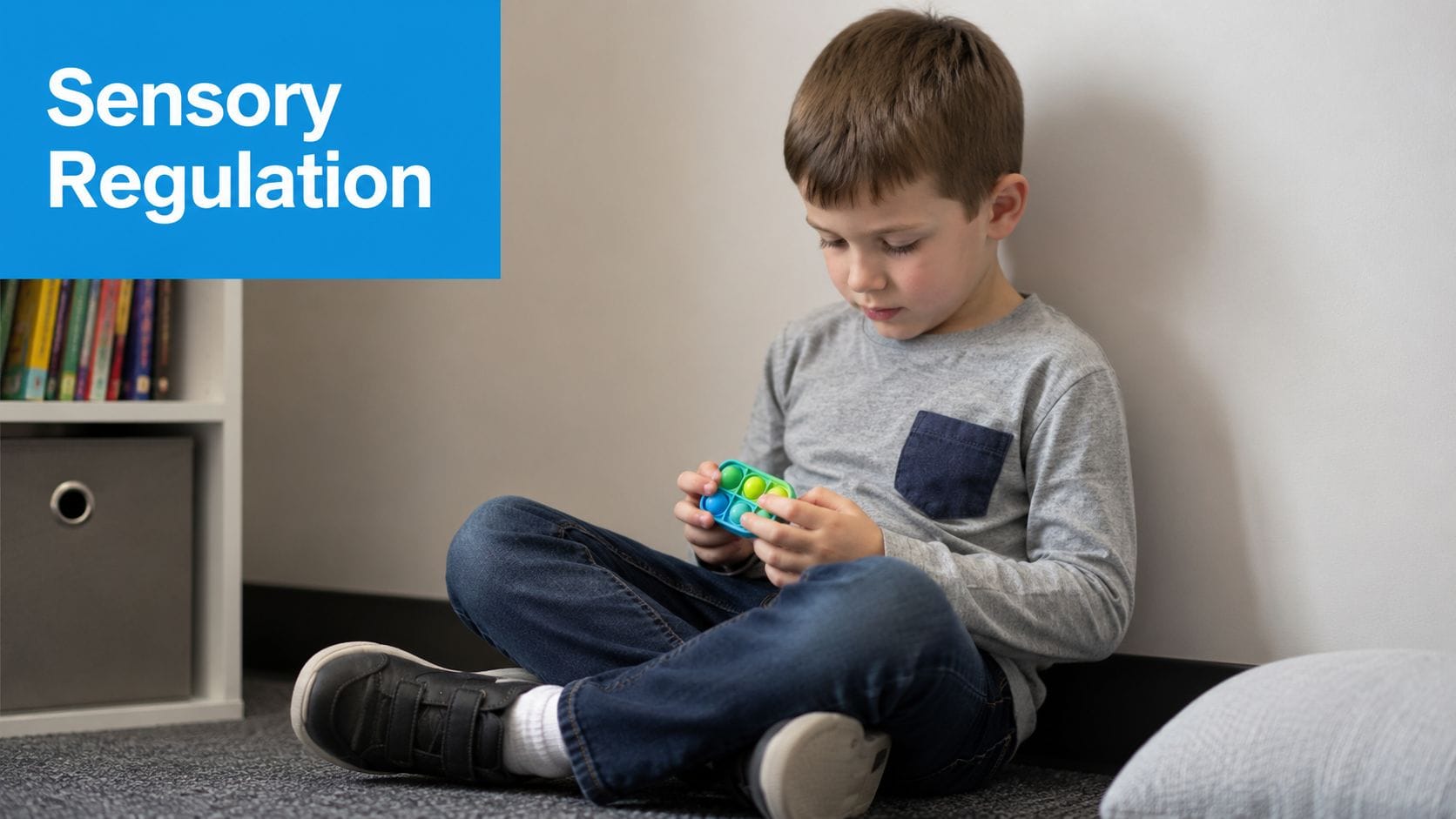
Stimming is often the behavior adults most want to stop and the behavior they should understand first. Hand flapping, rocking, spinning, lining up objects, humming, pacing, or fidgeting often serve a real regulatory purpose. When you suppress the form without respecting the function, the child's stress usually rises.
A regulation-first example
A child hand-flaps intensely when excited, then again during long periods of waiting. Those may look similar, but the internal state is different. In one case the movement may express joy and organize energy. In the other, it may help the child stay regulated during under-stimulation or uncertainty.
Another child lines up toys before leaving the house. Adults may call it obsessive behavior. The antecedent shows it happens during transitions and reduces distress. That suggests the behavior helps create predictability when the environment feels unstable.
Safer and more supportive alternatives
The first question isn't whether the behavior looks typical. The first question is whether it's safe, whether it interferes with the child's own goals, and what need it serves. If the stim is safe and regulating, support may mean protecting it, not replacing it.
Helpful responses often include:
- Allowing safe stims: Especially at home, during transitions, and after hard demands.
- Adding sensory options: Fidgets, chew tools, movement breaks, weighted items, or alternate seating.
- Teaching context, not shame: Some children benefit from stim choices that fit different settings without being told their natural regulation is wrong.
- Watching intensity shifts: Increased stimming often signals rising stress, fatigue, or sensory overload.
What matters most: treat stimming as information. If it rises sharply, ask what changed in the environment or demand load.
What doesn't work is constant “quiet hands” prompting or forcing stillness for appearance's sake. Guiding Growth can help you track the sensory environment, activity type, stress load, and the form of stimming, which makes it easier to support regulation before distress escalates.
7-Case Functional Behavior Analysis Comparison
| Intervention / Focus Area | Implementation complexity 🔄 | Resource requirements ⚡ | Expected outcomes ⭐ | Ideal use cases 💡 | Key advantages 📊 |
|---|---|---|---|---|---|
| School-Based FBA for Classroom Disruptive Behavior | Moderate, structured observations and team coordination | Moderate, trained observers, time in-class, data forms/apps | High, targeted BIPs, reduced disruptions, supports IEPs | Elementary classrooms with repeated disruptive behaviors | Provides concrete teacher strategies and cross-setting consistency |
| FBA for Meltdowns & Shutdowns | High, individualized, emotionally intense, needs longitudinal data | High, parent/caregiver logs, specialist support, safety planning | High, fewer/severe episodes, better de-escalation and recovery | Home and community settings with sensory/emotional escalations | Preventative strategies that improve family safety and predictability |
| FBA for Demand Avoidance / PDA | High, requires mindset shift and nuanced functional assessment | Moderate, training in low-demand approaches, sustained implementation | Moderate–High, reduced conflict, improved cooperation (may be slow) | Families/schools facing chronic resistance linked to control/anxiety | Reduces power struggles by prioritizing autonomy-respecting strategies |
| FBA for Selective Eating & Feeding | Moderate, sensory/nutritional assessment and gradual exposures | Moderate, feeding therapist/nutritionist input, time for gradual change | Moderate, gradual food variety expansion, reduced mealtime stress | Persistent food selectivity, texture aversions, nutritional concerns | Balances sensory needs with nutrition; reduces family mealtime conflict |
| FBA for Sleep Disturbances & Insomnia | Moderate, multifactorial assessment, systematic sleep logs | Moderate, environmental modifications, possible sleep specialist input | High, improved sleep duration/quality and daytime functioning | Night wakings, bedtime resistance, circadian irregularities | Concrete sleep-hygiene and sensory adjustments with family-wide benefit |
| FBA for Echolalia & Repetitive Speech | Moderate, requires SLP expertise to identify communicative function | Low–Moderate, context tracking, speech therapy collaboration | Moderate–High, uncovers communication, supports functional language growth | Repetitive speech interfering with or masking communication intent | Respects neurodiversity while using existing speech for communication gains |
| FBA for Stimming & Sensory Behaviors | Low–Moderate, identify sensory modality and triggers | Low–Moderate, sensory tools, OT guidance, environmental changes | High, better self-regulation, reduced suppression, improved function | Frequent stimming tied to stress, boredom, or sensory needs | Supports adaptive regulation and creates acceptable sensory outlets |
Your Action Plan Turning FBA Insights into Daily Support
The biggest shift in FBA is simple. Stop treating behavior as a mystery to solve with better discipline. Start treating it as communication that becomes clearer when you collect the right information.
Across settings, the same pattern holds. Define the behavior in observable terms. Record what happened before it, what the behavior looked like, and what followed it. Keep the notes concrete. “Hit table with open hand for ten seconds after worksheet was placed down” is useful. “Got upset for no reason” isn't.
One reason this approach has become standard is that it gives teams a shared structure. School guidance under IDEA formalizes the process around measurable behavior, multiple sources of information, and analysis of antecedents, behavior, and consequences before building intervention. That basic logic is still the heart of a good parent-led tracking system, even when you're using it at home rather than in a formal school meeting.
You don't need to track everything at once. Start with one behavior that affects daily life the most. Pick something specific, like bolting during transitions, screaming when homework starts, repeating a phrase at bedtime, or refusing toothbrushing. Log the same details for several days before making big changes. Then test one support at a time.
A good intervention should match the function. If the behavior gets escape, teach a break request and reduce overload. If it gets attention, teach a clearer way to connect and give attention for that skill. If it serves sensory regulation, meet the sensory need safely instead of punishing the behavior. If it protects control in a high-anxiety moment, lower the pressure and build collaboration.
Parents often get stuck because the data lives in too many places. One note in your phone. One message from school. One half-remembered story from your partner. One paper sleep log on the kitchen counter. That's exactly where a tool like Guiding Growth helps. You can quickly log antecedents, behaviors, consequences, routines, sleep, food, and recovery patterns in one place, then share the picture with the people supporting your child.
That doesn't just make life more organized. It changes the emotional tone of support. You move from “Why is this happening again?” to “I know what usually comes before this, and I know what helps.” That kind of clarity builds confidence for parents and safety for children.
If you're tired of scattered notes and want a simpler way to track behaviors, routines, sleep, food, and triggers in one place, Guiding Growth is built for exactly that. It helps parents of autistic and neurodivergent children log patterns quickly, including by voice, spot what's really driving meltdowns or shutdowns, and collaborate with caregivers and professionals without the usual chaos.