You're standing in a checkout line. The cart wheel squeaks. The freezer cases hum. A baby cries somewhere behind you. Your child covers their ears, their breathing changes, and you can feel the moment tipping from manageable to overwhelming.
Many parents know this scene by heart.
The best noise cancelling headphones for autism can help, but not because they “shut the world out.” Their value is that they can give your child a more manageable sound environment, so their nervous system isn't working so hard just to cope. For some children, that means surviving a grocery trip. For others, it means being able to stay in class, join therapy, or ride in the car without spending all their energy on sound.
That's also why the “best” pair isn't the same for every child. One child may struggle most with the steady drone of a bus engine. Another may do fine with background hums but melt down when a chair scrapes or a hand dryer starts. Those are different sensory patterns, and they call for different headphone features.
If you're also building support around school, home routines, or respite, families often benefit from learning about broader autism care services for children that can complement sensory tools like headphones.
Table of Contents
- From Overwhelmed to Regulated An Introduction
- Why Headphones Work A Scientific Look at Sensory Calm
- Matching Headphones to Your Child's Sensory Profile
- ANC vs Passive Noise Reduction What Parents Must Know
- The Ultimate Checklist for Choosing Headphones
- A Gentle Guide to Introducing and Using Headphones
- Measure What Matters Track Headphone Use with Guiding Growth
From Overwhelmed to Regulated An Introduction
Parents often get told to buy “the best noise cancelling headphones for autism” as if there's one right answer. There isn't. A better question is: what kind of sound is hard for your child, and where does that struggle happen most often?
That shift matters. Headphones aren't just a purchase. They're a support tool for regulation, energy conservation, and participation. When sound takes less effort to process, a child may have more capacity left for learning, communicating, waiting, transitioning, and being present with other people.
Why “best” can be misleading
A pair that works beautifully on a long car ride may be a poor fit for classroom discussion. A child who needs relief from low background rumble may benefit from different technology than a child who startles at sudden sharp sounds.
The right headphones should help your child stay connected to life, not simply retreat from it.
That's why comfort, sound type, setting, safety, and ease of use all matter. If the ear cups feel scratchy, if the pressure on the head feels wrong, or if the controls are confusing, even strong noise reduction may not help much in real life.
What parents are usually trying to solve
Most families I speak with aren't looking for a fancy gadget. They're trying to solve very ordinary, very important problems:
- School strain: The classroom buzz, chairs moving, hallway noise, and assemblies can drain a child before lunch.
- Public outings: Shops, transport, restaurants, and waiting rooms can pile sound on top of social and visual demands.
- Home hotspots: Vacuum cleaners, siblings playing, kitchen clatter, and appliance hum can all wear a child down.
- Recovery time: Some children need a sound break after school or therapy so they can reset.
Once you know which problem you're solving, choosing gets easier. And when parents understand the match between their child's sensory profile and the headphone technology, they stop guessing.
Why Headphones Work A Scientific Look at Sensory Calm
For autistic children with auditory hypersensitivity, sound isn't always “just annoying.” It can create a full-body stress response. You may see it as ear covering, fleeing, irritability, refusal, tears, or what looks like sudden noncompliance. Often, the child's system is overloaded long before anyone else notices the noise.
That's why headphones can be more than a convenience item. They can reduce the burden on the nervous system.
What the body can tell us
A small study discussed in an autism-focused review found that six children aged 8 to 16 years with ASD and auditory hypersensitivity showed a protective effect from noise-attenuating headphones. After the headphones were introduced, skin conductance level and non-specific skin conductance responses decreased, which suggests lower physiological stress, and the effect stayed stable even when environmental noise increased, as described in this clinical summary of headphones for autism.
That matters because it gives parents and professionals something more concrete than “my child seems calmer.” It suggests that in at least some children, reducing sound input can reduce bodily arousal.
Practical rule: If your child seems “fine” but always crashes after noisy places, their body may still be working very hard during the experience.
Why this changes how parents advocate
When adults understand that headphones may support regulation, they can talk about them differently at school, in therapy, and in community settings. The goal isn't to avoid life. The goal is to make life more accessible.
A child who's using less energy on filtering noise may have more room for:
- Listening to instructions
- Joining group activities
- Tolerating transitions
- Recovering faster after stress
If you're still figuring out which situations push your child toward overload, this guide on identifying sensory triggers in autism can help you notice patterns before you buy anything.
Silence isn't the point
Parents sometimes worry that headphones will isolate their child or stop them from learning to cope. In practice, the healthier frame is often this: headphones can lower demand enough that the child can participate.
That might mean wearing them during the loudest part of an assembly, then taking them off for quieter discussion. It might mean using them in the supermarket but not at home. It might mean a child chooses them only during bus rides.
The support works best when it's purposeful, flexible, and tied to what your child's body is telling you.
Matching Headphones to Your Child's Sensory Profile
The biggest mistake parents make is buying based on popularity instead of pattern. Many articles lump every autistic child into one category, yet a child who's upset by sudden sound spikes has different needs from a child who's worn down by constant background noise. That gap is highlighted in this review of noise-canceling headphones and sensory profiles.
Before you compare brands, compare triggers.
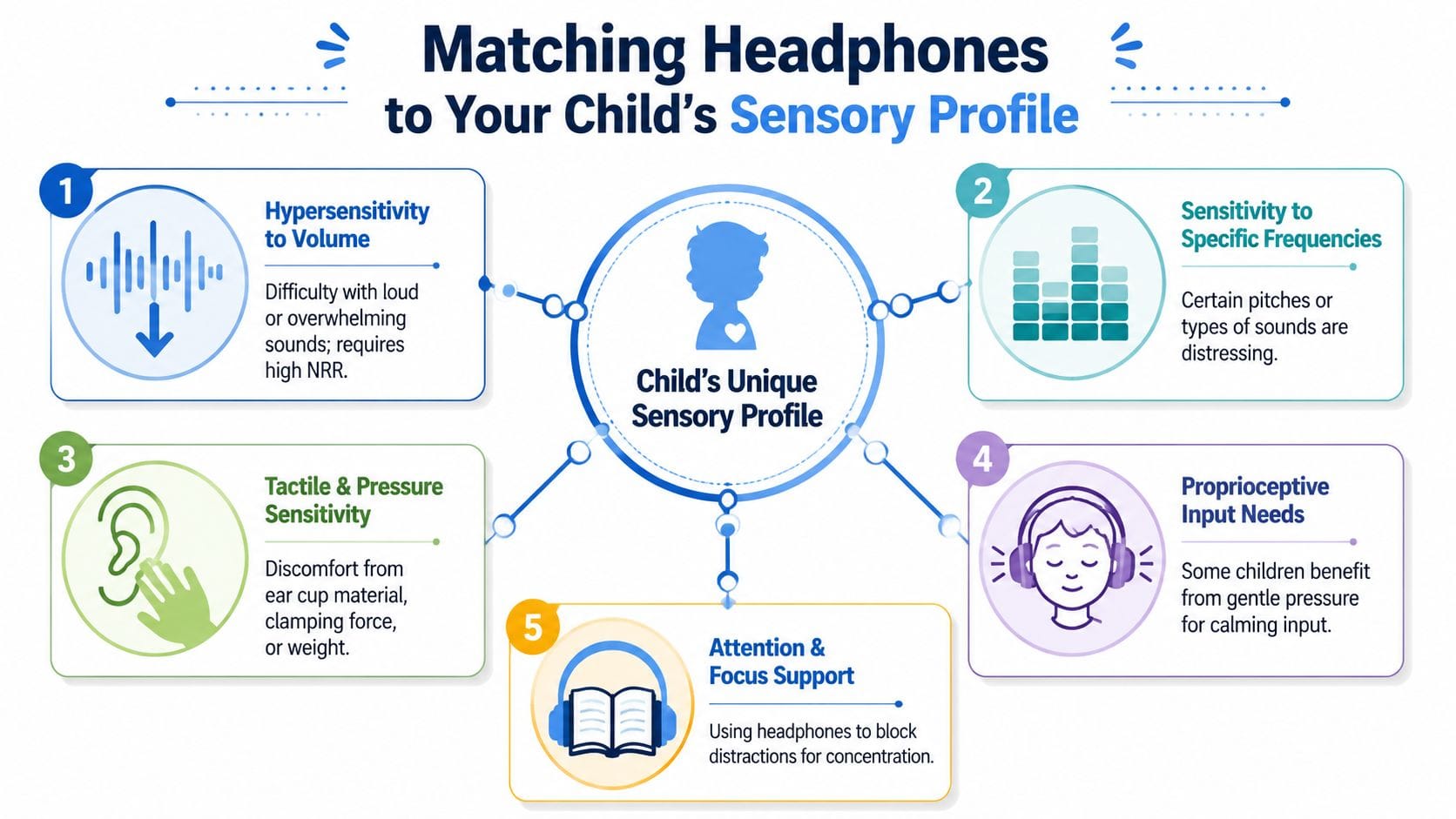
Two sound patterns parents often notice
Some children struggle most with steady, ongoing sound. Think bus engines, air conditioning, ventilation systems, refrigerators, or the general hum of a busy room. These children may not react dramatically to one sharp noise, but they get worn down by the constant layer underneath everything.
Other children react more to sudden, unpredictable sound. A dropped spoon, barking dog, toilet hand dryer, fire alarm practice, or chair scraping can send them into immediate distress. Their system may be less troubled by a low hum and more disrupted by sharp sound spikes.
Neither pattern is better or worse. They're just different.
How to spot your child's pattern
Try looking at the last few hard moments and ask:
- What came first? Was it a noisy buildup over time, or one abrupt sound?
- How fast did the reaction happen? Immediate reactions often point toward sudden-sound sensitivity.
- What settings are hardest? Buses and supermarkets often expose background-hum sensitivity. Cafeterias and bathrooms often expose spike sensitivity.
- What helps already? If your child seeks quiet corners, covers their ears before appliances start, or avoids particular rooms, those clues matter.
A few examples can make this clearer:
- Classroom example: If your child copes during lessons but struggles when chairs scrape and classmates shuffle materials, passive sound dampening may deserve strong consideration.
- Travel example: If your child becomes tense during long car rides or public transport even when nothing dramatic happens, low-frequency background noise may be the bigger issue.
- Home example: If your child relaxes once the extractor fan or vacuum stops, constant sound may be the load-bearing trigger.
A child doesn't need to explain their sensory profile in words for you to observe it in patterns.
You also need to factor in tactile preference. Some children hate over-ear pressure. Some like the steady, snug feel. Some can't tolerate certain fabrics or heat around the ears. In those cases, the “best noise cancelling headphones for autism” may not be the pair with the most advanced technology. It may be the pair your child will wear.
ANC vs Passive Noise Reduction What Parents Must Know
Parents often hear these terms and assume one is better. It isn't that simple. ANC and passive noise reduction solve different problems.
What ANC actually does
Active Noise Cancellation, or ANC, uses microphones to pick up surrounding sound and generate anti-noise waveforms. In the low-frequency range of 20 to 500 Hz, ANC can reduce ambient noise by up to 30 dB, particularly the kinds of background hums produced by engines or HVAC systems. That's why it's often useful for children who struggle with steady environmental noise, as explained in this guide on choosing noise-canceling headphones for autism.
A simple way to think about ANC is this: it's like noise-erasing for droning sounds.
If your child is overwhelmed by:
- bus or car engine rumble
- airplane cabin noise
- air conditioning systems
- the ongoing hum of crowded indoor spaces
ANC is often the technology worth prioritizing.
What passive noise reduction does better
Passive noise reduction doesn't use microphones or electronic processing. It works by creating a physical barrier around the ears. Thick ear cups, snug fit, and sound-blocking materials help muffle outside noise.
This approach can be especially useful when the problem is higher-pitched or irregular noise. It's also often simpler. No charging. No ANC mode. Fewer moving parts. Sometimes that simplicity is a relief for both parent and child.
Passive options may be a better fit when your child is most distressed by:
- chair scraping
- dishes clattering
- barking
- squeaky or sharp sounds
- environments where simple hearing protection is enough
A simple comparison
| Need | ANC | Passive noise reduction |
|---|---|---|
| Constant low hums | Best fit | May help, but often less targeted |
| Sudden sharp noises | Can help somewhat, depending on model | Often a strong option |
| Charging required | Usually yes | Usually no |
| Tech complexity | Higher | Lower |
| Good for travel | Often yes | Sometimes, depending on child |
The best choice depends on what your child is trying to escape from. A lot of frustration comes from buying advanced ANC headphones for a child who mainly needs a physical sound barrier, or buying simple ear defenders for a child who's significantly affected by ongoing engine or ventilation noise.
The Ultimate Checklist for Choosing Headphones
Once you know the sound pattern, the buying decision gets much more practical. You're no longer asking which pair is most popular. You're asking which pair your child can tolerate, use safely, and benefit from in real settings.
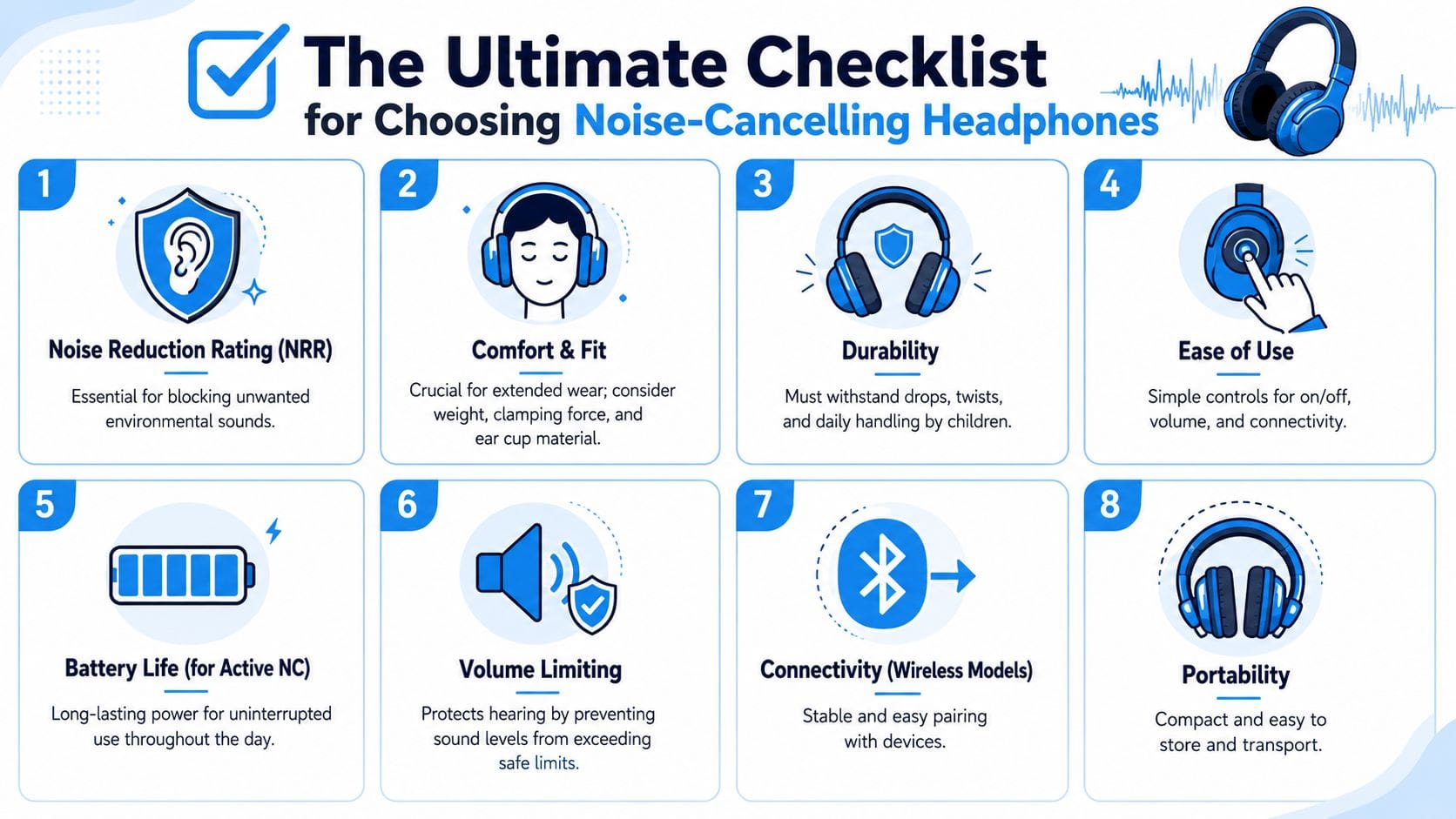
Comfort comes first
For prolonged use, adjustable headbands, cushioned ear cups, and lightweight materials matter because discomfort can become a second sensory trigger that cancels out the benefit of noise reduction. Some advanced models also use adaptive sound adjustment to help manage sudden unpredictable sounds in real time.
That means comfort isn't a bonus feature. It's central.
Look for:
- Soft contact points: Ear cups and headbands should feel gentle, not scratchy or stiff.
- Manageable pressure: Some children like a secure fit. Others feel trapped by clamping force.
- Low heat buildup: Warm ears can end a trial quickly.
- Adjustability: A fit that can change with hairstyles, hats, or growth is helpful.
If possible, let your child try headphones for a short calm activity before testing them in a hard environment.
Safe listening matters
If your child will use headphones for music, videos, or educational audio, volume safety matters as much as noise reduction. The youth-focused BT2200 is described as following the World Health Organization's 85 dB volume limit, which is an important safeguard for young listeners, according to this autism-focused headphone review from Soundcore.
If a pair lowers outside noise well, your child may not need to turn audio up as much to feel comfortable.
That's one reason families often prefer headphones that combine sound management with listening safety.
Battery and daily practicality
A pair that dies before the school day ends becomes one more problem to solve. Battery life matters most when headphones are part of daily transitions, travel, or school support.
A few examples from the same review can help parents compare:
- Soundcore Life Q30: described as reducing noise by up to 95% using dual microphones
- Bose QuietComfort 45: reported battery life of up to 24 hours
- Sony flagship model: reported up to 30 hours of continuous playback with Bluetooth and ANC active
Those details don't tell you which pair is right for your child, but they do tell you what to check: runtime, ease of charging, and whether the headphones can reliably get through a full day.
Durability and ease of use
Children use equipment in real life, not in product photos. Headphones get dropped, twisted, stuffed into bags, and worn during stress.
Check for:
- Simple controls: Too many buttons can be frustrating.
- Easy pairing: If Bluetooth setup is fussy, the headphones may get abandoned.
- Sturdy hinges and bands: Especially if your child squeezes, flaps, or removes them quickly.
- Wired option if needed: Some families prefer no battery worries. Others find wires irritating or unsafe in active settings.
For many children, the best noise cancelling headphones for autism are the pair they can put on independently, tolerate on their skin, and trust to work every time.
A Gentle Guide to Introducing and Using Headphones
Even the right headphones can fail if the introduction feels too abrupt. Many children need time to accept a new sensation on their head and ears. If you rush, your child may reject a pair that might otherwise have helped.
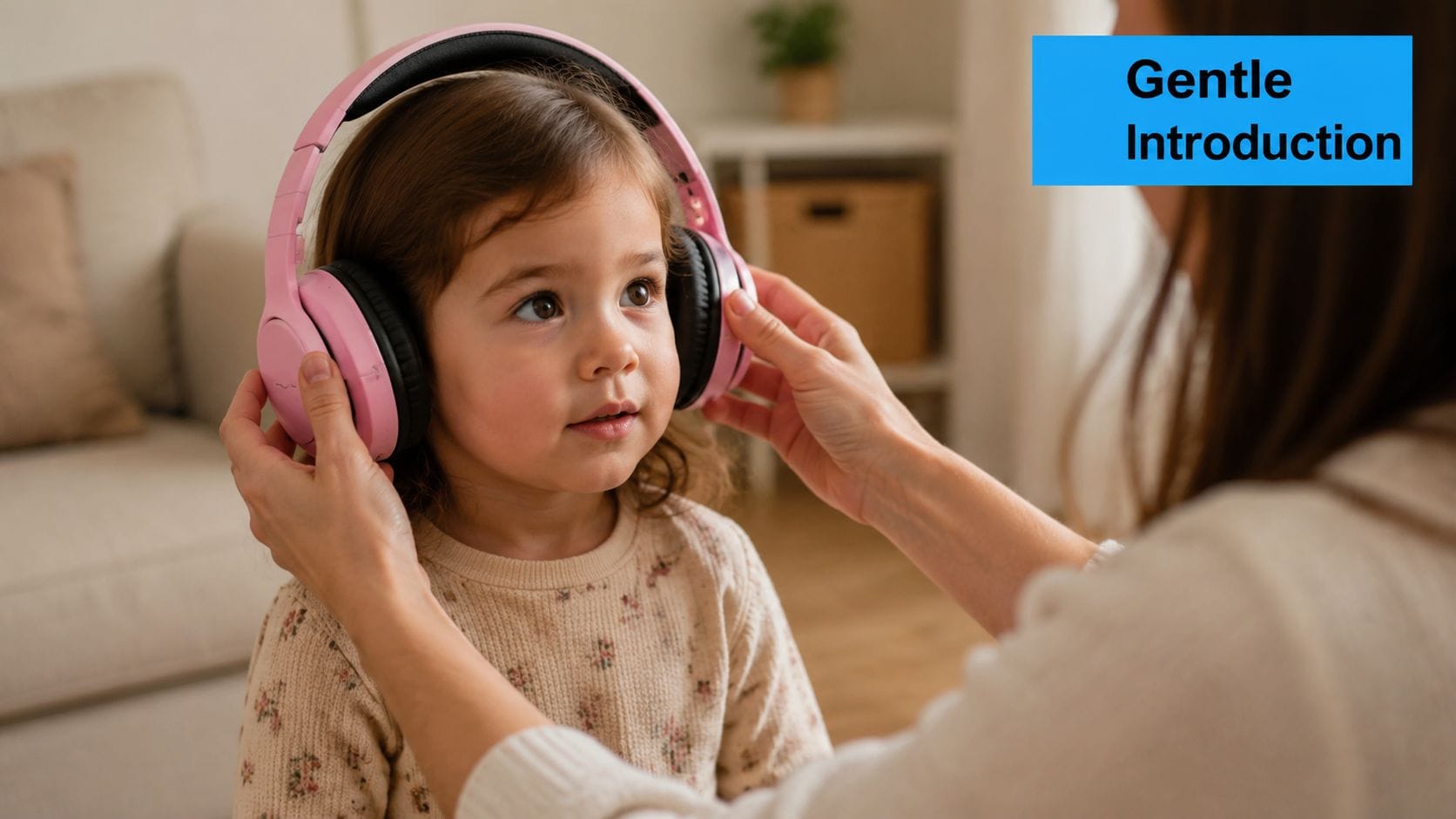
Start before the hard moment
Don't first introduce headphones in the middle of a meltdown or in the busiest part of a store. Begin in a calm, low-demand place.
A gentle progression often works better:
- Let your child explore them off the head. Touch, hold, open, close.
- Model wearing them yourself. Children often accept new gear more easily when they see it used calmly.
- Pair them with a preferred activity. A favorite show, book, snack, or quiet game can help build positive association.
- Keep first wears short. End before discomfort builds.
If your child refuses, pause and try again later. Refusal is information, not failure.
Make them a participation tool
Headphones work best when they support engagement, not disappearance. A child may need them during the loudest part of an environment, then take them off when sound demands decrease.
A few practical habits help:
- Agree on an attention cue: A gentle shoulder tap, visual card, or standing in front of your child before speaking.
- Teach choice language: “Headphones on,” “headphones off,” or a simple gesture if speech is hard in stress.
- Plan specific use times: School assembly, shopping trip, vacuuming, bus ride.
Some children wear headphones best when they know they can remove them whenever they choose.
That sense of control can make all the difference.
Build routines around charging and breaks
Daily use goes more smoothly when the logistics are predictable. According to the same Soundcore review, practical adoption factors include battery life that can last up to 30 hours in some models and the WHO-recommended 85 dB volume limit for safer listening in children.
That means two routines matter:
- Charging routine: Plug them in at the same time each day if they're wireless.
- Break routine: Encourage short breaks during safe, quiet moments if your child tolerates that transition.
Also pay attention to context. In some situations, complete sound reduction may not be ideal. Your child may still need awareness for instructions, safety, or social interaction. The goal is enough relief to cope, not automatic maximum blocking at all times.
Measure What Matters Track Headphone Use with Guiding Growth
Parents often know a tool is “helping,” but they can't always tell exactly where, when, or how much. That's a problem when you're trying to make decisions with teachers, therapists, or other caregivers.
A simple tracking habit can change that.
Instead of relying on memory, log a few consistent details:
- Where the headphones were used
- What kind of environment it was
- How long they were worn
- What happened before and after
- Whether your child seemed more regulated, more communicative, or more able to stay
Over time, patterns become easier to see. You may notice your child needs headphones during transport but not during classroom work. Or that one pair helps with shopping trips but isn't tolerated at home. Or that meltdowns decrease when headphones are offered earlier, before signs of escalation appear.
Why tracking helps the whole team
Good decisions get easier when everyone is looking at the same information.
Tracking can help you:
- Spot context-specific success: Maybe the headphones work well in assemblies but not in restaurants.
- Separate comfort issues from sound issues: If your child removes them quickly every time, fit may be the primary barrier.
- Share observations clearly: Teachers and caregivers can respond more consistently when they know what works.
If you want a structured way to record these patterns, tracking sensory milestones in autism can make the process simpler and more useful across home, school, and therapy.
The point isn't collecting data for its own sake. It's reducing guesswork so your child gets support that fits.
If you want one place to track headphone use, sensory triggers, meltdowns, routines, sleep, and what's helping over time, Guiding Growth can help you turn daily observations into clear patterns you can share with the people supporting your child.