You're watching your child do something ordinary. Stack two blocks. Ignore a third. Laugh at the dog. Melt down when the sock seam feels wrong. Say one clear word, then hum the same phrase all afternoon.
And somewhere in the middle of that very normal parenting moment, the question lands. Is this child development? Is my child on track? Should I be worried?
If you've asked that, you're not overreacting. You're paying attention.
The simplest answer to what is child development is this: it's the way a child grows, learns, connects, communicates, and handles everyday life over time. It isn't a race. It isn't one straight line. And it isn't only about when a child walks or talks. Development happens across many areas at once, and each child has their own pattern.
That's especially important for parents of neurodivergent children. Some children develop evenly. Others show a more uneven profile. They may move ahead quickly in one area and need more support in another. That difference doesn't make their development less real. It means you need a better map than a simple checklist.
Table of Contents
- Your Child's Journey Awaits What Is Development?
- The Five Building Blocks of Your Child's Growth
- Mapping the Journey Milestones and Normal Timelines
- When Your Child's Path Looks Different
- Practical Ways to Nurture Growth Every Day
- How to Track Patterns and Talk to Professionals
- Embracing Your Role as Your Child's Guide
Your Child's Journey Awaits What Is Development?
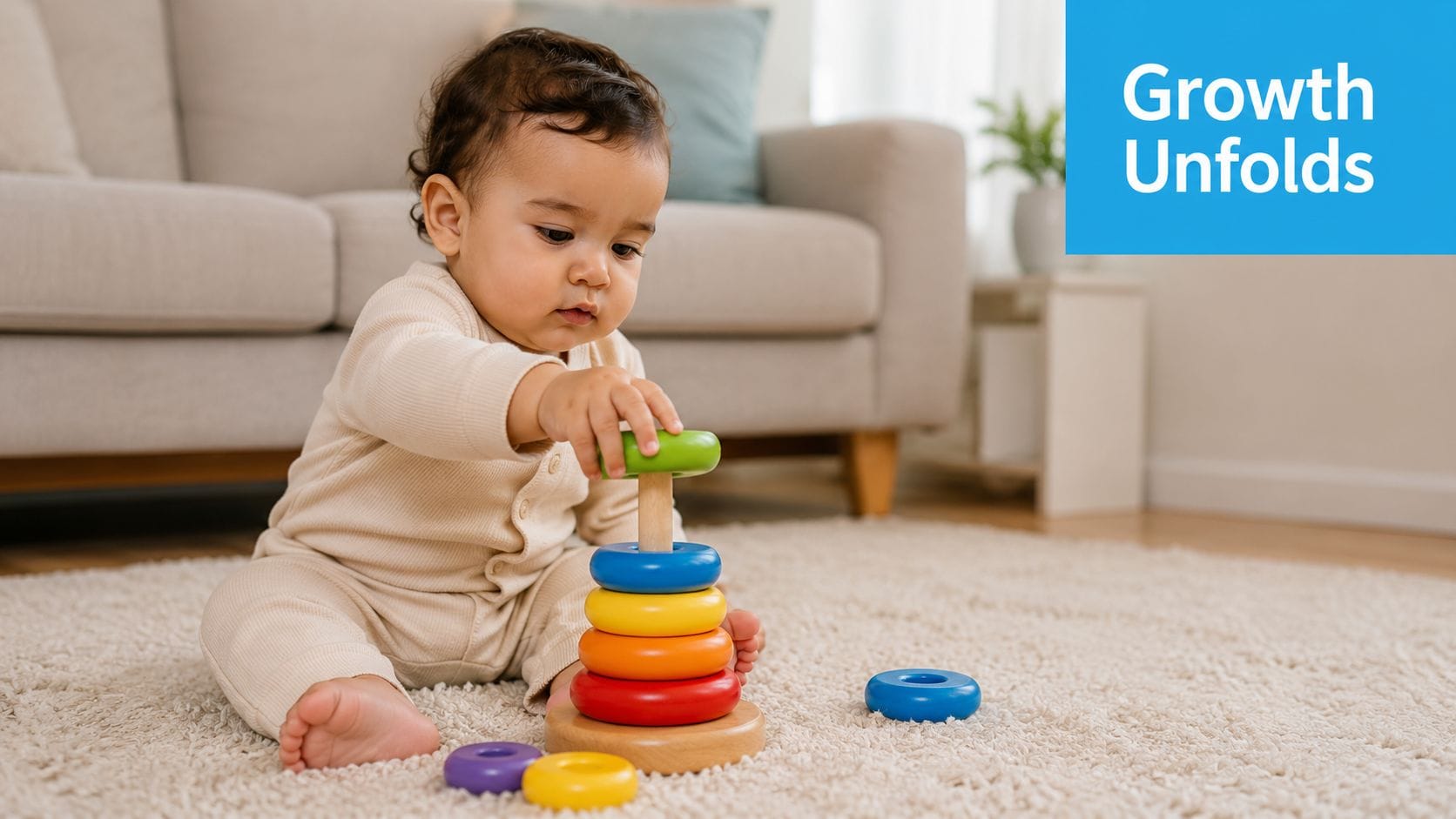
A parent sits on the floor while their baby taps a ring against a toy, drops it, searches for it, then looks up for reassurance. That small scene contains a lot. Movement. curiosity. memory. connection. Problem-solving. Communication without words.
That's why child development is broader than many parents expect. It includes physical growth, but it also includes how children think, relate to people, understand language, express needs, and adapt to their environment. In the earliest years, this happens very fast. The American Academy of Pediatrics notes that in the first few years of life, more than 1 million new neural connections are formed every second (AAP summary in this review).
For worried parents, that fact can feel intense. It can also be reassuring. It tells you early childhood is active, dynamic, and full of change. A child who seems hard to “read” today may show very different strengths over the next stretch of time.
Child development isn't about forcing a child into a perfect timeline. It's about understanding how that child is building skills, step by step.
If you like seeing age ranges in a practical format, this parent's guide to child development can help translate broad ideas into everyday examples. Just keep the checklist in perspective. A milestone list is a tool, not a verdict.
The Five Building Blocks of Your Child's Growth
Think of development like a house under construction. If you only inspect one wall, you'll miss the wiring, the plumbing, and the foundation. Children work the same way. A child's growth makes more sense when you look at the whole structure.
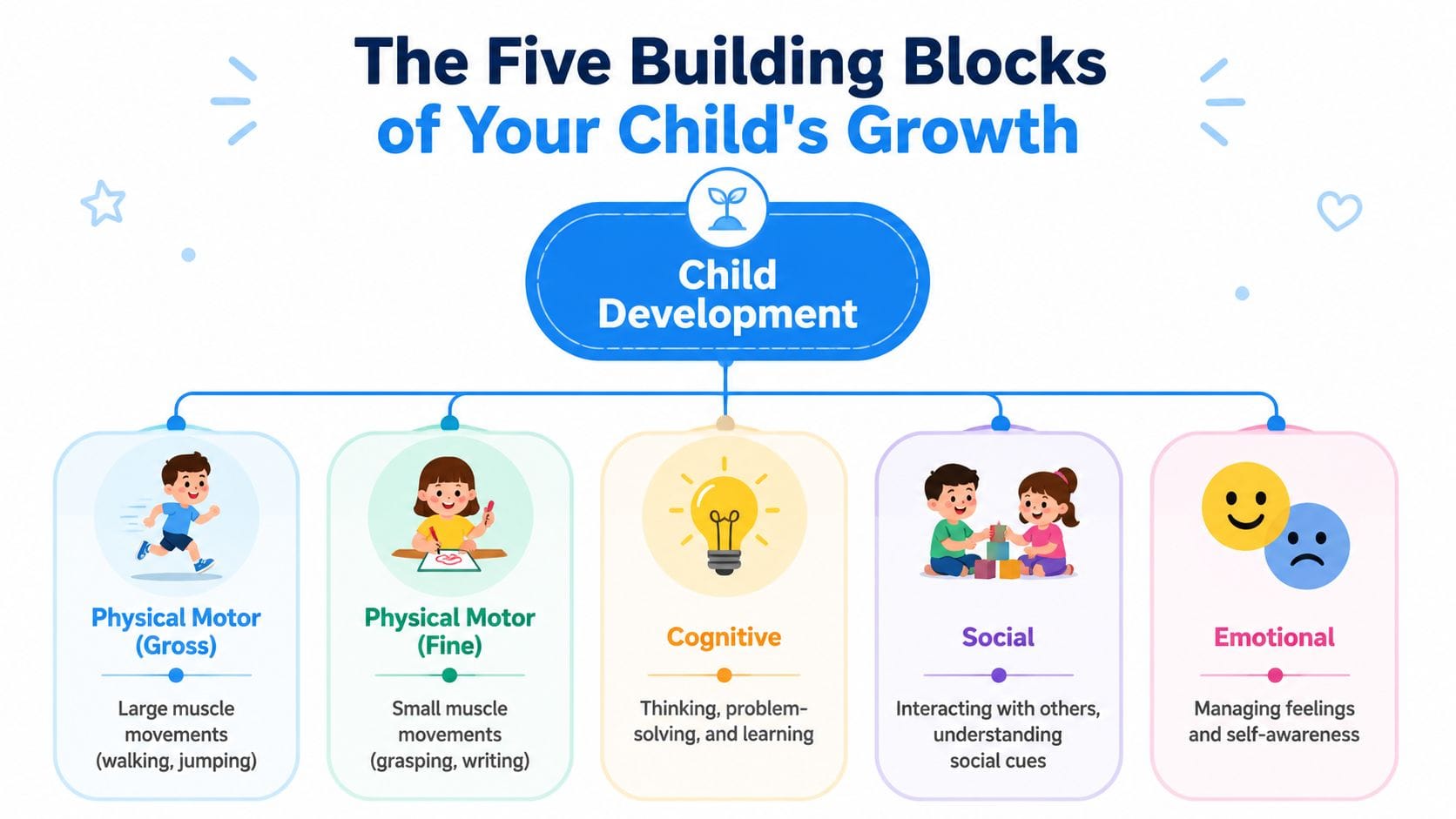
Development happens in several areas at once
Child development is best understood as a multidomain, functional process, not a simple age-by-age checklist. Major monitoring frameworks group children's progress into cross-domain outcomes because functional skills matter more in real life than isolated subskills (development overview from the NCBI Bookshelf).
That matters at home. A child doesn't use “language” in a vacuum. They use it to ask for juice, protest a sound, join a game, or tell you what scared them. The same is true of movement, thinking, and emotional regulation.
The Five Domains of Child Development
| Domain | What It Is | Examples |
|---|---|---|
| Gross motor | Large body movement | Rolling, walking, climbing, jumping |
| Fine motor | Small hand and finger movement | Picking up cereal, turning pages, using a crayon |
| Language | Understanding and expressing communication | Following directions, pointing, using words, combining gestures and sounds |
| Cognitive | Thinking, memory, learning, problem-solving | Looking for a hidden toy, matching shapes, pretending a block is a car |
| Social-emotional and adaptive | Relating to others, managing feelings, and meeting everyday needs | Taking turns, seeking comfort, tolerating transitions, feeding or dressing with support |
A child may be strong in one domain and still need help in another. For example, a child might have advanced problem-solving skills but struggle to communicate frustration. Another might be physically adventurous but need more support with transitions or social cues.
Why these domains overlap in real life
Real life doesn't split development into neat categories.
- Snack time can involve fine motor skill, language, sensory tolerance, and adaptive skill.
- Playground play can involve gross motor ability, risk judgment, turn-taking, and emotional regulation.
- Story time can support attention, memory, vocabulary, and connection.
That's why isolated milestones don't always tell the full story. What often matters more is function. Can your child join daily routines? Show what they know? Get needs met? Recover from stress with support?
Parents of children with unusual communication patterns often notice this clearly. A child may not speak in the expected way but still communicate very intentionally through movement, repetition, scripting, gesture, or device use. If that sounds familiar, this piece on autism speech patterns may help you put language differences in a more useful frame.
Practical rule: When you observe your child, ask “What is this helping them do?” not just “Does this match the chart?”
Mapping the Journey Milestones and Normal Timelines
Milestones matter. They give parents and professionals a shared language. The problem starts when milestones get treated like deadlines.
Milestones are signposts, not deadlines
A better way to think about milestones is as markers on a map. They show a common route, but not every child takes the same road or moves at the same speed.
Some early examples help make this concrete. Before age 1, most infants develop object permanence, which means understanding that something still exists even when it's out of sight. By age 3, many children can have simple conversations, understand words like “where” and “mine,” and use a fork independently. By age 5, children are typically able to follow rules, hold conversations well, begin writing, and recognize letters.
Those examples are useful because they show development is not just about size or strength. It's a sequence of brain-based and functional skills that show up in everyday life.
Typical development includes variation
Two children can both be developing typically and still look very different.
One toddler may speak early and climb cautiously. Another may say fewer words and scale every piece of furniture in the house. One preschooler may love group play and chatter all day. Another may watch, warm up slowly, and join in once they feel safe.
Variation is part of development, not proof that something is wrong. Children differ in temperament, sensory preferences, opportunities, stress levels, health, and how evenly their skills come together.
A checklist can't always capture that. A child may “miss” a box for one reason and still be moving forward meaningfully in another way.
A spiky profile can still be a valid path
Many neurodivergent children show what parents often describe as a spiky profile. Their skills don't rise in a smooth curve. They may read words early but struggle with conversation. They may build complex systems in play but find peer interaction exhausting. They may understand far more than they can express in the moment.
That profile can be confusing if you're only using a linear milestone chart. It makes more sense if you think in patterns.
A child can be ahead, behind, and deeply capable at the same time, depending on which skill you're looking at.
That's one reason comparison can mislead parents. A better question isn't “Does my child look exactly like other children this age?” It's “How is my child learning, where are they getting stuck, and what support helps?”
When Your Child's Path Looks Different
Some parents read milestone lists and feel relieved. Others feel a knot in their stomach because their child's pattern doesn't quite fit. Maybe your child avoids eye contact, repeats phrases, resists certain textures, struggles with changes in routine, or seems overwhelmed in busy places. Maybe they're progressing, but not in the order people expected.
Curiosity is more helpful here than panic.
Look for patterns, not isolated moments
A key challenge for parents is telling the difference between a temporary delay and a more persistent developmental difference. Current practice is moving toward earlier identification and more context-aware screening, which means collecting real-world observations over time, including sleep, routines, triggers, and communication patterns (ASPE review).
One rough day rarely tells you much. A repeated pattern often does.
What to notice in everyday life
Instead of asking only “Did my child do this milestone?”, try noticing how the skill appears across settings.
- Communication: Does your child use words, gestures, movement, scripts, pictures, or sounds to get needs met?
- Play: Do they explore objects in one repeated way, use toys creatively, or prefer sensory experiences over pretend play?
- Social interaction: Do they seek closeness, avoid it when overloaded, copy others, or connect more comfortably with adults than peers?
- Regulation: What happens during transitions, hunger, noise, waiting, or changes in expectation?
- Sensory response: Do certain sounds, fabrics, lights, or touch experiences lead to distress or shutdown?
If sensory discomfort is part of what you're seeing, this article on covering ears and autism offers a practical way to think through one common parent concern.
Delay, difference, and context
A child's behavior doesn't happen in a vacuum. Stress, adversity, health needs, and family pressure can all affect development. Context matters. The same outward behavior can mean different things in different children.
That's also why broad internet advice can get messy fast. For example, families often explore sleep, regulation, nutrition, and supplement questions at the same time. If you're trying to sort through one piece of that puzzle, FindMyScript's resource on supplements for kids may give you a starting point for questions to bring to a qualified clinician. It shouldn't replace individualized medical advice.
Watch for what repeats, what helps, and what makes things harder. Those details are often more informative than a single missed milestone.
Practical Ways to Nurture Growth Every Day
Parents often assume development support has to look like therapy flashcards, expensive toys, or highly structured activities. Usually, it doesn't. The strongest support is often built into ordinary life.
Small daily interactions do real work
Child development is strongly influenced by the caregiving environment. Responsive caregiving, nutrition, protection, and early learning opportunities are foundational, especially during the first 1,000 days, and supports aimed at families can have outsized effects for disadvantaged children (Brookings overview).
That means your everyday responses matter. Not perfect responses. Responsive ones.
When you pause and notice your child's cues, join what they're doing, and help them recover when they're stressed, you're supporting development across domains at once. A game of peek-a-boo can support thinking, anticipation, social connection, and early communication. A walk outside can build vocabulary, motor planning, regulation, and shared attention.
Five steady ways to support development at home
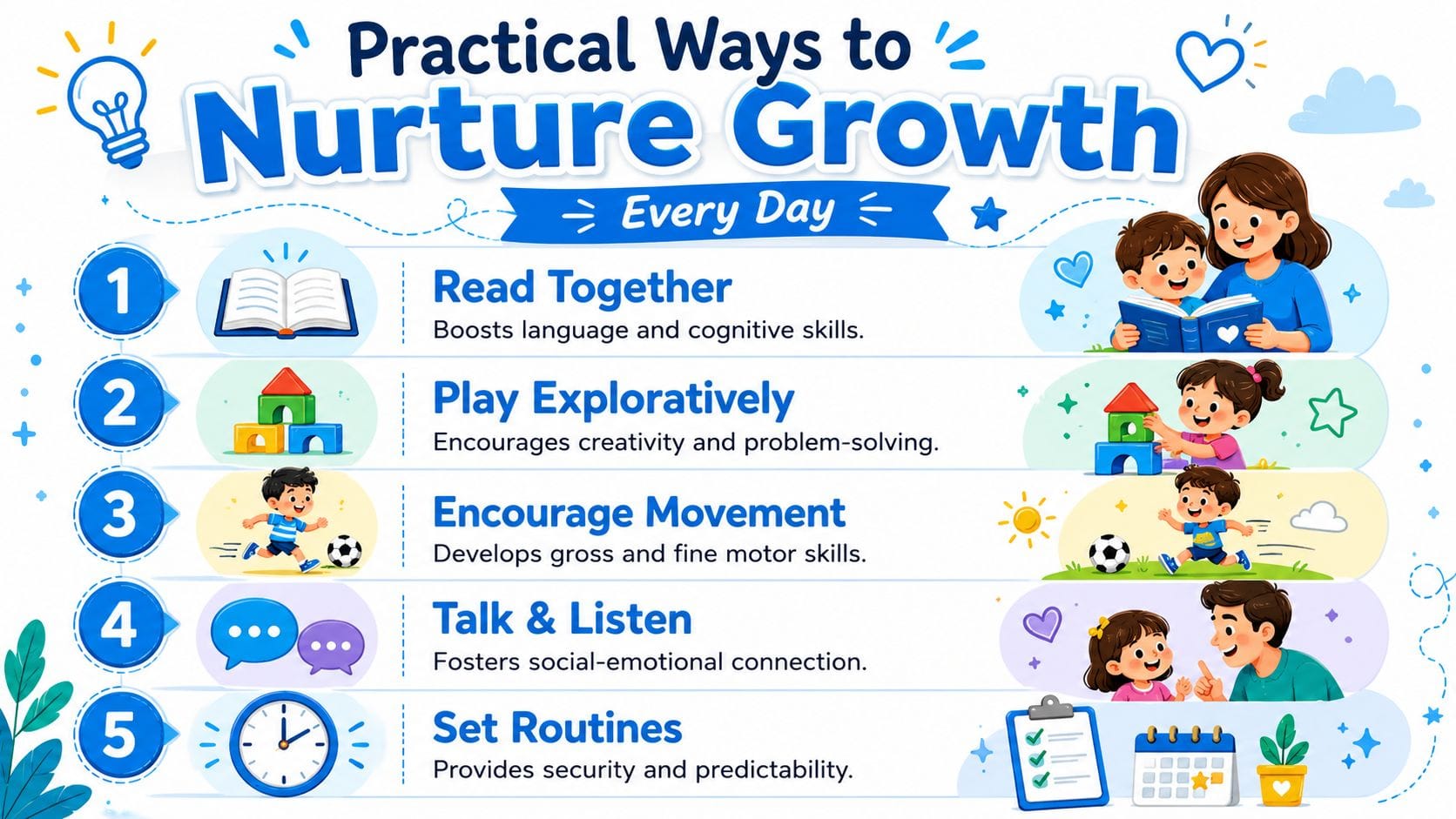
Talk during real routines. Narrate what you're doing while dressing, eating, bathing, or driving. Simple language tied to real action helps children connect words with meaning.
Follow your child's interests. If they care about trains, water, letters, or spinning objects, start there. Interest opens the door to attention, connection, and learning.
Protect predictable routines. Many children do better when they know what comes next. Routines reduce cognitive load and can make communication easier.
Make room for movement. Climbing cushions, carrying laundry, stirring batter, and kicking a ball all build useful skills. Movement isn't separate from learning.
Support the parent too. A stressed, exhausted caregiver has less bandwidth to notice cues and stay regulated. Help with meals, rest, and practical support counts as developmental support.
Some parents like short reminder lists for this. This article on 5 things parents can do may be a helpful companion read.
Your child doesn't need constant performance from you. They need enough safety, responsiveness, and repetition to keep building skills.
How to Track Patterns and Talk to Professionals
Worry gets vague very quickly. Tracking makes it concrete.
Why tracking changes the conversation
Many parents go into appointments saying, “Something feels off, but I can't explain it well.” That's common. Daily life is busy, and hard moments blur together.
A dated note is different. So is a pattern across several weeks. Instead of offering a general worry, you can say your child covers their ears during hand dryers, wakes often after late activities, eats only certain textures, scripts more when tired, or has fewer meltdowns when transitions are previewed.
That kind of observation helps pediatricians, therapists, teachers, and other providers ask better questions. If you're wondering which professionals may be involved in formal assessment, this overview of who can diagnose autism can clarify this area.
What information helps most
You don't need to document everything. Track the information that creates context.
- Sleep patterns: bedtime, night waking, early rising, rough mornings
- Communication: words used, scripts, gestures, device use, frustration points
- Behavior and regulation: what happened before, during, and after distress
- Sensory factors: noise, clothing, food textures, crowds, lights
- Routines and transitions: where things go smoothly and where they break down
- Appointments and support notes: what providers suggested, what changed, what happened next
A short video can make this feel less abstract:
A simple way to organize what you notice
Paper notes, phone notes, calendar entries, and text messages to yourself can work. The challenge is fragmentation. When information lives in five places, it's hard to see patterns.
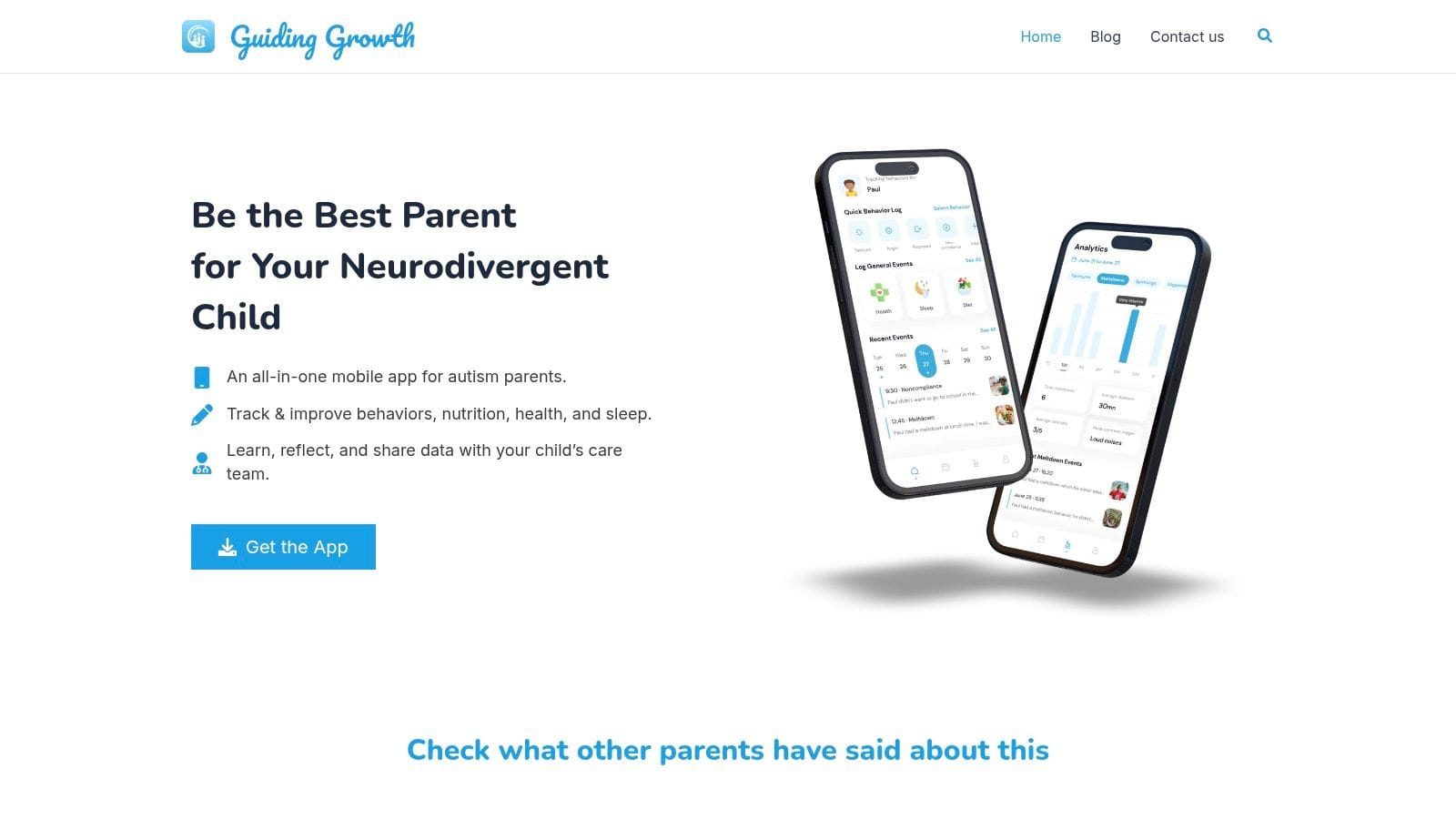
One tool built for this purpose is Guiding Growth. It lets parents log behavior, sleep, routines, food, appointments, and related observations in one place, including voice logging for moments when typing isn't realistic. The useful part isn't just storage. It's seeing repeated triggers, outcomes, and changes over time so conversations with professionals become more specific.
If you don't use an app, you can still borrow the method:
- Write down the date and setting
- Note what happened right before
- Describe what your child did
- Record how long it lasted or how it resolved
- Add what seemed to help
That's often enough to turn uncertainty into a clearer next step.
Embracing Your Role as Your Child's Guide
When parents ask what child development is, they're usually asking something deeper. They want to know whether their child is okay, whether they're missing something important, and what they should do next.
The answer is rarely found in one milestone chart. Child development is a multidomain process shaped by the child, the environment, and the fit between them. Some children move in a smooth pattern. Others develop unevenly, intensely, or differently. Both situations deserve understanding, not snap judgment.
Your job isn't to force your child onto someone else's timeline. It's to notice how your child learns, what throws them off, what helps them recover, and where they may need more support. That makes you more than an observer. It makes you an essential guide.
You don't need to know everything today. You do need to stay curious, keep notes when something repeats, and bring concrete observations into conversations with professionals. That's how you build clarity over time.
Most of all, remember this. Your child is not a checklist. Your child is a whole person with a developing pattern, and you're allowed to learn that pattern one day at a time.
If you want one place to organize behaviors, sleep, routines, food, appointments, and the small observations that often matter most, Guiding Growth can help you track patterns and walk into appointments with clearer, more useful information.