Some days it can feel like your whole relationship with your child has been reduced to prompts, reminders, transitions, and recovery. You wake up already planning how to avoid the next struggle. You track snacks, screens, shoes, noise, and timing. By bedtime, you may realize you spent the day managing reactions more than sharing moments.
That's a painful place for many parents. Not because you aren't trying hard enough, but because you want more than cooperation. You want connection. You want your child to look to you, enjoy being with you, and grow through your relationship, not only through tasks and routines.
Relationship Development Intervention therapy, often called RDI, appeals to many families for that reason. It starts from a different question. Instead of asking only, “How do we change this behavior?” it asks, “How do we strengthen the guiding relationship that helps a child learn from real life?” If you've been craving that shift, this approach may feel familiar in a good way.
If the idea of relationship-based growth speaks to you, this piece on secure attachment in autism and what parents should know can also help put words to what many families are already sensing.
Table of Contents
- Searching for Connection Beyond Behaviors
- What Is RDI and Its Core Principles
- The Parent's Role as a Guide Not a Therapist
- What RDI Looks Like in Daily Life
- How RDI Compares to Other Approaches
- Is RDI a Good Fit for Your Family
- Practical Next Steps and How to Get Started
Searching for Connection Beyond Behaviors
A parent might tell me, “I know my child loves me, but it feels like we're always troubleshooting.” Breakfast is a negotiation. Getting dressed turns into a chain of prompts. Play feels one-sided, or it collapses the moment anything changes. That parent isn't asking for perfection. They're grieving the feeling that family life has become mechanical.
That's where many people first hear about relationship development intervention therapy. Not in a research paper. In the quiet moment after another hard day, when they realize they don't want one more script to memorize. They want to understand how connection itself can become the path for growth.
RDI treats the parent-child relationship as the center of learning. The idea isn't that your child needs more correction from you. It's that your child may need more chances to experience you as a trusted guide through uncertainty, shared attention, and small problem-solving moments.
You don't have to turn your home into a clinic to support development. Many families are looking for a way to make ordinary life feel meaningful again.
That can sound abstract at first. Parents often ask, “So what do I do?” A fair question. RDI can seem vague until you see how it works in real routines. Once you do, it becomes less about performing therapy and more about slowing down enough for your child to notice, reference, and respond to you.
What Is RDI and Its Core Principles
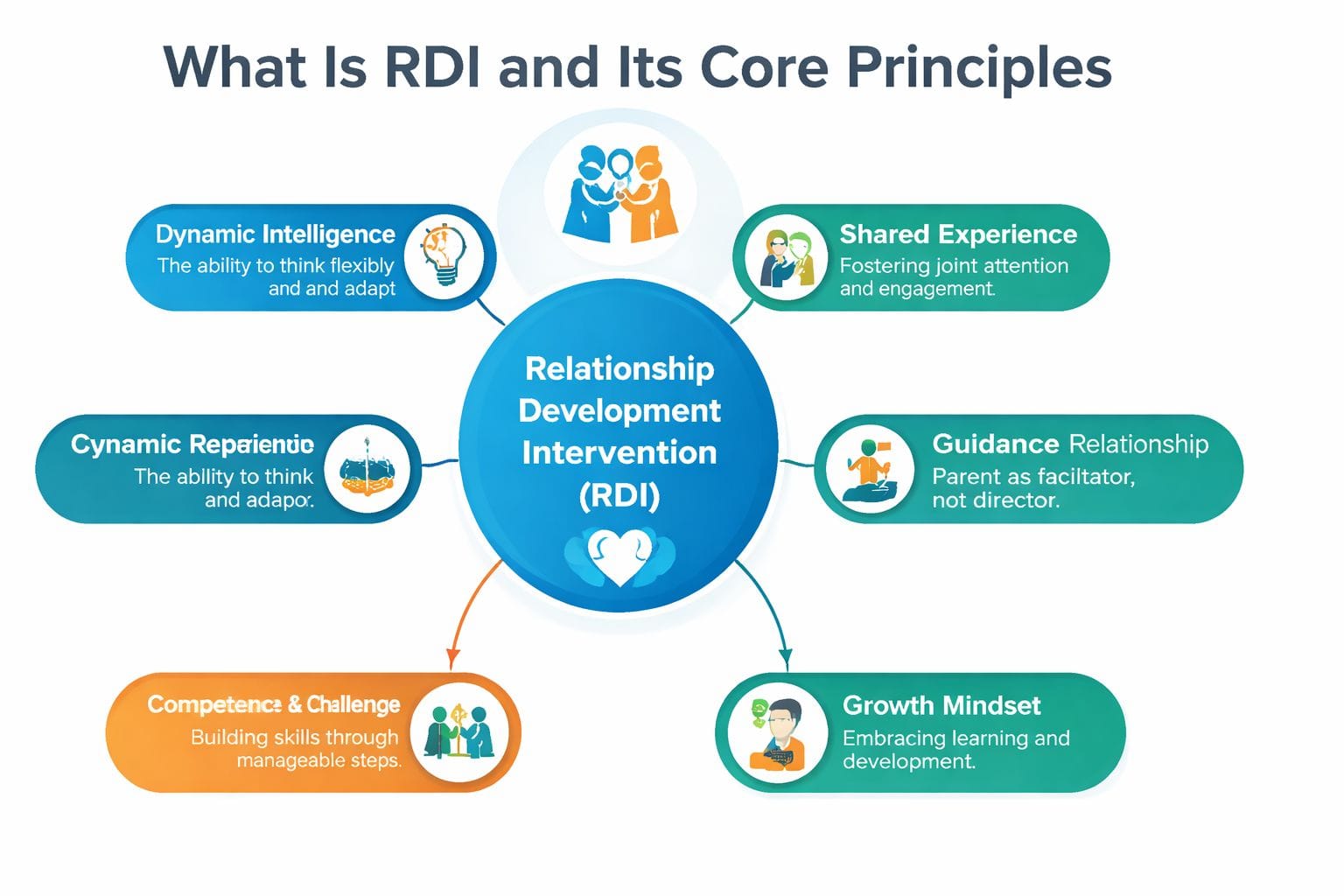
RDI is a parent-based, cognitive-developmental intervention that began emerging in the early 2000s. One of the earliest published evaluations followed 16 children who participated between 2000 and 2005, with a minimum 30-month follow-up. That report stated that no child met ADOS or ADI-R criteria for autism at follow-up and also described positive changes in flexibility and school placement, though the study was small and has important limits on how broadly it can be applied (early published evaluation of RDI). For parents, the practical meaning is simple. This approach has been used in real family life over extended periods, not only discussed in theory.
Parents who want a broader overview of evidence-based autism interventions often place RDI alongside other models so they can compare philosophy, fit, and day-to-day demands.
A different goal than teaching isolated skills
The heart of RDI is often described as building dynamic intelligence. In plain language, that means helping a child handle situations that aren't fixed or scripted. Life is full of these moments. A plan changes. Someone gives a subtle look. A game doesn't go as expected. Another person has a different idea.
RDI pays close attention to abilities such as:
- Emotional referencing. Your child learns to look to another person's face, tone, or pacing for clues.
- Shared experience. Two people stay mentally connected during an activity, not just physically near each other.
- Flexible thinking. A child learns that uncertainty can be managed, not only avoided.
- Social coordination. Actions begin to adjust in response to another person, back and forth.
These aren't usually built through endless correction. They grow through guided experiences.
The dance partner analogy
Imagine learning a dance. One method teaches individual steps in isolation. Left foot here. Turn now. Pause. Repeat. That can be useful for some goals.
RDI is more like learning to dance with a partner. You notice rhythm together. You adjust when the other person slows down. You read intention. You recover from mistakes without the whole thing falling apart. The skill isn't only memorizing movement. The skill is coordinating with another human in real time.
Practical rule: If an activity can be completed without your child noticing you at all, it may not be an RDI moment yet. The relationship has to matter inside the task.
That's why many RDI activities look simple from the outside. A pause while pouring juice. A shared grin before opening a container. Waiting together to see what happens next. Small moments, but rich ones.
The Parent's Role as a Guide Not a Therapist
The biggest emotional shift in RDI is this. You aren't expected to become your child's therapist. You're invited to become a more intentional guide.
That matters because many parents are already overloaded. If they hear “parent-led intervention,” they imagine one more credential they now have to earn. RDI doesn't ask you to run a clinic from your kitchen table. It asks you to use your existing relationship more deliberately.

Guidance is different from pressure
A therapist often delivers treatment protocols. A guide does something different. A guide notices when to slow down, when to wait, when to offer support, and when to let a child struggle just enough to grow.
That guiding role fits what many parents already believe deep down. Children develop inside relationships. If you want a thoughtful overview of how parent child relationships and mental health influence emotional development, that perspective can be helpful alongside any autism-specific support plan.
In RDI, the parent is usually coached to become better at seeing the small signals that are easy to miss. A glance. A hesitation. A bid for help that doesn't look like asking. A moment when the child almost coordinates, then pulls away.
What parents actually do
Parents in an RDI model often practice a few core habits:
- Observing before acting. Instead of filling every silence, they watch what the child does when there's a little room.
- Scaffolding lightly. They offer just enough help to keep the child engaged, but not so much that the child can ignore the relationship.
- Creating manageable challenges. They make tasks a little less predictable so the child has a reason to reference the parent.
- Reviewing interactions. They look back at what worked, where connection broke, and how to adjust next time.
Many families benefit from some form of autism training for parents because this kind of observation is a skill. It gets easier with practice.
The parent's job in RDI isn't to produce perfect responses. It's to become a reliable partner in moments of uncertainty.
That can be surprisingly healing for parents too. It replaces the feeling of “I'm failing to manage everything” with “I'm learning how my child grows.”
What RDI Looks Like in Daily Life
RDI usually makes the most sense when you stop thinking about formal sessions and start looking at ordinary routines. The point isn't to add more appointments. The point is to change how everyday interactions feel.
Snack time before and after
Before RDI, snack time might sound like this: “Go get your plate. Sit down. Do you want crackers or apple? Open this. Wipe your hands.” The child may comply, resist, or tune out. The routine gets done, but the interaction stays transactional.
With an RDI lens, the same moment can become shared problem-solving. A parent pauses at the counter, looks toward the fridge, and waits. Maybe the child glances back. Maybe not at first. The parent uses a small facial expression or gesture instead of a long verbal instruction. The child has a reason to check in. The task is still simple, but now the relationship carries information.
That doesn't mean every snack turns into a lesson. It means the child begins to experience, “I can use this person to help me make sense of what's happening.”
Laundry and walks become learning spaces
Laundry offers another useful example. Before, a parent may hand over a pile and say, “Put the socks here.” Efficient, clear, done.
After a shift toward RDI, the parent might hold one sock, look around the room with exaggerated curiosity, and pause. The child notices the mismatch or searches with the parent. They share the uncertainty. They solve it together. That tiny moment asks for coordination, not just compliance.
A walk can work the same way. Instead of narrating every step or asking constant questions, the parent changes pace near a puddle, glances at the child, and shares the moment of deciding. Do we go around? Through? Stop and watch the reflection? The learning is in the mutual regulation and flexibility.
Here are signs that an everyday routine is becoming more RDI-like:
- The child checks your face or body language before acting.
- You use pauses on purpose instead of rushing to fill every gap.
- The activity has a bit of uncertainty so your child needs shared attention.
- Success means staying connected, not just finishing the task.
Some days this feels natural. Other days it won't. That's normal. Real family life is messy, and RDI is designed for real family life.
How RDI Compares to Other Approaches
Parents often compare RDI with behavioral therapies because the two can look very different in practice. The difference usually starts with the main target. RDI centers the guiding relationship, shared experience, and flexible thinking. Traditional behavioral therapy often centers observable skills and behavior change through structured teaching methods.
By September 2009, a review reported over 200 certified RDI therapists, which shows how quickly the model spread. The same review also noted that there was only one formal study available at that time, a reminder that professional growth moved faster than the research base (review of RDI effectiveness and historical growth).
For parents exploring different forms of support, broader resources like reVIBE's guide to child therapy can help place relationship-based work within the larger mental health and developmental context.
RDI vs other approaches at a glance
| Aspect | Relationship Development Intervention (RDI) | Traditional Behavioral Therapy (e.g., ABA) |
|---|---|---|
| Primary focus | Shared experience, flexible thinking, guidance relationship | Skill acquisition and observable behavior |
| Role of parent | Parent is the main guide and practices daily | Parent may support carryover, but clinician often directs treatment |
| Where learning happens | In home routines and natural interaction | Often in structured sessions, though formats vary |
| Teaching style | Slower pacing, pauses, co-regulation, real-time adaptation | More explicit instruction, prompting, reinforcement, repetition |
| What progress may look like | More referencing, coordination, tolerance for change, shared problem-solving | More consistent responses to taught goals and target behaviors |
Why families experience the difference so strongly
Families usually feel the contrast most in the rhythm of the day. RDI tends to ask the parent to do less talking, less directing, and more noticing. Behavioral therapy often gives families clearer task targets and more concrete teaching procedures.
Neither format is automatically right for every child or every family. Some families prefer a highly structured framework. Others are looking for an approach that changes the emotional texture of everyday life. Many parents also combine ideas from more than one model, as long as the goals are clear and the adults involved are communicating well.
The key is honesty. RDI has a distinct philosophy and a smaller evidence base than more established interventions. Families deserve both parts of that sentence.
Is RDI a Good Fit for Your Family
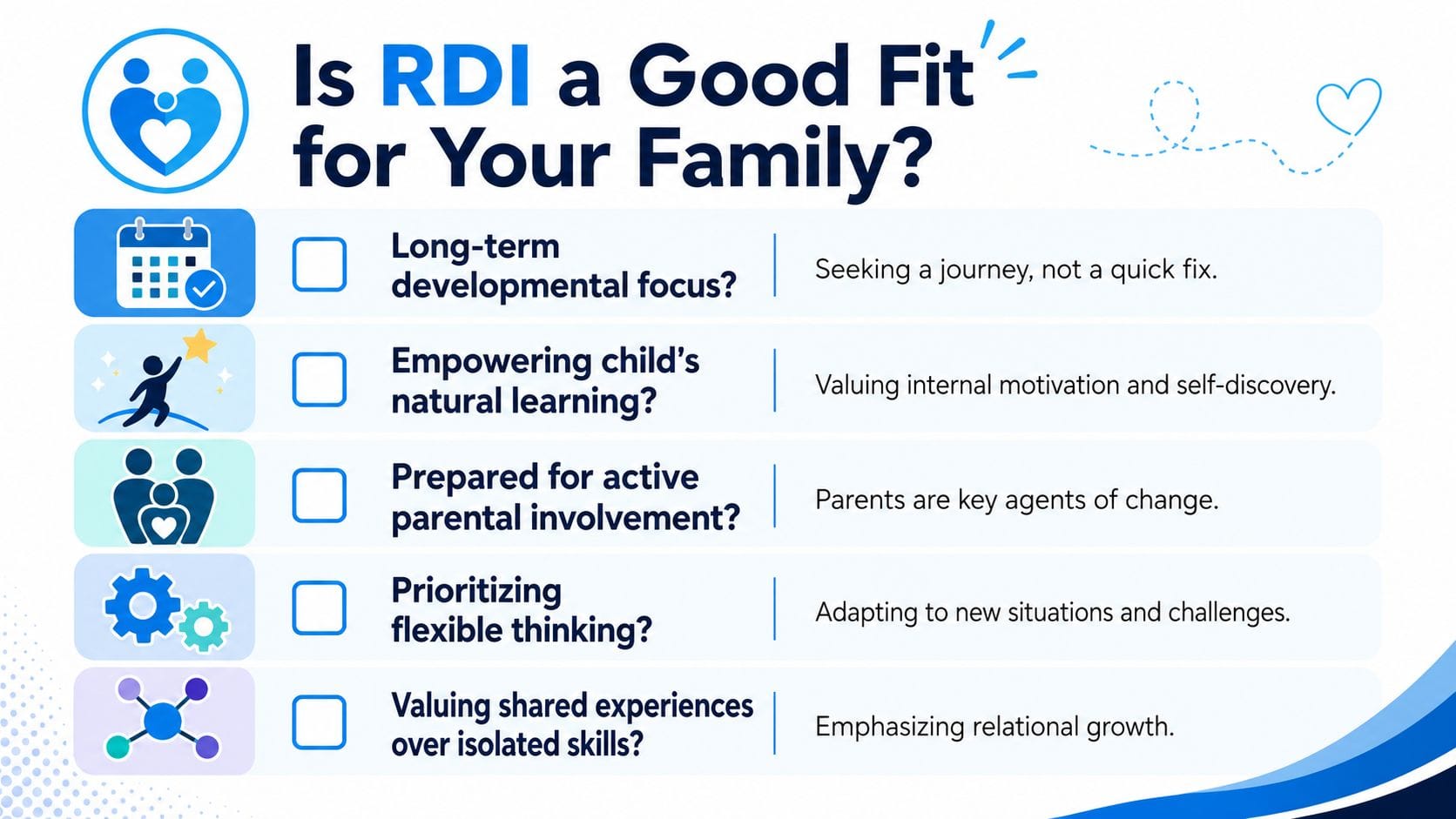
The families who tend to stay with RDI are often the ones who want a long-view developmental approach and are willing to make their own interaction style part of the work. That doesn't mean you need endless time or perfect consistency. It means you need enough bandwidth to observe, reflect, and practice.
Expert reviews describe the evidence base for RDI as limited, with early studies often lacking a control group. Those reported gains are considered promising but not definitive, and implementation is strongest when it includes structured parent coaching, video review, and measurable targets such as social engagement and flexibility (overview of RDI evidence and implementation).
Questions worth asking at home
You don't need to answer every question with a perfect yes. But these are useful starting points:
- Are we hoping for deeper connection, not only better compliance?
- Can we picture ourselves being active participants, not just scheduling providers?
- Does our child struggle most in unscripted moments, transitions, and shared problem-solving?
- Are we open to slowing down daily routines so interaction matters more?
- Can we track specific goals instead of relying on gut feeling alone?
A family that says yes to most of those questions may find RDI aligns well with their values.
What commitment really means
RDI asks for a particular kind of effort. Not nonstop effort. Observational effort. Reflective effort. The willingness to review a moment and ask, “Did my child use me as a guide there?”
That's a different commitment from drilling a target skill. It can be highly rewarding, but it also asks parents to tolerate slow, uneven progress. If your family is in a crisis season, you may need more immediate supports first. If you have enough steadiness to work on interaction quality over time, RDI may make more sense.
A good fit isn't about choosing the most appealing philosophy. It's about choosing the approach your family can actually live with and learn from.
Practical Next Steps and How to Get Started
If relationship development intervention therapy feels worth exploring, start small. You don't need to redesign your household this week. You need a way to observe your child clearly and a plan for what to bring to a professional conversation.
Start with observation not pressure
Pick one daily routine. Snack, getting shoes on, bath time, folding towels, or a short walk. For a week, notice just a few things:
- When does your child naturally reference you?
- What kinds of pauses increase connection?
- What makes the interaction collapse into stress or avoidance?
- Where do you tend to over-prompt because silence feels uncomfortable?
If you're also looking for local support, services such as professional counselling for autism can be part of a broader care picture, especially when family stress, anxiety, or regulation challenges are affecting daily life.
Write your observations down somewhere consistent. Many parents struggle to maintain such consistency. Notes end up scattered across phones, paper, and memory. A structured tool can make a real difference. Guiding Growth is one option parents can use to log routines, behaviors, triggers, sleep, meals, and therapy-related observations in one place, then review patterns over time or share them with professionals.
Build a simple system you can sustain
A future consultant will likely care less about polished language and more about usable detail. Try keeping records that include:
- The routine you were doing.
- What your child noticed or missed in the interaction.
- What you changed such as pacing, gesture, or amount of language.
- What happened next in terms of engagement, flexibility, or distress.
Video review can also be useful when families are comfortable with it, because small interaction patterns are hard to remember accurately. This short overview may help you picture how that kind of guidance can look in practice.
From there, you can look for an RDI consultant, prepare specific questions, and bring real examples from your home life instead of vague concerns. That makes your first steps far more grounded.
If you want one place to track daily routines, interaction patterns, behaviors, and observations that matter for parent-led developmental work, Guiding Growth can help you keep those details organized and easier to share with the people supporting your child.