You tell your child, “If you finish your homework, you can have screen time.” Some days that works. Other days your child argues, stalls, or seems not to connect your words to what happens later. A therapist might say, “We need to build rule following,” but that can sound more complicated than it needs to be.
Most families are already working on rule governed behavior ABA every day. You use it when you say, “Wait in the parking lot until I hold your hand,” “Put your plate in the sink after dinner,” or “Ask before taking a toy.” The challenge isn't whether rules matter. It's how to teach them clearly, how to know if they're working, and how to avoid turning helpful structure into rigidity.
Table of Contents
- Understanding Rule-Governed Behavior in Your Daily Life
- Rules vs Experience Contrasting Two Learning Styles
- The Anatomy of an Effective Rule
- How to Teach and Measure Rule-Following
- Avoiding Common Pitfalls Like Rule Rigidity
- Turning Rules into Real-World Skills
Understanding Rule-Governed Behavior in Your Daily Life
A parent tells their child, “Wait your turn for the toy.” If the child waits because they understand the toy will come later, that's more than simple compliance. That's rule-governed behavior. In ABA, it means behavior is controlled by a verbal rule that describes a contingency, so a person can respond to a future or distant outcome without having to learn only by direct experience, as explained in this overview of using rule-governed behavior in treatment plans.
For many parents, the confusing part is this: a child may understand some rules and miss others. That doesn't mean they're being defiant. It may mean the rule is too vague, too long, too delayed, or not yet meaningful enough to guide behavior in the moment.
What this looks like at home
Morning routines are a good example. “Get ready for school” is broad. “First get dressed, then brush teeth, then put shoes on” is much easier to follow. Many children do better when the rule is broken into visible, concrete steps, especially when those steps are paired with supports like a morning routine visual schedule.
A child also has to trust that the rule connects to something real. If “Finish your homework, then screen time” changes from day to day, the rule loses power. If the adult follows through consistently, the child starts learning that words predict outcomes.
Practical rule: If a child doesn't follow a rule, first check whether the rule was understandable and consistent before assuming the child refused it.
Why it matters so much
Rule-following supports safety, social learning, and independence. Children use it when they stop at the curb, wait in line, follow classroom expectations, or move through a bedtime routine. These are daily life skills, not just therapy skills.
One of the most hopeful findings in this area is that rule-following can be taught. Research has confirmed that autistic children who previously lacked this skill can learn it systematically through intervention, which gives families and therapists a clear message: this is a teachable repertoire, not something a child either magically has or doesn't have.
Rules vs Experience Contrasting Two Learning Styles
Some skills grow from rules. Others grow from experience. Children need both.
A simple way to think about it is baking. One person follows a recipe exactly. Another learns by trial and error, changing ingredients, checking texture, and adjusting the oven after a few disappointing cakes. Both people can learn to bake. They're just learning through different paths.
The fast path and the hands-on path
Rule-governed behavior is the recipe path. A child hears, “Keep your seatbelt on to stay safe,” and follows that instruction without having to contact the dangerous outcome directly. Contingency-shaped behavior is the trial-and-error path. A child learns over time from what happens after each action.
According to this discussion of rule-governed and contingency-shaped behavior, rule-governed behavior allows rapid learning without direct contact with consequences, while contingency-shaped behavior builds more slowly through trial and error. That speed is a major advantage in ABA, especially for safety and daily living expectations. The tradeoff is that rules can also produce rigidity if they aren't balanced with direct experience.
A side-by-side comparison
| Characteristic | Rule-Governed Behavior | Contingency-Shaped Behavior |
|---|---|---|
| How learning starts | Through a spoken or written rule | Through direct experience |
| Speed of learning | Often faster once the rule is understood | Usually slower |
| Safety value | Useful for dangerous situations | Can be risky if the child must learn by mistakes |
| Flexibility | Can become rigid if overused | Often builds adaptability |
| Language demands | Relies more on understanding instructions | Relies more on contact with outcomes |
| Example | “Wait until I say go” | Learning how hard to stack blocks before they fall |
Why parents often need both
If you only teach by rules, a child may memorize exact phrases but struggle when the setting changes. If you only teach by experience, some skills take too long and some risks are too serious. You don't want a child to learn traffic safety only through mistakes.
That's why the strongest teaching usually mixes the two. Start with a clear rule. Then let the child practice it in real situations. For example, “Walk beside me in the parking lot” can begin as a verbal rule and become stronger through repeated, supported trips to the car.
Rules are often the bridge. Experience is what helps the bridge hold in real life.
When confusion shows up
Parents often wonder why a child can recite a rule but not use it. This usually happens because saying a rule and being guided by a rule are not always the same thing. A child may repeat, “Hands to self,” but still need practice during play, with support in the moment, before that rule affects behavior reliably.
That's not failure. It's information. It tells you the child may need shorter wording, more immediate reinforcement, or more direct practice in the setting where the rule matters.
The Anatomy of an Effective Rule
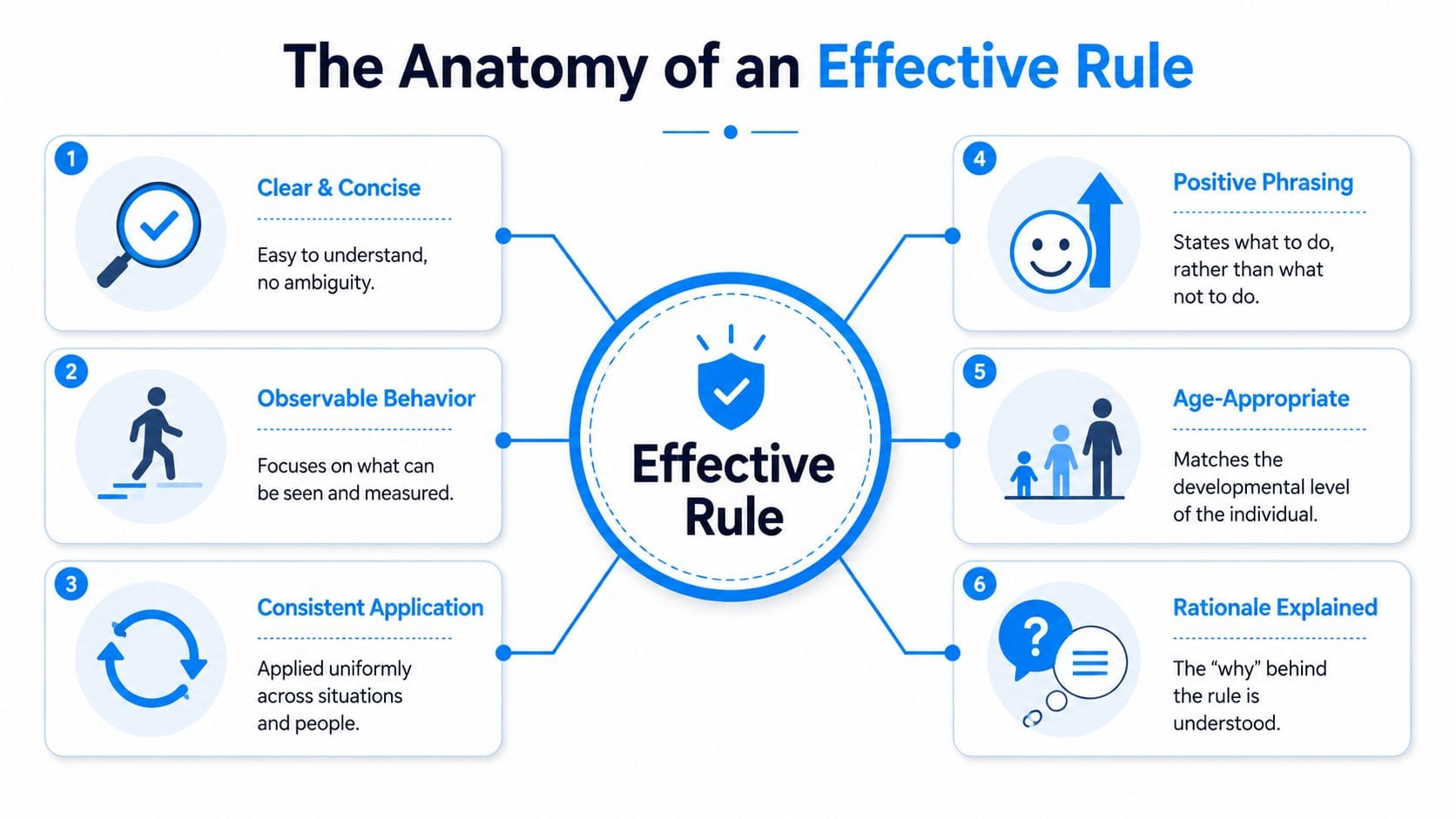
A rule can be technically correct and still fail. “Be good” is a rule adults understand, but it doesn't tell a child what to do. Effective rules are concrete, short, and tied to something meaningful.
What makes a rule usable
A strong rule usually has these features:
- Clear wording. “Put your shoes by the door” works better than “Get organized.”
- Observable action. You can see whether the child did it.
- Short length. Long explanations often get lost.
- Positive phrasing. “Use a quiet voice” is easier to act on than “Don't yell.”
- Consistent follow-through. The same rule should mean the same thing across people and settings when possible.
- A reason the child can access. The child doesn't need a lecture, but they do need the rule to connect to something that matters.
Why the child is following the rule
ABA gives us useful language here. Research summarized in this FIT repository paper on rule-governed behavior notes that rules describing a behavior-consequence link are learned significantly faster than rules that only state an antecedent-behavior link. The same work also describes pliance, tracking, and augmentals.
For parents and new therapists, the most practical distinction is usually between pliance and tracking.
- Pliance means the child follows the rule mainly because of the social consequence. They want approval, want to avoid disapproval, or want to comply with the adult.
- Tracking means the child follows the rule because it matches how the world works. “Put your cup on the table so it doesn't spill” is easier to sustain because the rule maps onto a natural outcome.
Augmentals are different. They change how important or valuable a consequence feels. A child may work harder to pack a lunchbox if the rule is tied to being ready for a favorite outing.
How to rewrite weak rules
Weak rules often sound like this:
- “Be nice.”
- “Act better.”
- “Calm down.”
- “Listen.”
Stronger versions sound like this:
- “Use gentle hands with your sister.”
- “Put the crayons in the bin.”
- “Take three slow breaths, then sit on the couch.”
- “Look at my hand and wait.”
The best rule tells the child exactly what action to do next.
If you support families, it can help to think about rules the same way healthy groups think about expectations. Clear standards reduce conflict. This guide to successful community growth offers a useful parallel on why explicit, understandable rules work better than vague ones.
A practical phrasing tip
“If-then” language can be especially helpful because it lays out the contingency in plain form. “If your plate is on the table, then snack is finished.” “If your shoes are on, then we go outside.” A child doesn't have to guess what links to what.
That clarity is one reason rule governed behavior ABA can be so effective when used carefully. The child isn't just hearing words. They're learning the structure behind daily expectations.
How to Teach and Measure Rule-Following
Some children pick up rules quickly. Others need a more deliberate teaching process. That doesn't mean the skill is out of reach.
A landmark study published in PMC3139547 showed that all six participants learned to follow novel if/then rules after intervention. That finding mattered because it demonstrated that rule-governed behavior is teachable in autistic children who previously did not show it. The takeaway for practice is simple. Don't treat rule-following as an all-or-nothing trait. Teach it like any other skill.
Start with one rule and one routine
Pick one situation that happens every day. Shoes at the door. Washing hands before dinner. Waiting before opening the fridge. Don't start with five rules across five settings.
A good early teaching sequence looks like this:
- Say the rule clearly. “If shoes are on, then we go outside.”
- Show it visually. Use a picture, gesture, object cue, or written first-then board.
- Prompt success. Help right away so the child contacts success, not repeated failure.
- Reinforce immediately. The consequence should come soon enough for the rule to make sense.
- Repeat in the same context. Stability helps the rule gain control.
- Fade help gradually. The goal is independent responding, not permanent prompting.
Use supports that make the rule visible
Many children don't respond well to words alone. They benefit when rules are turned into something they can see and act on.
Useful teaching tools include:
- Visual schedules for routines like morning prep or bedtime
- First-then boards to make delayed outcomes concrete
- Social stories for recurring social expectations
- Modeling so the child can see the action
- Role-play for situations like turn-taking or greeting others
A lot of families also need a practical way to record what they tried. A tool like a behavior tracking app can help parents log the rule, context, prompt level, and outcome so they can spot patterns over time.
What to measure so you're not guessing
Parents often remember the hardest moments and forget the quieter progress. Data helps balance that. You don't need complicated charts to begin.
Track things like:
- Which rule was given
- Where it happened
- Whether the child followed it independently, with a prompt, or not yet
- What reinforcement followed
- Whether the rule worked better with visual support
This short video gives a helpful visual example related to building practical support systems:
What good progress actually looks like
Progress isn't only “my child follows every rule now.” More often it looks like this:
- The child follows one familiar if/then rule more consistently.
- The child needs fewer prompts in the same routine.
- A visual cue works where words alone didn't.
- The child begins using the same rule with a different adult.
Those changes matter. They show that the child is beginning to connect language, context, and outcomes in a more durable way.
Avoiding Common Pitfalls Like Rule Rigidity
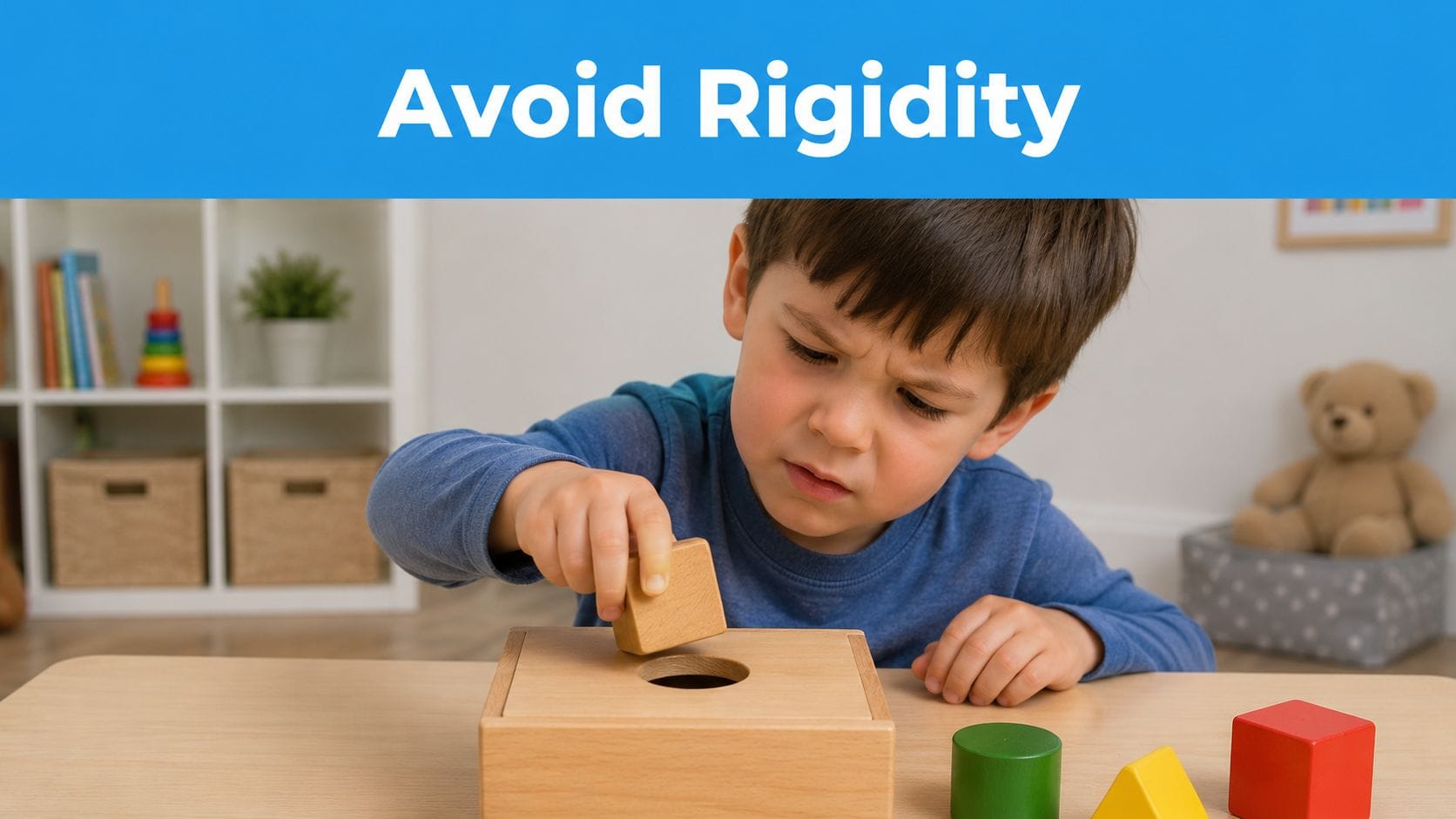
Many adults assume more rule-following is always better. It isn't. A child can become so dependent on exact wording or exact routines that even small changes lead to distress or shutdown.
That's where rule rigidity becomes important. A child may follow “Put your backpack on the hook” perfectly at home, then freeze when the hook is missing at school. The issue isn't disobedience. The child may have learned the rule too narrowly.
What rigidity can look like
A child may:
- Insist on exact wording and reject a familiar direction if it sounds different
- Follow a rule in one place only and miss it in a new setting
- Become upset when conditions change even if the goal stays the same
- Ignore natural feedback because the original rule feels more important than the current situation
This concern is real. As described in this discussion of contingency-shaped versus rule-governed behavior, one challenge in ABA is balancing rule-governed learning with contingency-shaped experiences to prevent maladaptive stiffness. The same source notes that few clinical protocols give parents clear metrics for judging when this risk is increasing.
How to build flexibility on purpose
You don't need to remove structure. You need to widen it.
Try these adjustments:
- Change small details while keeping the goal the same. If the rule is “Put dirty clothes in the hamper,” practice with different hampers or rooms.
- Use more than one phrasing. Alternate “Come sit at the table” with “Find your chair” when both lead to the same action.
- Teach a repair option. Add rules like “If the usual plan changes, ask what's next.”
- Let the child contact safe natural outcomes. During play, allow mild mistakes and problem-solving instead of correcting everything immediately.
A flexible learner doesn't abandon rules. They learn when to adapt them.
Other common mistakes
Sometimes the problem isn't rigidity. It's poor rule design.
Watch for these traps:
- Vague directions like “Behave” or “Be careful”
- Too many instructions at once
- Rules that clash with motivation such as asking for a low-value task with no meaningful payoff
- Delayed consequences that are too far removed from the behavior
- Inconsistent adult responses that weaken trust in the rule
If a child seems stuck, simplify first. Then test whether the rule works better with a visual, a shorter phrase, or a more immediate consequence.
Turning Rules into Real-World Skills
The point of rule governed behavior ABA isn't to create robotic compliance. It's to help a child connect words, actions, and outcomes in ways that support safety, participation, and independence.
That matters most when daily life gets messy. Rules are useful, but many children need more than spoken directions. A common clinical challenge is teaching rules to children who don't respond well to verbal instruction alone. As noted in this research overview on rule-governed behavior, the practical answer often includes visual supports and motivation-based framing that can be tracked and refined over time.
What families can hold onto
A strong approach usually includes all three:
- Clear rules that describe what to do
- Real practice so the child learns in everyday contexts
- Flexible supports so the child can adjust when life doesn't match the script
If you keep those three pieces in mind, rules stop feeling like lectures and start becoming teaching tools.
Many of the daily living goals families care about most, such as hygiene, routines, waiting, transitions, and household participation, grow from this combination of structure and flexibility. If you want a broader look at how these pieces fit together, this article on how ABA therapy builds daily living skills offers a helpful next step.
You don't need perfect wording. You need steady teaching, honest observation, and enough flexibility to adjust when a rule isn't landing. That's the work skilled parents and therapists do every day.
Guiding Growth can support that work in a practical way. The Guiding Growth app helps families organize behavior notes, routines, triggers, outcomes, and care information in one place, so patterns are easier to see and share with therapists, caregivers, and medical professionals. Instead of relying on memory or scattered notes, parents can track what happened, reflect on what changed, and make more confident decisions as their child turns simple rules into real-world skills.