You've just finished a dinner that nobody really ate. One child is melting down over a change in routine, another is asking for a screen, your phone is buzzing with a school message you didn't see earlier, and the medication you meant to give is still sitting on the counter. Your co-parent is physically there but mentally gone, so the whole evening lands on you again. That's the part most advice skips, the part where self-care for caregivers has to happen while care is still happening.
The problem isn't that you're doing nothing for yourself. The problem is that the usual version of self-care assumes you can leave, reset, and come back as a different person. For parents and family members supporting autistic or neurodivergent children, that's often not the reality. Caregiving already carries a measurable health burden, and the CDC found that 22.3% of U.S. adults reported providing care or assistance in the past 30 days, while 36.7% of caregivers reported insufficient sleep, 40.7% had two or more chronic diseases, 14.5% reported 14 or more mentally unhealthy days, and 17.6% reported 14 or more physically unhealthy days CDC caregiver brief. When the caregiver's sleep, mood, and body start taking the hit, the child's care plan is taking the hit too.
Table of Contents
- What Caregiver Self-Care Really Looks Like on Hard Days
- Spotting Burnout Before It Becomes a Crisis
- A Daily and Weekly Self-Care Routine That Survives Real Life
- Micro-Care Moves for Days You Cannot Step Away
- How Tracking and Shared Notes Lower Your Daily Load
- Boundaries, Scripts, and Asking for Help Without Guilt
- Building a Crisis-Prevention Plan You Trust
What Caregiver Self-Care Really Looks Like on Hard Days
The evening starts with one small shift and turns into a cascade. One child is overwhelmed by noise, another wants dinner now, and the routine you counted on is gone before you even sit down. You realize you skipped lunch, forgot to drink water, and never answered the school message because there was no clean moment to think. That is what caregiver self-care looks like on a hard day, deciding which basic need gets handled first.
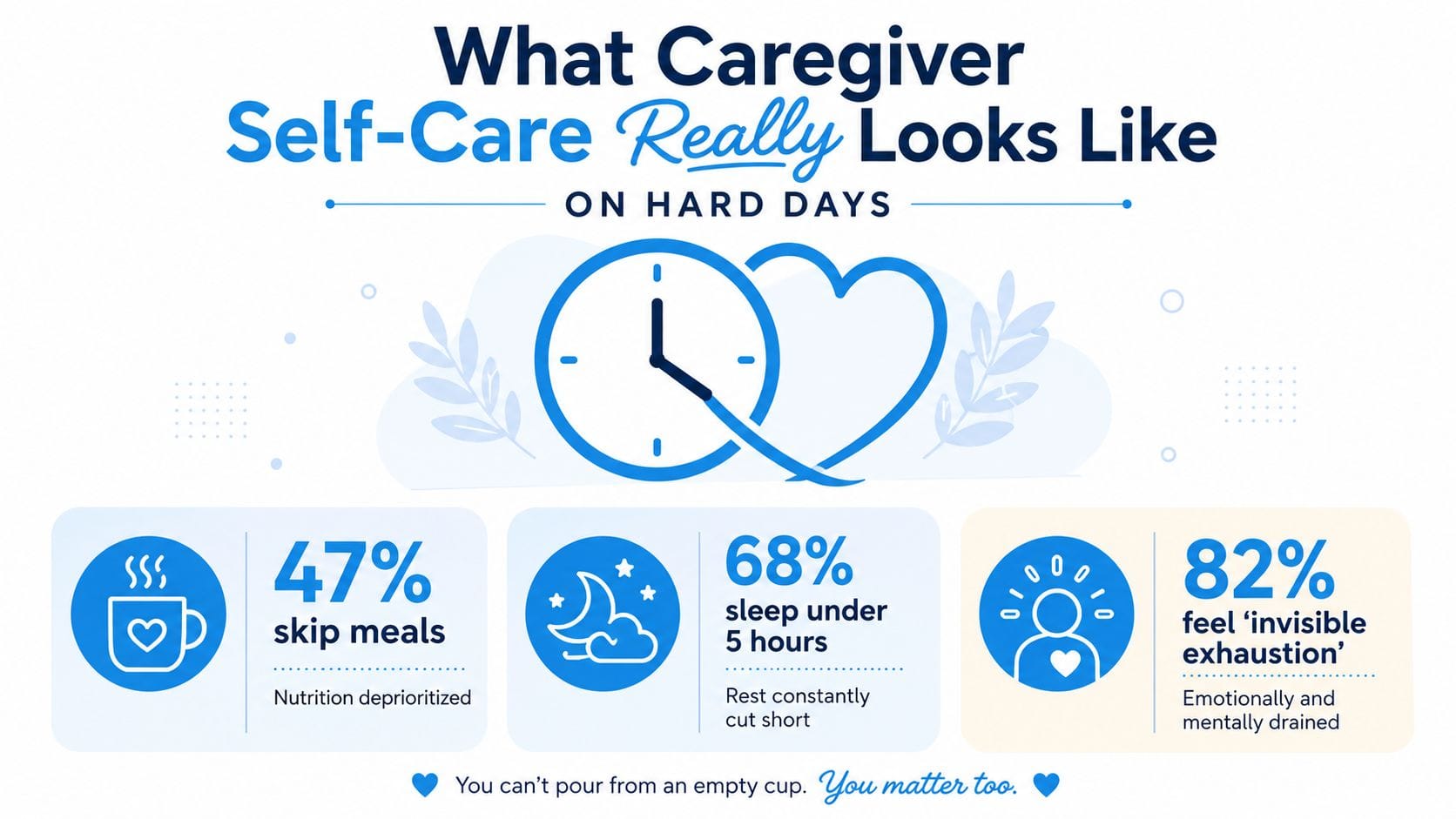
A lot of families treat self-care like a reward for getting through the day. That model fails because the day never really ends. Caregiver burnout is not just about feeling tired, it shows up when the load keeps outrunning recovery, and understanding the causes of caregiver burnout helps explain why the strain builds. For families supporting autistic or neurodivergent children, the load is operational too, with constant coordination, monitoring, and advocacy layered on top of ordinary family life.
Where the cracks show up first
The cracks usually show up in ordinary places first. Dinner gets skipped because a sensory issue hijacks the kitchen. A medication is late because two adults assumed the other one handled it. One parent stays in command mode so long that they stop noticing their own anger until they snap at the wrong moment.
Practical rule: if your care day runs on emergency mode, your self-care has to be built into the emergency mode, not added after it.
That is why advice like “take a bubble bath” feels insulting on the worst nights. A more usable resource is something that helps you set boundaries to protect energy when your attention is already fragmented, because the boundary is part of the care system, not a luxury layered on top. When the day is this full, self-care means reducing the number of times your nervous system has to restart from zero.
Spotting Burnout Before It Becomes a Crisis
Burnout rarely arrives with a dramatic announcement. It starts with tiredness that sleep does not fix, small tasks that feel oddly heavy, and irritability that spreads into ordinary family moments. On caregiver days, the pressure is often operational as much as emotional, because you are tracking transitions, meals, sensory needs, messages, and backup plans at the same time.
That is why early warning signs matter. If the load keeps outrunning recovery, your body usually signals it before you are ready to name it, and the Family Caregiving Kit burnout guide lays out how that pattern can build in real life. Burnout can look like fog, flatness, or a short fuse long before it looks like a collapse.
A short weekly check
Run these four checks once a week, ideally at the same time.
- Feeling foggy. If simple tasks take more effort than they should, your brain may be overloaded. The smallest useful move is to drop one nonessential task that day and write down the one thing you cannot afford to forget.
- Chronic fatigue. If rest is not restoring you, stop treating it like a rough patch. Protect the next sleep window and trim one evening obligation, even if it is small.
- Emotional numbness. If you feel detached instead of responsive, that is a sign to shorten the day where possible and ask another adult to take one care task.
- Increased irritability. If every sound feels like too much, use a timeout before the next transition, not after the blowup.
A useful rule is simple. If the same signal shows up two weeks in a row, act instead of waiting. The action can be tiny, but it needs to change the load in a real way.
For a closer look at what drives the pattern, the Guiding Growth article on caregiver burnout causes and solutions is a useful companion read. The point is not to label yourself. It is to catch the pattern early enough to change what tomorrow asks of you.
Burnout gets dangerous when you keep calling it “just tired.”
A Daily and Weekly Self-Care Routine That Survives Real Life
The routine that lasts through caregiving is the one built onto what already happens. A morning habit should not depend on a child being cooperative, a few micro-breaks should land at predictable points, and an evening wind-down should protect sleep instead of assuming the house will quiet down on its own. The National Institute on Aging recommends 7 to 9 hours of sleep each night, a steady sleep and wake time, and a relaxing bedtime routine NIA caregiver sleep tips. That is a target, not a report card, but it gives the day a workable structure.
A school-day version
Start with one anchor habit in the morning. Keep it small enough that your brain does not argue with it, such as coffee before checking messages, or two minutes of breathing before the first request hits. Then place two or three micro-breaks at fixed points, like after school drop-off, before dinner, and once the children are asleep.
Use the same pattern in the evening. Pick a repeatable wind-down, dim the lights, lay out tomorrow's basics, and do one calming practice before bed. The body responds to cues more than intentions, and repeated cues make sleep easier to reach.
A weekend version
Weekends fill up fast with errands and catch-up work, so keep the same backbone and cut the extras. One social connection, one small reset, and one practical planning block is enough. If the week has been rough, the reset block may be the only time you look at appointments, medications, and school messages together.
Use existing moments: pair self-care with the care task that is already happening, because the habit is more likely to stick when it is tied to something unavoidable.
A one-hour weekly reset can keep the system from slipping. Spend a few minutes checking sleep, medications, appointments, school notes, and anything that felt harder than usual. In an autism parenting day, the load often comes from small frictions stacking up, so the goal is to reduce that pile before it spills into the next week. You are not building a perfect wellness routine. You are lowering the odds that Monday starts with a scramble.
Micro-Care Moves for Days You Cannot Step Away
Some days, leaving the room isn't possible. A child is unsafe, regulation is fragile, or you're the only adult who can keep the day moving. That's where micro-recovery matters, because it fits inside the care instead of waiting outside it. Harvard Health recommends a structured breathing practice, seated comfortably, with 5-count inhales, 5-count holds, and 5-count exhales for 10 minutes, and says the exhale can be extended to twice the inhalation length for deeper relaxation Harvard Health self-care for the caregiver.
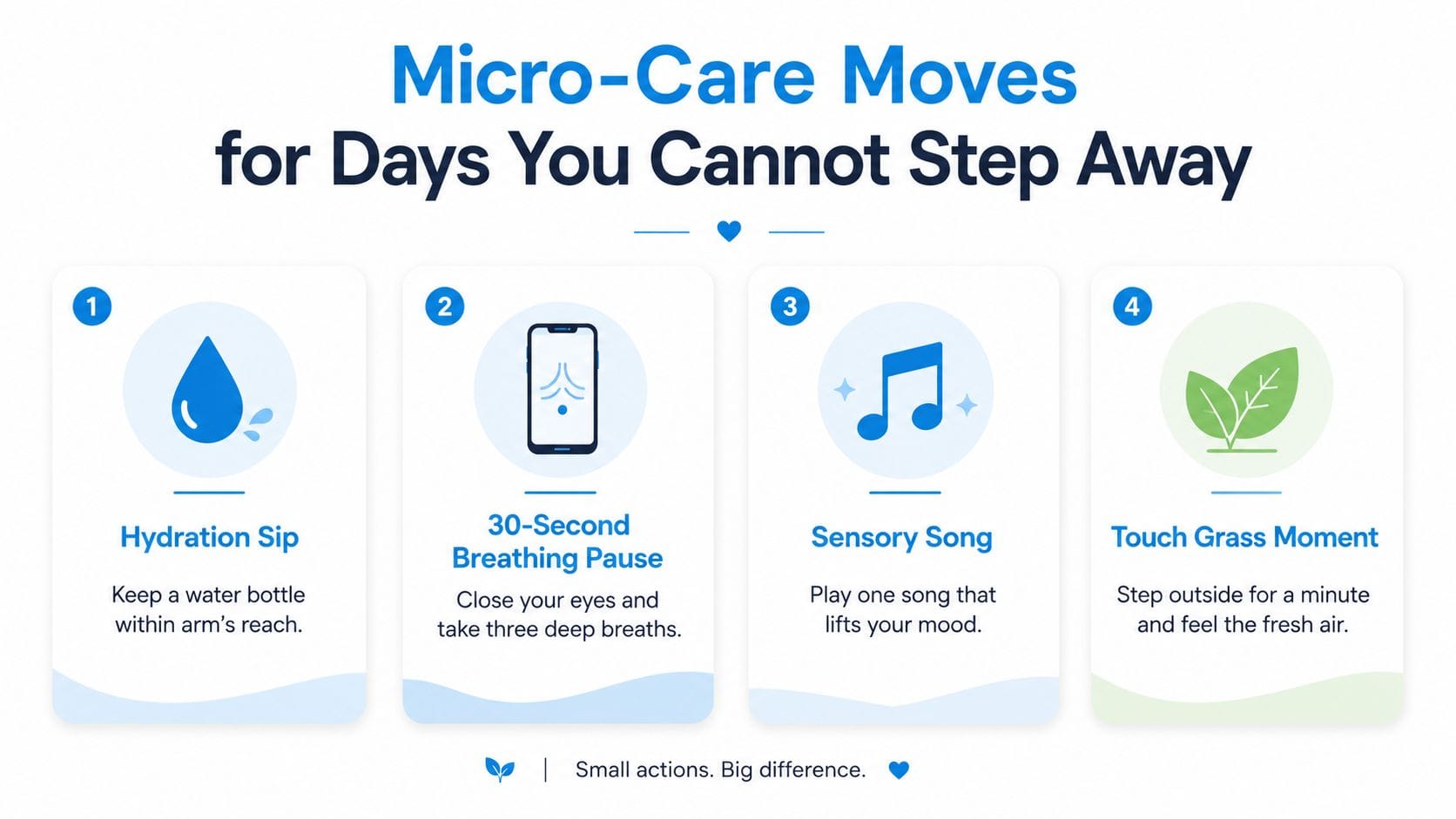
Five moves that fit real life
- Breathing at a stoplight. If your child is stimming in the car or you're parked outside school, do three slow cycles of nose-in, longer-out breathing. It lowers the sense that you're still sprinting.
- Hand on belly after a meltdown. Put one hand on your stomach for two minutes and breathe lower and slower than you have been. This is especially useful when your body feels braced long after the crisis ends.
- Water on a medication pass. Use the same moment you handle meds to take a sip yourself. Hydration works better when it is attached to a routine you never miss.
- Protein before the next errand. Keep something simple within reach so you're not running on fumes by afternoon. Missing meals tends to show up as irritability and fatigue first.
- Sensory swap. If noise is the problem, change the input, not the whole schedule. One earbud, a softer shirt, or stepping into a hallway for thirty seconds can reduce the pressure enough to keep going.
The recent NIH review on caregiver well-being interventions points out a real gap, too many solutions stay generic and don't account for the structural barriers that keep caregivers trapped in constant supervision NIH review on caregiver self-care interventions. That's why micro-care matters. It doesn't pretend you have an hour you don't have.
How Tracking and Shared Notes Lower Your Daily Load
A caregiver day can turn into an endless recall test. One person remembers the behavior trigger from Tuesday, the medication shift from last week, the school note from this morning, and the sleep change nobody else noticed. That second shift drains people because it never really ends.
Treat visibility as relief
When behavior patterns, sleep, diet, medications, and appointments sit in different places, every choice takes more mental energy. Shared notes lower that cost because they stop one adult from being the only memory in the house. A short daily log can be enough to record what happened, what helped, and what seemed to make things harder.
A family can use that in a plain, low-friction way. Snap a photo of the school communication notebook, add one sentence after bedtime, and keep a shared sleep note that everyone can check without asking for a recap. If you want a place built for this kind of coordination, therapy session notes in Guiding Growth fits the idea of turning scattered observations into one usable record.
| What to track | Why it helps |
|---|---|
| Behavior patterns | Reduces guesswork around triggers and outcomes |
| Sleep | Makes fatigue easier to spot before it spills everywhere |
| Diet and meals | Helps the family notice sensitivities and missed nutrition |
| Medications and appointments | Cuts the chance that one adult carries all the reminders |
That kind of tracking is not busywork. It turns memory into a shared tool, and that counts as self-care because it lowers the number of decisions you have to hold alone.
Use the information, don't drown in it
Tracking should reduce friction, not become another job. Keep the log short enough that you will use it on a hard day. If the system starts asking for too much typing, too many fields, or too much cleanup, it is no longer helping the caregiver.
A shared app or central note can help here. It keeps behavior logging, sleep habits, diet details, and care coordination in one place, so the caregiver is not the only person carrying the whole story. The goal is simpler than perfect data, shared clarity.
Boundaries, Scripts, and Asking for Help Without Guilt
A hard autism parenting day can fall apart in small ways, one extra request, one unclear handoff, one more round of explaining. Most caregivers do not need a lecture about asking for help. They need words that work when they are tired, overstimulated, and trying to keep the household moving. The best boundary lowers explanation time and makes the next step obvious to the other person.
Scripts you can use
- With a partner: “I need you to own bedtime tonight. Please handle pajamas, teeth, and lights out without checking back with me.”
- With a grandparent or friend: “I don't need advice right now. I need one task taken off my plate, and the easiest one is laundry or pickup.”
- With a professional: “I'm at capacity. I need this written down so I can follow it without having to remember every detail.”
The pattern matters more than the exact wording. Name the task, name the time, and leave out vague offers that make you manage the helper. “Tell me what you need” can sound kind, but it often sends the work back to the caregiver who is already carrying too much.
A delegation map
Start with the easiest handoffs first. Transportation, grocery runs, message pickup, and one recurring household task are often easier to delegate than core behavioral care. Then give one person one job, not a list of maybe-jobs that still leave you coordinating everything.
Shared support works better when it is visible. If you need a place to build that kind of coordination, building support networks in Guiding Growth offers a practical model for making help easier to see and use. Specific help gets used more often because everyone knows what they are responsible for.
Boundary rule: a good ask is small enough that someone else can finish it without coming back to you for a second briefing.
Caregivers often wait until they are depleted before they ask clearly. That makes the conversation heavier than it needs to be. Name the task earlier, and you carry less guilt, less confusion, and less cleanup afterward.
Building a Crisis-Prevention Plan You Trust
A solid care plan does not start during a crisis. It starts with three lists, your own warning signs, your child's warning signs, and the point where the family stops trying to solve it alone. That turns self-care for caregivers into a prevention system instead of a last-minute rescue.
Your escalation map
Write down the signs that mean you are heading toward shutdown, for example, no sleep that restores you, snapping at everyone, or forgetting basic steps. Then write down the child's signs, such as rising sensory distress, behavior changes, or patterns that usually mean the day is unraveling. Match each sign to one action, one person to contact, and one support you will use first.
Keep the professional names on hand before you need them. That usually means your primary care clinician, your child's pediatrician, a therapist or counselor familiar with caregiver fatigue, a trusted respite option, and a crisis line. Use each one for the problem it fits, not as a vague backup for everything.
A plan like this works best when it reflects the friction of the day. If mornings fall apart after a bad night, your first move might be a slower start, fewer decisions, or a prewritten message to school. If afternoons usually bring sensory overload, the plan should name the break that comes first, the snack that settles things, and the adult who can step in without a long handoff.
Make the plan shared
The plan works best when it lives in one place that other adults can see. If only one person can find the information, the plan is still fragile. A shared note, calendar, or care hub keeps the family from rebuilding the same context every time things get hard.
That setup also lowers the amount of explaining you have to do while you are already depleted. One person can check the note, see what changed, and act without asking you to replay the whole day. That matters when you are trying to hold the household together and do not have the energy to brief everyone from scratch.
Build in the parts people usually skip, because those are the parts that fail under stress. Add the names of backup caregivers, the first calming step that tends to help, the places where your child usually gets stuck, and the sentence you use when you need help fast. A plan is stronger when it is plain enough for another adult to use on a rough day.
The point is not perfect coverage. It is having a short, shared system that reduces decisions when your bandwidth is already thin.
A tool can help if it cuts down on work and keeps the details in one place. A system that centralizes behavior notes, sleep, diet, medication reminders, and shared collaboration makes the rest of the plan easier to hold under pressure. The value is fewer loose ends when the day starts to slip.