Your child melts down in the grocery store, and you're left replaying the moment in your head. Was it the bright lighting, the crowded aisle, a skipped snack, an unexpected change, or a request that felt too difficult? Without a clear record, every explanation is possible, and none is easy to test.
Behavior assessment tools give families and professionals a practical way to move from guesswork to observation. They help you record what happened before a behavior, describe what the child did, and note what followed. Over time, those details can reveal patterns that are difficult to see during a stressful moment.
Behavior is often communication, especially when a child has limited speech, uses communication differently, or becomes overwhelmed by demands and sensory input. A useful assessment doesn't reduce a child to a score. It helps adults understand needs, adjust the environment, and choose support that fits daily life.
Table of Contents
- Why Behavior Assessment Tools Matter for Autism Families
- Understanding the Core Types of Behavior Assessment Tools
- Comparing Behavior Assessment Tools by Use Case
- How to Collect and Analyze Behavior Data Effectively
- Choosing the Right Tool for Your Family or Practice
- Integrating Behavior Tracking with Guiding Growth
- Privacy Considerations and Collaborative Best Practices
Why Behavior Assessment Tools Matter for Autism Families
A parent may remember that meltdowns happen “all the time,” while a teacher notices they happen mostly before transitions. A therapist may see that the child calms when given a visual schedule, while a grandparent notices that hunger makes difficult moments more likely. Each observation can be accurate, but disconnected observations rarely create a usable plan.
A behavior assessment tool brings those observations into the same frame. It gives adults a consistent way to record setting events, triggers, behavior, responses, and outcomes. The purpose isn't to collect paperwork for its own sake. The purpose is to ask a better question: What is this behavior communicating, and what support might change the situation?
Practical rule: Describe what you can observe, not what you assume the child intends.
“Refused to cooperate” is hard to measure because people may interpret refusal differently. “Pushed the worksheet away, said ‘no,’ and left the table” gives a parent, teacher, and therapist something concrete to discuss. That distinction matters when several adults support the same child across home, school, therapy, and community settings.
The history of autism care shows why repeated measurement matters. The Autism Treatment Evaluation Checklist, or ATEC, was developed in the mid-1990s to monitor treatment effects and track change over time. More than 1 million ATEC forms have been completed across the past two decades, reflecting a shift from occasional observation toward repeated, longitudinal measurement used by parents, schools, clinics, and insurers (York research on the ATEC).
That history also offers a useful lesson for families. Structured tracking isn't a niche clinical exercise. It can help organize changes in communication, sociability, sensory awareness, health, and behavior, while keeping attention on progress rather than a single difficult incident.
Adults who recognize similar patterns in their own lives may also benefit from learning about autism assessment for adults, particularly when childhood needs were overlooked. For daily family tracking, a mobile system such as Guiding Growth's behavior tracking app can make structured observation easier to maintain between appointments.
Understanding the Core Types of Behavior Assessment Tools
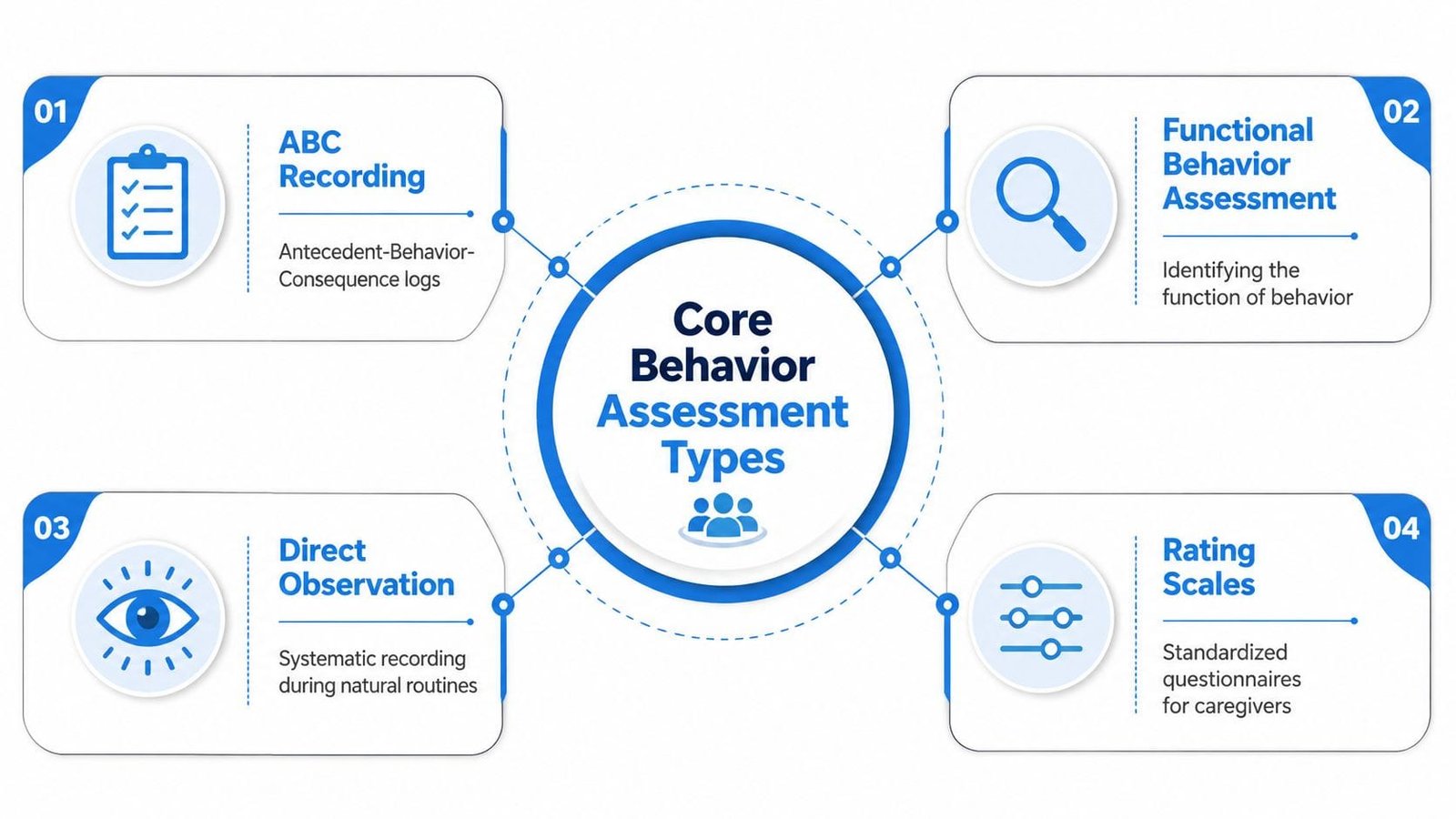
A child cries and drops to the floor when homework begins, bolts from the classroom during math, or struggles at the classroom door each morning. Each situation calls for a different kind of information. A brief home record may reveal a repeated pattern, while a formal assessment can help a school team plan support. The goal is to match the tool to the question, then turn structured observations into practical changes at home and school.
ABC recording
ABC stands for Antecedent, Behavior, and Consequence. ABC recording maps three moments: what happened before, what the child did, and what followed.
- Antecedent: What happened immediately before the behavior?
- Behavior: What did the child say or do in observable terms?
- Consequence: What happened immediately afterward, including adult responses and the eventual outcome?
An ABC entry might show that a child throws materials after a difficult writing demand and then receives a break. The record does not prove that escape caused the behavior. It gives the team a pattern to test by changing the demand, teaching a break request, or observing whether the same sequence appears elsewhere. ABC chart guidance describes this three-part format.
A mobile log such as Guiding Growth's behavior tracking app can help families record these moments consistently and notice patterns between appointments. The value comes from connecting the entry to a daily decision, such as adjusting a transition, offering a communication choice, or reviewing what happened after a request.
Functional behavior assessment
A functional behavior assessment, or FBA, is a broader process for examining why behavior occurs and what keeps it going. It may combine interviews, record reviews, direct observation, ABC data, and a hypothesis about the behavior's function. A functional behavior assessment example can help families see how separate observations become a testable explanation.
Schools may use an FBA when challenging behavior interferes with learning, creates safety concerns, or affects development. Guidance on FBA includes establishing baseline data, analyzing ABC information, forming and testing a hypothesis, and selecting interventions (special education FBA brief).
If a child regularly bolts during math, the team examines what happens before the bolting, what the child gains or avoids afterward, and whether a safer replacement response could meet the same need. Families may also consider anxiety and OCD therapy options when anxiety symptoms affect participation or routines. Such services do not replace autism-focused assessment.
Behavior rating scales
Rating scales ask parents, teachers, or clinicians to rate behavior across defined items. Examples include the Aberrant Behavior Checklist, the Behavior Assessment System for Children, the Child Behavior Checklist, and the Nisonger Child Behavior Rating Scales.
The Behavior Problems Inventory separates self-injury, stereotypy, and aggressive or destructive behavior into distinct domains rather than combining them into one global score (ASRS technical supplement). These scales support comparison across informants, but a score alone cannot explain what triggers a behavior or what consequence maintains it.
Direct observation and structured interviews
Direct observation means watching behavior during natural routines and recording agreed measures such as frequency, duration, latency, or intensity. A therapist might observe morning arrival to examine why a student struggles at the classroom door.
Structured interviews and checklists add the caregiver's history. They can reveal sleep disruption, medication changes, or difficulties that occur only at home, details a short observation may miss. Together, these methods connect clinical findings with the routines families must handle every day.
Comparing Behavior Assessment Tools by Use Case
The right tool depends on the question you're trying to answer. A parent who needs to understand evening meltdowns shouldn't begin with the same process a school team uses to develop an FBA for an IEP meeting.
| Tool Type | Best For | Who Uses It | Time Required | Data Output |
|---|---|---|---|---|
| ABC recording | Identifying immediate triggers and outcomes | Parents, teachers, therapists | Brief entry after an event | Antecedent, observable behavior, consequence |
| Functional behavior assessment | Testing a hypothesis about why behavior occurs | Clinicians and school teams, with family input | Multiple observations and meetings | Baseline data, functional hypothesis, intervention direction |
| Behavior rating scales | Comparing behavior across domains or informants | Parents, teachers, clinicians | Scheduled questionnaire completion | Standardized ratings and scale scores |
| Direct observation | Measuring behavior in a natural routine | Therapists, teachers, trained observers | Planned observation periods | Frequency, duration, latency, intensity, context |
| Structured interviews and checklists | Gathering history and caregiver perspective | Clinicians, educators, families | Interview or form-based | Background, patterns, concerns, priorities |
Use a quick log for immediate questions
If a child has a meltdown during toothbrushing, an ABC entry may be the most useful first step. Record whether the toothpaste, task demand, sensory sensation, time pressure, or change in routine came first. Then note whether the child escaped the task, received help, or moved to another activity.
This kind of log is practical because it captures the event close to when it happens. It also keeps the family from relying on memory alone.
Choose formal assessment for complex decisions
A formal FBA or direct observation makes more sense when behavior affects access to learning, safety, or participation across settings. The process usually requires agreement on definitions, coordinated observation, and interpretation by someone with relevant training.
Rating scales serve a different purpose. Expert guidance for autism-related assessment emphasizes reliability, validity, sensitivity, specificity, and positive-predictive value, while the Vineland Adaptive Behavior Scales and Adaptive Behavior Assessment System are commonly used adaptive-behavior measures in clinical and research settings (expert guidance on autism assessment).
No row in the table is automatically superior. A short family log may reveal a useful home pattern that a formal appointment never sees, while a standardized scale may provide context for clinical discussion that an informal note can't supply.
How to Collect and Analyze Behavior Data Effectively
Good data collection starts with a definition everyone can use. “Aggressive” may mean hitting to one caregiver and yelling to another. A stronger definition might be, “The child makes contact with another person using an open hand,” or, “The child yells above conversational volume for longer than a brief instruction.”
Start with a focused workflow
Use this sequence:
- Define the target behavior. Choose one behavior and describe its observable form. Include when it starts and stops if duration matters.
- Choose your tool. Use ABC notes for context, frequency counts for repeated events, duration recording for prolonged episodes, or a rating scale when a standardized comparison is needed.
- Set a realistic observation window. Decide whether you'll track mornings, transitions, meals, bedtime, or another routine. A consistent window produces more useful comparisons than scattered notes.
- Record the surrounding events. Capture sleep, hunger, demands, sensory conditions, people present, communication attempts, and what happened afterward when those details are relevant.
- Review before changing the plan. Look for patterns, discuss them with the care team, and adjust one part of the environment or support at a time.
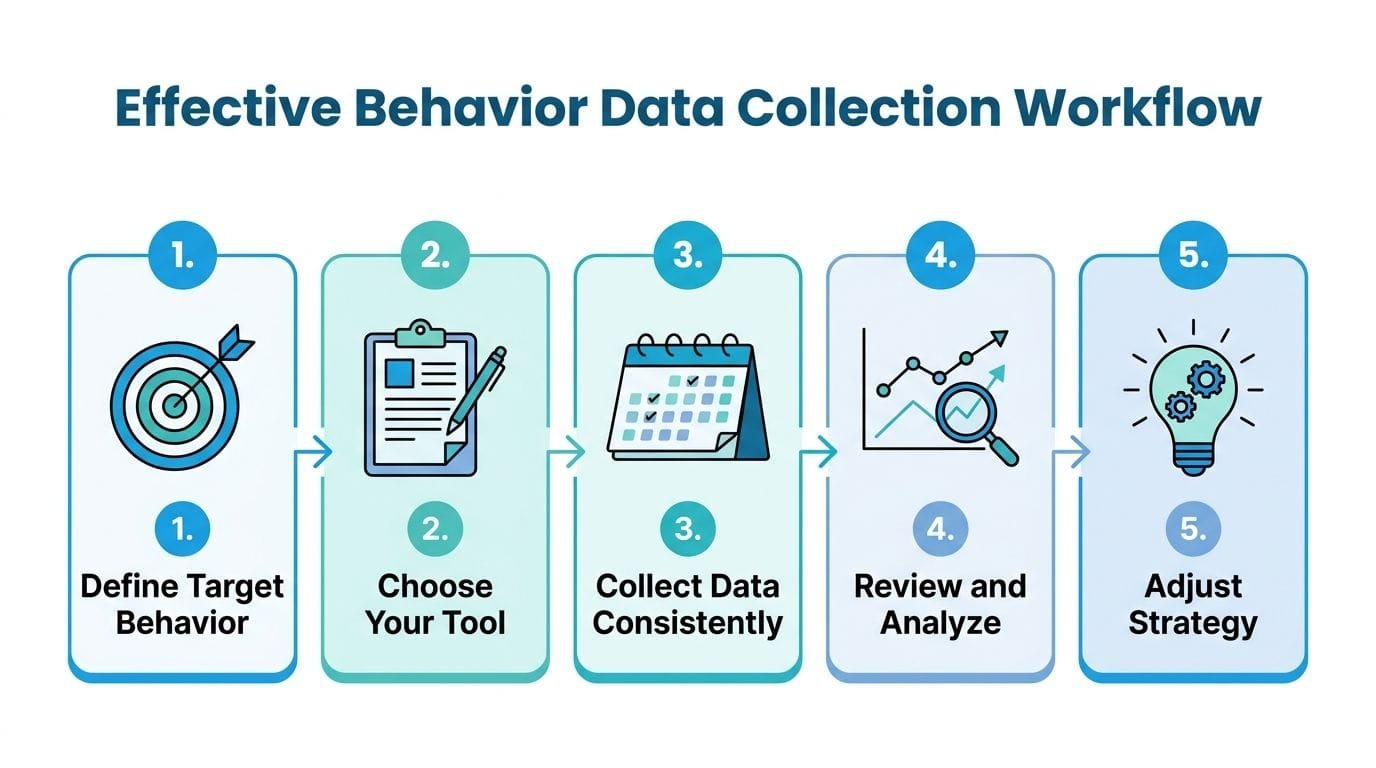
Consistency matters more than perfect records. A parent who logs one meaningful event each evening may learn more than a parent who attempts a complicated chart for a few days and then abandons it.
Look for patterns, not isolated incidents
Suppose a family records hand flapping episodes over two weeks. The entries include the activity, transition, noise level, sleep context, and what adults did next. During review, the family notices that episodes cluster around transitions from preferred play to dressing, especially when the transition is announced without visual support.
That pattern doesn't mean hand flapping is always a problem. Stimming can serve regulation, enjoyment, communication, or sensory purposes. The data may instead suggest that the transition needs more predictability, or that adults should focus on supporting participation rather than suppressing the movement.
Look across several dimensions:
- Timing: Does the behavior occur during arrival, meals, bedtime, or transitions?
- Environment: Are noise, lighting, crowding, or temperature present?
- Demand: What task, request, or expectation came first?
- Communication: Did the child ask for help, a break, a preferred item, or more time?
- Outcome: Did the child gain attention, escape a demand, access a routine, or return to regulation?
Families wanting a digital way to organize this review can explore behavioral data analysis in Guiding Growth. The central principle remains the same: record observable information, review it with care, and avoid treating a pattern as proof until the team has considered alternative explanations.
Choosing the Right Tool for Your Family or Practice
Tool selection should begin with fit, not popularity. Ask what the child can communicate, where the behavior occurs, who can collect information, and how the results will be used.
A toddler who communicates through gestures may need a simple caregiver log that captures routines and early signs of distress. An older student may participate in a self-report interview, use a visual rating scale, or help identify which demands feel confusing. A behavior that occurs only during classroom transitions calls for school-based observation, while a bedtime pattern may require family tracking.
Match the method to the setting
Consider these questions before choosing:
- Where does the behavior happen? Home, school, therapy, transportation, and community settings may produce different patterns.
- Who sees the behavior? Include the adult who is present most often, not only the professional with formal training.
- What decision is coming next? A routine adjustment may need a short ABC record. An IEP or safety decision may require a formal assessment.
- Can the team use the output? A score or chart matters only if parents, educators, and clinicians understand what it means and can act on it.
- What burden is sustainable? The most advanced tool won't help if caregivers can't use it during real routines.
Measurement quality matters. For young children with ASD, a systematic review found that only a limited set of tools had sufficiently strong measurement properties, with the Child Behavior Checklist and the Home Situations Questionnaire, Pervasive Developmental Disorder version emerging as the strongest questionnaires (systematic review of tools for young children with ASD).
Standardized scores also need careful interpretation. In one peer-reviewed autism screening study, clinical scale T-scores from 60 to 69 were considered at-risk, while scores of 70 or above were clinically significant. In that study's 62/62 comparison sample, a DSD cut-score of 60 produced sensitivity of .98 and specificity of .95 (peer-reviewed autism screening study). Those thresholds belong to the specific instrument and study context. They aren't universal labels for a child.
Families should also ask whether a tool measures what matters at home. A systematic review identified gaps in well-being, participation, and family quality-of-life outcomes, even though stakeholders value those areas (outcome-measure review). A useful system should connect behavior records to daily life, not merely produce symptom totals.
Integrating Behavior Tracking with Guiding Growth
Traditional behavior assessment methods are valuable, but families often struggle to use paper forms consistently. A parent may be carrying groceries, helping another child, or trying to keep everyone safe when a meltdown occurs. A system that requires lengthy typing can turn good intentions into abandoned records.
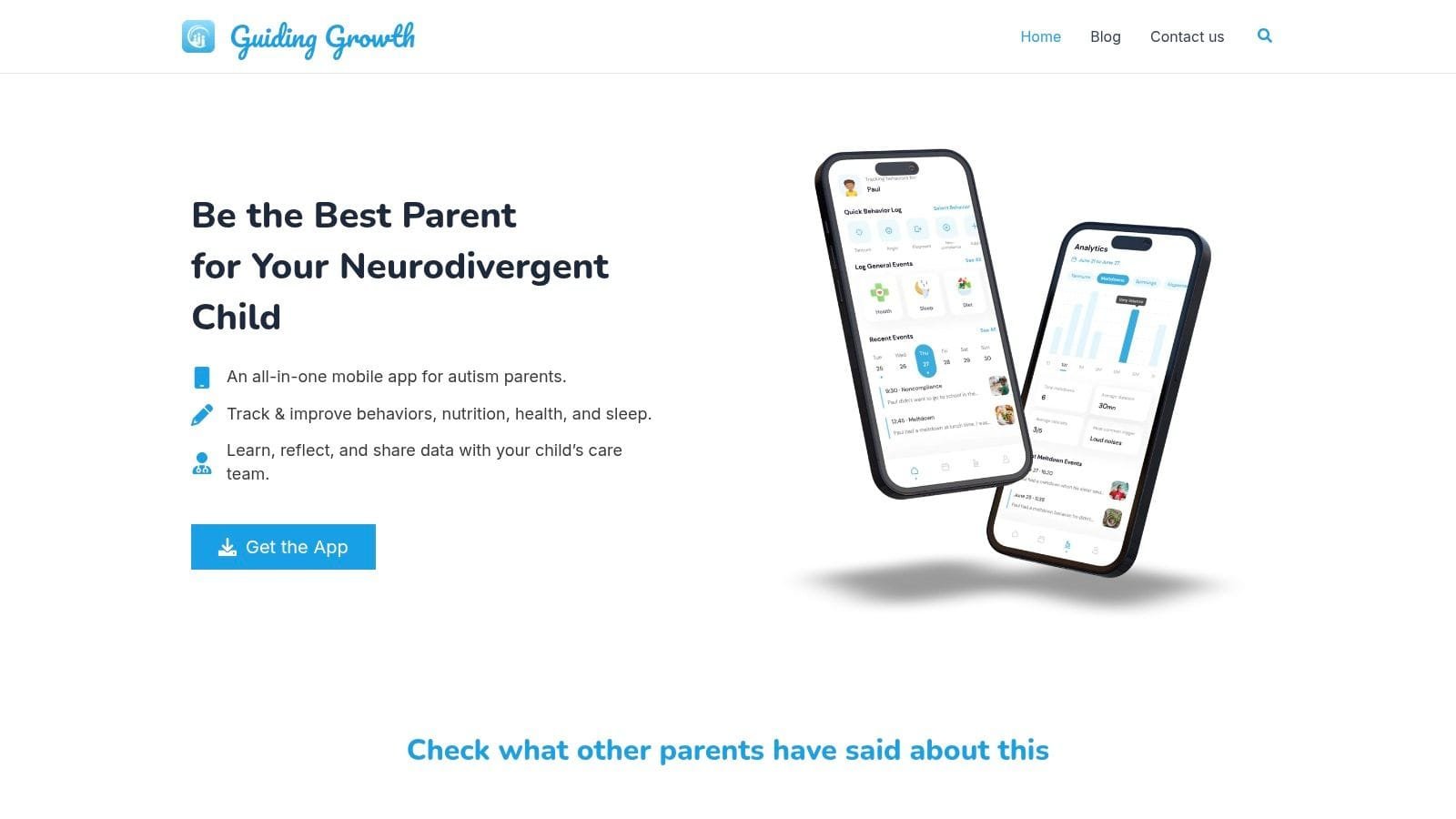
Guiding Growth brings several familiar assessment ideas into a mobile workflow. Parents can create quick voice entries, record contextual triggers and outcomes, and track behaviors such as meltdowns, shutdowns, demand avoidance, echolalia, and hand flapping. The app's behavior logging can include triggers, purposes, and intensity, giving families more context than a single checkbox.
Put behavior beside the surrounding routine
A behavior entry becomes more useful when adults can compare it with sleep, routines, diet, nutrition, medications, appointments, and therapy sessions. These records don't establish causation by themselves, but they can help a family notice questions worth discussing with a clinician.
For example, repeated evening distress may prompt a family to compare the timing of the behavior with bedtime routines, meal patterns, or changes in medication. A therapist can then help decide which variable to examine rather than offering a conclusion based on one difficult night.
The app also supports sharing and collaboration with family members, caregivers, and medical professionals. That can reduce the problem of each adult keeping a separate version of the story. Alma AI can help parents review logged information, identify possible patterns, and consider next steps, while important clinical decisions should remain part of a conversation with qualified professionals.
The value of a digital tool isn't that it replaces an FBA, rating scale, or clinician. It can make the structured observation those tools depend on more practical between visits. For a busy family, voice logging and visual summaries may offer a workable bridge between clinical rigor and daily reality.
Privacy Considerations and Collaborative Best Practices
Behavior data is sensitive because it can include health information, medication details, school experiences, family routines, and descriptions of distress. Before using a digital tool, parents should understand how information is stored, who can access it, how sharing works, and whether they can remove access later.
A clear privacy process protects the child and also improves collaboration. When families know exactly which people can view records, they can share relevant information without distributing every private detail to every member of the care team.
Share with purpose
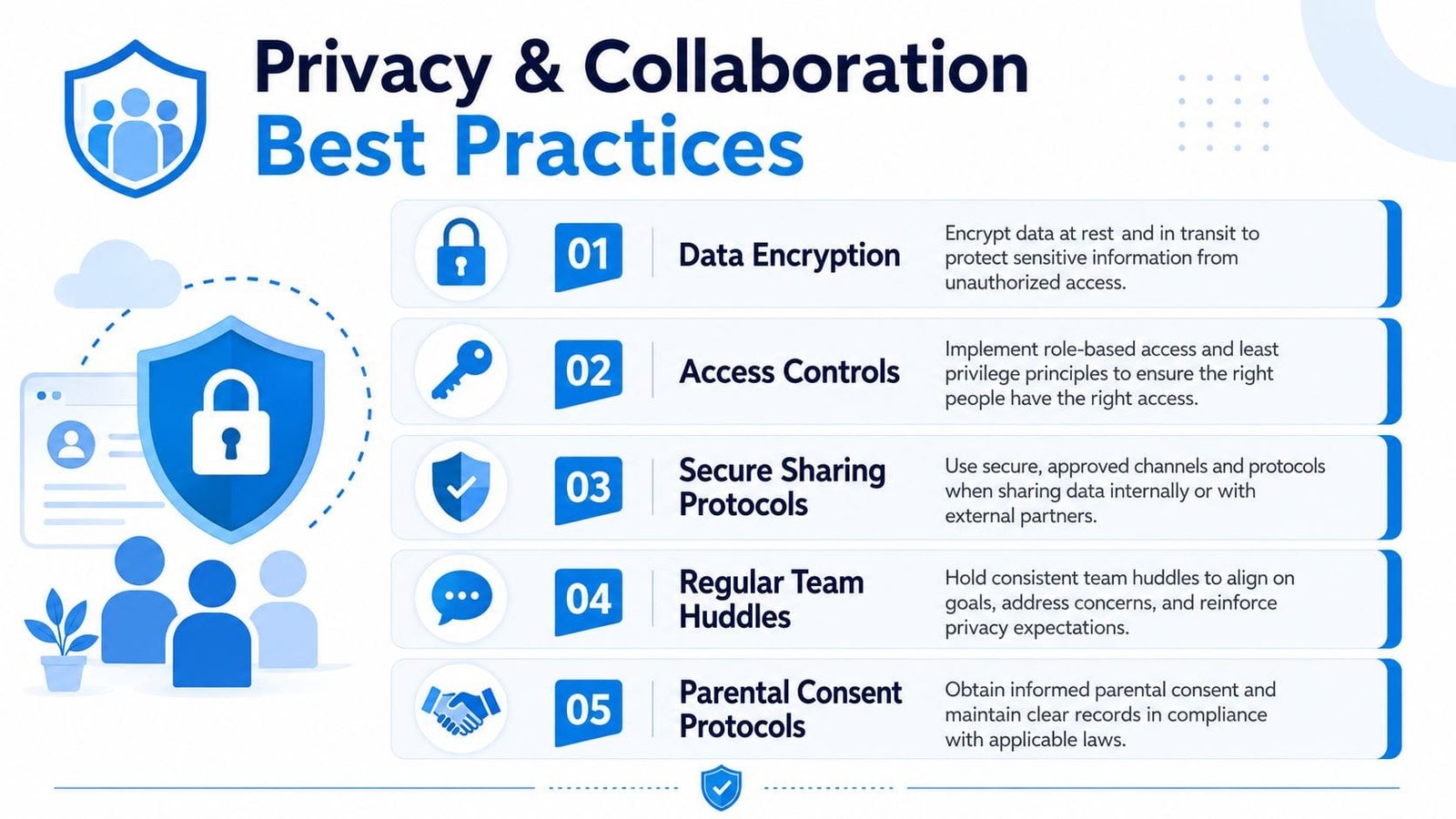
Use a few simple safeguards:
- Review encryption information: Look for plain-language explanations of how data is protected during storage and transfer.
- Use access controls: Give each collaborator only the access they need, and remove access when a role changes.
- Agree on sharing protocols: Decide whether the family, teacher, therapist, or clinician will review records and how often.
- Bring focused summaries to meetings: Share patterns, examples, and questions that relate to the IEP or treatment goal instead of overwhelming the team with every entry.
- Keep parental consent central: Make sure parents understand what is being shared and with whom before adding collaborators.
A school meeting becomes more productive when the family can say, “These episodes occur during unexpected transitions, and visual preparation appears to help,” rather than handing over a large collection of unorganized notes. The team can then discuss environmental changes, communication supports, replacement skills, and safety planning.
Families should also protect the meaning of the data. A chart can show that a behavior occurred, but it can't automatically explain the child's feelings, medical status, or intent. Share observations as evidence for discussion, not as a permanent label.
Start small this week by choosing one behavior, recording what happens before and after it, and reviewing the pattern with one trusted support person. Guiding Growth offers voice-based behavior logging, routine and care tracking, visual pattern review, and collaboration features that can help turn scattered observations into organized information, so visit Guiding Growth and begin building a practical record your family can use.