At breakfast, your child chews through another shirt collar. The toaster pops, the dog crosses the kitchen, and you're already deciding whether to intervene before the fabric tears. You feel exhausted, embarrassed about what might happen in public, guilty that you snapped yesterday, and afraid that the chewing means something is medically wrong.
Many families searching for answers about oral fixation autism are living in this confusing space. Chewing, mouthing, biting, sucking, or tasting may look like defiance or a habit that should just stop. Often, though, the behavior is a message from a nervous system trying to regulate itself. The useful question isn't only, “How do I stop this?” It's, “What is the chewing doing for my child, and how can I make that need safer?”
This guide starts with function, then moves to safe substitutions, pattern tracking, and professional screening. You'll learn how to distinguish sensory seeking from pica, anxiety, feeding difficulty, and oral-motor concerns, so you're not left cycling through chew toys without understanding the reason behind the behavior.
Table of Contents
- When Chewing Becomes Your Whole Day
- What Oral Fixation Really Means in Autism
- Sensory Seeking Versus Pica and Other Concerns
- Why Mouth-Seeking Happens in the First Place
- Safe Management Strategies That Actually Work
- Tracking Patterns Without Losing Your Mind
- When to Bring in Professional Help
- Putting It All Together and Next Steps
When Chewing Becomes Your Whole Day
The chewing may begin unnoticed. Your child mouths a sleeve while watching television, bites a pencil during homework, or presses their teeth into a shirt collar in the car. Then it spreads across the day. Clothing becomes wet and damaged, toys disappear into the mouth, and every outing requires a scan for small or unsafe objects.
Parents often describe the same emotional whiplash. They understand that their child isn't trying to create trouble, yet they still have to stop a choking risk quickly. They want to protect their child without turning every interaction into correction. Public reactions can add embarrassment, while family members may ask why the child “just can't stop.”

A 2023 scoping review found that 81% of studies on oromotor skills in autism reported a significant abnormality involving speech production, nonspeech oromotor skills, or feeding. That finding doesn't mean every autistic child has an oral-motor difficulty, but it does show why persistent mouth-related behavior deserves more thoughtful attention than a simple behavior label. The same review described historical reports of unusual sensory behaviors across visual, auditory, tactile, and oral domains in 45% to 95% of autistic individuals, and a review of autistic adults reported an unusual sensory profile in 60% to 95% of participants, which could include altered oral sensitivity. These figures come from the 2023 scoping review on oromotor and sensory features in autism.
A helpful reframe: The behavior may be inconvenient, messy, or unsafe, but it isn't proof that you've failed as a parent or that your child is seeking attention.
Start with curiosity. Notice what happens before the chewing, what kind of pressure or texture your child chooses, and what changes afterward. That small shift can replace a battle with a clue.
What Oral Fixation Really Means in Autism
Oral fixation describes persistent mouth-based seeking, such as chewing, mouthing, biting, sucking, licking, or tasting, that continues beyond the period when typical toddler mouthing is expected. It can be occasional, such as chewing a sleeve during a difficult transition, or pervasive enough to interfere with meals, school, sleep, clothing, and safety.
A useful analogy is a thermostat. Some children register oral input strongly, so a small sensation feels intense and they avoid certain textures. Others register less information around the lips, tongue, cheeks, or jaw. Their nervous system keeps turning up the input, so they seek harder chewing, stronger flavors, cold foods, or repeated pressure to feel organized.
The mouth also gives the brain information about texture, temperature, movement, pressure, and taste. That input can support attention and calming, especially during sensory overload, waiting, transitions, or low-arousal moments. This doesn't make every chewing behavior automatically sensory, but it explains why removing the behavior without replacing its function often fails.
How it differs from ordinary mouthing
Babies and toddlers commonly mouth objects as they explore. Persistent chewing later in development becomes more important to assess when it is frequent, difficult to interrupt, linked to distress, directed toward nonfood items, or associated with feeding, speech, dental, or safety concerns.
The behavior's meaning also depends on the object. A child who repeatedly chews a designated silicone tool during a noisy activity may be seeking predictable pressure. A child who swallows paper, dirt, or paint chips needs a different response because ingestion creates medical and safety concerns.
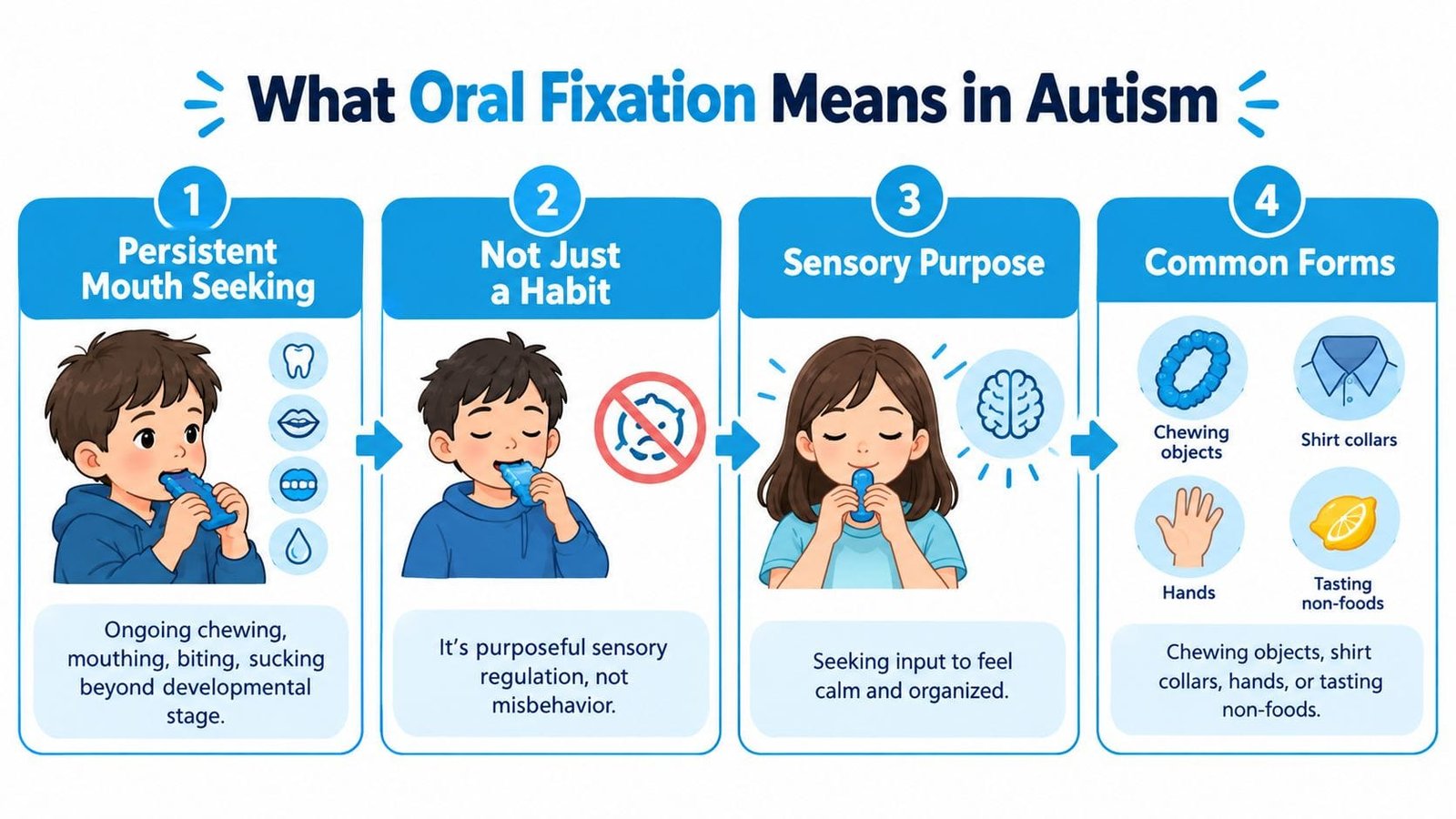
Sensory differences are common in autism, but oral fixation itself isn't a diagnosis. Think of it as a signal that points toward a question about regulation, communication, feeding, anxiety, oral-motor function, or health. The next step is to compare those possibilities rather than treating every form of mouth seeking as the same behavior.
Sensory Seeking Versus Pica and Other Concerns
Two children may chew constantly for entirely different reasons. One may seek firm pressure and calm down with a safe substitute. Another may eat nonfood items, which raises concern for pica and requires medical evaluation. A third may chew only during transitions because anxiety makes oral input feel stabilizing.
| Behavior Type | What It Looks Like | Key Clue | Main Risk or Concern |
|---|---|---|---|
| Sensory-seeking chewing | Chewing clothing, hands, or a safe oral tool | Chewing is predictable and may help the child settle or focus | Choking, hygiene problems, tooth wear, or damaged skin |
| Pica | Repeatedly eating items such as dirt, paper, or paint chips | The child swallows nonfood materials rather than only mouthing them | Poisoning, blockage, infection, choking, or nutritional concerns |
| Oral overresponsivity | Gagging, refusing textures, or reacting strongly to tastes and smells | Avoidance and distress appear around particular sensory qualities | Restricted diet, inadequate intake, and feeding stress |
| Anxiety-driven chewing | Biting or chewing during transitions, demands, noise, or uncertainty | The behavior rises after a clear stressor and falls when the child feels safe | Escalation, self-injury, and reduced participation |
| Feeding or oral-motor difference | Pocketing food, overstuffing, rapid eating, weak chewing, or difficulty swallowing | Mealtime mechanics are difficult even when the child wants to eat | Choking, poor nutrition, fatigue, or delayed feeding skills |
A pediatric dentistry study found that parents of autistic children reported oral sensitivities more often than parents of typically developing children, 68.9% versus 17.6%, while 1.5% of parents of autistic children in that sample reported oral oversensitivity. The findings illustrate an important point: oral sensory differences can move in different directions, and a child may be underresponsive in one situation and overwhelmed in another. The broader sensory findings are described in the pediatric dentistry study of oral sensory issues.
Look at the action, not just the label. Sensory chewing usually involves seeking pressure or texture. Pica involves ingestion. Overresponsivity often includes gagging or avoidance. Feeding and oral-motor problems show up in the mechanics of eating, not only in the child's desire to chew.
For more context on how oral seeking fits within broader sensory patterns, see this guide to sensory-seeking behaviors. If your child swallows nonfood items, don't rely on redirection alone.
Why Mouth-Seeking Happens in the First Place
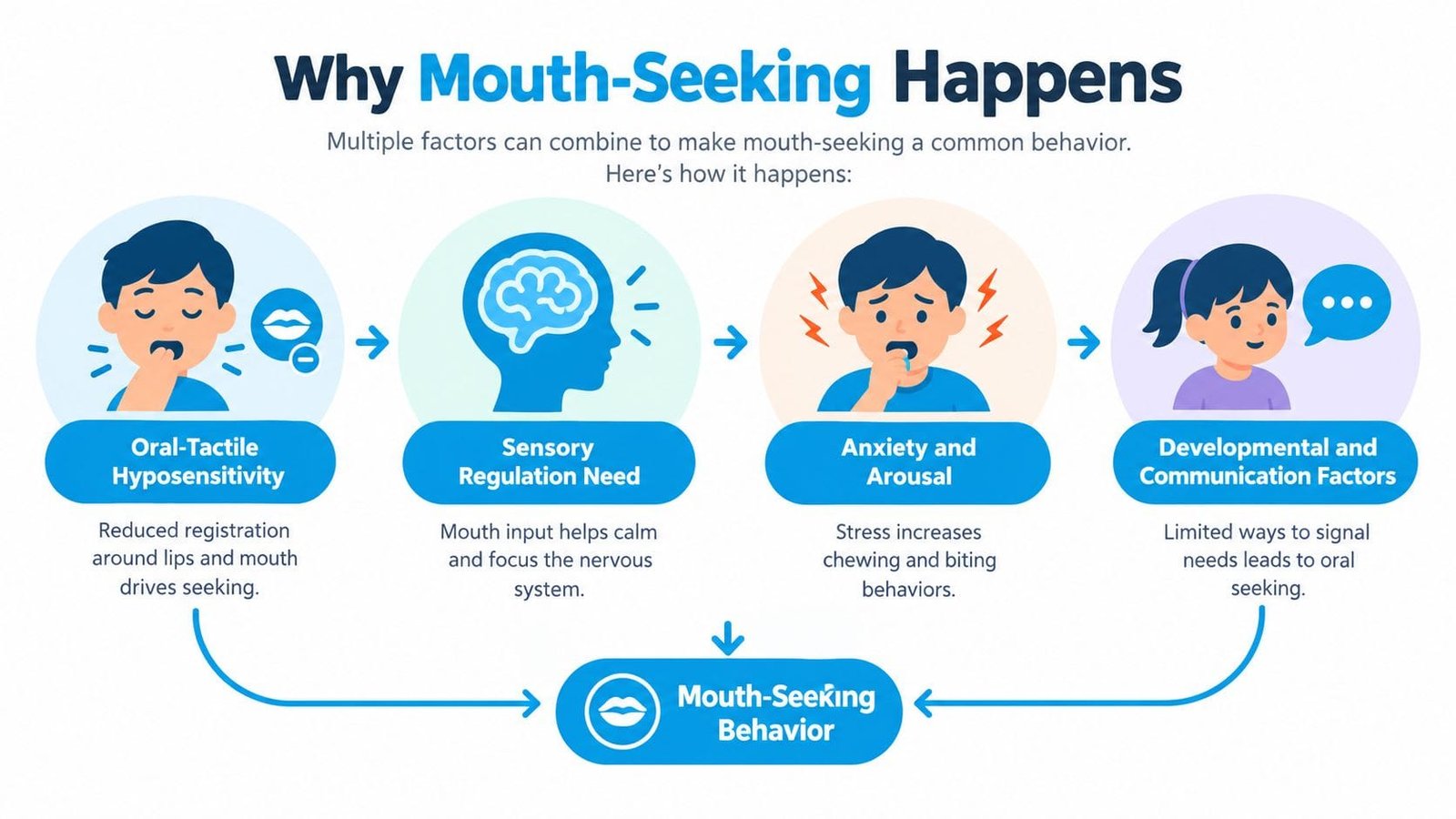
A child may seek mouth input because the mouth doesn't register sensation clearly enough. Reduced oral-tactile registration around the lips, tongue, and jaw can lead to stronger chewing, intense flavors, crunchy textures, or repeated pressure. The child isn't necessarily choosing the most disruptive option. They may be choosing the input their body can notice.
The same behavior can also regulate arousal. A child who chews a sleeve during a long car ride may be tired, under-stimulated, anxious about the destination, or trying to stay organized while movement and waiting continue. Another child may seek spicy or strongly flavored food at the table because taste provides a powerful, predictable sensation. The visible behavior is similar, but the underlying need differs.
A connected set of influences
Several factors can raise the drive for oral input:
- Oral underresponsiveness: The child seeks more pressure, resistance, temperature, or flavor because ordinary input feels too faint.
- Transitions and overload: Chewing may help during noise, waiting, changes in routine, or difficult demands.
- Fatigue and sleep disruption: A tired nervous system may have less capacity to manage sensory information and communication.
- Anxiety and communication needs: When a child can't easily signal “I need a break” or “this is too much,” the mouth may become the available regulation tool.
- Nutrition and health: Persistent nonfood ingestion can warrant screening for iron deficiency and other medical concerns. Don't assume a supplement is appropriate without clinical guidance.
A 2022 systematic review connected sensory processing, particularly taste, smell, and hypersensitivities, with a broad range of eating behaviors in autism. It also cited evidence that autistic children with atypical oral sensitivities were significantly more likely to show food selectivity than peers with typical oral sensory processing. The review is available as the systematic review of sensory processing and eating behaviors in autism.
Research on oral-gut-brain pathways and the oral microbiome is emerging, but it shouldn't be used to explain an individual child's behavior without clinical assessment. At home, focus on the pattern you can observe: what raises the demand for oral input, what safely meets it, and what changes when your child is rested, fed, and supported.
Safe Management Strategies That Actually Work
Safety comes before reduction. If your child mouths small objects, batteries, chipped paint, dirty items, or pieces of damaged tools, change the environment and supervision plan before teaching a replacement.
Start with the surroundings
Scan the places where chewing happens most often. Remove loose pieces, damaged toys, unsafe jewelry, accessible household chemicals, and objects that can break into small parts. Keep a small go-bag for school, appointments, and travel with approved oral tools, water, familiar snacks, wipes, and a spare shirt.
Offer choices that differ by texture and resistance, such as smooth silicone, textured tubing, or a washable fabric option designed for chewing. Check every item before use and retire it when it cracks, frays, becomes sticky, or loses pieces. A replacement isn't safe only because it was sold as a chew product.
Match input to the child
An occupational therapist or feeding professional can help determine whether your child needs pressure, movement, temperature, resistance, or a different kind of support. Depending on the child's skills and medical guidance, options may include chewy tubes, a vibrating toothbrush, or crunchy and chewy foods included in meals and snacks.
Food substitutions need care. A crunchy snack isn't appropriate if your child has swallowing difficulty, overstuffing, poor chewing coordination, or a known choking risk. Use foods and tools recommended for your child's developmental and oral-motor abilities.
Safety rule: Never introduce a chew item as a test of independence. Match access to the child's ability to use it safely, and supervise more closely when mouthing is intense or unpredictable.
Build regulation into the routine
Offer oral-motor input before a difficult transition rather than waiting for chewing to become unsafe. A short, predictable routine before leaving home, starting homework, or entering a noisy place may include a drink, an approved oral tool, a movement break, and a simple visual cue.
Avoid making the chew item a punishment. Calmly block an unsafe object, name the replacement, and reduce the demand if your child is overloaded. If the behavior is driven by anxiety, a chew toy alone won't solve the problem. Your plan may also need a transition warning, a break card, fewer spoken instructions, or a quieter setting.
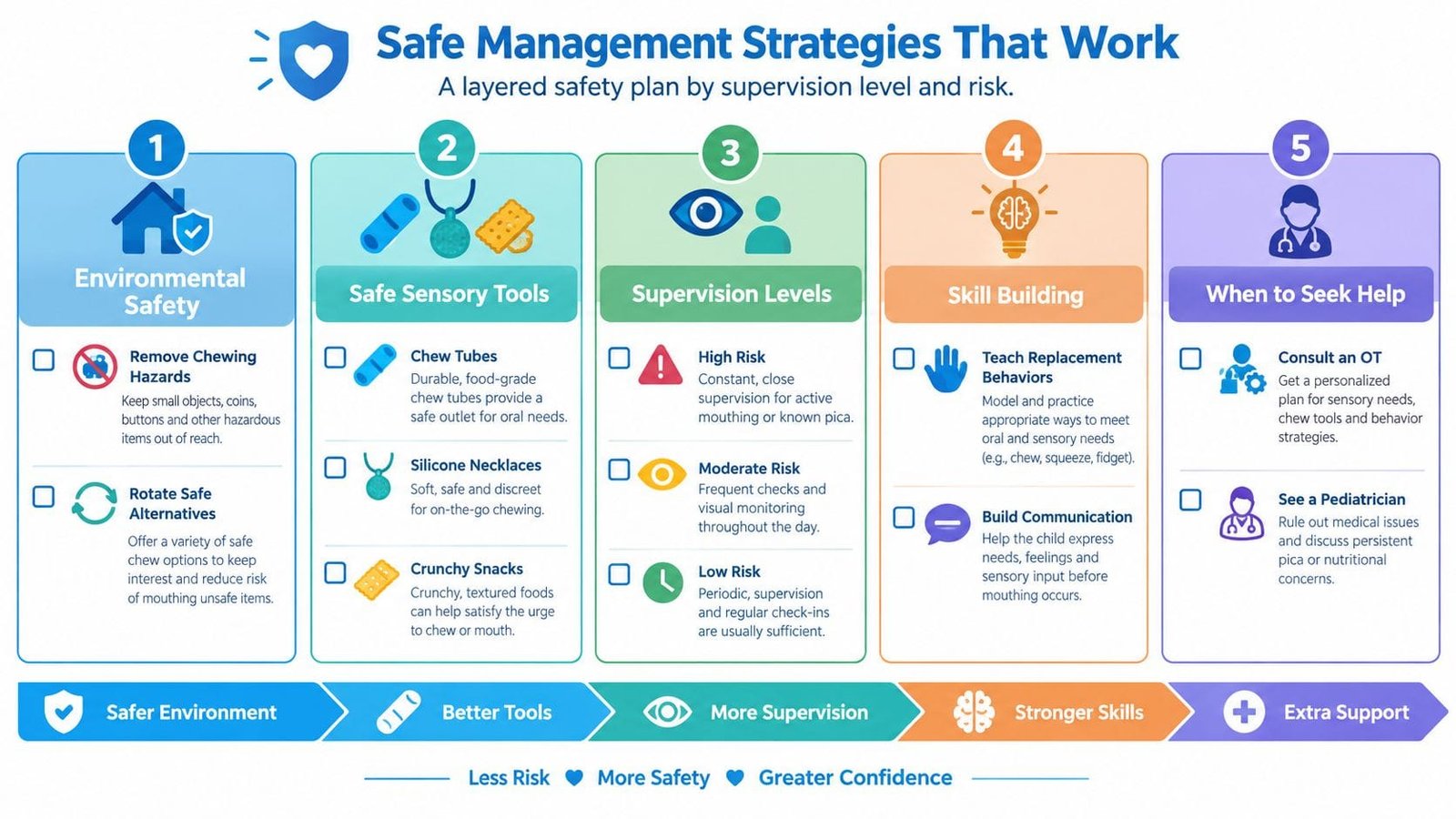
Share the plan with teachers, relatives, and caregivers. Tell them what to block, what to offer, how to supervise, and which signs require immediate help. You can also review ideas for sensory chew toys for autism while keeping professional advice and individual safety needs at the center.
A practical demonstration of safe redirection can help caregivers see the difference between stopping a behavior and meeting its function:
Tracking Patterns Without Losing Your Mind
You don't need to record every bite, chew, or lick. A short, consistent log is more useful than a perfect one. Capture enough information to reveal what happens before and after the behavior.
Record these details:
- Time and setting: Note whether it happened at home, school, in the car, during meals, or before sleep.
- What came before: Write down the activity, transition, demand, noise, waiting period, or change in routine.
- What your child chose: Record the object, texture, flavor, pressure, or body part involved.
- Intensity and safety: Note whether the behavior was brief, persistent, damaging, or involved swallowing.
- Your response and the outcome: Record the substitute offered, whether your child accepted it, and what happened next.
Log in real time when the event involves pica, injury, choking risk, or a sudden escalation. For routine chewing, jot down a quick phrase and complete details later in the day. This protects your attention while preserving the pattern.
Look for clusters. Chewing at the same time each day may point toward fatigue or low arousal. Chewing after particular transitions may suggest anxiety or communication difficulty. Rejection of one substitute and acceptance of another may reveal a mismatch in texture, resistance, size, or availability.
After two weeks, turn the notes into one page. Include the most common settings, triggers, objects, successful replacements, safety incidents, and questions for the clinician. A tool such as this behavior tracking chart can make phone-based logging and pattern review easier than maintaining loose paper notes, especially when several caregivers share observations.
When to Bring in Professional Help
Persistent mouthing becomes a clinical concern when safety, health, feeding, sleep, or daily participation is affected. Arrange professional input if your child repeatedly mouths nonfood items beyond six months, swallows objects, develops visible tooth wear or gum injury, shows weight changes, loses sleep, or suddenly chews with much greater intensity.
Pica deserves particular attention. It means repeated ingestion of nonfood items, not touching or chewing them. A large CDC-published study found pica in 23.2% of preschool-aged children with ASD, compared with 3.5% in population controls. The rate was 28.1% among children with ASD and intellectual disability and 14.0% among autistic children without intellectual disability, as reported in the CDC-published study on pica in young children. These figures don't predict what will happen for your child, but they show why ingestion should never be dismissed as harmless mouthing.
Different signs point toward different supports:
- Pica or suspected deficiency: Start with a pediatrician or developmental pediatrician. Ask whether iron studies, lead screening, or other medical evaluation is appropriate. Gastroenterology may be involved when ingestion causes digestive symptoms or blockage concerns.
- Feeding and oral-motor difficulty: Seek an occupational therapist or speech-language pathologist with feeding and oral-motor experience if your child overstuffes, pockets food, struggles to chew, gags, or has difficulty swallowing.
- Anxiety or restricted eating: A psychologist, feeding clinic, or multidisciplinary team may help when chewing is tied to distress, avoidance, or a very limited diet.
Bring your log and say, “My child chews or mouths these items at these times, after these triggers, and responds to these replacements. I'd like a sensory profile, oral-motor and feeding assessment, dental evaluation, and guidance about iron and lead screening.” Professional help should expand your home plan, not erase your understanding of your child.
Putting It All Together and Next Steps
Use a simple four-part loop:
- Read the function. Ask what the chewing may provide, such as pressure, alertness, calm, predictability, or escape from overload.
- Match the explanation. Separate sensory seeking from pica, anxiety, overresponsivity, feeding selectivity, and oral-motor concerns.
- Layer safety. Remove hazards, offer an appropriate substitute, adjust supervision, and support difficult transitions.
- Track change. Look for safer choices, easier transitions, better mealtime participation, and less distress, not only less mouthing.
Oral fixation can't diagnose autism, pica, deficiency, anxiety, or a feeding disorder on its own. It's a signal that deserves context. With careful observation, progress may look like your child choosing a safe tool, accepting a transition, or recovering more quickly, even if mouth seeking doesn't disappear.
Use Guiding Growth's behavior logging and AI companion to capture patterns by voice, prepare focused questions for appointments, and adjust your plan week by week without losing the thread.
Guiding Growth gives parents a practical place to log chewing, triggers, sleep, food patterns, and outcomes, then share clear summaries with caregivers and clinicians. Visit Guiding Growth to turn scattered observations into safer, more informed support for your child.