You've finally settled your child after a long bedtime routine. The lights are low, the familiar comfort item is in place, and you're hoping tonight will be different. Then bedtime resistance starts again, followed by a quiet wake in the early hours and a morning filled with irritability, shutdown, or difficulty getting dressed. By breakfast, the details already feel blurred.
A sleep tracking app can help you capture what memory misses, but its real value isn't a perfect sleep score. For neurodivergent families, useful tracking connects sleep timing with sensory input, behavior, diet, medications, routines, and the people supporting your child. A comfortable bedroom setup, including durable minimalist beds, may support a calmer environment, but a consistent record helps you understand what happens before and after sleep.
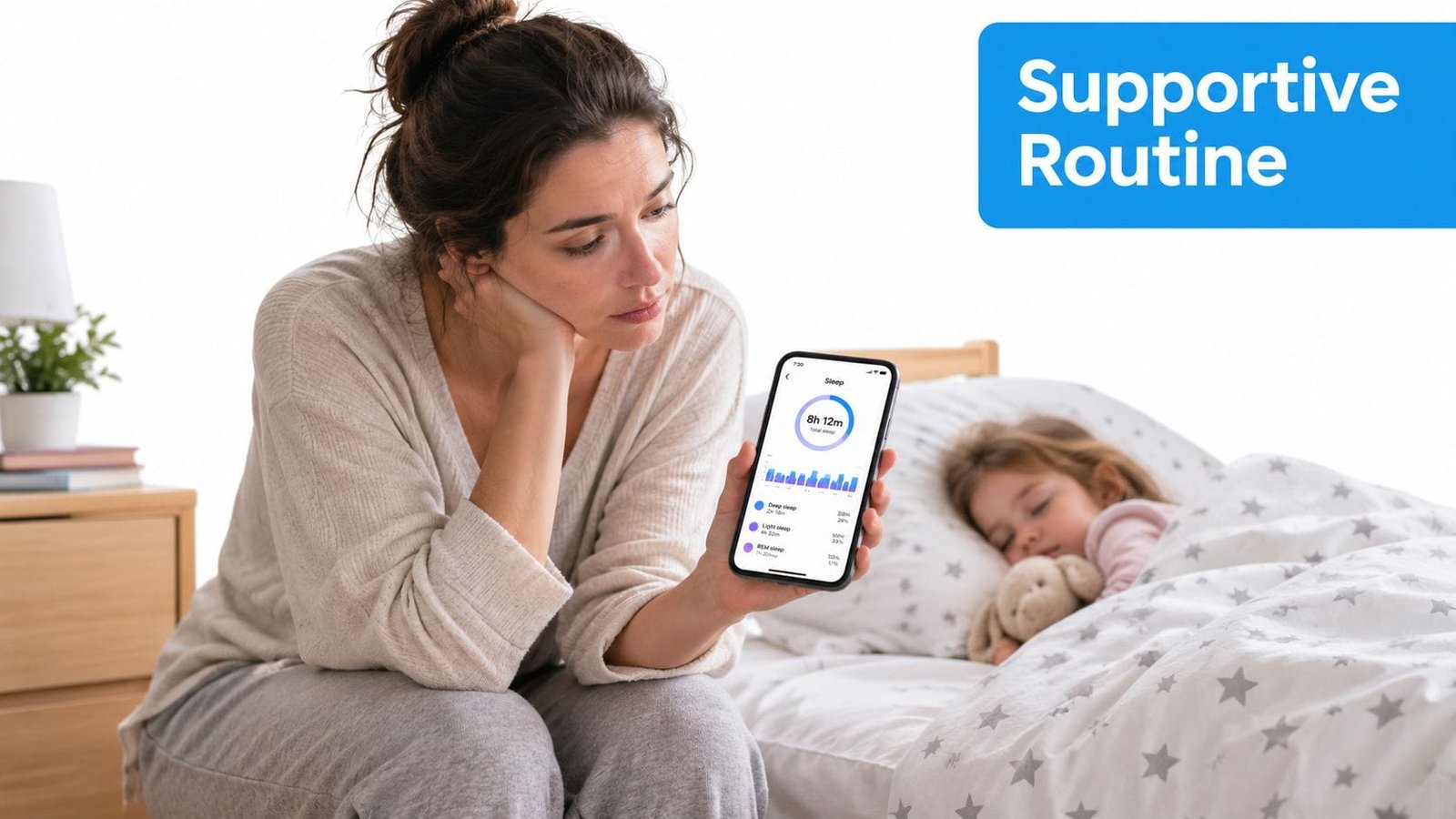
The sections below will help you understand what these apps estimate, where their numbers become uncertain, and which features matter most when bedtime is unpredictable. You'll also see how shared, contextual notes can turn scattered nights into a clearer story for caregivers and clinicians. Guiding Growth brings sleep monitoring into a broader family-care record, so sleep doesn't have to sit separately from the rest of your child's day.
Table of Contents
- Introduction to Sleep Tracking for Busy Families
- How a Sleep Tracking App Actually Works
- Why Sleep Tracking Matters More for Autistic and Neurodivergent Children
- Must Have Features in a Sleep Tracking App for Neurodivergent Families
- Understanding Data Privacy and Accuracy Before You Trust the Numbers
- How to Use Sleep Data to Improve Routines and Clinical Collaboration
- Choosing a Calmer Path Forward with the Right Sleep Tracking Support
Introduction to Sleep Tracking for Busy Families
After a difficult night, a parent may notice more distress during transitions, stronger reactions to sensory demands, less flexible communication, or a harder school morning. The connection can be easy to miss because one challenging day rarely explains the whole pattern.
Memory also shifts under pressure. One caregiver may recall that a child “barely slept,” while another remembers a late bedtime but forgets the long period of quiet wakefulness afterward. A sleep tracking app gives caregivers a shared timeline, then lets them add the details that explain it.
Practical rule: Track to understand patterns, not to grade your child's sleep.
A useful record can include bedtime, estimated sleep onset, night waking, final wake time, and morning mood. Add context such as a changed routine, an uncomfortable texture, a late meal, illness, medication timing, or an unusually demanding day. These notes can show whether a difficult night followed a sensory trigger, a schedule change, or something unrelated. A calm sleep environment may help too, including durable minimalist beds, but the record connects that setting with what happened before and after sleep.
Voice logging can make this practical on busy mornings. A short note such as “new pajamas felt scratchy” may be more useful than trying to remember the detail later. Shared access also helps a co-parent, grandparent, or clinician review the same context instead of comparing incomplete memories.
The market reflects how familiar sleep tracking has become. One estimate valued worldwide sleep tracking apps at USD 2.24 billion in 2025 and projected USD 7.64 billion by 2032, with a 19.15% compound annual growth rate over that forecast period (market estimate for worldwide sleep tracking apps). That growth does not make every sleep-stage label reliable. For neurodivergent families, choose the app that makes a 10-second voice note about sensory triggers easy, supports caregiver sharing, and helps you review trends rather than chase a perfect score.
How a Sleep Tracking App Actually Works
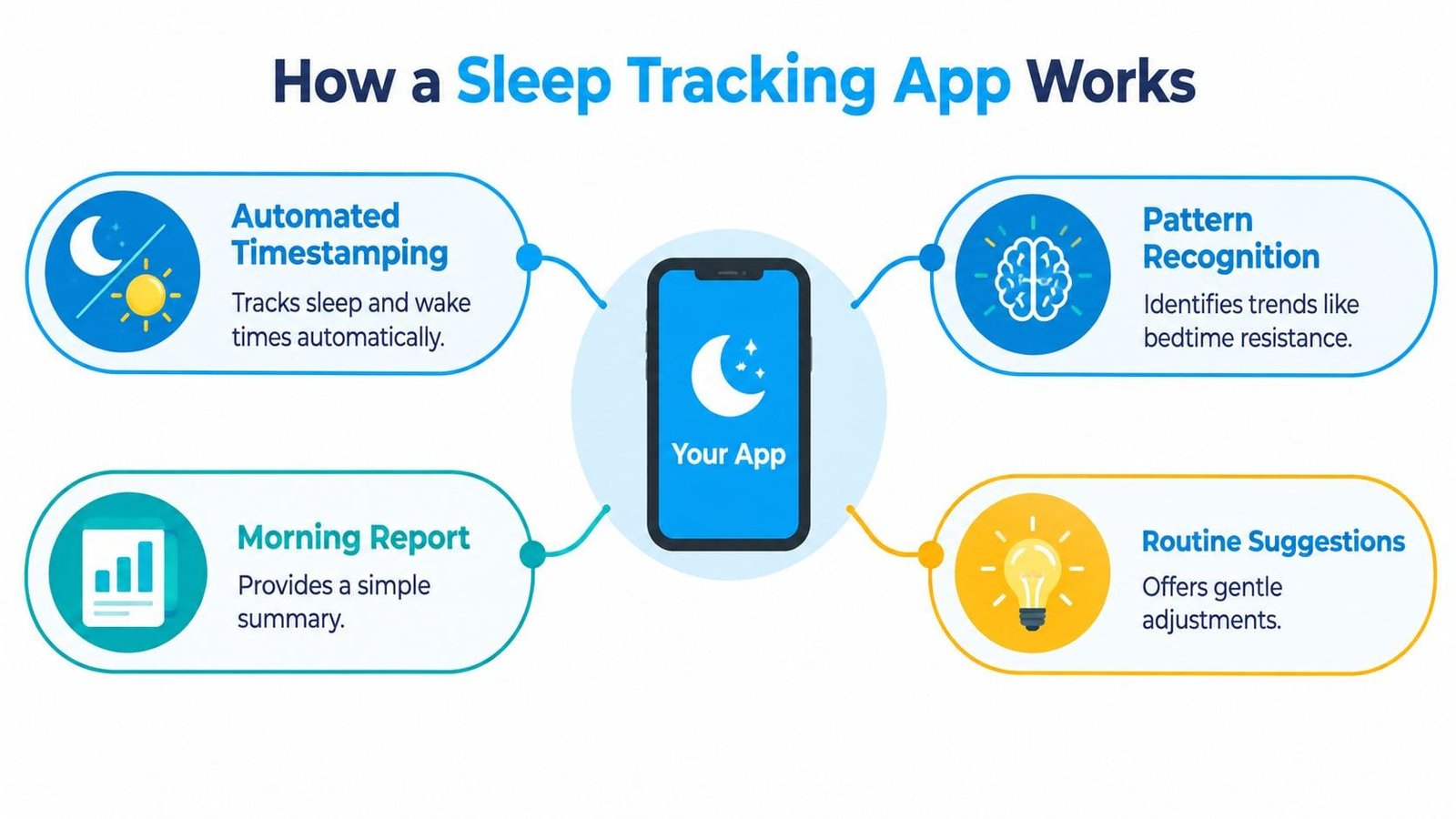
A sleep tracking app works like a night-time notebook with a clock attached. It records or estimates when sleep began, when waking may have occurred, and when the day started, so families do not have to reconstruct the whole night from memory.
The basic record
Some apps depend on manual entries. Others collect information from a phone, smartwatch, or ring. These devices commonly use movement and related sensor signals to estimate whether a person is still, moving, asleep, or awake. Depending on the product and settings, sound may add context.
The first useful layer is duration and timing. Did bedtime shift later? Did morning waking happen earlier? Did settling take longer? These broad patterns can show whether a routine change deserves attention.
More advanced screens may label light sleep, deep sleep, or other stages. Treat those labels as estimates, not direct measurements of brain activity. A consumer device does not perform a clinical sleep study in the bedroom.
Sleep detection isn't wake detection
Apps generally identify sleep more reliably than wakefulness. A large validation study found sleep sensitivity of 0.93 or higher across consumer devices, while wake specificity ranged from 0.18 to 0.54 (consumer sleep tracker validation study). In plain language, a child who lies still may be marked as asleep even while awake.
That limitation matters when a child wakes often or spends a long time calmly awake at night. The app may display one uninterrupted sleep block, while the child's body and next morning suggest several periods of wakefulness.
A 2024 validation study found that mean absolute percent error for total sleep time ranged from 5.3% for Fitbit Versa to 14.3% for Garmin Vivosmart, while the Oura Ring was the main outlier with weaker total-sleep-time accuracy (2024 validation study of commercial sleep trackers). Device model matters, so compare trends from the same device instead of treating products as interchangeable.
For families comparing hardware, comfort and consistent use matter more than appearance. Replacement accessories such as top rated Fitbit Sense replacements may help a child or caregiver tolerate the setup, but the device still produces an estimate.
A sleep timeline becomes more useful when paired with a broader behavior tracking app. Voice-logged notes can capture details a sensor cannot, such as a scratchy shirt, a demanding afternoon, or a long period of quiet wakefulness. Shared access lets caregivers review the same record rather than compare incomplete memories.
Review several nights together. A single unusual reading may reflect sensor error, a missed log, or an atypical evening. Repeated timing patterns, especially when paired with caregiver notes, offer a better basis for deciding what to explore than a perfect-looking score.
Why Sleep Tracking Matters More for Autistic and Neurodivergent Children
Neurodivergent children may experience sleep differently from their parents or siblings. Sensory sensitivity can make pajamas, bedding, temperature, sound, or darkness difficult. A child may resist the sequence of brushing teeth, changing clothes, and getting into bed, even when tired. Night waking can also involve fear, seeking movement, needing a caregiver, or difficulty returning to sleep.
Raw sleep duration can't explain those experiences by itself. A bedtime may look “late” in an app, but the reason could be a noisy household, a change in school schedule, an uncomfortable fabric, a missed movement break, or a dysregulated afternoon. Context turns a timestamp into a question you can investigate.
Sleep and daytime regulation
Poor sleep and difficult mornings can appear together, but parents should avoid assuming that one always causes the other. Instead, track both sides of the day. Record sleep timing alongside morning mood, transition difficulty, repetitive behavior, appetite, school readiness, or a need for extra recovery time.
A voice note might sound like this: “Started bedtime at the usual time. Refused pajamas because the seam felt wrong. Fell asleep later after changing clothes. Woke gently, then needed help returning to bed.” That entry is more actionable than a score alone because it identifies a possible sensory barrier and a response that helped.
Guidance for autistic children explicitly recommends a sleep diary to document sleep duration, sleep patterns, and what happens during problem times. One guide recommends keeping the diary for one week before changing routines or settings (autism sleep guide recommending a one-week diary). This supports a careful process: observe first, make a focused change, and then observe again.
Why the surrounding notes matter
A sleep diary can help a family notice whether bedtime resistance follows particular transitions, whether night waking appears after certain sensory experiences, or whether morning distress follows fragmented nights. It can also reveal that a suspected trigger isn't consistent, which prevents a family from removing foods, activities, or routines without a clear reason.
Parents looking for background on night waking can review common causes of waking at night in autistic children, then use their own records to discuss which possibilities fit their child. Tracking doesn't diagnose a cause. It gives caregivers a shared starting point for observation and professional conversation.
The goal is not to make sleep look typical. The goal is to understand the child's actual rhythm, reduce avoidable strain, and identify changes that support comfort and participation during the day.
Must Have Features in a Sleep Tracking App for Neurodivergent Families
A generic sleep app may offer attractive charts but still create work for the person already carrying the bedtime routine. For neurodivergent families, the best feature is often the one that makes accurate context easier to capture when hands are busy and emotions are high.
Use the table below to separate essential support from features that may be pleasant but aren't central to care.
Essential Sleep Tracking Features for Neurodivergent Families
| Feature | Why It Matters | Priority |
|---|---|---|
| Voice logging | Lets a caregiver record bedtime resistance, night waking, sensory factors, or morning behavior without typing | Essential |
| Contextual notes | Connects sleep timing with routines, diet, medication, illness, environment, and outcomes | Essential |
| Caregiver sharing | Helps parents, relatives, in-home caregivers, and professionals work from the same record | Essential |
| Trend-based visuals | Makes recurring timing and behavior patterns easier to review than scattered notes | Essential |
| Manual corrections | Allows caregivers to fix an estimated bedtime or wake time when the app misreads quiet wake | Essential |
| Device labeling | Helps families distinguish readings from different phones, watches, or wearables | Useful |
| Sleep-stage display | May satisfy curiosity, but stage labels shouldn't drive decisions on their own | Optional |
| Notifications | Can prompt logging, though too many alerts may increase family stress | Optional |
| Gamification | May encourage engagement for some users, but it must remain secondary to comfort and routine | Optional |
Capture the moment, not a perfect report
Voice logging is especially practical during bedtime. A parent can say, “Lights out later than usual, bathroom delay, loud vacuum earlier, woke once, calm morning,” instead of reconstructing the night from memory. The note doesn't need to sound polished. It needs to preserve the detail that may otherwise disappear.
Context should be flexible rather than limited to a fixed list. Useful categories can include sensory input, food and drink, medication, physical discomfort, illness, screen use, activity, emotional state, and changes at school. A family should be able to add what matters to their child.
Share the record without duplicating work
Caregiver sharing helps prevent one parent from becoming the only person who knows what happened. A professional may also need a concise view of patterns without receiving every unrelated family detail. Look for permissions that let you decide who can view, add, or discuss information.
Guiding Growth combines sleep monitoring with behavior, diet and nutrition, medications, appointments, and therapy information. It also supports quick voice logging and an AI parenting companion called Alma AI. Families considering it should evaluate whether this broader structure fits their workflow, rather than choosing an app solely for attractive sleep graphics.
Visual summaries should answer practical questions quickly. Can you see whether late settling overlaps with difficult mornings? Can you compare routine changes without building a spreadsheet? Can you correct an inaccurate estimate? Those functions are more valuable than a long list of advanced metrics that no one reviews.
Understanding Data Privacy and Accuracy Before You Trust the Numbers
Parents usually ask two questions before sharing a child's sleep record. Who can access it? And can we act on what it says? The answer to both depends on the app, the connected device, the account settings, and how caregivers use the information.
Start with privacy controls. Read the policy in plain language and look for explanations of where data is stored, how it moves between devices, who can receive access, and how an account can be deleted. Check whether caregiver invitations can be revoked and whether different people receive different permissions.
A practical privacy check
Before adding sensitive details, review:
- Storage choices: Find out whether the service describes local storage or remote storage.
- Transmission safeguards: Look for clear information about encryption during transfer.
- Sharing controls: Confirm that you can choose individual caregivers rather than making the record broadly visible.
- Account access: Use strong, unique credentials and review connected devices.
- Deletion process: Check what happens when you remove an entry or close an account.
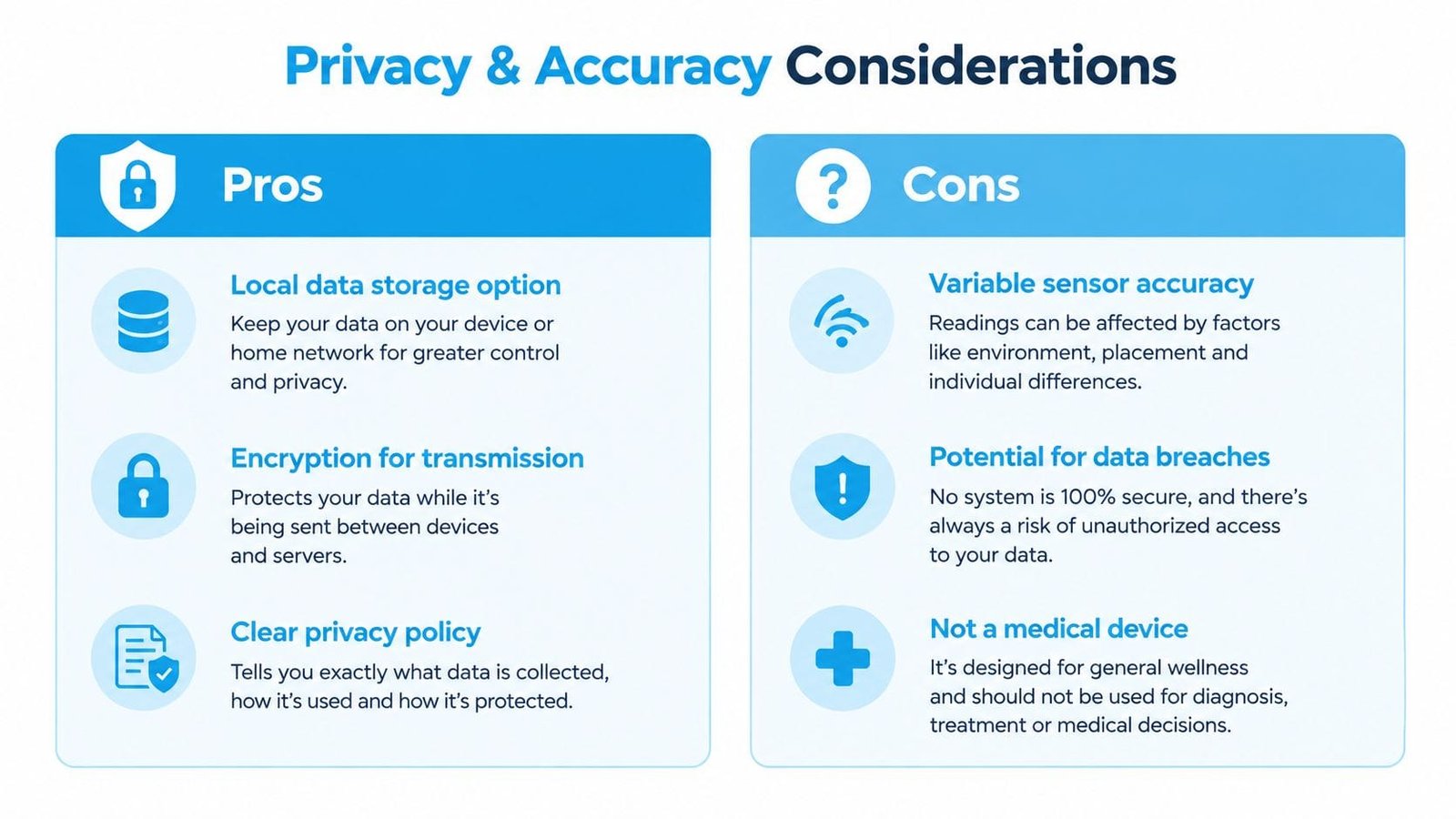
The accompanying privacy overview captures the main tradeoff. A service may offer local storage options, encryption for transmission, and a clear privacy policy, while still facing variable sensor accuracy, possible data breaches, and the limitation that a consumer app isn't a medical device.
Treat stages as clues, not conclusions
Independent clinical literature doesn't support treating consumer sleep-stage breakdowns as medically accurate. One guide summarizes mainstream apps as typically falling within about ±15 to 20% of polysomnography for total sleep time and ±25 to 30% for stage breakdowns (consumer sleep app accuracy guide). A clinical validation study of a smartphone sleep app found poor correlation with polysomnography for sleep efficiency, light sleep percentage, deep sleep percentage, and sleep latency. Its overall epochwise accuracy was 45.9%, despite 85.9% sleep-wake detection accuracy (smartphone sleep app clinical validation study).
That distinction matters for a child who lies still while awake. The app may label quiet wake as sleep, creating an overly reassuring picture of the night. Use manual notes to mark known awakenings, and discuss persistent concerns with a qualified clinician rather than trying to diagnose from an app screen.
Accuracy principle: Act on repeated timing and context patterns. Treat single-night stages and unexplained gaps as uncertain.
How to Use Sleep Data to Improve Routines and Clinical Collaboration
A useful review doesn't require a complicated dashboard. It needs a repeatable habit that turns observations into one careful next step.
Review the week as a story
Begin with the basic timeline. Look for changes in bedtime, settling, night waking, final wake time, and morning behavior. Then add context. Did bedtime resistance follow a particular transition? Did a sensory issue appear before delayed settling? Did a medication, diet change, illness, or unusually demanding day occur near a difficult night?
Keep the interpretation modest. If several nights show the same sequence, treat it as a hypothesis rather than proof. For example, repeated difficulty after a late, noisy evening may justify testing a calmer transition, but it doesn't establish a universal cause.
Change one part of the routine
Choose one small adjustment that fits your child's needs. You might change the order of bedtime steps, offer a preferred clothing option, reduce a difficult sensory input, or make the transition more predictable. Record what changed and continue observing instead of changing several variables at once.
A voice note can preserve the reason behind the decision: “Changed pajamas because the waistband caused distress. Kept the rest of the routine the same.” That level of detail helps you understand whether the change was feasible and whether the outcome was different.
Prepare for professional conversations
Bring a concise summary to a pediatrician, sleep clinician, ABA therapist, occupational therapist, or educator. Highlight recurring observations, known uncertainties, and questions. Don't present an app score as a diagnosis.
Shared access can also reduce repeated explanations. An information sharing platform for family and care teams can help authorized people review the same context, clarify goals, and add observations from home, therapy, or school. Ask each professional what information they need, and share only what supports that conversation.
A clinician may act more readily on “three nights with late settling after a clothing change, followed by difficult mornings” than on a colorful chart with no explanation. The story around the number is what makes the record useful.
Choosing a Calmer Path Forward with the Right Sleep Tracking Support
A sleep tracking app should make family life easier, not turn bedtime into a data collection project. For neurodivergent children, prioritize easy logging, contextual notes, caregiver sharing, privacy controls, and trend-based visuals. Those features help you see the whole routine instead of treating sleep as an isolated score.
The right tool also respects uncertainty. Duration and timing can guide questions, while quiet wake and sleep-stage labels require caution. A consistent record can still be valuable when the device isn't perfect, because your observations add the context a sensor can't detect.
Some families may also explore evening sleep routine apps for routine support. Whatever tool you choose, use it lightly enough that your child's comfort remains the priority.
Guiding Growth offers a centralized place to log sleep alongside behavior, diet, medications, appointments, and care-team observations. Its voice logging and Alma AI support are designed to reduce typing and help parents organize daily information, so visit Guiding Growth to see whether it fits your family's approach to sleep tracking and collaborative care.