Some evenings it happens so fast that parents barely know what started it. Your child was playing, or finishing a snack, or being asked to put shoes on. Then the shouting starts. Maybe they throw something. Maybe they hit, kick, bolt, or collapse into a level of distress that feels far bigger than the moment. You try talking. It makes it worse. You try comforting. They push you away. Later, when the house is finally quiet, you're left with the same aching questions: Was that anger? Was it a meltdown? Did I miss a sign?
Many families call these episodes autism rage attacks because that phrase matches how intense and sudden they can look. In clinical writing, these moments are usually described with terms like aggression, irritability, challenging behavior, or meltdowns. That language shift matters, because it moves the focus away from blame and toward support. It helps parents find strategies that fit what is happening inside the child's nervous system.
If this is happening in your home, you're not failing. Your child isn't choosing chaos for no reason. These episodes usually make more sense when you look at regulation, stress load, sleep, sensory strain, communication pressure, and the small events that piled up beforehand. That same lens also points to what helps.
Parents often need two kinds of support at once. They need practical ways to get through tonight, and they need a calmer way to understand the bigger pattern. If you're also trying to rebuild connection after hard moments, this guide on parenting through meltdowns and repairing trust can help with that part.
Table of Contents
- Introduction What Autism Rage Attacks Really Feel Like
- Understanding Autism Rage Attacks Beyond Anger
- How Common Are Rage Attacks and How They Change Over Time
- Common Triggers and Hidden Amplifiers Behind Outbursts
- Evidence Based Ways to Prevent and De Escalate Episodes
- How Structured Tracking With Guiding Growth Reveals Patterns
- When to Seek Professional Help and Next Steps Forward
Introduction What Autism Rage Attacks Really Feel Like
A child can look furious when they're overwhelmed. That's one of the hardest parts for parents. The outside behavior can seem explosive, but the inside experience is often closer to overload, panic, confusion, or a complete loss of coping capacity.
Why the phrase feels right to parents
When families say "rage attack," they're usually describing a pattern like this:
- A fast switch: Your child seems okay, then suddenly isn't.
- Big outward behavior: Yelling, hitting, biting, throwing, or trying to escape.
- Low access to language: They may not be able to explain what hurts, what changed, or what they need.
- A long recovery: Even after the peak passes, they may stay shaky, tearful, tired, or shut down.
That doesn't mean the behavior is harmless. Safety still matters. But it does mean the episode usually isn't best understood as simple defiance.
These moments often make more sense when you ask, "What overloaded my child?" instead of "Why are they acting like this?"
Why language changes what you do next
If you treat the episode as a behavior problem only, you may focus on consequences after the fact. If you treat it as emotion dysregulation, you start looking for the hidden chain. What happened before the blowup? How full was the child's stress bucket already? Were they tired, overloaded, confused, hungry, in pain, or pushed past their communication limits?
That shift doesn't excuse harmful behavior. It gives you a better map.
A parent might notice that the outburst seems to come "out of nowhere." Then, when they slow it down, they see a different sequence: poor sleep, loud bus ride, scratchy shirt, substitute teacher, hard transition home, then one small request that becomes the final drop in an already full cup.
What helps most at the start
Before you try to solve everything, hold onto three ideas:
| What parents often fear | A more useful frame |
|---|---|
| "My child is becoming aggressive for no reason." | There is usually a pattern, even if it's hidden at first. |
| "This means things will always be this way." | These behaviors can change over time. |
| "I need a perfect response in the moment." | Prevention, pattern tracking, and repair matter as much as the crisis response. |
Understanding Autism Rage Attacks Beyond Anger
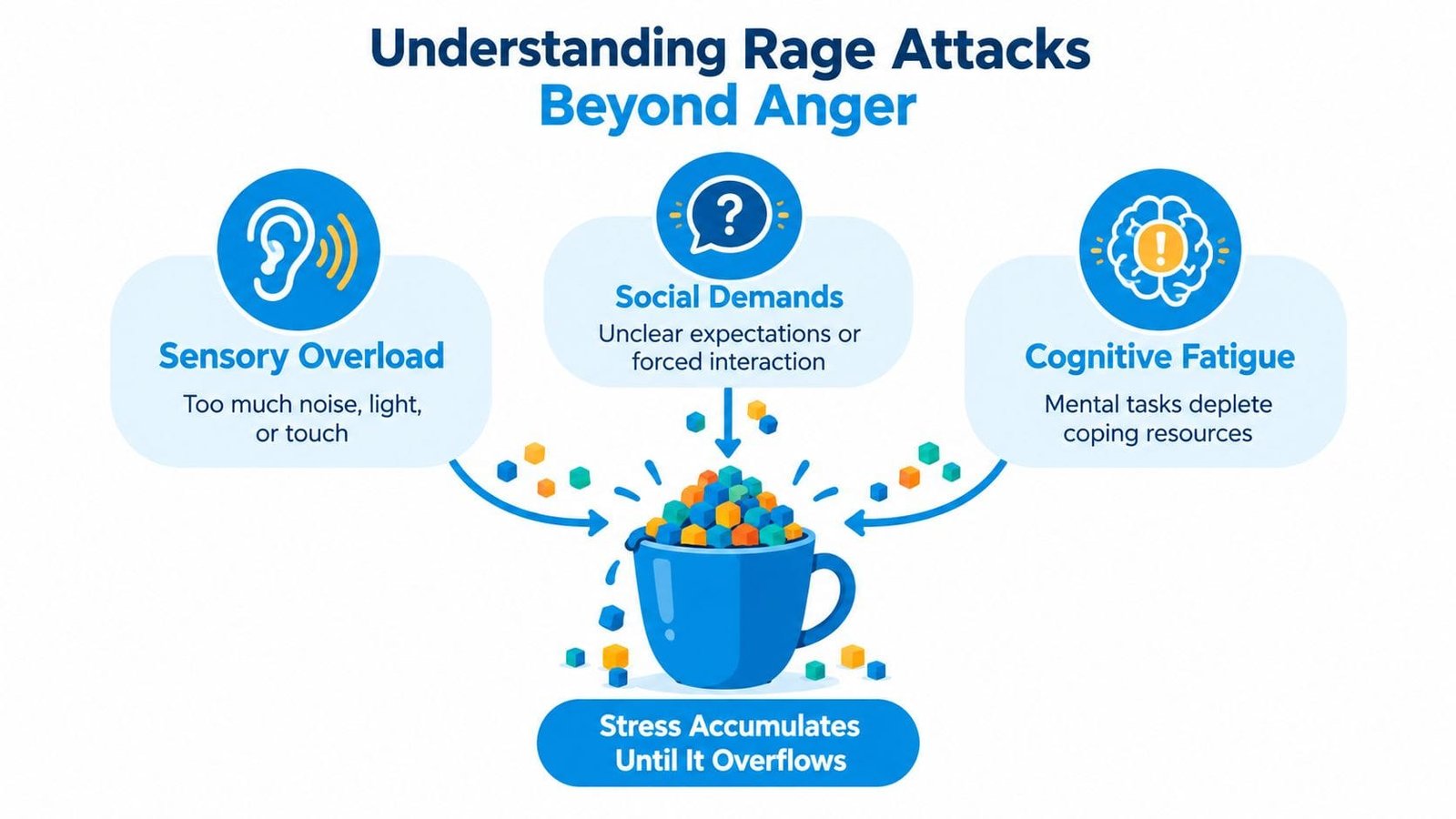
The most helpful reframe is simple. Autism rage attacks are usually not just anger. They are episodes of dysregulation that happen when demands exceed the child's ability to cope in that moment.
The overflowing cup model
A useful analogy is an overflowing cup. Your child starts the day with some space in the cup. Noise fills it. Unclear instructions fill it. Social effort fills it. Waiting fills it. Masking at school fills it. By the time you ask them to stop a preferred activity and come to dinner, that last request may be tiny by adult standards but still enough to spill the whole cup.
This is why the trigger that parents can see is often not the true cause. The visible moment is just the final overload point.
A recent review gives a brain-based frame for this. A 2025 multidisciplinary review describes autistic meltdowns as arising from chronic hypervigilance and acute hyperreactivity to ordinarily benign stressors, and it highlights the insular cortex as a key brain region involved in adapting autonomic state and behavior to environmental demands (multidisciplinary review on autistic meltdowns and hyperreactivity).
What hypervigilance can look like at home
Hypervigilance doesn't always look dramatic. Sometimes it looks like a child who scans for change, reacts strongly to ordinary sounds, or seems "on edge" before anything obvious has gone wrong.
You may notice:
- Body tension: clenched jaw, stiff shoulders, pacing
- Reduced flexibility: "No" to routine changes that might seem minor
- Faster escalation: less ability to tolerate waiting or correction
- More sensory guarding: covering ears, refusing certain clothes, avoiding touch
Here's a short explainer that can help put this pattern into words.
Why social and thinking demands matter too
Emotion regulation difficulties are common in autistic adolescents, and a systematic review found they were consistently associated with internalizing and externalizing symptoms. That same review reported that greater autism symptom severity, lower theory of mind, and social challenges were frequently linked to poorer emotion regulation, while no consistent associations were found with age, gender, or IQ (systematic review on emotion regulation in autistic adolescents).
In plain language, some children aren't only managing feelings. They're also managing confusion about what others expect, working hard to interpret social situations, and using extra mental energy to keep up. That cognitive load adds up.
Core reframe: When a child explodes after a small demand, the problem often isn't the demand itself. It's the total load their nervous system was already carrying.
How Common Are Rage Attacks and How They Change Over Time
A parent may see a child go from calm to explosive over something that looks small, then wonder, "How often does this happen in autism, and will it always be this way?" Those are reasonable questions. The answer is less about a fixed anger problem and more about how often a child's nervous system gets pushed past its limit.
Research numbers vary for a simple reason. Studies do not all measure the same thing. Some count aggression toward caregivers, some include aggression in school or community settings, and some look at a single point in time while others follow children over years. That is why one article can report a high rate and another a lower one without either being wrong.
What the numbers show
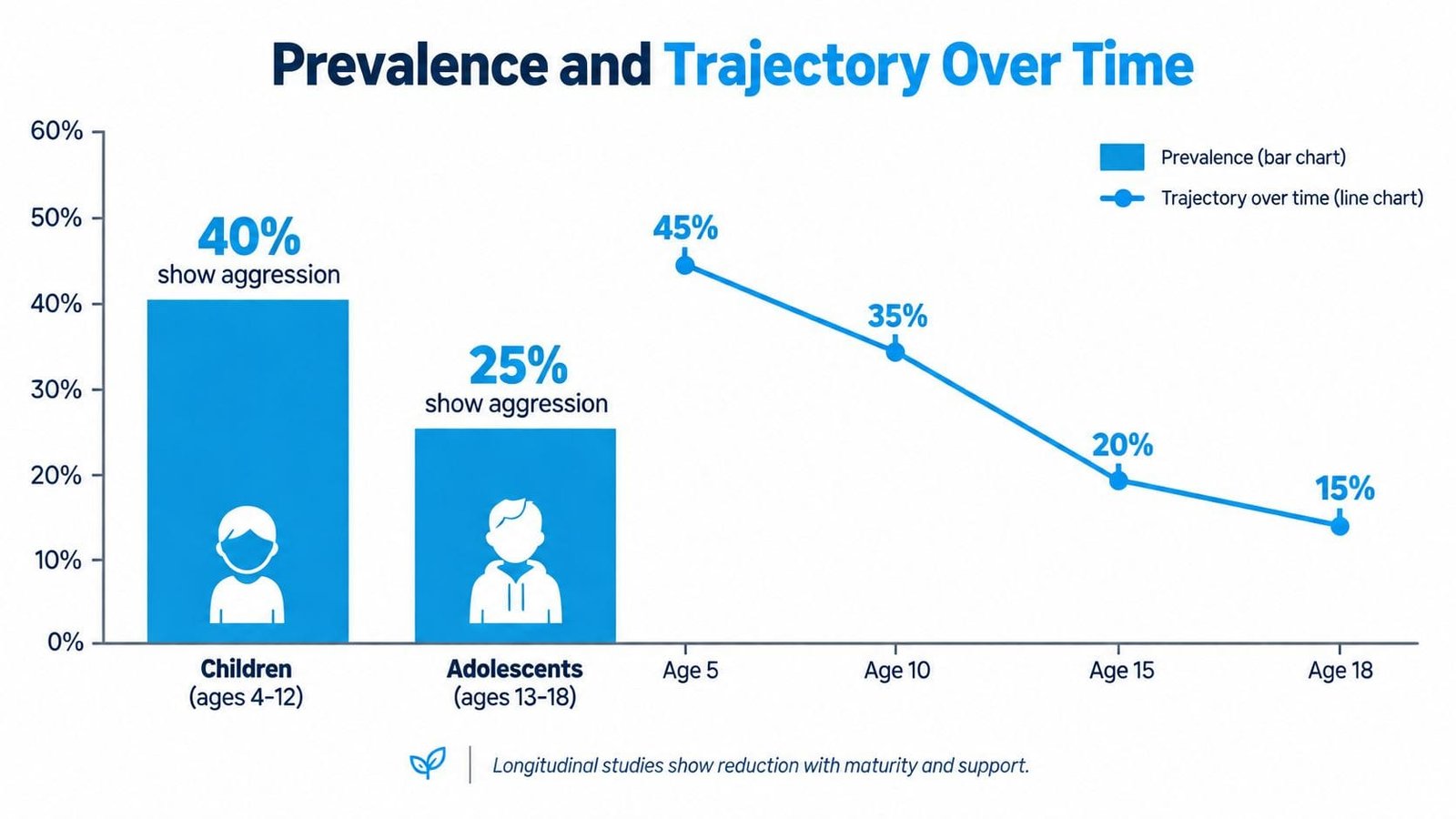
A large longitudinal study found that aggression was common in early childhood and school age, then less common by emerging adulthood, with rates reported at 54.0% at age 2, 69% in school age, and 42% in emerging adulthood. The same review also summarized a wide range across earlier studies, from 8% to 68%, depending on how aggression was defined and measured (longitudinal study on aggression across development).
Other reviews help explain why families can have such different experiences. One review of aggression trajectories in autism described a 10 year pattern in which aggressive behavior became less frequent over time for many participants, dropping from 61.6% at baseline to 45.7% at a second assessment and 22.2% at the final follow up. That same review noted that aggression often rises into middle childhood, peaks around age 9, and then declines for many youth as they move toward adulthood (review of aggression trajectories in ASD).
A helpful way to read these numbers is to picture a fever chart rather than a personality trait. The reading can go up or down. It changes with development, stress load, support, health, and environment.
What changes over time
Improvement is common, but it is rarely a straight line.
Some children have fewer episodes as communication, flexibility, and self regulation grow. Others improve only after hidden drivers are addressed, such as poor sleep, sensory overload, pain, or repeated demand patterns that keep setting off the same chain reaction. A child can look "fine for months" and then have a hard stretch when school demands increase or sleep falls apart.
That pattern matters. It means these episodes are often dynamic states of emotion dysregulation and hyperreactivity, not a permanent level of anger.
Many parents look for one cause. More often, change over time reflects the total load on the nervous system. Lower the load, and the pattern often softens.
Why this matters for parents
The main takeaway is perspective, not prediction.
- Your family is not alone: These episodes are common enough that researchers see them across many autism studies.
- Different numbers do not mean random numbers: Study methods differ, so prevalence estimates differ too.
- Change is possible: Many children show improvement across development, especially when the drivers of dysregulation are identified early.
- Patterns are easier to see when written down: Daily tracking often reveals that "out of nowhere" episodes cluster after poor sleep, high sensory load, illness, transitions, or stacked demands.
Memory after a hard week is like trying to recall last month's weather from one stormy day. A simple log gives you something better than memory. It gives you pattern recognition. That is often the point where families stop guessing and start seeing what has really been fueling the outbursts.
Common Triggers and Hidden Amplifiers Behind Outbursts
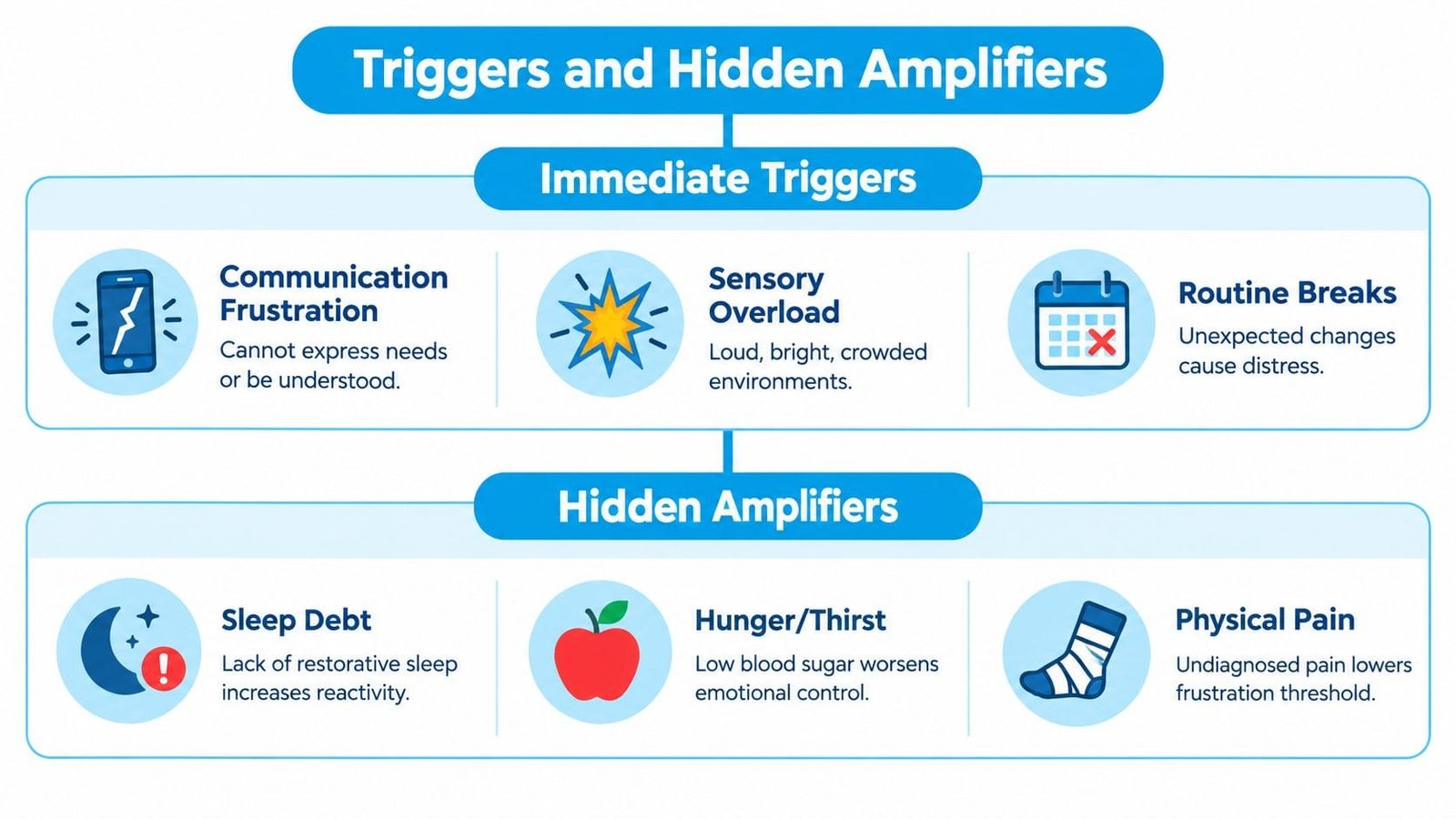
Parents usually notice the obvious triggers first. A denied request. A transition. A loud room. A sibling argument. Those matter. But many autism rage attacks are driven by a combination of immediate antecedents and hidden amplifiers that raised the child's reactivity long before the visible incident.
Immediate triggers you can usually spot
These are the events right before the outburst:
- Communication frustration: Your child can't explain discomfort, protest, or ask for help fast enough.
- Demand pressure: A task starts, a preferred activity ends, or a transition arrives before they're ready.
- Routine disruption: A different route home, a late meal, a substitute teacher, a canceled plan.
- Sensory overload: Noise, crowds, bright light, smells, touch, or clothing textures.
- Social-cognitive load: Too many spoken directions, confusing group situations, or pressure to respond quickly.
Families working on daily structure often find it useful to define a few concrete parenting goals with ABA therapy, especially around transitions, communication, and consistent responses across caregivers.
Hidden amplifiers that often get missed
Some factors don't cause an episode by themselves. They lower the child's threshold so that ordinary stressors hit harder.
A strong example is sleep. Sleep and sensory factors are major, evidence-linked amplifiers of aggression and meltdown risk in autism. Heightened sensory sensitivity, especially tactile and auditory sensitivity, is associated with difficulty falling asleep, while sleep problems then correlate with next-day attention problems, restlessness, and daytime challenging behavior (review on sleep, sensory sensitivity, and daytime behavior).
That means a child who slept poorly because the room felt noisy, the pajamas felt wrong, or their body stayed too alert may wake up with much less room in the cup.
A hard morning often looks like behavior. It may be physiology.
A practical way to think about trigger chains
Try reading episodes as a chain instead of a single event.
| What happened | What it may mean |
|---|---|
| Bedtime took a long time and sleep was broken | Lower baseline regulation the next day |
| Morning routine felt rushed and noisy | Faster stress buildup |
| School demanded social effort and transitions | More accumulated load |
| A small request at home triggered yelling or hitting | Final overload point, not whole cause |
Parents who want a simple way to sort sensory patterns can use this guide on how to identify sensory triggers in autism.
Practical rule: If an outburst seemed bigger than the moment, look upstream. Sleep, sensory strain, pain, hunger, communication load, and transition stress often explain the mismatch.
Evidence Based Ways to Prevent and De Escalate Episodes
Prevention and de-escalation are related, but they aren't the same job. Prevention lowers the chances of overload building in the first place. De-escalation helps once the child is already tipping over.
A systematic review of 95 studies found that explicit emotion-regulation interventions, parent-implemented intervention, reinforcement, visual supports, cognitive-behavioral or instructional strategies, and antecedent-based interventions had the strongest empirical support for reducing or preventing these episodes (systematic review of interventions for emotion dysregulation and challenging behavior).
Prevention works best before the hard moment
The strongest approaches share one idea. Don't wait for the explosion and then do all your teaching there.
Helpful prevention strategies include:
Adjust antecedents
If transitions are hard, prepare earlier. If noise is a problem, reduce noise before the demand. If after-school hours are rough, lower expectations during that window.
Use visual supports
Many children process visual information more easily than spoken language during stress. A first-then board, simple schedule, countdown, or choice card can reduce uncertainty.
Teach replacement skills
"Stop hitting" isn't a replacement skill. "Ask for break," "show help card," "point to all done," and "move to quiet space" are replacement skills.
Reinforce alternatives
Catch the moments when your child uses a safer behavior, even imperfectly. If they hand you a break card, step away instead of throwing, or tolerate a brief wait, that response needs support.
Keep caregivers aligned
Parent-implemented approaches matter because consistency matters. A child does better when home, school, and therapy respond in similar ways.
De-escalation is mostly about reducing load
Once a child is in the peak of dysregulation, reasoning usually won't work well. Processing language gets harder. Flexibility drops. Demands feel bigger.
In that moment, focus on these moves:
- Protect safety first: Move dangerous objects, block harm if needed, and keep other children safe.
- Lower language: Use short, concrete phrases like "You're safe," "Break," or "I'm here."
- Reduce demands: Pause nonessential instructions and correction.
- Lower sensory input: Dim lights, reduce noise, give space, or move to a calmer setting if that helps.
- Offer simple choices: "Water or quiet?" is easier than open-ended questions.
- Co-regulate: Your calm body, slower voice, and predictable presence can help more than explanation.
A practical reference many parents find useful in the moment is this set of 7 de-escalation techniques for autism meltdowns.
What usually backfires
Parents often do these things because they're trying hard, not because they're doing something wrong. But these responses can increase overload:
| During escalation | Why it can backfire |
|---|---|
| Asking many questions | The child may not be able to process language well |
| Lecturing about behavior | Adds demand during low regulation |
| Threats or punishment in the peak | Increases fear and arousal |
| Forcing eye contact or physical closeness | Can intensify sensory and emotional strain |
| Returning to the demand too quickly | Triggers another surge before recovery is complete |
A child in full dysregulation needs less input, not better arguments.
How Structured Tracking With Guiding Growth Reveals Patterns
Memory is a poor behavior tracker. After a rough episode, most parents remember the worst moment and forget the buildup. That's why structured tracking matters so much.
A longitudinal study of aggressive behaviors in autistic individuals reported prevalence of 61.6% at the first measurement, 45.7% at the second, and 22.2% at the third over a 10-year span, with 30% showing persistence across the full decade (10-year longitudinal study of aggressive behaviors). For families, that long view matters. It reminds you to look for patterns over time instead of judging progress by the hardest day this week.
What to log after an episode
You don't need a perfect narrative. You need a few repeatable data points:
- Antecedent: What happened right before the shift
- Setting: Home, car, store, school pickup, bedtime
- Sleep the night before: Short sleep, restless sleep, long sleep onset, early waking
- Sensory context: Noise, clothing, smells, crowds, touch, screen exposure
- Communication load: Was your child trying to explain, protest, or process several directions?
- Outcome: What helped recovery, what made it worse, and how long recovery seemed to take
That turns "He just lost it" into something more usable, like "episodes happen most often after poor sleep plus fast transitions."
What patterns often emerge
Once families track consistently, hidden patterns show up. Outbursts may cluster after late bedtimes. They may spike during rushed mornings, after therapy-heavy days, or when a particular demand appears without warning. Some children show more distress around noise. Others around social uncertainty. Others around delayed access to a preferred activity.
This is also where one practical tool can help. Guiding Growth lets parents log behaviors, sleep, diet, medications, appointments, and contextual triggers in one place, including quick voice logging for moments when typing isn't realistic. That kind of structured record can make it easier to compare sleep with next-day behavior, share a cleaner summary with teachers or therapists, and notice whether the same trigger chains keep repeating.
How to make the data useful to professionals
Bring short summaries, not a giant stack of impressions.
Try a simple format like:
- Most common pattern: "Big episodes happen most often after poor sleep and transitions."
- Most common trigger: "Stopping screens without a visual warning."
- What helps: "Quiet room, low language, water, and delayed problem-solving."
- What doesn't help: "Repeated talking and fast physical prompting."
That gives a pediatrician, therapist, or school team something concrete to work with.
When to Seek Professional Help and Next Steps Forward
Some families can reduce autism rage attacks with environmental changes, skill-building, and better pattern tracking. Other families need added support, and that's not a sign that anyone has failed.
Seek professional help when episodes are becoming more frequent or more intense, when safety is at risk, when your child is hurting themself or others, when sleep disruption is persistent, or when school and family life are being shaped around fear of the next blowup. Help may also be needed when you suspect pain, anxiety, communication barriers, or another unmet need that isn't getting clearer with home strategies.
Who can help and what to bring
Depending on the pattern, useful support may come from a pediatrician, psychologist, behavior specialist, speech-language pathologist, occupational therapist, or sleep-informed clinician. If you need a starting point for assessment options, a CBT-based autism evaluation page like this can help families understand what a more structured evaluation process may involve.
Bring a brief summary of what you've observed:
- Frequency and intensity pattern: getting worse, staying stable, or improving
- Top suspected triggers: transitions, noise, sleep loss, communication breakdowns
- Safety concerns: aggression, elopement, self-injury, property destruction
- What helps recovery: quiet, visuals, reduced demands, sensory supports
- What you've ruled out or still wonder about: pain, GI discomfort, medication timing, school stress
Small progress still counts. A shorter recovery time, one safer replacement behavior, or one less explosive transition is real progress.
The goal isn't to stop every big feeling. It's to help your child carry those feelings with more support, more safety, and less overwhelm.
If you're trying to connect sleep, sensory load, triggers, and behavior without relying on memory, Guiding Growth gives you one place to log meltdowns, routines, sleep, diet, medications, and appointments. It can help you turn scattered hard moments into clearer patterns you can act on and share with the people supporting your child.