A child points toward the kitchen, vocalizes, and reaches. You offer the snack you think they want. They push it away, cry, or pull you toward the cupboard. The problem isn't a lack of communication. The problem is that the child's message and your interpretation aren't meeting clearly.
Picture cards for autism can give that message a reliable form. A card can help a child request a preferred item, reject something, make a choice, begin an interaction, or participate in a routine without waiting for an adult to guess. Used well, picture cards aren't a test of compliance or a promise that speech will appear. They're a practical communication bridge that should be selected, taught, observed, and adjusted around the child's real life.
Table of Contents
- Why Picture Cards Work and What They Do
- Choosing the Right Picture Card System for Your Child
- Creating Effective Picture Cards That Get Used Daily
- Teaching Picture Cards with Prompts, Fading, and Data
- Troubleshooting Common Problems and Adjustment Strategies
- Going Beyond Picture Cards and Tracking Progress Over Time
- Frequently Asked Questions About Picture Cards for Autism
Why Picture Cards Work and What They Do
A child may understand exactly what they want at breakfast while lacking a dependable way to express it. Pointing can mean several things. Pulling an adult's hand signals urgency but may not identify the request. When repeated attempts fail, distress can escalate because the message has not been understood.
A picture card creates a clear exchange. The child gives a picture representing a preferred food, activity, or object, and the communication partner responds. The routine is simple, but it changes the interaction from adult guesswork to a message the child can initiate and control.

The strongest outcome is functional communication
Research supports picture-card interventions most clearly when the goal is functional communication, particularly independent requesting. A 2026 systematic review and meta-analysis of randomized controlled trials reported a large overall effect on communication skills, with an SMD of 0.95. It also found benefits for maladaptive behaviors, social skills, and health-related quality of life, but no significant effect for language development (systematic review and meta-analysis).
That distinction guides realistic home goals. A child may learn to ask for bubbles, a favorite toy, or a break with much less frustration without suddenly speaking in sentences. The communication outcome has improved, even if spoken language has not changed at the same pace.
Earlier evidence shows a similar pattern. A 2017 pragmatic randomized controlled trial found more initiations after PECS teacher training, with an odds ratio of 2.72 for placement in a higher initiations category and 3.90 for placement in a higher PECS usage category. The trial found no increase in speech, ADOS-G ratings, or language test scores, and treatment effects were not maintained after active intervention ended (trial summary).
Practical rule: Track independent requests and spoken communication as separate outcomes. Progress in one does not guarantee an immediate change in the other.
A bridge, not a speech guarantee
Some families worry that cards will reduce a child's motivation to talk. A 2008 systematic review of AAC interventions found that AAC interventions did not impede speech production. Most included studies reported increased speech production, although the gains were modest (AAC systematic review)).
The practical aim is communication access now. Pair cards with natural spoken language, pause after offering choices, and respond to vocal attempts without requiring speech before honoring the card exchange. A child should not need to experience repeated communication failure to receive support.
Picture cards work best when adults judge them by daily function, not by speech alone. Fewer frantic pulls, more independent choices, a request made with another caregiver, or a return to the cards after a disrupted routine all show useful progress. If the system becomes difficult to carry, update, or use across settings, a digital option such as Guiding Growth may be easier to maintain. The decision should follow the child's access needs and the family's actual routines.
Choosing the Right Picture Card System for Your Child
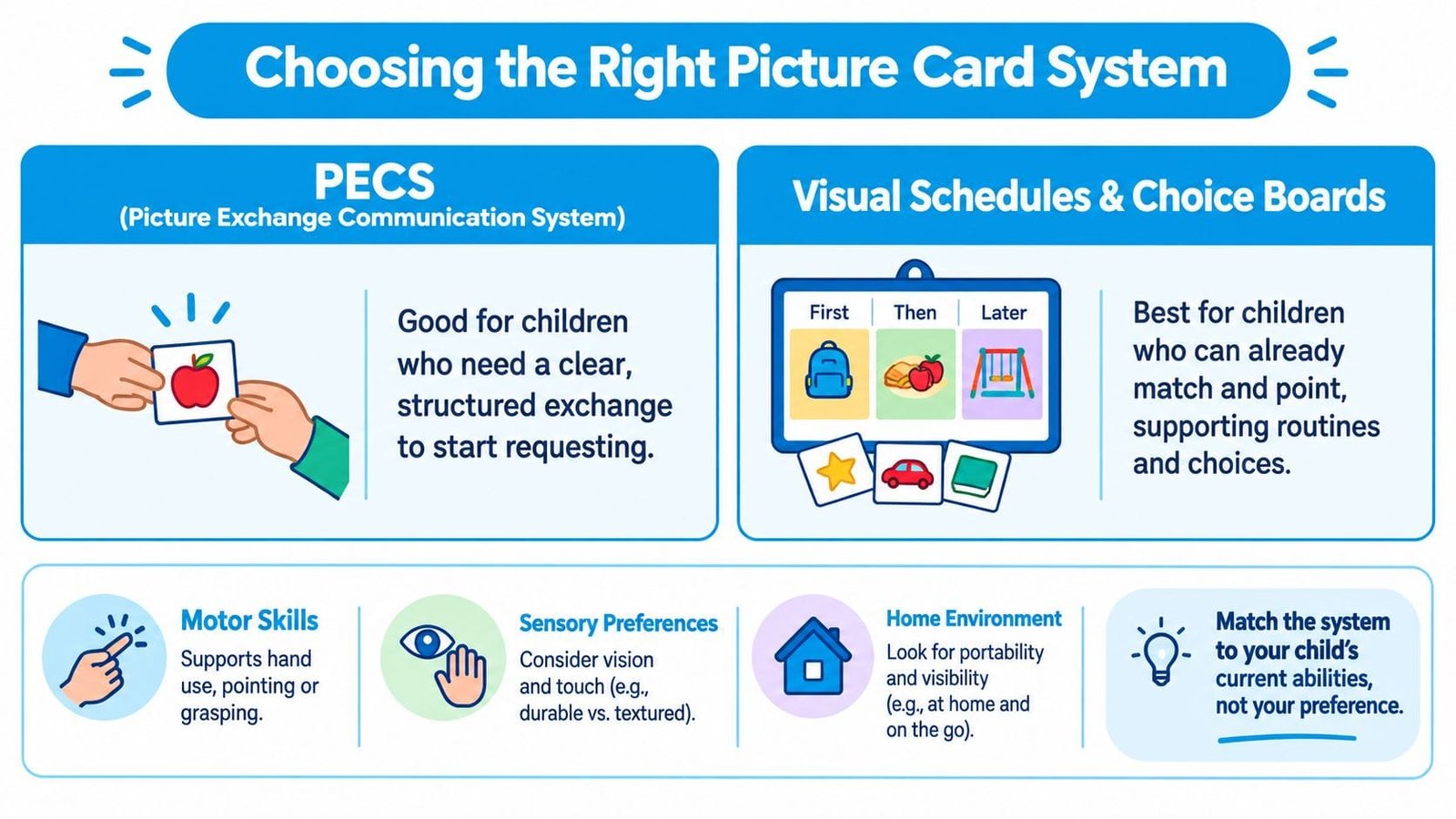
There isn't one universally correct picture-card format. The right choice depends on what the child can currently do, including reaching, grasping, matching, scanning, pointing, shifting attention, and tolerating visual information.
PECS, or the Picture Exchange Communication System, uses a structured hierarchy. It begins by teaching a child to initiate an exchange and progresses from single-picture requests toward discrimination, sentence strips, and more complex communication. PECS was developed in 1985 at the Delaware Autism Program by psychologist Andy Bondy and speech-language pathologist Lori Frost, giving it a long history as a structured AAC method (PECS history).
A choice board may suit a child who already points to or matches symbols. A core-word board may provide flexible language such as “more,” “stop,” “help,” and “go,” while fringe vocabulary names specific foods, toys, people, or activities. Static symbols can work well when visual clarity matters more than a large vocabulary display.
Match the system to the child
Look at the communication task before choosing the materials. A child who grabs an adult's hand and has a strong preference for concrete objects may benefit from a clear exchange routine. A child who points accurately but becomes overwhelmed by a crowded page may need a sparse choice display. A child who can interpret symbols across settings may be ready for a more flexible board or digital AAC assessment.
| Approach | Best For | Key Limitation | Typical Next Step |
|---|---|---|---|
| PECS | Children who need a clear, structured exchange to begin requesting | Requires consistent phased teaching and partner participation | Build discrimination, sentence structure, and generalization |
| Core and fringe word boards | Children who need flexible vocabulary across routines | May be difficult if the display is visually crowded | Reduce or expand vocabulary around daily communication |
| Choice boards | Children who can point to or match symbols | Often supports choices without teaching a full initiation sequence | Add more functions, such as refusal, help, and commenting |
| Static symbol cards | Children who benefit from simple, visually consistent supports | Limited flexibility when needs change | Reorganize cards or combine them with another AAC format |
A useful reference for families comparing PECS with visual schedules and communication books is this guide to PECS communication books for autism. Keep the system visible, portable, and available during the routines where communication matters most.
Digital support becomes worth considering when a child is moving beyond single-item requests, has difficulty generalizing paper symbols, or the adults supporting them can't maintain consistent tracking. Guiding Growth can centralize observations about communication, routines, sleep, diet, behavior, appointments, and therapy sessions, giving families a broader record to discuss with professionals.
Creating Effective Picture Cards That Get Used Daily
A card system fails when it's technically complete but inconvenient. Cards stay in a drawer, the communication book is too bulky for the playground, or the symbols are so similar that the child can't tell them apart. Build for the moments when the child needs to communicate, not for an attractive collection of vocabulary.
Start with a small, high-value set. Choose items and actions that matter during ordinary routines, such as a preferred snack, drink, tablet, outside, tickle, music, help, stop, and finished. A focused set gives you clearer information about what the child understands and uses than a large collection introduced all at once.
Build for handling and visibility
Use sturdy card stock or another durable base, then laminate cards that will be handled frequently. Rounded edges can reduce sharp corners, while a hole punch and binder ring can keep a small portable set together. Velcro can work inside a communication book, especially when cards need to be removed and returned repeatedly.
Official PECS materials describe pictures as either black-and-white or color drawings (PECS materials). The most important feature isn't whether the image is colored. It's whether the child can recognize it quickly and whether everyone uses the same symbol consistently.
Keep the background uncluttered, use clear borders, and avoid changing symbol styles without a reason. If a photograph of the child's actual cup is easier to understand than a line drawing, begin there. You can gradually test more abstract symbols as the child's discrimination skills develop.
Organize by routines, not alphabet
Alphabetical storage helps adults, but activity-based organization helps children communicate. Place snack-related cards together, keep outdoor cards in a portable pouch, and store calming or break-related cards where those routines happen.
Useful groupings include:
- Snack and meals: food, drink, more, different, finished, help.
- Play: favorite toys, music, bubbles, swing, turn, stop.
- Transitions: outside, car, school, home, wait, first, then.
- Comfort and regulation: break, quiet, squeeze, headphones, finished.
Put the communication book or card strip where the child can reach it without asking an adult to retrieve it. At the same time, keep duplicate high-value cards in more than one relevant location so the child doesn't learn that communication only works at the kitchen table.
Before teaching, arrange the environment so motivation is visible but the preferred item isn't freely available at that moment. Have the card ready, identify the communication partner, and respond quickly when the exchange happens. Ordinary routines provide better teaching opportunities than long artificial drills because the message has an immediate purpose.
Teaching Picture Cards with Prompts, Fading, and Data
The cards don't teach communication by themselves. The adult has to create a clear exchange, provide help without taking over, and then reduce that help as the child becomes more independent.
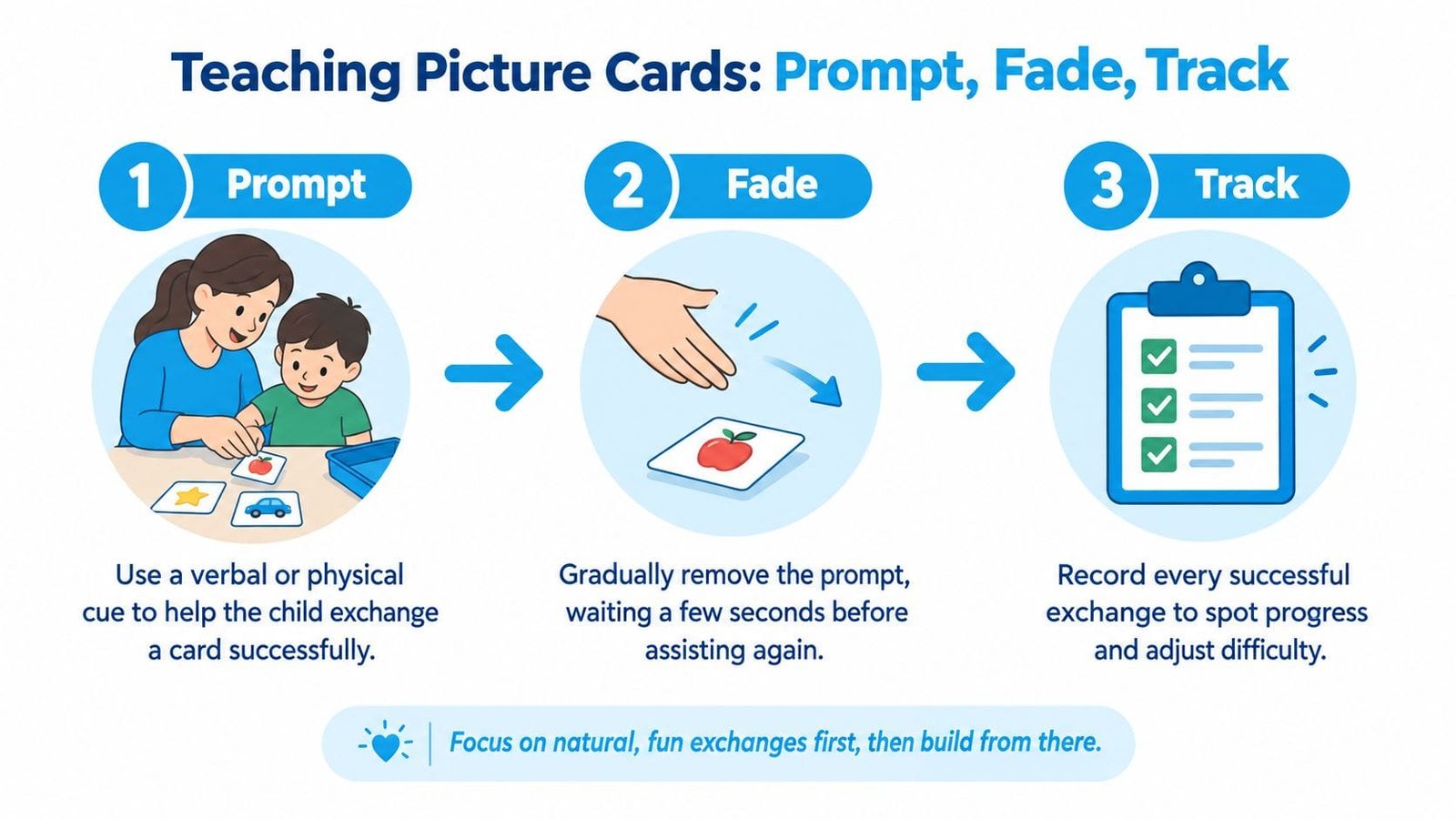
Begin with a highly motivating item or activity. Keep the matching card accessible, allow the child to show interest, and help them complete the exchange if needed. Deliver the requested item promptly so the child experiences the connection between the card and the outcome.
Prompt without creating dependence
A prompt should make success possible, not replace the child's action. Depending on the child and the teaching plan, support may include moving the card closer, gesturing toward it, modeling an exchange, or providing physical assistance. Use the least intrusive support that allows the child to finish the action safely and successfully.
After successful exchanges, pause before helping again. Give the child time to reach, choose, or initiate. If the child waits for an adult every time, the prompt may be arriving too quickly or remaining in place too long.
A useful sequence is:
- Arrange: Place the desired item in view and make the relevant card available.
- Wait: Allow an opportunity for the child to initiate.
- Assist: Provide only the support needed to complete the exchange.
- Respond: Honor the request promptly and naturally.
- Fade: Reduce physical, gestural, or verbal help across opportunities.
Avoid turning every exchange into a demand to repeat words. If the child vocalizes while exchanging the card, respond warmly and model the word, but don't make speech a condition for receiving the requested item.
Here's a short visual demonstration to help caregivers see how an exchange can be supported in practice:
Generalize and record what matters
Practice with different people and in different locations. A child who exchanges a card with a parent in the kitchen may need deliberate opportunities with another caregiver, at the front door, in the car, or during play. Structured caregiver training and planned generalization probes matter because implementation quality affects whether the skill transfers beyond the original teaching context (caregiver PECS study).
Keep data simple enough to maintain. Record whether a request was independent, prompted, refused, or followed by avoidance. Note the routine and relevant context, such as a schedule change, poor sleep, hunger, or a difficult transition.
The communication cards resource for autism can support families as they think through communication opportunities. A broader tracker can also help connect card use with behavior and routine patterns, rather than treating each exchange as an isolated event.
Troubleshooting Common Problems and Adjustment Strategies
A difficult exchange often points to a mismatch in the system, not an inability to communicate. Check the pictures, layout, motivation, prompting, and setting before changing the whole approach.
When the child can't discriminate pictures
Treat repeated selection errors as a design problem first. Reduce the visual field temporarily, increase contrast between choices, and use symbols that look clearly different. Avoid placing nearly identical images together until the child has a reliable way to compare them.
Comparative evidence on PECS and a speech-generating device found improved requesting across participants, while picture-discrimination difficulties still occurred (comparative evidence). Practically, repeating the same confusing arrangement is unlikely to solve the problem. Change one feature at a time, then check whether accuracy improves.
When use stays tied to one setting
Generalization requires planned practice. Move the cards across routines, change communication partners, and create short opportunities in places where the child has a real reason to request. Record whether initiation occurs with a parent, caregiver, educator, or therapist, rather than measuring progress only in the easiest familiar context.
A child who exchanges a card in the kitchen may not yet use it at the front door, in the car, or during play. Build those situations gradually, with the same symbols and clear access to meaningful outcomes.
Watch the pattern, not one difficult day. Fatigue, sensory overload, illness, or an unexpected schedule change can temporarily reduce communication without showing that the system has stopped working.
When prompts become the routine
If the child waits for hand-over-hand help, the adult may be prompting too quickly or too strongly. Pause longer, place the system within easy reach, and reinforce movement toward an independent exchange. Coordinate prompt-fading decisions with the professionals supporting the child, particularly when physical prompting causes distress.
Avoidance can indicate an overloaded environment or vocabulary that does not match the child's immediate needs. Add cards for “break,” “stop,” “help,” or “different” when those messages are relevant, and respond consistently when the child uses them.
A newer format may be worth testing when careful teaching produces little progress. In a targeted comparison of augmented reality and picture cards for auditory-visual discrimination, all participants succeeded with augmented reality, while only one acquired, generalized, and maintained the skill in the picture-card condition. The authors also reported stronger social validity for augmented reality (augmented reality comparison). This does not make digital tools automatically better. It supports a measured trial when paper cards remain difficult, while keeping cards available if they are faster or more reliable in daily routines.
Going Beyond Picture Cards and Tracking Progress Over Time
Picture cards can be a starting point, a long-term support, or one part of a blended communication system. The right endpoint isn't determined by age or by another child's trajectory. It's determined by whether the current system lets the child communicate what they need across the environments that matter.
A child may begin with a single request card, then use several symbols, combine pictures on a sentence strip, add spoken words, or use a speech-generating device alongside low-tech supports. Another child may continue to rely on cards because they remain efficient and understandable. Keeping paper cards available can also provide a useful backup when a device is charging, unavailable, or too difficult to use during a stressful moment.
Let progress guide the next format
Consider a change when the child:
- Needs richer messages: Single-item requests no longer cover comments, refusals, questions, or descriptions.
- Handles symbols well: The child can scan, match, or select reliably and may be ready for a broader display.
- Needs portability: Communication must work across school, travel, appointments, and community routines.
- Shows persistent barriers: Discrimination, motor access, or visual overload remains difficult despite thoughtful adjustments.
A digital transition shouldn't erase what already works. A blended plan can keep a small card set for urgent needs while introducing device-based communication for more complex messages.
Long-term decisions improve when families record context rather than relying on memory. Guiding Growth is designed to organize observations about communication attempts alongside meltdowns, shutdowns, demand avoidance, echolalia, hand flapping, sleep, diet, medications, appointments, and therapy sessions. Quick voice logging can reduce the burden of typing, while shared records can help caregivers and clinicians discuss patterns using the same information.
Families can also use visual supports for social skills training as part of a broader plan. The important shift is from asking whether cards “worked” to asking which messages the child can now communicate, with whom, where, and under what conditions.
Frequently Asked Questions About Picture Cards for Autism
How soon should a child use picture cards independently?
There is no universal timetable. Look for practical changes: the child reaches for the cards, approaches a communication partner, completes an exchange with less help, or uses the system with a new person or in a new place. Track these changes instead of judging progress only by spoken language.
Do picture cards help autistic children speak?
Picture cards can support communication while speech develops. Research on AAC has not shown that these interventions prevent speech production, as noted in the earlier review. Speech gains linked with PECS remain mixed, while functional requesting is more consistently supported. Model spoken words with the card, accept vocal attempts, and honor communication without requiring speech first.
When should we move to a device or another system?
Request a broader AAC assessment when the child needs complex messages, continues to struggle with static symbols after careful adjustments, or communicates more effectively through another access method. A device can supplement cards rather than replace them immediately. The communication team should review the combination with the child and caregivers.
Progress is rarely linear. Track what the child communicates, with whom, where, and under which conditions. Guiding Growth helps families organize communication observations alongside behavior, routines, sleep, diet, appointments, and therapy information, including quick voice logging. Shared records can help caregivers and clinicians identify patterns and make better-informed decisions.