Your child is pulling you toward the pantry, crying harder by the second, and you know they want something. You just don't know what. You try choices. You point. You guess. They get more upset. You feel helpless, and they feel unheard.
That moment is where many families start looking into a PECS communication book for autism. Not because they want something complicated, but because they need a clear, usable way for a child to say, “I want juice,” “I need help,” or “I'm done.” A good PECS book can turn daily friction into a real exchange between two people.
PECS works best when it's built carefully, taught systematically, and used far beyond the therapy table. It also works better when adults stop relying on memory alone and start noticing patterns in how communication changes across routines, sleep, stress, and support. That combination, old-school structure plus better tracking, is where many families make their biggest gains.
Table of Contents
- Why a PECS Book Can Transform Communication
- Assembling Your Child's First PECS Book
- A Practical Guide to the Six Phases of PECS
- Mastering Prompting and Fading Techniques
- Troubleshooting Common PECS Challenges
- Helping Skills Generalize Beyond the Home
- Tracking Communication Growth with Data
Why a PECS Book Can Transform Communication
A PECS book gives a child a reliable way to initiate. That's the key difference. Instead of waiting for an adult to guess, prompt, or fill in the blanks, the child learns to hand over a picture to communicate a real need or interest.
PECS stands for Picture Exchange Communication System. It was developed in the USA in 1985 by Andy Bondy, PhD and Lori Frost, MS, CCC-SLP, and it remains one of the most widely used structured systems for teaching functional communication to autistic children. It isn't just a stack of picture cards. It's a teaching protocol with clear phases, defined adult roles, and a strong focus on spontaneous communication.
What makes it worth trying
The biggest shift families notice first is emotional, not academic. A child who can request a snack, a toy, a break, or help has a way to influence their world. That matters.
A strong research base supports that practical value. A meta-analysis of 13 studies on PECS found a significant positive effect on functional communication for individuals with ASD, especially for preschool-aged children. The same review also found that PECS does not delay or inhibit spoken language acquisition.
Practical rule: Don't wait for perfect readiness. If communication is hard right now, giving a child a usable system matters more than waiting for speech to emerge on its own.
Many parents worry that pictures will replace talking. In practice, that fear often keeps children stuck longer than necessary. PECS is designed to build communication first. Speech can grow alongside it. If you're comparing options, this guide to communication devices for nonverbal children can help place PECS within the wider AAC picture.
What PECS does well
PECS is especially useful when a child:
- Needs a concrete starting point and doesn't yet use speech consistently
- Struggles to initiate even if they understand more than they can express
- Gets frustrated quickly when adults don't understand what they want
- Benefits from visual information and clear motor routines
It's not magic, and it isn't plug-and-play. Adults have to prepare materials, choose motivating items, respond consistently, and resist the urge to over-talk during teaching. But when the system matches the child and the adults use it well, a PECS book can become the first dependable bridge between wanting something and being understood.
Assembling Your Child's First PECS Book
Start simple. The first PECS book does not need to look polished or expensive. It needs to be durable, easy to carry, and built around things your child wants.
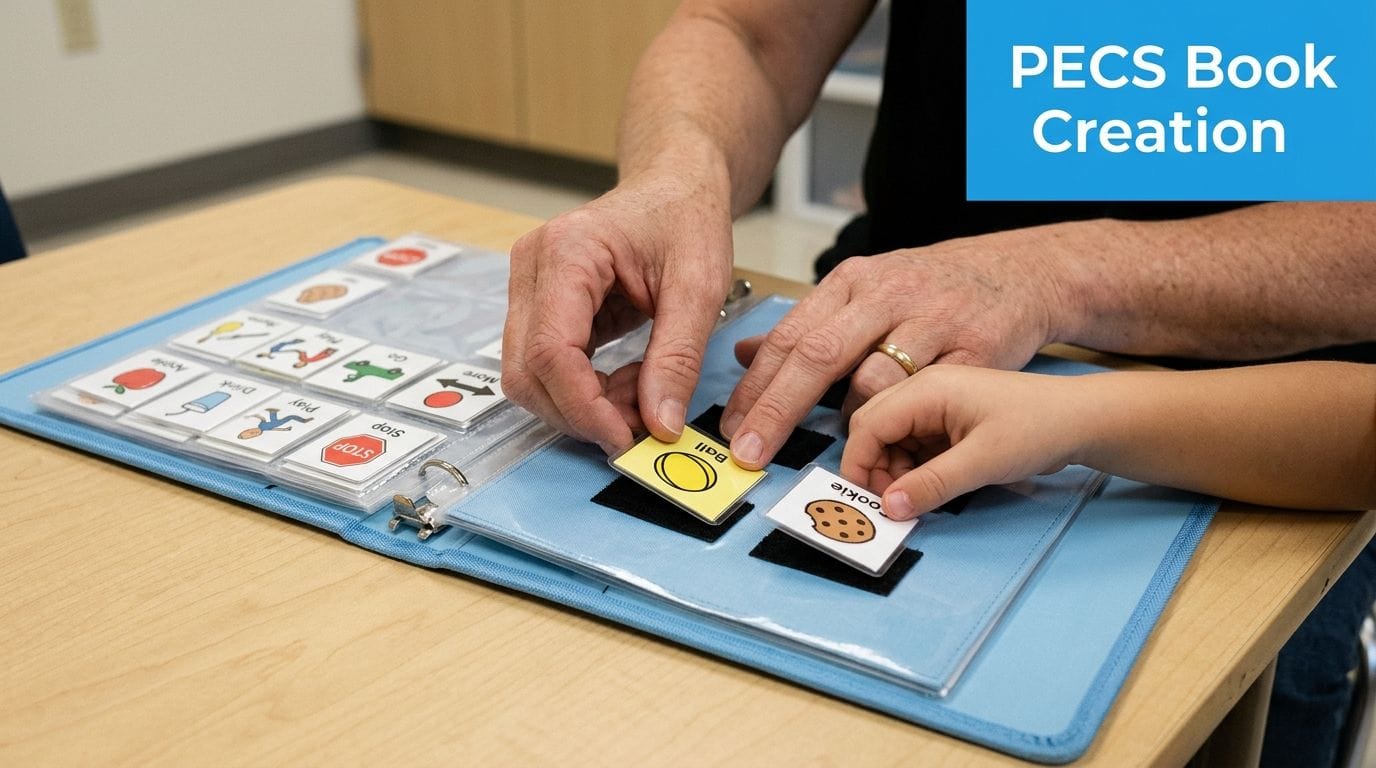
Most families do better with a small binder or sturdy folder than with loose cards. Loose cards disappear into couch cushions, get bent, or turn into confetti. A book creates a home base. It also teaches the child that communication materials travel with them.
What to gather first
You don't need a giant symbol library on day one. You need a manageable setup.
- A sturdy binder or communication book with pages that can handle frequent opening and closing
- Laminated picture cards or cardstock cards covered for durability
- Velcro so cards can be removed and exchanged easily
- A sentence strip for later phases
- A carry method such as a handle, shoulder strap, or spot in the stroller bag
- A first set of high-interest pictures based on your child's strongest motivators
The most common early mistake is building the book around what adults think a child should request. Start with what the child already loves. Think favorite snack, specific cup, bubbles, tablet time, swing, tickles, a certain song, or a preferred video.
If you need a starting point for printable visuals, these ASD communication cards can help you organize the first set of practical requests.
How to choose the first pictures
Use real motivation, not theory. If your child would cross the room for mini pretzels but ignores crackers, use mini pretzels. If they only want one exact stuffed animal and not “toys” in general, make a card for that item.
A first set often works better when it includes:
- Immediate rewards such as a snack or favorite sensory item
- Repeatable opportunities so the child can practice many times in a day
- Clear differences between items to reduce confusion later
- Portable choices you can bring into different routines
The best first card is not the cutest one. It's the one your child is most motivated to exchange right now.
Avoid filling the book with colors, numbers, and classroom labels before the child understands the exchange itself. A thick book looks organized to adults, but it can overwhelm a beginner.
Make it usable, not just pretty
Place the most valuable items in easy reach. Keep pages uncluttered. Test whether the cards peel off smoothly. If the Velcro is too weak, the cards fall off. If it's too strong, the child spends more energy pulling than communicating.
This short demonstration can help you picture the physical setup and handling in real life.
A good first book feels boring in the best way. It works. It survives spills. Adults can grab it quickly. The child can find what matters. That's what you want.
A Practical Guide to the Six Phases of PECS
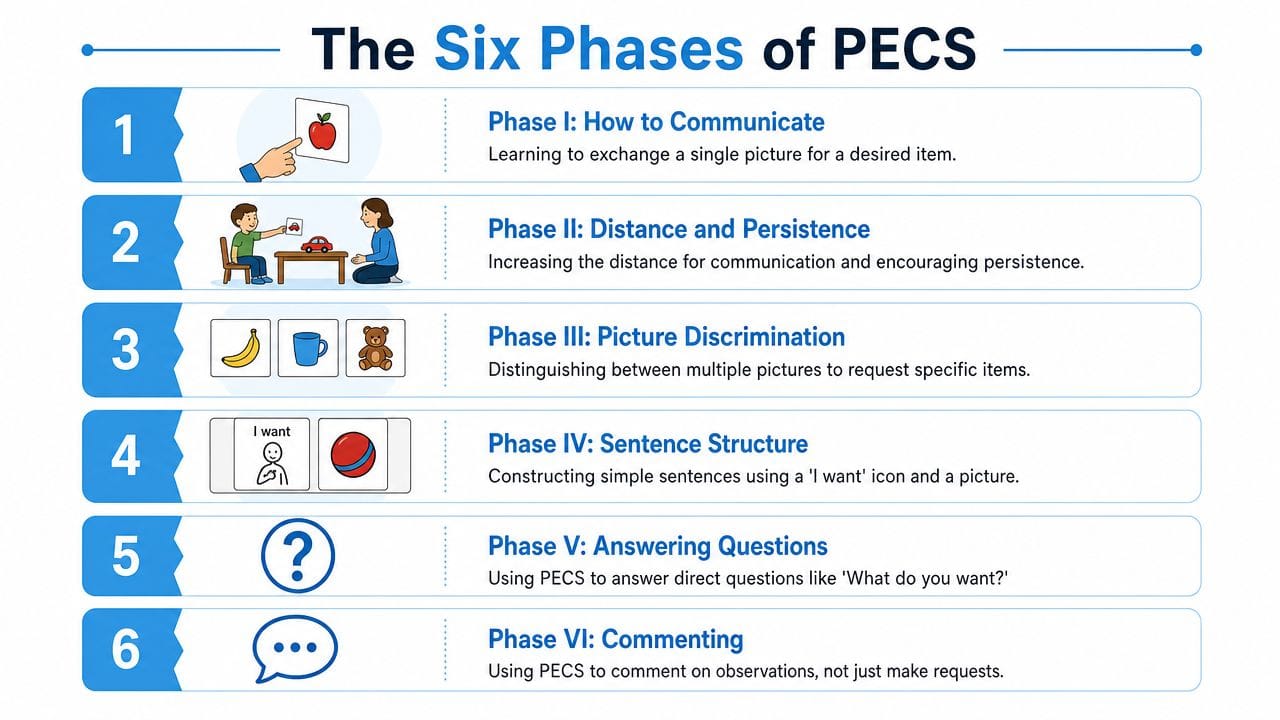
PECS is a sequence. Families often run into trouble when they treat it like a generic picture board and skip the teaching structure. Each phase builds on the last one, and the child needs enough success at one level before moving on.
Phase by phase in plain language
| Phase | What the child learns | What adults need to do |
|---|---|---|
| Phase I | Exchange one picture for one desired item | Create a fast, rewarding exchange |
| Phase II | Travel to the book, reach the partner, persist | Increase distance without losing motivation |
| Phase III | Choose between pictures | Teach discrimination carefully |
| Phase IV | Build a simple sentence strip | Introduce “I want” plus item |
| Phase V | Answer “What do you want?” | Ask after the child can already initiate |
| Phase VI | Comment on what they see, hear, or notice | Expand beyond requesting |
Phases I and II
In Phase I, the child learns the core idea: “If I hand this picture to a person, I get the thing I want.” The adult's job is to honor the exchange quickly. Keep language minimal. Long verbal explanations often slow learning.
In Phase II, the child learns that communication takes effort. They may need to go to the book, remove the picture, move toward the communication partner, and hand it over. Persistence matters here. If the partner is two steps away, the exchange still needs to happen.
Keep the reward immediate. Early PECS breaks down when adults turn a clear exchange into a quiz, a waiting game, or a speech drill.
Phases III and IV
Phase III introduces picture discrimination. Now the child has to pick the correct picture from more than one option. Sloppy setup at this stage creates confusion. Don't place five similar snack cards in front of a child who is just beginning to discriminate. Use clearly different items and rotate thoughtfully.
Phase IV adds sentence structure with a strip, usually beginning with “I want” plus the item picture. At this point, the child is no longer only exchanging a single card. They're constructing a basic request.
Research on outcomes shows that consistency matters. One study found that higher training frequency, defined as more than 6 sessions per year, and frequent home practice, defined as 3 or more times per week, were significant predictors of proficiency in PECS phases, according to this study on PECS predictors and practice frequency.
Phases V and VI
Phase V teaches the child to answer, “What do you want?” This comes after initiation is already present. If adults start here too early, the child can become dependent on questions instead of learning to approach and communicate independently.
Phase VI expands into commenting. The child may use PECS to respond to things they notice, not just things they want. That's a different communication function, and it requires a broader teaching approach.
A few points help families stay grounded:
- Move only when the current phase is solid
- Teach in short, frequent opportunities
- Use strong reinforcers, not random materials
- Keep the book available across the day
- Coordinate with therapists and school staff so the teaching response stays consistent
PECS works best as a daily habit, not a once-a-week activity that only appears at the table.
Mastering Prompting and Fading Techniques
Prompting is where many adults accidentally help too much. They point to the card, say “Give me the picture,” hold out their hand, repeat the item name, and then wonder why the child waits for all of that every time.
The point of a prompt is to help the child succeed once. The point of fading is to help the child stop needing that help.
Use the least help that still works
Think of prompts on a ladder from more intrusive to less intrusive. A child who is brand new to exchanging may need physical guidance at first. Another child may only need the book positioned closer. The right prompt is the one that gets a correct response without becoming a permanent crutch.
Common prompt types include:
- Physical prompts such as guiding the hand toward the picture or exchange
- Gestural prompts such as pointing to the card or open hand
- Positional prompts such as placing the target picture closer
- Visual prompts such as arranging the page to reduce clutter
- Verbal prompts which should be used carefully because they can create dependence fast
Verbal prompting is often the sneakiest problem. Adults mean well, but a child can learn to wait until they hear “What do you want?” or “Use your words” before acting. That isn't independent communication.
Clinical habit to keep: Pause before you speak. Many children need a moment to scan, reach, and act.
Fade faster than feels comfortable
If a child succeeds with a prompt several times, look for a way to reduce that prompt. Don't keep using full physical guidance just because it feels safe. Move to a lighter touch, then to a gesture, then to a pause.
A simple way to think about fading:
- Support the exchange enough for success
- Repeat while watching for initiation
- Remove one layer of help
- Stay quiet long enough for the child to act
- Reinforce the independent attempt immediately
Watch the child, not your lesson plan. If they're reaching toward the correct picture before you touch them, you're probably prompting too much. If they freeze completely when support drops, you may have faded too quickly.
What good prompting looks like in daily life
At snack time, you place the preferred item in view but out of reach. The child notices it. You wait. If they reach toward the book and grab the picture, great. If not, you provide the smallest prompt that helps them complete the exchange. Then you give the snack right away.
That sequence is clean. No long lecture. No repeated command. No forcing eye contact. Just a clear route from communication to result.
When prompting is done well, the adult becomes less visible over time. That's success.
Troubleshooting Common PECS Challenges
A rough week with PECS doesn't mean the system is failing. It usually means something in the setup, motivation, or teaching response needs adjusting.
One of the strongest practical reasons to stay with it is that PECS use is linked to a 60 to 80 percent reduction in problem behaviors related to communication frustration, because it gives the child a more reliable way to make needs known, as described in this overview of how PECS supports communication and behavior. That doesn't mean every hard behavior disappears. It means better communication often removes one major source of stress.
When a child ignores the pictures
The usual reason is motivation, not stubbornness. The picture may represent something the child doesn't care enough about in that moment, or the reward may come too slowly after the exchange.
Try this:
- Rebuild the reinforcer list by checking what the child seeks out right now
- Offer fewer choices so the page isn't visually busy
- Shorten the delay between exchange and reward
- Practice during naturally motivated moments such as snack, bubbles, outside play, or favorite songs
If the child will work hard to get the item without the picture, the picture hasn't become valuable yet. Your teaching setup needs to make the exchange the fastest path.
When they grab the whole book
That usually means the motor routine is still shaky, the page is overloaded, or the child has learned that access to the book itself is part of the game. Don't treat it as misbehavior first. Treat it as information.
A few practical fixes work well:
- Use fewer cards per page
- Make the target card easier to remove
- Stabilize the book position
- Prompt the single-card exchange quickly, then fade
A messy exchange is still useful data. It tells you the child wants the outcome but doesn't yet have a clean communication routine.
When they get stuck on one picture
Sometimes a child learns one highly preferred request and wants only that card. That's not unusual. It shows the exchange has meaning. Now you need to widen the system without lowering success too much.
Use a mix of easy wins and gentle expansion:
- Keep one reliable favorite available
- Introduce one new meaningful option at a time
- Rotate practice across routines, not only one setting
- Make sure adults respond consistently to all taught pictures
When adults feel discouraged
Progress with PECS rarely looks neat. One day a child travels across the room to exchange. The next day they throw the card. That doesn't erase the skill. It means learning is still under construction.
Look for patterns. Is the child tired? Hungry? Overwhelmed? Is one adult prompting very differently from another? Those details often explain “regression” better than the PECS system itself.
Helping Skills Generalize Beyond the Home
A child who can use PECS only at the kitchen table doesn't yet have a functional communication system. The actual test is whether the skill shows up with other people, in other places, and for other needs.
Research supports aiming for that broader use. In a controlled comparison, a significantly higher percentage of children generalized PECS to new items compared with children learning manual signs, according to this controlled PECS comparison study.

Bring the book into normal life
Generalization happens when the book leaves the shelf. Take it to the car, the yard, the store, grandma's house, therapy, and school pickup. If the child only sees the PECS book during formal teaching, they learn that communication belongs to “lesson time,” not daily life.
Use ordinary moments:
- At the grocery store for snack choices, help, or breaks
- At the playground for swing, slide, push, or all done
- During family visits for favorite foods, games, or space
- In the car or stroller for music, drink, or stop
Get adults aligned
Children struggle when one adult honors exchanges quickly, another waits for speech, and another turns every request into a test. Consistency across people matters.
A simple caregiver plan often works better than a long explanation. Share:
| Adult | What they should do |
|---|---|
| Parent or guardian | Keep the book accessible and respond quickly |
| Teacher | Use the same picture labels and response pattern |
| Therapist | Match current phase goals |
| Grandparent or sitter | Accept the exchange and avoid adding extra demands |
When a child uses PECS with three different people in three different places, communication starts becoming part of life instead of part of therapy.
Generalization doesn't require perfection. It requires repetition in real settings with adults who understand the system well enough to keep it alive.
Tracking Communication Growth with Data
Most PECS guides stop at setup and teaching. That leaves families doing something important without a reliable way to see patterns. You remember a great exchange at breakfast and a rough one at dinner, but memory doesn't tell you much about what's changing across weeks.
That gap matters. A discussion of PECS and modern tracking needs highlights a major problem in current guidance: families often struggle to connect PECS use with broader behavioral outcomes, even though integrating communication data with other patterns can produce more actionable insights.
What to track besides the exchange itself
A simple log can tell you much more than “used PECS” or “didn't use PECS.” Useful context often includes what happened before, what the child requested, how much prompting was needed, and what happened after.
Track details like these:
- Time of day so you can notice whether requests are stronger in certain routines
- Requested item or activity to spot what remains motivating
- Prompt level so independence doesn't get confused with prompted success
- Location and communication partner because some settings support better use than others
- Behavior before and after including calm engagement, protest, or escalation
- Related factors such as sleep, meals, transitions, therapy days, or overstimulation
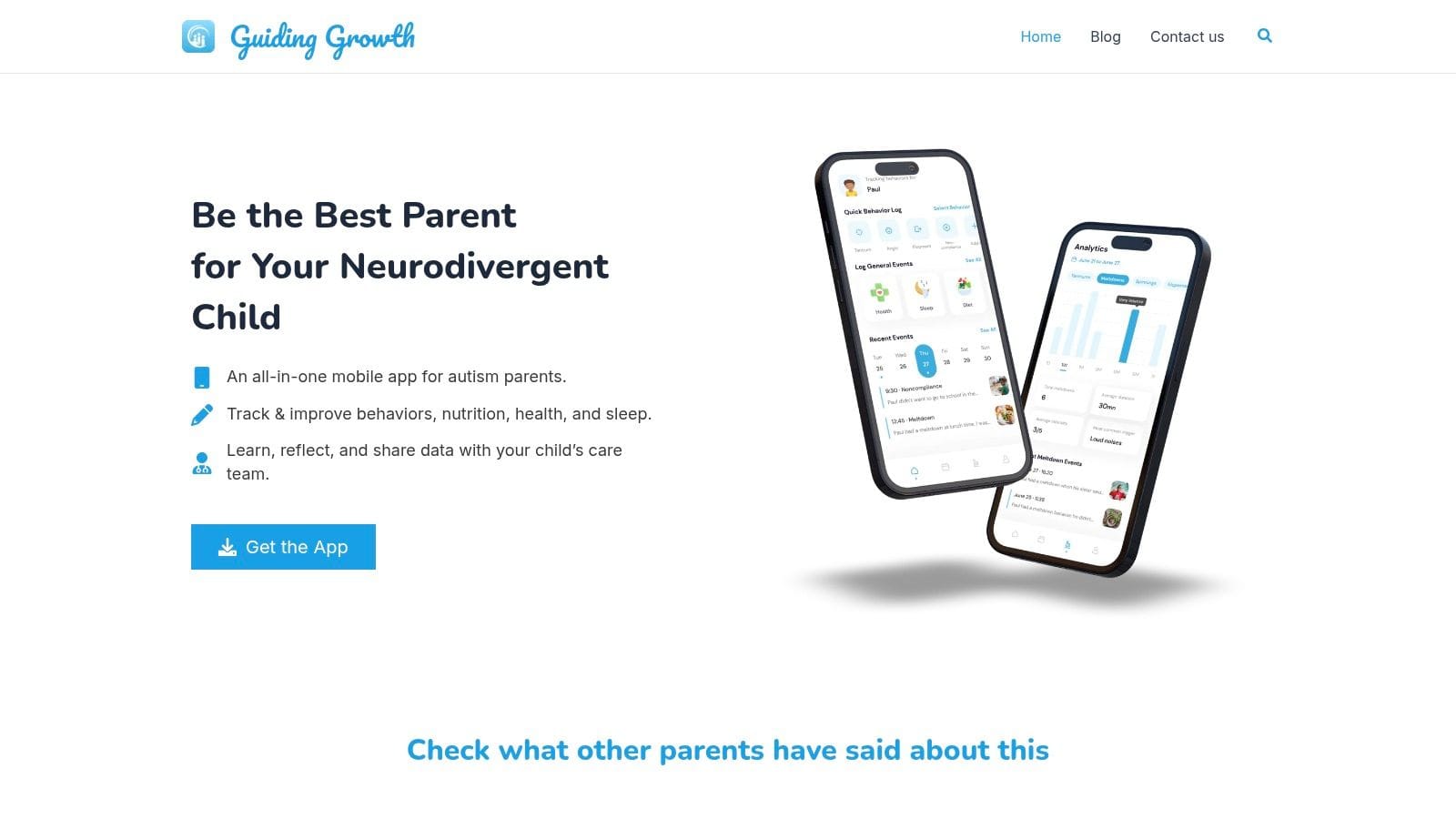
Technology can assist, rather than increasing workload. A dedicated behavior tracking app for autism support makes it easier to log patterns consistently, especially when you're balancing therapy, meals, school communication, and everyday life.
What the data can reveal
Data often answers questions that feel emotional in the moment. Is the child “refusing” PECS, or are requests dropping mainly when they're tired? Are meltdowns random, or do they cluster after communication breakdowns during transitions? Is one picture used constantly because it's preferred, or because the rest of the book isn't meaningful enough yet?
A good tracking routine helps with practical decisions:
- Which requests are stable
- Where prompting is still too heavy
- Which adults need better consistency
- Whether behavior improves when communication gets easier
- When the system may need expansion or revision
Good data doesn't replace your judgment as a parent or therapist. It sharpens it.
PECS is a communication tool, but it can also become a useful signal inside the child's broader care picture. When you connect exchanges with sleep, behavior, routines, and stress, you stop guessing as much. That reduces conflict and helps the adults around the child respond more clearly.
If you want one place to log PECS exchanges, track behavior, note sleep and diet patterns, and share clear observations with the people supporting your child, Guiding Growth is built for that daily reality. It helps families replace scattered notes with organized insight, so communication progress doesn't get lost in the rush of everyday care.