Some mornings unravel before breakfast. You've asked your child to get dressed, brush teeth, and put shoes on. They heard you, but the words didn't turn into action. Then one change hits the routine, the blue cup is in the dishwasher, a sibling gets in the way, the bus is early, and the whole morning tips into tears, refusal, or shutdown.
That's the point where many families start searching for help with picture schedules autism support. Not because they want a cute printable. Because they need a way to make the day make sense.
Table of Contents
- Why Picture Schedules Matter for Autism
- What Are Picture Schedules and How Do They Work
- Step-by-Step Guide to Creating Picture Schedules
- Choosing the Right Format for Your Child
- When Picture Schedules Alone Are Not Enough
- Integrating Picture Schedules with Guiding Growth
- Real-World Examples and Printable Templates
Why Picture Schedules Matter for Autism
A picture schedule works because it turns spoken demands into something visible. Instead of hearing a string of instructions and trying to hold them in mind, a child can see the sequence. That matters when stress is high, language is hard to process quickly, or transitions feel abrupt.

For many autistic children, anxiety rises when the day feels unpredictable. A picture schedule adds structure without adding more talking. It answers the questions that often drive resistance: What am I doing now? What comes next? When will this end?
What it changes in daily life
Morning routines are a common starting point. A schedule with toilet, get dressed, breakfast, brush teeth, shoes, backpack gives the child a map. The adult's job shifts from constant verbal prompting to brief support such as “check your schedule.”
That change sounds small, but it often reduces friction for everyone in the house.
- Less verbal overload: The schedule carries the sequence, so you don't have to repeat it over and over.
- More predictability: The child can preview the routine before it starts.
- Better independence: The goal is for the child to refer to the schedule, not rely on an adult narrating every step.
- Clearer transitions: Ending one activity and moving to the next becomes more concrete.
Practical rule: If a child melts down when routines change, start by making the routine visible before you try to make it faster.
Consistency matters here. Families who use the same structure across days often find that routines become easier to start, easier to finish, and easier to recover when something goes off track. That's one reason consistency improves outcomes in everyday autism support. The schedule itself isn't magic. The predictability it creates is what helps.
Why visuals often work better than more words
A spoken instruction disappears the second you say it. A picture stays put. The child can look back, check again, and keep going without needing the whole sequence repeated.
That's why picture schedules aren't just a classroom trick. They're a practical accommodation for children who need the environment to do more of the organizing.
What Are Picture Schedules and How Do They Work
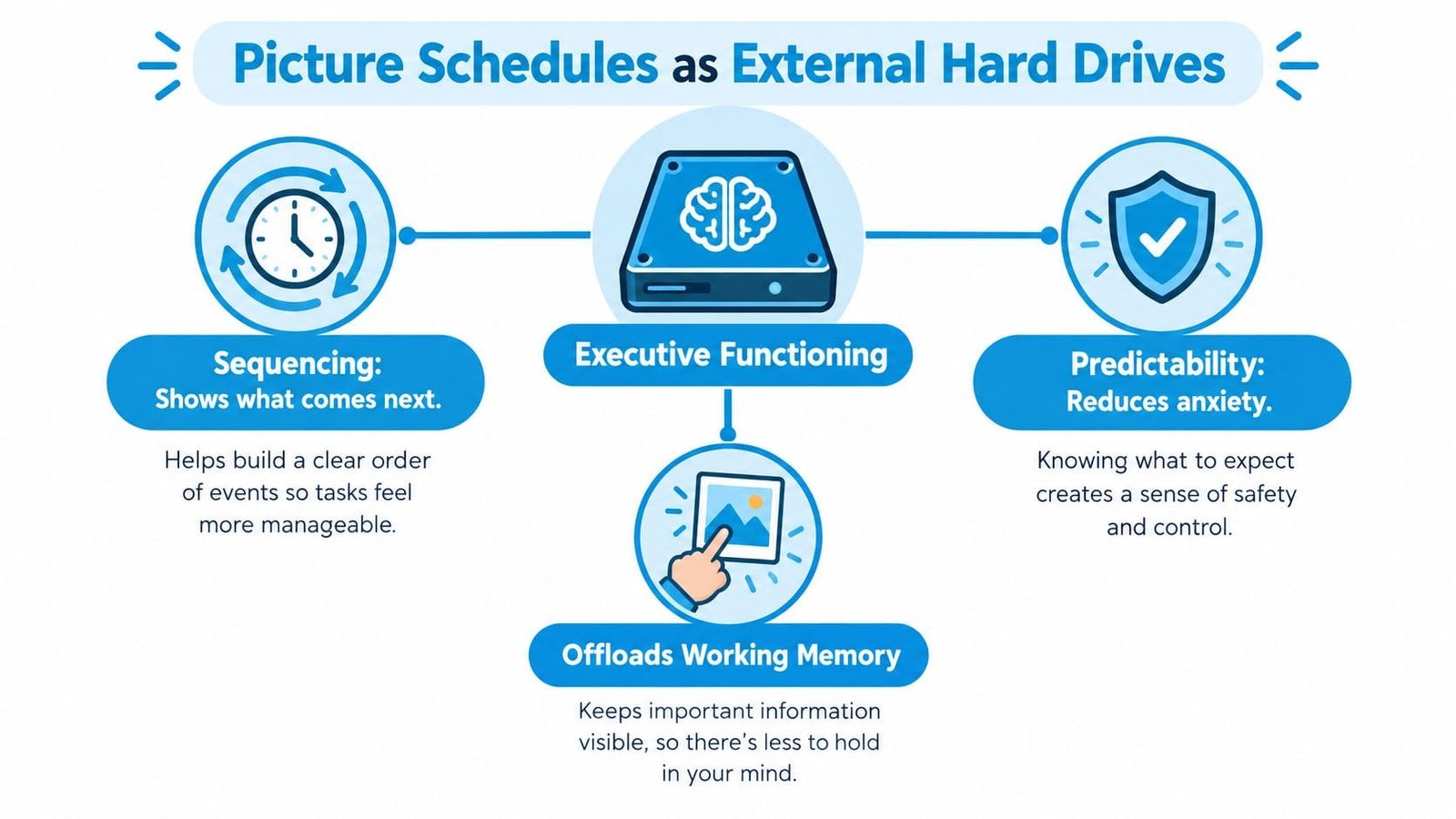
Think of a picture schedule as an external hard drive for executive functioning. When sequencing, working memory, and task initiation are hard to manage internally, the schedule stores that information in the environment. The child doesn't have to remember every step. They can look, act, and return to the plan.
What counts as a picture schedule
The format can be simple. A strip of photos on the fridge. Laminated icons on Velcro. A small first-then board. A checklist with symbols and words. The common feature is visual sequencing.
Some schedules show a full routine. Others break down one task such as washing hands, packing a backpack, or bedtime steps. If a child gets stuck in the middle of a routine, a task-specific schedule is often more useful than a whole-day board.
What the research actually supports
A systematic review found 31 studies on visual activity schedules for students with autism spectrum disorder, and 16 met acceptable-quality criteria. The review concluded that visual activity schedules can be considered an evidence-based practice, especially when paired with systematic instructional procedures, and reported use from preschool through adulthood across settings including general education and community environments (visual activity schedules review).
That last point matters. Picture schedules aren't only for preschool classrooms. They can support older children, teens, and adults across home routines, school tasks, and community activities.
A later review reported evidence from 31 participants aged 4 to 19 years, with a mean age of 10, showing that visual schedules can improve academic-related on-task behavior when combined with prompting and reinforcement (2024 review of visual schedules in autism).
Visual schedules work best when adults teach the routine clearly and respond consistently, not when the pictures are posted and everyone hopes for the best.
Why some schedules help and others flop
The schedule itself is only one part of the intervention. Children usually need support learning how to use it. That may include pointing to the next item, waiting, reinforcing completion, and gradually reducing prompts.
A useful way to think about it is this:
| Schedule element | What it does |
|---|---|
| Visual sequence | Shows what comes next |
| Prompting | Directs attention to the schedule |
| Reinforcement | Gives the child a reason to complete steps |
| Repetition | Builds familiarity and fluency |
When families say, “We tried a schedule and it didn't work,” the missing piece is often instruction, not effort.
Step-by-Step Guide to Creating Picture Schedules
The best picture schedule is the one your child can use. Not the prettiest one online. Not the most detailed one your therapist has ever seen. Usable beats impressive.
Start small and concrete
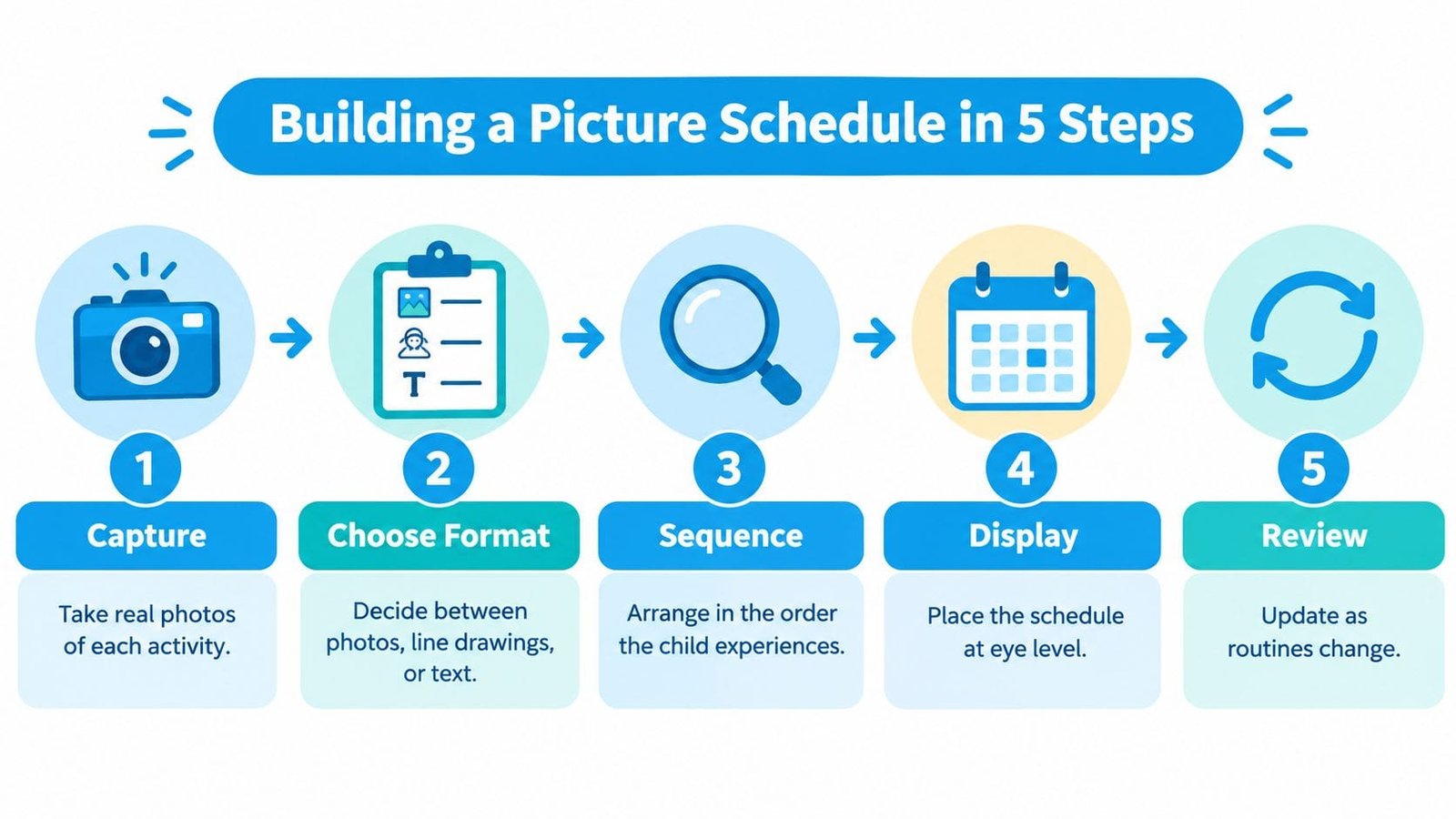
Begin with a short routine your child already does most days. Good starter options include getting ready for bed, brushing teeth, or coming home from school.
Use visuals your child understands:
- Real photos often work well for children who need a direct match to their own environment.
- Simple drawings or symbols can work if the child already understands representational pictures.
- Words with pictures help when reading is emerging and you want to build toward more independence.
If your child ignores abstract icons, switch to photos of the sink, pajamas, or backpack.
Build the schedule in order
The sequence should match how the child experiences the routine, not how an adult talks about it. If “put on socks” always happens after “get dressed,” keep it that way.
A strong starter schedule usually has only a few steps. Too many pictures at once can make the routine feel bigger, not clearer.
- Choose one routine: Don't launch morning, bedtime, chores, and homework all on the same day.
- Limit the first version: Keep it short enough that the child can finish and feel successful.
- Place it where it's used: Bedtime schedule in the bedroom or bathroom. Shoe routine by the door.
- Keep materials sturdy: Laminated cards, cardstock, magnetic strips, or a clipboard all work if they're easy to access.
Here's a quick teaching walkthrough.
Teach the child to use it
Many parents put up a schedule and wait. Teaching works better.
At the start of the routine, show the child the first picture. Give a brief cue such as “check schedule” or “first toothbrush.” After the child completes the step, guide them back to the schedule to mark it finished, remove the card, or point to the next item.
Common mistake: Adults keep talking through every step, so the child follows adult speech instead of learning to reference the visual.
Prompt lightly, then fade. Over time, reduce pointing, verbal reminders, and physical guidance so the child learns that the schedule is the source of information.
If the child refuses or ignores it
Try one of these adjustments:
- Make it simpler: Reduce the number of steps.
- Make it more meaningful: Use photos from the child's real life.
- Add a finish cue: A visible end helps many children tolerate less preferred tasks.
- Pair it with something positive: Put a preferred activity after the routine when appropriate.
- Review before the transition: Don't wait until the child is already upset.
If you want examples of how to structure visual cards before building your own, picture cards for autism can help you compare common formats.
Choosing the Right Format for Your Child
Not every child needs the same schedule format. Some do well with a paper strip on the wall. Some need removable cards they can manipulate. Others respond better to a phone, tablet, or short video clip. The right choice depends less on trend and more on fit.
What research suggests about format
A comparison study from 2010 to 2011 found mixed results. Two students reached criteria faster with static-picture schedules, while one did slightly better with video modeling (comparison of static pictures and video modeling). That's a useful reminder that one format isn't universally better.
In practice, format should follow function. If a child is distracted by screens, a paper schedule may be cleaner. If they're highly motivated by a device and can stay on task, a digital schedule may increase engagement.
A practical comparison
| Format | Often useful when | Possible drawback |
|---|---|---|
| Photo cards | The child needs concrete, real-world visuals | Can be bulky to update |
| Line drawings or symbols | The child understands symbolic pictures | May be too abstract for some learners |
| Written checklist | The child reads reliably | Too language-heavy for others |
| Video model | The child learns well by watching action | Harder to scan quickly during a routine |
| App-based schedule | The family needs portability and quick edits | Can become another screen battle |
Questions worth asking before you choose
- How much language does the child understand during stress?
- Can they manipulate cards easily, or is fine motor effort a barrier?
- Will this be used mostly at home, school, or in the community?
- Does the format increase independence, or does it create a new dependency on adult setup?
A child who can read but freezes during transitions may still do better with pictures. A child who loves making choices may engage more with removable cards than with a static poster. A teen may reject babyish icons and use a cleaner checklist or phone-based version more willingly.
The format isn't a style choice. It's part of the intervention.
When Picture Schedules Alone Are Not Enough
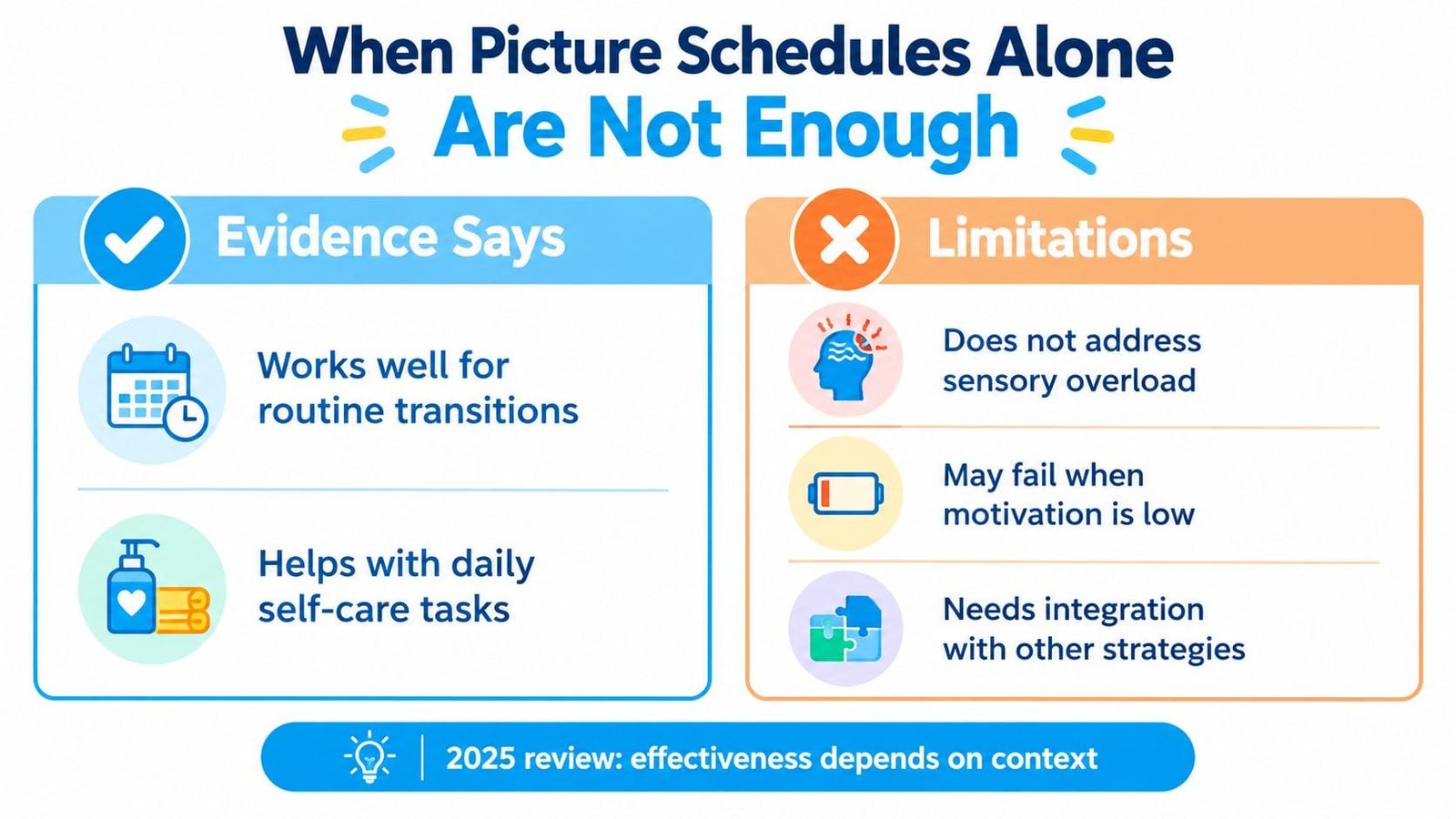
Picture schedules help with structure. They don't automatically solve distress, escape behavior, sensory overload, or low motivation. That distinction matters, because families often blame themselves when a schedule is posted and meltdowns still happen.
What the evidence says about limits
A 2025 review found insufficient evidence that the visual-schedule component itself caused better transitions in ASD interventions (review of transition interventions and visual schedules). That doesn't mean schedules are useless. It means the schedule may be one helpful part of a larger support plan, not the active ingredient by itself.
A controlled study of two children with autism found that visual schedules alone were ineffective at reducing problem behavior during transitions from preferred to nonpreferred activities, but problem behavior decreased once extinction plus differential reinforcement of other behavior were added (controlled study on transitions and problem behavior).
That lines up with what many clinicians see. The schedule organizes the transition. It doesn't necessarily change why the child is resisting it.
What to add when the schedule isn't enough
If transitions are still explosive, look at the whole situation:
- Reinforcement: Is there a clear payoff for finishing the routine?
- Task demand: Is the next activity too hard, too long, or too abrupt?
- Sensory load: Is the environment noisy, bright, crowded, itchy, or rushed?
- Communication: Can the child ask for help, more time, or a break?
- Consistency: Are adults responding in the same way each time?
A schedule can show “dentist after school.” It can't remove fear of the dentist, the sound of the drill, or the grief of ending a preferred activity.
That's why broader planning matters. Bedtime is a good example. A visual chart can help, but some children also need lower lighting, fewer demands, stronger transition warnings, and a smaller routine. If you want examples of age-specific routine ideas, it helps to compare simple versions rather than assuming one bedtime chart fits every age.
When a schedule doesn't fix everything, it hasn't failed. It's given you information about what else needs support.
Integrating Picture Schedules with Guiding Growth
The missing step for many families isn't another printable. It's tracking whether the schedule is helping. Without that, it's hard to know if the routine is improving, staying stuck, or getting worse under certain conditions.
A practical system should let you record what happened before, during, and after schedule use. That includes the trigger, the transition itself, the child's response, and what adults did next. Over time, that makes patterns easier to spot.
What to log so the schedule becomes useful data
You don't need long notes. Brief entries are enough if they're consistent.
Log details such as:
- Before the routine: Poor sleep, hunger, noise, change in plan, sibling conflict
- During the routine: Ignored first cue, followed two pictures, refused third step, dropped to floor
- Adult response: Prompted, waited, reduced demand, offered choice, reinforced completion
- Outcome: Finished with support, escalated, recovered, needed break
Guiding Growth can be useful as one option among other tracking methods. It centralizes behavior logging, routines, triggers, and outcomes in one mobile app, and it includes voice logging plus Alma AI for quick entry when typing isn't realistic.
Why tracking changes the intervention
Patterns usually show up faster than parents expect once data is in one place. A child may follow the picture schedule well on school mornings but fall apart on therapy days. Or the child may complete every step until the routine reaches a nonpreferred item such as hair brushing or shoes.
That kind of detail changes the conversation with therapists, teachers, and caregivers. Instead of “the schedule isn't working,” you can say:
- The child completes the first three visuals independently
- Refusal starts at one specific step
- Transitions go better when the routine is previewed early
- The same schedule works in one setting but not another
What to watch: If the child checks the schedule but still melts down at the same step, the problem may not be understanding. It may be demand tolerance, sensory discomfort, or the need for a stronger reinforcement plan.
Collaboration matters
When one adult uses the schedule one way and another adult uses it differently, progress gets muddy. Shared tracking helps everyone stay aligned on the exact routine, the prompts used, and the child's response.
That's especially valuable when parents, teachers, therapists, and relatives are all involved. The picture schedule becomes more than a support tool. It becomes something the whole team can review and refine based on what's happening.
Real-World Examples and Printable Templates
A morning strip might show toilet, dressed, breakfast, teeth, shoes, backpack. A mealtime board might show sit, plate, drink, spoon, all done. A community outing schedule could include car, store, checkout, car, home. Simpler is usually better.
For printable layouts, two formats cover most needs. A linear strip works well for routines with a fixed order. A choice board or activity board works better when the child is selecting from options rather than following a strict sequence. If you want a model to adapt, this morning routine visual schedule shows how a simple sequence can stay clear without becoming cluttered.
Use special interests thoughtfully. A favorite character can increase buy-in, but don't let decoration overwhelm readability. If the child avoids the schedule, shorten it. If they forget it exists, move it closer to the action. If they resist changes, preview the new picture before the routine starts.
Guiding Growth gives families one place to pair picture schedules with real-world tracking, so you can see which routines are improving and which transitions still need extra support. You can log meltdowns, shutdowns, triggers, and successful steps without scattered notes, then share that information with the people helping your child. If you're using visual supports and want clearer patterns instead of guesswork, it's worth a look.