You're heading into an IEP meeting, therapy review, or pediatric appointment, and the details are already slipping away. You remember that the morning was difficult, that a transition triggered something, and that yesterday seemed better, but the evidence is scattered across texts, paper notes, and memory. That's a frustrating position for any parent.
Data collection in ABA can turn those fragments into information a care team can use. It doesn't require you to watch your child every second or record every event perfectly. It requires choosing the right detail for the decision at hand, recording it consistently enough to reveal a pattern, and preserving the context that explains why two adults may see the same behavior differently.
Table of Contents
- Why Data Collection Matters Beyond Paperwork
- Understanding Core Measurement Methods in ABA
- Making Sense of Reliability and Observer Agreement
- Collecting Useful Data Without Becoming Full-Time Observers
- Reconciling Different Observations Across Settings
- Choosing Tools That Fit Your Family's Reality
- Turning Logs Into Actionable Insights for Meetings
- Building a Sustainable Data Collection Practice
Why Data Collection Matters Beyond Paperwork
A parent may arrive at a therapy review saying, “The meltdowns seem worse,” while a therapist says, “The frequency has decreased.” Both observations may feel honest. The disagreement often comes from measuring different things. One person may be remembering the longest episodes, while the other is looking at the number of episodes recorded during sessions.
The Behavior Analyst Certification Board Ethics Code treats measurement as part of clinical work, not as administrative decoration. Behavior analysts must select appropriate collection procedures, use them correctly, graph and summarize results, then use those results to decide whether an intervention should continue, change, or end.
What a useful record contains
A useful entry gives the team something more precise than “bad behavior.” It identifies:
- The behavior: What could another observer see or hear?
- The time: When did it begin, and when was it recorded?
- The context: What happened before and after?
- The setting: Where did it occur, and who was present?
- The decision: What question might this record help answer?
Repeated observations across baseline and intervention phases can reveal changes in level, trend, variability, and immediacy after treatment begins. A single difficult afternoon can't show that pattern. A time-stamped series of comparable observations can.
Practical rule: If a data point won't help someone decide what to keep, change, investigate, or discuss, it probably doesn't belong in the family's minimum tracking routine.
This is why operational definitions matter. “Refusal” might mean not beginning a task after an instruction, pushing materials away, leaving the area, or saying “no.” Those are different responses and may require different supports. Clear definitions help parents and providers compare observations without pretending that memory is a measurement system.
Understanding Core Measurement Methods in ABA
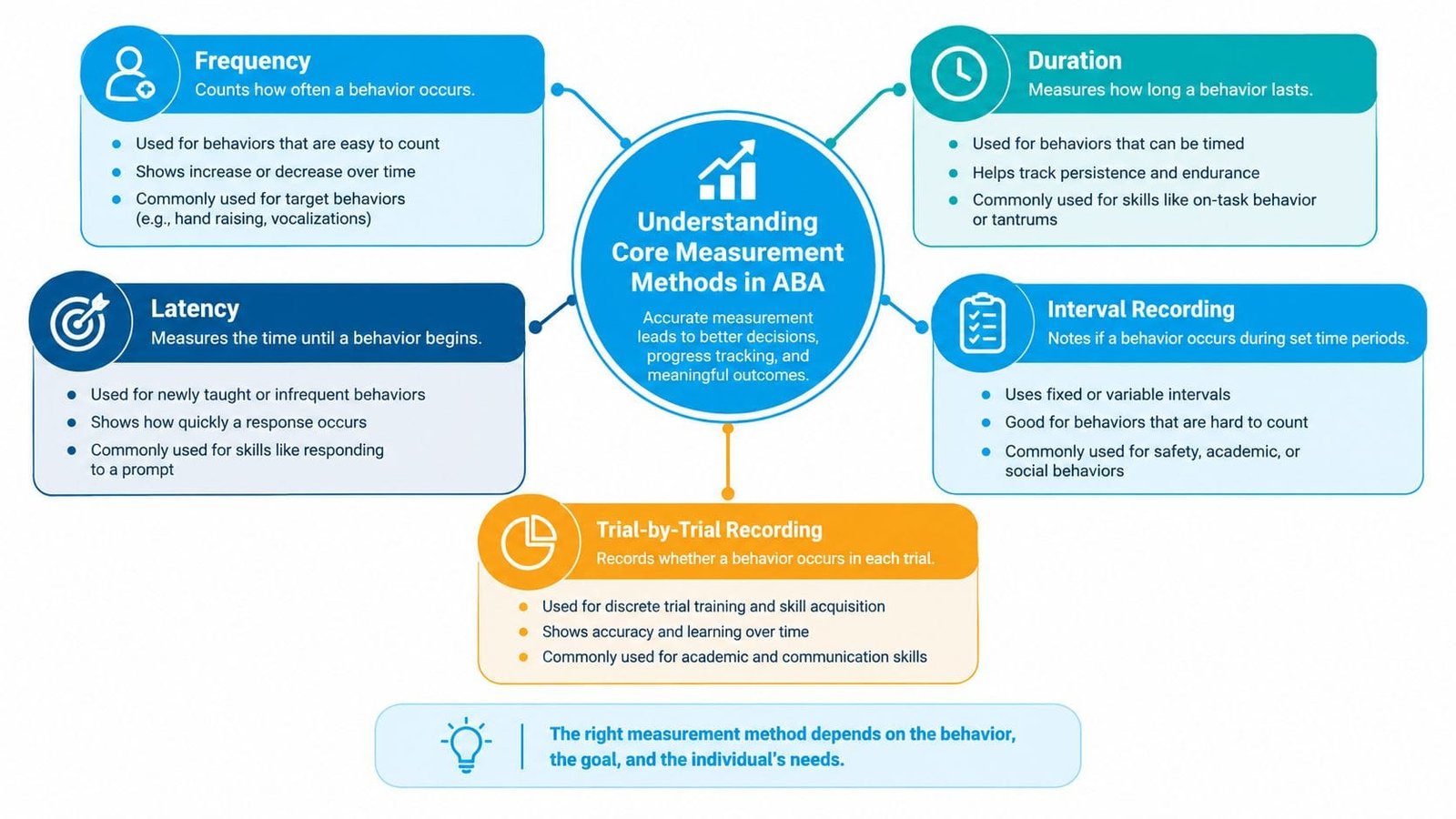
The right method depends on the behavior's measurable dimension and the decision you need to make. Before choosing a form or app, ask, “What do I need to know?”
Match the measure to the question
Frequency is the raw count of responses. It fits discrete behaviors with a clear beginning and end, such as hitting, requesting, or leaving a seat. If sessions vary in length, use rate, which adjusts the count for the observation period, such as responses per minute.
Duration records how long a behavior lasts from a defined onset to a defined offset. It's often more informative than frequency for prolonged crying, time out of seat, or time engaged with a task. Two episodes may count as two incidents, but their impact can be very different if one ends quickly and the other continues much longer.
Latency measures the time between an instruction or other antecedent and the beginning of a response. It can help answer whether a child is starting a routine more independently or whether prompts are still needed.
Interresponse time measures the interval between successive responses. It can be useful when the concern isn't only how many responses occur, but how closely they occur together.
Continuous measurement records every occurrence or the full duration of behavior. It generally avoids the estimation error associated with sampling, so it's preferred when feasible, although a busy classroom or family morning may make it impractical. The clinical reasoning behind establishing a clear starting point also resembles the idea of a project management baseline explained, where later observations are compared with a defined reference rather than a vague impression.
For skill acquisition, trial-by-trial recording preserves information about individual learning opportunities, including whether a response was independent or prompted. That level of detail can show a response pattern that a single session percentage would hide. The core distinction is simple: frequency tells you how often, duration tells you how long, latency tells you how quickly, and interresponse time tells you how far apart responses are. These distinctions are described in the clinical review of ABA measurement methods.
Making Sense of Reliability and Observer Agreement
A record can be detailed and still unreliable. Reliability asks whether different observers would record the same event in the same way under the same definition. It doesn't mean that every observer must interpret a situation identically. It means the observable measurement rules are specific enough to compare.
Interobserver agreement, or IOA, is a formal reliability check. Two observers independently record the same response, then calculate percentage agreement as agreements divided by agreements plus disagreements, multiplied by 100. For continuous recording, they may compare observations second by second. Both observers showing the event, or both showing an ongoing event during the same second, counts as agreement.
The exact agreement method matters. If an interval counts as agreement only when both observers record the same value, mutual nonoccurrence can count as agreement, while two records that both show behavior but differ in the number of responses or seconds count as disagreement. The review of agreement procedures in free-operant human behavior research explains why “we mostly agree” isn't a substitute for a defined calculation.
Why caregivers disagree
Different reports don't automatically indicate poor care or careless recording. Parents may see behavior during rushed mornings, teachers may see it during group demands, and therapists may see it during structured teaching. The behavior can change with the task, communication partner, sensory conditions, or available support.
Use disagreement as a question:
- Did both observers use the same operational definition?
- Did they record the same setting and activity?
- Were they describing frequency, duration, intensity, or consequence?
- Was one report based on direct observation and the other on recollection?
- Did one adult see the beginning while another saw only the aftermath?
In Guiding Growth, shared entries can be more useful when caregivers and providers record the observer, setting, trigger, and measurement dimension rather than submitting one unverified summary. Preserve the conflicting reports. Don't average them into a tidy number that hides the context.
Collecting Useful Data Without Becoming Full-Time Observers
Parents already monitor sleep, meals, school communication, appointments, medications, transportation, and daily routines. Asking them to become continuous observers can make a clinically sound plan impossible to sustain. Research on caregiver impact has found substantial inconsistency in what caregiver effects are measured, which tools are used, when measurement happens, and how results are reported. Financial strain, physical health, and emotional strain were identified as high-priority outcomes in that research, summarized in the caregiver-impact study.

More data isn't automatically better data. If logging increases stress, disrupts sleep, or forces a parent to divide attention during a safety-sensitive moment, the system may produce fewer usable observations over time. The practical target is a minimum viable dataset tied to one decision.
Start with the smallest useful entry
For a behavior where episode length matters, record duration and one context note. For a discrete response, frequency may be enough. If you're trying to understand a trigger, record what happened immediately before and after, rather than attempting to document every surrounding detail.
When you're unsure, write uncertainty:
- “Observed directly for part of the episode.”
- “Duration estimated because the timer wasn't started.”
- “Reported by school, not observed at home.”
- “Trigger unclear.”
- “Two adults described the intensity differently.”
That's better than entering false precision. A structured narrative can preserve both the event and the limits of your observation.
A voice-first tool such as Guiding Growth's ABA data collection app can let a parent describe an event naturally while retaining fields such as trigger, intensity, duration, purpose, location, and people present. Used appropriately, that approach reduces data-entry friction without turning a parent into a full-time therapist.
The sustainable system is the one a tired caregiver can still use on an ordinary day.
The cost of collection deserves attention too. If the routine takes too long, causes arguments between caregivers, or makes family life feel like a constant assessment, bring that information to the behavior analyst. Burden isn't a personal failure. It's a treatment-planning variable.
Reconciling Different Observations Across Settings
Families rarely have one complete source of truth. A parent, co-parent, teacher, aide, and clinician each sees a different slice of the child's day. Home-school collaboration research recommends using multiple evidence sources, including communication records, parent-training feedback, surveys, meeting agendas, and student learning measures, rather than relying on one interview or record type. The research on collaboration across home and school settings supports a broader view of information flow.
Paper notes are accessible and quick, but they can lose timestamps, become difficult to compare, and rarely preserve who made each observation. Spreadsheets offer structure and sorting, yet they depend on manual entry and shared formatting. Dedicated apps can make collaboration easier, provided the family sets permissions carefully and agrees on definitions.
Build a meeting-ready timeline
Keep conflicting entries side by side:
| Record | What to preserve |
|---|---|
| Parent observation | Setting, activity, antecedent, response, outcome |
| School report | Reporter, routine, task demand, support provided |
| Therapist entry | Operational definition, measurement method, intervention context |
| Caregiver recollection | Mark clearly as recalled rather than directly observed |
Look for patterns across people and environments. If a behavior occurs mainly during transitions at school but not during similar transitions at home, that difference may point toward task demands, communication partners, timing, or implementation. If two adults repeatedly disagree about intensity, the team may need a clearer intensity scale.
The goal isn't to decide which adult is right. It's to determine whether the definition, context, or support plan needs refinement. Store the observer and setting with every entry, then share only what each collaborator is authorized to see. A summary should preserve provenance, meaning who contributed the information, without implying clinical certainty that the records can't support.
Choosing Tools That Fit Your Family's Reality
The right collection system fits the family's available time while preserving the details needed for clinical decisions. A tool that demands constant logging may produce more fields but less consistent information.
| Tool | Strength | Limitation | Useful setting |
|---|---|---|---|
| Paper ABC chart | Fast to start and easy to use without technology | Harder to search, graph, and share | Occasional home observations |
| Spreadsheet | Flexible fields and sortable records | Requires manual entry and upkeep | Coordinated family tracking |
| Dedicated app | Structured entries, collaboration, and summaries | Needs setup and clear permissions | Ongoing multi-person tracking |
A workable routine starts with a few shared decisions. Agree on the behavior definition, select the measurement dimension, decide who may enter data, and mark estimates or uncertainty clearly. Families can adapt structured aba therapy data sheets to their routines instead of trying to document every moment. Review a focused date range before a meeting rather than bringing every note ever written.
Guiding Growth offers voice-first logging, structured behavior fields, meal snap-to-log, and summaries that can be exported for appointments or IEP discussions. Collaborator permissions can support different roles for parents, caregivers, therapists, and educators. These features do not replace clinical judgment. The team still needs a clear behavior definition and a measurement plan that family members can follow.
A simple system used consistently often gives a clearer clinical picture than a detailed system that families abandon.
Protect the record as well as the measurement
The BACB conduct guidelines for records and data state that behavior analysts must create, maintain, store, transfer, and dispose of records according to applicable laws, regulations, organizational policies, and ethical requirements. These responsibilities cover written, automated, and electronic records.
Before sharing information with a school, clinician, or other organization, confirm the required consent and appropriate access. Record the observer, date, setting, and source for each entry. A convenient tool becomes unsafe when it loses that context or exposes family information too broadly.
Turning Logs Into Actionable Insights for Meetings
A long list of incidents can overwhelm a clinician and still fail to answer the important question. Start with the decision. Are you asking whether a behavior is changing, whether a trigger is recurring, whether support differs by setting, or whether a replacement skill is emerging?
Measurement choice shapes the answer. Frequency is a raw count, while rate adjusts for observation time. Duration captures elapsed time between defined onset and offset, and latency captures the time from an instruction or discriminative stimulus to response onset. The ABA measurement guide outlines these distinctions and why a count alone can misrepresent progress when observation periods differ.
Prepare a concise meeting summary
Select:
- A relevant date range: Use the period that reflects the decision, not every available record.
- Specific event types: Include the target behavior, replacement response, and relevant context.
- Comparable measures: Don't place frequency, duration, and intensity on one chart as though they mean the same thing.
- Observer and setting: Show whether a pattern belongs to home, school, therapy, or several environments.
- Uncertainty notes: Identify missing entries, estimates, and conflicting reports.
Guiding Growth's data visualization tools can help organize patterns such as frequency over time, common triggers, time-of-day clustering, and changes around particular people. The purpose of a visual summary isn't to prove causation. A behavior may occur more often after a specific event without that event being the sole cause.
Bring three observations and three questions. For example: “Episodes lasted longer during evening transitions,” “school reports differ from home reports,” and “duration fell while frequency stayed similar.” Then ask what definition, intervention, or environmental variable should be reviewed.
Disagreement belongs in the discussion too. A recurring difference between observers may reveal a setting effect or inconsistent implementation, not merely measurement error. Good data narrows the conversation without pretending to settle every question.
Building a Sustainable Data Collection Practice
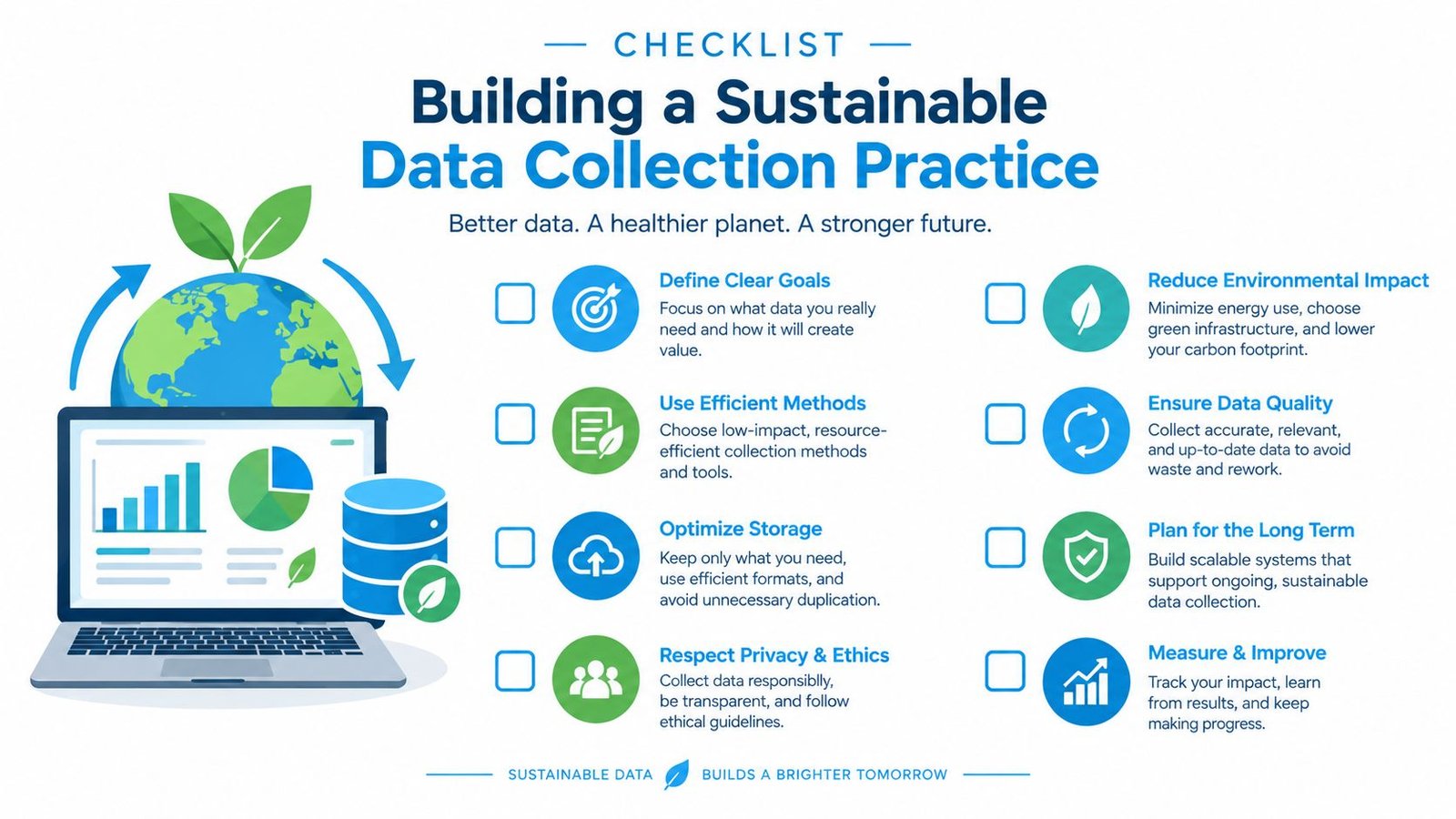
Families often abandon tracking because they begin with an elaborate system that demands too much attention. A simpler practice, used consistently enough to show useful patterns, is more valuable than sporadic perfect documentation.
Start with one behavior, one measurement dimension, and one collection tool. Ask the behavior analyst to confirm the operational definition and the decision the data should support. Then set a review point with the care team, rather than changing the system every time one difficult event occurs.
A workable launch checklist
- Choose one target: Select a behavior or skill that matters to the family's current decision.
- Define it plainly: State what counts and what doesn't, including onset and offset.
- Pick the dimension: Use frequency, rate, duration, latency, or another method that fits the question.
- Record context: Add setting, observer, trigger, people present, and outcome when relevant.
- Mark uncertainty: Separate direct observation from recollection and estimates.
- Check the burden: Notice time, stress, sleep disruption, and family conflict caused by logging.
- Review the pattern: Share a focused summary with the behavior analyst and revise only when the decision requires it.
Watch for warning signs that the system is too demanding. You're skipping entries because the form takes too long, entering numbers from memory later, arguing about who should record, or focusing on logging instead of supporting your child. Those signs call for simplification, not blame.
Data collection in ABA works best when it respects both measurement standards and family life. The goal isn't clinical perfection. It's dependable information that helps the people supporting your child make better decisions.
Guiding Growth gives families one place for voice-first daily logging, structured behavior details, shared caregiver access, pattern tracking, and meeting-ready summaries. Start building a sustainable record that fits your real routine by visiting Guiding Growth.