A parent sits at the kitchen table with a stack of ABC sheets, a school progress report, and three message threads from different therapists. None of them agree on what happened on Tuesday. One record says the behavior followed a demand, another mentions poor sleep, and the third records only that the session was difficult.
Good data collection can close that gap, but only when the sheet matches the question. ABA data collection sheets aren't interchangeable. Frequency answers how often something happened. Duration answers how long it lasted. An ABC form captures what came before and after. A task-analysis sheet shows which step of a routine still needs support.
This list orders ten tools by the decision they can support, from free single-method forms to paid systems. Each entry explains what the sheet captures well, where it falls short, and where the resulting information should live afterward. The aim is practical: help you choose one method for a classroom trial, a home ABC log, a skill-acquisition program, or an IEP progress check, then carry the useful context into Guiding Growth so meetings begin with patterns rather than memory. For broader context on classroom decisions, see these benefits of data driven teaching.
Table of Contents
- 1. Texas SPED Support TEA A-B-C Data Collection Form
- 2. Sightline Behavior Free ABC Data Sheet
- 3. Understand Behaviour Printable Behaviour Templates
- 4. Bright Path Sped Behavior Data Sheets Free and Editable Full Pack
- 5. StreamABA Free ABA Data Sheets Library
- 6. ThinkPsych Free Task Analysis Data Sheet
- 7. Spectrum Unlocked Free IEP and ABA Data Sheet Templates
- 8. Little Victories in Learning Behavior Data Tracking Sheets Bundle
- 9. The Autism Helper Editable Special Education Data Sheets TPT
- 10. The Autism Helper Data Driven Classroom Toolkit and Course
- Top 10 ABA Data Collection Sheets Comparison
- Pick One Sheet This Week and Start Logging Today
1. Texas SPED Support TEA A-B-C Data Collection Form
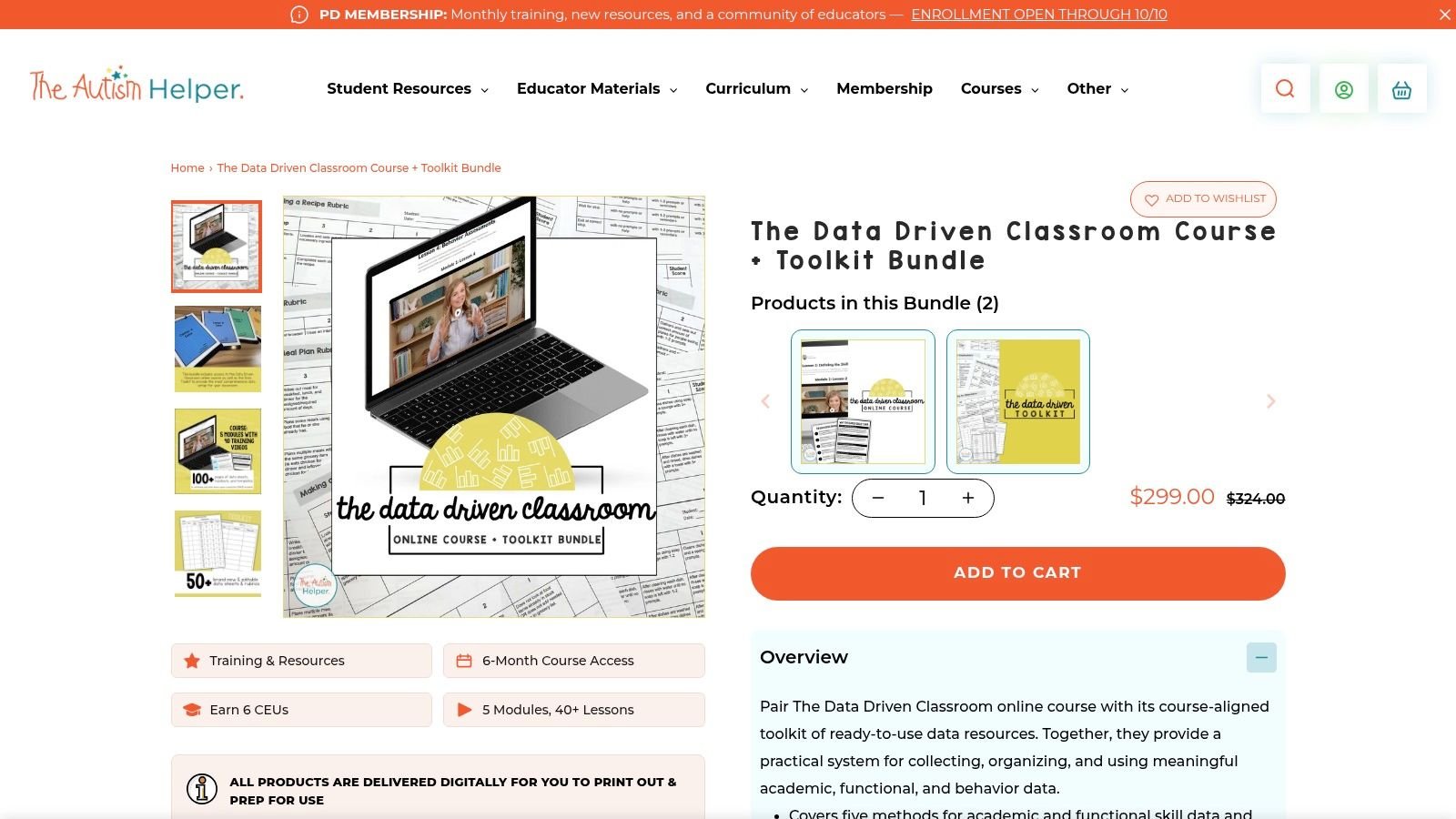
When the question is “What tends to happen immediately before and after this behavior at school?”, the Texas SPED Support A-B-C Data Collection Form is a sensible starting point. The Texas Education Agency resource provides a printable ABC form and plain-language guidance for using observations in IEP decision-making.
The form follows the basic sequence: antecedent, behavior, and consequence. That structure helps a teacher, paraprofessional, parent, or clinician describe what was observable instead of writing a general impression such as “had a bad day.” The behavior entry should state what the person did, while the surrounding fields document what happened before and what followed.
Best use and limitation
This is a strong fit for a classroom trial when a school team needs a shared, reputable form that families can understand. It is free, easy to print, and straightforward to attach to school documentation. It also gives teams a common vocabulary for discussing triggers and consequences.
Its limit is equally clear. It is an ABC form, not a complete measurement system. It won't tell you the total frequency, duration, latency, or percentage of intervals occupied by a behavior unless those details are added separately.
Record completed forms in the student's secure school or clinical record according to the care team's process. For home observations, Guiding Growth can hold the accompanying context, such as sleep, meals, location, people present, and recovery, so the care team can compare the home record with school observations without treating them as identical forms of evidence.
2. Sightline Behavior Free ABC Data Sheet
Choose Sightline Behavior when the question is “Can several people record ABC events quickly without sharing a paper binder?” The Sightline Behavior free ABC data sheet works in a browser, can be completed on screen, printed, or exported to CSV.
That flexibility matters for mixed-tech teams. A parent can print the sheet for a kitchen counter, while a paraprofessional can enter an observation digitally. The page includes instructions for what belongs in each column, which reduces the training burden for someone who doesn't routinely collect behavior data.
Where it fits in a home observation
The local autosave design is useful when privacy matters and a team doesn't want observations uploaded to a cloud service. CSV export also gives a supervisor a workable file for sorting events by date, setting, or observer.
Practical rule: A CSV file is an export format, not a clinical interpretation. Keep the operational definition and observation conditions with the rows.
Sightline Behavior remains a single-method tool. It won't replace a duration timer, trial-by-trial program sheet, or task analysis. After an ABC entry, record the richer daily context in Guiding Growth's behavioral data analysis so patterns can be reviewed alongside sleep, meals, medication schedules, and other events. Use the app record as a family observation log, then discuss interpretation with the BCBA or care team.
3. Understand Behaviour Printable Behaviour Templates
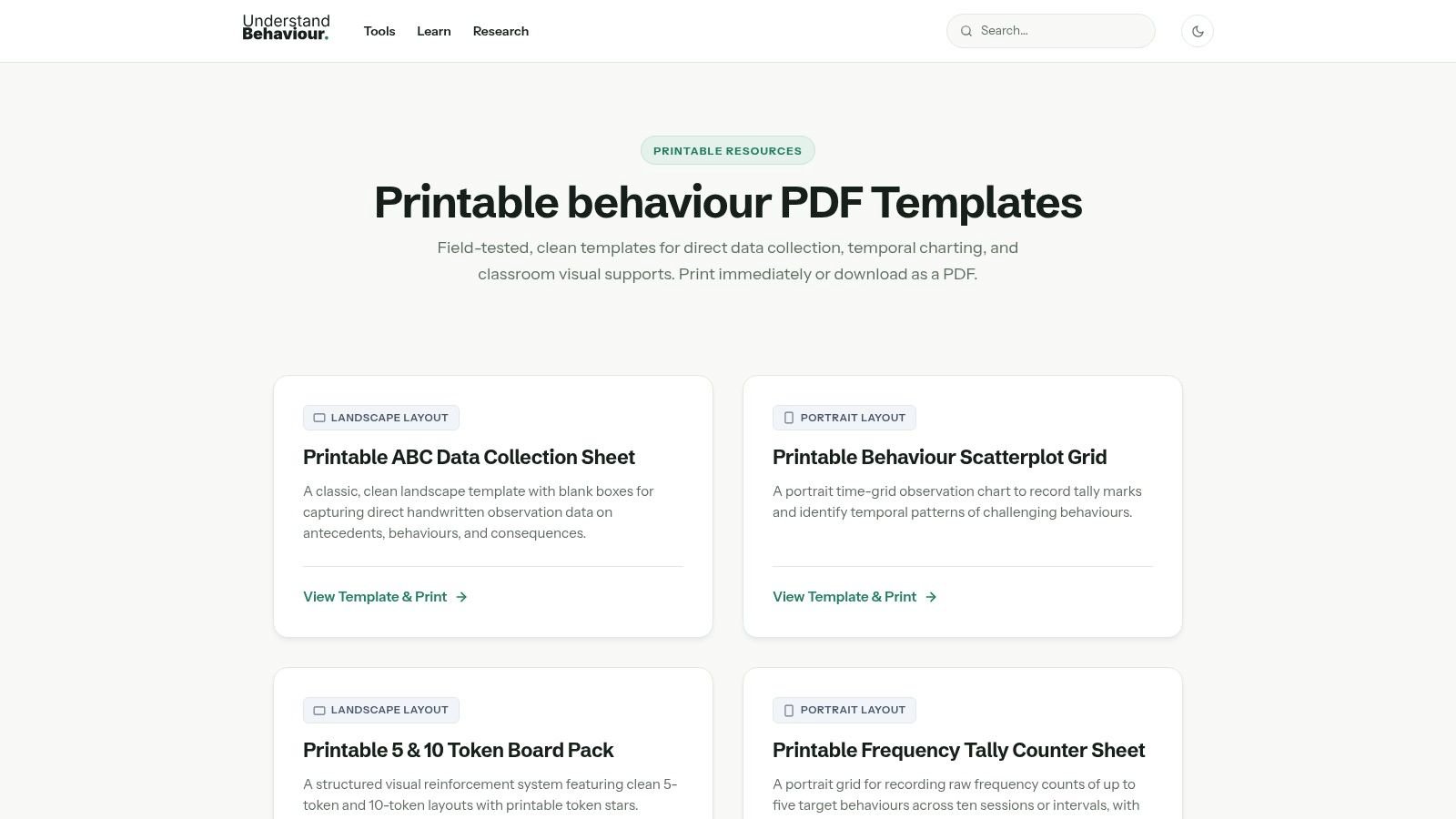
If the decision is “Which simple paper form can a caregiver or paraprofessional use today?”, the Understand Behaviour template library is built for that situation. It includes printable ABC forms, frequency tallies, scatterplots, token boards, and short BIP summary pages.
The value here is the low setup burden. A classroom team can keep a few forms in a binder, while a family can print a scatterplot to check whether events cluster around transitions, meals, bedtime, or particular parts of the school day. The horizontal and vertical layouts make the pages easier to adapt to the recording task.
What it captures well
The collection is useful when a team needs different paper methods without building each form from scratch.
- ABC templates: Capture the events surrounding a behavior.
- Frequency forms: Count discrete occurrences when the behavior has a clear beginning and end.
- Scatterplots: Show when events occur across a day or week.
- Token boards: Support reinforcement routines, though they aren't a substitute for behavior measurement.
- BIP summaries: Keep key plan details visible for staff.
The trade-off is manual review. These forms don't automatically graph results or export them into a spreadsheet. A frequency count also needs a defined observation period if the team wants to compare sessions fairly. A behavior occurring ten times in sixty minutes isn't equivalent to ten times in ten minutes, as explained in the review of continuous recording methods published in Behavior Analysis in Practice.
Keep the completed paper forms in the relevant school or clinical record. Use Guiding Growth for the family timeline and contextual notes that explain why a paper count may differ between home and therapy.
4. Bright Path Sped Behavior Data Sheets Free and Editable Full Pack
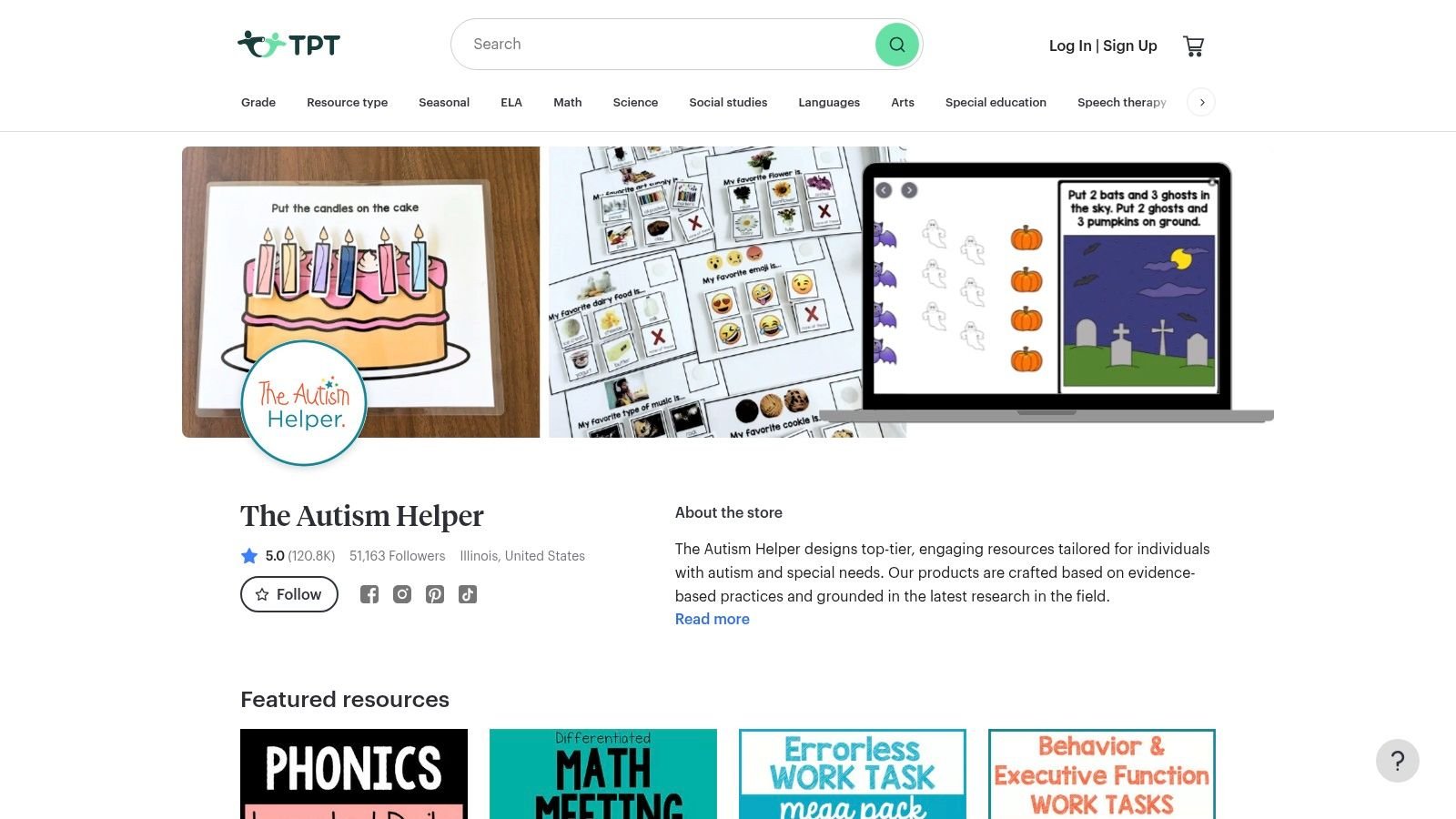
Bright Path Sped suits the question “Can one starter set support a weekly behavior review?” The free Bright Path Sped behavior data sheets include ABC recording, frequency by period, interval recording, a two-week scatterplot, and a weekly summary with decision rules.
The forms print as a nine-page PDF. Codes and definitions appear on the sheets, which helps different staff use the same scoring language instead of inventing shorthand during a busy session. The weekly summary is particularly useful for a classroom trial because it gives the team a place to turn daily entries into a review question.
A practical school workflow
Use the ABC page when the team is still identifying patterns. Add frequency or interval recording when the team needs to see whether the target changes across periods. Use the scatterplot when time of day or routine appears more important than individual incidents. At the weekly review, compare the result with the operational definition and check whether observation opportunities were similar.
The expanded editable pack is available for teams that need editable files, but the free set remains PDF-based. That distinction matters if your team expects automatic calculations or shared spreadsheet editing.
Don't mix continuous frequency counts with interval scores as though they were the same metric. Each method answers a different question and needs its own summary.
Store the completed forms in the classroom or clinical documentation system. Add a concise family-facing summary to Guiding Growth, including the setting, observer, trigger, and recovery details. The app can help organize what happened outside school, but a BCBA or educator should decide whether the data supports a program change.
5. StreamABA Free ABA Data Sheets Library
StreamABA is the better match when the question is “Which measurement method fits this behavior or skill?” The StreamABA resources library brings together frequency, duration, interval, ABC, and trial-by-trial sheets, along with task-analysis pages and parent resources.
That range is useful because frequency is not automatically the right answer. Frequency counts occurrences. Rate places the count in relation to the observation period. Duration measures elapsed time, while latency measures the time between an instruction and the start of a response. If a behavior occurs less often but lasts longer, a frequency-only sheet can make the situation look better than it is.
Match the sheet to the decision
- Use frequency or rate for discrete responses with clear starts and stops.
- Use duration when the length of an episode matters.
- Use interval recording when continuous observation isn't realistic.
- Use trial-by-trial recording for repeated teaching opportunities.
- Use task analysis when a routine contains several component steps.
The library's breadth is its strength, but the files may differ in formatting and depth. A new staff member may still need instruction on operational definitions, observation windows, and scoring rules.
A useful practice is to place the clinician's selected sheet in the formal therapy or school record, then use a family tracker for observations between sessions. Guiding Growth's ABA therapy data sheets resource can help families understand how to organize those observations without presenting a caregiver entry as equivalent to trained direct observation.
6. ThinkPsych Free Task Analysis Data Sheet
Use the ThinkPsych form when the decision is “Which step of this routine needs a different prompt or teaching plan?” The ThinkPsych task analysis data sheet is designed for chained skills and activities of daily living such as handwashing and dressing.
A whole-routine score can hide the actual problem. A learner may complete most of a routine independently but need help with one transition, one motor step, or the final cleanup. A task-analysis sheet lists the component steps and records performance across trials, including prompt levels.
What to record
The sheet's five-step usage guidance supports consistent implementation, especially when more than one person teaches the routine. Record whether each step was completed correctly and independently, then note the prompt used when independence wasn't achieved.
A simple independent-correct calculation is independent correct steps divided by total steps, multiplied by 100. A learner who completes six of ten steps independently has an independent-correct percentage of 60%, a calculation described in the task-analysis reference from the University of Southern Maine Digital Commons.
The form is deliberately narrow. It won't answer an ABC question or show how long a routine took. Keep the completed task-analysis records in the program documentation, then add family observations to the child's broader Guiding Growth history. Sleep, sensory factors, meals, and changes in routine may explain why the same step looks different from one day to the next.
7. Spectrum Unlocked Free IEP and ABA Data Sheet Templates
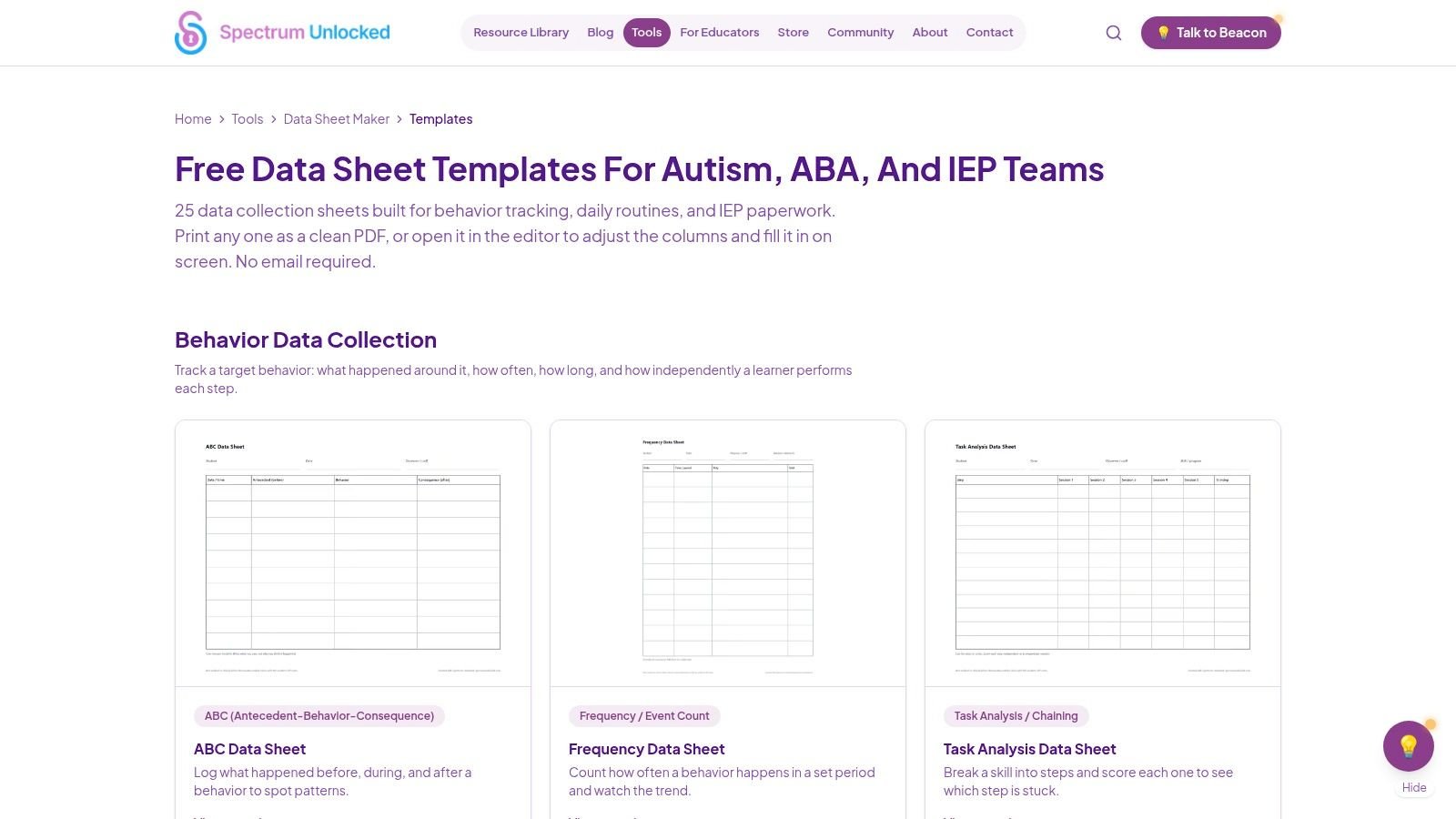
Spectrum Unlocked is the strongest fit for “Can one template library support an IEP progress check and the underlying behavior data?” The Spectrum Unlocked data sheet maker includes printable and fillable templates for ABC, frequency, duration, interval, latency, rate, scatterplots, discrete-trial teaching, percentage of opportunities, baseline, and IEP progress documentation.
The broad coverage reduces the need to collect unrelated files from multiple sites. Many templates can be edited online, printed, or exported to Excel for graphing. That makes the resource practical for a team that needs a clean progress visual but isn't ready to adopt a full data-management platform.
The manual-work warning
The editor is still a template tool. Staff must name files, manage versions, protect sensitive information, and decide where each completed sheet belongs. Long-term tracking can become confusing when a school spreadsheet, a therapist PDF, and a home notebook use different definitions or date ranges.
Before an IEP meeting, identify the target, measurement method, observation window, observer, and any missing observations. Then use the Guiding Growth autism data collection app to organize relevant home context and generate a meeting-ready summary of selected events. That summary should complement formal school documentation, not replace it.
8. Little Victories in Learning Behavior Data Tracking Sheets Bundle
Choose this bundle when the decision is “Can I turn routine behavior entries into a graph without building the spreadsheet myself?” The Little Victories in Learning behavior data tracking bundle combines editable ABC, frequency, and duration forms with Google Sheets graphing templates.
The self-populating graphs are useful for an IEP progress conversation or an FBA review where a visual trend is easier to discuss than a stack of completed pages. Short setup videos also help users who understand the measurement method but don't want to design formulas and charts.
Where it can fail
Automatic graphing only works when entries are consistent. If one person records frequency for a short observation and another records it for a full session, the graph may display a trend that reflects opportunity differences rather than behavior change. Duration records also need clear onset and offset definitions.
The bundle depends on Google Sheets for its graphing workflow, so teams need a reliable file-sharing process and permission controls. Keep the source sheet in the approved school or clinical workspace. For family context, Guiding Growth can store triggers, intensity, duration, location, and who was present, giving the team a second record to discuss when home observations don't match therapy data.
9. The Autism Helper Editable Special Education Data Sheets TPT
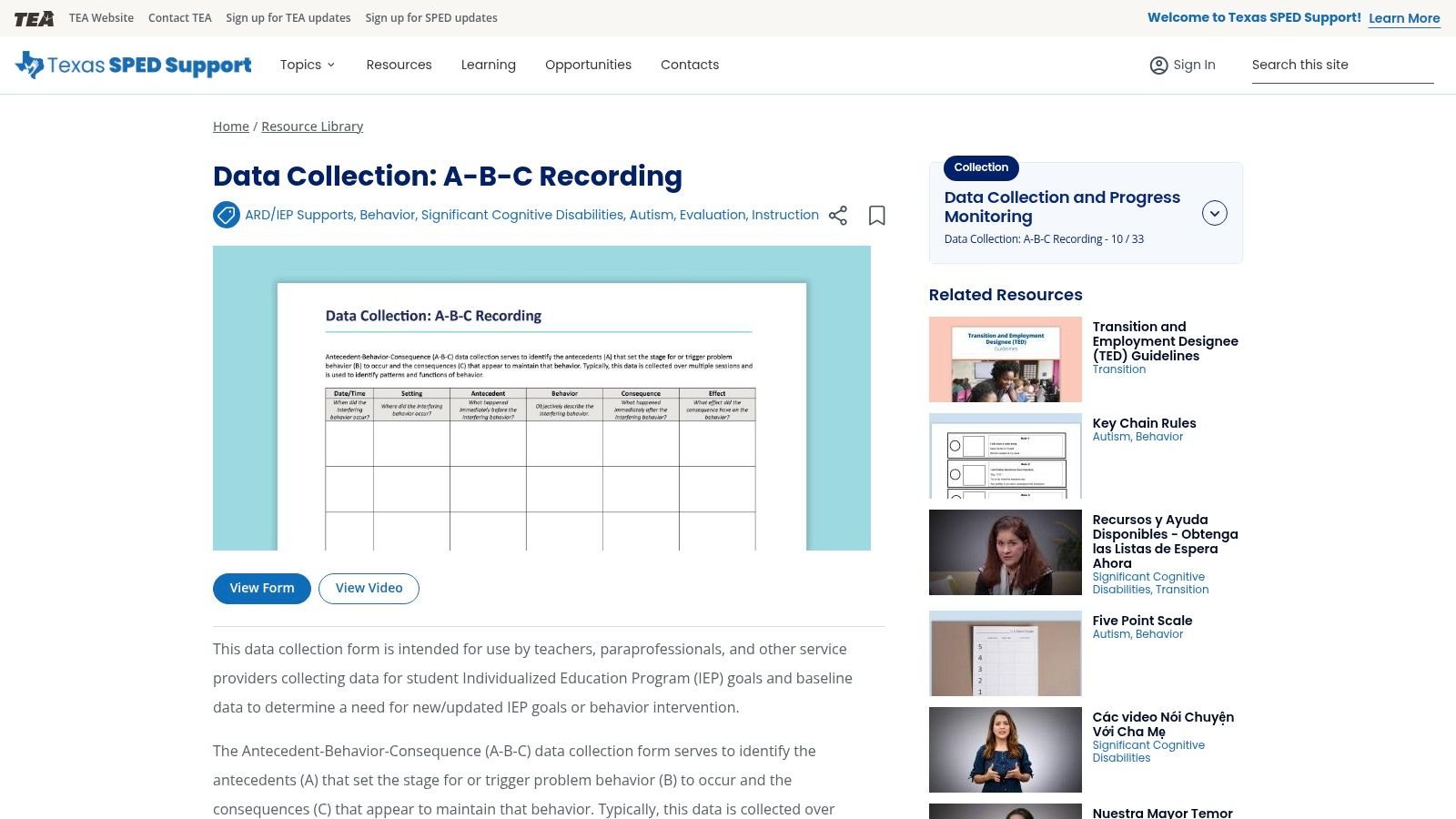
For the question “Do we need a consistent editable pack for classroom and IEP monitoring?”, the Autism Helper data sheets on Teachers Pay Teachers provide a practical entry point. The pack includes editable forms for ABC recording, interval data, discrete trials, frequency, and weekly summaries.
The consistent layout reduces the amount of time staff spend learning a new page for each target. A teacher can adapt a form for classroom use, while a team can keep weekly summaries with IEP progress materials. The pack is budget-friendly compared with a larger training toolkit, and its focus stays on deployable forms.
Who should choose it
This works well for teams that already know how to define behavior and select a measurement system. It isn't a replacement for method training or clinical supervision. The pack is also smaller than a full program library, so teams with academic, social, life-skills, and behavior targets may eventually need additional forms.
Keep the editable originals in a controlled shared folder and store completed versions according to school policy. Don't let a home message thread become the permanent record. A family can log daily context in Guiding Growth, export a selected summary for an authorized meeting, and bring the original school data to the BCBA or IEP team for interpretation.
10. The Autism Helper Data Driven Classroom Toolkit and Course
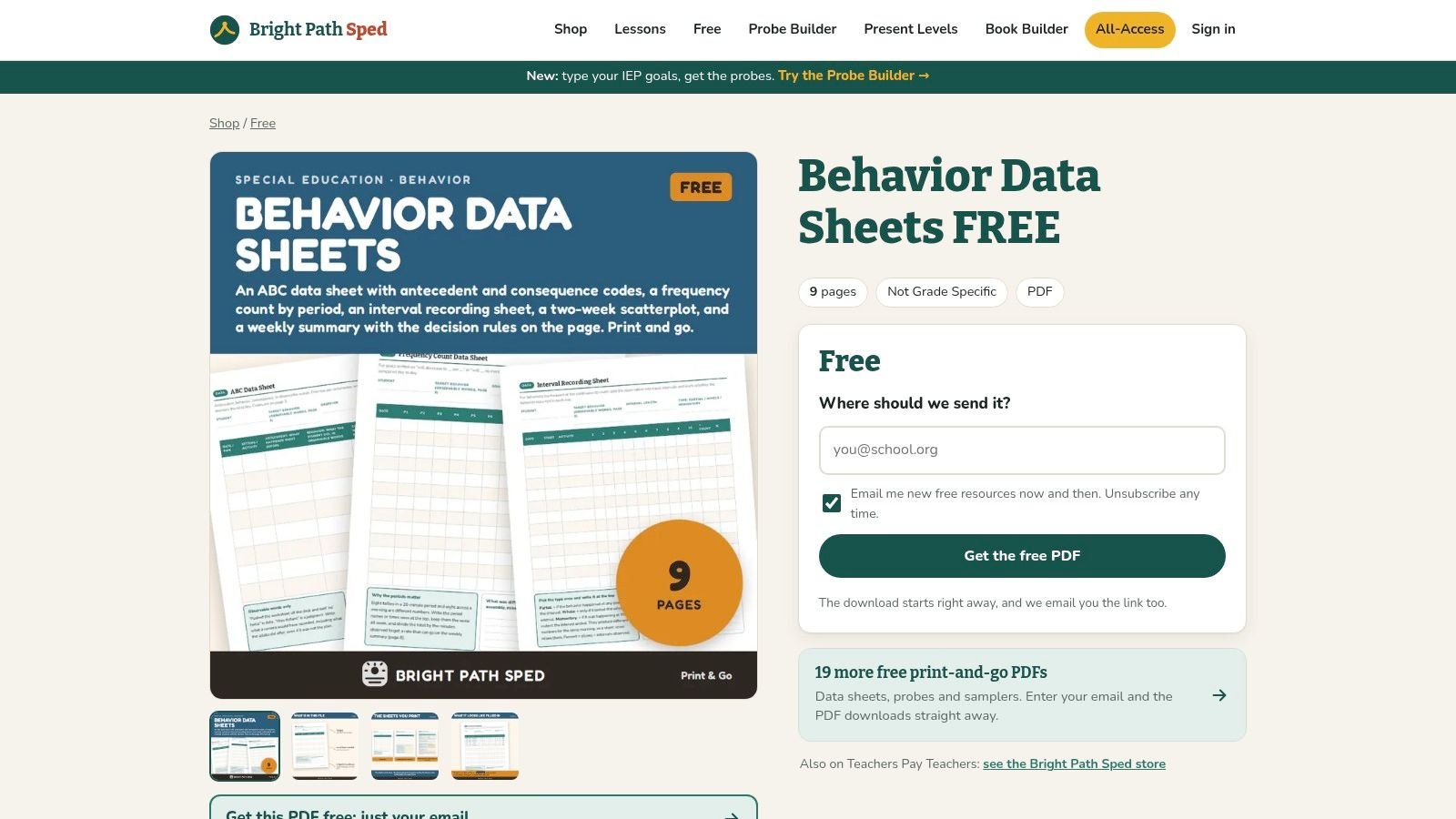
The final option answers the broadest question: “How can an entire classroom or program standardize data collection and decision-making?” The Autism Helper Data Driven Classroom Toolkit and Course combines an on-demand course with a large printable library covering behavior, academics, life skills, and social skills.
The toolkit includes customizable sheets for ABC recording, interval data, discrete trials, fluency, and other common programs, plus rubrics and program guides. That combination is more useful than a folder of blank forms when a team needs a shared process for selecting targets, recording performance, reviewing graphs, and deciding whether instruction should change.
The trade-off at program scale
The system described costs more and takes more time to implement than a single printable ABC form. Course access is time-limited even though the printables are downloadable, so a program should plan how new staff will be trained after access ends. School licensing may also matter when multiple classrooms need the same materials.
Professional standards place responsibility on behavior analysts to select and correctly implement data-collection procedures, summarize data, and use results to decide whether services should continue, change, or end. The Behavior Analyst Certification Board ethics materials also emphasize accurate documentation, confidentiality, and records management.
Keep formal program data in the approved clinical or educational record. Use Guiding Growth as a family-facing companion for context, collaboration, and meeting summaries, not as a substitute for the clinician's required documentation or judgment.
Top 10 ABA Data Collection Sheets Comparison
| Tool | Core features | UX / Quality ★ | Price / Value 💰 | Target audience 👥 | Unique selling points ✨ / 🏆 |
|---|---|---|---|---|---|
| Texas SPED Support (TEA) – A‑B‑C Data Collection Form | Printable ABC form + plain‑language guidance | ★★★★ | 💰 Free | 👥 school teams, families | ✨ State‑aligned, easy to share · 🏆 authoritative |
| Sightline Behavior – Free ABC Data Sheet | Browser fillable ABC, local autosave, CSV export | ★★★★ | 💰 Free | 👥 parents, paras, mixed‑tech teams | ✨ Local autosave & CSV export for quick analysis |
| Understand Behaviour – Printable Behaviour Templates | ABC, frequency, scatterplot, token boards (printable) | ★★★★ | 💰 Free | 👥 classrooms & home caregivers | ✨ Minimalist, field‑tested layouts for low training burden |
| Bright Path Sped – Behavior Data Sheets (Free + paid) | 9‑page core PDF (ABC, frequency, interval, scatterplot) + decision rules | ★★★★ | 💰 Free core / paid editable pack | 👥 school teams & therapists | ✨ Built‑in codes & decision rules to standardize data |
| StreamABA – Free ABA Data Sheets Library | Multiple measurement forms, task analyses, parent guides | ★★★★ | 💰 Free | 👥 BCBAs, RBTs, teachers, families | ✨ Broad starter library covering common ABA methods |
| ThinkPsych – Free Task Analysis Data Sheet | Task analysis with prompt‑level scoring + usage instructions | ★★★★ | 💰 Free | 👥 BCBAs, therapists, clinicians | ✨ Clear scoring instructions to boost reliability |
| Spectrum Unlocked – IEP & ABA Templates (editable/Excel) | 25+ templates, editable online, Excel export & IEP pages | ★★★★★ | 💰 Free (editable + exports) | 👥 clinicians, educators, families preparing IEPs | ✨ Largest free set + Excel export for graphing · 🏆 most comprehensive |
| Little Victories in Learning – Tracking Sheets Bundle | Editable PDFs + Google Sheets auto‑graphing & video walkthroughs | ★★★★ | 💰 Low‑cost bundle | 👥 parents & small teams wanting visuals | ✨ Self‑populating graphs for meetings and IEPs |
| The Autism Helper – Editable Data Sheets (TPT) | 24 editable sheets (ABC, interval, DTT, frequency, summaries) | ★★★★ | 💰 Low cost (TPT) | 👥 teachers, paraprofessionals | ✨ Consistent, classroom‑ready layouts for quick deploy |
| The Autism Helper – Data Driven Classroom Toolkit + Course | 100+ customizable sheets + on‑demand course & rubrics | ★★★★★ | 💰 Higher price (toolkit + timed course) | 👥 schools, programs, district teams | 🏆 End‑to‑end system + training to standardize practice |
Pick One Sheet This Week and Start Logging Today
The best ABA data collection sheet is the one that answers a specific question without creating a recording burden nobody can sustain. If you need to understand what happens around a behavior, start with an ABC form. If you need to compare discrete events across equal observation periods, use frequency or rate. If episodes vary in length, add duration. If you're teaching a routine, use task analysis. If the team needs a classroom-wide progress visual, choose a form that supports consistent weekly summaries or spreadsheet graphing.
Don't collect every possible measure by default. A New York State Association for Behavior Analysis parent resource recommends individualizing data with the BCBA or LBA, reducing the number of behaviors measured when collection becomes difficult, and collecting for only as long as needed to identify a clear pattern. The NYSABA guidance for families challenges the assumption that families should record everything every day indefinitely.
Run the selected sheet for two weeks, then review whether the method answers the decision in front of you. That review should include the target definition, observation window, observer, setting, opportunities to respond, and missing entries. A form that looks complete can still produce weak evidence if different people use different definitions or if one session covers a much longer period than another.
Interobserver agreement provides an important quality check when two observers can record the same session independently. A review of studies published in the Journal of Applied Behavior Analysis and Behavior Analysis in Practice from 2017 through 2021 found that 96.4% of relevant articles reported IOA for participant behavior, while only 54.7% assessed procedural fidelity. The comparison appears in the 2023 review of IOA and procedural fidelity. Families don't need to calculate IOA for every home note, but teams should be clear about who observed an event and how the event was measured.
Keep completed sheets in one approved location. Don't backfill from memory or alter a record to match an expected outcome. For home observations, Guiding Growth can bring together behavior entries and the daily details paper forms often miss, including sleep, meals, triggers, medication schedules, location, intensity, and recovery. Its analytics and Smart Summaries can help families prepare for an IEP, 504 review, therapy session, or specialist visit, while authorized collaborators can work from the same up-to-date record.
Guiding Growth does not provide medical advice. Decisions based on any sheet's results belong with the BCBA, educator, physician, or broader care team. Start at guidinggrowth.app.
Guiding Growth gives families one place to organize ABA-related observations, daily context, and meeting-ready summaries instead of relying on scattered paper forms and message threads. Log behavior with triggers, intensity, duration, purpose, location, and notes, then invite authorized caregivers or professionals to contribute. Visit Guiding Growth to connect your data collection sheets with the rest of your child's day.