What if the plan your child gets matters less than whether anyone can prove it's happening each day? Most conversations about 504 Plan vs IEP choices start with labels and eligibility checklists. Parents leave the meeting with a document, then discover weeks later that a break was skipped, a tool stayed in a drawer, or no one tracked whether a goal moved. The stronger question isn't which name sounds more powerful. It's whether your child needs access supports, specially designed instruction, or both, and whether the school will measure delivery in a way you can check.
Table of Contents
- 504 Plan vs IEP Side by Side
- Legal Foundations and Who Qualifies
- Accommodations, Services and Assistive Technology
- Documenting Needs and Tracking Data That Supports Either Plan
- Matching Your Child's Situation to the Right Plan
- Confirm the Plan Before You Sign
- What to Do When a Plan Is Not Delivered
504 Plan vs IEP Side by Side
A 504 plan is a civil-rights access plan, and an IEP is a special-education plan with measurable goals and specialized instruction. That one sentence explains most of the practical difference, but it doesn't mean the plans never overlap.
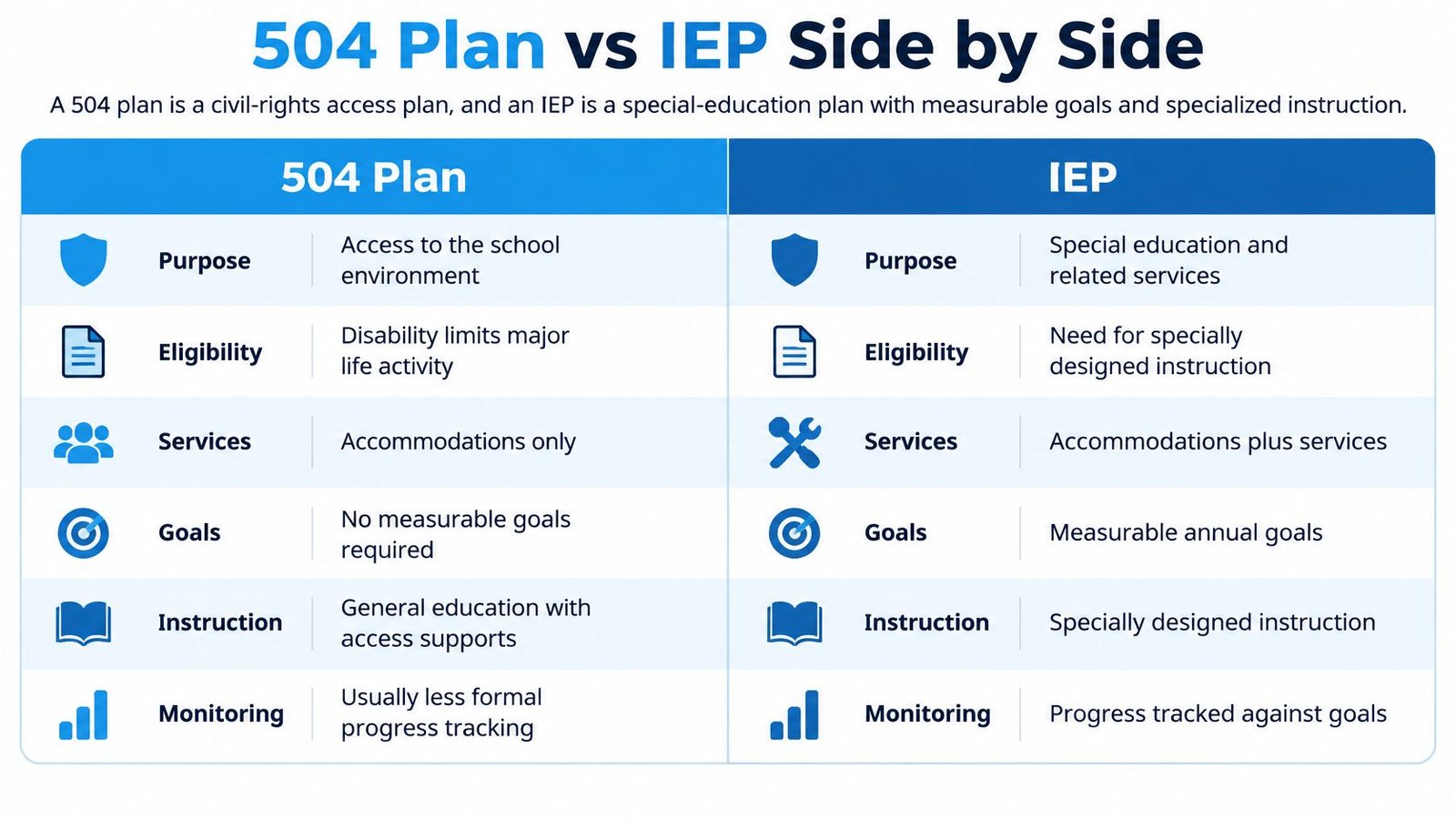
504 Plan vs IEP at a Glance
| Criterion | 504 Plan | IEP |
|---|---|---|
| Legal basis | Section 504 of the Rehabilitation Act of 1973, a civil-rights law | Individuals with Disabilities Education Act (IDEA), a special-education law |
| Eligibility test | Physical or mental impairment that substantially limits a major life activity, including learning | Meets an IDEA disability category and needs specially designed instruction |
| Typical supports | Extended time, breaks, preferential seating, assistive technology, schedule changes | Specialized instruction, related services, accommodations, program modifications |
| Required written content | No federal template, districts commonly write one to record supports | Measurable annual goals, progress measurement, service schedule, participants |
| Progress reporting | District-set schedule, not standardized | Periodic progress reports tied to each goal |
| Who decides | Knowledgeable group using an individualized evaluation | IEP team including the parent, following IDEA procedures |
| Common example | Child with ADHD who needs extra time and movement breaks | Child with autism who needs speech therapy minutes and goal-based instruction |
Both plans can include accommodations. Both should be written clearly enough for school staff to follow. A child can also hold protections under both laws, so this isn't always a clean either-or choice.
The first practical split is what changes during the school day. A 504 plan changes the conditions under which your child reaches instruction, such as where they sit, how long they get for a test, or when they can take a sensory break. An IEP changes how instruction is designed and delivered, with teaching methods, service minutes, and goals built around disability-related needs.
Ask this first: Does my child need specialized instruction, or only access supports to use the instruction already being offered?
Bring that question to the first meeting and don't let the team answer it from a diagnosis alone. Ask them to test it against real data from your child's day, including work completion, behavior, attendance, and response to supports already tried. If the team can't point to that evidence, you're not ready to choose a label yet. You're ready to request better evaluation and documentation.
Legal Foundations and Who Qualifies
A diagnosis does not automatically decide which plan fits. The laws set different eligibility tests: IDEA requires both an eligible disability category and a need for special education, while Section 504 asks whether a student meets its disability standard and needs protection from discrimination or support to access school.
The U.S. Department of Education's Section 504 FAPE guidance explains that an IEP is created under IDEA, a special-education statute requiring eligible children to receive a free appropriate public education (FAPE) designed around individual needs. Section 504 comes from the Rehabilitation Act of 1973, a civil-rights law prohibiting disability discrimination by federally funded programs.
For an IEP, a diagnosis alone isn't enough. Your child must meet an IDEA disability category and need special education and related services. The document then specifies measurable annual goals, specialized instruction, related services, accommodations, progress reporting, and participation in the least restrictive environment.
The Broader 504 Test
Section 504 uses a different eligibility test. A student may qualify if a physical or mental impairment substantially limits one or more major life activities, if there is a record of such an impairment, or if the student is regarded as having one. Section 504 FAPE can consist of regular or special education plus related aids and services that meet the student's needs as adequately as the needs of nondisabled students.
The U.S. Department of Education's special education FAQ explains that an IEP requires both IDEA-category eligibility and a need for specially designed instruction. Section 504 does not require membership in an IDEA disability category, but the student must still meet Section 504's disability standard. Autism, ADHD, diabetes, and anxiety can each be relevant to either pathway, depending on the student's eligibility and educational needs.
Families can also review the guide to Section 504 and ADA protections for parents before a meeting. If statutory language is difficult to organize into questions, a legal assistant tool is another resource to consider.
The U.S. Department of Education's disability discrimination FAQ reports that in 2020-21, the Civil Rights Data Collection counted 8.4 million public-school students with disabilities, equal to 17% of enrollment. It also counted 1.6 million students, 3% of all enrolled students, receiving aids and services under Section 504 only. All IDEA-eligible students are also protected by Section 504.
Use the eligibility tests as a starting point, then ask how the proposed plan will address your child's documented needs. A 504 plan may fit when the student meets Section 504's standard and needs aids or services to access school. An IEP may fit when the student also meets an IDEA category and needs specially designed instruction. Ask the team to explain its decision using the evaluation evidence and to describe how the supports will be delivered and measured.
Accommodations, Services and Assistive Technology
Parents often hear, "504 means accommodations, IEP means services." That's a useful starting point, but it's too neat. The clearer distinction is between accommodations, which change access conditions, and specially designed instruction, which changes how content is taught and measured.
The team meeting below shows where that distinction should be tested, with work samples and daily data on the table rather than labels alone.
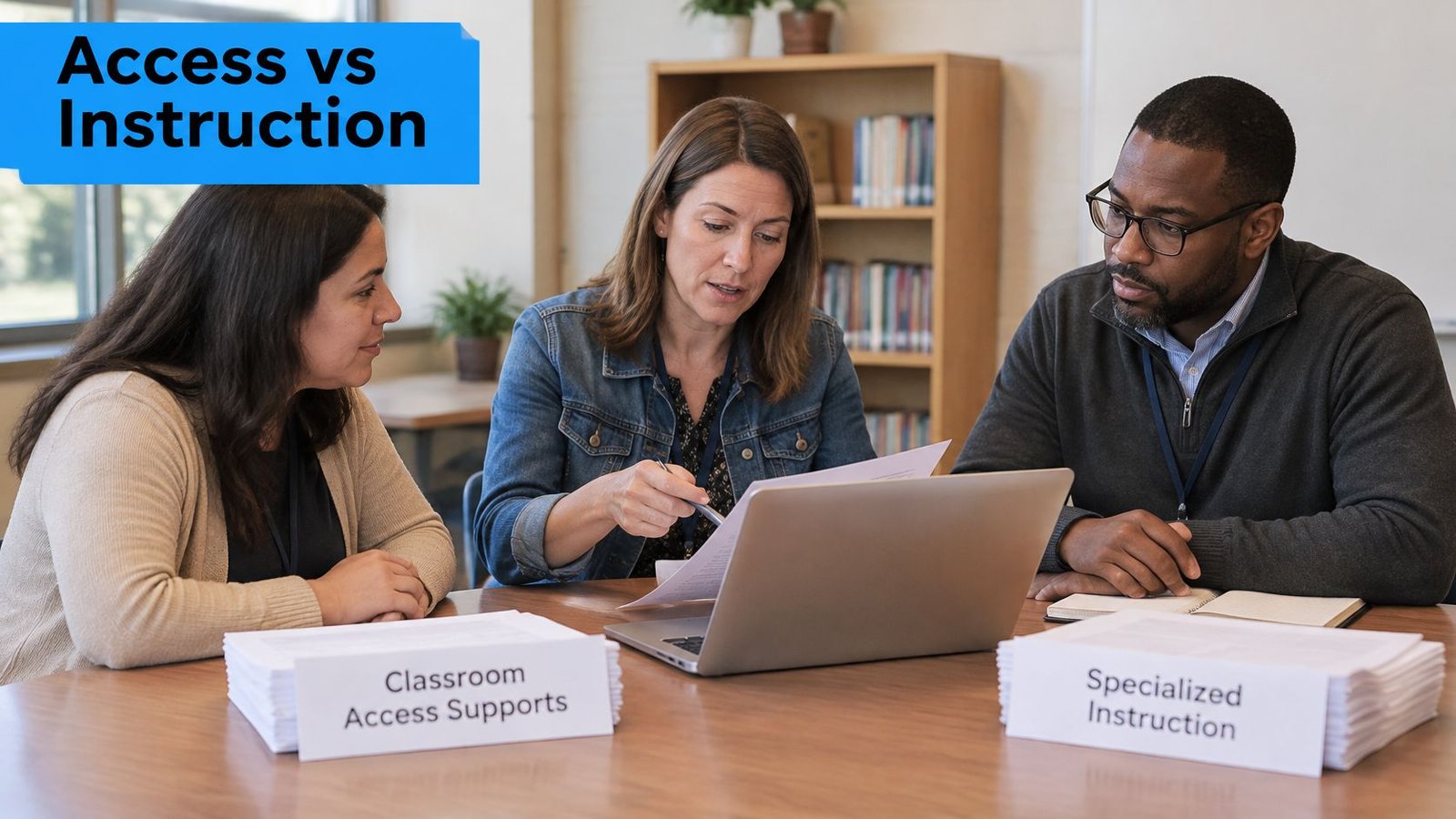
A 504 plan typically holds extended time, movement or sensory breaks, preferential seating, visual schedules, and daily check-ins. Your child still learns the same content in the same general way, but barriers around attention, sensory load, health, or executive function are reduced.
An IEP can include those same accommodations and add goal-based instruction. For example, a child might receive explicit reading instruction with a baseline, an annual target, and progress checks. Another child might get scheduled speech-language, occupational, or behavioral therapy with named providers and service minutes.
Where Assistive Technology Overlaps
Assistive technology is the most overlooked overlap in the 504 Plan vs IEP comparison. A U.S. Government Accountability Office review found that staff in five of eight school districts visited said assistive technology was less commonly provided through Section 504 plans than through IEPs, even though Education officials stated that students with either type of plan may need it and the district must provide needed assistive technology at no cost to parents.
That finding matters if a school tells you a tool is "IEP only." Ask what the individualized evaluation showed. Autistic students may need support for communication, sensory, motor, or executive-function barriers rather than a conventional academic deficit, and the right tool follows the barrier, not the plan title.
Common tools include:
- AAC devices: Support expressive communication when speech isn't reliable across settings.
- Text-to-speech: Gives access to grade-level text while reading skills are still developing.
- Visual schedules: Make sequence, transitions, and expectations visible before problems start.
- Noise-reduction headphones: Reduce auditory load during assemblies, cafeteria time, or independent work.
Watch this explanation with a specific barrier in mind, then write down which tool would remove it and how you'd know it worked.
A Request Sequence That Works
- Document the barrier: Keep dated examples showing what task failed, where, and what happened without the tool.
- Request evaluation in writing: Name the functional area, such as communication or written output, not only a product you want.
- Define successful use: State the observable result, such as independent requests, finished assignments, or calmer transitions.
- Train the users: Ask who trains staff and your child, and when that training happens.
- Review across settings: Set a date to check use in classrooms, specials, lunch, and transitions.
A device by itself is an aid. Instruction in how to use it, measurable goals, service minutes, and progress monitoring point toward IEP territory. Ask the team to separate those pieces instead of treating technology as a single yes-or-no item.
Documenting Needs and Tracking Data That Supports Either Plan
Dated examples help turn a broad concern into a question the school team can answer: what barrier is the child experiencing, what support was provided, and what changed afterward? IEPs generally include baselines, annual goals, and progress reporting. A 504 plan may list accommodations without standardized goal measures, so a family's own records can help assess whether those supports are working.
ERIC guidance on Section 504 and IDEA documentation describes the difference in their documentation requirements. IDEA includes requirements for parent participation, annual goals, services, placement, progress reporting, and periodic review. Section 504 requires evaluation and a decision by a knowledgeable group, but does not prescribe an IEP-equivalent document or uniform national format.
Data to Track and the Plan It Supports
| Data to Track | What to Record | Plan It Supports |
|---|---|---|
| Behavior episodes | Frequency, duration, intensity, triggers, and outcome | Both, including baselines for IEP goals |
| Attendance and tardies | Dates, partial days, and stated reasons | Both, to show access barriers |
| Assignment completion | Tasks finished, accommodations used, and time taken | 504 accommodation review |
| Sleep and medication | Hours slept, medication times, and morning mood | Both, as context for behavior |
| Therapy and specialist notes | Session dates, goals addressed, and outcomes | IEP related services |
| Communication and sensory | Observed triggers and supports that worked | Both, including technology decisions |
Ask for a school record that makes each support observable: the accommodation, setting, frequency, responsible staff member, evidence it was delivered, student response, and review date. “Will provide breaks” leaves too much unclear. A written record can specify when a break is offered, who supports it, and how the team will judge whether it helps.
Why Time Stamps Change the Meeting
“Mornings are hard” leaves room for conflicting interpretations. Dated examples give the team something specific to examine. For instance, records might show that an autistic child leaves class after noisy transitions, completes little work before lunch, and settles more quickly when given a visual schedule and headphones. Tracking the timing, triggers, and outcomes helps the team consider whether access supports are sufficient or whether learning gaps persist.
The special education data collection guide explains ways to keep records consistent. Short entries made the same day can be more useful than trying to reconstruct a long stretch of events before a meeting.
Guiding Growth lets parents manage medications, doctor appointments, and therapy sessions in one place. With Quick Log, parents can record the day by voice, while Behavior Tracking logs episodes, triggers, and outcomes. It also keeps records of echolalia, hand flapping, and other stimming behaviors, including their triggers and outcomes.
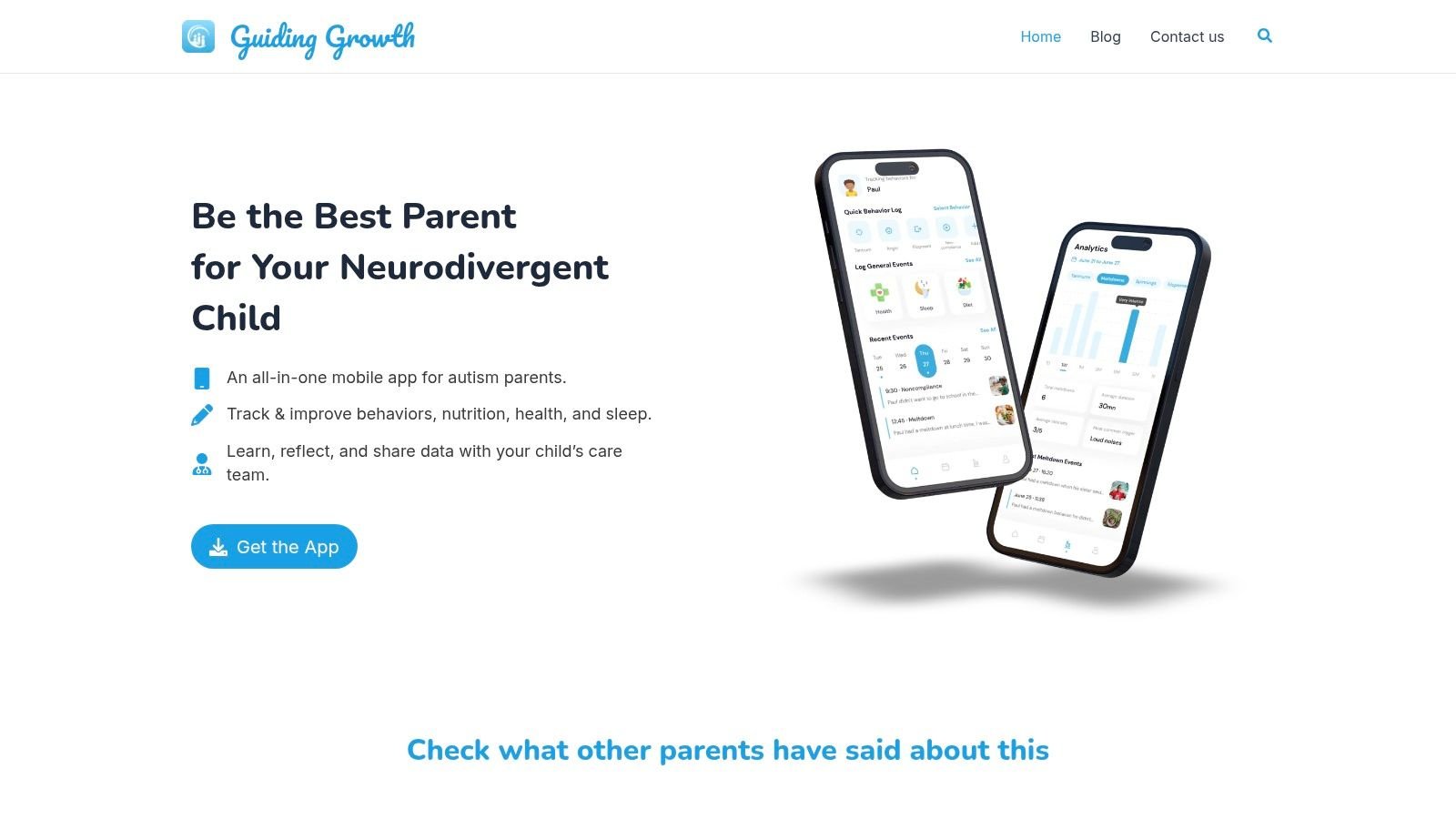
Guiding Growth's analytics dashboard displays behavior frequency, common triggers, and time-of-day patterns. Its four key features, Behavior Tracking, Sleep Monitoring, Diet and Nutrition, and Collaboration, present data with visualizations. Smart Summaries can create a date-filtered report for an IEP or 504 review and export it as a PDF.
If records show that accommodations are closing the gap, a 504 plan may meet the child's needs. If difficulties persist across settings despite supports being delivered, the pattern can help explain why you are requesting an IEP evaluation.
Bring a focused date range, two or three clear patterns, and examples that connect a barrier, a support, and a result. That gives the team concrete evidence to discuss and a way to check whether the plan is working.
Matching Your Child's Situation to the Right Plan
Start from the functional gap, not the label. Ask what's preventing progress, what support removes that barrier, and whether the support changes access or changes instruction itself.
The functional gap matters more than the label. Choose the plan that matches what your child needs adults to do differently each day.
Which Plan Fits Which Situation
| Situation | Likely Fit | What to Ask For |
|---|---|---|
| Doing well academically but needs extended time or breaks | 504 plan | Written accommodations and named staff responsibilities |
| Needs weekly speech, occupational or behavioral services | IEP | Measurable goals and service minutes |
| Needs specially designed reading or math instruction | IEP | Goals, baselines and progress reports |
| Health need such as diabetes or seizures | 504 plan | Emergency protocol and staff training |
| Gaps persist despite accommodations | Request IEP evaluation | Written evaluation request and data review |
| Needs AAC or sensory tools across settings | Either, based on evaluation | Technology determination and trial period |
The most common 504 pattern is a child who's learning grade-level content but can't show it under standard conditions. Extended time, a quieter setting, chunked directions, or planned breaks may remove the barrier. The written plan should still say who provides each support and where it applies, including tests and substitute-teacher days.
The answer shifts when your child needs adults to teach a skill systematically. Weekly speech, occupational, or behavioral services usually point to an IEP because the team should define the skill, set a measurable goal, schedule service minutes, and report progress. The same logic applies to specially designed reading or math instruction that differs from general classroom teaching.
Health needs need operational clarity, whichever plan holds them. A child with diabetes or seizures may fit a 504 plan when the central need is a written health protocol, trained staff, permission to manage medical needs, and clear emergency steps. Ask who is trained in each setting, not only who wrote the protocol.
Persistent gaps are your signal to change the conversation. If accommodations are delivered consistently and your child still isn't progressing, submit a written request for an IEP evaluation and attach your data summary. A student can move from a 504 plan to an IEP after evaluation, and a student with an IEP still retains broader civil-rights protection. A child with several needs may have instruction and services in an IEP while access details still need careful coordination across the school day.
Bring four questions to the meeting:
- Specialized instruction: Does my child need teaching designed specifically for their disability-related needs?
- Across settings: Are supports needed in class, transitions, lunch, specials, and testing?
- Learning or access: Is the main gap in acquiring a skill, or in reaching and showing learning?
- Evidence: What data shows the current approach is or isn't working?
If the team answers with general reassurance, ask them to write down the measure they'll use next. A good 504 Plan vs IEP decision should leave you with a testable next step, not just a category.
Confirm the Plan Before You Sign
The most common failure point isn't a wrong label. It's an accommodation that exists on paper but is inconsistently delivered. Before you sign, run an implementation audit and ask the team to fix vague language while everyone is still in the room.
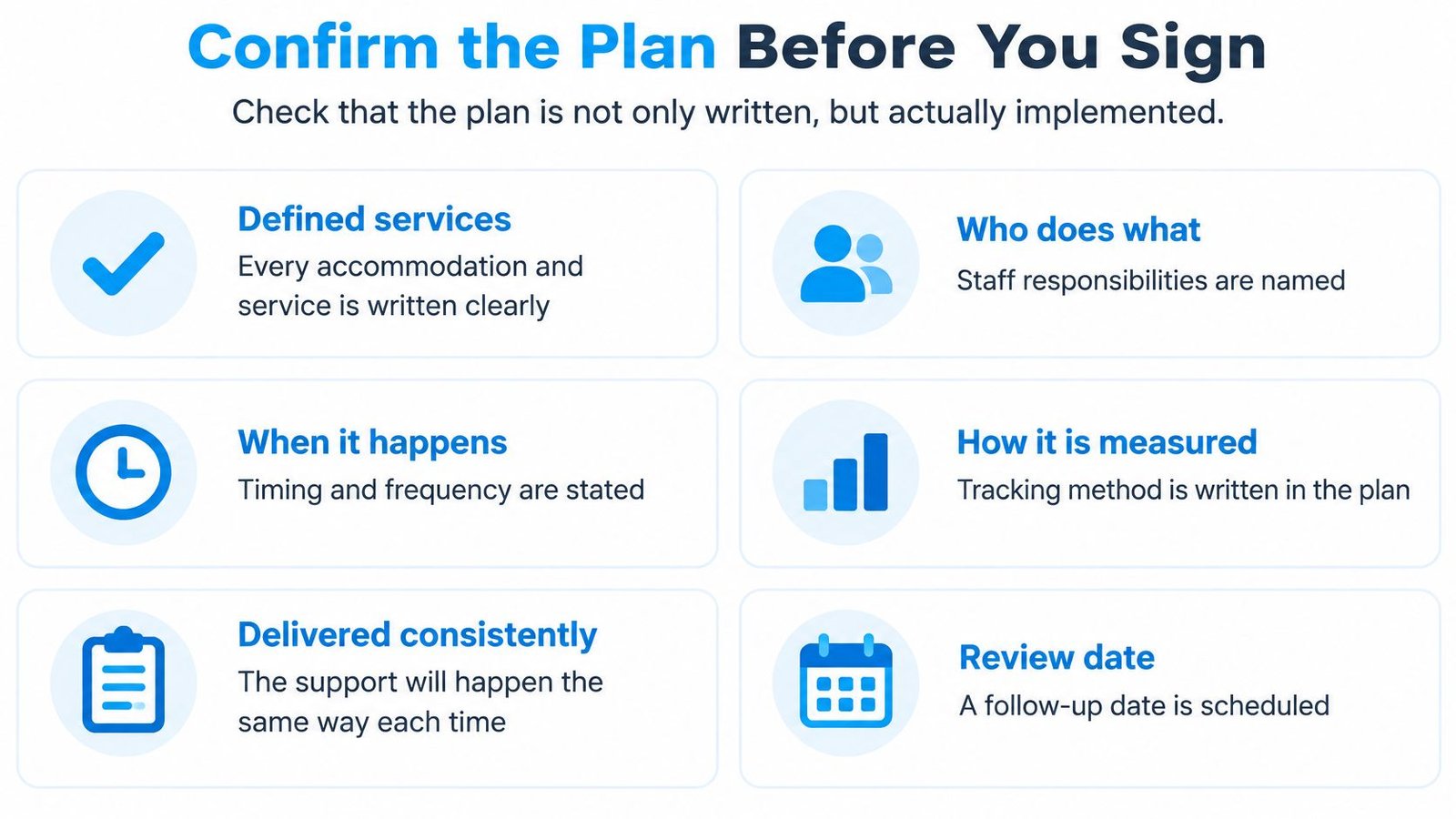
The Idaho Section 504 Practice Guide emphasizes that plans should identify the district as the implementer, use unambiguous language, provide parents a copy, and notify or train responsible personnel before the school year begins. It also notes that Section 504 doesn't explicitly require a document called a "504 plan", although schools must provide aids and services determined necessary and written plans are recommended so responsibilities are clear.
Check these items line by line:
- Who delivers it: A named role is responsible for each accommodation or service.
- Where it applies: Settings include classrooms, transitions, meals, toileting, specials, and testing when relevant.
- How often: Frequency, duration, and timing are stated in plain language.
- What counts as missed: The team defines a missed support and what happens next.
- How delivery is documented: Staff record use and student response, not just intent.
- When you'll review: A follow-up date is scheduled before problems accumulate.
Sensory, communication, transition, meal, toileting, executive-function, and behavior supports need the same clarity as extended test time. "Access to breaks as needed" isn't a usable instruction for a substitute teacher. Our IEP meeting preparation guide can help you turn those audit questions into a short meeting checklist.
For your next step, log your child's day for two to four weeks before the review. We let parents manage medications, doctor appointments, and therapy sessions all in one place, so behavior, sleep, medication, and therapy records aren't scattered across notebooks and messages. Our Collaboration feature lets parents share information in real time with family members, caregivers, and medical professionals, which keeps the adults supporting your child aligned.
Generate a Smart Summary for the meeting date range before you go. You'll walk in with a clear, data-backed report and a plan audit, not a stack of disconnected notes.
What to Do When a Plan Is Not Delivered
Don't wait for a full dispute to learn the escalation path. Start close to the classroom, put each step in writing, and bring the same evidence packet forward so the pattern stays visible.
Step 1 Request a Team Meeting in Writing
Email the teacher, case manager, or 504 coordinator and list each support that wasn't delivered. Include dates, settings, and examples, and ask for a meeting to correct delivery. Attach your record of behavior, attendance, assignment completion, and therapy context so the discussion focuses on observable facts.
Keep your tone specific and practical. "Breaks were missed on three afternoons, and work completion dropped each time" gives the team something to fix. Ask who will document delivery after the meeting and when you'll review the correction.
Step 2 Ask the District for a Corrective Response
If the school doesn't respond or the same supports keep slipping, write to the district. Ask for an explanation and a corrective plan with responsible staff and dates. Save every reply, meeting notice, and revised document in one folder.
For an IEP, your options can include mediation, a state complaint, or an IDEA due process hearing. Ask your state education agency which process fits the problem and what forms are required. Put deadlines from official notices on your calendar as soon as you receive them.
Step 3 Use the Civil Rights and State Routes
For a 504 plan, you can file a complaint with the U.S. Department of Education Office for Civil Rights. Check the current filing window and instructions before you submit, and don't delay while informal conversations continue. Your state complaint procedure may also cover either plan, so check that route in parallel.
At every step, bring the same core evidence: time-stamped behavior records, attendance and partial days, assignment completion, and therapy notes. Guiding Growth can turn that record into a date-filtered Smart Summary exported as a PDF, so your packet shows the pattern across weeks rather than relying on one parent's account of a difficult day. That pattern is often your strongest tool because it connects missed supports, settings, and student response in one place.
Start your next 504 or IEP meeting with evidence instead of scattered notes by logging behavior, sleep, meals, medication, and therapy in one place, then generating a Smart Summary for the team. Visit Guiding Growth to download the app and build a clear, date-filtered record you can share before you sign.