You notice it while your child is standing by the window. Two fingers move quickly in front of their face. Later it happens again in the grocery store line, then during a favorite cartoon, then when the room gets loud. Your mind starts racing. Is this normal? Is it anxiety? Is it autism finger flicking?
That mix of concern and curiosity is entirely understandable. Parents often tell me the hardest part isn't the movement itself. It's not knowing what it means. When you don't yet have a framework for what you're seeing, every repeated movement can feel loaded.
The reassuring truth is that finger flicking is often a meaningful behavior, not a random one. In many autistic children, it helps with sensory regulation, focus, emotional expression, or coping during stress. When you understand the reason behind it, your next steps get much clearer and much kinder.
Table of Contents
- A Parent's First Question About Finger Flicking
- What Is Finger Flicking in Autistic Children
- Finger Flicking vs Tics Differentiating Repetitive Movements
- Common Triggers and Functions of Finger Flicking
- How to Support Your Child With Supportive Management Strategies
- Using Data to Understand Patterns and Triggers
- Frequently Asked Questions About Finger Flicking
A Parent's First Question About Finger Flicking
A parent once described it to me this way. "She was excited about the bubbles, but then she started flicking her fingers near her eyes, and I couldn't tell if she was happy, overwhelmed, or both." That uncertainty is where many families start.

What most parents worry about
Usually, the first question sounds simple. "Why is my child doing that?" Underneath it are several bigger worries:
- Is this a sign of distress: Parents want to know whether their child is struggling.
- Should I stop it: Many wonder if allowing it will make things worse.
- Does it mean autism: Some parents are noticing finger flicking along with speech, play, or sensory differences.
- Will other people judge my child: Public reactions can make ordinary parenting feel very exposed.
All of those concerns make sense. None of them make you overreactive.
Practical rule: Before asking how to stop the movement, ask what the movement may be doing for your child.
A more useful first question
Instead of "How do I make this go away?" try "What is my child's nervous system telling me?" That small shift changes everything. It moves you away from correction and toward understanding.
Finger flicking can show up during joy, stress, anticipation, boredom, sensory overload, or concentrated attention. The same outward movement can serve different purposes in different moments. A child who flicks fingers while watching sunlight move across the wall may be seeking visual input. A child who does it in a crowded birthday party may be trying to stay regulated in a busy environment.
That's why autism finger flicking is best understood as communication through movement. Your child may not be choosing words in that moment, but their body is still telling you something important.
Reassurance that matters
You don't need to decode everything on day one. You only need to get curious. Notice when it happens, what came before it, and whether your child seems calmer, more focused, or more overwhelmed afterward.
That kind of observation is the beginning of good support. It's also how many parents stop feeling scared and start feeling capable.
What Is Finger Flicking in Autistic Children
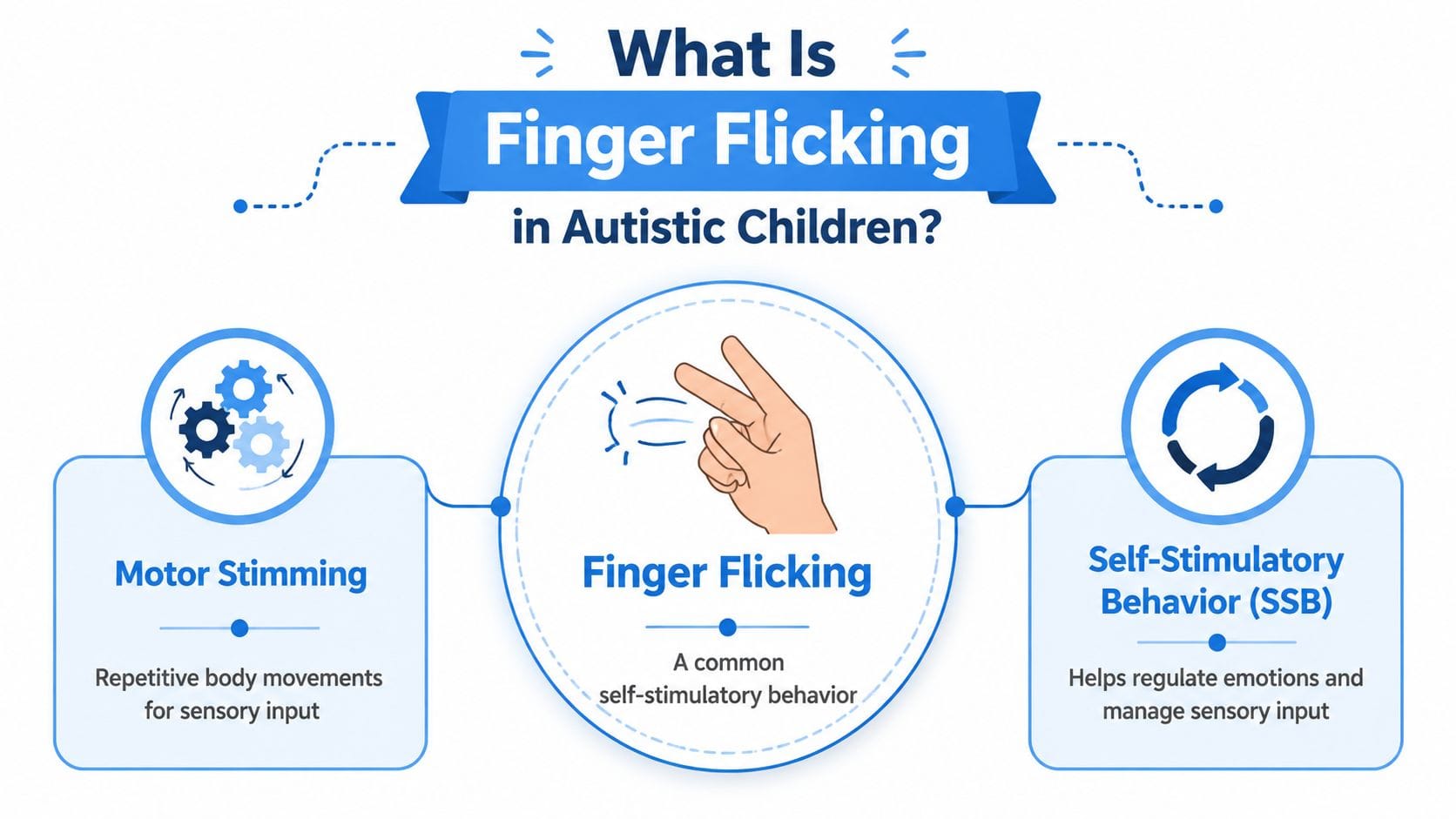
Finger flicking is a form of motor stimming, which means a repeated body movement a person uses to regulate sensation, emotion, or attention. In autism, motor stimming falls under restricted and repetitive behaviors, often shortened to RRBs, which are part of the broader behavioral profile clinicians consider when evaluating Autism Spectrum Disorder.
A simple way to think about stimming
A lot of adults already do mild versions of this. Someone taps a pen during a meeting. A musician taps a foot to keep rhythm. A student twists hair while thinking through a hard problem. Those actions help the body organize itself.
Finger flicking works in a similar way. The difference is that in autistic children, the movement is often more visible, more frequent, and more closely tied to sensory processing.
Research summarized by Kids Club ABA on stimming in autism notes that approximately 75% of autistic individuals regularly engage in motor stims, and 94% of autistic individuals experience sensory differences that often trigger behaviors like these. That helps explain why autism finger flicking is so common in practice.
What the movement may look like
Finger flicking doesn't look exactly the same in every child. You might see:
- Quick finger movements near the face
- One or more fingers wiggling in front of the eyes
- Repeated snapping or flicking motions
- Rhythmic finger movements during excitement or stress
Some children seem drawn to the visual pattern. Others appear to enjoy the feeling of movement itself. Sometimes both are true at once.
Finger flicking isn't usually meaningless motion. It's often a child's way of creating a sensory experience that feels predictable and manageable.
Why this matters
Parents sometimes hear the word "repetitive" and assume the behavior should be eliminated. But repetition is often the point. A predictable movement can help a child steady an unpredictable world.
That doesn't mean every repeated movement points to autism. It does mean finger flicking deserves interpretation before correction. If your child uses it to regulate, suppressing it without understanding the need can leave them with fewer coping tools, not more.
For many families, the most helpful reframe is this. Finger flicking is not just something your child does. It's often something your child uses.
Finger Flicking vs Tics Differentiating Repetitive Movements
One of the biggest points of confusion for parents is whether they're seeing a stim or a tic. The movements can look similar at first glance, especially when they happen often or show up suddenly.
A useful distinction is purpose. According to Heartlinks ABA's explanation of finger flicking in autism, autistic finger flicking is a voluntary, self-generated coping mechanism that provides a predictable sensory feedback loop to restore balance and reduce anxiety. That is different from pathological reflexes or involuntary neurological signs.
Stimming vs tics at a glance
| Characteristic | Finger Flicking (Stimming) | Tics |
|---|---|---|
| Control | Often semi-voluntary or voluntarily initiated | Often involuntary or hard to suppress |
| Purpose | Usually serves regulation, focus, or sensory needs | Doesn't typically serve a sensory regulation purpose |
| Pattern | Can be rhythmic or repeated in a consistent way | Often sudden, brief, and less rhythmic |
| Context | May increase with excitement, stress, sensory overload, or concentration | May appear across settings without clear sensory function |
| After effect | Child may look calmer, more focused, or better organized | May not lead to visible regulation |
Questions that help you tell the difference
Ask yourself these:
- Does it seem to help my child settle or focus: If yes, stimming is more likely.
- Is there a pattern in the environment: Loud rooms, bright light, waiting, and excitement often go with stimming.
- Can my child pause it briefly if engaged elsewhere: Sometimes children can shift away from a stim if something else meets the same need.
- Does it look abrupt and unwanted: That may point more toward a tic or another movement pattern worth discussing with a clinician.
If your child also has attention differences, sensory challenges, or you're sorting through overlapping traits, these expert insights on co-occurring conditions from Refresh Psychiatry & Therapy can help you think more clearly about what may be happening.
When parents get stuck
The hardest cases are the mixed ones. A child may have autism, anxiety, sensory differences, or another co-occurring condition, and not every movement fits neatly into one box. That's okay. You don't need to diagnose the movement at home. You only need to describe it clearly.
A detailed description such as "he flicks his fingers near the window when sunlight is moving and seems calmer after" is far more useful than "he does weird hand things."
Common Triggers and Functions of Finger Flicking
If you want to understand autism finger flicking, focus less on the movement and more on the moment around it. What happened right before? What changed in the room? What does your child seem to gain from it?
This visual summary can help organize what you're seeing.
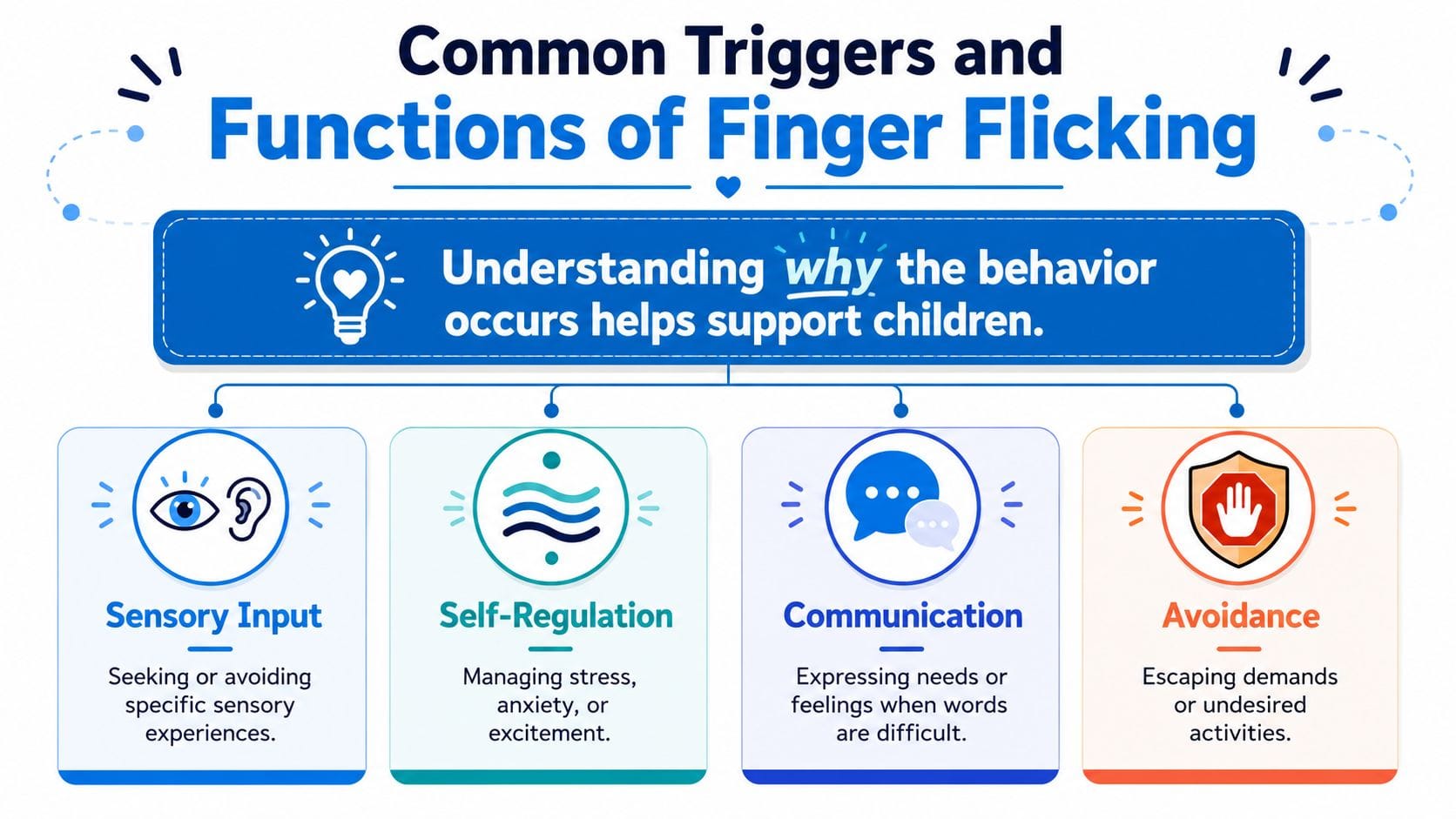
Guidance on identifying sensory triggers in autism can be helpful when you're trying to spot patterns across the day.
Sensory seeking
Some children flick their fingers because the movement itself feels good or interesting. They may enjoy the visual effect, the rhythm, or the body feedback it creates.
A common example is a child who watches their fingers move in sunlight or in front of a bright screen. In that case, the behavior may be giving the nervous system input it wants.
Sensory avoidance
The same movement can also help block out too much input. A noisy store, crowded classroom, or echoing hallway can overload the senses. A repeated hand movement may help the child narrow attention and create something predictable.
You might notice this when your child starts finger flicking in busy places, during transitions, or when several sounds are happening at once.
When a child increases repetitive movement in a stressful setting, the behavior may be working like a shield, not a problem.
Communication
Not every child can quickly say, "I'm excited," "I'm frustrated," or "this is too much." Bodies often communicate first. Finger flicking may appear during joy, anticipation, disappointment, or agitation.
Elevation Autism's discussion of hand movements in autistic children explains that finger flicking can serve functions such as sensory seeking, communication, and focus, and warns that punishing these behaviors can increase a child's anxiety. That matches what many therapists see in daily life.
A child who finger flicks when a favorite song starts may be expressing delight. A child who does it when asked to stop a preferred activity may be showing frustration or overload.
Self-regulation and focus
Some children use finger flicking to stay organized internally. The rhythm helps them focus on a task, wait through uncertainty, or recover from a surge of emotion.
This is the child who flicks fingers while listening to a story, riding in the car, or sitting through a hard transition. The movement can act like a metronome for the nervous system.
This short video offers another helpful lens on why repeated hand movements happen in autistic children.
What to look for in real life
Try observing these factors for a few days:
- Setting: Home, car, school, store, playground
- State: Excited, tired, hungry, anxious, focused
- Trigger: Noise, waiting, transitions, bright light, demands
- Result: Calmer, more alert, more upset, no clear change
That simple detective work often reveals that the behavior is logical, even when it first seemed puzzling.
How to Support Your Child With Supportive Management Strategies
The most helpful question usually isn't "How do I stop finger flicking?" It's "How do I support the need underneath it?" That shift protects your child's regulation and your relationship.
Research summarized by The Transmitter on repetitive behaviors and age in autistic children reports that approximately 75% of autistic children experience a marked decrease in restricted and repetitive behaviors between ages 3 and 11. For many children, these behaviors lessen as they develop other coping strategies. That's one reason forceful suppression is rarely the right starting point.
Do this instead of that
| Supportive response | Less helpful response |
|---|---|
| Notice the pattern and ask what the behavior is doing for your child | Assume defiance or attention-seeking |
| Offer another tool that meets the same sensory need | Take the behavior away with no replacement |
| Protect regulation in public | Correct for appearance |
| Redirect only if unsafe | Stop all stimming on principle |
What supportive care can look like
- Create a calm zone: A quiet corner with lower light, familiar toys, soft textures, or a favorite blanket can give your child a place to regulate.
- Offer sensory tools: Fidgets, putty, textured items, or visual toys may meet a similar need. This guide to sensory tools that help calm meltdowns gives practical ideas.
- Use simple language: Try "Your body looks busy" or "It's loud in here" instead of "Stop that."
- Prepare for tough settings: Waiting rooms, shopping trips, and family events often go better when you bring regulation tools before stress builds.
Support doesn't mean permissive chaos. It means matching your response to your child's actual need.
When redirection makes sense
Redirection is appropriate when the movement is unsafe, disruptive in a way that harms the child, or keeps them from doing something they want to do. The key is to replace, not remove.
If a child flicks fingers so close to their eyes that they become distressed, you might offer a ribbon wand, spinner toy, or another visual-motor activity. If finger flicking ramps up during long waits, a tactile fidget or movement break may help.
Getting outside help
If the behavior is tied to bigger sensory struggles, communication challenges, or school participation problems, a pediatric occupational therapist can help you match supports to function. Families looking for therapy options may also want to know that Therapsy offers autism therapy for those seeking added professional support.
The big idea is simple. Your child doesn't need fewer ways to cope. Your child needs safer, broader, better-supported ways to cope.
Using Data to Understand Patterns and Triggers
Parents are often told to "watch for patterns," but memory gets messy fast. The school called during lunch. Your child skipped breakfast. Bedtime ran late. By the time you try to explain the week to a therapist, the details blur together.
That's where tracking helps. Instead of relying on impressions, you can collect observations that show when finger flicking happens, what happened before, and what seemed to help after. This turns a stressful mystery into a pattern you can work with.
What to track
You don't need a huge spreadsheet. Start with a few useful variables:
- Time of day: Morning, after school, bedtime
- Context: During play, during demands, in noisy places, while waiting
- Possible trigger: Hunger, fatigue, transitions, bright light, excitement
- What followed: Calm, escalation, easier focus, meltdown, recovery
Practical help for tracking and understanding behavioral triggers can make this process feel much less overwhelming.
Why this matters clinically
The pattern often tells the story. A child who finger flicks mostly in fluorescent stores may need environmental changes. A child who does it before dinner every day may be tired, hungry, or both. A child who flicks fingers during favorite songs may be expressing positive emotion, not distress.
According to the CDC autism data and research hub, motor stims like finger flicking are present in approximately 75% of autistic individuals, and 88% engage in at least three different forms of stimming regularly. That means finger flicking often isn't an isolated behavior. Tracking helps you see the broader pattern, not just one movement in one moment.
Why parents benefit from faster logging
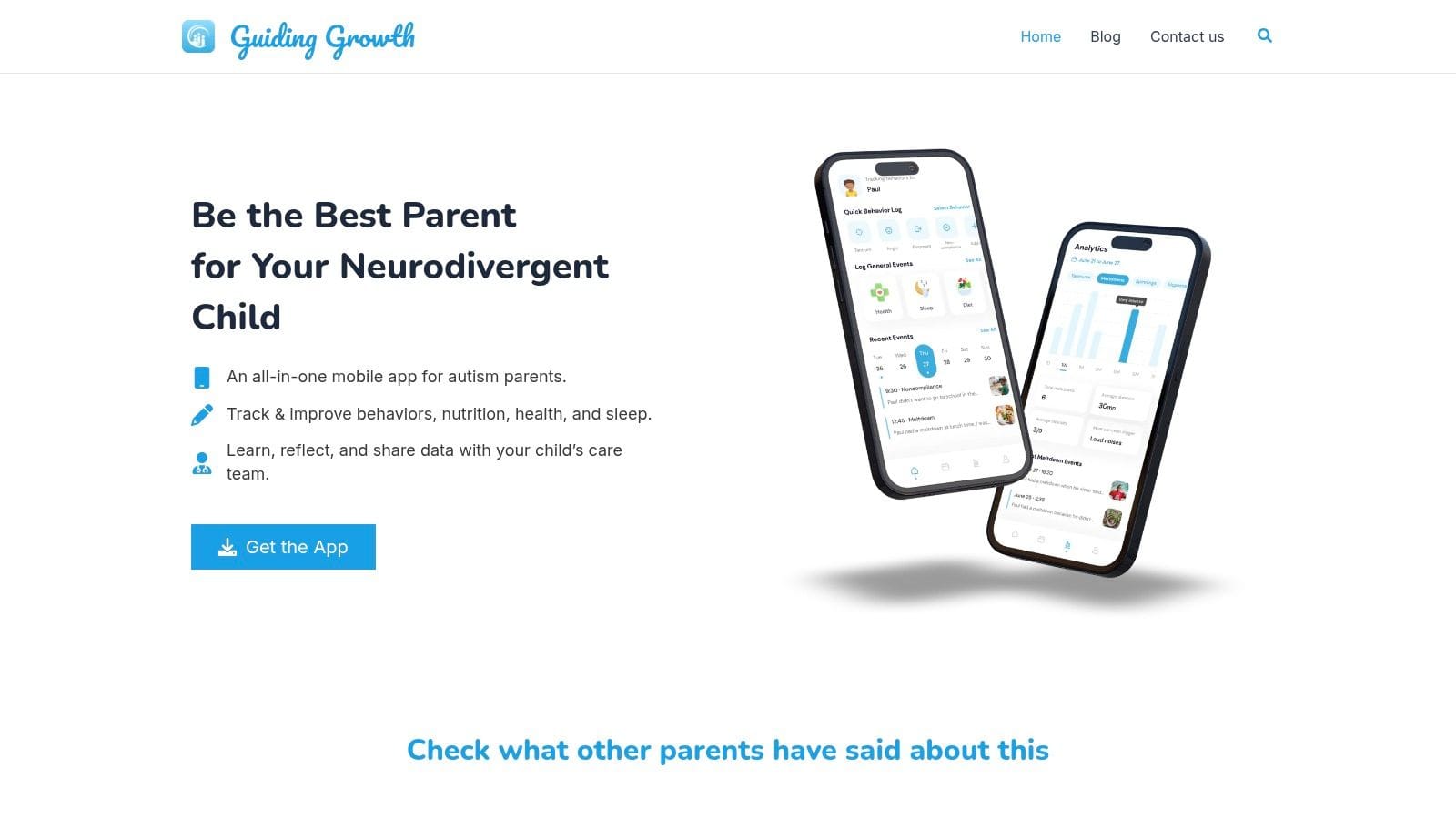
Busy parents need a system they'll use. Guiding Growth is built for that reality. Its voice logging feature lets parents quickly capture high-frequency behaviors without stopping to type. That matters when a behavior happens in the car line, kitchen, or middle of a rough transition.
Value isn't just convenience. It's clarity. When you bring organized notes to an OT, pediatrician, teacher, or therapist, the conversation changes. You're no longer saying, "I think this happens a lot." You're showing what tends to happen before, during, and after.
Good tracking doesn't turn you into a data analyst. It helps you become a calmer, more informed advocate for your child.
Frequently Asked Questions About Finger Flicking
Is finger flicking always a sign of autism
No. Finger flicking can also appear in children with other sensory or attention-related differences, and some young children do brief repetitive movements as part of typical development. What matters is the full picture.
If finger flicking appears alongside social communication differences, sensory sensitivities, language concerns, or other repetitive behaviors, it makes sense to bring those observations to your pediatrician or an autism-informed clinician.
Should I stop my child from doing it in public
Usually, no. If the movement is safe, the kinder approach is to support your child rather than manage other people's reactions. Many children stim more in public because public spaces are harder on the nervous system.
If you're concerned about attention from others, try shifting your focus back to your child. Are they overwhelmed, excited, tired, or trying to stay organized? Meeting that need matters more than looking typical for strangers.
When should I seek professional help
Seek help if finger flicking is only one part of a larger concern, or if the behavior seems to be interfering with daily life. Useful reasons to ask for support include:
- Broader developmental concerns: Speech, play, social interaction, or sensory processing differences
- Safety issues: The movement becomes self-injurious or leads to distress
- Participation problems: Your child can't engage in meals, learning, sleep, or community activities
- Family uncertainty: You're not sure what the behavior means and want skilled guidance
A pediatric occupational therapist can help identify the sensory function of the movement. A developmental pediatrician, psychologist, or autism evaluation team can help with diagnosis.
What should I say to teachers or caregivers
Keep it simple and concrete. Describe what you see, when it tends to happen, and what helps. For example: "She finger flicks most when the room is noisy or when she's excited. It seems to help her regulate. Please don't ask her to stop unless it's unsafe."
That kind of language invites support instead of punishment.
If you're tired of guessing and want one place to log behaviors, sensory triggers, sleep, routines, and notes from daily life, Guiding Growth can help. It gives parents a practical way to track patterns, use quick voice logging during busy moments, and share clearer information with therapists, teachers, and other caregivers so support stays consistent.