Your child refuses bedtime, melts down in the hallway, or clings to one more tablet minute while you're already running on empty. By the time the house is quiet, you're left wondering what set it off, what helped, and what made it worse. That's where behavior modification techniques stop being an abstract idea and start becoming a calmer way to understand everyday family life.
These methods aren't about forcing compliance. They're about noticing patterns, shaping the environment, and making responses more predictable so your child doesn't have to guess what happens next. When families track behavior clearly and respond consistently, they can replace guesswork with insight, which matters even more when a child is neurodivergent and the usual parenting advice doesn't fit.
Table of Contents
- Why Behavior Modification Matters for Neurodivergent Families
- Understanding the ABC Model of Behavior
- Core Behavior Modification Techniques Explained
- Tracking Patterns to Make Techniques Work
- Adapting Techniques for Autistic and Neurodivergent Children
- Coordinating with Caregivers and Professionals
- Ethical Considerations and Common Misconceptions
Why Behavior Modification Matters for Neurodivergent Families
A parent can spend weeks trying to “fix” a behavior that is not random at all. The struggle may happen every time the day shifts from screen time to dinner, or every time a child is asked to leave a favorite activity without warning. Once families start looking at behavior as something shaped by triggers and consequences, the picture changes from frustration to pattern recognition.
That shift matters because behavior modification is built on observable, measurable learning. The field uses operant principles like reinforcement, punishment, extinction, shaping, fading, and chaining, and those ideas come from B. F. Skinner's operant-conditioning work. In plain language, families are not guessing at motives, they are watching what happens before and after a behavior and changing the conditions around it NIH/StatPearls summary of behavior modification.
A lot of the emotional burden sits outside the child. Parents are often carrying a long list of invisible tasks, from appointments to routines to school communication, and that load can make consistency hard to maintain. A practical guide to redistribute household mental load can help create the space needed for steady follow-through, especially when a family is trying to track patterns across home, school, and care settings. Tools like Guiding Growth fit into that same need, because they let caregivers collect observations in one place instead of relying on memory alone.
Practical rule: If the same moment keeps going wrong, look at the setup first, not just the reaction.
Daily tracking turns scattered moments into something a parent can use. A note about what happened before the upset, how the child responded, and what changed afterward can reveal a pattern that feels invisible in the middle of a hard day. Apps and shared caregiver tools make that easier, because one adult can log a quick observation after dinner while another adds a note later from the car line or a therapy visit. That kind of shared record helps families compare what happens at home, at school, and during transitions without having to rebuild the story each time.
The value here is predictability, not control. A child who knows what happens next, and a caregiver who responds the same way each time, gets a steadier learning environment. That matters for neurodivergent children, who often do better when routines are clear, transitions are supported, and adults respond in ways the child can count on.
Understanding the ABC Model of Behavior
The ABC model is the simplest place to start because it turns a confusing moment into something you can observe. Antecedent means what happened before the behavior. Behavior means the observable action itself. Consequence means what happened immediately after ABC model guide.
Here's a familiar example. Bedtime starts, a child is asked to stop a preferred activity, and within seconds they drop to the floor, yell, or throw the blanket. The antecedent is the transition away from something preferred. The behavior is the meltdown itself. The consequence might be delayed bedtime, extra talking from adults, or a return to the tablet for a few more minutes.
How the ABC pattern becomes useful
When parents map the sequence carefully, the behavior stops looking mysterious. It may be getting attention, escaping a difficult transition, or stretching out access to something the child wants. That doesn't make the child manipulative. It means the behavior is communicating something the child can't say cleanly in words.
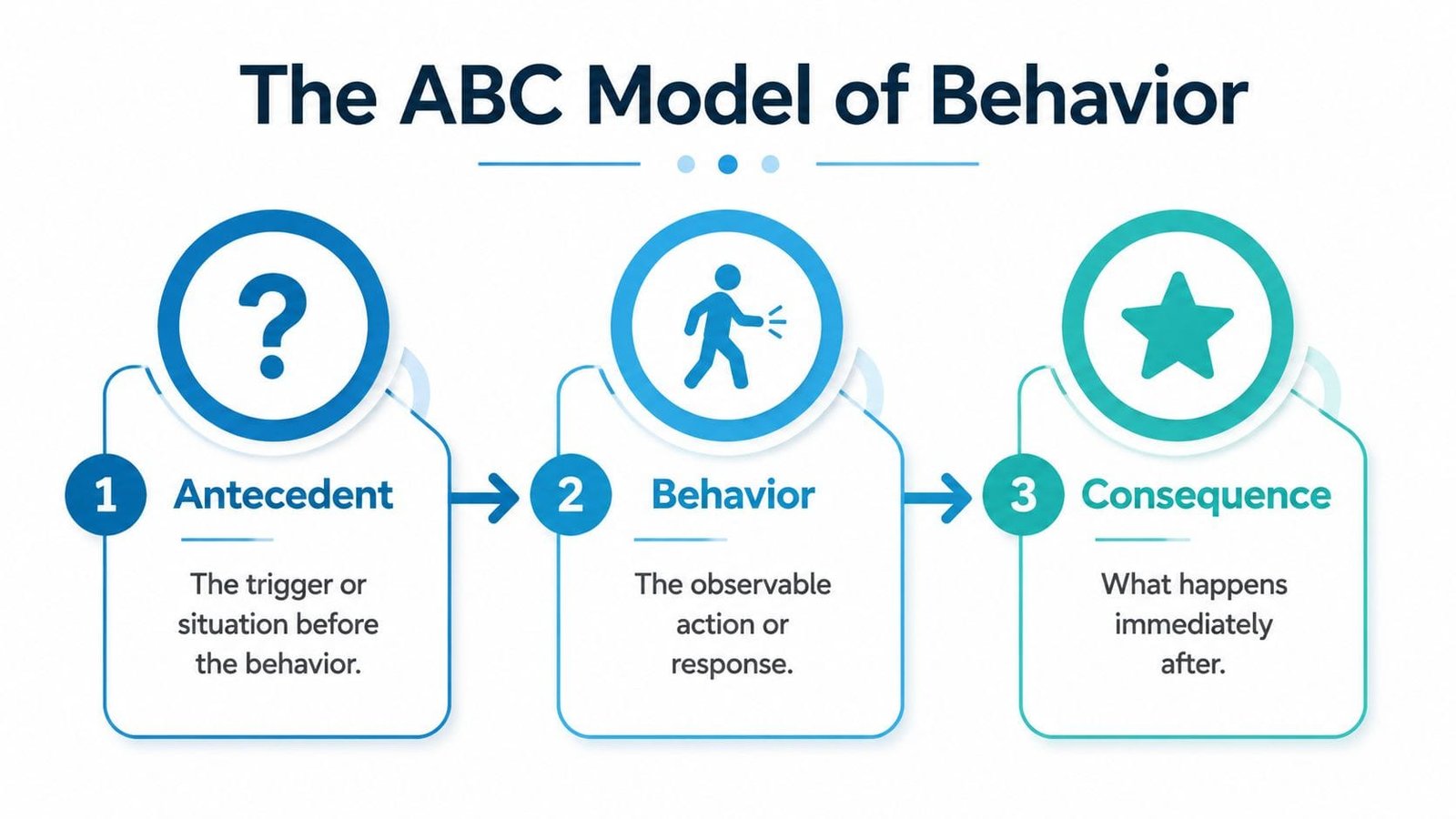
Change the antecedent when you can. Change the consequence when you must. Don't guess at the reason before you've looked at the pattern.
The most useful habit is to write the behavior down in concrete terms. Not “had a bad night,” but “cried for 12 minutes after lights out.” Not “was defiant,” but “left the table three times during dinner.” That kind of clarity makes it possible to choose whether the next move should be more preparation, a different reinforcement strategy, or a calmer follow-through.
For a more detailed look at practical tracking around triggers and outcomes, the internal guide on functional antecedents and consequences can be a helpful companion.
Core Behavior Modification Techniques Explained
A child finishes brushing their teeth and gets a few minutes with a favorite game. Another child puts on shoes after one calm reminder, and the repeated nagging stops. A third child only starts to tolerate haircuts after each tiny step is noticed and praised. These are different behavior modification techniques, and the details matter because each one changes what happens before or after the behavior in a different way.
Positive reinforcement adds something helpful after a behavior so that behavior happens more often. Negative reinforcement removes something unpleasant after the right behavior. Extinction means a behavior no longer produces the payoff it used to. Shaping rewards small steps toward a harder goal. Prompting gives a cue or aid. Token economies build a structured reward system ERIC review of behavior-modification methods.
What each technique really looks like at home
A child brushes their teeth and then earns five minutes of a favorite game. That is positive reinforcement. A child puts on shoes when asked, and the repeated nagging stops. That is negative reinforcement from the adult's perspective, because the unpleasant pressure is removed once the desired behavior happens. If a bedtime protest no longer leads to more screen time, that protest may fade because it is no longer paying off.
Extinction can be hard for families at first because it often looks like the behavior gets worse before it gets better. If a child has learned that loud protests bring attention, the protests may briefly become louder when the attention stops. That does not mean the plan is failing. It means the old pattern is losing power.
Shaping helps when the full behavior is too hard all at once. A child who hates haircuts might first tolerate sitting in the chair, then the cape, then the clippers near the head, with each small step reinforced. Prompting can be as simple as a visual card, a gentle verbal cue, or a hand signal before a transition. Those supports are not failures. They are bridges.
| Technique | How It Works | Example | Best For |
|---|---|---|---|
| Positive reinforcement | Adds a reward after the target behavior | Screen time after a hygiene routine | Building new routines |
| Negative reinforcement | Removes an unpleasant condition after the target behavior | Ending repeated reminders once shoes are on | Reducing escape-based struggle |
| Extinction | Stops the usual payoff for the unwanted behavior | Not returning to the tablet after a protest | Behaviors maintained by attention or access |
| Shaping | Rewards closer and closer approximations | Sitting near the sink before full toothbrushing | Hard skills and tolerance building |
| Prompting | Gives a cue, model, or reminder | Visual schedule before leaving the house | Transitions and multi-step tasks |
| Token economy | Earn tokens, trade them for rewards | Tokens for each homework step, traded later | Structured motivation over time |
A token economy often works better than casual praise because the rules are concrete. An ERIC-cited review lists token economy alongside contingency contracting, modeling, time-out, fines, and overcorrection as standard behavior-modification procedures, and it stresses explicit goals and clear reinforcement ERIC behavior-modification review. That structure matters more than intensity. A small reward delivered consistently usually teaches more than a big reward delivered randomly.
For families who want fewer last-minute power struggles, noncontingent reinforcement in ABA is useful because it gives support on a schedule instead of waiting for a child to escalate first.
Tracking Patterns to Make Techniques Work
A good behavior plan falls apart if the adults are guessing from memory. Busy families need a record of when the behavior happened, what came right before it, and what followed. That's the only way to spot the maintaining factors that keep a pattern going, and the reviewed literature is clear that self-monitoring, goal setting, prompts, feedback, and rewards are the most frequently used behavior-change techniques in digital and clinical settings behavior-change techniques review JMIR digital review.
What to log without making life harder
You don't need a research lab on the kitchen counter. A notebook, a spreadsheet, or a family app can work if it captures the right details. The point is to make the pattern visible before stress blurs it.
A practical log usually includes:
- What happened before the behavior, such as a noisy room, a rushed transition, or a denied request.
- What the behavior looked like, using plain observable language.
- What happened after, including attention, delay, escape, food, or comfort.
- What else was going on, like sleep, meals, or a crowded schedule.
An app can save real time here. Guiding Growth centralizes behavior logs, sleep habits, routines, diet details, medications, appointments, and shared updates in one place, which helps families stop scattering notes across paper, texts, and memory. The internal resource on behavioral data analysis can also help parents understand how to turn raw logs into practical decisions.
Tracking is not surveillance. It's how families notice the difference between a hard day and a repeating pattern.
The bigger payoff is often hidden at first. A child's demand avoidance may line up with poor sleep. A sensory behavior may spike after noisy outings. A tantrum might happen most often when hunger and transitions collide. Those patterns usually don't appear from one day of logging, but they do emerge when adults keep collecting the same kinds of information in a steady way.
Adapting Techniques for Autistic and Neurodivergent Children
Generic advice often fails because it ignores sensory load, communication differences, and the way some behaviors help a child regulate. A recent systematic review found that effective behavioral interventions were specific to particular populations, addressed stigma, and adapted to users' linguistic, cultural, and socio-economic backgrounds, with co-design and community input recommended before implementation systematic review on culturally and linguistically diverse families. That same principle applies at home. A plan has to fit the child and the family, not the other way around.
Respect regulation before trying to reduce behavior
If a child flaps their hands when overwhelmed, that movement may be helping them self-regulate. If a child avoids a demand, the behavior may be a signal that the task feels too loud, too fast, or too hard. Starting with sensory supports, visual schedules, and clearer language often works better than jumping straight to consequences.
For non-speaking or minimally verbal children, augmentative communication can make reinforcement more meaningful because the child has a clearer way to request help, breaks, or attention. For children with intense special interests, the reinforcer doesn't need to be generic. It can be tied to what matters to that child, as long as it stays respectful and predictable.
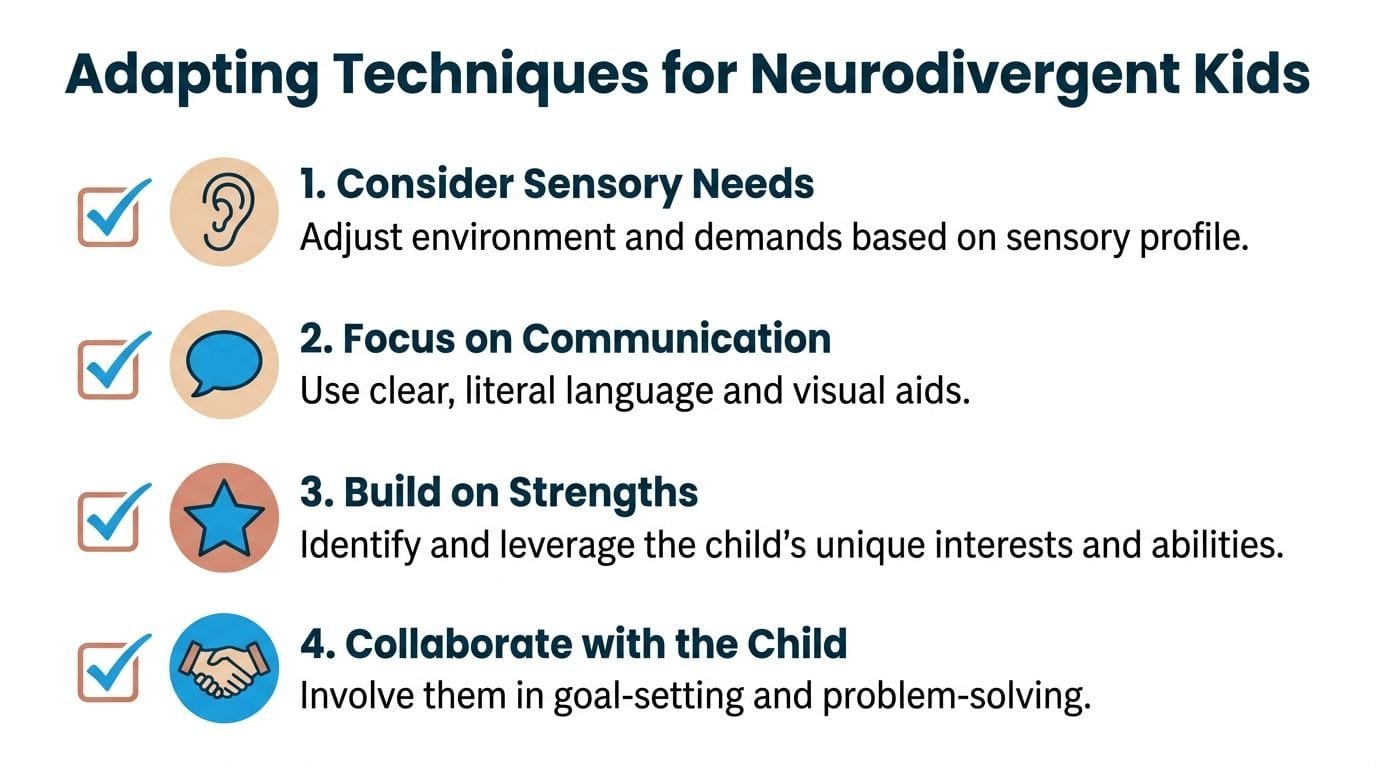
- Consider sensory needs: Lower noise, brightness, or rush before asking for a hard task.
- Focus on communication: Use literal, simple language and visual supports for transitions.
- Build on strengths: Tie goals to interests the child already cares about.
- Collaborate with the child: Include them in goals and choices whenever possible.
The mechanics still matter, but the dignity matters too. A child should not be asked to abandon every self-soothing behavior just because it looks different. The better question is whether the behavior harms the child, blocks daily life, or makes adults uncomfortable.
If a family is juggling language differences, school expectations, and uneven access to support, the plan needs to stay simple enough to use on an ordinary Tuesday. That may mean fewer goals, clearer visuals, and reinforcement that fits the child's actual preferences rather than a standard template.
Coordinating with Caregivers and Professionals
Behavior plans often fail for one plain reason, adults don't respond the same way. A child may learn that one parent gives extra attention for a protest, a grandparent offers a snack to stop the noise, and a teacher redirects the same behavior in a completely different way. That inconsistency can keep the behavior going because the child never gets one stable outcome to learn from.
Shared information makes the plan usable
Coordination doesn't need to be complicated, but it does need to be visible. A shared log lets caregivers see what happened at school, at home, and during appointments. When everyone uses the same language for the target behavior, the same goals, and the same reinforcement plan, the child gets a more reliable learning environment.
The practical value of a tool like Guiding Growth stands out here. It lets families and professionals share behavior notes, routines, and related context in real time, so a strategy that worked in one setting can be reinforced in another without relying on memory or long text threads. That matters in IEP meetings, therapy check-ins, and everyday handoffs between caregivers.
Consistency is not about being rigid. It's about making sure the child isn't learning a different rule from every adult.
Parents also have the right to ask clear questions. What exactly is being reinforced? What data is being tracked? How will we know the plan is helping? Therapists and teachers should be able to explain their methods in plain language, because families are the ones carrying the plan into daily life.
The strongest teams treat information as shared work, not private expertise. When home, school, and therapy all stay aligned, the child doesn't have to relearn the rules in every room.
Ethical Considerations and Common Misconceptions

A common worry is that behavior modification means manipulation. In practice, it is a structured way of teaching by changing what happens before and after a behavior. Its roots are in measurable learning, which is why clear observation and consistent follow-through matter more than pressure or control. Children deserve support that is understandable, respectful, and tied to real life.
Another misunderstanding is that the goal should be to erase every unusual behavior. Ethical support does not target harmless self-expression just because it looks different. It focuses on behaviors that cause distress, create safety concerns, or make it harder for a child to take part in daily routines, school, or family life.
A third misconception is that behavior support replaces relationships. Families usually find the opposite is true. When caregivers understand what a child is communicating through behavior, they often respond with more patience and less guesswork.
That is why respectful plans keep the child's dignity in view. They include the child's voice when possible, watch for signs that a strategy is not helping, and adjust rather than forcing a plan to fit. Parents can ask direct questions about what is being reinforced, what patterns are being tracked, and how progress will be judged. Therapists and teachers should be able to explain their approach in plain language, because families are the ones using it in everyday moments.
When a school plan feels too rigid, or a professional recommendation seems to ignore a child's needs, that is a signal to pause and ask for clearer reasoning. The best plans are collaborative, flexible, and based on careful observation, not blind obedience.
If you're ready to turn scattered notes into a clearer behavior plan, Guiding Growth gives families one place to log patterns, share updates, and keep routines aligned across home and school. It fits the day-to-day reality of parenting a neurodivergent child, where consistency matters and memory alone is rarely enough.