“Take a bubble bath.” “Get more sleep.” “Try meditation.”
That advice isn't useless, but it often misses the problem. Parents of autistic and neurodivergent children don't burn out because they forgot to schedule enough relaxing activities. They burn out because they're carrying an invisible operations department in their heads: appointments, school messages, therapy goals, medication details, sleep changes, food reactions, sensory triggers, meltdowns, and the question of who needs to know what next.
Caregiver burnout prevention has to address that workload directly. A sustainable plan reduces decisions, makes information visible, shares responsibility, and creates a response before the next crisis arrives. Self-care matters, but it can't compensate for a care system that depends on one exhausted person remembering everything.
Table of Contents
- Redefining Burnout Prevention Beyond Basic Self-Care
- Externalizing the Mental Load Through Daily Tracking
- Securing Evidence-Based Respite and Mindfulness Support
- Delegating Care and Aligning Your Support Network
- Streamlining Collaboration with Medical Professionals
- Building a Proactive Crisis and Meltdown Protocol
Redefining Burnout Prevention Beyond Basic Self-Care
The popular version of burnout prevention treats exhaustion as a personal failure of recovery. If you're overwhelmed, you're told to rest, exercise, meditate, or protect “me time.” Those actions can support your health, but they don't remove the appointment you still have to arrange, the school concern you still have to interpret, or the pattern you still have to reconstruct from memory during a pediatric visit.
For parents of neurodivergent children, the heaviest burden often comes from decision fatigue. You may make dozens of small judgments before breakfast: whether a behavior reflects pain, anxiety, sensory overload, demand avoidance, poor sleep, hunger, or a change in routine. When every day requires fresh detective work, your brain never gets a reliable off-duty period.
Recent caregiver reporting supports a broader interpretation. EY's 2025 Global Consumer Health Study found that 48% of caregivers said the care system was extremely or very difficult to work through, while 58% wanted more education about caregiving roles and tasks and 60% wanted financial support (EY's 2025 Global Consumer Health Study). Those findings point to a coordination problem, not merely a relaxation problem.
Treat cognitive load as a care need
Start by asking a more useful question than “How can I calm down?”
Ask: Which decisions, reminders, and explanations are only happening because I'm holding them in my head?
Write those responsibilities down. Separate them into four groups:
- Observe: behaviors, sleep, food, sensory conditions, and stress signals.
- Coordinate: appointments, school communication, therapy schedules, and forms.
- Decide: what needs immediate action, what needs monitoring, and what can wait.
- Explain: your child's routines, communication style, triggers, and effective supports.
This inventory makes the default-parent trap visible. You can't delegate a burden you haven't named, and you can't improve a pattern you haven't recorded.
Practical rule: If another adult has to call you to ask what happened, what usually helps, or what happens next, that information belongs in a shared system rather than in your memory.
A structured approach to coping with parental exhaustion can help you recognize the emotional side of the problem, but emotional insight needs a practical counterpart. Use a caregiver self-care resource alongside a system that reduces repeated decisions. The aim isn't to become better at tolerating an impossible workload. It's to make the workload more visible, shareable, and predictable.
Externalizing the Mental Load Through Daily Tracking
Memory is a poor care-recording system, especially during a stressful week. You might remember that a meltdown happened, but not whether your child had slept well, skipped a meal, encountered an unexpected transition, or spent the afternoon in a noisy environment. Without context, the event feels random, and random events create more anxiety because you can't plan around them.
Daily tracking turns scattered impressions into usable information. It doesn't mean recording every movement or scrutinizing your child all day. It means choosing a small set of observations that answer practical questions.
Start with context, not judgment
Avoid labels such as “bad day” or “difficult behavior.” Record what happened before, what you observed, and what followed.
A useful entry might include:
- Before: poor sleep, a schedule change, a demand, a crowded room, a food change, or an unexpected interruption.
- During: shutdown, echolalia, hand flapping, refusal, aggression, crying, escape behavior, or another specific observation.
- Response: reduced language, offered a quiet space, changed the demand, provided food, used a visual schedule, or called for support.
- After: recovery time, return to routine, continued distress, sleep, or a later change in appetite or mood.
This format keeps you from treating behavior as an isolated event. It also gives therapists and family members something more useful than “it was a rough day.”
Use a single location for these records rather than a collection of notes, messages, and screenshots. A single source of truth for caregiving information makes it easier to find what happened and reduces the need to repeat the same story to every person involved.
Make logging realistic enough to continue
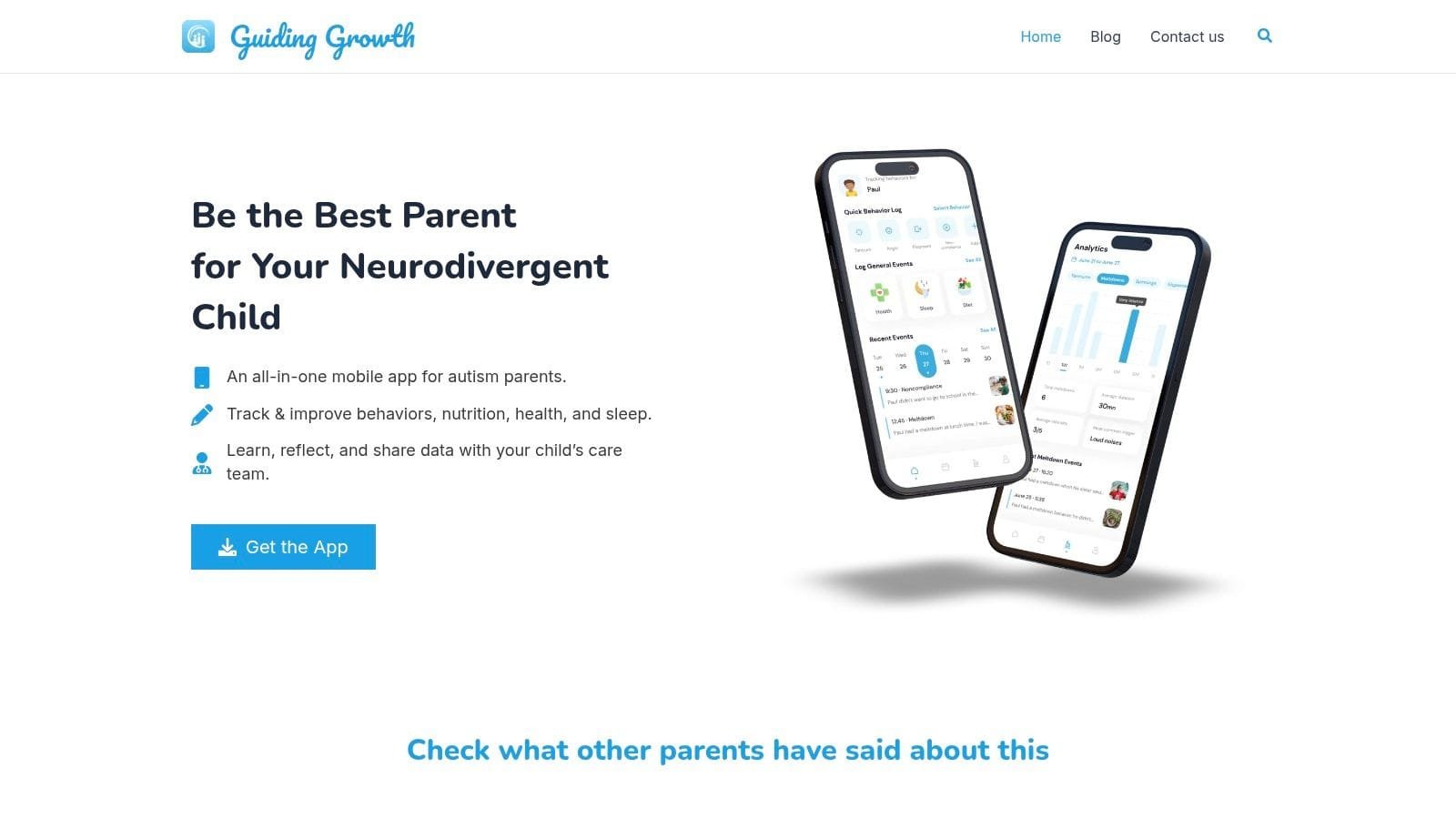
A system that requires perfect typing won't survive school pickup, a public meltdown, or a night when you're already depleted. Guiding Growth can centralize behavior, sleep, diet, medication, appointment, and therapy records, while its AI voice logging feature lets a parent capture an entry without typing. Its Alma AI companion can help parents think through autism-parenting questions, while visualizations can connect child patterns with caregiver stress over time.
Keep the tracking fields narrow at first. Choose the variables you can act on:
- Sleep: bedtime, waking, interruptions, and noticeable changes in daytime regulation.
- Routine: transitions, school attendance, travel, visitors, and schedule disruptions.
- Sensory context: noise, light, clothing, crowds, or physical discomfort.
- Food and medication: changes, missed doses, new items, and timing.
- Caregiver state: your stress level, available support, and whether you were able to take a handoff.
The point isn't to prove that one factor caused one behavior. Look for repeated relationships over time, then bring those patterns to a qualified professional before changing treatment, medication, or diet.
Externalized information also gives you permission to stop rehearsing the day in your head. Once the entry exists, you don't need to keep carrying it as a mental warning. You can review it at a planned time, share it with the right person, and return to the present.
Securing Evidence-Based Respite and Mindfulness Support
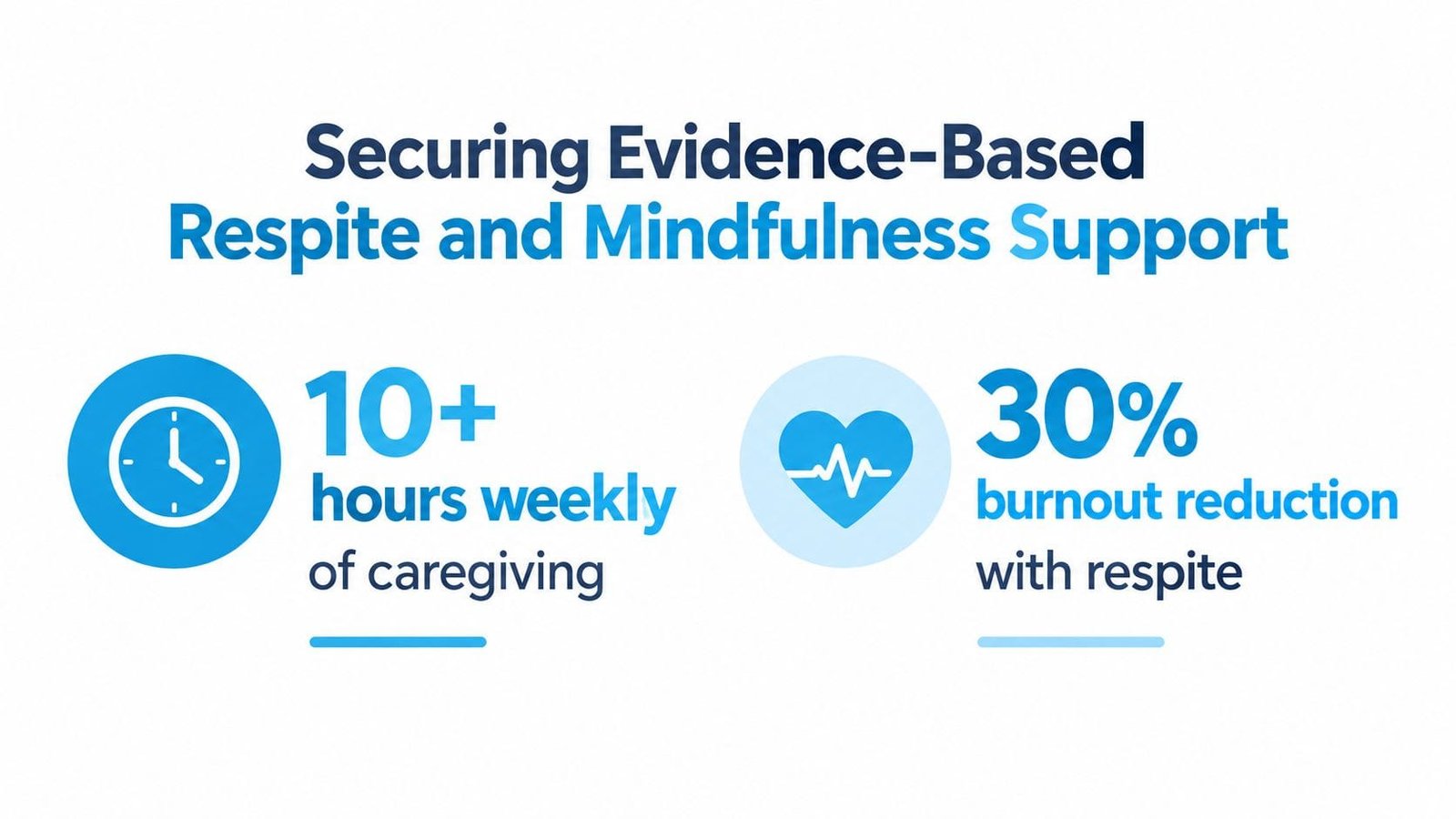
Respite is a prevention system, not a reward for reaching collapse. Request it while the primary caregiver can still coordinate care, communicate clearly, and make decisions. The need is substantial: 87% of family caregivers receive no respite, 39% rank respite as their greatest service need, and 75% of family caregivers of children have unmet respite needs, according to the ARCH National Respite Network respite facts. A separate U.S. aging-policy report found that approximately 86% of caregivers of adults don't receive respite. Cost, limited services, and complicated eligibility rules often block access.
Ask for usable hours, not vague support
Respite reduces caregiver load only when another trained person can take over. Ask agencies, insurers, school teams, case managers, and local disability services precise questions:
- Which respite programs serve children with this support profile?
- Does eligibility depend on diagnosis, income, caregiver status, or assessed need?
- Can approved hours cover after-school care, evenings, weekends, or appointments?
- Who trains the respite worker in communication, sensory needs, safety, and transitions?
- What happens if the assigned worker cancels?
- Can a family member provide the care after completing required training?
Ask for a recurring block of care with a defined purpose. That might mean covering a therapy appointment, creating an uninterrupted evening, or giving the primary caregiver time to recover without remaining responsible for every decision.
Historical evidence summarized by ARCH found that National Family Caregiver Support Program caregivers receiving 4 or more hours of respite per week experienced a decrease in self-reported burden over time, while comparison caregivers experienced an increase. Use that finding to request specific, repeatable coverage rather than accepting general advice to “ask for help.”
The evidence is mixed. A 2020 systematic review in the WHO ICOPE evidence base found that pooled respite interventions across four randomized trials and four quasi-experimental studies involving 989 participants did not significantly reduce caregiver burden, depression, or anxiety after six months (WHO ICOPE evidence base). That result does not make respite pointless. It means you should assess whether the service is reliable, frequent enough, suited to the family's needs, and long enough to create genuine recovery time.
Choose structured mindfulness, not another obligation
Mindfulness can support burnout prevention when its format fits your schedule. It should not become another task to track or another reason to feel behind. A clinical review found that psychosocial approaches, including support groups and psychoeducation, had mild to modest efficacy for caregivers of people with dementia, with effect sizes from 0.09 to 0.23. The review also identified social isolation, financial stress, and high caregiving hours as relevant risk factors (NIH-indexed clinical review).
A more recent synthesis cited in the same evidence summary found that a 2025 network meta-analysis of 31 trials with 4,687 participants ranked mindfulness-based interventions highest among tested psychosocial approaches, with a reported SMD of −6.67 and a 95% CI of −12.94 to −0.41.
A digitally supported five-week mindfulness trial in Taiwan used weekly live online sessions and daily guided practice. Among 57 meditation-naïve caregivers, the intervention significantly reduced professional caregivers' personal and work-related burnout compared with a wait-list control, but it did not significantly affect client-related burnout or informal caregiver burden (Taiwan digital mindfulness trial). Choose a program that matches your caregiving role, then track the specific outcome you want to change.
For informal caregivers, a randomized MBCL study assigned 54 caregivers to intervention and control groups. After the intervention, emotional exhaustion and depersonalization decreased, while personal accomplishment and self-compassion increased at P < 0.05 (MBCL caregiver study). Track those dimensions separately instead of relying only on a general distress score.
Delegating Care and Aligning Your Support Network
The default parent isn't necessarily the parent who does the most physical care. Often, it's the person who knows the most. They know which cup prevents a morning crisis, how long a transition takes, which words increase demand avoidance, what echolalia signals, and whether a shutdown means “give space” or “check for pain.” Everyone else waits for instructions, so the same person remains on call.
Delegation starts by transferring ownership, not by handing someone a vague list of chores. “Can you help more?” creates another decision for the exhausted parent. “You own the Tuesday therapy handoff, including transport, the communication log, and the follow-up note” creates a defined responsibility.
Build a handoff that another adult can use
Create a short care profile with only information that changes what someone should do:
- Communication: preferred words, visuals, gestures, AAC access, and signs of overload.
- Regulation: early stress signals, calming activities, sensory preferences, and recovery needs.
- Routines: what must happen before school, meals, sleep, and appointments.
- Safety: wandering risks, medical concerns, allergies, and emergency contacts.
- Current priorities: one or two therapy or daily-living goals, written in plain language.
Then assign tasks across people. One person may manage appointments, another school communication, another medication refills, and another evening routines. Give each assignment a backup so a cancellation doesn't automatically route the work back to the default parent.
Delegation means transferring the information and the decision boundary, not merely transferring the physical task.
A shared tracking tool can let family members, in-home caregivers, and professionals see current records without relying on forwarded messages. Set access according to role. A babysitter may need routines and safety information, while a therapist may need behavior context and progress notes. Review permissions regularly and remove access when a role ends.
Resources about supporting loved ones at home can complement this process, especially when family members need practical ideas for making daily care safer and more manageable. But advice alone won't align a team. Your network needs a shared record, clear ownership, and a simple rule for escalating concerns.
Hold a brief weekly coordination check. Review what changed, what remains unresolved, and who owns the next action. Don't use that meeting to retell every event. Use the records to focus attention on decisions that need a person.
Streamlining Collaboration with Medical Professionals
Appointments become exhausting when the parent has to perform as both historian and analyst. You arrive at an ABA session, IEP meeting, or pediatric visit carrying weeks of observations in your head, then try to answer questions about frequency, timing, triggers, and response while your child is in the room. The pressure encourages vague summaries, even when you've noticed important patterns.
Structured records change the conversation. Instead of saying “sleep has been worse,” you can show when sleep changed, what else changed around the same time, and how daytime regulation appeared afterward. Instead of describing “more meltdowns,” you can distinguish transitions, demands, sensory environments, and recovery patterns.
Prepare a one-page clinical summary
Before a meeting, pull together:
- The question: What decision do you need the professional to help make?
- The pattern: What changed, when it appears, and what context surrounds it.
- The response: Which strategies were tried and what happened afterward.
- The impact: Effects on communication, sleep, school participation, family routines, or safety.
- The request: Assessment, referral, accommodation, training, or a revised plan.
Guiding Growth can keep behavior logs, sleep observations, nutrition details, medications, appointments, and therapy information in one place. Its visualizations can help families present patterns without asking a clinician to interpret a pile of notes. Real-time sharing can also reduce the burden of explaining the same information separately to a pediatrician, therapist, caregiver, or school support person.

A record doesn't replace clinical judgment, and a correlation isn't a diagnosis. Its value is more practical: it helps you ask a sharper question and gives the professional a clearer starting point.
Keep appointments focused
Send or bring only the relevant window of information. Lead with the change and the decision you need. Ask the professional to state the next action, the person responsible, and when you'll review the result.
This protects you from becoming the permanent messenger between systems. When the team can see the same information and document the agreed plan, fewer details depend on your memory. That saves energy before the appointment and reduces the chance that an important observation disappears during a rushed conversation.
Building a Proactive Crisis and Meltdown Protocol
The most draining crisis is often the one that forces you to make every decision while your nervous system is already overloaded. A child begins escalating after a difficult transition. A sibling is nearby. The other caregiver is unsure whether to speak, leave, block access to a room, or call for help. Everyone looks at the default parent, who has to invent a plan in real time.
A written protocol changes that scene. It doesn't eliminate distress, and it shouldn't treat a meltdown as misbehavior that needs punishment. It gives adults a shared sequence for reducing demands, protecting safety, and supporting recovery.
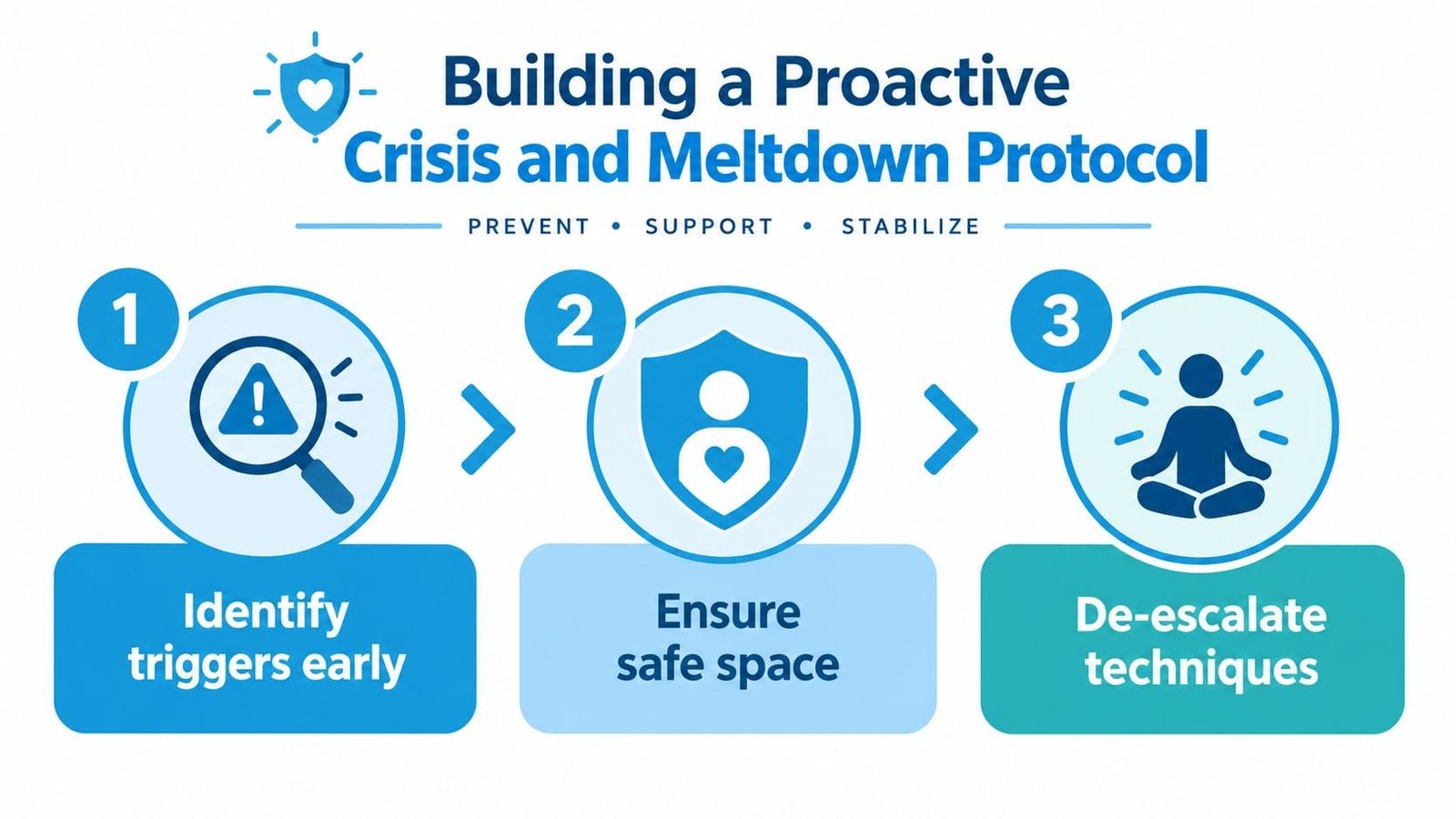
Write the protocol in three layers
Identify triggers early. Record the signals that usually appear before escalation, such as pacing, repeated language, covering ears, fleeing, refusal, rapid movement, or a sudden loss of communication. Add common contexts, including poor sleep, hunger, pain, transitions, crowded spaces, and unexpected changes.
Ensure a safe space. Choose the area in advance. Remove hazards, keep exits clear, protect siblings, and decide which adult stays close. Document emergency contacts and any medical or safety instructions that professionals have provided.
Use de-escalation techniques. Write down what adults should do and what they must avoid. This might include reducing language, lowering demands, offering a familiar sensory tool, giving physical space, using a visual choice, or waiting without speaking. Don't add new strategies during the crisis unless a qualified professional has advised them.
Imagine a caregiver seeing the first signs of overload during a rushed evening transition. Instead of asking, “What do we do?” the caregiver opens the shared plan. One adult moves siblings to the safe area, another reduces language and clears the demand, and the primary parent is allowed to step back rather than coordinate every movement.
Afterward, record what preceded the escalation, which responses helped, and what needs changing. Review the protocol when everyone is calm. A plan that exists only in the primary caregiver's head isn't a team plan.
Use a practical guide to prevent autism meltdowns as a starting point, then adapt the protocol to your child's communication, sensory profile, medical needs, and professional guidance. If a crisis involves immediate danger, injury, or a medical emergency, contact appropriate emergency or clinical support.
Caregiver burnout prevention is an ongoing system, not a single relaxing evening. Track the patterns, document the response, delegate ownership, and schedule respite before you reach the point of collapse. Guiding Growth brings behavior, sleep, diet, medications, appointments, therapy records, caregiver stress patterns, voice logging, and collaboration into one mobile workspace, so visit Guiding Growth and build a care system that lets your whole team act with less guesswork.